• 検索結果がありません。

Early Permian Tabulate Corals from the Jamal Formation, East-Central Iran

N/A
N/A
Protected

Academic year: 2021

シェア "Early Permian Tabulate Corals from the Jamal Formation, East-Central Iran"

Copied!
11
0
0

読み込み中.... (全文を見る)

全文

(1)

Early Permian Tabulate Corals from the Jamal Formation, East-Central Iran

Shuji Niko

1

, Mahdi Badpa

2

, Abbas Ghaderi

3

and Mohammad Reza Ataei

3

1

Department of Environmental Studies, Faculty of Integrated Arts and Sciences, Hiroshima University, 1–7–1 Kagamiyama, Higashihiroshima 739–8521, Japan

2

Department of Geology, Payame Noor University of Qom, Qom, Iran

3

Department of Geology, Faculty of Science, Ferdowsi University of Mashhad, Mashhad, Iran

Abstract Seven species of tabulate corals, Sutherlandia jamalensis sp. nov., Pseudofavosites exiguus Flügel, 1972, P. fusiforme (Flügel, 1972), Michelinia sp. indet., Gertholites? diversaporus (Flügel, 1972), G. sp. indet., and Thamnoptychia directa (Flügel, 1972), are described from the Bagh-e Vang Member (late early Permian) of the Jamal Formation at the Tabas area, East-Central Iran. The discover- ies of Sutherlandia and Thamnoptychia mark the first records of these genera in Iran. This assemblage inhabited on the southern shelves of the Paleotethys along northern margin of Gondwana.

Key words: late early Permian, Jamal Formation, Iran, Gondwana, Tabulata

Introduction

Permian tabulate corals are poorly known from Iran. Since the initial study by Flügel (1964), who described Michelinia? cf. glomerata MʼCoy, 1849, Protomichelinia abnormis (Huang, 1932), P.

favositoides (Girty, 1908), P. laosensis (Mansuy, 1914) and Cystomichelinia biknia Flügel, 1964 from the Ruteh Limestone, only 13 species of the subclass have been recorded by Flügel (1968, Nesen Formation; 1972, Jamal Formation; 1995, Jamal Formation; 1997, “Mittere schiefrige Fazies der Yabeina-Zone Perm, Zagros Mountains”), Ezaki (1991, Surmaq, Adadeh, Hambast and Gnishik for- mations), Ataei et al. (2018, Jamal Formation), and Ghaderi et al. (in press, Khachik, Julfa and Ali- Bashi formations).

This contribution deals with new material col- lected from the Jamal Formation in two localities at the Tabas area of East-Central Iran. They are Shesh-Angosht (coordinates of N33°59′15″ and E56°46′50″) on the western flank of the Shesh- Angosht Mountain and Bagh-e Vang (coordinates of N33°58′27″ and E56°47′33″) on the southwestern flank of the Bagh-e Vang Mountain (Figs. 1, 2). The purposes are to revise the systematics of the known tabulate coral species by previous workers (Flügel, 1972, 1995; Ataei et al., 2018) and add undescribed taxa for the fauna.

Repositories: Except for a specimen S72 that is kept in the National Museum of Nature and Sci- ence, Tokyo, Japan, all specimens are housed in the paleontological collections at Ferdowsi University of Mashhad, Mashhad, Iran.

Geologic setting

The Jamal Formation was introduced by Stöcklin et al. (1965) for the Permian rocks consisting mainly of limestone and dolomite in the Shotori and Shirgesht mountain ranges of the Tabas Block. Its thickness ranges from 293 to 473 m (Stöcklin et al., 1965; Ruttner et al., 1968; Leven and Vaziri Mohaddam, 2004). The succession rests uncon- formably upon eroded surface of sandstone belong- ing to the Carboniferous Sardar Formation and is conformably overlain by the Lower Triassic Sorkh Shale Formation (Partoazar et al., 2014). The strati- graphic interval in which all examined tabulate cor- als occur represents the lowest ca. 60 m part (=Bagh-e Vang Member in Partoazar, 1995), where carbonate facies are sandy to marly and contain interlayers of sandstone, shale, and olistolith.

The lowest member was dated by various taxa.

These results are as follows: Bolorian (=Kungu-

rian; fusulinids; Leven and Vaziri Mohaddam,

2004), Yakhtashian (=Artinskian) to Bolorian

(fusulinids; Arefifad, 2006), Artinskian to Kungu-

(2)

S. Niko, M. Badpa, A. Ghaderi and M. R. Ataei 20

rian (bryozoans; Ernst et al., 2006), Bolorian to early Kubergandinian (=early Roadian; fusulinids;

Leven and Gorgij, 2011), and Sakmarian to Kungu- rian (conodonts; Voulo, 2014). Taking these infor- mation into consideration, the age of tabulate corals examined herein is best constrained as late early Permian. The Tabas Block forms the Central-East Iranian Microcontinent with the Yazd and Lut blocks, whose paleogeographic position is inter-

preted to have been part of northern margin of Gondwana during early Permian time (e.g. Berbe- rian and King, 1981; Scotese and Langford, 1995;

Ruban et al., 2007). It is concluded that, therefore, habitat of the Jamal tabulate coral assemblage was on the southern shelves of the Paleotethys.

Fig. 1. Maps showing geologic setting and geographic position of tabulate coral localities (modified from Badpa et al.,

2016). A, tectonic map of Iran. B, close-up of rectangular area in Fig. 1A, note fossil localities (asterisk) belonging

to the Tabas Block. C, close-up of rectangular area in Fig. 1B, showing detailed position of fossil localities (aster-

isk) in the Tabas area, East-Central Iran.

(3)

Systematic Paleontology

Subclass Tabulata Milne-Edwards and Haime, 1850 Order Favositida Wedekind, 1937

Suborder Favositina Wedekind, 1937 Superfamily Favositoidea Dana, 1846

Family Favositidae Dana, 1846 Subfamily Emmonsiinae Lecompte, 1952 Genus Sutherlandia Cocke and Bowsher, 1968 Type species: Sutherlandia irregularis Cocke and Bowsher,

1968.

Sutherlandia jamalensis sp. nov.

(Figs. 3-1–8)

Pseudofavosites sp., Flügel, 1972, p. 93, 94, pl. 6, fig. 3;

1995, p. 39.

Material examined: Holotype, specimen S43, from which two thin sections were made. Paratype,

specimen S76.

Locality: Shesh-Angosht.

Diagnosis: Species of Sutherlandia with corallum diameter of 12–14 mm and prismatic to subcylindri- cal corallites; diameters of distal corallites approxi- mately 1.7 mm; intercorallite walls thickened, 0.10–

0.61 mm; squamulae relatively short for genus;

conical to hemi-spherical septal spins developed at distal corallites; tabulae relatively rare, complete.

Description: Coralla cerioid, subspherical in growth form and consist of radially arranged coral- lites; diameters of coralla are small for the subfam- ily, but moderate for the genus, indicating 12–14 mm. Corallites prismatic to subcylindrical;

transverse sections of proximal portions of corallites are 3–5 sided polygonal, then they shift to rounded polygonal to nearly circular in distal portions; diam- eters of corallites range from 0.4 to 2.2 mm with approximately 1.7 mm mean (n=7) at distal coral- lites; lumina (tabularia) rounded polygonal to circu- Fig. 2. Exposures of the Permian Jamal Formation and landscape of the Shirgesht Mountain Range in the Tabas area,

East-Central Iran. A, the Shesh-Angosht Mountain. Flank of front is Shesh-Angosht locality. B, close-up of Shesh-

Angosht locality, showing the Bagh-e Vang Member (arrow). The persons are the third author (A. G), the forth

author (M. R. A.) and the second author (M. B.), from left to right. C, silhouette of the Bagh-e Vang Mountain (left)

and the Shesh-Angosht Mountain (right). Distance between these mountains is about 1 km. D, the Bagh-e Vang

Mountain. Bagh-e Vang locality is on other side of the mountain.

(4)

S. Niko, M. Badpa, A. Ghaderi and M. R. Ataei 22

lar in transverse section; calices deep to very deep and perpendicularly oriented to corallum surface; no calical modification recognized; increase of new

corallite is intermural(?). Intercorallite walls thick- ened, 0.10–0.61 mm, differentiated into median dark line and stereoplasm, the latter of which has rect- Fig. 3. Sutherlandia jamalensis sp. nov., thin sections. 1–4, 7, holotype, specimen S43. 1, transverse section (slightly

off its center) of corallum, ×5. 2, partial enlargement of Fig. 3-1, showing transverse to longitudinal sections of

corallites, ×10. 3, partial enlargement of Fig. 3-4, showing squamulae, septal spines and tabula, ×14. 4, oblique

section (off its center) of corallum, note complete tabulae, ×10. 7, partial enlargement of Fig. 3-1, showing mural

pores, squamulae and septal spines, ×14. 5, 6, 8, paratype, specimen S76. 5, 6, transverse to oblique sections of

corallites, ×10. 8, partial enlargement of Fig. 3-5, showing mural pores and septal spines, ×14.

(5)

radiate fibers in microstructure; mural pores occur on corallite faces, forming two rows, and circular to subcircular in profile; diameters of pores are 0.06–

0.31 mm; squamulae commonly occur in proximal corallites and sporadic in distal ones, relatively short for the genus, 0.25–0.48 mm; approximate ratios of squamula length per lumen diameter are up to 0.6; thickness of squamula is thin to moderately thickened, attaining 0.13 mm; considerable squamu- lae replaced by conical to hemi-spherical septal spins at distal corallites; spine length 0.08–0.23 mm;

tabulae relatively rare, complete, slightly concave to nearly transverse.

Etymology: The specific name is derived from the type stratum, named the Jamal Formation.

Discussion: Although Flügel (1972) placed this species in Pseudofavosites, we herein transfer it to Sutherlandia on the basis of the possessions of thickened intercorallite walls and complete tabulae.

The present two specimens represent the first record of the genus from Iran.

Permian occurrences of Sutherlandia are very rare. As far as we know, only four species are previ- ously documented from North China (Tchi, 1980;

Lin, 1983; Ding et al., 1984) and Japan (Senzai and Niko, 2005). Among them, the new species most resembles S. finitimus minor (Ding in Ding et al., 1984, p. 85, pl. 16, figs. 1a, a′, b, b′, c, c′, 2a–d, d′;

Lin et al., 1988, p. 419), which is reported from the middle Permian of Inner Mongolia. However, the presence of conical to hemi-spherical septal spins distinguishes it from the Chinese species.

Family Pseudofavositidae Sokolov, 1950 Genus Pseudofavosites Gerth, 1921 Type species: Pseudofavosites stylifer Gerth, 1921.

Pseudofavosites exiguus Flügel, 1972 (Figs. 4-1–3)

Pseudofavosites extraspinosus exiguus Flügel, 1972, p. 93, pl. 6, fig. 2; 1995, p. 39; Ataei et al., 2018, figs. 4a, b.

Material examined: Specimen S35.

Locality: Shesh-Angosht.

Description: An incomplete corallum is available for study; it is cerioid and consists of radially arranged corallites; growth form of corallum is

probably sub-spherical with approximately 18 mm in maximum diameter. Corallites prismatic to sub- prismatic, whose diameters range from 0.5 to 1.8 mm; transverse sections of each corallite are quadrate in proximal portion, then become rounded polygonal in distal one; calices very deep. Interco- rallite walls 0.04–0.21 mm in thickness; mural pores occur at corallite angles and faces; profiles of pores are longitudinally elliptical having diameters of 0.20×0.25, 0.22×0.29 mm in typical ones; squa- mulae well developed though all growth stages of corallites and long, attaining 0.67 mm; tabula absent.

Discussion: In the original description by Flügel (1972), this species was established as a new sub- species of Pseudofavosites extraspinosus Sokolov (1955, p. 157, pl. 7, figs. 7, 8, text-figs. 30a, b), of which the types are known from the lower Permian of the Urals. However, P. extraspinosus lacks squa- mulae in proximal portion of corallites and has larger corallite diameters (1.5–2.5 mm) than those of the Iranian species. We think that these morphologic differences beyond intraspecific variations.

The distinctive characters between Pseudofa- vosites exiguus and an associated species in the Jamal Formation, P. fusiforme, are given in the dis- cussion of the latter species.

Pseudofavosites fusiforme (Flügel, 1972) (Figs. 4-4–6)

Favosites fusiforme Flügel, 1972, p. 92, pl. 6, fig. 1; 1995, p.

Pseudofavosites extraspinosus exiguus Flügel; Ataei et al., 39.

2018, figs. 5a, b.

Material examined: Specimens S42, B163.

Localities: Shesh-Angosht (S42) and Bagh-e Vang (B183).

Description: Coralla cerioid formed by radially arranged corallites, sub-spherical in growth form and encircling crinoid stems; diameters of coralla are large for the genus, attaining to at least 32 mm.

Corallites prismatic and measure 0.3–2.6 mm in

diameter; except for the most proximal adhesive

portions where transverse sections of corallite are

triangular to quadrate, then they become rounded

polygonal in distal one; calices very deep. Interco-

rallite walls 0.07–0.25 mm in thickness; mural pores

occur at corallite angles and faces; profiles of pores

(6)

S. Niko, M. Badpa, A. Ghaderi and M. R. Ataei 24

are longitudinally elliptical to circular having diam- eters of 0.20×0.27, 0.13 mm in typical ones; squa- mulae common in proximal and almost absent in

distal portions of corallites; lengths of squamulae are long, attaining 0.88 mm; thickness of squamulae is mostly very thin; tabula absent.

Fig. 4. 1–3, Pseudofavosites exiguus Flügel, 1972, specimen S35, thin sections. 1, transverse section of corallum, ×5.

2, partial enlargement of Fig. 4-1, showing longitudinal sections of corallites, × 10. 3, transverse sections of coral-

lites, ×10. 4–6, Pseudofavosites fusiforme (Flügel, 1972), specimen S42, thin sections. 4, transverse section of cor-

allum, ×3. 5, partial enlargement of Fig. 4-4, showing transverse sections of corallites, ×10. 6, partial enlargement

of Fig. 4-4, showing longitudinal sections of corallites, × 10.

(7)

Discussion: This species, originally introduced by Flügel (1972) as Favosites fusiforme, is herein transferred to Pseudofavosites on the basis of the preserved characters of newly collected specimens from the identical stratum with the holotype.

Among them, the corallum encircling crinoid stem and the possession of squamulae warrant the generic assignment.

Pseudofavosites fusiforme differs from P. exiguus by having larger corallite diameters and fewer squa- mulae.

Family Micheliniidae Waagen and Wentzel, 1886 Subfamily Micheliniinae

Waagen and Wentzel, 1886 Genus Michelinia de Koninck, 1841 Type species: Calamopora tenuiseptata Phillips, 1836.

Michelinia sp. indet.

(Figs. 5-1, 2) Material examined: Specimen S9.

Locality: Shesh-Angosht.

Description: A fragmentary corallum is available for study; it is cerioid and 13 mm in maximum diameter. Corallites prismatic with transverse sec- tions of 4–8 sided polygonal; diameters of corallites are 1.6–4.3 mm. Intercorallite walls weakly thick- ened for the genus, 0.19–0.46 mm; mural pores cir- cular in profile and occur on corallite faces and at angles; diameters of pores are 0.10–0.31 mm; septal spines well developed, low conical; tabulae numer- ous, in which incomplete tabulae are predominant, but complete ones not rare.

Discussion: This specimen is tentatively assigned to Michelinia rather than Protomichelinia because

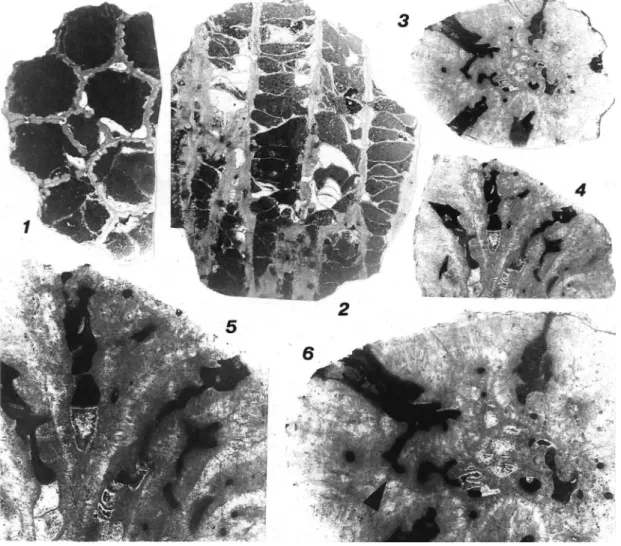
Fig. 5. 1, 2, Michelinia sp. indet., specimen S9, thin sections. 1, transverse sections of corallites, ×5. 2, longitudinal sections of corallites, ×5. 3–6, Gertholites sp. indet., specimen S58, thin sections. 3, transverse section of branch,

×5. 4, longitudinal section of branch, ×5. 5, partial enlargement of Fig. 5-4, showing longitudinal sections of cor-

allites, ×10. 6, partial enlargement of Fig. 5-3, showing transverse to longitudinal sections of corallites, arrow indi-

cates vermiform tunnels, ×10.

(8)

S. Niko, M. Badpa, A. Ghaderi and M. R. Ataei 26

of being well-developed incomplete tabulae. How- ever, it is too fragmentary to be identified confi- dently.

Superfamily Pachyporoidea Gerth, 1921 Family Pachyporidae Gerth, 1921

Genus Gertholites Sokolov, 1955

Type species: Pachypora curvata Waagen and Wentzel, 1886.

Gertholites? diversaporus (Flügel, 1972) (Figs. 6-1–4)

Trachypora archilaeus[sic] diversapora Flügel, 1972, p. 94, 95, pl. 6, figs. 4, 5; 1995, p. 39.

Gertholites diversaporus (Flügel); Tourneur, 1988, p. 305.

Material examined: Specimen S66.

Locality: Shesh-Angosht.

Description: A fragment of cylindrical branch is available for study; it is cerioid and 9 mm in diame- ter. Corallites prismatic to subprismatic with trans- verse sections of indistinct 4–7 sided to rounded polygonal; diameters of corallites are 0.2–2.7 mm;

each corallite consists of directly longitudinal proxi- mal portion and outwardly curved distal one; proxi- mal and distal portions respectively form axial and peripheral zones; calices deep, open upward with 55°–70° for branch surface. Intercorallite walls rela- tively thin in axial zone, 0.11–0.36 mm; then, their thickness abruptly increases attaining approximately 1.2 mm to form stereozone at peripheral zone;

apparent mural pore is not observable in axial zone;

mural tunnels in peripheral zone are circular profiles and 0.08–0.15 mm in diameter; septal spines rare, restrict in in calical pit, high conical, and 0.13–

0.36 mm in length; septal ridges also developed in calical pit; tabulae sporadic, complete.

Discussion: This species was established by Flü- gel (1972) as a new subspecies of Trachypora achil- leos Heritsch (1937, p. 206–209, figs. 1–10), whose the type series is known from the Upper Carbonifer- ous of Chios, Greek. Subsequently, it was removed from the abolished genus (see Lecompte, 1939) and placed in Gertholites by Tourneur (1988). Among the known pachyporid genera, Gertholites seems the most apposite for the generic assignment. How-

ever, neither the holotype nor the present newly col- lected specimen indicate anastomosed mural tunnels that is the most diagnostic character of Gertholites.

The possession of septal ridges in this Iranian spe- cies also beyond the diagnosis of the genus.

Gertholites sp. indet.

(Figs. 5-3–6) Material examined: Specimen S58.

Locality: Shesh-Angosht.

Description: A fragment of cylindrical branch is available for study; it is cerioid and 10 mm in diam- eter. Corallites subprismatic with rounded polygonal transverse sections; each corallites gradually diver- gent; approximate diameters of corallites are 0.5–

2.5 mm; calices mostly deep, open oblique upward.

Intercorallite walls uniformly thickened in axial zone of branch, 0.15–0.44 mm; then, their thickness abruptly increases attaining approximately 1.8 mm to form peripheral stereozone; mural tunnels vermi- form and anastomosed with circular profiles; diame- ters of tunnels are 0.12–0.27 mm; septal spines com- mon, high conical with more or less curved tips, and 0.19–0.48 mm in length; tabulae rare, complete.

Discussion: This specimen is placed in Gertho- lites on the basis of the possessions of thickened intercorallite walls, vermiform and anastomosed mural tunnels, and high conical septal spines. It probably represents new species, but identification is uncertain because of insufficient material.

Genus Thamnoptychia Hall, 1876 Type species: Madrepora limbata Eaton, 1832.

Thamnoptychia directa (Flügel, 1972) (Figs. 6-5–9)

Trachypora directus Flügel, 1972, p. 95, pl. 6, figs. 6, 7;

1995, p. 39.

Material examined: Specimens S72, S82, B165.

Localities: Shesh-Angosht (S72, S82) and Bagh-e Vang (B165).

Description: Coralla ramose consisting of cylin-

drical and cerioid branches; branching probably

bifurcate; diameters of branches are 6–12 mm. Cor-

allites prismatic to subprismatic with indistinct 4–9

(9)

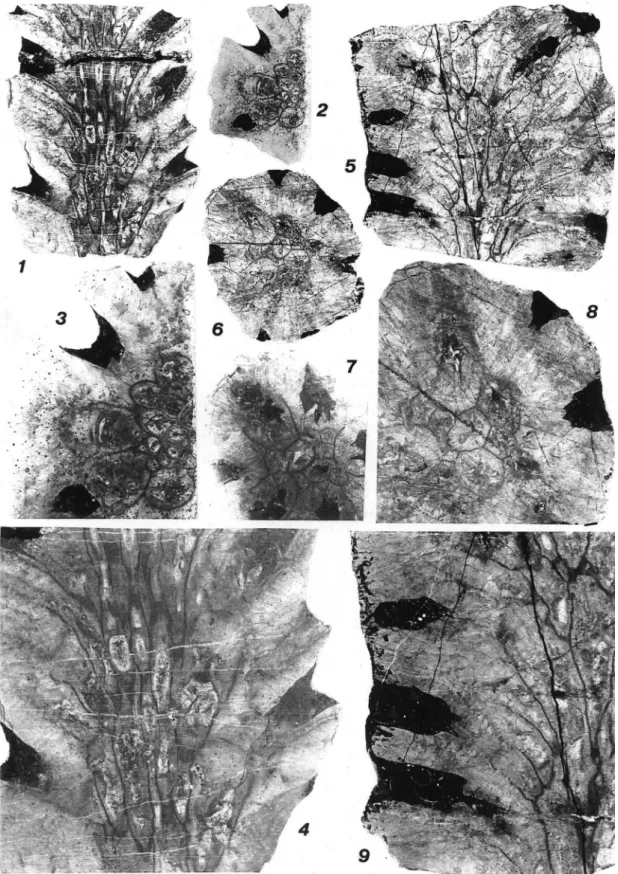
Fig. 6. 1–4, Gertholites? diversaporus (Flügel, 1972), specimen S66, thin sections. 1, longitudinal section of branch,

×5. 2, transverse section of branch, ×5. 3, partial enlargement of Fig. 6-2, showing transverse to oblique sections of corallites, ×10. 4, partial enlargement of Fig. 6-1, longitudinal sections of corallites, ×10. 5–9, Thamnoptychia directa (Flügel, 1972), thin sections. 5, 6, 8, 9, specimen B165. 5, longitudinal sections of branches, ×5. 6, trans- verse section of branch, ×5. 8, partial enlargement of Fig. 6-6, showing transverse to oblique sections of corallites,

×10. 9, partial enlargement of Fig. 6-5, showing longitudinal sections of corallites, ×10. 7, specimen S72, oblique

to transverse sections of corallites, note well-developed septal ridges, ×10.

(10)

S. Niko, M. Badpa, A. Ghaderi and M. R. Ataei 28

sides, whose diameters 0.3–3.8 mm; each corallite consists of directly longitudinal proximal portion and outwardly curved distal one; proximal and dis- tal portions of corallites respectively form axial and peripheral zones; calices open at nearly right angle to branch surface. Intercorallite walls uniformly thickened in axial zone, 0.17–0.75 mm; then, their thickness increases attaining approximately 1.5 mm to form wide stereozone; lumina (tabularia) almost closed by thickened walls; mural pores circular in profile and occur at corallite angles and faces, then they shift tunnels in peripheral zone; diameters of pores (tunnels) are 0.08–0.17 mm; septal spines well developed, conical, 0.13–0.23 mm in length; septal ridges also developed in calical pit; tabulae rare, complete.

Discussion: Because Trachypora is an obsolete genus name (Lecompte, 1939), we transfer this Ira- nian species described by Flügel (1972) to Tham- noptychia on the basis of its perpendicularly directed calices to the branch surface, wide ste- reozone, almost closed lumina (tabularia), and rare tabulae. Thamnoptychia directa described herein represents the first record of the genus from Iran.

Acknowledgements

We would like to dedicate this paper to the late Dr. Helmut W. Flügel. Without his pioneering works on Palaeozoic corals in Iran, the present study could not have been done. We are grateful to Dr. Tetsuo Sugiyama for his valuable comments which improved the manuscript.

References

Arefifard, S. (2006) Microbiostratigraphy and microfacies of Permian strata in Shotori, Shirgesht and Kalmard areas.

252 pp. Ph. D. Thesis, Shahid Beheshti University, Teh- Ataei, M. R., Ghaderi, A., Badpa, M. and Ashouri, A. R. ran.

(2018) Permian corals of the Bagh-e-Vang Member of the Jamal Formation in Shesh-Angosht Mountain of Tabas, Central Iran. The 36th National and the 3rd International Geosciences Congress, Teheran, Iran (Poster session).

Badpa, M., Poty, E., Ashouri, A. and Khaksar, K. (2016) Fasciculate kleopatrinid corals from the Bashkirian (Late Carboniferous) of Sadar Formation (Ozbak-Kuh Moun- tains, East-Central Iran. Revista Brasileira de Paleontolo- gia, 19: 151–166.

Berberian, M. and King, G. C. P. (1981) Toward a paleoge-

ography and tectonic evolution of Iran. Canadian Journal of Earth Sciences, 18: 210–265.

Cocke, J. M. and Bowsher, A. L. (1968) New tabulate genus Sutherlandia (Coelenterata, Anthozoa) from Pennsylva- nian of Oklahoma and Kansas. The University of Kansas Paleontological Contributions, 33: 1–8.

Dana, J. D. (1846) Structure and Classification of Zoo- phytes: United States Exploring Expedition. During the Years 1838, 1839, 1840, 1841, 1842. Under the Com- mand of Charles Wilkes, U. S. N. Volume 7. 740 pp. 61 pls. Lea and Blanchard, Philadelphia.

Ding, Y., Xia, G., Duan, C., Li, W., Liu, X. and Liang, Z.

(1984) Study on the Early Permian stratigraphy and fauna in Zhesi district, Nei Mongol Ziziqu (Inner Mongolia).

Bulletin Tianjin Institute of Geology and Mineral Resources, 10: 1–244, pls. 1–58. (In Chinese with English abstract)

Eaton, A. (1832) Geological Text-book, for Aiding the Study of North American Geology: Being Systematic Arrangement of Facts, Collected by the Author and His Pupils, Under the Patronage of the Hon. Stephen van Rensselader. 132 pp. 59 pls. Webster and Skinners, G. and C. and H. Carvill, William S. Parker, New York, Troy.

Ernst, A., Senowbari-Daryan, B. and Rashidi, K. (2006) Lower Permian Bryozoa of the Jamal Formation from Bagh-e Vang (Shotori Mountains, northeast Iran). Facies, 52: 627–635.

Ezaki, Y. (1991) Permian corals from Abadeh and Julfa, Iran, west Tethys. Journal of the Faculty of Science, Hok- kaido University. Series IV, 23: 53–146.

Flügel, H. W. (1964) The Geology of the Upper Djadjerud and Lar Valleys (N-Iran). Rivista Italiana di Paleontolo- gia e di Stratigrafia, 70: 403–444, pls. 28–34.

Flügel, H. W. (1968) Korallen aus der oberen Nesen-Forma- tion (Dzhulfa-Stufe, Perm) des zentralen Elburz (Iran).

Neues Jahrbuch für Geologie und Paläontologie. Abhan- dlungen, 130: 275–304, pl. 25.

Flügel, H. W. (1972) Die paläozoischen Korallenfaunen Ost-Irans. 2. Rugosa und Tabulata der Jamal-Formation (Darwasian?, Perm). Jahrbuch der Geologischen Bunde- sanstalt, 115: 49–102, pls. 1–6.

Flügel, H. W. (1995) Biostratigraphie und Korallenfaunen des Jungpaläozoikums Ost-Iran. Geologishe-paläontolo- gishe Mitteilungen Innsbruck, 20: 35–49.

Flügel, H. W. (1997) Korallen aus dem Perm von S-Tune- sien, W-Iran und NW-Thailand. Sitzungsberichte.

Abteilung I, Biologische Wissenschaften und Erdwissen- schaften, 204: 79–109.

Gerth, H. (1921) Die Anthozoën der Dyas von Timor.

Paläontologie von Timor, 9: 65–147, pls. 145–150.

Ghaderi, A., Badpa, M. and Ashouri, A. R. (in press) Perm- ian corals of Ali-Bashi Mountains, Julfa, Northwest of Iran. Report. Geological Survey of Iran. (In Persian with English abstract)

Girty, G. H. (1908) Descriptions of new species of Upper Paleozoic fossils from China. Proceedings of the United States National Museum, 33: 37–48.

Hall, J. (1876) Illustrations of Devonian Fossils: Corals of the Upper Helderberg and Hamilton Groups. 7 pp. 43 pls.

Geological Survey of the State of New York, Weed, Par-

(11)

sons and Co., Albany.

Heritsch, F. (1937) Karbonische Korallen von der Insel Chios. I. Trachypora achilleos nov. spec. Praktikates Akademias Athenon, 12: 203–209.

Huang, T. K. (1932) Permian corals of southern China. Pal- aeontologia Sinica. Series B, 8: 1–163, pls. 1–16.

de Koninck, L. (1841–1844) Description des animaux fos- siles qui se trouvent dans le terrain carbonifère de Bel- gique. 650 pp. pls. A–H, H. Dessain, Liége.

Lecompte, M. (1939) Les Tabulés du Dévonien moyen et supérieur du Bord sud du Basin de Dinant. Méoires du Musée Royal dʼHistoire Naturelle, 90: 1–229, pls. 1–23.

Lecompte, M. (1952) Madréporaires paléozoïques. In: Pive- teau, J. (Ed.), Traité de Paléontologie. Volume 1, Masson et Cie, Paris, pp. 419–538.

Leven, E. Ja. and Gorgij, M. N. (2011) Fusulinids and stra- tigraphy of the Carboniferous and Permian in Iran. Stra- tigraphy and Geological Correlation, 19: 687–776.

Leven, E. Ja. and Vaziri Mohaddam, H. (2004) Carbonifer- ous-Permian stratigraphy and fusulinids of eastern Iran.

The Permian in the Bag-e-Vang section (Shirgesht area).

Rivista Italiana di Paleontologia e di Stratigrafia, 110:

441–465.

Lin, B. (1983) Lower Permian stratigraphy and coral faunas from both flanks of Yarlung Zangbo River in central- southern Xizang (Tibet). Contribution to the Geology of the Qinghai-Xizang (Tibet) Plateau, 8: 69–181, pls. 1–32.

(In Chinese with English abstract)

Lin, B., Tchi, Y., Jin, C., Li, Y. and Yan, Y. (1988) Mono- graph of Palaeozoic corals. Tabulatomorphic Corals. Vol- ume 2, 493 pp. Geological Publishing House, Beijing. (In Chinese)

Mansuy, H. (1914) Contribution á la Paléoleontologie du Laos. Mémoires du Service Géologique de lʼIndochine, 3:

37–34, pls. 2–4.

MʼCoy, F. (1849) On some new genera and species of Pal- aeozoic corals and foraminifera. The Annals and Maga- zine of Natural History. Second Series, 3: 1–20, 119–136.

Milne-Edwards, H. and Haime, J. (1850) A Monograph of the British Fossil Corals. First Part. Introduction; Corals from the Tertiary and Cretaceous Formations. 71 pp. 11 pls. Monographs of the Palaeontographical Society, Lon- Partoazr. H. (1995) Permian deposits in Iran. In: Treaties on don.

the Geology of Iran, Volume 22. Geological Survey of Iran, Teheran, pp. 1–370. (In Persian with English abstract)

Partoazar, H., Hamdi, B. and Aghanabati, S. A. (2014) New approach on biostratigraphy of Permian deposits of Jamal Formation in Bagh Vang section, Shirgesht area (Central Iran). Geopersia, 4: 141–154.

Phillips, J. (1836) Illustrations of the Geology of Yorkshire:

or a Description of the Strata and Organic Remains:

Accompanied by a Geological Map, Sections, and Dia- grams, and Figures of the Fossils. Part II. The Mountain Limestone District. 253 pp. 25 pls. John Murray, London.

Ruban, D. A., Al-Husseini, M. I. and Iwasaki, Y. (2007) Review of Middle East Paleozoic plate tectonics. GeoAr- abia, 12: 35–56.

Ruttner, A. W., Nabavi, M. H., Hajian, J. (1968) Geology of the Shirgesht area (Tabas area, East Iran). Report. Geo- logical Survey of Iran, 4: 1–133.

Scotese, C. R. and Langford, R. P. (1995) Pangea and the paleogeography of the Permian, In: Scholle, P. A. et al.

(Eds.), The Permian of Northern Pangea. Volume 1:

Paleogeography, Paleoclimates, Stratigraphy. Springer- Verlag, Berlin, Heidelberg, pp. 3–19.

Senzai Y. and S. Niko, S. (2005) An early Permian tabulate coral Sutherlandia from the Tamba Belt in the Oji area, Kameoka City, Kyoto Prefecture, Central Japan.

Chigakukenkyu, 54: 3–7. (In Japanese with English abstract)

Sokolov, B. S. (1950) Systematics and history of the devel- opment of the Paleozoic corals Anthozoa Tabulata.

Voprosy Paleontologii, 1: 134–210. (In Russian)

Sokolov, B. S. (1955) Paleozoic Tabulata of the European parts of the USSR. Introduction to the general study of the systematics and development of the tabulates. Trudy Vsesoyuznogo Neftyanogo Nauchno-Issledovatelʼskogo Geologo-Razvedochnogo Instituta, Novaya Seriya, 85:

1–527. (In Russian)

Stöcklin, J., Eftekhar-Nezhad, J. and Hushmand-Zadeh, A.

(1965) Geology of the Shotori Range (Tabas area, East Iran). Report. Geological Survey of Iran, 3: 1–69.

Tchi, Y. (1980) Tabulata. In: Shenyang Institute of Geology and Mineral Resources (Ed.), Paleontological Atlas of Northeast China. (1), Paleozoic Volume. Geological Pub- lishing House, Beijing, pp. 153–188, 646–649, pls.

67–87. (In Chinese)

Tourneur, F. (1988) Mise au point sur le genre Trachypora Milne-Edwards & Haime 1851 (Tabulata, Devonien).

Annales de la Sociètè Géologique de Belgique, 110: 297–

Vuolo, I. (2014) Conodont biostratigraphy from Carbonifer- 308.

ous and Permian successions of Pamir, Central Iran and Tunisia. 308 pp. Ph. D. Thesis, Universitá degli Studi di Milano, Milan.

Waagen, W. H. and Wentzel, J. (1886) Salt Range fossils.

Volume 1, Productus Limestone fossils; 6, Coelenterata.

Paleontologica Indica, 13: 835–924, pls. 97–116.

Wedekind, R. (1937) Einführung in die Grundlagen der His-

torischen Geologie. II. Band. Mikrobiostratigraphie, Die

Korallen- und Foraminiferenzeit. 136 pp. 16 pls. Ferdi-

nand Enke, Stuttgart.

Fig.  1.  Maps showing geologic setting and geographic position of tabulate coral localities (modified from Badpa et al.,  2016)
Fig. 4.  1–3, Pseudofavosites exiguus Flügel, 1972, specimen S35, thin sections. 1, transverse section of corallum, ×5
Fig. 5.  1, 2, Michelinia sp. indet., specimen S9, thin sections. 1, transverse sections of corallites, ×5
Fig. 6.  1–4, Gertholites? diversaporus (Flügel, 1972), specimen S66, thin sections. 1, longitudinal section of branch,

参照

関連したドキュメント

In this paper a result of Zograf is used to find a bound for the level of any congruence subgroup in terms of its genus.. We call these groups “moonshine groups.” The list of genus

Throughout our present work we study the Heston model of pricing for European call options on stocks with stochastic volatility (Heston [27]) by abstract analytic methods coming

Then we have to examine all possible 2g-gons up to 6(g − 1)-gons as [10] indicated, but the procedure is of highly exponentional complexity by g [15]... The list of fundamental

In the previous section, we revisited the problem of the American put close to expiry and used an asymptotic expansion of the Black-Scholes-Merton PDE to find expressions for

The geometric configurations of singularities at infinity of the family of quadratic systems possessing finite singularities of total multiplicity 4 (i.e. µ 0 6= 0) are classified

If c = 0 the system has two finite hyperbolic nodes, the stable at the origin and the unstable at (a, 0). These two points belong to the Piriform invariant curve of the system. For

Let us suppose that the first batch of P m has top-right yearn, and that the first and second batches of P m correspond to cells of M that share a row.. Now consider where batch 2

In fact, we can substantially improve on the conclusion of [8, Theorem 1.1], even without the splitting hypothesis. We then consider two cases. Hilton, Calculating the Mislin genus