• 検索結果がありません。

The Gilpinia abieticola Species Group (Hymenoptera, Diprionidae)

N/A
N/A
Protected

Academic year: 2021

シェア "The Gilpinia abieticola Species Group (Hymenoptera, Diprionidae)"

Copied!
21
0
0

読み込み中.... (全文を見る)

全文

(1)

Bull. Natl. Mus. Nat. Sci., Ser. A, 41(1), pp. 21–41, February 20, 2015

The Gilpinia abieticola Species Group (Hymenoptera, Diprionidae)

Hideho Hara

1

and Akihiko Shinohara

2

1

Forestry Research Institute, Hokkaido Research Organization, Bibai, Hokkaido 079–0198, Japan

E-mail: [email protected]

2

Department of Zoology, National Museum of Nature and Science, 4–1–1 Amakubo, Tsukuba, Ibaraki 305–0005, Japan

E-mail: [email protected]

(Received 15 October 2014; accepted 24 December 2014)

Abstract The Gilpinia abieticola species group (Hymenoptera, Diprionidae) is proposed for G.

abieticola (Dalla Torre, 1894) from Europe and Siberia, G. albiclavata Hara and Nakamura, 2015 from Japan (Honshu), G. hokkaidoensis n. sp. from Japan (Hokkaido) and G. kojimai n. sp. from Japan (Honshu). This species group is recognized only by the combination of some structural and color characters in the female. Gilpinia abieticola (=Lophyrus abietis Stein, 1886, a primary hom- onym of Lophyrus abietis Harris, 1841) is redescribed based on the type material and a lectotype is designated for Lophyrus abietis Stein, 1886. Descriptions of the two new species and a key to all four species and the closely similar male of G. hercyniae are given. The larva of G. kojimai feeds solitarily on the needles of Pinus pumila (Pall.) Regel.

Key words : Hymenoptera, Diprionidae, Gilpinia abieticola, redescription, Lophyrus abietis, lectotype designation, Gilpinia hokkaidoensis, Gilpinia kojimai, new species.

Introduction

Gilpinia (Hymenoptera, Diprionidae) is a saw- fly genus consisting of 38 Palaearctic and Orien- tal species (Taeger et al., 2010; Hara and Naka- mura, 2015). The Euro-Siberian Gilpinia abieticola (Dalla Torre, 1894) has been recog- nized by the combination of the richly white- or yellow-marked body, the dark band between eyes crossing the frontal and ocellar areas, the short flagellar rami, the simple posterior spur of the hind tibia and the large oval scopa in female (Enslin, 1917; Reeks, 1941; Gussakovskij, 1947;

Ermolenko, 1975; Beneš and Krístek, 1979; Vii- tasaari and Varama, 1987; Zhelokhovtsev, 1988).

Recently, Hara and Nakamura (2015) described G. albiclavata from Honshu, Japan, which is morphologically closely similar to G. abieticola, and referred to the occurrence of two additional Japanese species, which are externally hardly distinguishable from G. abieticola.

We here redescribe G. abieticola in detail based on the type specimens, designate a lecto- type for Lophyrus abietis Stein, 1886, describe G. kojimai n. sp. from Honshu, Japan and G.

hokkaidoensis n. sp., from Hokkaido, Japan, and propose treating these three species and G. albi- clavata as comprising the G. abieticola species group.

Material and Methods

Material used in this work is kept in the fol- lowing institutions: BMNH=Natural History Museum, London; HU=Hokkaido University, Sapporo; NMW=Naturhistorisches Museum, Wien; NSMT=National Museum of Nature and Science, Tsukuba; SDEI=Senckenberg Deutsches Entomologisches Institut, Müncheberg;

USNM=National Museum of Natural History,

Washington, D.C. Specimens are listed under the

material examined section. We also examined

(2)

and dissected the ovipositors or genitalia of the following specimens of Gilpinia polytoma (Har- tig, 1834) and G. hercyniae (Hartig, 1837). Gil- pinia polytoma ― ESTONIA: 1 ♂, “Painurmi”,

“VII・2・'39”, Sellersetal (NSMT). GERMANY:

1 ♂, “Sierne 87” (SDEI); 1 ♂, Ottobeuren, Kohl- stattkopf, VI. 2000, M. Goßner (SDEI); 1 ♀, Ber- lin, Marzahn, 1. IX. 2012, Köhler (SDEI). GER- MANY or CZECH REPUBLIC: 1 ♂, Ore Mountains, Lange (SDEI). AUSTRIA: 1 ♂,

“Tschek 1872” “Wand 6/S 866” (NMW); 1 ♂,

“Tschek 1872 Piesting” (NMW); 1 ♂, Pulgarn,

“9. 8. 32”, H. Priesner (NSMT); 1 ♂, Tirol,

“Kilabüehler Horn” “24.7.85. Handl” (NMW).

CZECH REPUBLIC: 2 ♀, “Moravia Kuničky Krístek” (NSMT). HUNGARY: 1 ♂, Hegyalja,

“Kemeuce v.”, 13. VII. 1955, Erdōs (NSMT).

SLOVENIA: 1 ♀, Laško, 10–11. V. 1976, A. Shi- nohara (NSMT). CROATIA: 1 ♂, Plitvička Jezera, 8. V. 1976, A. Shinohara (NSMT). Gil- pinia hercyniae ― SWEDEN: 1 ♂, “"A" VII-13- 38” (USNM); 1 ♂, Vittangi, “VIII・22・38”

(USNM). USA: 1 ♀, Maine, Bar Harbor, 28. VI.

1936, A.E. Brower (USNM): 1 ♂, Maine, Bar Harbor, 24. V. 1937, bred (USNM); 1 ♀, Maine, Portage, 2. V. 1936, bred (USNM); 1 ♀, do. but 19. V. 1936; 1 ♂, do. but 17. VI. 1938; 1 ♂,

“Wilmington Vt. VI-79”, “Picea rubra” (USNM).

See Hara and Nakamura (2015) for terminol- ogy and methodology of morphological exami- nation and photography.

Results and Discussion Gilpinia abieticola species group

Female. Head anteriorly black at least above toruli, but dorsally pale (Fig. 1). Mesoscutum with median lobe widely pale along notaulus and lateral lobe laterally with pale marking. Mesos- cutellum pale, narrowly black along anterior and posterior margins. Mesepisternum at least cen- trally pale. Legs black with pale areas; femora except for trochantelli black, apically pale. Sec- ond to eighth abdominal terga pale along antero- lateral or anterior margins.

Postocellar area weakly or moderately convex (Fig. 1); anterior and lateral furrows distinct.

Clypeus with ventral margin very slightly con- cave (Fig. 3B, E, M). Flagellar rami short, becoming inconspicuous on apical flagellomeres (Fig. 3D, F, K, N); first flagellomere 1.0–

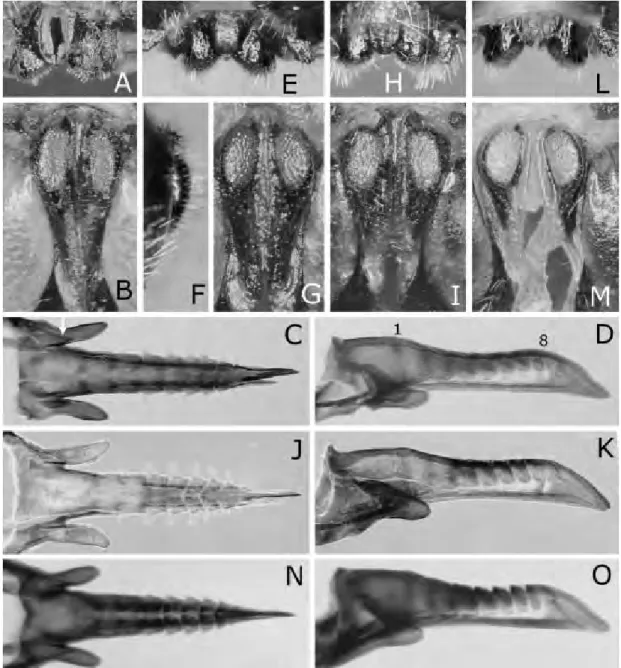
1.5 × length of second along dorsal margin, with ramus about 0.3 × length of first flagellomere along dorsal margin. Prepectus very small, far apart from postspiracular sclerite; pronotum and mesepisternum usually contiguous above prepec- tus. Mesoscutellum with anterior edge angled at 110–150° (Fig. 4); in dorsal view, mesoscutellar appendage not visible, except usually for narrow apex. Metascutellum small, not or strongly con- vex. Hind leg (Fig. 6A–B, E–F) with posterior (inner and longer) tibial spur tapering apically or rod shaped, and its length 0.9–1.2 × breadth of tibia, 0.8–1.0 × (rarely 1.1 ×) length of first tarso- mere (excluding pulvillar pad); length of second and third tarsomeres combined 1.1–1.7 × length of first. Ovipositor sheath in dorsal view about 3.0 × as wide as cercus (Fig. 7A, E, H, L); scopa oval and large, with height about 1.5–2.0 × width (Fig. 7B, G, I, M). Hypopygium with posterior margin very shallowly concave or slightly notched medially, without pair of posteromedial projections (Fig. 1B, G, J). Lance in lateral view with dorsal margin weakly concave at middle, mid-apically with longitudinal membranous area along ventral margin (Fig. 7D, K, O); posterior projection of processus articularis large, in dorsal view about 2.5–3.0 × as long as wide, with dis- tinct basal suture (Fig. 7C, J, N) (indicated by arrow in Fig. 7C; this suture present on ventral side). Lancet (Fig. 8) with ventral margin not or weakly convex at second annulus in outline and dorsal membranous area relatively narrow, wid- est at middle of lancet; first annulus without ser- rula, with row of spines (=ctenidium) not reach- ing ventral margin of lancet; serrulae simple, except for two or three apical serrulae, each is posteriorly angularly convex.

Male. Head, thorax and dorsum of abdomen

mostly black (Fig. 2A–C, G–H, L); dorsum of

abdomen at most laterally pale on some apical

(3)

Sawflies of Gilpinia abieticola Group 23

Fig. 1. Female: Gilpinia abieticola (A–E), G. hokkaidoensis (F–H) and G. kojimai (I–K). — A, D, F, I, Dorsal or

dorsolateral view; B, E, G, J, ventral or ventrolateral view; C, H, K, head, dorsal view. — A–C, Zittau; D–E,

lectotype; F–K, holotypes.

(4)

terga (ninth and 10th terga usually hidden and invisible). Legs mostly pale.

Structure as in female except for usual sexual differences. Antenna with 22–27 antennomeres.

Hind leg (Fig. 6C–D, G) with posterior tibial spur tapering apically, 0.6–0.9 × length of first tarsomere; length of second and third tarsomeres combined 1.0–1.3 × length of first. Basiparamere with parapenis very long (Fig. 9A–B, E, I–J, M).

Harpe in ventral view with medial margin con- cave and apex nearly pointed or narrowly rounded. Valviceps pigmented throughout, in lat- eral view narrow, apically curved ventrally (Fig.

9C, F, K, N), with spine at apex and minute or inconspicuous spines around sensory pores in narrow apical area delimited by sharp line anteri- orly and dorsally (Fig. 9D, G–H, L, O–P). Ergot long (Fig. 9C, F, K, N).

Remarks. Benson (1939) divided Gilpinia into two species groups, the G. polytoma group and the G. socia group, by the shape of the inner hind-tibial spur in the female. Gilpinia polytoma species group has a broadened spur, which is unique to the group in the Diprionidae and even in the Tenthredinoidea and strongly supports the monophyly of this species group. Gilpinia socia species group has a usual simple spur, and no characters suggesting its monophyly have been found. Gilpinia abieticola species group is a part of the G. socia species group. It is proposed here based on the close similarity between the mem- bers and not based on the possession of certain unique characters suggesting monophyly.

The females of the group are very similar to those of G. polytoma and G. hercyniae, but the latter two belong to the G. polytoma species group. The males of this species group (that of G.

hokkaidoensis is unknown) are very similar to that of G. hercyniae. These species differ from the other congeners in that the valviceps is pig- mented throughout and in lateral view it is nar- row and curved ventrally, with a pointed apex,

and the ergot is long (Figs. 9C, F, K, N, 10C, E).

Known males of the species of the G. abieticola group and that of G. hercyniae are separated by the characters given in the key below. The male of G. abieticola is also very similar to that of G.

polytoma in external characters, but in the latter species the valviceps in lateral view is relatively wide and apically with a wide non-pigmented area (Fig. 10A–B).

Gilpinia abieticola (Dalla Torre, 1894)

(Figs. 1A–E, 2A–F, 3A–H, P–Q, 4A–F, 5A–F, 6A–D, 7A–G, 8A–D, 9A–H)

Lophyrus abietis Stein, 1886: 141 [primary homonym of Lophyrus abietis Harris, 1841 =Neodiprion abietis (Harris, 1841)].

Lophyrus abieticola Dalla Torre, 1894: 293 [replacement name for Lophyrus abietis Stein, 1886]; Konow, 1905:

42; Enslin, 1914: 178, 179, 180; Enslin, 1917: 557, 562.

Gilpinia abieticola: Benson, 1939: 341; Reeks, 1941:

181, 186, 187; Gussakovskij, 1947: 162, 224, 225, 229 [part]; Thalenhorst, 1955: 353–361; Lorenz and Kraus, 1957: 28; Thalenhorst, 1960: 513–524; Vehrke, 1961:

179; Verzhutskii, 1966: 55; Verzhutskii, 1973: 119, 123, 124; Thalenhorst, 1968: 338–350; Smith, 1975:

412 [part]; Ermolenko, 1975: 133, 134, 159, 180;

Naito, 1976: 5, 6 [part]; Beneš and Krístek, 1979: 90, 92, 93; Verzhutskii, 1981: 74; Pschorn-Walcher, 1982:

105; Viitasaari and Varama, 1987: 53; Zhelokhovtsev, 1988: 78 [part]; Larsson et al., 1993: 458; Liston, 1995: 55; Taeger et al., 1998: 86 [part]; Pschorn-Wal- cher and Altenhofer, 2000: 283; Westendorff, 2006: 48;

Taeger et al., 2006: 460; Taeger et al., 2010: 204 [part]; Hara and Nakamura, 2015: 38.

Diprion abieticola: Kontuniemi, 1960: 1, 80.

Female [character states of lectotype in brack- ets]. Length 6.0–8.0 [7.5] mm. Black, with yel- low markings, without metallic reflection (Fig.

1A–B, D–E). Head yellow, with black transverse band between eyes crossing frontal and ocellar areas (Figs. 1C, 3A–B, E); this band sometimes dorsally becoming brown [brown]; facial groove sometimes slightly brown [slightly brown]; ante-

Fig. 2. Male: Gilpinia abieticola (A–F), G. kojimai (G–M). — A–B, G, Dorsal or dorsolateral view; C, H, L, ven-

tral or ventrolateral view; D, I, head, dorsal view; E, J, ventromedial part of head, anterior view; F, K, M, pro-

notum, anterolateral view. — A–F, Chodau; G–M, Mt. Yokote-yama.

(5)

Sawflies of Gilpinia abieticola Group 25

(6)

rior tentorial pit black; border between supr- aclypeal area and clypeus sometimes narrowly brown [narrowly brown]; malar space ventrally narrowly brown, sometimes with brown to black vertical band (Fig. 3E) [with faint brown vertical band (Fig. 3B)]; gena black narrowly along eye margin (Fig. 3C); occiput mostly black. Antenna brown to black brown, often basally yellow or yellow brown [yellow brown]. Mandible basally yellow, apically red brown. Labrum dark brown, basally pale, or entirely pale brown (Fig. 3B, E) [dark brown, basally pale]. Palpi pale yellow, basally somewhat darkened. Pronotum yellow, narrowly black anteriorly (Fig. 1A–B). Mesepi- sternum except for pectus yellow with black mar- gins (Figs. 1B, E, 5A, C); pectus black. Legs brown to black, yellow on apices of coxae, most of trochanters and trochantelli, apices of femora, fore and middle tibiae except for narrow apices and ventral parts of apical two-thirds, hind tibia except for apical fourth, and bases of tarsomeres;

fore and middle femora sometimes anteriorly mostly yellow [fore femur anteriorly mostly yel- low]; trochanters often widely darkened [some- what darkened]; tibial spurs yellow to brown.

Wings nearly clear hyaline; stigma pale brown, basally and marginally darkened; in fore wing, veins black, pale brown on C, most of section of R1 basal to stigma, apical section of R1, and most of A. Abdomen dark brown to black; first tergum with yellow or brown marking [brown];

second to seventh terga and sterna yellow anteri- orly, but second to fourth or fifth terga not or nar- rowly so medially; eighth tergum yellow anteri- orly and black posteriorly, with black anterolateral spot; ninth tergum yellow, black on narrow anterolateral margin and on dorsal area except for narrow dorsomedial area; tenth tergum black, medially yellow. Cercus dark brown. Ovi- positor sheath black; scopa yellow to brown.

Head and thorax densely punctured, moder- ately or weakly shiny [moderately]. Frontal area and its adjacent areas with punctures mostly con- tiguous (Fig. 3A). Supraclypeal area and dorsal area of clypeus weakly punctured (Fig. 3B, E).

Ventral area of clypeus and labrum nearly smooth. Punctures on mesonotum and mesepi- sternum mostly contiguous and well defined (Figs. 4A–D, 5 A–D).

Postocellar area with width 1.7–2.0 [2.0] × length (Fig. 1C). Distances between eye and lat- eral ocellus, between lateral ocelli, and between lateral ocellus and posterior margin of head 0.9–

1.2 : 1.0 : 0.7–1.0 [1.2 : 1.0 : 0.8]; distances between eye and lateral ocellus and between lateral ocel- lus and posterior margin of head 1.2–1.4 : 1.0 [1.4 : 1.0]. Distance between eyes 1.9–2.1 [2.1] × eye height. Distance between torulus and eye 1.2–1.6 [1.6] × distance between toruli. Malar space 1.2–1.9 [1.5] × width of median ocellus, 0.2–0.3 [0.3] × eye height. Antenna (Fig. 3D, F) with 18–20 [20] antennomeres. Ovipositor sheath as in Fig. 7A–B, E–G.

Lance (Fig. 7C–D) with eight annular sutures and middle sutures weakly oblique. Lancet (Fig.

8A–D) with 10 or rarely nine annuli (Fig. 8D) [10 annuli], abruptly narrowing apically beyond seventh annulus; length of lancet from its apex to ventral end of most basal (first) row of spines (=ctenidium) 3.1–3.5 [3.4] × maximum width of lancet; first row of spines distinctly oblique, with ventral end located basal to dorsal end; fourth row of spines (=ctenidium+serrula) about as long as second row of spines; serrula of second annu- lus somewhat smaller than that of third; eighth and ninth annuli each nearly straight, less oblique than middle annuli, and spinose throughout or often not spinose dorsally [ninth annulus not spi- nose dorsally].

Male. Length 5.7–6.3 mm. Black (Fig. 2A–

Fig. 3. Head (A–C, E, G–J, L–M, O), female antenna (D, F, K, N) and label (P, Q): Gilpinia abieticola (A–F, female; G–H, male), G. hokkaidoensis (I–K, female) and G. kojimai (L–N, female; O, male). — A, G, I, L, O, Anterolateral view; B, E, J, M, anteroventral part, anterior or anteroventral view; C, H, lateral view; D, F, K, outer lateral view (D, reversed); N, inner lateral view, reversed. — A–D, Lectotype; E–F, Zittau; G–H, Chodau;

I–N, holotypes; O, Mt. Yokote-yama; P, lectotype of Lophyrus abietis; Q, paralectotype of Lophyrus abietis.

(7)

Sawflies of Gilpinia abieticola Group 27

(8)

C). Head brown to dark brown between postocel- lar area and eye (Fig. 2D); supraclypeal area sometimes dark brown; clypeus dark brown, ven- trally brown yellow (Fig. 2E), or yellow except for narrow dorsal margin. Labrum pale brown.

Mandible apically red brown. Palpi pale yellow, basally somewhat darkened. Antenna dark brown to black. Pronotum posterolaterally widely pale yellow (Fig. 2F). Legs yellow (Fig. 2C); coxae basally widely black; femora often widely brown to dark brown posteriorly (according to Stein, 1886, femora usually not darkened); tarsi some- times apically narrowly black. Wings (Fig. 2A) as in female. Abdomen dorsally with sixth to eighth terga anterolaterally yellow brown or slightly pale (Fig. 2B), ventrally yellow or yel- low brown, slightly darkened along narrow pos- terior margins of sterna and laterotergites (Fig.

2C); subgenital plate anteriorly slightly and nar- rowly darkened. Basiparamere of genital capsule dark, harpe somewhat pale (Fig. 9A–B).

Punctation as in female, but punctures gener- ally more dense and distinct (Figs. 3G, 4E–F, 5E–F). Supraclypeal area densely punctured (Fig. 2E).

Structure as in female except for usual sexual differences. Postocellar area with width 2.0–2.2 × length (Fig. 2D). Distances between eye and lat- eral ocellus, between lateral ocelli, and between lateral ocellus and posterior margin of head 1.0 : 1.0 : 0.6; distances between eye and lateral ocel- lus and between lateral ocellus and posterior margin of head 1.6–1.7 : 1.0. Distances between eyes 1.9–2.0 × eye height. Distance between toru- lus and eye 1.2–1.4 × distance between toruli.

Malar space 1.6–1.8 × width of median ocellus, 0.3 × eye height. Antenna (Fig. 2A) with 22–27 antennomeres; flagellum with 18–22 biramose flagellomeres (basal and preapical flagellomeres uniramose, and apical flagellomere not ramose) (see also Stein, 1886).

Genitalia as in Fig. 9A–H. Basiparamere in ventral view with parapenis tapering apically, nearly straight, with apex narrowly rounded.

Valviceps in lateral view with very small spine at apex and ventral margin weakly rounded near apex; apical area narrow, with longest axis 4.1–

4.5 × shortest axis.

Material examined. Lectotype (hereby desig- nated) (Fig. 1D–E): ♀ labeled “L. abietis e. larva

♀ 31/3 69 Keivpa [?]” “CZECHOSLOVAKIA Bohemia, Chodau. R. von Stein Coll. B. M.

1935-271” (Fig. 3P) (BMNH). Paralectotype:

1 ♀, “L. abietis, e larva ♀ 28/7 85 Ch” “Diprion abieticola DT ♀ Forsius det.” (Fig. 3Q) (USNM).

Stein (1886) described Lophyrus abietis based on nine adults reared from 35 larvae collected in the Chodau area in Czech Republic and three other specimens, including one female reared from a larva collected in “sächsischen Erzge- birge”. The “sächsischen Erzgebirge” belongs to Saxony, Germany (A. Taeger, personal commu- nication, 2014). Stein (1886) did not designate types, and these 12 adult specimens are regarded as syntypes.

In the Stein collection now kept in the Natural History Museum, London (BMNH) (Horn et al., 1990), there are eight specimens labeled “abietis”

but six of these were collected (or emerged) in 1887. One male labeled “L. abietis, e larva 21/3 86 Ch” may have emerged from a larva collected in 1885 and referred to in Stein (1886) but the emergence of the adults in 1886 was not men- tioned in the paper and therefore it cannot be regarded as a syntype. The remaining specimen, a female labeled “L. abietis, e. larva ♀ 31/3 69 Keivpa[?]” (Fig. 3P), agrees with the data of a female mentioned by Stein (1886, 151), “das letzte, ein am 31. März 1869 ausgekrochenes Thier, stammt aus dem sächsischen Erzgebirge”, though the last word on the hand-written label, apparently a locality name, is illegible. This

Fig. 4. Medial part of mesonotum, dorsal view: Gilpinia abieticola (A–D, female; E–F, male), G. hokkaidoensis

(G–H, female) and G. kojimai (I–J, female; K–L, male). — A, C, E, G, I, K, Digital microscope using ring-

light; B, D, F, H, J, L, SEM. — A–B, Lectotype; C–D, Zittau; E–F, Chodau; G–J, holotypes; K–L, Mt. Yokote-

yama.

(9)

Sawflies of Gilpinia abieticola Group 29

(10)

specimen certainly belongs to Steinʼs original type series. We also examined one female labeled

“L. abietis, e larva ♀, 28/7 85 Ch” (Fig. 3Q) kept in the National Museum of Natural History, Washington, D.C. (USNM). We designate the female syntype in BMNH as a lectotype of Lophyrus abietis Stein, 1886. The female in USNM also agrees with the data of Stein (1886) and is a paralectotype.

Other material examined: CZECH REPUB- LIC: 1 ♂, “L. abietis, e larva 21/3 86 Ch”

“CZECHOSLOVAKIA Bohemia, Chodau. R.

von Stein Coll. B. M. 1935-271” “Dissection on slide Series. No. 1. 30. 1. 1964/8.” (BMNH); 1 ♂,

“abietis, 10/5 87 Ch” (USNM); 1 ♀, “Bohemia Prachatitz” “23. 7. 84. Handl.” (NMW). GER- MANY or CZECH REPUBLIC: 3 ♀, Ore Moun- tains between Czech Republic and Germany, Lange (SDEI); 1 ♀, same locality (SDEI). GER- MANY: 1 ♀, Ottobeuren, “Kohlstattkopf”, VII.

2000, M. Goßner (SDEI); 1 ♀, “Leipzig Fla[?]

18. 4. 92 Braun”, Konow (SDEI); 1 ♀, “Lückend- orf bei Zittau, 6. 7. 11, Sieber” (SDEI). AUS- TRIA: 1 ♀, “Piesting Tschek” (NMW); 1 ♀,

“Tschek 1872 Piesting.” “abietis enel[?] 6/7 65”

(NMW); 1 ♂, “Tschek 1872 Piesting.” (NSMT);

1 ♀, “Piesting.” “Wand 10/S 866” (NSMT). BOS- NIA AND HERZEGOVINA: 1 ♀, “Treskavica pl. Bosnia, Fodor.” (NSMT).

Distribution. Europe (for more details, see Taeger et al., 2006); Siberia (Verzhutskii, 1966).

The records from Japan by Takeuchi (1940), Togashi (1961), Okutani (1967) and Naito (1976) are most probably erroneous (see Hara and Nakamura, 2015).

Host plants. Pinaceae: Picea abies (L.) (“Pinus abies L.” in Stein, 1886; “Picea excelsa Link” in Lorenz and Kraus, 1957) and P. obovata Ledeb. (Verzhutskii, 1966).

Okutaniʼs (1967) record of Pinus pumila (Pall.) Regel. was based on a misidentification of

the sawfly (Okutani, 1970).

Remarks. Gilpinia abieticola is similar to G.

albiclavata, G. hokkaidoensis and G. kojimai in the female and also to G. hercyniae in the male, but these species are distinguished from each other by the characters given in the key below.

Reeks (1941) separated the males of G. abieti- cola, G. polytoma and G. hercyniae by the color- ation of the hind femur, the punctation on the thoracic dorsum and the shape of the valviceps.

His treatment was accepted by Ermolenko (1975) and Beneš and Krístek (1979). We recognized that the valviceps shows distinct differences among the three species (cf. Figs. 9–10), but the coloration and the punctation may not be useful in separating males of these three species. Reeks (1941) wrote that the hind femur is posteriorly mostly black and the punctation on the thoracic dorsum is coarse in G. abieticola and G. hercyn- iae, while the hind femur is mostly yellow and the punctation is fine in G. polytoma. However, in our material, the coloration of the femur and the punctation is not distinctly different among the three species.

The number of biramose antennomeres is 21–23 for “G. polytoma” (probably including G.

hercyniae) and 19 or 19–20 for G. abieticola in Enslin (1917) and Gussakovskij (1947), but it overlaps in G. abieticola, G. hercyniae and G.

polytoma according to Reeks (1941) and in our material. Enslin (1917) and Zhelokhovtsev (1988) used the antennal length to separate G.

abieticola from G. polytoma and G. hercyniae, but the antenna very often curls up, so that the accurate measurement is difficult. Viitasaari and Varama (1987) used the color and pilosity of the area just in front of the median ocellus, the color of the clypeus and the color of the tenth abdomi- nal tergum (=“viimeinen selkäkilpi”) in the key to the males of the European Gilpinia species, though they suggested rather wide variability of

Fig. 5. Dorsal part of mesepisternum, lateral view: Gilpinia abieticola (A–D, female; E–F, male), G. hokkaidoen-

sis (G–H, female) and G. kojimai (I–J, female; K–L, male). — A, C, E, G, I, K, Digital microscope using ring-

light; B, D, F, H, J, L, SEM. — A–B, Lectotype; C–D, Zittau; E–F, Chodau; G–J, holotypes; K–L, Mt. Yokote-

yama.

(11)

Sawflies of Gilpinia abieticola Group 31

(12)

these characters. In our limited material, the area in front of the median ocellus is narrowly yellow in G. abieticola, narrowly or rather widely yel- low or black in G. polytoma and black in G. her- cyniae, and the area is narrowly or widely gla- brous in all the three species. The clypeus is mostly (or its wide ventral margin) yellow, pale brown or brown in G. abieticola and G. hercyn- iae, and mostly yellowish white or yellow in G.

polytoma. The tenth tergum is often difficult to observe. In the specimens with a visible tenth ter- gum, it is brown in G. abieticola and G. hercyn- iae and yellow or brown in G. polytoma. We con- sider that these characters are rather difficult to use for the separation of these three species, although the frequency of character states may differ between them.

Gilpinia hokkaidoensis n. sp.

[Japanese name: Kita-shima-matsuhabachi]

(Figs. 1F–H, 3I–K, 4G–H, 5G–H, 6E, 7H–K, 8E–H)

Female [character states of holotype in brack- ets]. Length 6.0–7.0 [7.0] mm. Black, with pale yellow to yellow markings, without metallic reflection (Fig. 1F–G). Head yellow, anteriorly with black marking between eyes (Fig. 1H); this

black marking dorsally margined with brown, sometimes lateroventrally extending to malar space (Fig. 3J) [extending to malar space]; posto- cellar area usually medially dark brown (Fig. 1H) [medially dark brown]; pale area between posto- cellar area and gena narrow or wide [narrow];

border of supraclypeal area and clypeus dark brown (Fig. 3J); anterior tentorial pit black; area between facial groove and malar space yellow, or black and with yellow or brown spot near by facial groove [black with brown spot]; malar space anteriorly black; gena yellow except for black area along eye margin, or yellow or brown ventrally and black dorsally [yellow ventrally and black dorsally]; occiput mostly black.

Antenna dark brown to black, basally yellow or brown [brown]. Mandible basally brown, api- cally red brown. Labrum dark brown (Fig. 3J).

Palpi yellow, basally somewhat darkened. Prono- tum yellow, narrowly black anteriorly (Fig.

1F–G). Mesepisternum except for pectus dark brown to black, centrally with yellow marking [yellow marking present only on left mesepister- num]; pectus black (Fig. 1G). Legs brown to black; apices of coxae yellow; trochanters and trochantelli partly yellowish; apices of femora, fore and middle tibiae except for narrow apices and apical parts of ventral sides, hind tibia except

Fig. 6. Hind leg (from apex of tibia to third or fourth tarsomere): Gilpinia abieticola (A–B, female; C–D, male),

G. hokkaidoensis (E, female) and G. kojimai (F, female; G, male). — A, Left leg, anterior view; B, D, right leg,

ventral view; C, E–F, do., anterior view, reversed; G, do., posterior view, reversed. — A–B, Zittau; C–D, Cho-

dau; E–F, holotypes; G, Mt. Yokote-yama.

(13)

Sawflies of Gilpinia abieticola Group 33

for apical third and bases of tarsomeres yellow;

tibial spurs yellow to brown. Wings nearly clear hyaline; stigma pale brown, basally and margin- ally dark brown; in fore wing, veins dark brown to black, yellow to pale brown on C, most of sec- tion of R1 basal to stigma, apical section of R1

and most of A. Abdomen dark brown to black;

first tergum often with wide yellow brown area medially [with yellow brown area]; second to seventh terga yellow anteriorly, but anterior terga not or narrowly so medially; laterotergites yellow anterolaterally; sterna anteriorly or anterolater-

Fig. 7. Ovipositor sheath (A–B, E–I, L–M) and lance (C–D, J–K, N–O): Gilpinia abieticola (A–G), G. hokkaid-

oensis (H–K) and G. kojimai (L–O). — A, E, H, L, Posterodorsal view; B, G, I, M, posterior view; F, lateral

view; C, J, N, dorsal view; D, K, O, lateral view; 1, 8 in D, first (most basal) and eighth (most apical) annular

sutures. — A–D, Lectotype; E–G, Zittau; H–I, holotype; J–K, locality unknown; L–O, holotype.

(14)

ally yellow [anterolaterally]; eighth tergum ante- riorly yellow, with small black spot anterolater- ally; ninth tergum yellow or brown [yellow], black on narrow anterior margin and dorsal area

except for brown narrow dorsomedial area; tenth tergum black, medially yellow or brown [yel- low]. Cercus dark brown. Ovipositor sheath black; scopa yellow or brown [yellow].

Fig. 8. Lancet: Gilpinia abieticola (A–D), G. hokkaidoensis (E–H) and G. kojimai (I–L). 1, 2, 9 in A, First (most basal), second and ninth row of spines. — A, Lectotype; B, Chodau; C, Leipzig; D, Piesting; E, holotype;

F, Aizankei; G, locality unknown; H, Tomakomai; I, holotype; J–L, Mt. Yokote-yama.

(15)

Sawflies of Gilpinia abieticola Group 35

Fig. 9. Genitalia: Gilpinia abieticola (A–H) and G. kojimai (I–P). — A, I, Genital capsule, dorsal view; B, E, J,

M, do., ventral view; C, F, K, N, penis valve, lateral view, left dorsal (K, reversed); D, G–H, L, O–P, apical

part of valviceps, lateral view, left dorsal (L, reversed). — A–D, Piesting; E–H, Chodau; I–P, Mt. Yokote-yama.

(16)

Head and thorax densely punctured, moder- ately shiny. Frontal area and its adjacent areas with punctures mostly contiguous (Fig. 3I). Supr- aclypeal area and dorsal part of clypeus weakly punctured (Fig. 3J). Ventral part of clypeus nearly smooth. Labrum weakly punctured. Punc- tures on mesonotum and mesepisternum predom- inantly contiguous and well defined (Figs. 4G–H, 5G–H); those on posterior part of median mesos- cutal lobe sometimes ill-defined [ill-defined].

Postocellar area with width 1.7–2.1 [1.7] × length (Fig. 1H). Distances between eye and lat- eral ocellus, between lateral ocelli, and between lateral ocellus and posterior margin of head 1.1–

1.2 : 1.0 : 0.8–1.1 [1.1 : 1.0 : 0.9]; distances between eye and lateral ocellus and between lateral ocel- lus and posterior margin of head 1.1–1.3 : 1.0 [1.3 : 1.0]. Distance between eyes 1.8–2.0 [1.9] × eye height. Distance between torulus and eye 0.9–1.2 [1.2] × distance between toruli. Malar space 1.1–

1.7 [1.7] × width of median ocellus, 0.2–0.3 [0.3] × eye height. Antenna (Fig. 3K) with 20–21 [20]

antennomeres. Ovipositor sheath as in Fig. 7H–I.

Lance (Fig. 7J–K) with eight annular sutures and middle sutures weakly oblique. Lancet (Fig.

8E–H) with 10 annuli, gradually narrowing api- cally; length of lancet from its apex to ventral

end of most basal (first) row of spines (=ctenid- ium) 3.2–3.4 [3.4] × maximum width of lancet;

first row of spines oblique, with ventral end located anterior to dorsal end; fourth row of spines (=ctenidium+serrula) about as long sec- ond row of spines; second serrula somewhat smaller than third serrula; eighth and ninth annuli each curved, not spinose dorsally.

Male. Unknown.

Material examined. Holotype: ♀ (Fig. 1F–

G), labelled “Yamada-onsen 800 m, Tokachi, Hokkaido, 28–30. VI. 1995, A. Shinohara”

(NSMT). Paratypes: 2 ♀, “Lot 11-J. IV-15-1937”

“770” (NSMT); 1 ♀, Hokkaido, Tomakomai, 23.

VI. 1959, T. Kumata (HU); 1 ♀, Hokkaido, Aizankei, 16. VII. 1960, S. Takagi (HU); 1 ♀, same locality, 15. VII. 1963, A. Nakanishi (NSMT).

Etymology. The species epithet is derived from the locality.

Distribution. Japan: Hokkaido.

Host plants. Unknown.

Remarks. Gilpinia hokkaidoensis is distin- guished from similar species in the key below.

This species may be associated with Abies or Picea, because the holotype was collected at a site where Abies and Picea are abundant but

Fig. 10. Penis valve: Gilpinia polytoma (A–B) and G. hercyniae (C–F). — A–C, E, Lateral view, left dorsal (E, reversed); D, F, apical part of valviceps, lateral view, left dorsal (F, reversed). — A, Ottobeuren; B, Pulgarn;

C–D, Wilmington; E–F, Portage.

(17)

Sawflies of Gilpinia abieticola Group 37

Pinus is not found.

Gilpinia kojimai n. sp.

[Japanese name: Shima-haimatsu-habachi]

(Figs. 1I–K, 2G–M, 3L–O, 4I–L, 5I–L, 6F–G, 7L–O, 8I–L, 9I–P)

[Shima-haimatsu-habachi] (Japanese name only): Anony- mous, 1986: 198; Nakamura, 2004: 33.

Female [character states of holotype in brack- ets]. Length 6.5–7.5 [6.8] mm. Black, with yel- low markings, without metallic reflection (Fig.

1I–J). Head yellow, anteriorly with black mark- ing between eyes (Fig. 1K); this black marking narrowly margined with brown dorsally, extend- ing posteriorly along midline on postocellar area, and extending to malar space lateroventrally (Figs. 1K, 3M); anterior tentorial pit black; nar- row or wide yellow spot present near facial groove [narrow]; malar space black; gena black, ventrally yellow; occiput mostly black. Antenna dark brown to black, basally narrowly or widely yellow to brown [widely yellow to brown]. Man- dible basally brown yellow, apically red brown.

Labrum brown yellow to dark brown [brown].

Palpi pale yellow or brown yellow, basally some- what darkened. Pronotum yellow, narrowly black anteriorly (Fig. 1I–J). Mesepisternum black, with yellow marking at middle and pectus black, very often posteromedially yellow or brown [brown].

Legs brown to black; apices of coxae yellow; tro- chanters and trochantelli partly yellowish; apices of femora, fore and middle tibiae except for nar- row apices, hind tibia except for apical fourth and bases of basal tarsomeres yellow; tibial spurs yellow to brown. Wings nearly clear hyaline;

stigma pale brown, basally and marginally black;

veins mostly black; in fore wing, C yellow, api- cally darkened, and most of section of R1 basal to stigma and most of A pale brown. Abdomen dark brown to black; first tergum black, often with yellow marking medially [entirely black];

second to eighth terga yellow anteriorly, but anterior terga not or narrowly so medially; sterna anteriorly or anterolaterally yellow [anterolater-

ally]; ninth tergum black, dorsomedially nar- rowly yellow, posterolaterally narrowly dark brown or widely brown [narrowly dark brown];

tenth tergum dark brown, medially yellow or brown [yellow]. Cercus black. Ovipositor sheath black; scopa yellow.

Head and thorax densely punctured, moder- ately shiny. Frontal area and its adjacent areas with punctures predominantly contiguous (Fig.

3L). Supraclypeal area and dorsal part of clypeus weakly punctured (Fig. 3M). Ventral part of clyp- eus nearly smooth. Labrum weakly and sparsely punctured. Punctures on mesonotum and mesepi- sternum predominantly contiguous and well defined (Figs. 4I–J, 5I–J); punctures on mesono- tum rarely predominantly separated [contiguous].

Postocellar area with width 2.0–2.3 [2.1] × length (Fig. 1K). Distances between eye and lat- eral ocellus, between lateral ocelli, and between lateral ocellus and posterior margin of head 1.0–

1.2 : 1.0 : 0.8–1.0 [1.2 : 1.0 : 1.0]; distances between eye and lateral ocellus and between lateral ocel- lus and posterior margin of head 1.2–1.3 : 1.0 [1.2 : 1.0]. Distance between eyes 1.9–2.2 [2.2] × eye height. Distance between torulus and eye 1.2–1.3 [1.2] × distance between toruli. Malar space 1.5–

1.7 [1.6] × width of median ocellus, 0.3 × eye height. Antenna (Fig. 3N) with 19–21 [20] anten- nomeres. Ovipositor sheath as in Fig. 7L–M.

Lance (Fig. 7N–O) with eight annular sutures, and middle sutures weakly oblique. Lancet (Fig.

8I–L) with 10 annuli (10th annulus inconspicu- ous), abruptly narrowing apically beyond seventh annulus; length of lancet from its apex to ventral end of most basal (first) row of spines (=ctenid- ium) 2.6–2.9 [2.6] × maximum width of lancet;

first row of spines nearly erect; fourth row of spines (=ctenidium+serrula) slightly shorter than second row of spines; second serrula somewhat smaller than third serrula; eighth and ninth annuli each nearly straight, less oblique than middle annuli, and not spinose dorsally.

Male. Length 5.5–6.5 mm. Black (Fig.

2G–H). Head sometimes dark brown between

postocellar area and eye as in Fig. 2D. Clypeus

ventrally narrowly or widely brown yellow to

(18)

brown (Fig. 2J), or entirely black. Labrum yel- low, brown or black. Mandible apically red brown. Palpi pale yellow, basally somewhat darkened. Antenna dark brown to black. Prono- tum posterolaterally narrowly or somewhat widely brown or yellow (Fig. 2K, M); pale area ventrally not extending beyond postspiracular sclerite, in only one specimen extending beyond this sclerite. Legs brown yellow (Fig. 2H, L);

coxae basally widely black; trochanter and troch- antelli narrowly or widely darkened; femora nar- rowly or widely brown to dark brown posteriorly, often also basally; middle and hind tibiae some- times narrowly darkened apically. Wings as in female. Abdomen almost entirely black or dor- sally with sixth or seventh to eighth terga each anterolaterally brown, ventrally dark brown to black, brown yellow to brown on sixth to seventh sterna, sixth to eighth laterotergites, wide poste- rior area of subgenital plate, and narrow antero- lateral areas of second to fifth laterotergites (Fig.

2H) (in one specimen, also pale on subgenital plate and wide areas of fourth and fifth sterna and laterotergites, as in Fig. 2L). Basiparamere of genital capsule dark, harpe somewhat pale (Fig. 9I–J, M).

Punctation as in female (Figs. 3O, 4K–L, 5K–L). Supraclypeal area densely punctured (Fig. 2J).

Structure as in female except for usual sexual differences. Postocellar area with width 2.2–2.6 × length (Fig. 2I). Distances between eye and lat- eral ocellus, between lateral ocelli, and between lateral ocellus and posterior margin of head 1.0–

1.1 : 1.0 : 0.6–0.7; distances between eye and lat- eral ocellus and between lateral ocellus and pos- terior margin of head 1.5–1.8 : 1.0. Distances between eyes 1.9–2.3 × eye height. Distance between torulus and eye 1.1–1.4 × distance between toruli. Malar space 1.4–2.0 × width of median ocellus, 0.3–0.4 × eye height. Antenna (Fig. 2G) with 23–26 antennomeres.

Genitalia as in Fig. 9I–P. Basiparamere in ven- tral view with parapenis weakly curved laterally, slightly or distinctly tapering apically, with apex narrowly rounded. Valviceps in lateral view with

distinct apical spine and ventral margin weakly or moderately rounded near apex; apical area narrow, with longest axis 3.8–4.3 × shortest axis.

Material examined. Holotype: ♀ (Fig. 1I–J), labelled “JAPAN, HONSHU, Nagano pref., Yamanouchi, Mt. Yokote-yama, coll. larva on Pinus pumila, 30. VIII. 2012, coc. 1–8. IX., em.

17–28. IX. 2012, H. Kojima” (NSMT). Para- types: 1 ♂, Nagano Pref., Mt. Yokote-yama, em.

30. VII. 1984, host Pinus pumila, H. Kojima (NSMT); 1 ♂, do., but em. 2. VIII. 1984; 1 ♀, do., but em. 3. VIII. 1984; 9 ♀5 ♂, same data as holotype (NSMT); 1 ♀, do., No. 34; 8 ♂, off- spring of No. 34, em. 15. XI. – 1. XII. 2012 (NSMT); 1 ♀, No. 44, same data as holotype (NSMT); 2 ♂, offspring of No. 44, em. 12–18.

XI. 2012 (NSMT); 9 ♀6 ♂, same data as holo- type, but coll. larva on Pinus pumila, 10. IX.

2013, coc. –17. IX., em. 28. IX.–30. X. 2013 (NSMT).

Etymology. This new species is named after Haruyoshi Kojima, who discovered this species.

Distribution. Japan: Honshu (Nagano Pref., Mt. Yokote-yama) (Anonymous, 1986).

Host plants. Pinaceae: Pinus pumila (Pall.) Regel (Anonymous, 1986).

Remarks. The differences between Gilpinia kojimai and the most similar species are shown in the key below. Anonymous (1986) already reported on the occurrence of this species (as an undescribed species) on Pinus pumila stands on Mt. Yokote-yama, but the species was left unde- scribed.

Host plants are Pinus for G. kojimai and G.

albiclavata, while they are Picea for G. abietic- ola. Gilpinia kojimai and G. albiclavata are asso- ciated with the same plant, P. pumila, and occur in the alpine regions of central Honshu. How- ever, the two species differ in the larval habit and distribution in addition to the slight adult differ- ences. Larvae of G. kojimai are always solitary (H. Kojima, personal communication, 2014), while the larvae are solitary or gregarious in G.

albiclavata (Hara and Nakamura, 2015). The for-

mer species has been collected only in a small

area near the top of Mt. Yokote-yama in Shiga-

(19)

Sawflies of Gilpinia abieticola Group 39

kogen Highland. On the other hand, the latter species is widely distributed on Yatsugatake Mountains, Akaishi Mountains, Hida Mountains,

Kiso Mountains and Mt. Hakusan, but not in Shiga-kogen Highland.

Key to species of Gilpinia abieticola group

The following key contains the members of G. abieticola species group, G. abieticola, G. albiclav- ata, G. hokkaidoensis (male unknown) and G. kojimai, and the male of G. hercyniae.

1. Female. . . . 2

― Male. . . . 5 2. First abdominal tergum pale, narrowly dark along margins (very rarely widely dark with pale

medial marking); antenna with 17–19 antennomeres; malar space 1.8–2.2 × width of median ocel- lus; mesepisternum with punctures usually ill defined; lance with seven sutures; lancet with nine annuli. [Pectus narrowly or mostly pale; lancet gradually narrowing apically, with length from apex to ventral end of first (most basal) row of spines 2.6–2.8 × maximum width and first row of spines nearly erect.] . . . . G. albiclavata

― First abdominal tergum predominantly dark with pale medial marking or entirely dark (Fig. 1A, F, I); antenna with 19–21 antennomeres; malar space 1.1–1.9 × width of median ocellus; mesepister- num with punctures well defined (Fig. 5A, C, G, I); lance with eight sutures (Fig. 7D, K, O); lancet with 10 annuli (rarely nine annuli) (Fig. 8). . . 3 3. Pectus entirely black (Fig. 1B, G); lancet narrow, length from apex to ventral end of first row of

spines 3.1–3.5 × maximum width (Fig. 8A–H); first row of spines distinctly oblique. . . . 4

― Pectus very often posteromedially pale (Fig. 1J); lancet wide, length from apex to ventral end of first row of spines 2.6–2.9 × maximum width (Fig. 8I–L); first row of spines nearly erect. [Lancet abruptly narrowing apically beyond seventh annulus.] . . . . G. kojimai 4. Lancet abruptly narrowing apically beyond seventh annulus (Fig. 8A–D); eighth and ninth annuli

nearly straight. . . . G. abieticola

― Lancet gradually narrowing apically (Fig. 8E–H); eighth and ninth annuli curved.

. . . . G. hokkaidoensis 5. Valviceps with very small apical spine (Fig. 9D, G, H). [Pronotum posterolaterally with wide pale

yellow area ventrally extending beyond postspiracular sclerite; subgenital plate entirely yellow to yellow brown; malar space 1.6–1.8 × width of median ocellus; antenna with 22–27 antennomeres.]

. . . . G. abieticola

― Valviceps with distinct apical spine (Figs. 9L, O–P, 10D, F). . . . 6 6. Valviceps with long apical spine (Fig. 10D, F); subgenital plate entirely yellow to yellow brown.

[Pronotum posterolaterally with wide yellow area ventrally extending beyond postspiracular scler- ite; malar space 1.5–1.8 × width of median ocellus; antenna with 23–28 antennomeres.]

. . . . G. hercyniae

― Valviceps with short apical spine (Fig. 9L, O–P); subgenital plate usually basally or entirely black.

. . . 7 7. Pronotum posterolaterally with yellow or brown area usually not extending beyond postspiracular

sclerite ventrally; malar space 1.4–2.0 × width of median ocellus; antenna with 23–26 antenno- meres. . . . . G. kojimai

― Pronotum posterolaterally with wide pale yellow area extending beyond postspiracular sclerite ven-

trally; malar space 1.9–3.0 × width of median ocellus; antenna with 22–24 antennomeres.

(20)

. . . . G. albiclavata

Acknowledgments

We thank H. Kojima (Nagano) for offering the material and information on biology of Gilpinia kojimai, A. D. Liston and A. Taeger (SDEI), M.

Ohara (HU), S. Ryder (BMNH), D. R. Smith (USNM) and D. Zimmermann and M. Vizek (NMW) for the loan of the material, A. D. Liston for his careful reading of the manuscript and valuable suggestions, and A. Taeger for the infor- mation on the label data. This study was partly supported by JSPS KAKENHI Grant No.

25440223.

References

Anonymous 1986. [New species of sawflies.] In: Fauna and Flora of Shinano, Photobook, pp. 198–201. Shi- nano Mainichi Shinbun, Nagano. (In Japanese.) Beneš, K. and J. Krístek 1979. Present state of taxonomic

knowledge on European species of the families Pam- philiidae, Diprionidae and Tenthredinidae (Hymenop- tera, Symphyta). Acta Universitatis Agriculturae (Brno), Series C (Facultas Silviculturae), 48(1–4):

77–118. (In Czech with English abstract.)

Benson, R. B. 1939. On the genera of Diprionidae (Hymenoptera Symphyta). Bulletin of Entomological Research, 30: 339–342.

Dalla Torre, C. G. 1894. Tenthredinidae incl. Uroceridae (Phyllophaga & Xylophaga). Catalogus Hymenoptero- rum hucusque descriptorum systematicus et synonym- icus, vol. 1. 459 pp. Sumptibus Guilelmi Engelmann, Lipsiae.

Enslin, E. 1914. Die Blatt- und Holzwespen (Tenthre- diniden) Mitteleuropas, insbesondere Deutschlands. In Schröder, C. (ed.): Die Insekten Mitteleuropas insbe- sondere Deutschlands, Band III, Hymenopteren (Dritter Teil), pp. 95–213. Franckh ʼ sche Verlagshandlung, Stutt- gart.

Enslin, E. 1917. Die Tenthredinoidea Mitteleuropas VI.

Deutsche Entomologische Zeitschrift [1917] (Beiheft 6): 539–662.

Ermolenko, V. M. 1975. Rohokhvosty ta pyl ʼ shchyky.

Vypusk 3. Arhidy. Dyprionidy. Tentredynidy (selandri- iny, doleryny). Fauna Ukrainy, 10(3). 374 pp.

Gussakovskij, V. V. 1947. Chalastogastra (pt. 2). Faune de l ʼ URSS (n. s. 32), Insectes Hyménoptères, II (2).

235pp. Édition de lʼAcademie des Sciences de l'URSS, Moscou, Leningrad. (In Russian with English sum-

mary.)

Hara, H. and H. Nakamura 2015. A pine sawfly, Gilpinia albiclavata sp. nov. (Hymenoptera: Diprionidae), infesting Pinus pumila in the Japanese Alps. Entomo- logical Science, 18: 31–40.

Horn, W., I. Kahle, G. Friese and R. Gaedike 1990. Col- lectiones Entomologicae, ein Kompendium über den Verbleib Entomologischer Sammlungen der Welt bis 1960, Teil II: L bis Z, pp. 221–573. Akademie der Landwirtschaftswissenschaften der Deutschen Demo- kratischen Republik, Berlin.

Konow, F. W. 1905. Hymenoptera, Fam. Tenthredinidae.

In Wytsman, P. (ed.): Genera Insectorum, (29). 176 pp., 3pls. Bruxelles.

Kontuniemi, T. 1960. Suomen sahapistiäistoukkien ravin- tokasvit. Die Futterpflanzen der Sägewespenlarven (Hymenoptera, Symphyta) Finnlands. Animalia Fen- nica, 9: 1–104.

Larsson, S., C. Björkman and N. A. C. Kidd 1993. Out- breaks in diprionid sawflies: Why some species and not others? In Wagner, M. R. and K. F. Raffa (eds.): Sawfly Life History Adaptations to Woody Plants, pp. 453–

483. Academic Press, San Diego and London.

Liston, A. D. 1995. Compendium of European Sawflies.

190 pp. Chalastos Forestry, Gottfrieding.

Lorenz, H. and M. Kraus 1957. Die Larvalsystematik der Blattwespen (Tenthredinoidea und Megalodontoidea).

Abhandlungen zur Larvalsystematik der Insekten, 1:

1–389.

Naito, T. 1976. Chromosomes and sex of sawflies. Forest Pests, 25(5): 2–7. (In Japanese.)

Nakamura, H. 2004. Sawflies infesting Pinus pumila around Mt. Kiso-komagatake in the Japan Central Alps.

Annals of Environmental Science, Shinshu University, 26: 33–38. (In Japanese with English abstract.)

Okutani, T. 1967. Food plants of Japanese Symphyta (I).

Japanese Journal of Applied Entomology and Zoology, 11: 43–49. (In Japanese with English abstract.) Okutani, T. 1970. Food plants of Japanese Symphyta (III).

Japanese Journal of Applied Entomology and Zoology, 14: 25–28. (In Japanese with English abstract.)

Pschorn-Walcher, H. 1982. Unterordnung Symphyta, Pflanzenwespen. In Schwenke, W. (ed.): Die Forst - schädlinge Europas, 4, pp. 4–196, 232–234. Paul Parey, Hamburg und Berlin.

Pschorn-Walcher, H. and E. Altenhofer 2000. Langjährige Larvenaufsammlungen und Zuchten von Pflanzen - wespen (Hymenoptera, Symphyta) in Mitteleuropa.

Linzer biologische Beiträge, 32: 273–327.

Reeks, W. A. 1941. On the taxonomic status of Gilpinia

polytoma (Htg.) and G. hercyniae (Htg.) (Hymenop-

tera, Diprionidae). The Canadian Entomologist, 73:

(21)

Sawflies of Gilpinia abieticola Group 41 177–188.

Smith, D. R. 1975. Conifer sawflies, Diprionidae: Key to North American genera, checklist of world species, and a new species from Mexico (Hymenoptera). Proceed- ings of the Entomological Society of Washington, 76:

409–418.

Stein, R. 1886. Neue Afterraupen. Wiener Entomolo- gische Zeitung, 5: 141–151.

Taeger, A., E. Altenhofer, S. M. Blank, E. Jansen, M.

Kraus, H. Pschorn-Walcher and C. Ritzau 1998. Kom- mentare zur Biologie, Verbreitung und Gefährdung der Pflanzenwespen Deutschlands (Hymenoptera, Symphyta).

In Taeger, A. and S. M. Blank (eds.): Pflanzenwespen Deutschlands (Hymenoptera, Symphyta), Kommenti- erte Bestandsaufnahme, pp. 49–135. Goecke & Evers, Keltern.

Taeger, A., S. M. Blank and A. D. Liston 2006. European sawflies (Hymenoptera: Symphyta) ― A species check- list for the countries. In Blank S. M., S. Schmidt and A.

Taeger (eds.): Recent Sawfly Research: Synthesis and Prospects, pp. 399–504. Goecke & Evers, Keltern.

Taeger, A., S. M. Blank and A. D. Liston 2010. World cat- alog of Symphyta (Hymenoptera). Zootaxa, 2580:

1–1064.

Takeuchi, K. 1940. A systematic study on the suborder Symphyta (Hymenoptera) of the Japanese Empire (III).

Tenthredo, 3: 187–199.

Thalenhorst, W. 1955. Zur Kenntnis der Fichten- Blattwespen. III. Die Apparenzen der Diprionini.

Zeitschrift für Pflanzenkrankheiten und Pflanzenschutz, 62: 353–361.

Thalenhorst, W. 1960. Zur Kenntnis der Fichten- blattwespen. VI. Die Populationsdichte der Diprioni- dae: Niveau und Fluktuationen. Zeitschrift für Pflan - zenkrankheiten und Pflanzenschutz, 67: 513–524.

Thalenhorst, W. 1968. Zur Kenntnis der Fichten-

blattwespen VIII. Eizahl und Eiablage. Zeitschrift für Pflanzenkrankheiten und Pflanzenschutz, 75: 338–350.

Togashi, I. 1961. Sawflies (Hym. Symphyta) of Mt. Haku - san. Life Study, 5: 27–42. (In Japanese with English abstract.)

Vehrke, H. 1961. Zur Unterscheidung der Larven von Gil- pinia abieticola (D.T.), G. polytoma (Htg.) und G. her- cyniae (Htg.) (Hymenoptera: Diprionidae) nach dem Zeichnungsmuster der Kopfkapseln. Zeitschrift für Angewandte Entomologie, 48: 176–185.

Verzhutskii, B. N. 1966. Pilil ʼ shchiki Pribaikal ʼ ia. 162 pp.

Nauka, Moskva. (English translation, 1978, Sawflies of Baikal Region. 234 pp. Indian National Scientific Doc - umentation Centre, New Delhi.)

Verzhutskii, B. N. 1973. Opredelitelʼ Lichinok Rogokh- vostov i Pililʼshchikov Sibirii i Dalʼnego Vostoka. 140 pp. Nauka, Moskva.

Verzhutskii, B. N. 1981. Rastitel ʼ noiadnye Nasekomye v Ekosistemakh Vostochnoi Sibiri (Pililʼshchiki i Rogokhvosty). 303 pp. Nauka, Novosibirsk.

Viitasaari, M. and M. Varama 1987. Sawflies 4. Conifer sawfly (Diprionidae). University of Helsinki, Depart - ment of Agricultural and Forest Zoology, Reports, 10:

1–79. (In Finnish with English summary.)

Westendorff, M. 2006. Chromosomes of sawflies (Hyme - noptera: Symphyta) - A survey including new data. In Blank S. M., S. Schmidt and A. Taeger (eds.): Recent Sawfly Research: Synthesis and Prospects, pp. 39–60.

Goecke & Evers, Keltern.

Zhelokhovtsev, A. N. 1988. Symphyta. In Medvedev, G.

S. (ed.): Opredelitelʼ Nasekomykh Evropeiskoi Chasti SSSR, Tom III, Pereponchatokrylye, Shestaia Chast ʼ . 599 pp. Nauka, Leningrad. (English translation, 1994, Keys to the Insects of the European Part of the USSR, Vol. III, Hymenoptera, Part VI, Symphyta, pp. 7–234.

E.J. Brill, Leiden, New York, Köln.)

Fig. 1.  Female:  Gilpinia abieticola (A–E), G. hokkaidoensis (F–H) and G. kojimai (I–K)
Fig.  6.  Hind leg (from apex of tibia to third or fourth tarsomere): Gilpinia abieticola (A–B, female; C–D, male),  G
Fig.  7.  Ovipositor sheath (A–B, E–I, L–M) and lance (C–D, J–K, N–O): Gilpinia abieticola (A–G), G
Fig. 8.  Lancet:  Gilpinia abieticola (A–D), G. hokkaidoensis (E–H) and G. kojimai (I–L)
+3

参照

関連したドキュメント

As far as local conditions at infinity are concerned, it is shown that at energy zero the Dirac equation without mass term has no non-trivial L 2 -solutions at infinity for

The calibration problem for the Black-Scholes model was solved based on the S&P500 data, and the S&P 500 call and put option price data were interpreted in the framework

In this section we show that both log-Sobolev and Nash inequalities yield bounds on the spectral profile Λ(r), leading to new proofs of previous mixing time estimates in terms of

Zaslavski, Generic existence of solutions of minimization problems with an increas- ing cost function, to appear in Nonlinear

We can also confirm that the spreading speed coincides with the minimal wave speed of regular traveling waves of (1.1), which has been founded in many reaction-diffusion

Case 1: Without loss of generality, say all the lines are black; then the black con- figuration together with the members of the special class which also have all black lines

The oriented Sato–Levine invariant [33] is defined for any oriented 2–component diagonal link (meaning pairwise linking numbers vanish) as the self-linking of the curves of

We formalize and extend this remark in Theorem 7.4 below which shows that the spectral flow of the odd signature operator coupled to a path of flat connections on a manifold