Ultra-High Definition/Wide-Color-Gamut Standard Test Images
Reference Manual
Institute of Image Information and Television Engineers
Association of Radio Industries and Businesses
− 1 −
On the Release of Ultra-High Definition/Wide-Color-Gamut Standard Test Images
The Institute of Image Information and Television Engineers (ITE; formerly the Institute of Japanese Television) is dedicated to the development and progress of cutting-edge imaging technologies throughout history. Toward this end, we have released various kinds of standard test images. It cannot be overstated that the use of these test images in research and development and evaluation trials has played a major role in the practical implementation of information communication services and image information media widely used today, such as the digitization of broadcasting and communication and the development of high definition TV and 3D video systems.
In the past several years, improvements in the resolution and quality of image information media have accelerated around in the world. In Japan especially, creating the environment for 4K (3840 × 2160 pixels) and 8K (7680 × 4320 pixels) broadcasting is positioned as a part of economic growth strategy using ICT. Recently, Tokyo was also chosen as the host of the 2020 Summer Olympics.
These circumstances have led to a quickening in the efforts toward the practical implementation of 4K/8K technologies, such as the development of a 4K/8K satellite broadcast system and related equipment. In addition to their high pixel counts, their bit depth and color gamut have also been expanded. As a result, it is currently not easy to set up equipment and environment to obtain test images necessary for research and development. Thus, providing ultra-high definition/wide-color-gamut standard test images that conform to new international standards, so that next-generation imaging systems such as 4K/8K can be expeditiously implemented, has become an urgent task for many institutions in academia, industry, and government involved in the R&D of imaging technologies.
Against this background, ITE and the Association of Radio Industries and Businesses (ARIB) have collaborated in producing a set of still digital images that comply with ITU-R Recommendation BT.2020, which specifies the international standards for 4K/8K images. We are releasing these images as “Ultra-High Definition/Wide-Color-Gamut Standard Test Images.” We are pleased to say that they truly meet today’s demands. I sincerely hope that with these images, R&D of next-generation image information media will be invigorated even more, and an era in which anyone can conveniently and intimately enjoy the benefits of a video experience brimming with the sensation of reality will arrive a day earlier.
May 2014
Susumu ITOH
President of the Institute of Image Information and Television Engineers
− 2 −
Selection and Production of Ultra-High Definition/Wide-Color-Gamut Standard Test Images
The studio production standard for ultra-high definition television (UHDTV) was developed by International Telecommunication Union Radiocommunication Sector (ITU-R) as Recommendation ITU-R BT.2020. The ARIB standard STD-B56 was also developed by the Association of Radio Industries and Businesses (ARIB). Technical specifications toward the start of UHDTV broadcasting are also being developed. There is growing demand for standard test images appropriate for the evaluation of 8K and 4K imaging equipment and systems that are compliant to the studio standards.
The “Study Group for the Quality Evaluation Method” of the ARIB has been investigating quality evaluation methods for images and sound. As a part of these activities, we already selected and produced standard test images and sequences for the assessment of high definition systems. These test materials have been distributed by the Institute of Image Information and Television Engineers (ITE).
Recently, under the supervision of ITE, we selected and produced ultra-high definition/wide-color-gamut still images that conform to the UHDTV studio standard. These images are released as “Ultra-High Definition/Wide-Color-Gamut Standard Test Images.” We expect that these new standard test images will be widely used and lead to the rapid popularization and expansion of UHDTV.
May 2014
Yukihiro NISHIDA Chairman
Study Group for the Quality Evaluation Method Association of Radio Industries and Businesses
− 3 −
This DVD and the Reference manual are copyrighted by the Institute of Image Information and Television Engineers (ITE) and the Association of Radio Industries and Businesses (ARIB).
Copyright of recorded images belong to the following organizations:
(1) Images copyrighted by the Japan Broadcasting Corporation (NHK)
“Books”, ”MusicBox”, ”StainedGlass”, ”Butterfly”, ”ChromaKey”, ”Sea”, ”Flowers”
(2) Images jointly copyrighted by ITE and ARIB
“Moss”, ”Kimono”, ”Ship”
Duplication of these standard test images without prior permission is a violation of copyright and strictly prohibited.
Use of these images in conference presentations and academic article, however, is allowed.
The use of these standard test images is limited to the following purposes:
(1) Use for technical evaluation
Research and development of equipment/systems
Examination and testing in equipment production process
Evaluation of transmission paths for broadcasting/communication
Maintenance of equipment (2) Use for exhibitions
Exhibition in academic conferences and research meetings
Exhibition of equipment’s performance/functions in exhibitions1 (With the exception of sales and promotional purposes)
1 When using the standard test images for this purpose, contact ITE beforehand.
− 4 −
The following institutions were involved in the production of the standard test images.
Institute of Image Information and Television Engineers, Test Chart Committee
Chair: Masayuki Sugawara (NHK)
Coordinator: Shigeyuki Sakazawa (KDDI R&D Laboratories)
Members: Hiroshi Watanabe (Waseda University), Naoki Shimizu (NHK), Ichiro Matsuda (Tokyo Univ. of Science)
Institute of Image Information and Television Engineers, Still Image Test Chart Subcommittee
Leader: Ichiro Matsuda (Tokyo Univ. of Science)
Members: Kazuhisa Iguchi (NHK), Shigeyuki Sakazawa (KDDI R&D Labs.), Masayuki Sugawara (NHK), Junichi Takeda (Canon),
Toshihiro Yamamoto (NHK)
Secretariat: Yukio Iwahana, Toru Mochizuki
Association of Radio Industries and Businesses, Study Group for the Quality Evaluation Method, HD Standard Sequences Working Group
Leader: Hidehiko Ikegawa (Fuji Television)
Members: Akira Koike (Sharp), Hiroyuki Fukukawa (Sharp), Hiroyuki Seimiya (Sony), Yasuhisa Nakata (NEC), Norimichi Hiwasa (Mitsubishi Electric), Kazuyuki Arai (NHK),
Kenichiro Masaoka (NHK), Tsukuru Kai (Nippon Television), Haruyasu Onoda (TV Asahi), Naruhiko Shinoda (WOWOW), Hidetaka Yanagidaira (ASTRODESIGN)
Secretariat: Tatsuo Nishizawa, Hiroyuki Hattori
− 5 −
Ultra-High Definition/Wide-Color-Gamut Standard Test Images Reference Manual
Table of Contents
1. Overview of Ultra-High Definition/Wide-Color-Gamut Standard Test Images ... 6
2. Recording Formats ... 11
3. Description of Standard Test Images ... 17
No. 1 Books ... 19
No. 2 MusicBox ... 20
No. 3 Moss ... 21
No. 4 Kimono ... 22
No. 5 StainedGlass ... 23
No. 6 Butterflies ... 24
No. 7 ChromaKey ... 25
No. 8 Sea ... 26
No. 9 Flowers ... 27
No. 10 [Sample] Ship ... 28
− 6 −
1. Overview of Ultra-High Definition/Wide-Color-Gamut Standard Test Images
In order to offer convenient and accurate ways to assess image quality and to evaluate performance of imaging devices, systems, and methods, the Institute of Image Information and Television Engineers (ITE) has released a variety of standard test images. For example, in 1990 it published “High-Vision Standard Test Pictures” (set of nine slides) for still images. In 1992 and 1999 its digitalized versions of the images were released as “Digital HDTV Standard Pictures for Subjective Assessment” [1] and “Digital HDTV Standard Pictures for Subjective Assessment (Revised Edition)”
[2], respectively. For video, ITE released “ITE/ARIB Hi-Vision Test Sequences” (60 standard test sequences, 10 reference sequences) [3] in 1993 and “ITE/ARIB Hi-Vision Test Sequences 2nd Edition” (44 general sequences, 34 specific sequences) [4] in 2009. These standard test sequences were created in collaboration with the Association of Radio Industries and Businesses (ARIB) and meet the standards of high definition images at the time. Meanwhile, the progress in technology to improve picture quality in image capture devices and display equipment has been remarkable.
Research and development for commercializing next-generation imaging systems with greater sensation of reality, such as ultra-high definition TV, which features high spatial resolution of 8K and 4K as well as wide-color gamut color representation, is proceeding at an accelerated pace.
In this state of affairs, there is a growing need for standard test images compliant to new image formats. Thus, ARIB and ITE again cooperated to produce and distribute “Ultra-High Definition/Wide-Color-Gamut Standard Test Images.” These high-quality digital still images were captured using the newest photography equipment.
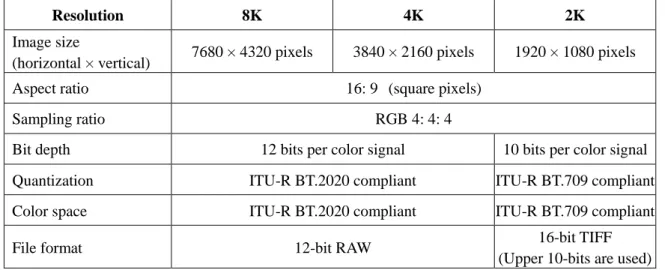
These standard test images are provided in three formats: 8K and 4K resolutions prescribed by the International Telecommunication Union Radiocommunication Sector (ITU-R) Recommendation BT.2020 [5] as studio production standards for ultra-high definition television (UHDTV), and 2K resolution compliant with ITU-R Recommendation BT.709 [6], which prescribes studio standards for high definition television (HDTV). Table 1-1 provides a summary of each format.
− 7 −
Table 1-1 Image formats of standard test images.
Resolution 8K 4K 2K
Image size
(horizontal × vertical) 7680 × 4320 pixels 3840 × 2160 pixels 1920 × 1080 pixels
Aspect ratio 16: 9 (square pixels)
Sampling ratio RGB 4: 4: 4
Bit depth 12 bits per color signal 10 bits per color signal
Quantization ITU-R BT.2020 compliant ITU-R BT.709 compliant
Color space ITU-R BT.2020 compliant ITU-R BT.709 compliant
File format 12-bit RAW 16-bit TIFF
(Upper 10-bits are used)
− 8 −
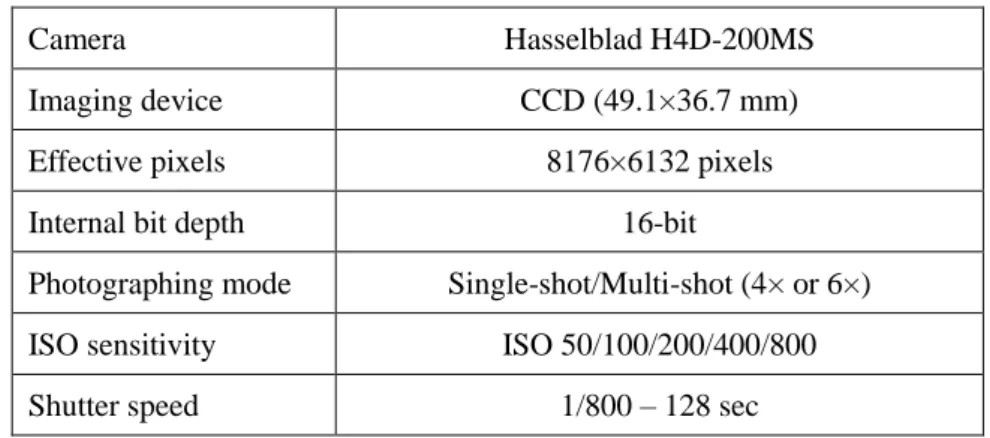
For photographing the material images, the Hasselblad H4D-200MS, a digital single-lens reflex camera, was used. The primary specifications of the camera and lenses used are shown in Tables 1-2 and 1-3. The camera has two photographing modes: single-shot and multi-shot. In a single-shot mode, images are captured in a similar way to a general single-plate CCD camera. Complete color information per pixel is obtained by an interpolative process called demosaicing from pixel values each of which exclusively corresponds to one of R, G, or B color signals captured through a Bayer color filter array placed in front of the CCD sensor. In contrast, multi-shot is a photographing mode in which all color signals are directly obtained for each pixel by shifting the CCD sensor precisely one pixel in the horizontal and vertical directions while capturing the image successively four or six times. The multi-shot mode can capture faithful color information without moire or false color produced by the demosaicing process. However, because in principle it can only be applied to still objects, either single-shot or multi-shot (four times) mode was used for shooting the material images depending on the object being photographed.
Table 1-2 Camera specifications.
Camera Hasselblad H4D-200MS
Imaging device CCD (49.1×36.7 mm)
Effective pixels 8176×6132 pixels
Internal bit depth 16-bit
Photographing mode Single-shot/Multi-shot (4× or 6×)
ISO sensitivity ISO 50/100/200/400/800
Shutter speed 1/800 – 128 sec
Table 1-3 Lens specification.
Model HCD
4/28
HC 3.5/35
HC 3.5/50-II
HC 2.8/80
HC Macro 4/120-II
Focal length 28.9 mm 35.8 mm 50.3 mm 82.3 mm 118.7 mm
Maximum aperture 4.0 3.5 3.5 2.8 4.0
Number of elements/
group 12/9 11/10 10/9 6/6 9/9
Focal range 0.35 m – ∞ 0.5 m – ∞ 0.6 m – ∞ 0.7 m – ∞ 0.39 m – ∞
− 9 −
For 8K image data, utility software provided by the camera manufacture (Phocus, ver. 8.1) was used to trim the region that fits the 8K specification and to develop it in ProPhotoRGB (ROMM RGB) color space [7]. The region was quantized/converted to a Rec. 2020-compliant color system using numerical analysis software MATLAB. For 4K and 2K resolution image data, the aforementioned region was down-sampled using the same utility software. Images conforming to Rec. 2020 or Rec. 709 were then generated using MATLAB.
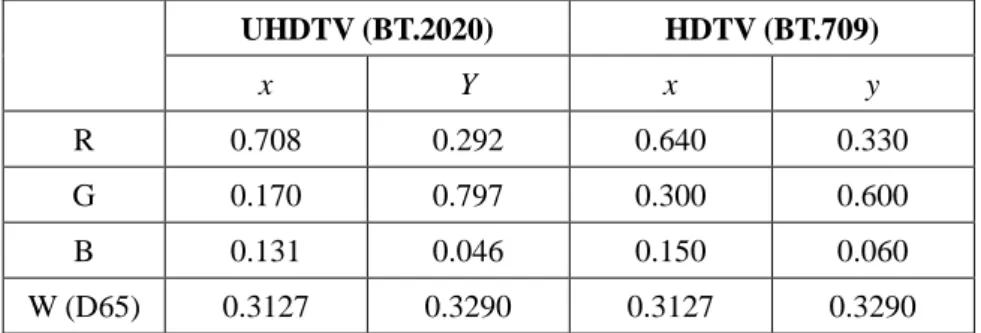
Table 1-4 compares the chromaticity coordinates of the RGB primary colors and the reference white (W) specified for UHDTV (Rec. 2020) and HDTV (Rec. 709), respectively. Figure 1-1 shows the points of the primary colors on the CIE 1931 xy chromaticity diagram. For the UHDTV color space, the points of the three RGB primary colors lie on the horseshoe-shaped spectral locus. The color space was designed to realize a wide-color gamut compared with conventional HDTV [8, 9].
Note that when RGB values of 8K/4K image data were provided as-is to the conventional HDTV display system, correct color reproduction would not be possible.
Table 1-4 Chromaticity coordinates (CIE 1931) of UHDTV and HDTV.
UHDTV (BT.2020) HDTV (BT.709)
x Y x y
R 0.708 0.292 0.640 0.330
G 0.170 0.797 0.300 0.600
B 0.131 0.046 0.150 0.060
W (D65) 0.3127 0.3290 0.3127 0.3290
− 10 −
Figure 1-1 Three primary colors used in the RGB color spaces of UHDTV and HDTV.
[1] S. Yamashita, Y. Hattori, K. Masaru, and N. Narita, “Digitizing Process of HDTV Standard Pictures for Subjective Assessment” [in Japanese], The Journal of the Institute of Television Engineers of Japan, Vol. 46, No. 6, pp. 756–765, June 1992.
[2] “Digital HDTV Standard Pictures for Subjective Assessment Reference Manual (Revised Edition)”
[in Japanese], ITE, April 1999.
[3] “ITE/ARIB Hi-Vision Test Sequences Reference Manual,” [in Japanese], ITE, Oct. 1993.
[4] “ITE/ARIB Hi-Vision Test Sequences 2nd Edition Reference Manual,” ITE, Nov. 2009.
[5] Rec. ITU-R BT.2020, “Parameter Values for Ultra-high Definition Television Systems for Production and International Programme Exchange,” Aug. 2012.
[6] Rec. ITU-R BT.709, “Parameter Values for the HDTV Standards for Production and International Programme Exchange,” Apr. 2002.
[7] Eastman Kodak Company, “Reference Output Medium Metric RGB Color Space (ROMM RGB) White Paper,” Version 2.2, July 1999.
[8] K. Masaoka, Y. Nishida, M. Sugawara, and E. Nakasu, “Design of Primaries for a Wide-Gamut Television Colorimetry,” IEEE Trans. Broadcast., Vol. 56, No. 4, Dec. 2010.
[9] K. Masaoka, Y. Nishida, and M. Sugawara, “Wide-Gamut Colorimetry for Super Hi-Vision: Advanced Television System Providing Better Visual Experience,” [in Japanese], IEICE Technical Report, Vol.
111, No. 35, pp. 19–24, May 2011.
− 11 −
2. Recording Formats
The recording formats of the standard test images recorded on the DVD differ for 8K/4K images and 2K images.
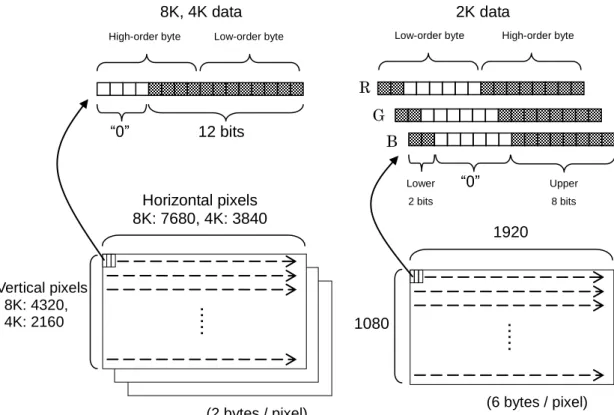
For 8K and 4K images (12-bit), there is one file each for the R, G, and B components of an image.
For each file, the data is expressed with 2 bytes per pixel. In the case of 8K, the size of one file is 66,355,200 bytes. In the case of 4K, the size is 16,588,800 bytes. Of the two bytes, a 12-bit pixel uses lower 4 bits of the first byte and all 8 bits of the second byte; the upper 4 bits of the first byte are set to “0”. Note that the 2-byte data of each pixel is recorded in high-to-low byte order (big-endian).
For 2K images (10-bit), each pixel is stored in uncompressed 16-bit TIFF format. The 10-bit value per RGB color is stored in upper 10 bits of 16-bit data for each color; the remaining lower 6 bits are set to “0”. Also, these 2-byte data are arranged in RGB order for each pixel. Each file has 12,441,600 bytes for the image data and additional data for the header information. Note that the byte order of the TIFF format is arbitrary. However, in these standard test images, the 2-byte data of each color is recorded in low-to-high byte order (little-endian).
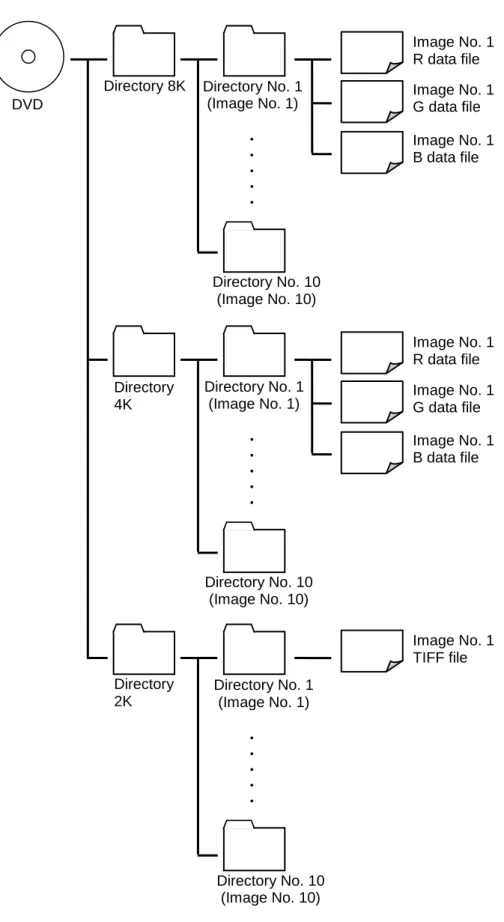
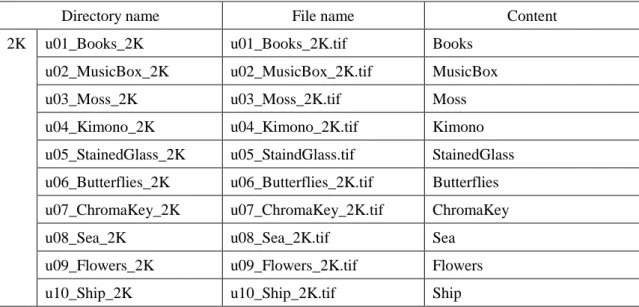
Figure 2-1 shows the structure of the file formats. Figure 2-2 shows the directory structure within the DVD. Tables 2-1, 2-2, and 2-3 show the list of files of the standard test images.
− 12 −
Figure 2-1 File formats
・・
・・
・
8K, 4K data 2K data
High-order byte Low-order byte
12 bits
“0”
Low-order byte High-order byte
Lower 2 bits
“0”
1920
1080 ・・・・・
(6 bytes / pixel)
Upper 8 bits
R G
B
Horizontal pixels 8K: 7680, 4K: 3840
Vertical pixels 8K: 4320, 4K: 2160
(2 bytes / pixel)
− 13 −
Figure 2-2 Directory structure DVD
Directory No. 1 (Image No. 1)
Image No. 1 R data file Image No. 1 G data file Image No. 1 B data file
・
・
・
・・ Directory 8K
Directory 4K
Directory 2K
Directory No. 10 (Image No. 10)
Directory No. 1 (Image No. 1)
Image No. 1 R data file Image No. 1 G data file Image No. 1 B data file
・
・
・・
・
Directory No. 1 (Image No. 1)
Image No. 1 TIFF file
・
・・
・
・
Directory No. 10 (Image No. 10)
Directory No. 10 (Image No. 10)
− 14 −
Table 2-1 List of file names (8K)
Directory name File name Content
8K u01_Books_8K u01_Books_8K.r “Books” - R data
u01_Books_8K.g “Books” - G data u01_Books_8K.b “Books” - B data u02_MusicBox_8K u02_MusicBox_8K.r “MusicBox” - R data
u02_MusicBox_8K.g “MusicBox” - G data u02_MusicBox_8K.b “MusicBox” - B data
u03_Moss_8K u03_Moss_8K.r “Moss” - R data
u03_Moss_8K.g “Moss” - G data
u03_Moss_8K.b “Moss” - B data
u04_Kimono_8K u04_Kimono_8K.r “Kimono” - R data
u04_Kimono_8K.g “Kimono” - G data u04_Kimono_8K.b “Kimono” - B data u05_StainedGlass_8K u05_StainedGlass_8K.r “StainedGlass” - R data
u05_StainedGlass_8K.g “StainedGlass” - G data u05_StainedGlass_8K.b “StainedGlass” - B data u06_Butterflies_8K u06_Butterflies_8K.r “Butterfly” - R data
u06_Butterflies_8K.g “Butterfly” - G data u06_Butterflies_8K.b “Butterfly” - B data u07_ChromaKey_8K u07_ChromaKey_8K.r “ChromaKey” - R data
u07_ChromaKey_8K.g “ChromaKey” - G data u07_ChromaKey_8K.b “ChromaKey” - B data
u08_Sea_8K u08_Sea_8K.r “Sea” - R data
u08_Sea_8K.g “Sea” - G data
u08_Sea_8K.b “Sea” - B data
u09_Flowers_8K u09_Flowers_8K.r “Flowers” - R data u09_Flowers_8K.g “Flowers” - G data u09_Flowers_8K.b “Flowers” - B data
u10_Ship_8K u10_Ship_8K.r “Ship” - R data
u10_Ship_8K.g “Ship” - G data u10_Ship_8K.b “Ship” - B data
− 15 −
Table 2-2 List of file names (4K)
Directory name File name Content
4K u01_Books_4K u01_Books_4K.r “Books” - R data
u01_Books_4K.g “Books” - G data u01_Books_4K.b “Books” - B data u02_MusicBox_4K u02_MusicBox_4K.r “MusicBox” - R data
u02_MusicBox_4K.g “MusicBox” - G data u02_MusicBox_4K.b “MusicBox” - B data
u03_Moss_4K u03_Moss_4K.r “Moss” - R data
u03_Moss_4K.g “Moss” - G data
u03_Moss_4K.b “Moss” - B data
u04_Kimono_4K u04_Kimono_4K.r “Kimono” - R data
u04_Kimono_4K.g “Kimono” - G data u04_Kimono_4K.b “Kimono” - B data u05_StainedGlass_4K u05_StainedGlass_4K.r “StainedGlass” - R data
u05_StainedGlass_4K.g “StainedGlass” - G data u05_StainedGlass_4K.b “StainedGlass” - B data u06_Butterflies_4K u06_Butterflies_4K.r “Butterfly” - R data
u06_Butterflies_4K.g “Butterfly” - G data u06_Butterflies_4K.b “Butterfly” - B data u07_ChromaKey_4K u07_ChromaKey_4K.r “ChromaKey” - R data
u07_ChromaKey_4K.g “ChromaKey” - G data u07_ChromaKey_4K.b “ChromaKey” - B data
u08_Sea_4K u08_Sea_4K.r “Sea” - R data
u08_Sea_4K.g “Sea” - G data
u08_Sea_4K.b “Sea” - B data
u09_Flowers_4K u09_Flowers_4K.r “Flowers” - R data u09_Flowers_4K.g “Flowers” - G data u09_Flowers_4K.b “Flowers” - B data
u10_Ship_4K u10_Ship_4K.r “Ship” - R data
u10_Ship_4K.g “Ship” - G data u10_Ship_4K.b “Ship” - B data
− 16 −
Table 2-3 List of file names (2K)
Directory name File name Content
2K u01_Books_2K u01_Books_2K.tif Books
u02_MusicBox_2K u02_MusicBox_2K.tif MusicBox
u03_Moss_2K u03_Moss_2K.tif Moss
u04_Kimono_2K u04_Kimono_2K.tif Kimono
u05_StainedGlass_2K u05_StaindGlass.tif StainedGlass u06_Butterflies_2K u06_Butterflies_2K.tif Butterflies u07_ChromaKey_2K u07_ChromaKey_2K.tif ChromaKey
u08_Sea_2K u08_Sea_2K.tif Sea
u09_Flowers_2K u09_Flowers_2K.tif Flowers
u10_Ship_2K u10_Ship_2K.tif Ship
− 17 −
3. Description of Standard Test Images
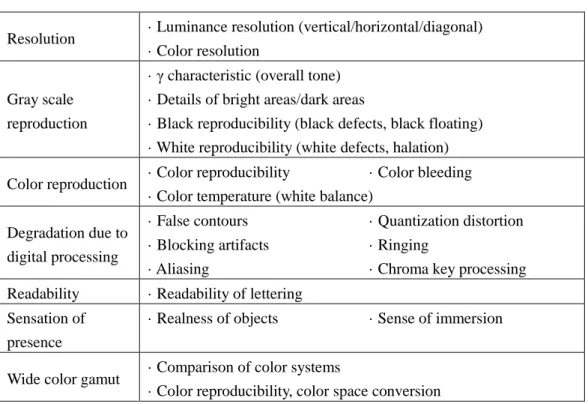
To evaluate image quality and performance efficiently, it is ideal that a few images can cover all the necessary evaluation items. However, if too many evaluation items are included in one image, the image becomes unnatural. Thus, taking into account the evaluation items shown in Table 3-1, the following images were selected with the goal of maintaining a good balance of evaluation items.
Table 3-1 Evaluation item and corresponding keywords
Resolution · Luminance resolution (vertical/horizontal/diagonal)
· Color resolution Gray scale
reproduction
· γ characteristic (overall tone)
· Details of bright areas/dark areas
· Black reproducibility (black defects, black floating)
· White reproducibility (white defects, halation) Color reproduction · Color reproducibility · Color bleeding
· Color temperature (white balance) Degradation due to
digital processing
· False contours · Quantization distortion
· Blocking artifacts · Ringing
· Aliasing · Chroma key processing
Readability · Readability of lettering Sensation of
presence
· Realness of objects · Sense of immersion
Wide color gamut · Comparison of color systems
· Color reproducibility, color space conversion
The names of the standard test images are shown in Table 3-2 along with their primary evaluation items. The remaining pages provide explanation of the respective image contents as well as their shooting data.
− 18 −
Table 3-2 Primary evaluation items for each image
No.
Evaluation item
Image name
Resolution Readability Wide color gamut
1 Books ◎ ◎ ◎
2 MusicBox ◎ ○ ○
3 Moss ○ ○ ◎
4 Kimono ◎ ◎ ○ ◎
5 StainedGlass ○ ◎ ◎ ○ ○ ◎
6 Butterflies ◎ ◎ ◎ ◎
7 ChromaKey ◎ ◎
8 Sea ◎ ○ ○ ◎
9 Flowers ○ ◎ ◎
10
[Sample] Ship ○ ○ ◎
◎ Extremely applicable for evaluation
○ Applicable for evaluation
Colorreproduction
Gray scale reproduction Sensation ofpresence
Degradation due to digital processing
− 19 −
No. 1 Books
File name: u01_Books_8K.r/g/b, u01_Books_4K.r/g/b, u01_Books_2K.tif
Description
A vast number of books are filled in bookshelves spanning the entire wall of a large room. The image is taken such that the books’ spines can be seen. The image can be used to directly evaluate the resolution of the display equipment. Also, because there are spot illuminations in addition to general illumination, the luminosity in each region of the shelves differs. Thus, the image can be also used to evaluate the display equipment’s presentation of dark areas through readability in those areas.
The image is also useful for evaluating the effects of degradation such as blurriness, aliasing, ringing, and quantization distortion, which noticeably appears in the lettering areas.
Shooting data
Location Hitoshi Suzuki Design Office (Shinjuku Ward, Tokyo)
Camera Hasselblad H4D-200MS
Photographing mode Multi-shot (4×)
Lens HC 3.5/50-II
Aperture (F-number) 13
Shutter speed 2 sec
ISO sensitivity 50
Photographed in cooperation with Hitoshi Suzuki Design Office
Chromaticity distribution
− 20 −
No. 2 MusicBox
File name: u02_MusicBox_8K.r/g/b, u02_MusicBox_4K.r/g/b, u02_MusicBox_2K.tif
Description
Various kinds of antique music boxes are placed in a room with wooden floor. The image is taken with illumination coming from the ceiling and the rear wall. Because the image is captured in high resolution, it contains not only the texture of decorative engravings on the music boxes and that of the antique dolls, but even the instruments’ wood grain and fine scratches. Thus you can use this image to test the resolution of the display equipment and compare image quality between 4K/8K and 2K formats. The image is also useful for evaluating black reproducibility using the wood grain in dark areas. Because several letters are engraved on the music boxes, the image can also be used to assess readability.
Shooting data
Location
Orugoru no Chiisana Hakubutsukan (Bunkyo Ward, Tokyo)
Camera Hasselblad H4D-200MS
Photographing mode Multi-shot (4×)
Lens HC 3.5/50-II
Aperture (F-number) 16
Shutter speed 10 sec
ISO sensitivity 50
Photographed in cooperation with Orugoru no Chiisana Hakubutsukan
Chromaticity distribution
− 21 −
No. 3 Moss
File name: u03_Moss_8K.r/g/b, u03_Moss_4K.r/g/b, u03_Moss_2K.tif
Description
This is an image of moss-covered garden. Because the entire composition, which has depth, contains detailed textures, it is well-suited for evaluating the sense of realness and immersion based on the screen size and image resolution. Elements in the image such as the moss’s sharpness and tones, the textures of the rock and tree surfaces, and the edges of leaves and grass are also useful for evaluating degradation such as blurriness, aliasing, ringing, and quantization distortion due to image processing. The veins on the surface of leaves as well as moss and leaves in dark areas such as shades cast by rocks are also well-suited for assessing degradation due to image encoding and other processing.
Shooting data
Location
Hakone Museum of Art (Hakone, Ashigarashimo District, Kanagawa Pref.)
Camera Hasselblad H4D-200MS
Photographing mode Single Shot
Lens HC 3.5/50-II
Aperture (F-number) 16
Shutter speed 1.6 sec
ISO sensitivity 50
Photographed in cooperation with the Hakone Museum of Art
Chromaticity distribution
− 22 −
No. 4 Kimono
File name: u04_Kimono_8K.r/g/b, u04_Kimono_4K.r/g/b, u04_Kimono_2K.tif
Description
This is an image of a kara-ori (“Chinese weave”) kimono (Noh costume) with complex patterns.
The detailed texture of the fabric and the colorful design of the kimono are well-suited for assessing the display equipment’s resolution and evaluating color tones. These features are also useful for examining degradation in image encoding and other image processing. Because the image, which includes a painted pine tree and wood grains of the Noh stage in the background, is also suited for evaluating the sensation of reality, it can be used to compare image quality due to differences in image formats.
Shooting data
Location Yarai Nohgakudo
(Shinjuku Ward, Tokyo)
Camera Hasselblad H4D-200MS
Photographing mode Multi-shot (4×)
Lens HC 2.8/80
Aperture (F-number) 11
Shutter speed 4 sec
ISO sensitivity 50
Photographed in cooperation with Kanzeke-Kyukoukai
Chromaticity distribution
− 23 −
No. 5 StainedGlass
File name: u05_StainedGlass_8K.r/g/b, u05_StaindGlass_4K.r/g/b, u05_StaindGlass.tif
Description
This image captures stained glass that includes detailed parts. Because it also includes detailed textures along with light and dark areas, the image is well-suited for evaluating degradation of details due to image processing and image encoding and corruption of gradation and color tones. It is also useful for reproducing wide-color gamut, including the stained glass’s red, yellow, green, and cyan, and for evaluating the columns’ black reproducibility. Because the image also contains detailed lettering, it can be used to evaluate readability and degradation of characters due to resolution conversion and image processing.
Shooting data
Location Nasu Stained Glass Museum (Nasu, Tochigi Pref.)
Camera Hasselblad H4D-200MS
Photographing mode Multi-shot (4×)
Lens HC 3.5/50-II
Aperture (F-number) 11
Shutter speed 1 sec
ISO sensitivity 50
Photographed in cooperation with Nasu Stained Glass Museum
Chromaticity distribution
− 24 −
No. 6 Butterflies
File name: u06_Butterflies_8K.r/g/b, u06_Butterflies_4K.r/g/b, u06_butterflies_2K.tif
Description
This image of butterfly specimens contains extremely fine textures. The butterflies’ delicate scales are captured by the wide-color gamut, so the image is useful for confirming resolution and the color system. The texture of the scales are well-suited for evaluating viewing conditions, displays, and change in resolution due to image format conversion and other processing. In the background, the butterflies’ shadows and dust are shown at extremely low signal levels. Thus differences in the reproduction conditions of black levels can be seen.
Shooting data
Location
NHK Science & Technical Research Laboratories (Setagaya Ward, Tokyo)
Camera Hasselblad H4D-200MS
Photographing mode Multi-shot (4×)
Lens HC Macro 4/120-II
Aperture (F-number) 13
Shutter speed 1.3 sec
ISO sensitivity 50
Chromaticity distribution
− 25 −
No. 7 ChromaKey
File name: u07_ChromaKey_8K.r/g/b, u07_ChromaKey_4K.r/g/b, u07_ChromaKey_2K.tif
Description
This image captures a model ship, flowers, and a doll against a blue background. It is particularly well-suited for assessing chroma key processing. Because a shallow depth of field is used in photographing the image, various blurry edges are included. The image also contains objects that make chroma key processing difficult, such as the glass filled with water and the doll’s lace. The image is thus useful for evaluating the performance of chroma key processing.
Shooting data
Location
NHK Science & Technical Research Laboratories (Setagaya Ward, Tokyo)
Camera Hasselblad H4D-200MS
Photographing mode Multi-shot (4×)
Lens HC 50-II
Aperture (F-number) 11
Shutter speed 0.7 sec
ISO sensitivity 50
Chromaticity distribution
− 26 −
No. 8 Sea
File name: u08_Sea_8K.r/g/b, u08_Sea_4K.r/g/b, u08_Sea_2K.tif
Description
This image captures the emerald green characteristic of seas with coral reefs. Because almost all colors of the sea lie outside HDTV’s color gamut, the image is well-suited for evaluating wide-color gamut and tones. The portion of the sky is also useful for evaluating gradation.
Shooting data
Location Ikema Island
(Miyako-jima, Okinawa Pref.)
Camera Hasselblad H4D-200MS
Photographing mode Single Shot
Lens HCD 4/28
Aperture (F-number) 11
Shutter speed 1/90
ISO sensitivity 50
Chromaticity distribution
− 27 −
No. 9 Flowers
File name: u09_Flowers_8K.r/g/b, u09_Flowers_4K.r/g/b, u09_Flowers_2K.tif
Description
This is a wide-color-gamut image in which numerous multi-colored flowers are laid out without any gaps. It contains mainly colors outside HDTV’s color gamut. The image is well-suited for evaluating reproduction of wide-color gamut and assessing tones.
Shooting data
Location
NHK Science & Technical Research Laboratories (Setagaya Ward, Tokyo)
Camera Hasselblad H4D-200MS
Photographing mode Multi-shot (4×)
Lens HCD 4/28
Aperture (F-number) 11
Shutter speed 2.5 sec
ISO sensitivity 50
Photographed in cooperation with dosco (flower arrangement)
Chromaticity distribution
− 28 −
No. 10 [Sample] Ship
File name: u10_Ship_8K.r/g/b, u10_Ship_4K.r/g/b, u10_Ship_2K.tif
Description
This is an image of a ship on a sunny day. It can be used to evaluate the sensation of presence based on differences in screen size and image formats between 4K/8K and 2K. The ship’s multiple masts and taut ropes are useful for assessing degradation of image quality, such as blurriness, aliasing, ringing, and quantization distortion, that occurs as a result of image encoding. The image is also well-suited for appraising gradation of the blue sky in the background.
This image is provided as a reference for purposes such as evaluation before obtaining this collection of standard test images. Because it is a single-shot image, be aware of false colors and color bleeding that occurs as a result of a noise reduction filter used to suppress false colors.
Shooting data
Location Nippon Maru Memorial Park (Nishi Ward, Yokohama City)
Camera Hasselblad H4D-200MS
Photographing mode Single Shot
Lens HC 3.5/35
Aperture (F-number) 11
Shutter speed 1/160 sec
ISO sensitivity 50
Photographed in cooperation with Nippon Maru Memorial Park
Chromaticity distribution
− 29 −
Ultra-High Definition/Wide-Color-Gamut Standard Test Images Reference Manual
First published (in Japanese): May 31, 2014 English translation: Nov. 10, 2014
Production Institute of Image Information and Television Engineers Association of Radio Industries and Businesses