• 検索結果がありません。

in Coupled Chaotic Circuits with Coupling Strength Depending on Number of Links

N/A
N/A
Protected

Academic year: 2021

シェア "in Coupled Chaotic Circuits with Coupling Strength Depending on Number of Links"

Copied!
1
0
0

読み込み中.... (全文を見る)

全文

(1)

令和元年度電気関係学会四国⽀部連合⼤会 講演論⽂集 (2019 新居浜⾼専)

2019 SHIKOKU-SECTION JOINT CONVENTION RECORD OF THE INSTITUTES OF ELECTRICAL AND RELATED ENGINEERS (NIIHAMA)

1-11

11

Synchronization Phenomena

in Coupled Chaotic Circuits with Coupling Strength Depending on Number of Links

Kyohei FUJII Yoko UWATE Yoshifumi NISHIO ( Tokushima University)

1. Introduction

In our living life, complex network can be seen in vari- ous fields. Synchronization phenomena observed in complex network have been investigated by many researchers. There are various investigations of synchronization using chaotic circuits.

In this study, we focus on indirect connection and cou- pling strength of coupled chaotic circuit network. Indirect coupling refers to a connection through multiple circuits.

We set coupling strength depending the number of links.

The network has scale free property.

2. System model

The chaotic circuit model is shown in Fig. 1. Figure 2 is network to used in this study. The point which constitute the network is called node and the lines connecting nodes are called links. Nodes having many links are called hubs.

Figure 1: Circuit model. Figure 2: Network model.

Normalized circuit equations of the coupled chaotic cir- cuits are as follows:

 

 

 

 

 

 

 

  dx = z

n

, dy

= αγy

n

αf(y

n

z

n

) αδ

nm

m∈Sn

(y

n

y

m

), dz

= f(y

n

z

n

) x

n

.

(1)

In this equation, δ denotes the coupling strength. S

n

is a set of nodes which are connected to CCn. We define synchronization as Eq. (2). Synchronization rate is ratio of number of synchronization to all calculate point.

| y

n

y

m

| < 0.03 (n, m = 1, 2, · · · , 20) (2) We decide coupling strength value based on the difference of links. The value of coupling strength is determined by degree of the node using Eq. (3).

δ

nm

= 1.0

1.0 + u (3)

We set that u is difference of degree between two nodes.

3. Simulation results

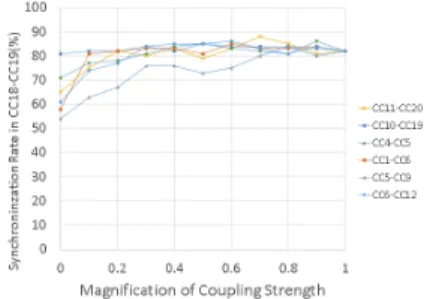
We investigate synchronization of CC18-CC19 when we change each coupling strength. Some link is multiplied mag- nification. We confirm synchronization when other links change synchronization of CC18-CC19. This link basically has about 80% synchronization rate. When synchronization rate reaches 50% to 70%, we judge that synchronization is changed. In Fig. 3, we represent some links. There are various types of these links. We choose indirect link, links with indirect and strong coupling strength, links far from CC18-CC19.

Figure 3: Synchronization rate of chosen links.

When some links of coupling strength are extremely weak, synchronization of CC18-CC19 is weakened. Next, we calculate magnification one by one for all links and in- vestigate synchronization rate. Figure 4, we checked judged links.

Figure 4: Judged links in network.

In this result, when some links open or extremely weaken the coupling strength, synchronization of far links is weaken.

4. Conclusion

In this study, we have investigated the influence of indi- rectry coupling by using a scale-free coupled chaotic net- work with changing the couplings strength. We com- pare some synchronization when the coupling strength was changed some values.

In this result, we found that the strength of synchroniza-

tion is different even with the same coupling strength. We

could not clarify the reason in this study. We must com-

pare this result with other result. Next, we focus other links

which have similar terms and simulate in the same way.

Figure 1: Circuit model. Figure 2: Network model.

参照

関連したドキュメント

In Section 4 we present conditions upon the size of the uncertainties appearing in a flexible system of linear equations that guarantee that an admissible solution is produced

Here we are interested in studying the weakly coupled system ( 1. 1 ) in the critical case. In particular we want to find solutions which concentrate in some points of in the sense

For this reason, as described in [38], to achieve low cost and easy implementation, it is significant to investigate how the drive and response networks are synchronized by pinning

Therefore, motivated by the impact of topological structures and the delays on the dynamics of the networks, this paper mainly focuses on the effect of delays on inner

While Theorem 1.1 illustrates how variable delay can complicate solution behav- ior, we emphasize that the feedback function f in Theorem 1.1 is only nonincreasing, rather than

Ntouyas; Existence results for a coupled system of Caputo type sequen- tial fractional differential equations with nonlocal integral boundary conditions, Appl.. Alsaedi; On a

As an application, in Section 5 we will use the former mirror coupling to give a unifying proof of Chavel’s conjecture on the domain monotonicity of the Neumann heat kernel for

Our result im- proves the upper bound on the number of BSDR’s with minimal weight stated by Grabner and Heuberger in On the number of optimal base 2 representations,