INVITED PAPER
Special Section on Information and Communication System SecurityAn Overview of Security and Privacy Issues for Internet of Things
Heung Youl YOUM†a),Nonmember
SUMMARY The Internet of Things (IoT) is defined as a global infras- tructure for the Information Society, enabling advanced services by inter- connecting (physical and virtual) things based on, existing and evolving, interoperable information and communication technologies by ITU-T. Data may be communicated in low-power and lossy environments, which causes complicated security issues. Furthermore, concerns are raised over access of personally identifiable information pertaining to IoT devices, network and platforms. Security and privacy concerns have been main barriers to implement IoT, which needs to be resolved appropriate security and pri- vacy measures. This paper describes security threats and privacy concerns of IoT, surveys current studies related to IoT and identifies the various re- quirements and solutions to address these security threats and privacy con- cerns. In addition, this paper also focuses on major global standardiza- tion activities for security and privacy of Internet of Things. Furthermore, future directions and strategies of international standardization for the Internet of Thing’s security and privacy issues will be given. This paper provides guidelines to assist in suggesting the development and standard- ization strategies forward to allow a massive deployment of IoT systems in real world.
key words: security, privacy, threats, new work item, internet of things, IEEE 802.15, standardization direction
1. Introduction
The internet of things (IoT) provides a feasible tool to fa- cilitate the vision of future Internet, where physical devices, vehicles (such as “connected devices” and “smart devices”), buildings and other items are interworked, which are em- bedded with electronics, software, sensors, actuators, and network connectivity that enable these objects to collect and exchange data. The Gartner estimated that the market for Internet of Things (IoT) devices is exploded and nearly 21 billion devices will be connected to the Internet by 2020[1].
With the increasing number of devices, security and pri- vacy concerns are also going to increase significantly. A study by HP reveals that 70% of the most popular Internet of Things (IoT) devices contain serious vulnerabilities[2].
The 5 stages of IoT device lifecycle are identified in[3]: de- sign and development, testing and debugging, deployment, management, and decommissioning of IoT devices, which need to be considered when security requirements are de- rived. Security and privacy should not be considered as an add-on to IoT devices later, but rather as an integral part to the IoT device’s reliable functioning throughout IoT device
Manuscript received December 19, 2016.
Manuscript revised January 27, 2017.
Manuscript publicized May 18, 2017.
†The author is with the Department of Information Security Engineering, Soonchunhyang University, Korea.
a) E-mail: [email protected] DOI: 10.1587/transinf.2016ICI0001
lifecycle.
There have been several surveys and studies regard- ing the security issues for IoT during about past 5 years.
Context aware computing research efforts are analyzed and evaluated to understand how the challenges in the field of context-aware computing have been tackled in desktop, web, mobile, sensor networks, and pervasive computing paradigms[4]. Capabilities are introduced to identify and connect worldwide physical objects into a unified system, and the security threats and privacy concerns of IoT are sum- marized[5]. Extensive analysis, as well as open research is- sues, on security protocols and mechanisms related to IoT is provided[6]. It also analyzes how existing approaches ensure fundamental security requirements and protect com- munications on the IoT, together with the open challenges and strategies for future research work in the area. Lifecy- cle of things and threats and their countermeasures are pre- sented[7]. A survey of all the security issues existing in the Internet of Things (IoT) along with an analysis of the pri- vacy issues are conducted[8]. A survey of the state-of-the- art in Intrusion Detection Systems (IDSs) that are proposed for Wireless Sensor Networks is provided[9].
Our paper differs from the previous surveys mentioned above in many ways. Our survey focuses on studies related to standardization activities and analyzing practical studies and works, including analyzing the existing security proto- cols stacks and security architecture. Our paper has con- sidered all survey described above to address standardiza- tion aspects. There are several Standards Developing Or- ganizations (SDOs) working for IoT security and privacy, such as ITU-T[10], ISO/IEC SC27[11], IEEE SA[12]and IETF[13]. Major international standardization work has been extensively evaluated in order to propose future stan- dardization directions to these organizations. Our paper also focuses on all related issues to propose future international standardization’s directions.
The rest of the paper is organized as follows: In Sect. 2, we identify the definition of IoT, relationship between sen- sor network and IoT, security threats and requirements, pri- vacy threats and security capabilities for IoT. In Sect. 3, ex- isting protocols applicable to IoT communications and se- curity characteristics of the protocols applicable to IoT are addressed and evaluated. In Sect. 4, we discuss new topic for IoT standardization as well as proposed future directions of international standardization activities related to IoT secu- rity. Finally, in Sect. 5, we conclude this paper with present- ing the relationship between new research topics and new Copyright c2017 The Institute of Electronics, Information and Communication Engineers
work items for standardization.
2. IoT Overview and Background
2.1 Application Areas of Internet of Things
The 10 most popular IoT applications are summarized by [14]: applications for smart home, wearables, smart city, smart grids, Industrial internet, connected car, connected health (digital health/telehealth/telemedicine), smart retail, smart supply chain and smart farming. Security and pri- vacy issues should be addressed to operate these systems and platforms.
2.2 What is the Internet of Things?
IoT has gained significant attention in industries as well as academia during the past decade. The term ‘Internet of Things’ was firstly coined by Kevin Ashton[15]in 1998.
He has mentioned “The Internet of Things has the potential to change the world, just as the Internet did”.
Terms definition of Internet of thing varies between dif- ferent contexts. Table 1 summarizes definitions of Internet of things by different relevant organizations. The definition provided by ITU-T Y.2060[20] is accepted for this paper, because this definition is agreed by the De jure standardiza- tion development organization.
2.3 Security Architectures of Internet of Things
Figure 1 presents a generic IoT topology[28], which com- prises sensor-equipped edge devices on a wired or wireless network sending data via a gateway to a public or private cloud. Aspects of the topology will vary broadly from ap- plication to application; for example, in some cases the gate- way may be implemented as a part of the IoT device. De- vices based on such topologies may be built from the ground
Table 1 Definition of internet of things
up to leverage IoT or may be legacy devices that will have IoT capabilities added post-deployment.
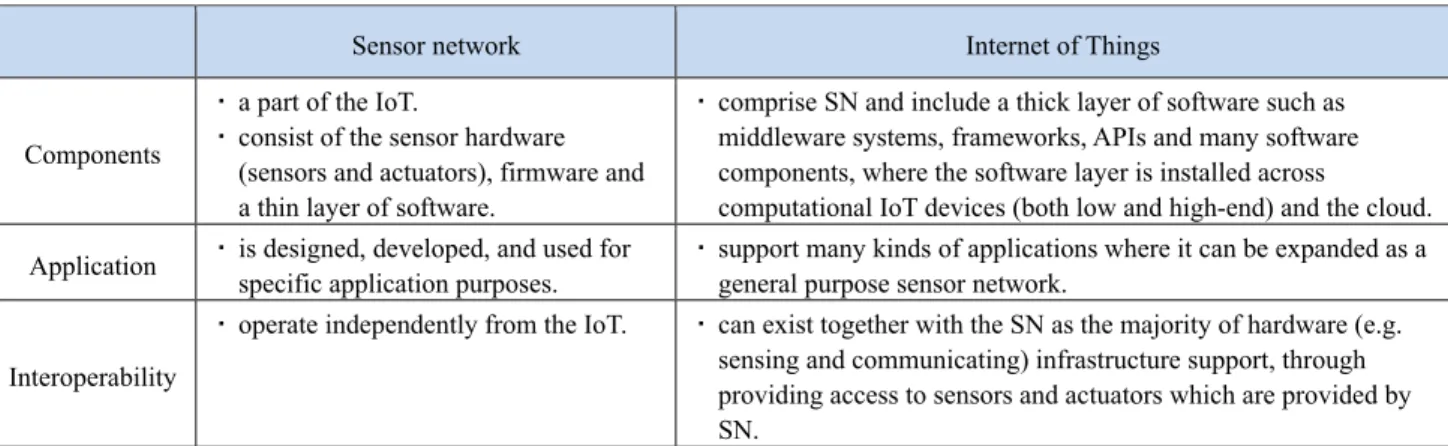
2.4 Relationship between Sensor Network and IoT In a sensor network, data is generated by either a low-end sensor nodes or high-end sensor nodes. Then, data is col- lected by mobile and static sink nodes. The sink nodes send the data to low-end computational devices. These devices perform a certain amount of processing on the sensor data.
Then, the data is sent to high-end computational devices to be processed further. Finally, data reaches the cloud where it will be shared, stored, and processed significantly.
The Ubiquitous Sensor Network (USN) is defined as an intelligent information infrastructure of advanced e-Life society. It delivers user-oriented information and pro- vides knowledge services to anyone anytime, anywhere and wherein information and knowledge are developed using context awareness by detecting, storing, processing, and integrating the situational and environmental information gathered from sensor tags and/or sensor nodes[29]affixed to anything described in Recommendation ITU-T X.1311[30].
It describes the security threats to and security requirements of the ubiquitous sensor network. The sensor networks (SN), a part of USN, are the most essential components of the IoT. They include sensors and actuators. The sensors collect data which then is processed and decisions are made.
Fig. 1 Generic IoT topology[21]
Finally, actuators make the decided actions. Relationship between sensor networks and Internet of Things is presented as shown in Fig. 2[4]. The comparison between sensor net- work and Internet of Things is described in Table 2.
2.5 ITU-T SG17’s Activities of Internet of Things Secu- rity
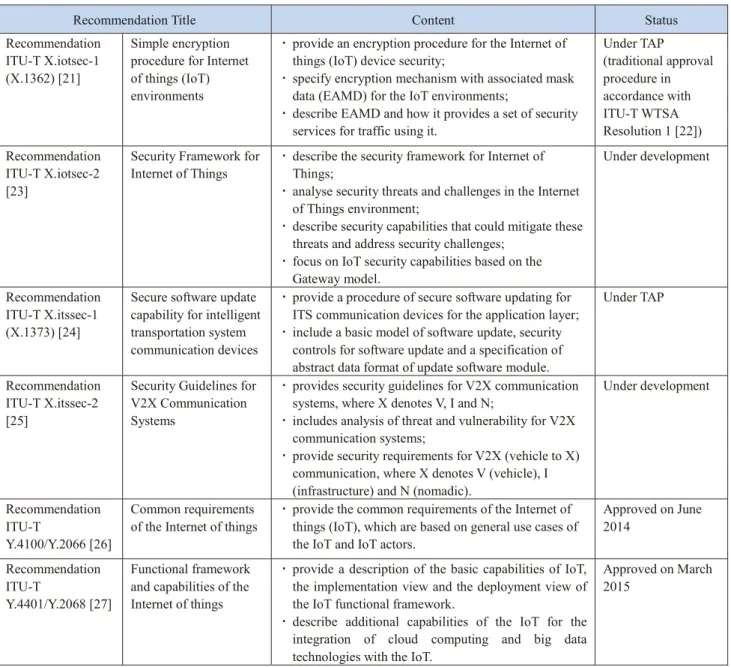
Table 3 provides current standardization activities of ITU-T SG17 (Study Group 17) on security[31]and SG20 on IoT and its applications including smart cities and com- munities[32]in the area of security and privacy of Internet of things. It is noted that ITU-T SG17 addresses all secu- rity issues and ITU-T SG20 addresses all issues related to IoT. So, there is a need for coordinating work related to IoT between two SGs.
2.6 Worst Security Scenarios for IoT
Seven worst scenarios[33]are described in terms of secu- rity in typical applications, such as home office, snapchat service in the smartphone, healthcare, satellite communica- tions, transport safety, connected car and printer firmware.
For example, attackers exploit smartphone through applica- tions, photos, videos, social media, and GPS. Thousands of photos and videos from the Snapchat service could be up- loaded online, which allows people to access to the site and to store photos within seconds of being viewed as shown in
Fig. 2 Relationship between Sensor Network and IoT
Table 2 Comparison between sensor network and Internet of Things[4]
Table 4.
The description of increasing challenges in privacy[8]
is provided: In the IoT environment, IoT devices such as sensors are expected to collect more information about users (i.e. people) in all aspects. This includes both physical and conceptual data, such as location, preferences, calendar data, and medical information to name a few. As a result, utmost care needs to be taken when collecting, modelling, reasoning, and with persistent storage. Security and privacy need to be addressed at different levels in the IoT. At the lowest level, the hardware layer should ensure security and privacy during collecting and temporary storage within the device. Secure protocols need to ensure communication is well protected. Once the data is received, application level protection needs to be in placed to monitor and control who- ever can see or use context and so on.
A survey presented in[34]identifies that only 22% of respondents agreed that the benefits of smart devices out- weighed any privacy concerns. Furthermore, 83% of re- spondents were concerned about the idea of personal in- formation being collected by smart devices and 87% are concerned about the type of personal information collected through smart devices.
2.7 Security Threats for IoT Things
As seen in Table 5, there are various threats that can ex- ist through the lifecycle of a thing: manufacturing, instal- lation/commissioning and operation, which are identified in [35]as follows:
• Cloning of things: During the manufacturing process of a thing, an untrusted manufacturer can easily clone the physical characteristics, firmware/software, or se- curity configuration of the thing.
• Malicious substitutions of things: During the instal- lation of a thing, a genuine thing may be substituted with a similar variant of lower quality without being detected.
• Eavesdropping attack: During the commissioning of a thing into a network, it may be possible to eaves- dropping on keying materials, security parameters, or
Table 3 ITU-T standardization activities in the area of IoT
configuration settings, if they are exchanged in the cleartext using a wireless medium. After obtaining the keying material, the attacker might be able to recover the secret keys established between the communicat- ing entities, thereby compromising the authenticity and confidentiality of the communication channel, as well as the authenticity of commands and other traffic ex- changed over this communication channel. When the network is in operation, communication between de- vices may be eavesdropped upon if the communication channel is not sufficiently protected or in the event of session key compromise due to a long period of usage without key renewal or updates.
• Man-in-the-middle attack: The commissioning phase may also be vulnerable to man-in-the-middle attacks, e.g., when keying material between communicating en- tities is exchanged in the cleartext and the security of
the key establishment protocol depends on the tacit as- sumption that no third party is able to eavesdrop on or sit in between the two communicating entities during the execution of this protocol.
• Firmware Replacement attack: When a thing is in operation or maintenance phase, its firmware or soft- ware may be updated to allow for new functionality or new features. An attacker may be able to exploit such a firmware upgrade by replacing the things with mali- cious software, thereby influencing the operational be- havior of the thing.
• Extraction of security parameters: A thing deployed in the ambient environment (such as sensors, actuators, etc.) is usually physically unprotected and could easily be captured by an attacker. Such an attacker may then attempt to extract security information such as keys (e.g., device’s key, private-key, group key) from this
Table 4 7 scary security scenarios[33]
Table 5 Security threats of IoT devices during lifecycle of things[35]
thing or try and re-program it to serve his needs.
• Routing attack: Routing information in IoT can be spoofed, altered, or replayed, in order to create rout- ing loops, attract/repel network traffic, extend/shorten source routes, etc. Other relevant routing attacks in- clude the followings[8]: 1) Sinkhole attack (or black- hole attack), where an attacker declares himself to have a high-quality route/path to the base station, thus allow- ing him to do anything to all packets passing through it, 2) Selective forwarding, where an attacker may selectively forward packets or simply drop a packet, 3) Wormhole attack, where an attacker may record packets at one location in the network and tunnel them to another location, thereby influencing perceived network behavior and potentially distorting statistics, thus greatly impacting the functionality of routing, and 4) Sybil attack, whereby an attacker presents multiple identities to other things in the network.
• Privacy threat: The typical privacy threats to the users may include the tracking of a thing’s location and us- age. An attacker may infer information based on data gathered about individual things, thus deducing behav- ioral patterns of the user of interest to him.
• Denial-of-Service attack (DoS): Things may have
tight memory and limited computation capability; they are thus vulnerable to resource exhaustion attack, for example DDoS (distributed denial of services). Attack- ers can continuously send requests to the specific things so as to deplete their resources.
2.8 Privacy Threats for IoT Devices
Privacy is defined as “the right of an entity (normally a per- son), acting in its own behalf, to determine the degree to which it will interact with its environment, including the de- gree to which the entity is willing to share its personal infor- mation with others”[47].
Privacy should be protected for data in the device, at rest, in transit and at processing [Kumar et al., 5]. Table 6 describes privacy threats as well as solution to address these privacy threats.
2.9 Threats for Applications and Platforms in IoT The OWASP (Open Web Application Security Project)[48]
provides security vulnerabilities for applications/platforms in the Internet of Things shown in Table 7. Various
Table 6 Privacy threats in the Internet of Things[5]
Table 7 Security vulnerabilities for applications/platforms in the Internet of Things[38]
types of threats should be addressed by appropriate security
measures. 2.10 Security Requirements for IoT
The 6 security requirements of the Internet of things (IoT)
are provided in[49]as follows:
• Communication security: Secure, trusted and privacy protected communication capability is required, so that unauthorized access to the content of data can be pro- hibited, integrity of data can be guaranteed and privacy- related content of data can be protected during data transmission or transfer in IoT.
• Data management security: Secure, trusted and pri- vacy protected data management capability is required, so that unauthorized access to the content of data can be prohibited, integrity of data can be guaranteed and privacy-related content of data can be protected when storing or processing data in IoT.
• Service provision security: Secure, trusted and pri- vacy protected service provision capability is required, so that unauthorized access to service and fraudulent service provision can be prohibited and privacy infor- mation related to IoT users can be protected.
• Integration of security policies and techniques: The ability to integrate different security policies and tech- niques is required, so as to ensure a consistent security control over the variety of devices and user networks in IoT.
• Mutual authentication and authorization: Before a device (or an IoT user) can access the IoT, mutual au- thentication and authorization between the device (or the IoT user) and IoT is required to be performed ac- cording to predefined security policies.
• Security audit: Security audit is required to be sup- ported in IoT. Any data access or attempt to access IoT applications are required to be fully transparent, trace- able and reproducible according to appropriate regula- tion and laws.
2.11 Basic Security Functions for IoT Devices
Similarly,[28]identifies 5 basic security functions for IoT devices: secure booting, access control, device authentica- tion, firewalling and IPS, updates and patches as follow:
• Secure booting: When IoT device being booted, the authenticity and integrity of the software and applica- tions on the device is verified using cryptographically generated digital signatures.
• Access control: Appropriate access controls should limit the privileges of device components and applica- tions so they access only the resources they need to do their jobs.
• Device authentication: When the device being plugged into the network, it should authenticate itself prior to receiving or transmitting data. Just as user au- thentication allows a user to access a corporate network based on user name and password, device authentica- tion allows a device to access a network based on a similar set of credentials stored in a secure storage area.
• Firewalling and IPS (intrusion protection system):
The device also needs a firewall or deep packet in- spection capability to control traffic that is destined to terminate at the device.
• Updates and patches: Once the device is in operation, it will start receiving hot patches and software updates.
Operators need to roll out patches, and devices need to authenticate them, in a way that does not consume bandwidth or impair the functional safety of the device.
In addition, basic security capabilities for IoT security stan- dards that IoT system should support are identified by[57]:
secure booting, authentication, secure communication, data protection, firewall, intrusion detection, event reporting, re- mote command audit, policy management and hardware in- tegration, which are very similar to those described in[28].
3. Existing Security Protocols Applicable to IoT This section describes some prominent existing protocols which are applicable to IoT and security characteristics of existing protocols.
3.1 Existing Protocols Stacks Applicable to IoT
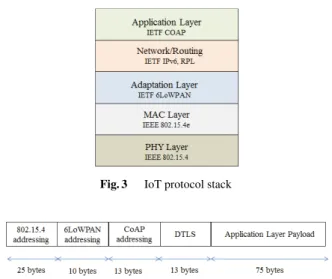
The communication protocols available or being designed by the IEEE and IETF currently enable a standardized pro- tocol stack in[58]and illustrated in Fig. 3, which describes the protocol stacks[59]applicable to IoT. Figure 4 presents payload space with DTLS on 6LoWPAN environment.
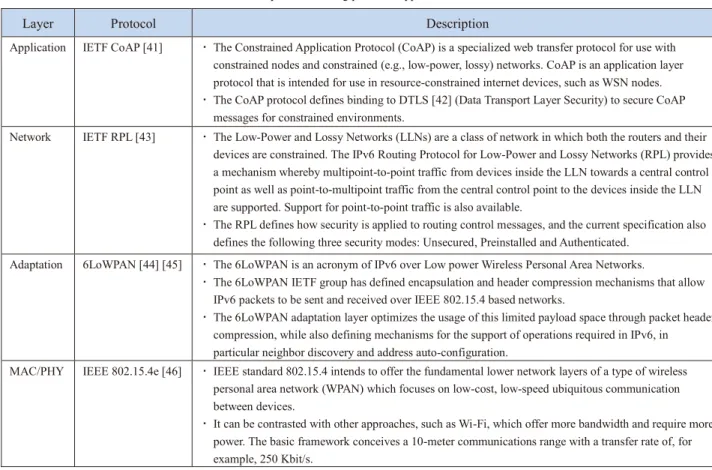
Table 8 provides description of existing protocols ap- plicable IoT. The current IEEE 802.15.4 PHY layer(s) spec- ifies the physical layer and media access control for low-rate wireless personal area networks (LR-WPANs). Given that a large amount of IoT applications requires only a few bits to be sent, a standardized PHY layer should be considered in order to allow for ultra-low rate transmissions over very narrow frequency bands. IEEE802.15.4e standard is very appropriate for a protocol stack for IoT because it is lat- est generation of highly reliable and low-power MAC pro-
Fig. 3 IoT protocol stack
Fig. 4 Payload space with DTLS on 6LoWPAN environment
Table 8 Description of existing protocols applicable IoT environments
tocol. From a networking perspective, the IETF 6LoWPAN (IPv6 over Low power Wireless Personal Area Networks.) protocol family defines encapsulation and header compres- sion mechanisms that allow IPv6 packets to be sent and received over IEEE 802.15.4 based networks, which have been instrumental in connecting the low power radios to the Internet. It is the work of IETF ROLL allowed suitable routing protocols to achieve universal connectivity. From the transport layer and an application perspective, the IETF CoAP (Constrained Application Protocol) family has been instrumental in ensuring that application layers. The CoAP is an application layer protocol that is intended for use in resource-constrained internet devices over low-power em- bedded networks.
3.2 Security Characteristics for Existing Protocol Stacks Applicable to IoT
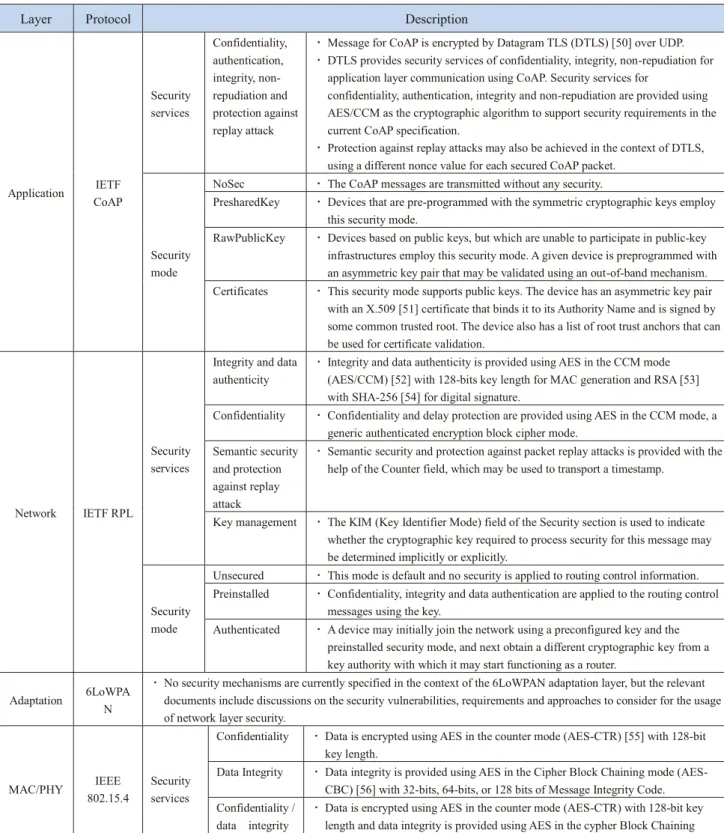
This clause describes security characteristics in existing pro- tocols applicable to IoT as shown in Table 9 which is sum- marized[6]. These characteristics should be considered when security requirements are derived as a standard.
4. Work Items and Proposed Future Directions for In- ternational Standardization Activities
This clause describes security challenges and future topics that are needed for the international standardization.
4.1 Security Challenges for IoT
The Internet of Things (IoT) may introduce new secu- rity challenges in cryptographic security, credentialing, and identity management[65] from the standardization’s point of view as described in Table 10.
4.2 Role of IoT Security Standards
A role of IoT security standards described in[57]includes protection for the device by ensuring only authentic code from a trusted source is allowed to run on the device, pro- tection for data by providing secure communication, data- at-rest protection and secure decommissioning of devices, awareness of attacks by including security monitoring, in- trusion detection and integration with security management systems, security management enabling updates to security policies in response to emerging threats, and device to de- vice authentication ensuring that IoT devices are only com- municating with other known, trusted entities.
4.3 Standardization Items by ISO/IEC JTC 1/SC 27 The SC 27 Study Group on Security and Privacy for Internet of Things (IoT) conducted gap analysis and iden- tified 8 gaps which need to be studied with the aim of International Standards at the April 2016 Tampa SC27 meet- ing as follows[66],[67]:
Table 9 Security characteristics in existing protocols applicable to IoT
• Gateway Security: The ISO/IEC 27033-4[68] ad- dresses gateway security for IoT in part, so, there is a room for improvement of this standard to fit it into IoT environment. It can be implemented with a firewall or deep packet inspection capability as well as monitoring functions.
• Network Function Virtualization security: It comprises NFV (network function virtualization)[69]and SDN (software defined network)[70] technology, where SDN is defined as the physical separation of the net- work control plane from the forwarding plane, and where a control plane controls several devices.
Table 10 Major challenges from standardization’s point of view[65]
• Management and measurement of IoT security: New management and measurement mechanisms to reflect IoT environments may be required to address the net- work technologies of the IoT such as SDN/NFV.
• Open Source assurance and security: Open software is a major part of the emerging, new technologies for the IoT, such as SDN (Open Flow[71]), NFV (Open Stack[72]) and Big data (Hadoop[73]). Open source may be used to implement software and application in IoT. Vulnerabilities in the Open Source should be man- aged in an appropriate manner.
• IoT Risk Assessment techniques: There is a room for improving current risk assessment process[74]due to data processing of IoT devices, cascading impacts and non-deterministic outcomes.
• Privacy and Big Data: Data collected in the IoT en- vironment may contain a subset of personally Identi- fiable Information (PII). The PII is defined as any in-
Table 11 Allocation of security work related to IoT/SCC in ITU-T[86]
formation that (a) can be used to identify the PII prin- cipal to whom such information relates, or (b) is or might be directly or indirectly linked to a PII princi- pal in ISO.IEC 29100[75]. There may be a room for updating the ISO/IEC. 29100 (privacy framework) to reflect new requirements in the IoT environments.
• Application Security Guidance for IoT: ISO/IEC 27034[76] offers guidance on information security to those specifying, designing and programming or procuring, implementing and using application sys- tems. There is a room for improvement of these standards to address new challenges in implementing software for IoT.
• IoT Incident Response Guidance: There may be a room for updating ISO/IEC 27035-2[77].
As a result of this activity, two Study Periods were initiated by ISO/IEC SC27/WG 4 and WG5 at the April 2016 Tampa SC27 meeting:
• SC 27/WG 4 Study period in the area of Guidelines for
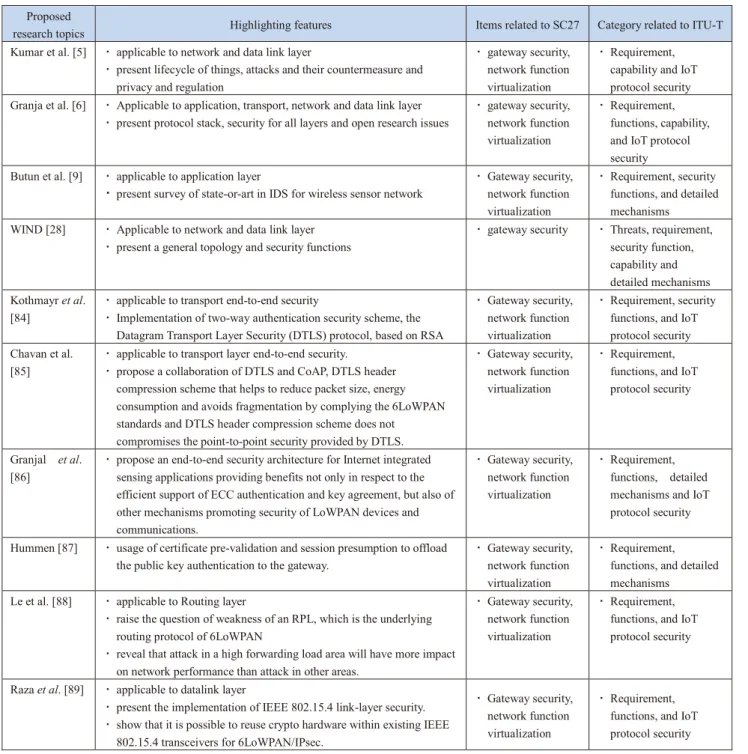
Table 12 Relationship between some research topics and potential work items by ISO/IEC SC27 and ITU-T
security in Internet of Things (IoT) for 6 months[78]
• SC 27/WG 5 Study Period on Guidelines for privacy in Internet of Things (IoT) for 12 months[79]
Those two Study Periods which are currently underway in SC 27 may explore new work items in the area of IoT secu- rity and privacy at the October 2016 Abu Dhabi SC27 meet- ing or in the future.
4.4 Future Topics for IoT/SCC Work in ITU-T
The ITU TSAG agreed on allocation of security work be-
tween ITU-T SG17 and SG20, which is related to IoT/SCC (Internet of Things/Smart Sustainable Cities) at its July 2016 meeting as shown in Table 11[80]. In this Table, common project defined as a means that both groups may participate in a certain activity and principal means that final decision on New Work Items and/or in approving Recommendations is made by the principal Study Group. Two SGs continue their work according to this decision by ITU-T TSAG. The Recommendation ITU-T X.iotsec-2[24]describes the secu- rity framework and security capabilities for IoT systems.
They include capabilities for authentication, key manage-
ment, authorization, audit, integration of various security policies, software module updates, vulnerabilities scanning, and monitoring. The consensus of ITU-T SG17 is to de- velop the further detailed security mechanisms based on the capabilities described ITU-T X.iotsec-2 in the future.
4.5 Future Directions for International Standardization The collaboration between relevant bodies, for example ITU-T, ISO and IEC, is very important to avoid any du- plication of efforts, diverse standards and unnecessary ex- pense for the security experts that need to participate in ac- tivities of relevant bodies. The collaboration team or joint coordination activities for example ITU-T Joint Coordina- tion Activity (JCA)[81]should be encouraged to establish for coordinated activities of all relevant standardization bod- ies related to IoT. The primary role of JCA is to harmonize activities in terms of subject matter, time-frames for meet- ings and publication goals. The first direction is to establish the Joint Coordination Activity (JCA) on IoT security and privacy with the leadership of ITU-T SG17. The member of this JCA should include at least ISO/IEC JTC 1/SC 27, IETF, GSMA[82], IEEE and ITU-T. Common text defined in[83]on the same topic between ITU-T SG17 and ISO/IEC JTC 1/SC 27 should be encouraged to be developed between two bodies, which is a standards developed both groups with exactly same text and different numbers.
Taking into account that two major bodies such as ITU-T and ISO/IEC JTC 1/SC 27 have already identified gaps (potential items) and there is a need for developing various kinds of new standards for application areas and de- tailed mechanisms of IoT and SCC, it is necessary to de- velop new standards about these gaps and detailed security mechanisms which are identified by both groups. The last direction is to enhance the existing collaboration mecha- nisms among the relevant bodies in accordance with[90].
The typical example of these collaboration mechanisms should include the liaison relationship, joint workshop, co- located meeting and exchange of relevant documents.
5. Conclusion
International standardization developing groups are striving to develop standards to address security and privacy issues for IoT. IoT has entered a phase of mass usage and it could not acceptable that 70% of IoT devices have major security vulnerabilities. It would take some time for IoT security standards to reach at a level where customers can feel con- fident in the security of a device based on a security rating, but it is believed that it is time to start this work to meet ur- gent market needs. As security may be an enabling factor of many of major IoT applications, detailed security mech- anisms and protocols including organizational management issues to secure communications are fundamental.
In the case where IoT devices would be used for dozens of years without upgrade or update, it may be impossible to protect IoT devices itself against new upcoming threats
or vulnerabilities. These security measures to prevent these new threats should be employed in the IoT devices. In ad- dition, security aspects are considered throughout the stan- dards development process. Since IoT device users have usually no knowledge of security technology, their default security setting should be employed to address this chal- lenge. It is noted that many security holes are created during developing, since a developer is not so interested in secu- rity compared with developer of general-purpose computer.
An education/training for development engineers becomes important.
In the paper, we conduct an exhaustive analysis on the security threats, protocols and mechanisms available to pro- tect communications about IoT from standardization’s point of view. We also propose relationship between some re- search topics and potential work items by ISO/IEC SC27 and ITU-T in Table 12, the relationship between research topics and standardization topics by ISO/IEC SC27 and ITU-T SG17 are presented, together with its related layer for further work by the international standardization bodies.
In conclusion, it is believed this paper may provide an important contribution to the standardization community, by providing all issues and solutions for international standard- ization activities, helping readers interested in developing new solutions address security and privacy in the context of communication protocols for the IoT.
References
[1] N. Eddy, “Gartner: 21 Billion IoT devices to invade by 2020,” Infor- mationWeek, Nov. 2015. Available at http://www.informationweek.
com/mobile/mobile-devices/gartner-21-billion-iot-devices-to- invade-by-2020/d/d-id/1323081
[2] E. Kovacs, “70% of Internet Of Things Devices Reveal Vulnerabili- ties,” Hewlett Packard, July 2014. Available at http://www8.hp.com/ us/en/hp-news/press-release.html?id=1744676#.V-e1I7Wa1fA [3] WIND White Paper, Managing the IoT Lifecycle From Design
Through End-of-Life, Nov. 2015.
[4] C. Perera, A. Zaslavsky, P. Christen, and D. Georgakopoulos, “Con- text Aware Computing for The Internet of Things: A Survey,” IEEE, vol.16, no.1, pp.414–454, 2014.
[5] J. Sathish Kumar and D.R. Patel, “A Survey on Internet of Things:
Security and Privacy Issues,” International Journal of Computer Ap- plications, vol.90, no.11, pp.20–26, March 2014.
[6] J. Granjal, E. Monteiro, and J.S. Silva, “Security for the Internet of Things: A Survey of Existing Protocols and Open Research Is- sues,” IEEE Commun. Surveys Tuts., vol.17, no.3, pp.1294–1312, Jan. 2015.
[7] C. Lu, “An Overview of Privacy and Security Issues in the Internet of Things,” Springer, May 2014. Available at http://www.cse.wustl.
edu/∼jain/cse574-14/ftp/security.pdf
[8] T. Borgohain, U. Kumar, and S. Sanyal, “Survey of Security and Privacy Issues of Internet of Things,” Jan. 2015. available at https://www.researchgate.net/publication/270763270 Survey of Security and Privacy Issues of Internet of Things
[9] I. Butun, S.D. Morgera, and R. Sankar, “A Survey of Intrusion De- tection Systems in Wireless Sensor Networks,” IEEE Commun. Sur- veys Tuts., vol.16, no.1, pp.266–282, 2014.
[10] ITU Telecommunication Standardization Sector (ITU-T), http://www.itu.int/en/ITU-T/Pages/default.aspx
[11] ISO/IEC JTC 1/SC 27 IT Security techniques, http://www.din.de/ en/meta/jtc1sc27
[12] IEEE SA (standards association), http://standards.ieee.org/ [13] Internet Engineering Task Force (IETF), https://www.ietf.org/ [14] K.L. Lueth, “The 10 most popular Internet of Things applications
right now,” IoT Analytics, Feb. 2015. available at https://iot- analytics.com/10-internet-of-things-applications/
[15] K. Ashton, “That ‘internet of things’ thing in the real world, things matter more than ideas,” RFID Journal, June 2009, http://www.
rfidjournal.com/article/print/4986
[16] Wikipedia, https://en.wikipedia.org/wiki/Internet of things [17] GSMA, IoT Security Guidelines Overview Document, version 1.0,
Feb. 2016.
[18] P. Guillemin and P. Friess, “Internet of things strategic research roadmap,” The Cluster of European Research Projects, Tech. Rep., Sept. 2009, available at http://www.internet-of-things-research.eu/ pdf/IoT Cluster Strategic Research Agenda 2011.pdf
[19] European Commission, “Internet of things in 2020 road map for the future,” Working Group RFID of the ETP EPOSS, Tech. Rep., May 2008, available at http://ec.europa.eu/informationsociety/policy/ rfid/documents/iotprague2009.pdf [Accessed on: 2011-06-12].
[20] Recommendation ITU-T Y.2060, Overview of the Internet of things, June 2012.
[21] Recommendation ITU-T X.iotsec-1, Simple encryption procedure for Internet of things (IoT) environments, Sept. 2016.
[22] ITU WTSA-12, Resolution 1 - Rules of procedure of the ITU Telecommunication Standardization Sector, 2012.
[23] Recommendation ITU-T X.iotsec-2, Security Framework for Internet of Things, Sept. 2016.
[24] Recommendation X.itssec-1, Secure software update capability for intelligent transportation system communication devices, Sept.
2016.
[25] Recommendation X.itssec-2, Security Guidelines for V2X Commu- nication Systems, Sept. 2016.
[26] Recommendation ITU-T Y.4100/Y.2066, Common requirements of the Internet of things, June 2014.
[27] Recommendation ITU-T Y.4401/Y.2068, Functional framework and capabilities of the Internet of things, March 2015.
[28] WIND white paper, Security in the Internet of Things: Lessons from the Past for the Connected Future, Jan. 2015.
[29] WIKI sensor node, available at https://en.wikipedia.org/wiki/ Sensor node Recommendation.
[30] ITU-T X.1311, Information technology - Security framework for ubiquitous sensor networks, Feb. 2011.
[31] ITU-T SG17 (Security), http://www.itu.int/en/ITU-T/studygroups/ 2013-2016/17/Pages/default.aspx
[32] ITU-T SG 20 (IoT and its applications including smart cities and communities), available at http://www.itu.int/en/ITU-T/
studygroups/2013-2016/20/Pages/default.aspx
[33] M. Cohodas, “The Internet of Things: 7 Scary Security Scenarios,”
Oct. 2016. (http://www.darkreading.com/perimeter/the-internet-of- things-7-scary-security-scenarios/d/d-id/1316659?image number= 1)
[34] A. Ross, “Privacy In All Things Includes the Internet of Things,”
The online privacy blog, July 2014.
[35] O. Garcia-Morchon, S. Kumar, et al., “Security Considerations in the IP-based Internet of Things,” IETF Internet Draft, Sept. 2013.
http://tools.ietf.org/html/draft-garcia-core-security-06
[36] E. Liu, Z. Liu, and F. Shao, “Digital Rights Management and Ac- cess Control in Multimedia Social Networks,” In Genetic and Evolu- tionary Computing, Springer International Publishing, pp.257–266, 2014.
[37] ISO/IEC 20889, Information technology – Security techniques – Pri- vacy enhancing data de-identification techniques, Oct. 2016.
[38] OWASP Internet of Things Project, (online available at https://www.
owasp.org/index.php/OWASP Internet of Things Project#tab=IoT Vulnerabilities)
[39] S. Turne and T. Polk, Prohibiting Secure Sockets Layer (SSL) Ver- sion 2.0, IETF 6176, March 2011.
[40] T. Dierks and E. Rescorla, “The Transport Layer Security (TLS) Pro- tocol Version 1.2,” RFC 5246, DOI 10.17487/RFC5246, Aug. 2008.
[41] Z. Shelby, K. Hartke, and C. Bormann, “The Constrained Applica- tion Protocol (CoAP),” IETF RFC 7252, June 2014.
[42] E. Rescorla and N. Modadugu, “DTLS: Datagram Transport Layer Security,” IETF RFC 4347, 2006.
[43] T. Winter, Ed. and P. Thubert, Ed., A. Brandt, J. Hui, R. Kelsey, P.
Levis, K. Pister, R. Struik, J.P. Vasseur, and R. Alexander, “RPL:
IPv6 Routing Protocol for Low-Power and Lossy Networks,” IETF RFC 6550, March 2012.
[44] G. Montenegro, N. Kushalnagar, J. Hui, and D. Culler, Transmission of IPv6 Packets Over IEEE 802.15.4 Networks, IETF RFC 4944, 2007.
[45] J. Hui and P. Thubert, Compression Format for IPv6 Datagrams Over IEEE 802.15.4-Based Networks, IETF RFC 6282, 2011.
[46] IEEE Standard for Local and metropolitan area networks—Part 15.4: Low-Rate Wireless Personal Area Networks (LR-WPANs), 2011.
[47] R. Shirey, Internet Security Glossary, Version 2 IETF RFC 4849, Aug. 2007.
[48] Open Web Application Security Project (OWASP), available at https://www.owasp.org/index.php/Main Page
[49] Recommendation ITU-T Y.4100/Y.2066, Common requirements of the Internet of things, June 2016.
[50] E. Rescorla and N. Modadugu, Datagram Transport Layer Security Version 1.2, IETF RFC 6347, Jan. 2012.
[51] Recommendation ITU-T X.509, Information technology - Open Systems Interconnection - The Directory: Public-key and attribute certificate frameworks, Oct. 2012.
[52] D. Whiting, R. Housley, and N. Ferguson, “Counter with CBC-MAC (CCM),” IETF RFC 3610, Sept. 2003.
[53] J. Jonsson and B. Kaliski, Public-Key Cryptography Standards (PKCS) #1: RSA Cryptography Specifications Version 2.1, IETF RFC 3447, Feb. 2003.
[54] D. Eastlake 3rd and T. Hansen, US Secure Hash Algorithms (SHA and HMAC-SHA), IETF 4634, July 2006.
[55] R. Housley, “Using Advanced Encryption Standard (AES) Counter Mode With IPsec Encapsulating Security Payload (ESP),” IETF RFC 3686, Jan. 2004.
[56] S. Frankel, R. Glenn, and S. Kelly, “The AES-CBC Cipher Algo- rithm and Its Use with IPsec,” IETF RFC 3602, Sept. 2003.
[57] A. Grau, IoT Security Standards – Paving the Way for Customer Confidence, IEEE Standard University, Feb. 2016.
[58] M. Palattella, N. Accettura, X. Vilajosana, T. Watteyne, L. Grieco, G. Boggia, and M. Dohler, “Standardized protocol stack for the in- ternet of (important) things,” Proc. IEEE, pp.1–18, 2012.
[59] WIKI protocol stacks, available at https://en.wikipedia.org/wiki/ Protocol stack
[60] B. Kaliski, PKCS #1: RSA Encryption Version 1.5, IETF RFC 2437, March 1998.
[61] E. Rescorla, Diffie-Hellman Key Agreement Method, IETF RFC 2631, June 1999.
[62] National Institute of Standards, FIPS Pub 197, Advanced Encryption Standard (AES), Nov. 2001.
[63] D. McGrew, K. Igoe, and M. Salter, Fundamental Elliptic Curve Cryptography Algorithms, IETF RFC 6090, Feb. 2011.
[64] J. Salowey, A. Choudhury, and D. McGrew, AES Galois Counter Mode (GCM) Cipher Suites for TLS, IETF, RFC 5288, Aug. 2008.
[65] T. Polk and S. Turner, Security Challenges For the Internet Of Things, Feb. 2011, available at https://www.iab.org/wp-content/ IAB-uploads/2011/03/Turner.pdf
[66] ISO/IEC JTC 1/SC 27 N16051, Summary of NB contributions to the SC 27 Study Group on Security and Privacy Issues on Internet of Things (IoT) (in response to SC 27 N15885), March 2016.
[67] ISO/IEC JTC 1/SC 27 N15298, Draft meeting report of SC 27/SG Security and Privacy Issues on IoT, Kuching, Malaysia, 3rd May 2015, June 2015.
[68] ISO/IEC 27033-4:2014, Information technology – Security tech- niques – Network security – Part 4: Securing communications be- tween networks using security gateways
[69] What is NFV – Network Functions Virtualization – Definition?
available at https://www.sdxcentral.com/nfv/definitions/whats-net work-functions-virtualization-nfv/
[70] Software-Defined Networking (SDN) Definition, available at https://www.opennetworking.org/sdn-resources/sdn-definition [71] OpenFlow, available at https://www.opennetworking.org/sdn-
resources/openflow
[72] OpenStack, available at https://openvirtualizationalliance.org/ what-kvm/openstack
[73] What Is Apache Hadoop?, available at http://hadoop.apache.org/ [74] ISO/IEC 27005:2011, Information technology – Security techniques
– Information security risk management
[75] ISO/IEC 29100:2011, Information technology – Security techniques – Privacy framework
[76] ISO/IEC 27034:2011+Information technology — Security tech- niques — Application security, available at http://www.
iso27001security.com/html/27034.html
[77] ISO/IEC 27035-2, Information technology – Security techniques – Information security incident management – Part 2: Guidelines to plan and prepare for incident response
[78] ISO/IEC JTC 1/SC 27/WG 4 N 1500, SoC SP IoT - Comments and contributions received on the call for contributions to the six month Study period in the area of Guidelines for security in Internet of Things (IoT), Aug. 2016.
[79] ISO/IEC JTC 1/SC 27/WG 5 N 1502, WG 5 SoC SP Privacy IoT - Contributions received to the SC 27/WG 5 Study Period on Guide- lines for privacy in Internet of Things, Aug. 2016.
[80] ITU-T SG17 TD 2637, Summary of agreements between ITU-T Study Groups 17 and 20 on IoT security studies, Sept. 2016.
[81] Recommendation ITU-T A.1, Working methods for study groups of the ITU Telecommunication Standardization Sector, Nov. 2012.
[82] GSMA, http://www.gsma.com/aboutus/
[83] Recommendation A.23 (2000) Annex A, Guide for ITU-T and ISO/IEC JTC 1 cooperation, June 2014.
[84] T. Kothmayr, C. Schmitt, W. Hu, M. Brunig, and G. Carle, “A DTLS based end-to-end security architecture for the Internet of Things with two way authentication,” Proc. 37th IEEE Conf. LCN Workshops, pp.956–963, 2012.
[85] A.A. Chavan and M.K. Nighot, “Secure CoAP Using Enhanced DTLS for Internet of Things,” International Journal of Innova- tive Research in Computer and Communication Engineering, vol.2, no.12, pp.7601–7608, Dec. 2014.
[86] J. Granjal, E. Monteiro, and J.S. Silva, “End-to-end transport-layer security for Internet-integrated sensing applications with mutual and delegated ECC public-key authentication,” Proc. IFIP Network, pp.1–9, 2013.
[87] R. Hummen, J.H. Ziegeldorf, H. Shafagh, S. Raza, and K. Wehrle,
“Towards viable certificate-based authentication for the Internet of things,” Proc. 2nd ACM Workshop Hot Topics Wireless Netw. Se- curity Privacy, pp.37–42, 2013.
[88] A. Le, J. Loo, A. Lasebae, A. Vinel, Y. Chen, and M. Chai, “The impact of rank attack on network topology of routing protocol for low-power and lossy networks,” IEEE Sensors J., vol.13, no.10, pp.3685–3692, Oct. 2013.
[89] S. Raza, S. Duquennoy, J. H¨oglund, and T. Voigt, “Secure commu- nication for the Internet of Things—a comparison of link-layer se- curity and IPsec for 6LoWPAN,” Security and Communication Net- works, vol.7, no.12, pp.2654–2668, Dec. 2014.
[90] ITU-T WTSA Resolution 7 – Collaboration with the International Organization for Standardization (ISO) and the International Elec- trotechnical Commission (IEC), Oct. 2012.
Heung Youl Youm received his PhD degree in Electronics Engineering from Hanyang Uni- versity, Seoul, Korea in 1990. He received his Master and Bachelor degree in Electronics Engi- neering from Hanyang University, Seoul Korea, in 1981 and 1983, respectively. Currently, he is a Professor in the department of information security engineering at the Soonchunhyang Uni- versity, Korea. He is a director of SCH cyberse- curity research center since December 2014. He is the emeritus president of KIISC (Korea insti- tute of information security and cryptology) and was the president of KIISC in 2011. He is a chairman of ITU-T SG17 since November 2016. He had been a vice-chairman of ITU-T SG17 during 2009 to 2016. He was a chair- man of ITU-T WP 3/SG 17 during 2013 to 2016 and a chairman of ITU-T WP 2/SG 17 during 2009 to 2012. He had been working for the former MIC (Ministry of Information and Communication), Korea as a Project Manager for information security, from November 2006 to February 2008.
His current interest includes theoretical and practical study on various secu- rity technologies/protocols such as IPTV/USN/NGN/IoT security. He had been an editor-in-chief for the KIISC Journal for KIISC (Korea Institute of Information Security and Cryptology) from January 2008 to December 2009, respectively. Since 2005, he has contributed to ITU-T by serving as an editor of 19 approved ITU-T Recommendations or Supplements such as Recommendation X.1034 (Guideline on extensible authentication protocol based authentication and key management in a data communication net- work), X.1111, X.1311 (Information technology – Security framework for ubiquitous sensor networks), X.1151 (Guideline on secure password-based authentication protocol with key exchange), X.1158 (Multi-factor authen- tication mechanisms using a mobile device), X.1191 (Functional require- ments and architecture for IPTV security aspects), X.1193 (Key manage- ment for IPTV services), X.1196 (Framework for the downloadable service and content protection system in the mobile Internet Protocol television environment), X.1197 (Guidelines on criteria for selecting cryptographic algorithms for IPTV service and content protection), X.1208 (A cyberse- curity indicator of risk to enhance confidence and security in the use of telecommunication/information and communication technologies), ITU-T X.1210 (Overview of source-based security troubleshooting mechanisms for Internet protocol-based networks) and X Suppl. 10 (ITU-T X.1205 – Supplement on usability of network traceback).
![Figure 1 presents a generic IoT topology [28], which com- com-prises sensor-equipped edge devices on a wired or wireless network sending data via a gateway to a public or private cloud](https://thumb-ap.123doks.com/thumbv2/123deta/5630529.1500977/2.892.492.791.615.738/figure-presents-generic-topology-equipped-devices-wireless-network.webp)
![Table 4 7 scary security scenarios[33]](https://thumb-ap.123doks.com/thumbv2/123deta/5630529.1500977/5.892.77.810.516.666/table-scary-security-scenarios.webp)
![Table 7 Security vulnerabilities for applications / platforms in the Internet of Things [38]](https://thumb-ap.123doks.com/thumbv2/123deta/5630529.1500977/6.892.79.808.565.1020/table-security-vulnerabilities-applications-platforms-internet-things.webp)
![Table 11 Allocation of security work related to IoT / SCC in ITU-T [86]](https://thumb-ap.123doks.com/thumbv2/123deta/5630529.1500977/10.892.76.428.133.757/table-allocation-security-work-related-iot-scc-itu.webp)