Toward the discovery of new soft quasicrystals:
From a numerical study viewpoint
TOMONARI DOTERA
Department of Physics, Kinki University, Higashi-Osaka 577-8502, Japan
Dated: November 2, 2011
Table of contents: The 2011 Nobel Prize for Chemistry was awarded for
“the discovery of quasicrystals” - crystals that are ordered without repeating unit cells, and possess ‘forbidden’ symmetries. Such crystals have potential photonic applications since they can be engineered with interesting optical properties and periodic bandgaps. In this Review, the rational design and realization of soft - including polymer, colloid, and liquid crystalline - qua- sicrystals is examined. Approaches to finding new quasicrystals is a particular focus.
ABSTRACT: This is a progress review of an emerging research front: soft quasicrystals including chalcogenide, liquid crystalline dendrons, nanoparti- cles, mesoporous silica, colloids, ABC star and linear terpolymers, and even water and silicon. As aids to readers, we explain the basics of quasicrystals de- veloped in solid-state physics: orders in quasicrystals, higher dimensional crys- tallography, approximants, phason randomness, and the origin of quasicrystal formation. Then we review some numerical studies from early to recent ones.
Our main purpose is to elucidate how to construct quasicrystalline structures:
The introduction of additional components or a new lengthscale is the key to discover new quasicrystals. As a case study, we describe our recent stud- ies on ABC star terpolymer systems and present the results of simulations of dodecagonal polymeric quasicrystals. In the case of dodecagonal quasicrys- tals, one easily finds that the key is to search square-triangle tiling structures with changing components. Application to photonic quasicrystals is reviewed as well. Our hope is that this review will contribute furthering quasicrystal chemistry.
Keywords: quasicrystal, soft matter, block copolymer, self-assembly, simu- lation, photonic crystal.
INTRODUCTION
In the 19th century, 17 plane groups or 230 space groups were determined based on periodicity, then the “classical” crystallography, in which the allowed rotationally symmetry is only twofold, threefold, fourfold or sixfold symmetry, was perfectly completed. In 1980s, however, a forbidden five-fold electron diffraction pattern was found by Shechtmanet al. in rapidly quenched aluminum manganese alloys1, which created a enormous sensation in solid- state physics. The Shechtman’s paper, which was regarded totally absurd in the textbook common sense of crystallography, had not been published for two years. According to him, he was strongly attacked by Nobel Laureate Linus Pauling even after the publication, and confessed that he was isolated in his colleagues.
In spite of the strong objection in chemistry, a new research field arose in physics soon after the discovery, and the concept of “quasicrystals” proposed by Levine and Steinhardt was established as a new class of ordered state with both non-crystallographic rotational symmetry and quasiperiodic translational symmetry2,3. Non-crystallographic symmetry re- ported so far is icosahedral, decagonal4, octagonal5, or dodecagonal symmetry6,7. In metallic physics in particular, the thermally stable icosahedral phases has been the central theme to be investigated8. Tsai et al. had the notable success of systematic discoveries of stable phases (Al63Cu25Fe12, Al70Pd20Mn10, Zn60Mg30Y10, Cd85Yb15) in terms of the Hume-Rothery rule9, and the first structural determination of a quasicrystalline system in terms of the higher- dimensional crystallography was achieved by Takakura et al. 10, hence the understanding of quasicrystalline alloys is now thought to be matured. Quasicrystals are now regarded as thermally stable structures with sharp Bragg peaks distinct from non-equilibrium states such as glassy or amorphous materials. In fact, in 1991 the International Union of Crystallogra- phy (IUCr) decided to redefine the term “crystal” to mean “Any solid having an essentially discrete diffraction diagram.” Accordingly, both periodic and “aperiodic” crystals are said to be crystals.
Meanwhile, the revolution of crystallography had not been recognized, as it seemed, in chemistry for two decades. However, as an unprecedented streamline a new frontier “soft quasicrystal” appeared in the twenty-first century chemistry11. More precisely, a sudden ex- plosion of the quasicrystal world occurred in “dodecagonal” quasicrystals and related phases
called “approximants,” which covered diverse kinds of materials: chalcogenide12,13, liquid crystalline organic dendrons14, nanoparticles15, mesoporous silica16,17, colloids18, ABC star polymers (Fig. 1)19,20, and ABC linear terpolymers21. We now realize that the study of soft quasicrystals is a fundamental issue to be explored in chemistry domain including colloidal and polymer chemistry. In addition, as for the application of soft quasicrystals, photonic quasicrystals attract growing interests as bottom-up technology. Furthermore, there are studies of artificial quasiperiodic structures such as quasiperiodic potentials generated by five laser beams22,23, and optical trapped quasiperiodic colloidal particles.24
This review is organized as follows. For the first half, we provide the fundamentals of quasicrystals, some concepts and tools for novice readers. To understand quasicrystal, we first introduce orders in quasicrystals: quasiperiodic translational order, non-crystallographic rotational order and self-similarity. Second, the most useful tool, higher-dimensional method is presented. Third, randomness in quasicrystals concerning the origin of quasicrystals is described. Then we focus our attention on the past numerical studies in statistical physics, which have elucidated the formation mechanism of quasicrystals, and find points at issues in order to discover designing principles of new soft quasicrystals in synthetic chemistry.
Surprisingly, one finds that there is a common principle beyond one specific research area.
Then, we discuss Archimedean tiling phases and our simulations of polymer quasicrystals in details as a case study. In the end, we review photonic quasicrystals as the application of soft quasicrystals. Finally, summary and future outlook are given. Since dodecagonal quasicrystals were found mostly in soft quasicrystals, we adopt dodecagonal examples in several explanations.
FUNDAMENTALS OF QUASICRYSTALS
Orders in Quasicrystals
Two types of long-ranged order needed to form quasicrystals are “quasiperiodic transla- tional order” and “non-crystallographic rotational order.”2,3 The former causes Bragg peaks and the latter represents non-crystallographic rotational symmetry. It should be noticed that Bragg peaks do not mean periodicity, but only mean translational order. The term
“quasiperiodic” means translational order with two or more incommensurate length-scales
in one direction, for instance, a quasiperiodic function:
f(x) = cos(x) + cos (√
6 +√ 2
2 x
)
, (1)
which gives two incommensurateδ-functions (Bragg peaks) in the reciprocal space, although it is nonperiodic (aperiodic). Hence the term quasiperiodic does not always mean non- crystallographic rotational symmetry. Such quasiperiodic structures are observed in modu- lated phases and incommensurate composites.25
We also note that the center of N-fold symmetry for the entire space is not necessary, although there are usually local clusters with N-fold symmetry. Exactly speaking, N-fold non-crystallographic rotational symmetry exists in the reciprocal space, which is observed in scattering experiments. Accordingly, the quasicrystalline structure can be generally de- scribed by
ρ(r) =
∑D i=1
cos(ki·r+φi), (2)
where D is larger than space dimensions, which property is specific to quasicrystals, φi are phases, and ki are reciprocal vectors that points to the vertices of an icosahedron, an octagon, a decagon, or a dodecagon representing non-crystallographic rotational symmetry.
Non-crystallographic rotational angles at the same time induce quasiperiodic translational order in each direction.
Finally let us mention the relation between algebraic numbers (Pisot numbers) and qua- sicrystals. There are special quadratic equations appearing in quasicrystal-related geometric objects:
x2−x−1 = 0, x= (1 +√
5)/2 = 1.618..., x2−2x−1 = 0, x= 1 +√
2 = 2.414..., x2+ 4x−1 = 0, x= 2 +√
3 = 3.732....
These numbers x are solutions of the above equations, which are called golden, silver, and platinum mean respectively, related to the ratios of self-similarity (scaling) transformations of pentagonal (or decagonal / icosahedral), octagonal and dodecagonal quasicrystals. Some ideal quasicrystals have self-similarity in addition to the above two orders.
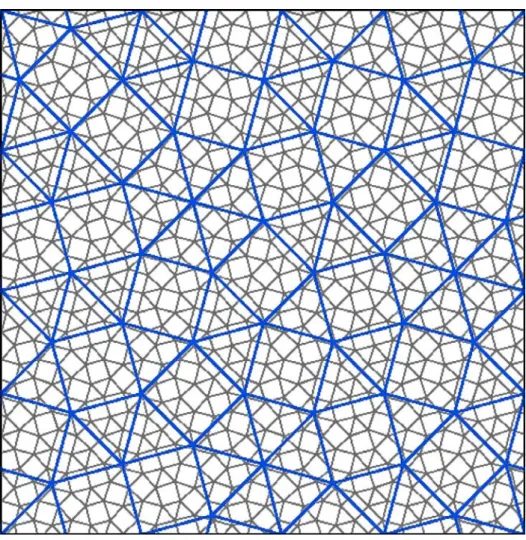
In the case of dodecagonal symmetry, the algebraic number is related to the self-similar transformation called Stampfli inflation, which is
sn+1 tn+1
=
7 3 16 7
sn tn
, (3)
wheresn andtn are the numbers of squares and triangles for thenth generation of tilings26. Figure 2 displays an example of the self-similar transformation. The eigenvalue of the matrix in eq.(3) is the square of 2 +√
3, whose value is the scaling ratio of Figure 2. Another ratio oftn/sn tends to 4/√
3 = 2.309401...asngoes to infinity. When one obtains square-triangle tilings in experiments or simulations, this ratio should be examined as a quality index of the tilings.
Higher Dimensional Crystallography
The state of art quasi-crystallography is called “higher-dimensional crystallography.”3,25 Why are higher dimensions needed? Why is higher-dimensional crystallography useful? Be- cause there are several reasons: (i) Construction of quasicrystals; (ii) Calculation of scattering intensities; (iii) Space group classification; (iv) Approximants.
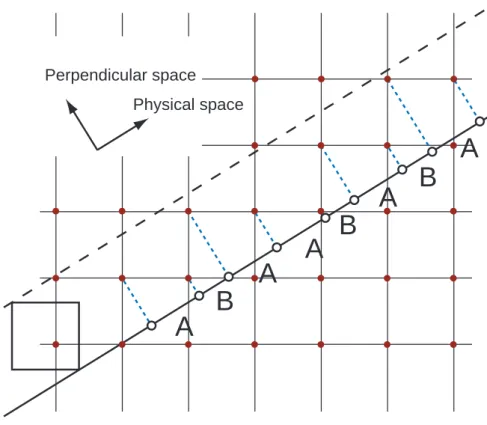
(i) Higher-dimensional method is convenient to construct quasicrystals. To see this in- tuitively, we look at a one-dimensional example, the Fibonacci lattice, which is known as the one-dimensional analogue of decagonal and icosahedral quasicrystals. As shown in Fig- ure 3, the Fibonacci lattice is obtained as the projection of the square-lattice points inside the window between broken and solid lines whose tangent is the inverse of the golden ratio [(√
5−1)/2 = 0.618...]. The width of the window is that of a square indicated by thick solid lines. The number ratio of two segments A and B indicated on the solid line is the golden ratio implying that there is no periodicity, as the ratio should be rational if a unit cell exists. In the terminology of higher-dimensional crystallography, the space along the Fibonacci lattice is called the physical space, and the space normal to the physical space is called the perpendicular (internal) space.
Similarly, for the most famous quasicrystal, the Penrose lattice, lattice points r can be represented by Z-module, meaning linear combinations of four basis vectors ei =
(cos[2πi/5],sin[2πi/5]) with integer coefficients:
r =
∑3 i=0
niei, (4)
where ni are integers. There is no need to employ five basis vectors because the fifth one is dependant: ∑4
i=0ei = 0. As a set of integers (n0, n1, n2, n3) is regarded as a lattice point in four dimensions, the Penrose lattice can be lifted up to the four-dimensional cubic lattice. This observation in turn implies that two-dimensional quasicrystals are obtained as the projection from four-dimensional lattices. The projected points are restricted by a window function in the perpendicular space as shown in Figure 3. In the same way, the icosahedral quasicrystal is considered as the projection of the six-dimensional simple cubic lattice points inside a window. Depending on the size, shape, and symmetry of a window, different quasicrystals are generated. Once a window is fixed, the structure obtained from the window is determined and considered as a perfectly ordered structure.
Without getting into details, we list additional reasons. (ii) The Fourier transform of a quasicrystal and its diffraction pattern are projections of the corresponding quantities in higher dimensions. Since the relation between the edge of tiles and the Bragg peaks is not straightforward, the higher-dimensional crystallography is indispensable. For instance, for dodecagonal quasicrystals, the relation between looks complex:
l = 2π q
√ 2 +√
3
3 (5)
whereqis the magnitude of the prominent scattering vectors, andlis the edge length of trian- gles and squares27. (iii) The space groups of quasicrystals are classified as higher-dimensional groups25. (iv) Finally, it is important to notice that higher-dimensional crystallography can be applied to traditional crystals. Namely, when the tangent is rational, crystals are ob- tained. In particular, the most important application of this idea is that related structures with similar alloy compositions are considered as rational approximations of quasicrystals called “approximants.” For approximants, analyses and theories for crystalline structures can be applied. The study of approximants has been hence very sound approach to comprehend the structure and the physical properties of quasicrystalline materials. Moreover, the search of approximants is the key to discover new quasicrystals, as we shall later see.
Disorder in Quasicrystals and the Origin of Quasicrystals
At the moment of discoveries, the detailed analyses of randomness in soft quasicrystals have not been pursued. However, randomness in quasicrystals is an astonishing feature of quasicrystals. For future study, we briefly describe the randomness in quasicrystals.
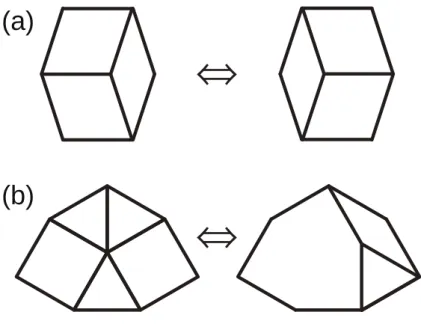
In quasiperiodic structures the rearrangement of tiles is possible as shown in Figure 4(a) in the case of Penrose rhombus tiles28. The corresponding tiling rearrangement process in dodecagonal tiling is illustrated in Figure 4(b)29,30. Since the energetic difference is thought to be small, it is thermally activated. This mode is impossible for crystals where the unit cell is single, while it is possible for quasicrystals where unit cells are multiple. This mode is called phason mode (phason flip), while elastic distortion of the lattice is called phonon mode31,32. As shown in Figure 5, the phonon mode is considered as move along the physical space, while the phason mode is considered as move along the perpendicular space. In fact, this kind of disorder has been observed by various experimental methods33–37.
Quasicrystals occupy the position between crystalline and amorphous materials (glasses).
Therefore, it is natural to raise a question: Are quasicrystals in random states? The answer is
“No” for perfect quasicrystals, and “YES” for random quasicrystals. This has been debated as a fundamental question. Remarkably, non-crystallographic symmetry can be generated from randomized states. The bond directions in tilings that are obtained after successive rearrangement of tiles is the same as those of perfectly ordered quasiperiodic tilings that are composed of the same tiles. Furthermore, randomized tiling does not lose its non- crystallographic symmetry, because the maximized entropic state is the highest rotationally symmetric state, where all N-fold Bragg peaks should have the same intensity. This idea is called “random tiling hypothesis.”29,38–40
With respect to the origin of quasicrystal formation, there are two arguments based on energy E and entropy S. Let us consider the Helmholtz free energy
F =E −T S, (6)
where T is temperature. To lower F, there are two ways: Making perfect quasicrystals by lowering energyE at low temperatures; Making random quasicrystals by maximizing entropy S at high temperatures.
To describe disorder in a quasicrystalline structure, let us discuss the density picture
again:
ρ(r) =
∑D i=1
cos(kki ·r+φi(r)). (7)
Disorder is represented through phases φi(r). The phase is described by
φi(r) =u(r)·kik+v(r)·k⊥i , (8) where u(r) is the usual phonon variable, and v(r) is the phason variable.
As shown in Figure 5a,u(r) andv(r) describe disorder in the physical and perpendicular spaces, respectively. Figure 5b displays wave vectors for dodecagonal quasicrystals. Notice that the definition of wave vectors for the perpendicular space is different from that for the physical space: this corresponds to the fact that the rotations that make the quasicrystal in- variant have two different two-dimensional representations, under which phonon and phason variables transform.
For perfect tilings, v(r) =const. The deviation form the correct tangent value is one type of disorder in quasicrystals, which is represented by a phason strain tensor ∇hi(rk). Here, h(rk) is a coarse-grained field of r⊥ aroundrk
hi(rk) =
∫
drkk(rk −r0k)r⊥i (r0k), (9) where a smearing kernel satisfying ∫
drkk(r) = 1. When ∇hi(rk) is finite for the entire system, it is called linear phason strain: Approximants have finite values. The analysis of the linear phason has been done in polymeric quasicrystal19.
There is another type of phason disorder called random phason. For random tilings, it is assumed that an elastic free energyF from tiling configurational entropy is described by
F = K 2
∫
drk∑
i
(∇hi(rk))2, (10)
where K is the elastic constant and h(rk) is a coarse grained field of r⊥ around rk. We assume that lowering the free energy enforces a quasicrystal to be organized. Notice that in F no energetic term exists as in the case of rubber elasticity. For simplicity, we assume no dependence of directions for the elastic constant.
Dimensionality of systems is one of important aspects. For two-dimensional quasicrystals, the thermal average of phason fluctuations is estimated by
h∆h2i ∼ 2π
βK lnL+ const., (11)
where ∆h = h− hhi, and L is the system size. Consequently, the phason fluctuation is logarithmically divergent40, stemming from long wave-length fluctuations. Therefore, phason variables cannot be restricted in a finite window. In other words, two-dimensional tiling systems cannot haveδ-function Bragg peaks and perfect quasiperiodicity in a strict sense. In fact, for the Penrose tiling with a ground state by matching rules, a Monte Carlo simulation showed that at any finite temperatures, the tiling is always in the random tiling state in which phason fluctuations dominate41. It means that even locally perfect Penrose tilings are globally random tiling when scaled up.
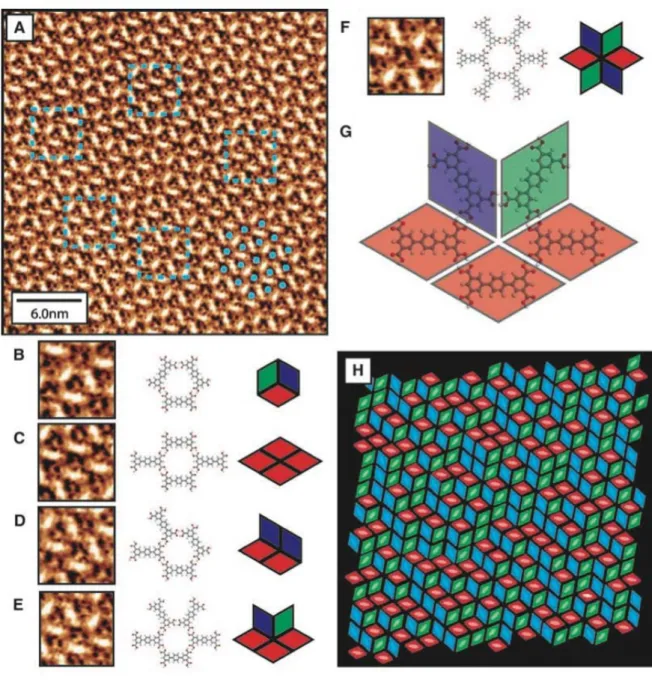
There is an experimental observation of a random tiling for a TPTC(p-terphenyl-3,5,3’,5’- tetracarboxylic acid)molecular network system on graphite, which is mapped to a random rhombus tiling with 60◦ and 120◦ angles (Fig. 6). Then the system can be viewed as a two-dimensional fluctuating membrane in a simple cubic lattice. In this case, the phason variable was just one dimension and turned out to diverge logarithmically42.
On the other hand, in three dimensions, the phason variables are confined to a finite value, there exist three-dimensional quasicrystals having true Bragg peaks with diffuse wings representing randomness. Bulk quasicrystals are of course three-dimensional and thus the origin of quasicrystalline structures can be random tilings. It should be noticed that the term “random tiling” in the field of quasicrystal physics does not simply mean a tiling with randomness, but it usually means a random tiling subjected to the random tiling hypothesis.
Perfectly ordered tiling generated by a certain local energetic rules in three dimensions can be a random tiling at high temperatures43–46. At low temperatures, long-wave phason fluctuations are locked, therefore they cannot behave as the elastic modes. This situation is similar to that of frozen polymers that cannot exhibit rubber elasticity. So far the transition between perfect and random tilings have not been observed even in hard quasicrystals.
Recent discussion includes the relation between phason disorder and chemical disorder.
Furthermore, it is known that there is no long-range translational and thus no quasiperi- odic translational order in two dimensions because of thermal fluctuations. Even if it exists, the translational order becomes quasi-long range in two-dimensional crystals; however, it is remarkable that bond-orientational order (BOO) can maintain long-range order. Moreover, even though the translational order is lost, the BOO can still be quasi-long range. Usually the latter bond-orientational ordered phase that exists between two-dimensional crystal and
liquid phases is called “hexatic phase” observed in colloidal and polymeric systems47–52. In the same spirit, the phase invariant under dodecagonal symmetry operations would be called
“dodecatic phase.
FROM SIMPLE TO COMPLEX: TWO APPROACHES
In the past, icosahedral clusters have been discussed in simulation studies of metallic glass using “monoatomic + simple” potentials. However, no quasicrystal formation extending to the whole system has been reported53. To form quasicrystals, at least one of two approaches was necessary: (I) multi-atomic + simple potentials; (II) monoatomic + complex potentials (that has two length-scales).
The method (I) is to simulate multi-atomic simulations based on the fact that the qua- sicrystal discoveries have been in alloys, in which the choice of atomic sizes are determined to form local icosahedral, decagonal or dodecagonal clusters. The first example was appeared just to investigate local stability54. Early works includes: Lan¸con and Billard conducting molecular dynamic simulations55, Widom et al. performing Monte Carlo simulations to form decagonal random tiling quasicrystals56, and Henley et al. conducting simulations for dodecagonal quasicrystals57. The lesson we can study from this approach is that the key to form quasicrystals is to construct local quasicrystal clusters by using multi-component systems. The drawback in these simulations is that the positional change of different atomic species is difficult and therefore to attain the equilibrium state becomes difficult. The same situation may happen in soft materials, where time scale to achieve thermal equilibrium often becomes long or impossible.
The method (II) is to add complexity for potentials. The first success is dodecago- nal quasicrystal formation by the Dzugutov potential58, which has been used by Roth and G¨ahler,59 and Keys and Glotzer et al.60 Several potentials were devised61,62, in particular, recent progress was done by Engel and Trebin, in which Lenard-Jones-Gauss potentials:
V(r) = 1 r12 − 1
r6 −εexp [
−(r−r0)2 2σ2
]
(12) was devised. This adds a Gaussian valley in addition to that of usual Lenard-Jones poten- tial. The key to form quasicrystals is to set the second valley at advantageous positions for non-crystallographic configurations. In addition, this potential avoids the triangular
lattice. Engel and Trebin performed two-dimensional simulations, and obtained decagonal and dodecagonal phases at high temperatures depending on the parameters ε and σ. The merit of this approach is that the simulation cost is reduced because of monoatomic systems.
The idea is more radicalized by Rechtsman, Stillinger, and Torquato64. They thought the optimization problem of a spherical potential that gives a target structure. According to the method, even the diamond lattice could be constructed in terms of a monoatomic but consid- erably complex spherical potential, which approach may hint in designing supra-molecules to form complex lattices. In fact, designing complex molecules is promising approach to form complex crystalline structures: Wiesner et al. obtained an A15 structure by using hybrid dendritic polymers (dendrons) with eight arms.65,66
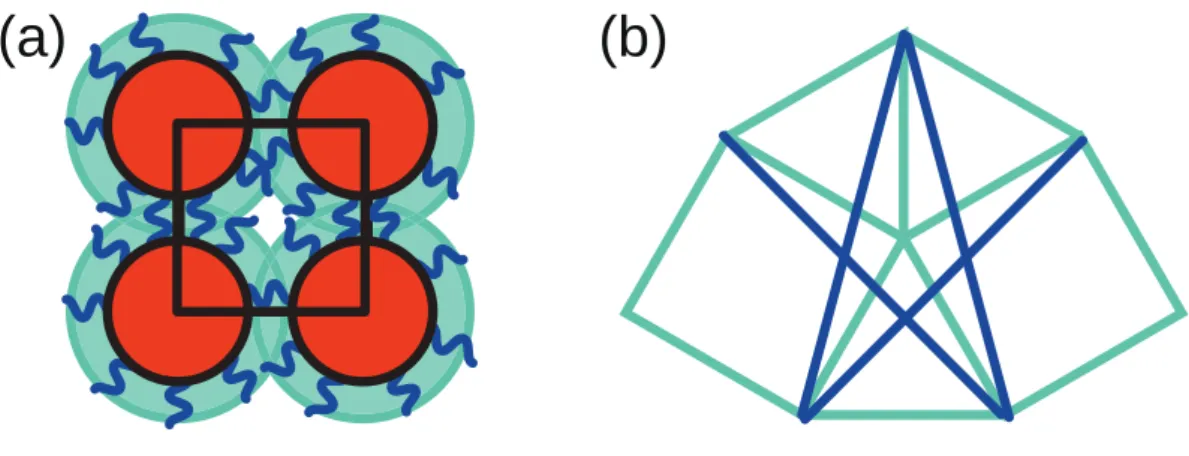
To materialize two-lengthscale, however, a feasible way is to synthesize coreshell particles as shown in Figure 7(a). The simplest model for the core-shell particles is represented by hard-core and soft-shell potential investigated by Jagla67 and Glaser et al. 68, which turned out to form various phases. It is an open question whether of not the simple potential can produce quasicrystals.
The length ratio r associated with dodecagonal (N = 12) or decagonal (N = 10) qua- sicrystals is given by
r = 1
2 sin(π/N)
=
√6+√ 2
2 = 1.932... (N = 12)
√5+1
2 = 1.618... (N = 10)
In Figure 7, two-length scales for dodecagonal quasicrystal are given in Figure 7(b), which were employed by Engel and Trebin63, and Lifshitz et al. 69,73.
In view of the reciprocal space, mean field theories were devised in the same sprits that cor- respond to (I) and (II). Alexander and MacTague theory48,70of crystallization of monoatomic systems has been extended to two- or multi-order parameter theory by Mermin and Troian to understand the stability of quasicrystalline phases71, and the theory was further extended to polymeric quasicrystals72. These approach corresponds to (I). On the contrary, corre- sponding to (II), Lifshitz and Petrich directly used two wavelengths for one order parameter to study Faraday waves73. The approach (I) is natural, while the approach (II) catches the essence of phenomena.
Other types of simulations such as a lattice polymer system74,75, a tetrahedral packing system76, and a bilayer of water or silicon77,78 turned out to exhibit dodecagonal order without any input of dodecagonal symmetry.
TILING BY POLYMERS
Archimedean tiling phases
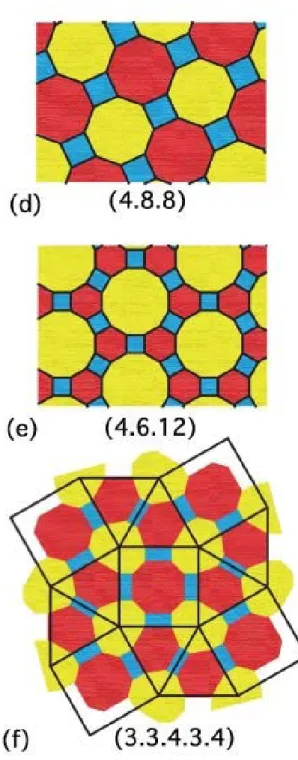
In the following paragraphs, we describe how we found a dodecagonal polymeric qua- sicrystal. Microphase separations of block copolymers composed of chemically distinct polymers linked together have provided magnificent crystalline morphologies such as lamel- lar, co-continuous, cylindrical, and spherical phases79–82. We investigated the phase behavior of ABC star block terpolymers consisting of chemically distinct three polymers linked at one junction (Fig. 8(a)). When the molecular weights of three components are not much dif- ferent, their melts can form two-dimensional tiling patterns, precisely, polygonal cylindrical phases whose sections are the Archimedean tilings (Fig. 8(b)). Archimedean tilings depicted by Kepler in Harmonices Mundi II (1619) are regular patterns of polygonal tessellation in plane by using regular polygons83. Here, a set of integers (n1.n2.n3.· · ·) denotes a tiling of a vertex type in the way that n1-gon, n2-gon, and n3-gon, · · ·, meet consecutively on each vertex. Superscripts are employed to abbreviate when possible.
If the interactions between ABC polymer components are equally strong, and only if one molecular environment is allowed in each tiling, only (63), (4.82), and (4.6.12) (Fig. 8(c)-(e)) belonging to the single junction class (SJC) can be obtained as direct patterns, where each polygon in the Archimedean tiling directly corresponds to each polymeric microdomain. It is firstly because only three polygons corresponding to ABC microdomains should meet on a vertex, and secondly because only even polygons should appear, the fact that is called even polygon theorem85. Three phases were firstly confirmed by simulation85, then by experiment86.
The first breakthrough was an experiment of an ABC star-shaped polymer alloy com- posed of polyisoprene (I), polystyrene (S) and poly(2-vinylpyridine) (P) revealed a complex Archimedean tiling phase (Figures 8(f) and 9) denoted as (32.4.3.4)20, or it is called σ phase in the Frank-Kasper family84. The tiling is composed of equilateral triangles and squares,
whose edge length is about 80 nm. The tiling is more complex than the SJC because molec- ular environment splits; however, the skeleton structure is the (32.4.3.4) Archimedean tiling.
Since the (32.4.3.4) phase has the triangle/square ratio 2 and thus is akin to dodecagonal quasicrystals, it was strongly suggested that dodecagonal quasicrystals were expected to exist in polymeric systems.
Other study concerning tiling structures for supramolecules is found in Tschierske’s review87.
Simulations of Polymeric Quasicrystals
In this subsection, we describe simulation study of polymeric quasicrystals motivated by the aforementioned (32.4.3.4) experiment. A simple extension of the bead-and-bond lattice polymer MC method called diagonal bond method was used85,88. A bead occupies only one lattice point to ensure excluded volume interactions. The bond length can be 1,√
2, or√ 3 in the unit of lattice spacing. One ABC star block copolymer consists of NA A-type beads, NB B-type beads, NC C-type beads, and one Y-type bead (junction), which are connected by N-1 bonds, where N=NA+NB+NC+1. To represent energetics that drives the system to microphase separation, unit contact energies are imposed only between pairs of different species within the body diagonal distance √
3: We consider the Hamiltonian as H =∑ ij, whereij = 1 wheni6=j, andiand j stand for A, B, C. The MC procedure is the following:
We select one bead randomly and choose a trial move randomly out of possible moves; if the trial is a vacancy, we determine move or not according to the Metropolis algorithm.
Here we choseNA=9, NB=7, andNC=12-18. In order to get broad two-dimensional struc- tures, whole simulations were carried out in a quasi-two-dimensional box with Lx=Ly=128 and Lz=10 subjected to periodic boundary conditions. The C component of a few star polymers can interact with themselves across Lz, leading to quick formation of cylinders parallel to thez-direction. The number of polymers in the system was determined such that the occupation ratio of beads in the lattice points was 0.75: 4237 (NC=12), 3964 (NC=14), 3724 (NC=16) or 3511 (NC=18). The system was prepared as totally randomized at the infinite temperature, and then quenched at β = 1/kBT=0.071 to wait ordering, wherekB is the Boltzmann constant and T is absolute temperature. This temperature was selected low
enough to retain ordering processes, but high enough to get sufficient entropy. To form a structure, we performed a run of 107 Monte Carlo steps (MCS) at β = 0.071.
In all simulations, cylindrical structures developed. We obtained a phase sequence:
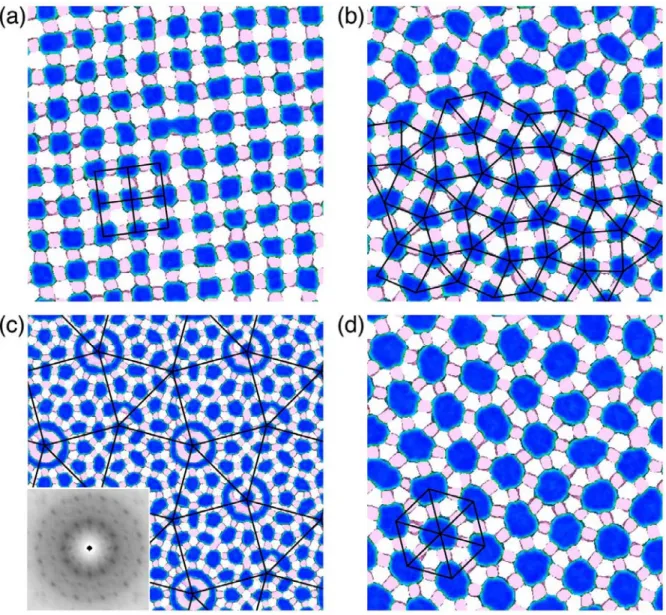
(4.82)→(32.4.3.4)→DDQC→(4.6.12), (13) with increasing C component. See Figure 10. In Figure 10(c) , we obtained a quasicrystal.
Results are summarized as follows: (i) The MC averaged structure function shown in the inset of Figure 10(c) is almost 12-fold. (ii) We find local 12-fold wheel patterns in Figure 10(c).
The centers of the wheels form a Stampfli self-similar lattice. (iii) Cells are dynamically rearranged and deformed, and consequently the wheels change their positions. This collective dynamics can be viewed as a rearrangement of the square-triangle tiling. (iv) Contrary to the usual square-triangle tiling, there is no six-fold node. Rather, the simulation resembles the density wave pattern of C component obtained from a Landau theory72. A similar situation occurred in the simulations of water and silicon bilayers77,78.
The phase behavior can be regarded as a transition from square tiling to triangle tiling via square-triangle tiling. In other word, from fourfold to sixfold. See superimposed solid lines in Figure 10 (a), (b) and (d). In Figure 10(a), C domains form square tiling as displayed in solid lines, while C domains form triangle tiling in Figure 10(d). Between them, exact five-fold (72◦) is desirable, but it is incompatible with crystalline structures. To compromise, one remedy is to deform five-fold nodes. In fact, a little flattened five-fold node (60◦-60◦- 90◦-60◦-90◦) is the elemental structure in (32.4.3.4) in Figure 10(b). Another way is to introduce new degrees of freedom producing additional entropy. In the case of A9B7C16, we frequently find that neighboring C domains are dynamically connected and disconnected (Fig. 11), meaning that the five-fold nodes and the wheel patterns are highly mobile. The collective dynamics on a large scale can be viewed as a type of move given in Figure 4(b).
Concerning the thermodynamic effect of phason degrees of freedom, Edagawa and Kajiyama have carefully measured an unusual increase in specific heat at high temperatures only in quasicrystalline samples (Al-Pd-Mn and Al-Cu-Co); the authors have attributed its origin to the phason modes89. We have compared the specific heat for the phases and find that the DDQC sample possesses higher specific heat at high temperatures, which may be attributed to phason dynamics.
APPLICATION: PHOTONIC CRYSTAL
The lattice constants of block copolymer and colloidal structures can reach the wave- length of visible light. Hence, they may open the possibility of constructing novel photonic band gap (PBG) devices, such as waveguides or dielectric mirrors, where the propagation of electromagnetic waves or the spontaneous emission of light is forbidden90–94.
It is worthwhile to mention that dodecagonal quasicrystals are thought to be promising candidates for PBG structures because of their high degree of rotational symmetry95–103. It was suggested that a complete PBG opens with low dielectric contrasts in a dodecagonal structure95. Furthermore, we mention a remarkable study by Zhang et al. that the nega- tive refraction of electromagnetic waves and the superlens imaging were demonstrated103,104. They have observed that the high-symmetric photonic quasicrystals can exhibit an effective refractive index close to -1 in a certain frequency window. The index shows small spatial dispersion, consistent with the nearly homogeneous geometry of the quasicrystal. Figure 12 displays that the incident wave from the left-hand side enters horizontally and the refractive wave goes out upward of the surface normal.
Finally, we call attention that with high dielectric contrasts, band structures are deter- mined by local structures, implying that long-ranged quasiperiodicity is not necessary. The effect of randomness of quasicrystals may be problematic; if it is, the approximant structures, which can be easily controlled in experiments, are useful. Using plane wave method, Uedaet al. found that three types of the (32.4.3.4) structures open complete PBGs and that both dielectric and air cylinders with the same shape have PBGs105.
SUMMARY AND OUTLOOK
Base on the result obtained by the polymer simulations, we searched polymeric quasicrys- tals in the composition range between those of (32.4.3.4) and (4.6.12) phase, and finally found as shown in Figure 1. Simple strategy exists that quasicrystals are found between the both ends: triangular and square lattices. Then one need to look for the (32.4.3.4) phase or other approximant phases106. The study of Frank-Kasper phases is still a sound approach even in clathrate hydrates107. This scenario has repeated in metallic alloys, chalcogenide, dendrons, nanoparticles, and mesoporous systems. As shown in simulations, a high temperature or
a full of solvent is needed to acquire molecular mobility necessary for phason dynamics, or rapid quenching may provide another possibility to keep randomness.
We have seen that (i) solids can exist with 5-, 8-, 10-, 12-fold, or icosahedral symmetry. (ii) δ-function Bragg peaks are for periodic and quasiperiodic structures. (iii) thermodynamically stable solids can be crystalline and quasicrystalline. (iv) soft quasicrystals exist. It has been shown that dodecagonal quasicrystals and related rational approximants cover a wide variety of materials, demonstrating that two-dimensional quasicrystalline order is universal over different length-scales: The edge lengths of polygons are 0.5 nm for metallic alloys, 2 nm for chalcogenide, 10 nm for liquid crystalline organic dendrons and mesoporous silica, 20 nm for binary nanoparticles, 50 nm for colloids, and 50-80 nm for ABC star terpolymers.
To encounter new complex phases, we have discussed two approaches: multi-components or complex potential. Surprisingly enough, Hayashidaet al. demonstrated a TEM image of ABC star terpolymers and Talapinet al.15showed a TEM image of binary alloys of surfactant capped metallic nanoparticles as shown in Figure 13. These system are alloy systems as hard quasicrystals. To the contrary, one component spherical systems can form quasicrystals: This direction is very new in soft quasicrystalline materials, and it should be further explored both theoretically and experimentally: core-shell particles such as dendrons, copolymers, colloidal particles with electric double layers108, surfactant or polymer coated metallic nano particles or silica particles are possible candidates. Future study includes other quasicrystals such as decagonal and icosahedral quasicrystals. A long search for the Boron quasicrystals109, and the construction ideas of the zincblende lattices may be helpful110,111. Randomness in known soft quasicrystalline phases should be investigated to make each formation mechanism clear. In addition, the most recent mysterious discovery is the 18-fold diffraction pattern from a colloidal system18,112 and the origin of the system should be clarified. Finally, the experimental realization of a photonic soft quasicrystal is awaited.
ACKNOWLEDGMENTS
The author is grateful to Y. Matsushita, A. Takano, K. Hayashida, A. Hatano, T. Gemma, J. Matsuzawa, K. Ueda, T. Oshiro, Y. Nakanishi, O. Terasaki, N. Fujita, Y. Sakamoto, K. Edagawa, T. Ishimasa, A. P. Tsai, Y. Ishii, M. Matsumoto, P. J. Steinhardt, H. C. Jeong,
C. L. Henley, M. de Boissieu, and P. Ziherl for collaborations, several discussions and com- munications on this topic. This work was supported by a Grant-in-Aid for Scientific Research (C) (No.22540375) from JSPS, Japan.
1. Shechtman, D.; Blech, I.; Gratias, D.; Cahn, J. W. Phys. Rev. Lett. 1984, 53, 1951.
2. Levine D.; Steinhardt, P. J. Phys. Rev. Lett. 1984, 53, 2477.
3. Steinhardt P. J., Ostlund S. Eds. The Physics of Quasicrystals; World Scientific, Singapore, 1987.
4. Bendersky, L. Phys. Rev. Lett. 1985, 55, 1461.
5. Wang, N.; Chen, H.; Kuo, K. H.; Phys. Rev. Lett. 1987, 59, 1010.
6. Ishimasa, T.; Nissen, H.-U.; Fukano, Y. Phys. Rev. Lett. 1985, 55, 511.
7. Chen, H.; Li, D. X.; Kuo, K. H. Phys. Rev. Lett. 1988, 60, 1645.
8. Tsai, A. P.; Inoue, A.; Masumoto, T. Jpn. J. Appl. Phys. 1987, 26, L1505.
9. Tsai, A. P. Acc. Chem. Res. 2003, 36, 31.
10. Takakura, H.; G´omez, C. P.; Yamamoto, A.; de Boissieu, M.; Tsai, A. P. Nature Mater. 2007, 6, 58.
11. Lifshitz R.; Diamant, H. Phil. Mag. 2007, 87, 3021.
12. Conrad, M.; Krumeich, F.; Harbrecht, B. Angew. Chem. Int. Ed. 1998, 37, 1383.
13. Conrad M.; Harbrecht, B. Chem. Eur. J. 2002, 8, 3094.
14. Zeng, X.; Ungar, G.; Liu, Y.; Percec,V.; Dulcey, A. E.; Hobbs, J. K. Nature 2004, 428 157.
15. Talapin, D. V.; Shevchenko, E. V.; Bodnarchuk, M. I.; Ye, X.; Chen, J.; Murray, C. B. Nature 2009, 461, 964.
16. Xiao, C.; Miyasaka, K.; Fujita, N.; Sakamoto, Y.; Che S.; Terasaki, O. private communication.
17. Terasaki, O.; Ohsuna, T.; Liu, Z.; Sakamoto, Y.; Garcia-Bennett, A. E. Mesoporous Crystals and Related Nano-Structured Materials; Terasaki, O. ed., Elsevier, Amsterdam, 2004.
18. Fischer, S.; Exner, A.; Zielske, K.; Perlich, J.; Deloudi, S.; Steurer, W.; Lindner, P.; F¨orster, S. PNAS. 2011, 08, 1810.
19. Hayashida, K.; Dotera, T.; Takano, A.; Matsushita, Y. Phys. Rev. Lett. 2007, 98, 195502.
20. Takano, A.; Kawashima, W.; Noro, A.; Isono, Y.; Tanaka, N.; Dotera T.; Matsushita, Y. J.
Polym. Sci. Part B: Polym. Phys. 2005, 43, 2427.
21. Lee, S.; Bluemle, M. J.; Bates, F. S. Science 2010, 330, 351.
22. Mikhael, J.; Roth, J.; Helden, L.; Bechinger, C. Nature 2008, 454, 501.
23. Mikhael, J.; Schmiedeberg, M.; Rausch, S.; Roth, J.; Stark, H.; Bechinger, C. PNAS 2010, 107, 7214.
24. Roichman, Y.; Grier, D. G. Optics Express 2005, 13, 5434.
25. Janssen, T.; Chapuis, G.; de Boissieu, M. Aperiodic Crystals: From Modulated Phases to Quasicrystals; Oxford Univ Press, Oxford, 2007.
26. Stampfli, P. Helv. Phys. Acta 1986, 59, 1260.
27. Yang, Q. B.; Wei, W. D. Phys. Rev. Lett. 1987, 58, 1020.
28. Elser, V. Phys. Rev. Lett. 1985, 54, 1730.
29. Oxborrow, M.; Henley, C. L. Phys. Rev. B 1993, 48, 6966.
30. Dotera, T.; Nakanishi, Y. to be published in Phys. Rev. B.
31. Socolar, J. E. S.; Lubensky, T. C.; Steinhardt, P. J. Phys. Rev. B 1986, 34, 3345.
32. Ishii, Y. Phys. Rev. B 1989, 39, 11862.
33. Edagawa, K.; Suzuki, K.; Takeuchi, S. Phys. Rev. Lett. 2000, 85, 1674.
34. Coddens, G.: Lyonnard, S.; Hennion, B. Phys. Rev. B 2000, 62, 6268.
35. Abe, E.; Pennycook, S. J.; Tsai, A. P. Nature 2003, 421, 347.
36. Francoual, S.; Livet, F.;de Boissieu, M.; Yakhou, F.; Bley, F.; Letoublon, A.; Caudron, R.;
Gastaldi, J. Phys. Rev. Lett. 2003, 91, 225501.
37. Abe, H.; Saitoh, H.; Ueno, T.; Nakao, H.; Matsuo, Y.; Ohshima, K.; Matsumoto, H. J. Phys.
Condens. Matter 2003, 15, 1665.
38. Kawamura, H. Prog. Theor. Phys. 1983, 70, 352.
39. Widom, M. Phys. Rev. Lett. 1993, 70, 2094.
40. Henley, C. L. In Quasicrystals: The State of the Art, Chap. 8; Steinhardt, P.J.; Divincenzo, D. P., Eds.; World Scientific: Sigaplore, 1999; 2 edition.
41. Tang, L.-H.; Jari´c, M. V. Phys. Rev. B 1990, 41, 4524.
42. Blunt M. O.; Russell, J. C.; Gim´enez-L´opez, M.; Garrahan, J. P.; Lin, X.; Schr¨oder, M.;
Champness, N. R.; Beton, P. H. Science 2008, 322, 1077.
43. Dotera, T.; Steinhardt, P. J. Phys. Rev. Lett. 1994, 72, 1670.
44. Dotera, T. Material Science Forum 1994, 150-151, 375;
45. Dotera, T. Mater. Sci. Eng. A 1994, 181-182, 758.
46. Jeong H.-C.; Steinhardt, P. J. Phys. Rev. B 1993, 48, 9394.
47. Nelson, D. R. Defects and Geometry in Condensed Matter Physics; Cambridge University Press, Cambridge, 2002.
48. Chaikin P. M.; Lubensky, T. C. Principles of condensed matter physics; Cambridge University Press, Cambridge, 1995.
49. Murray, C. A.; Sprenger, W. O.; Wenk, R. A. Phys. Rev. B 1990, 42, 688.
50. Marcus, A. H.; Rice, S. A. Phys. Rev. Lett. 1996, 77, 2577.
51. Zahn, K.; Lenke, R.; Maret, G. Phys. Rev. Lett. 1999, 82, 2721.
52. Segalman, R. A.; Hexemer, A.; Kramer E. J. Phys. Rev. Lett. 2003, 91, 196101.
53. Steinhardt, P. J.; Nelson, D. R.; Ronchetti, M. Phys. Rev. B 1983, 28, 784.
54. Levine D.; Steinhardt, P. J. Phys. Rev. B 1986, 34, 596.
55. Lan¸con, F.; Billard L.; Chaudhari, P. Europhys. Lett. 1986, 2, 625.
56. Widom, M.; Strandburg, K. J.; Swendsen, R. H. Phys. Rev. Lett. 1987, 58, 706.
57. Leung, P. W.; Henley, C. L.; Chester, G. V. Phys. Rev. B 1989, 39, 446.
58. Dzugutov, M. Phys. Rev. Lett. 1993, 70, 2924.
59. Roth J.; G¨ahler, F. Euro. Phys. J. B 1998, 6, 425.
60. Keys, A. S.; Glotzer, S. C. Phys. Rev. Lett. 2007, 99, 235503.
61. Quandt, A.; Teter, M. P. Phys. Rev. B 1999, 59, 8586.
62. Skibinsky, A.; Buldyrev, S. V.; Scala, A.; Havlin, S.; Stanley, H. E. Phys. Rev. E 1999, 60, 2664.
63. Engel, M.; Trebin, H.-R. Phys. Rev. Lett. 2007, 98, 225505.
64. Rechtsman, M.; Stillinger, F. H.; Torquato, S. Phys. Rev. E 2007, 75, 031403.
65. Cho, B.-K.; Jain, A.; Gruner, S. M.; Wiesner, U. Science 2004, 305, 1598.
66. Ziherl P.; Kamien, R. D. J. Phys. Chem. B 2001, 105, 10147.
67. Jagla, E. A. J. Chem. Phy. 1999, 110, 451.
68. Glaser, M. A.;Grason, G. M.; Kamien, R. D.; Koˇsmrlj, A.; Santangelo C. D.; Ziherl, P.
Europhys. Lett. 2007, 78, 46004.
69. Barkan, K.; Diamant, H.; Lifshitz, R. Phys. Rev. B 2011, 83 172201.
70. Alexander, S.; MacTague, J. Phys. Rev. Lett. 1974, 41, 702.
71. Mermin, N. D.; Troian, S. M. Phys. Rev. Lett. 1985, 54, 1524.
72. Dotera, T. Phil. Mag. 2007, 87, 3011.
73. Lifshitz, R.; Petrich, D. M. Phys. Rev. Lett. 1997, 79, 1261.
74. Dotera, T.; Gemma, T. Philos. Mag. 2006, 86, 1085.
75. Dotera, T. Philos. Mag. 2008, 88, 2245.
76. Haji-Akbari, A.; Engel, M.; Keys, A. S.; Zheng, X.; Petschek, R. G.; Palffy-Muhoray, P.;
Glotzer, S. C. Nature 2009, 462, 773.
77. Johnston, J. C.; Kastelowitz, N.; Molinero, V. J. Phys. Chem. Phys. 2010, 133, 154516.
78. Johnston, J. C.; Phippen, S.; Molinero, V. J. Phys. Chem. Lett. 2011, 2, 384.
79. Leibler, L. Macromolecules, 1980, 13, 1602.
80. Hamley, I. W. The Physics of Block Copolymer, Oxford Univ. Press, Oxford, 1998.
81. Bates, F. S. Fredrickson, G. H. Phys. Today, 1999, 52, 32.
82. Hadjichristidis, N.; Pipas, S.; Floudas, G. Block Copolymers: Synthetic Strategies, Physical Properties, and Applications; Wiley, Inc. Hoboken, NJ, 2003.
83. Gr¨unbaum, B.; Shephard, G. C. Tilings and Patterns; Freeman, NewYork, 1986.
84. Frank, F. C.; Kasper, J. S. Acta. Cryst. 1959, 12, 483.
85. Gemma, T.; Hatano, A.; Dotera, T. Macromolecules, 2002, 35, 3225.
86. Takano, A.;Wada, S.; Sato, S.;Araki, T.; Hirahara, K.; Kazama, T.; Kawahara, S.; Isono, Y.;
Ohno, A.; Tanaka, N. ; Matsushita, Y. Macromolecules 2004, 37, 9941.
87. Tschierske, C. Chem. Soc. Rev. 2007, 36, 1930.
88. Dotera T.; Hatano, A. J. Chem. Phys. 1996, 105, 8413.
89. Edagawa, K.; Kajiyama, K. Mater. Sci. Eng. A 2000, 294-296, 646.
90. Joannopolous, J. D.; Meade, R. D.; Winn, J. N. Photonic Crystals; Princeton University, Princeton, 1995.
91. Sakoda, K.; Optical Properties of Photonic Crystals; Springer-Verlag, Berlin, 2001.
92. Steurer, W.; Sutter-Widmer, D. J. Phys. D: Appl. Phys. 2007, 40, R229.
93. Park, C.; Yoon, J.; Thomas, E. L. Polymer 2003, 44, 6725.
94. Fink, Y.; Urbas, A. M. Bawendi, M. G. Joannopoulos, J. D.; Thomas, E. L. J. Lightwave Technol. 17, 1999, 1963.
95. Zoorob, M. E. Charlton, M. D. B.; Paker, G. J.; Baumberg, J. J. Netti, M. C. Nature (London) 2000, 404, 740.
96. David, S. Chelnokov, A. Lourtioz, J.-M. IEEE J. Quantum Electron. 37, 2001, 1427.
97. Hiett, B. P.; Beckett, D. H.; Cox, S. J.; Generowicz, J. M.; Molinari, M. Thomas, K. S. J.
Mater. Sci.: Mater. Electron 2003,14, 413.
98. Zhang, X.; Zhang, Z.-Q.; Chan, C. T. Phys. Rev. B 2001, 63, 081105(R).
99. Gauthier R. C.; Mnaymneh, K.; Opt. Express 2005, 13, 1985.
100. Wang, Y.; Wang, Y.; Feng, S.; Li, Z. Y. Europhys. Lett. 2006, 74, 49.
101. Notomi, M.; Suzuki, H.; Tamamura, T. Edagawa, K. Phys. Rev. Lett. 2004, 92, 123906.
102. Man, W.; Megens, M.; Steinhardt, P. J.; Chaikin, P. Nature (London) 2005, 436, 993.
103. Feng, Z; Zhang, X; Wang, Y; Li, Z.-Y.; Cheng, B; Zhang, D.-Z. Phys. Rev. Lett. 2005, 94, 247402.
104. Pendry, J. B.; Smith, and D. R. Scientific American 2006, 295, 60.
105. Ueda, K.; Dotera, T.; Gemma, T. Phys. Rev. B 2007, 75, 195122.
106. Iga, H.; Mihalkovic, M.; Ishimasa, T. Phil. Mag. 2011, 91, 2624.
107. Matsumoto, M.; Tanaka, H. J. Phys. Chem. B, 2011, 115, 8257.
108. Denton, A. R.; L¨owen. H. Phys. Rev. Lett. 1998, 81, 469.
109. Miyazaki, Y.; Okada, J.; Abe, E.; Yokoyama, Y.; Kimura, K. J. Phys. Soc. Jpn. 2010, 79, 073601.
110. Kalsin, A.M.; Fialkowski, M.; Paszewski, M.; Smoukov, S. K. Science 2006, 312, 420.
111. Hayashida, K.; Takano, A.; Dotera, T.; Matsushita, Y. Macromolecules, 2008, 41, 6269.
112. Glotzer, S. C.; Engel, M. Nature 2011, 471, 309.
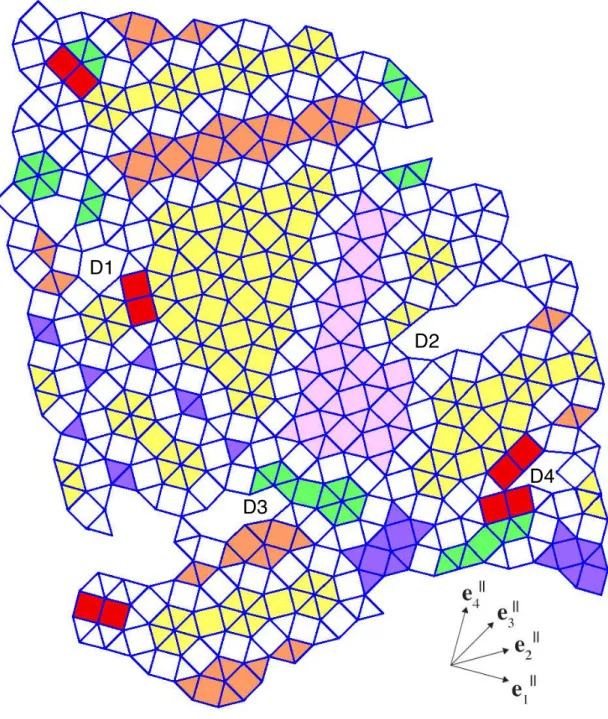
FIG. 1: Polymeric quasicrystalline square-triangle tiling by Hayashida et al19. Reproduced from Ref.19, with permission from American Physical Society.
FIG. 2: Self-similar transformation of a dodecagonal square-triangle tiling.
A
A A
A
A
B
B B
Physical space Perpendicular space
FIG. 3: Fibonacci lattice points obtained as the projection of the square lattice inside the window whose width is that of a square shown between broken and solid lines. A and B are arranged in a Fibonacci sequence, ABAABABA... obtained by substitution rules: A→AB, B→A.
⇔
⇔
(a)
(b)
FIG. 4: Tile rearrangement process by phason modes: (a) Penrose rhombus tiling case, (b) do- decagonal case.
x = r x
Physical space Perpendicular space
Phason fluctuation
Quasicrystal Phason v
4d
Phonon u
k
1k
2k
3k
4(a)
k
2k
1k
3k
4(b)
FIG. 5: (a) Phonon and phason. (b) Reciprocal vectors in physical and perpendicular spaces for dodecagonal quasicrystals.
FIG. 6: Random tiling in a two-dimensional molecular network by Blunt et al.42. STM images, molecular networks and the corresponding tiling representations. Reproduced with permission.
Copyright 2008, Science.
(a) (b)
FIG. 7: (a) Coreshell particles. (b) Two lengths whose ratio is (√ 6 +√
2)/2 = 1.932...in dodecago- nal quasicrystals. The ratio is favorable to form (32.4.3.4) (σ) vertices.
FIG. 8: Archimedean tiling phases from ABC star polymers: (a) ABC star block terpolymer; (b) and (c) (63), (d) (4.82), (e) (4.6.12), (f) (32.4.3.4) phases. The first three direct patterns constitute the single junction class, whereas the (32.4.3.4) net gives the skeleton of the real structure.
FIG. 9: Transmission electron micrograph for an ISP star-shaped block terpolymer molecule, I1.0S1.0P1.320. Archimedean tiling pattern, (32.4.3.4), is drawn as thin solid lines.
FIG. 10: Archimedean tiling phases (a), (b), (d) and a dodecagonal quasicrystal (c) for ABC starblock copolymers: A (transparent), B (pink) and C (blue). (a) (4.82) phase for A9B7C12.
Squares connecting centers of C regions are superimposed. (b) (32.4.3.4) phase for A9B7C14. A regular (32.4.3.4) graph is displayed. (c) Dodecagonal quasicrystal for A9B7C16. A two-periodic unit cell made up of four replicas is displayed. Wheel patterns construct a magnified (32.4.3.4) lattice superimposed (solid line), known as the Stampfli scaled lattice. (d) (4.6.12) phase for A9B7C18. Triangle tiling is superimposed.
FIG. 11: Dynamic phason modes in the A9B7C16 system. Superimposed lines represent tiling rearrangement from broken lines to solid lines.
FIG. 12: Negative refraction on a dodecagonal quasicrystal wedge103. Reproduced with permission.
Copyright 2005, American Physical Society.
FIG. 13: Dodecagonal quasicrystals self-assembled from binary nanoparticles by Talapin et al.15. Reproduced with permission. Copyright 2009, Nature.