The huge Package for High-dimensional Undirected Graph Estimation in R
Tuo Zhao
∗Han Liu
†Kathryn Roeder
‡John Lafferty
§Larry Wasserman
¶January 26, 2012
Abstract
We describe anRpackage namedhugewhich provides easy-to-use functions for estimating high dimensional undirected graphs from data. This package implements recent results in the literature, including Friedman et al. [2007b], Liu et al. [2009]
and Liu et al. [2010]. Compared with the existing graph estimation packageglasso, thehuge package provides extra features: (1) instead of using Fortan, it is written inC, which makes the code more portable and easier to modify; (2) besides fitting Gaussian graphical models, it also provides functions for fitting high dimensional semiparametric Gaussian copula models; (3) more functions like data-dependent model selection, data generation and graph visualization; (4) a minor convergence problem of the graphical lasso algorithm is corrected; (5) the package allows the user to apply both lossless and lossy screening rules to scale up large-scale problems, making a tradeoff between computational and statistical efficiency.
1 Overview
Undirected graphs is a natural approach to describe the conditional independence among many variables. Each node of the graph represents a single variable and no edge between two variables implies that they are conditional independent given all other variables.
In the past decade, significant progress has been made on designing efficient algorithms to learn undirected graphs from high-dimensional observational datasets. Most of these
∗email: [email protected], Department of Computer Science, Johns Hopkins University
†email: [email protected], Department of Biostatistics, Johns Hopkins University
‡email: [email protected], Department of Statistics, Carnegie Mellon University
§email: laff[email protected], Machine Learning Department, Carnegie Mellon University
¶email: [email protected], Department of Statistics, Carnegie Mellon University
methods are based on either the penalized maximum-likelihood estimation [Friedman et al., 2007b] or penalized regression methods [Meinshausen and B¨uhlmann, 2006]. Ex- isting packages include glasso, Covpath, CLIME and parcor. In particular, the glasso package has been widely adopted by statisticians and computer scientists due to its friendly user-inference and efficiency. There are also other graph estimation packages such as GeneNetand sna, but they are not targeting on conditional independence graph estimation.
In this vignette, we describe a newly developedRpackage namedhuge(High-dimensional Undirected Graph Estimation). Compared withglasso, the core engine of hugeis coded in C, making modifications of the package more accessible to researchers from the com- puter science and signal processing communities. The package includes a wide range of functional modules, including data generation, data preprocessing, graph estimation, model selection, and visualization. Many recent methods have been implemented, in- cluding the nonparanormal [Liu et al., 2009] method for estimating a high dimensional Gaussian copula graph, the StARS [Liu et al., 2010] approach for stability-based graph- ical model selection, and correlation screening [Fan and Lv, 2008] for graph estimation.
The package supports two modes of screening, lossless [Witten et al., 2011, Mazumder and Hastie, 2011a] and lossy screening. The user can select the desired screening level to scale up to larger problems, but this introduces some estimation bias. This package also addresses some minor convergence problem of the graphical lasso algorithm.
2 Background
2.1 Gaussian Graphical Models
The Gaussian Graphical Models assumes that the observations have a multivariate Gaus- sian distribution with mean µ, and covariance matrix Σ.The conditional independence can be implied by the inverse covariance (concentration) matrix Ω = Σ−1. If Ωjk = 0, then thei-th variable and j-th variables are conditional independent given all other vari- ables. Thus it makes sense to impose anℓ penalty for the estimation of Ω, to increase its sparsity, and the sparse pattern of Ω is essentially the same as the adjacency matrix of the underlying undirected graph.
Meinshausen and B¨uhlmann [2006] take a simple approach to this problem and they estimate a sparse graphical model by the following minimization problem,
Gb= argmin
G∈Rd×d,Gjj=0
1
2Tr(GTSG)−Tr(GTS) +λkGk1 for all j = 1, ..., d (1) whereS denotes the sample covariance matrix and λ >0 is the regularization parameter controlling the sparsity level. (2.1) is equivalent to fitting lasso to each variable, using the others as predictors. The component Ωbij is then estimated to be non-zero if either the
estimated coefficient of variableionj, (Gbij), or the estimated coefficient of variablej oni, (Gbji), is non-zero (alternatively they use an AND rule), i.e. Gbhas the same sparse pattern asΩ. They show that asymptotically, this consistently estimates the sparse pattern of Ω.b Other authors have proposed algorithms for the exact maximization of theℓ1-penalized log-likelihood and also formulates the estimation of Ω as a convex minimization problem,
Ω = argmaxb
Ω∈Rd×d,Ω≻0
log|Ω| −Tr(ΩTS)−λkΩk1 (2) Banerjee et al. [2008] establish that the simpler approach of Meinshausen and B¨uhlmann [2006] can be viewed as an approximation to the exact problem. While (2) can numerically estimate Ω, which usually leads to more possible applications.
In our implementation of the package huge, we exploit many suggested tricks and practices from Friedman et al. [2007b,a, 2010a]. We solve using coordinate descent and (2) using block coordinate descent. They are both combined with active set and covariance update tricks. We also modify the warm start trick to address the potential divergence problem of the graphical lasso algorithm [Mazumder and Hastie, 2011b].
Remark 1. Meinshausen and B¨uhlmann [2006] is more efficient than Banerjee et al.
[2008] in computation, but the degrees of nodes for the estimation are usually restricted, since we cannot get the non-zeros entries more than the sample size in eachℓ1-regularized regression problem.
Remark 2. Both Meinshausen and B¨uhlmann [2006] and Banerjee et al. [2008] can asymptotically recover the true sparsity pattern under the irrepresentable condition and a suitable choice of regularization. When the condition is violated or the regularization parameter is not well tuned, it is highly difficult to achieve perfect recovery.
2.2 Gaussian Copula Models
Gaussian copula models extends the Gaussian graphical models by marginally trans- forming the variables using smooth monotone functions. The underlying distribution is still assumed to be d-variate Gaussian distributionN(0,Σ) by introducing a collection of monotone functions fj’s such that (f1(X1), ..., fd(Xd))T ∼ N(0,Σ). The primary goal of the nonparanormal is to estimate the underlying sample covariance matrix for a better recovery of the underlying undirected graph [Liu et al., 2009].
Suppose we havenobservations forj-th variable,x1j, ..., xnj, we sort allnobservations and get the corresponding rank u1j, ..., unj. Let Φ denote the Gaussian CDF function,
then we can estimate the transformed data using:
fˆj(xij) = Φ−1(ˆuij)
| {z }
The normal score
or ˆfj(xij) =
Φ−1(δ) if ˆuij ≤δ
Φ−1(ˆuij) if δ < uˆij ≤1−δ Φ−1(1−δ) if ˆuij >1−δ
| {z }
The truncated normal
(3)
where
ˆ
uij = uij
n+ 1 and δ= 1 4n1/4√
πlogn. (4)
2.3 Screening
Although efficient algorithms have been developed, it is still very difficult to efficiently solve large scale problem. In the past few years, several fast screening method have been proposed to address the fast pre-selection before graph estimation. They aim to first reduce the high dimension to the moderate size with the informative variables preserved.
Then the refined algorithm can be further applied.
In our implementation, we provide an optional procedure Fan and Lv [2008] to Mein- shausen and B¨uhlmann [2006]. In each lasso problem, we can select the variables having larger sample correlation with the response. Since Fan and Lv [2008] only guarantee under certain regularity condition, it can preserve the informative variables with a large probability. We refer it as the lossy screening rule.
We further extended Fan and Lv [2008] to Friedman et al. [2007b]. If Sij ≤ λ, then we will set no edge between thei-th andj-th variable. In fact the graph generated by our lossy screening based on correlation can also roughly approximate the underlying partial correlation graph Friedman et al. [2010a]. Due to its low computational cost, it has been widely applied in biomedical research [Langfelder and Horvath, 2008].
Witten et al. [2011], Mazumder and Hastie [2011b] also establish a very simple rule to pre-select the nodes before graph estimation. If Sij ≤ λ for all j 6= i, then the i-th variable will be a isolated node in the final estimator. Eventually we only need to estimate a small block of the inverse covariance matrix. This screening rule is derived from the perspective of convex optimization (KKT condition), and doesn’t affect the statistical efficacy. We refer it to the lossless screening rule.
3 Design and Implementation
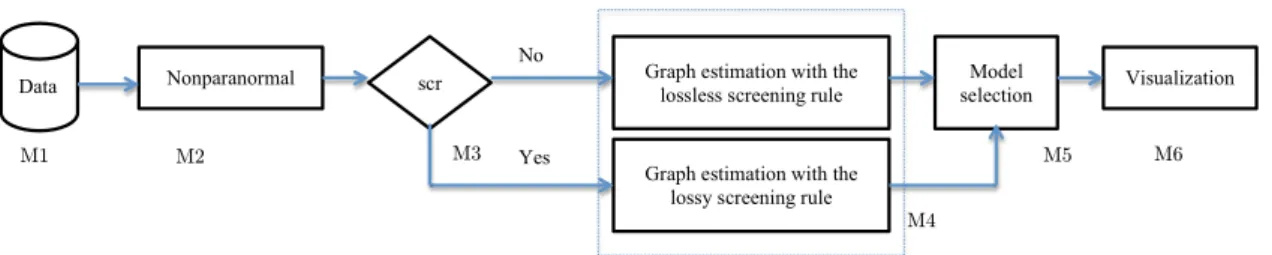
The package huge aims to provide a general framework for high-dimensional undirected graph estimation. Six functional modules (M1-M6) facilitate a flexible pipeline for anal- ysis (Figure 1).
Nonparanormal Graph estimation with the lossless screening rule
Graph estimation with the lossy screening rule
scr Model
selection Visualization Data
No
M1 M2 M3 Yes
M4
M5 M6
Figure 1: The graph estimation pipeline.
M1. Data Generator: The function huge.generator() can generate multivariate Gaussian data with different undirected graph structures, including hub, cluster, band, scale-free, and Erd¨os-R´enyi random graphs. The sparsity level of the graph structures and signal-to-noise ratios can also be adjusted by users.
M2. Semiparametric Transformation: The function huge.npn() implements the nonparanormal method [Liu et al., 2009] for estimating a semiparametric Gaussian cop- ula model by truncated normal or normal score. Computationally, the estimation of a nonparanormal transformation only requires one pass through the data matrix.
Remark 3. Although in the existing high-dimensional theory, the truncation has been proved to be asymptotically consistent and no corresponding result has been established for normal score, we find the normal score also has a good performance in practice.
M3. Graph Screening: The scr argument in the main function huge() controls the use of large-scale correlation screening before graph estimation. The function supports two types of screening rules,lossless screening and lossy screening. The lossless screening method is from Witten et al. [2011], Mazumder and Hastie [2011b] and the lossy screening method is from Fan and Lv [2008]. Such screening procedures can greatly reduce the computational cost and achieve equal or even better estimation by reducing the variance at the expense of an increase in bias.
M4. Graph Estimation: Similar to the glasso package, the method argument in the huge() function supports two estimation methods: (i) the Meinshausen-B¨uhlmann covariance selection algorithm [Meinshausen and B¨uhlmann, 2006] and (ii) the graphical lasso algorithm [Friedman et al., 2007b, Banerjee et al., 2008]. One difference between huge and glasso is that we implement all the core components using C instead of For- tran. The code is also memory-optimized using sparse matrix data structures so that it can handle larger datasets when estimating and storing full regularization paths. We also provide an additional graph estimation method based on thresholding the sample correlation matrix. Such an approach is computationally efficient and has been widely applied in biomedical research [Langfelder and Horvath, 2008].
Remark 4. We find the graphical lasso algorithm may fail to converge using the warm start trick when estimating the solution path. We proposed a modified warm start trick and explained the reason of the failure for the original warm start trick in the Appendix.
M5. Model Selection: The function huge.select() provides three regularization parameter selection methods: the stability approach for regularization selection (StARS) [Liu et al., 2010]; a modified rotation information criterion (RIC) [Lysen, 2009]; and the extended Bayesian information criterion [Foygel and Drton, 2010]. The latter approach is a likelihood-based model selection criterion that is only applicable for the graphical lasso method. StARS conducts many subsampling steps to calculate variability score using the U-statistics, which is computationally intensive but can be trivially parallelized. RIC is closely related to the permutation approach for model selection and scales to large datasets.
Remark 5. Under certain regularity condition, StARS is partially consistent and suffers overselection. The performance of StARS also depends on the tuning grid chosen by user.
Remark 6. RIC randomly rotates the variables for each sample multiple times and selects the minimum regularization which generates all zero estimated using rotated data. It has no theoretical guarantee of the consistent recovery and often suffers serious underselection or overselection.
M6. Graph Visualization: The plotting functions huge.plot() and plot() provide visualizations of the simulated data sets, estimated graphs and paths. The implementa- tion is based on the igraph package. Due to the limits of igraph, sparse graphs with only up to 2,000 nodes can be visualized.
4 User Interface by Example
We illustrate the user interface by two simple examples. The first one is based on the simulated data generated by huge.generator(),
> library(huge) # Load the package huge
> L = huge.generator(n=200,d=200,graph="hub") # Generate data with hub structures
> X = L$data; X.pow = X^3/sqrt(15) # Power Transformation
> X.npn = huge.npn(X.pow) # Nonparanormal
> out.mb = huge(X.pow,nlambda=30) # Estimate the solution path
> out.npn = huge(X.npn,nlambda=30)
> huge.roc(out.mb$path,L$theta) # Plot the ROC curve
> huge.roc(out.npn$path,L$theta)
> mb.stars = huge.select(out.mb,criterion="stars",
+ stars.thresh=0.05) # Select the graph using StARS
> npn.stars = huge.select(out.npn,criterion="stars",stars.thresh=0.05)
> mb.ric = huge.select(out.mb) # Select the graph using RIC
> npn.ric = huge.select(out.npn)
0.00 0.05 0.10 0.15 0.20 0.25 0.30 0.35
0.00.20.40.60.81.0
ROC Curve
False Postive Rate
True Postive Rate
(a) The ROC curve (b) The optimal graph by StARS
(c) The optimal graph by RIC
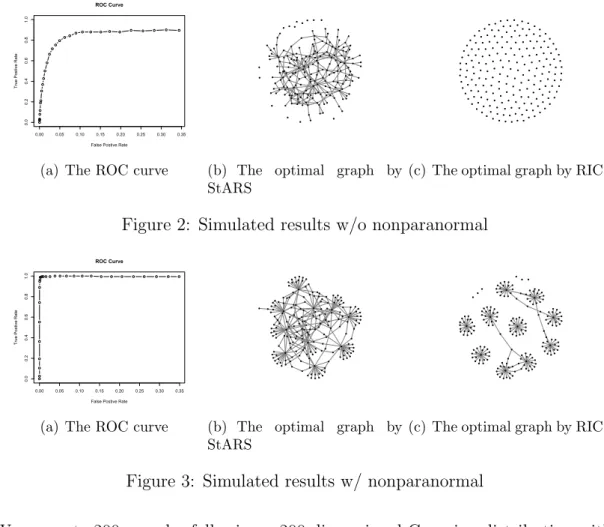
Figure 2: Simulated results w/o nonparanormal
0.00 0.05 0.10 0.15 0.20 0.25 0.30 0.35
0.00.20.40.60.81.0
ROC Curve
False Postive Rate
True Postive Rate
(a) The ROC curve (b) The optimal graph by StARS
(c) The optimal graph by RIC
Figure 3: Simulated results w/ nonparanormal
We generate 200 samples following a 200-dimensional Gaussian distribution with the hub structure, then transform the data using power transformation, which preserves the population mean and population variance. The graph is estimated by Meinshausen and B¨uhlmann [2006] by default. The program automatically sets up a sequence of 30 regularization parameters and estimates the corresponding graph path. The results w/o and w/ non paranormal are shown in Figure 2 and Figure 3 respectively. We can see a significant improvement by using nonparanormal. As mentioned in the previous section, the StARS and RIC yields a overselected and a underselected graph respectively.
The second example is based on a stock market data which we contribute to thehuge package. We acquired closing prices from all stocks in the S&P 500 for all the days that the market was open between January 1, 2003 and January 1, 2008. This gave us 1258 samples for the 452 stocks that remained in the S&P 500 during the entire time period.
> data(stockdata) # Load the stock data
> Y = log(stockdata$data[2:1258,]/stockdata$data[1:1257,]) # Preprocessing Here the data have been transformed by calculating the log-ratio of the price at time t to price at time t−1, and then standardized by subtracting the mean and adjusting the variance to one.
> Y.npn = huge.npn(Y, npn.func="truncation") # Nonparanormal
> out.npn = huge(Y.npn,method = "glasso", nlambda=40,lambda.min.ratio = 0.4)
> out = huge(Y,method = "glasso", nlambda=40,lambda.min.ratio = 0.4) Here the nonparanormal transformation is applied to the data, and the graph is estimated using the graphical lasso (the default is the Meinshausen-B¨uhlmann estimator). The pro- gram automatically sets up a sequence of 40 regularization parameters and estimates the corresponding graph path. The lossless screening method is applied by default. The out- put of graph estimation using the transformed data is shown in Figure 4. To investigate
0.8 0.6 0.4
0.000.040.08
Sparsity
Regularization
● ●
●
lambda = 0.664
●
●
●
●
●
●
●
●
●
●
●
●
●
●
●
●
●
●
●
●
●
●
●
●
●
●
●
●
●
●●
●
●
●
●
●
●
●
●
●
●
●
●
●
●
●
●
●
●
●
●
●
●
●
●
● ●
●
●
●
●
●
●
●
●
●
●
●
●
●
●
●
●
●
●
●
●
●
●
●
●
●
●
●
●
●
●
●
●
●
●
●
●
●
●
●
●
●
●
●
●
●
●
●
●
●
●
●
●
●
●
●
●
●
●
●
●
●
●
●
●
●
●
●
●
●
●
●
●
●
●
●
●
●
●
●
●
●
●
●
●
●
●
●
●
●
●●
●
●
●
●
●
●
●
●
●
●
●
●
●
●
●
●
●
●
●
●
●
●
●
●
●
●
●
●
●
●
●
●
●
●
●
●
●
●
●
●
●
●
●
●
●
●
●
●
●
●
●
●
●
●
●
●
●
●
●
●
●
●
●
●
●
●
●
●
●
●
●
●
●
●
●
●
●
●
●
●
●
●
●
●
●
●
●
●
●
●
●
●
●
●
●
●
●
●
●
●
●
●
●
●
●
●
●
●
●
●
●
●
●
●
●
●
●
●
●
●
●
●
●
●
●
●
●
●
●
●
●
●
●
●
●
●
●
●
●
●
●
●
●
●
●
●
●
●
●
●
●
●
●
●
●
●
●
●
●
●
●
●
●
●
●
●
●
●
●
●
●
●
●
●
●
●
●
●
●
●
●
●
●
●
●
●
●
●
●
● ●
●
●
●
●
●
●
●
●
●
●
●
●
●
●
●
●
●
●
●
●
●
●
●
●
●
●
●
●
●
●
●
●
●
●
●
●
●
●
●
●
●
●
●
●
●
●
●
●
●
●
●
●
●
●
●
●
●
●
●
●
●
●
●
●
●
●
●
●
●
●
●
●
●
●
●
●
●
●
●
●
●
●
●
●
● ●
●
●
●
●
●
●
●
● ●
●
●
●
●
●
●
●
●
●
●
●
●
●
●
●
●
●
●
lambda = 0.605
●
●
●
●
●
●
●
●
●
●
●
●
●
●
●
●
●
●
●
●
●
●●
●
●
●
●
●
●
●
●
●
●
●
●
●
●
●
●
●
●
● ●
●
●
●
●
●
●
●
●
●
●
●
●
●
●
●
●
●
●
●
●
●
●
●
●
●
●
●
●
●
●
●
●
●
●
●
●
●
●
●
●
●
●
●
●
●
●
●
●
●
●
●
●
●
●
●
●
●
●
●
●
●
●
●
●
●
●
●
●
●
●
●
●
●
●
●
●
●
●
●
●
●
●
●
●
●
●
●
●
●
●
●
●
●
●
●
●
●
●
●
●
●
●
●
●●
●
●
●
●
●
●
●
●
●
●
●
●
●
●
●
●
●
●
●
●
●
●
●
●
●
●
●
●
●
●
●
●
●
●
●
●
● ●
●
●
●
●
●
●
●
●
●
● ●
●
●
●
●
●
●
●
●●
●
●
●
●
●
●
●
●
●
●
●
●
●
●
●
●
●
●
●
●
●
●
●
●
●
●
●
●
●
●
●
●
●
●
●
●
●
●
●
●
●
●
●
●
●
●
●
●
●
●
●
●
●
●
●
●
●
●
●
●
●
●
●
●
●
●
●
●
●
●
●
●
●
●
●
●
●
●
●
●
●
●
●
●
●
●
●
●
●
● ●
●
●
●
●
●
●
●
●
●
●
●
●
●
●
●
●
● ●
●
●
●
●
●
●
●
●
●
●
●
●
●
● ●
●
●
●
●
● ●
●
●
●
●
●
●
●
●
●
●
●
●
●
●
●
●
●
● ●
●
●
●
●
●
●
●
●
●
●
●
●
●
●
●
●
●
●
●
●
●
●
●
●
●
●
●
●
●
●
●
●
●
●
●
●
●
●
●
●
●
●
●
●
●
●
●
●
●
●
●
●
●
●
●
●
●
●
●
●
●
●
●
●
●
●
●
●
●
●
●
●
●
●
●
●
●
●
●
●
●
●
●
●
●
●
●
●
●
●
●
●
●
●
●
●
●
lambda = 0.538
●
●
●
●
●
●
●
●
●
●
●
●
●
●
●
●
●
●
●
●
●
●
●
●
●
●
●
●
●
●
●
●
●
●
●
●
●
●
●
●
●
●
●
●
●
●
●
●
●
●
●
●
●
●
●
●
●
●
●
●
●
●
●
●
●
●
●
●
●
●
●
● ●
●
●
●
●
●
●
●
●
●
●
●
●
●
●
●
●
●
●
●
●
●
●
●
●
●
●
●
●
●
●
●
●
●
●
●
●
●
●
●
●
●
●
●
●
●●
●
●
●
●
●
●
●
●
●
●
●
●
●
●
●
●
●
●
●
●
●
●
●
●
●
●
●
●
●
●
●
●
●
●
●
●
●
●
●
●
●
●
●
●
●
●
●
●
●
●
●
●
●
●
●
●
●
●
●
●
●
●
●
●
●
●
●
●
●
●
●
●
●
●
●
●
●
●
●
●
●
●
●
●
●
●
●
●
●
●
●
●
●
●
●
●
●
●
●
●
●
●
●
●
●
●
●
●
●
●
●
●
●
●
●
●
●
●
●
●
●
●
●
●
●
●
●
●
●
●
●
●
●
●
●
●
●
●
●
●
●
●
●
●
●
●
●
●
●
●
●
●
●
●
●
●
●
●
●
●
●
●
●
●
●
●
●
●
●●
●
●
●
●
●
●
●
●
●
●
●
●
●
●
●
●
●
●
●
●
●
●
●
●
●
●
●
●
●
●
●
●
●
●
●
●
●
●
●
●
●
●
●
●
●
●
●
●
●
●
●
●
●
●
●
●
●
●
●
●
●
●
●
●
●
●
●
●
●
●
●
●
●
●
●
●
●
●
●
●
●
●
●
●
●
●
●
●
●
●
●
●
●
●
●
●
●
●
●
●
●
●
●
●
●
●
●
●
●
●
●
●
●
●
●
● ●
●
●
●
●
●
●
●
●
●
●
●
●
●
●
●
●
●
●
●
●
●
●
●
●
●
●
●
●
●
●
●
●
●
●
●
●
●
●
●
●
●
●
●
●
●
●
Figure 4: The estimated graph path.
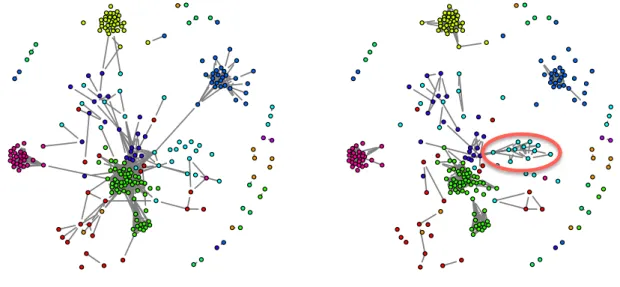
the impact of the nonparanormal transformation, we plot points in a subgraph calculated with and without the transformation (Figure 5). Both graphs have the sparsity level at
!
!
!
!
!
!
!
!
!
!
!
!
!
!
!
!
!
!
!
!
!
!
!
!
!
!
!
!
!
!
!
!
!
!
!
!
!
!
!
!
!
!
!
!
! !
!
!
!
! !
!
!
!
!
!
!
!
!
!
!
!
!
!
!
!
!
!
!
!!
!
! !
!
!
! !
!
!
!
!
!
!
!
!
!
!
!
!
!
!
!
!
!
!
!
!
!
!
!!
!
!
!
!
!
!
!
!
!
!
!
!
!
!
!
!
!
!
! !
!
!
!
!
!
!
!
!
!
!
! !
!
!
!
!
!
!
!
!
!
!
!
!
!
!
!
!
!
!
!
!
!
!
!
!
!
!
!
!
!
!
!
!
!
!
!
!
!
!
!
!
!
! !
!
!
!
!
!
!
!
!
!
!
!
!
!
!
!
!
!
!
!
!
!
!
!
!
!
!
!
!
!
!
!
!
!
!
!
!
!
!
!
!
!
!
!
!
!
!
!
!
!
!
!
!
!
!
!
!
!!
!
!
!
!
!
!
!
!
!
!
!
!
!
!
!
!
!
! !
!
!
!
!
!
!
!
!
!
!
!
!
!
!
!
!
!
!
!
!
!
!
!
!
!
!
!
!
!
!
!
!
!
!
!
!
!
!
!
!
!
!
!
! !
!
!
!
! !
!
!
!
!
!
!
!
!
!
!
!
!
!
!
!
!
!
!
!!
!
! !
!
!
! !
!
!
!
!
!
!
!
!
!
!
!
!
!
!
!
!
!
!
!
!
!
!
!!
!
!
!
!
!
!
!
!
!
!
!
!
!
!
!
!
!
!
! !
!
!
!
!
!
!
!
!
!
!
! !
!
!
!
!
!
!
!
!
!
!
!
!
!
!
!
!
!
!
!
!
!
!
!
!
!
!
!
!
!
!
!
!
!
!
!
!
!
!
!
!
!
! !
!
!
!
!
!
!
!
!
!
!
!
!
!
!
!
!
!
!
!
!
!
!
!
!
!
!
!
!
!
!
!
!
!
!
!
!
!
!
!
!
!
!
!
!
!
!
!
!
!
!
!
!
!
!
!
!
!!
!
!
!
!
!
!
!
!
!
!
!
!
!
!
!
!
!
!
Figure 5: The estimated glasso graph (left) and nonparanormal graph (right).
about 1% and we can see the different pattern between them. We highlight a dense mod- ule in the nonparanormal graph which is much sparser in the corresponding glasso graph.
We can see all nodes in this module belong to the same category. This example well demonstrates the power of the nonparanormal method to reveal the relationship beyond the normality assumption.
5 Performance Benchmark
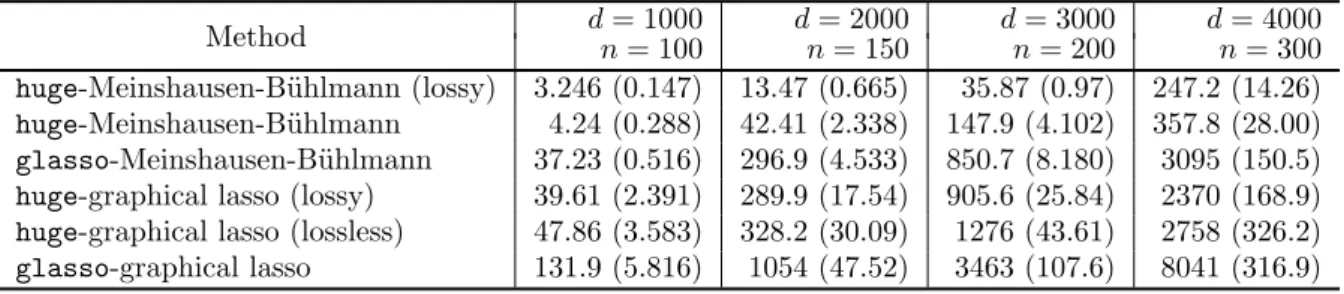
We adopt similar experimental settings as in Friedman et al. [2010b] to compare huge with glasso (ver 1.4). We consider four scenarios with varying sample sizes n and number of variables d, as shown in Table 1. We simulate the data from three different multivariate normal distributions with null graph (diagonal covariance matrix) and Erd¨os- R´enyi random graph (with probability 0.01 )structures respectively. Timings (in seconds) are computed over 10 values of the corresponding regularization parameter, and the range of regularization parameters is chosen so that each method produced approximately the same number of non-zero estimates. The convergence threshold of bothglasso andhuge is chosen to be 10−4. All experiments were carried out on a PC with Intel Core i5 3.3GHz processor. Unfortunately,CLIME(ver 1.0)Covpath(ver 0.2), were unable to obtain timing results due to numerical issues. parcor (ver 0.22) failed to get any results in 3 hours.
Table 1: Experimental Results on Null Graph
Method d= 1000 d= 2000 d= 3000 d= 4000
n= 100 n= 150 n= 200 n= 300
huge-Meinshausen-B¨uhlmann (lossy) 2.688 (0.140) 11.14 (0.623) 30.47 (0.738) 223.5 (13.14) huge-Meinshausen-B¨uhlmann 4.032 (0.267) 37.51 (2.254) 119.6 (3.888) 330.6 (25.49) glasso-Meinshausen-B¨uhlmann 34.38 (0.481) 245.8 (4.143) 800.7 (7.652) 2694 (136.5) huge-graphical lasso (lossy) 34.39 (2.173) 246.5 (16.18) 857.3 (24.18) 2015 (151.1) huge-graphical lasso (lossless) 43.13 (3.461) 310.4 (28.19) 1071 (41.51) 2510 (293.4) glasso-graphical lasso 122.1 (5.259) 931.4 (45.96) 2998 (97.71) 7485 (307.5)
For Meinshausen-B¨uhlmann graph estimation, we can see thathugeachieves the best performance. In particular, when the lossy screening rule is applied, huge automatically reduces each individual lasso problem from the original dimension d to the sample size n, therefore even better efficiency can be achieved in settings when d≫n. Based on our experiments, the speed up due to the lossy screening rule can be up to 400%.
Table 2: Experimental Results on Random Graph
Method d= 1000 d= 2000 d= 3000 d= 4000
n= 100 n= 150 n= 200 n= 300
huge-Meinshausen-B¨uhlmann (lossy) 3.246 (0.147) 13.47 (0.665) 35.87 (0.97) 247.2 (14.26) huge-Meinshausen-B¨uhlmann 4.24 (0.288) 42.41 (2.338) 147.9 (4.102) 357.8 (28.00) glasso-Meinshausen-B¨uhlmann 37.23 (0.516) 296.9 (4.533) 850.7 (8.180) 3095 (150.5) huge-graphical lasso (lossy) 39.61 (2.391) 289.9 (17.54) 905.6 (25.84) 2370 (168.9) huge-graphical lasso (lossless) 47.86 (3.583) 328.2 (30.09) 1276 (43.61) 2758 (326.2) glasso-graphical lasso 131.9 (5.816) 1054 (47.52) 3463 (107.6) 8041 (316.9)
Unlike the Meinshausen-B¨uhlmann graph approach, the graphical lasso estimates the inverse covariance matrix. The lossless screening rule [Witten et al., 2011, Mazumder and Hastie, 2011b] greatly reduces the computation required by the graphical lasso algorithm, especially when the estimator is highly sparse. The lossy screening rule can further speed up the algorithm and provides an extra performance boost.
6 Conclusions
We developed a new package namedhuge, for high dimensional undirected graph estima- tion. The package is complementary to the existing glasso package by providing extra features and functional modules. We plan to maintain and support this package in the future.
7 Appendix
7.1 A Typical Example of Failure
In the packageglasso, the warm start trick begins with the larger regularization parame- ters and gradually decreases the regularization parameter. However, in real applications, we find this strategy may lead to divergence or other numerical issues sometimes. We first provide an example that glasso fails to converge.
> library(huge) # load the package huge
> library(glasso) # Load the package glasso
> data(stockdata) # Load the stock data
> X = log(stockdata$data[2:1258,]/stockdata$data[1:1257,]) # Preprocessing
> out.huge = huge(X,method = "glasso", nlambda=5)
> out.glasso = glassopath(cor(X),rholist = out.huge$lambda[5:1])
7.2 A Modified Warm Start trick
From Banerjee et al. [2008], we know a good initial value for the estimated covariance matrix Σ should satisfy the constraintb
kΣb−Sk∞ ≤λ and Σ≻0 (5)
whereS is the sample covariance matrix. Otherwise, the algorithm cannot guarantee the positive definiteness of the estimation. Once the positive definiteness is violated in some iteration, the whole algorithm will fail. Now suppose we have a sequence of decreasing regularization parameters λ1, ..., λK and for λk, we have obtain the estimated covariance matrix as Σbk. By KKT condition, we know
kΣbk−Sk∞≤λk (6) However, when we useΣbk as the initial values for estimatingΣbk+1 corresponding toλk+1, although Σbk ≻ 0 hold, it is highly likely that Σbk may violate our requirement of (5) when using the regularization parameterλk+1, sinceλk> λk+1. The glass algorithm may tolerate slight violation sometimes, but when we decrease the regularization parameter