
Linux 環境へのPMIPv6 の実装と評価
6
0
0
全文
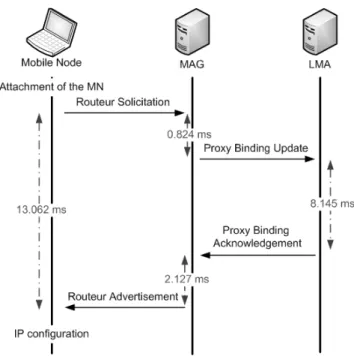
(2) Figure 2 Registration Procedure of PMIPv6 Figure 1 Architecture of PMIPv6. different access to the PMIP network, the MN will receive providing a better understanding of what must be changed. the same advertised prefixes and will believe that it didn’t. in MIP for implementing PMIP. Then, we will explain how. change its network access.. the protocol was implemented, what limitations we assigned. 2. 3 Messages processing. and the choices we made. Following this, we will describe the. 2. 3. 1 First registration. results of the evaluation of our implementation. Eventually. The messages exchanged during the registration of the. we will conclude by stating the functionalities we could add. node for mobility support are described in figure 2. The. in order to improve our work.. registration process begins as soon as the MAG detects a new MN in the network. At the detection, it will get the. 2. PMIP Principles. MN identifier from the node information and get the node’s. 2. 1 The architecture. profile from the identifier. If the node’s profile states that the. Figure 1 shows the architecture of a typical PMIP net-. MN is allowed to use PMIP, the MAG will register the MN. work. We can see that PMIP introduces a new entity in the. with the LMA. This registration is similar to the one used. network, the mobile access gateway (MAG). This entity will. in MIP but adapted to PMIP. So the MAG will first send. act as the access router of the network. It will also perform. a Proxy Binding Update (PBU) to the LMA. The PBU is a. the mobility management on behalf of the mobile node. With. Binding Update with the proxy flag set to 1. A PBU must. PMIP, the HA is renamed Local Mobility Anchor (LMA) but. carry the MN information such as its identifier, the home. its actions remain the same, it is responsible for maintaining. network prefixes if known by the MAG, the link local and. the node’s reachability state and the home network prefixes. link layer addresses of the MN, and other information con-. associated to the mobile node will be anchored at the LMA.. cerning the access technology, the handoff status of the MN. 2. 2 Main principles. and a timestamp. The use of timestamp instead of sequence. The main principle of PMIP is to make the mobile node. number in PMIP is necessary because there is no context. believe that in the PMIP network, it always has access to the. transfer between MAGs and thus, a MAG that just detects. same router, even when changing the physical attachment to. the node on its link won’t be able to get the previously used. the network. For this, the LMA and MAG must have ac-. sequence number if the MN was previously registered for. cess to the mobile node (MN) profile and policy, common. PMIP use. On reception of the PBU, the LMA will deter-. to every PMIP entity. It means that a MN that wants to. mine if it must accept or not the PBU. If it is accepted, the. use the mobility in a PMIP network must be first registered.. LMA will create a binding cache entry for the node’s mobil-. The profile of the MN will include the MN identifier and. ity session, allocate to the node its home network prefixes. the home network prefixes allocated to the MN. So in the. and then set up a tunnel to the MAG, if there isn’t one pre-. mobility registration process, the MAG will advertise to the. viously existing, and the routes for forwarding the packets to. MN its home network prefixes. Hence, even when using a. and from the node’s allocated prefixes. The LMA will then. - 14 -. —2—.
(3) generate a Proxy Binding Acknowledgement (PBA) that will. 3. Implementation. echo the PBU information, indicate if the PBU was accepted or not, and carry the allocated prefixes with their associated. 3. 1 The umip client. lifetime. On reception of an accepted PBA, the MAG will. We realized the PMIP implementation based on the exist-. set up its own tunnel and routes for forwarding the pack-. ing Linux MIP client named umip in its version 0.4 [4]. This. ets of and to the MN. It will also store the node’s mobility. client is the most used in the Linux environment and is a. session in its binding update list. Then, it will send to the. free software, thus we had a free access to its sources. The. MN a Router Advertisement message, as defined in Neighbor. client is composed of several modules. We will now describe. Discovery Protocol [5], advertising the mobile node allocated. the main ones. One is related to the functionalities specific. prefixes.. to the MN, one is related to those specific to the HA. Those. On reception of the router advertisement, the Mobile Node. functions will mainly concern sending and receiving mobility. will configure its IP address itself (stateless autoconfigura-. messages. In order to store the information of the bind-. tion) or through DHCPv6 (stateful autoconfiguration), de-. ing update messages received by the HA, a module named. pending on the configuration of the network.. Binding Cache was created. In this module every mobility. Then the MAG will regularly send router advertisement. session created will be stored and managed as a new entry in. to the node, each time after successfully registered with the. the binding cache. A similar module has been created for the. LMA, in order to extend the lifetime of the prefixes.. MN. It is named Binding Update List and it stores, as indi-. 2. 3. 2 Mobile node de-registration. cated by the name, the binding update that have been sent. When the MAG detects the mobile node detachment, it. by the node. Both modules are relying on another module to. sends to the LMA a PBU corresponding to the mobile node. store the information, the hash tables. Another important. information but with an associated lifetime value of 0. The. module is the mobility one. This module handles the gener-. LMA on reception of this PBU will wait during a configured. ation and parsing of mobility messages and options. There. period of time for the reception of a PBU of another MAG. is also one module dedicated to the neighbor discovery pro-. in case of a handoff of the node between two MAGs. If it. tocol. Such module will allow the client to receive router. didn’t receive anything during this time, it will end the mo-. advertisement or neighbor advertisement message and send. bility session by deleting the binding cache entry of the node,. neighbor solicitation messages. There is also a function to. its associated routes and tunnel (if not in use by other nodes). perform a duplicated address detection (DAD) [5]. Concern-. and then send a PBA to the MAG, acknowledging the end. ing the tunnel creation, a module is dedicated to the tun-. of the mobility session. On reception of the PBA or after a. nel management. It is called by the modules HA and MN. period of time, the MAG will also delete the mobility session. for adding and deleting tunnels. Finally, at the core of the. from its binding update list and delete the routes and tunnel. client we have two modules. One is dedicated to the config-. associated.. uration management. It parses the configurations file of the. 2. 4 The support of mobility. client. The other one is the main module, it will initialize. With this registration process, once the node is registered,. the configuration and then launch all the needed modules.. it will be able to configure its IP address and then send. 3. 2 The changes to make for supporting PMIP. and receive packets. The packets sent by the MN will be. Though PMIP is derived from MIP, it has a lot of differ-. routed to the MAG, because it acts as the default router in. ences with the former. The main changes are in the part. PMIP network, then they will be tunneled to the LMA and. of detection of the movements of the node because in MIP,. finally they will be forwarded to their destination. Since the. since the daemon is running on the node it has access to all. home network prefixes allocated to the node are owned by. the desired information. That is not the case with PMIP. the LMA, the packets sent to the MN will be routed first to. since the actions realized on the node are transferred to the. the LMA which will forward them through the tunnel to the. MAG. For implementing the detection of the node, we chose. corresponding MAG, which will forward them to the mobile. to not rely on the link layer events because they are specific. node.. to the link layer technology. Instead we used the IP layers. Then, each time the node will change its attachment to. events. For detecting the presence of the Mobile Node, we. the network within the PMIP network, it will receive the. decided to use the Router Solicitation messages sent by a. same prefixes. Plus, in PMIP, the MAGs must all have the. node when attaching to a new link. For detecting that a. same link local and link layer address. So the MN have the. node is still present on the link, before sending a PBU for. impression to have always the same default router and thus,. extending the lifetime, we perform a Duplicate Address De-. doesn’t detect a change of network.. tection (DAD) [5] on the mobile node link local address. If. - 15 -. —3—.
(4) the DAD is a success, it means that the node is not on the. and added it in the module neighbor discovery. After having. link anymore. Else it means that the node is still there.. coded this part, we tested it by sending messages through the. Apart from detecting the node, the other differences are that we need to implement all the new mobility options and. PMIP client and analyzed them with the program Wireshark in order to check if they actually were as designed in [5].. status specific to PMIP that are defined in [3]. There is also. Once the neighbor discovery messages were correctly han-. the processing of proxy binding update and proxy binding. dled, we focused on the mobility messages exchanged be-. acknowledgment, the timestamp management and the gen-. tween the LMA and the MAG. We first added the genera-. eration of router advertisement messages from PMIP infor-. tion of the new options and then the generation of PBU and. mation.. PBA. For this, we modified in the module MAG the func-. 3. 3 The developpement of the PMIP client. tion for sending proxy binding aknowledgement. Similarly,. As said before, the MIP client is made of two distinct parts,. we modified the function for sending proxy binding update. one for the MN and one for the HA. Since the MAG actions. in the module LMA. We tested it by sending a PBU to a non. were close to the ones from the MN in MIP, we took over the. modified MIP client and saw how it reacted to the message.. MN code for implementing the MAG. Similarly, the LMA’s. It behaved as we planned, meaning that it was recognized as. algorithms were coded over the HA. For implementing the. a Binding Update but was rejected because it didn’t carry. changes described before, we began by defining the new mo-. the usual MIP options. So we then attached to develop the. bility options and status used in mobility messages. We had. processing of those messages in the corresponding modules. a problem with the Mobile Node Identifier option because. and implemented the forwarding of packets for the mobile. the RFC just specified it but didn’t say how to actually im-. node. The forwarding of packets is handled in the modules. plement it. So we eventually chose to use the Media Access. LMA and MAG, so we modified the related functions. PMIP,. Control (MAC) address of the mobile node as Mobile Node. as specified in RFC 5213, allows for two possible ways of. Identifier. Another possibility would have been to use a Net-. creating tunnels, statically (tunnels created permanently at. work Access Identifier, as defined in [6], but it was harder to. the initialization of the MAG) or dynamically (tunnels cre-. implement. Since the MAC address wasn’t specified as a mo-. ated when they are needed and then deleted). Since in MIP. bile node identifier, it didn’t have a type defined for the type. they were created dynamically, we chose to stick with this. field of the mobile node identifier option. We chose to assign. method. In PMIP, the forwarding of packets for the mobile. the type 2 for MAC address. All the other options and sta-. node is different (use of prefix instead of an address), par-. tus were implemented as specified as in the RFC. Then, we. ticularly on the MAG, because it has to forward the packet. implemented the options needed by PMIP in order to do the. to the MN, so we had to adapt it. We also implemented. PMIP client configuration. For this task, we simply modi-. the timestamp management for the MAG and LMA. This. fied the modules configuration management and mobility. In. was added to the modules LMA and MAG in the functions. the module configuration, we added the new client options. for processing the mobility messages. And of course the al-. to parse. In the module mobility, we added the parsing and. gorithms for processing the new options and for processing. creation of the new mobility options.. the proxy binding update and proxy binding acknowledg-. After having implemented the new options and status, we implemented the neighbor discovery messages used by PMIP.. ment were different too. So we had to further modify the functions for processing mobility messages.. First, we added a function for the reception of router solic-. Finally, when everything was implemented, we made some. itation messages in the MAG module and then we added a. test and made sure that everything worked as planned. So. function for sending the router advertisement messages in. we created a network composed of one LMA, two MAGs and. the neighbor discovery module. The router solicitation mes-. one mobile node. We then configured it for the use of PMIP. sages were quite easy to implement because of the existent. and realized some tests and performance evaluation. The. neighbor discovery functions in the module. So we added. results of those are described in the next session.. a handler of router soliciation messages in the MAG code. 3. 4 Limitations of the implementation. and coded the extraction of information such as the MAC. Because of the short time we had planned for the project,. address. Then, we implemented sending of router advertise-. we limited ourselves. One first limitation is the handle of. ment messages. Since with umip the router advertisement. only one prefix for the mobile node. Although the RFC. messages are sent via the radvd daemon and not with the. states that there may be more than one prefix assigned to. MIP client itself, we had to code the whole feature. For. the node, it was simpler to implement one. But one could. simplicity’s sake, we inspired ourselves from the radvd code. easily add the possibility to handle more than one prefix.. which is also free. Thus, we adapted the code to our client. Since we used the MAC address as a mobile node identifier,. - 16 -. —4—.
(5) Figure 4 Performances of our implementation during the lifetime extension. Figure 3 Performances of our implementation during the first registration. we implicitly limited ourselves by assuming that the mobile node possesses only one interface (the MAC address is different for each interface). Getting over this limitation would more difficult because we would have to somehow find a way to link every interface to a common mobile node identifier. Due to a time limitation, we didn’t either implement the use. Figure 5 Performances of our implementation during the deregistration. of IPSec for the mobility messages. Since this part was already implemented in the MIP client, one could easily add this possibility by taking over the MIP code. Lastly, since. sages, in the case of a life extension. Indeed, the generation. we chose to rely on the router solicitation messages instead. of those messages doesn’t require much computing time be-. of the link layer events, one could try to implement specific. cause they are generated from the information given by the. ways of detecting the MN, depending of the link layer type.. PBA just received. The node just needs to update the lifetime of the binding update list entry and then generate the. 4. Evaluation. message from the entry. Another message processing which. 4. 1 Time processing evaluation. is quick is the generation of a PBU from a Router Solicita-. For the performance evaluation of our client, we used for. tion message. The computing time for this task is also short. the MAG and LMA computers with as processor an Intel. because the MAG only needs to read the information of the. Celeron 1.5 GHz and for the random access memory (RAM). Router Solicitation message, create the entry in the binding. 2 GB of type DDR 266Hz. The results are given in the fig-. update list, and then send the Proxy Binding Update to the. ures 3, 4, and 5. On those figures, we put the processing. LMA. The other messages processing times are longer because. time for three distinct operations, the first registration, the. they require more complex actions. In the case of the gen-. lifetime extension and the de-registration. For each action measured, we did 10 measurements. For. eration of the Proxy Binding Acknowledgment, it is because. the MAG and LMA, we used the network capture software. the Proxy Binding Update message must be processed first. tcpdump and for the MN we used Wireshark. Those soft-. and there are a lot of verifications to do on the message and. ware allowed us to visualize the packets that were sent and. the number of mobility options carried by the Proxy Binding. received on each interface.. Update is important. In the case of the first time registra-. From all the figures, we can see that the times are really. tion, for which the times are the longer, once the PBU has. different, depending on each action. The shortest times are. been processed, the LMA still needs to allocate the prefixes,. seen with the generation of the Router Advertisement mes-. add the new entry to its binding cache and finally set up the. - 17 -. —5—.
(6) tunnel and routes for forwarding the packets of the mobile. the time needed for processing the overhead is around 0.020. node. We chose here to create the tunnels dynamically. So at. ms for both the LMA and the MAG, which is an acceptable. each first registration or de-registration, a tunnel is added or. value for most of the users.. deleted. We measured a time of 2 ms for the creation of the. 5. Conclusion. tunnel, hence with pre-established tunnels we could reduce. We described in this paper the implementation of the. the computing time for the generation of first registration. PMIP protocol. We decided to develop it under the Linux. and de-registration messages. We can also note that the processing time is longer on the. environment, following the implementation of MIP, namely. LMA than the MAG. This can be explained by the fact that. umip in its version 0.4. We chose to implement PMIP be-. the LMA creates a new thread for each proxy binding update. cause we believe that offering to the users the possibility to. received and because there are more checks in order to know. access to mobility without requiring anything apart from the. if the PBU must be accepted or not, than for accepting the. usual IPv6 stack, will help the use of mobility to spread. The implementation we realized here is only a prototype,. PBA. Finally, the average time for registering the mobile node. hence a lot of things are still needed. Among those we could. in our network for support of mobility is around 13 ms. In. state the need for IPSec, or adding the possibility to use. those 13 ms, we can distinguish around 11 ms for the pro-. more than one interface and prefix, or also change the node. cessing of messages and 2 ms that corresponds to the round. detection for using the link layer events instead of the neigh-. trip times between the LMA and the MAG and between the. bor discovery protocol. We could also offer the possibility to. MAG and the MN. In general, the registration time can be. configure the method for tunnel creation with the use of a. represented as follows:. configuration variable for instance. This way we could easily switch from pre-established tunnels and dynamic creation.. RT TM AG−LM A + RT TM N −M AG + 11 ms.. So a lot of work is still needed for improving the client and. where, RT TM AG−LM A is the round trip time between the. making it more mature for a larger distribution.. MAG and the LMA and RT TM N −M AG is the round trip time. But even without those features, our client is already of-. between the MN and the MAG. RT TM N −M AG is negligible. fering mobility support when a network is configured to use. because the MN and the MAG are usually directly connected. it. We managed to do some handover and keep the previ-. by a wireless link such as IEEE802.11. RT TM AG−LM A would. ous TCP and UDP connections open. The performances we. be less than 10 ms because the MAG and the LMA are con-. evaluated are quite reassuring and are well acceptable for a. nected to the same PMIP domain. Thus, the registration. general use of mobility.. time can be estimated as less than 20 ms in the actual environment.. So we hope that our prototype will be improved in the future in order to expand its use, but at the same time we. 4. 2 Handover evaluation. are pleased to see that the mobility is already working well. Apart from those time measurements, we tested our final. and that the performances of our client are good enough for. client by doing some handover between our two MAGs. Al-. a general use.. though packets were lost while we switched the access point to the network of the mobile node, the connections of the layers above the IP layer were not lost (UDP and TCP), meaning that the network correctly handled the mobility of the mobile node thanks to the LMA and both MAGs. 4. 3 Overhead evaluation Since with PMIP the packets are forwarded through a tunnel, we decided to measure the time processing related to the overhead. For this, we took some measures of the forwarding of packet by the LMA and the MAG through the PMIP protocol. Then, we compared them to the forwarding of. References [1] C. Perkins. IP Mobility Support for IPv4, August 2002. RFC 3344. [2] D. Johnson, C. Perkins, and J. Arkko. Mobility Support in IPv6, June 2004. RFC 3775. [3] S. Gundavelli, K. Leung, V. Devarapalli, K. Chowdhury, and B. Patil. Proxy Mobile IPv6, August 2008. RFC 5213. [4] Umip 0.4: Mobility client for linux. http://umip.linuxipv6.org. [5] T. Narten, E. Nordmark, W. Simpson, and H. Soliman. Neighbor Discovery for IP version 6 (IPv6), September 2007. RFC 4861. [6] B. Aboba, M. Beadles, J. Arkko, and P. Eronen. The Network Access Identifier, December 2005. RFC 4282.. the same packets without PMIP. So for forwarding an IPv6 packet through the tunnel, the MAG will need 0.039 ms. It is nearly the same for the LMA because it needs 0.040 ms. On the same computers, a simple forwarding of an IPv6 packet without PMIPv6 takes only 0.021 ms. So we can say that. - 18 -. —6—.
(7)
図

関連したドキュメント
An easy-to-use procedure is presented for improving the ε-constraint method for computing the efficient frontier of the portfolio selection problem endowed with additional cardinality
The inclusion of the cell shedding mechanism leads to modification of the boundary conditions employed in the model of Ward and King (199910) and it will be
(Construction of the strand of in- variants through enlargements (modifications ) of an idealistic filtration, and without using restriction to a hypersurface of maximal contact.) At
It is suggested by our method that most of the quadratic algebras for all St¨ ackel equivalence classes of 3D second order quantum superintegrable systems on conformally flat
[11] Karsai J., On the asymptotic behaviour of solution of second order linear differential equations with small damping, Acta Math. 61
Keywords: continuous time random walk, Brownian motion, collision time, skew Young tableaux, tandem queue.. AMS 2000 Subject Classification: Primary:
This paper develops a recursion formula for the conditional moments of the area under the absolute value of Brownian bridge given the local time at 0.. The method of power series
Answering a question of de la Harpe and Bridson in the Kourovka Notebook, we build the explicit embeddings of the additive group of rational numbers Q in a finitely generated group
