
スターグラフに基づく対費用効果に優れたP2Pオーバーレイの提案
7
0
0
全文
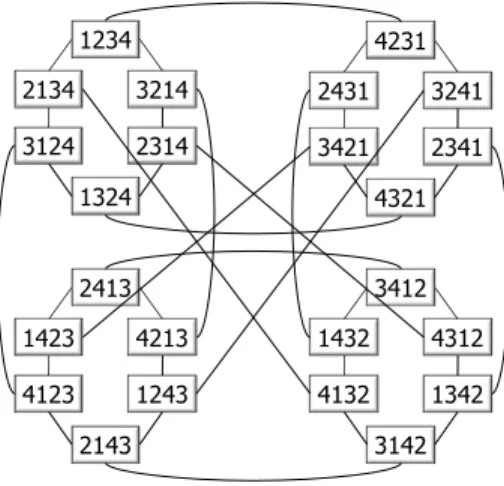
(2) Vol.2009-AL-125 No.4 2009/7/21 IPSJ SIG Technical Report. 1234 2134. 3214. 2431. 3241. 3124. 2314. 3421. 2341. 1324. 4321. 2413. 3412. 1423. 4213. 1432. 4312. 4123. 1243. 4132. 1342. 2143. log N log N log N = ≤ (1 + o(1)) . log n − 1 log log N − log log n log log N Hence the claim follows. n≤. 4231. Q.E.D.. 3. A Contracted Graph of Star Graph Given Sn , we can construct a class of graphs by repeatedly contracting several vertices into a vertex. Such graph is generally referred to as a contracted graph, and our proposed scheme is based on such notion of contraction of vertices. In the following, to clarify the exposition, we introduce the notion of “bags” to represent contracted vertices. We will use symbols x and y to denote bags, and symbol B to denote a set of bags. Each bag corresponds to a prefix of a vertex in Vn . In the following, we often identify a bag with its corresponding prefix. Bag x contains all vertices in Vn to have prefix x. For example, when n = 5, bag 123 contains two vertices 12345 and 12354 in Vn . Definition 1 Let G(B) be a graph with a bag set B and an edge set EB , where two bags x, y are connected by an edge in EB if and only if there exist two vertices u, v ∈ Vn such that u ∈ x, v ∈ y, and {u, v} ∈ En . For example, two bags 123 and 423 in B are connected by an edge in EB since there are two vertices 12345 and 42315 connected by an edge in S5 . Note that by the definition of Sn , any two vertices contained in a bag are not connected by an edge in En . Definition 2 (Type of edges) An edge in EB is said to be a base edge if it connects two bags x and y such that: 1) x, y ∈ Vn′ for some n′ ≤ n, and 2) x and y are connected by an edge in Sn′ . The other edges in EB are called cross edges. For example, when n = 5, bags 123 and 213 are connected by a base edge, and bags 123 and 423 are connected by a cross edge. For any 2 ≤ i ≤ n, let Bn,i denote a set of bags defined as follows: Bn,i = {u1 u2 . . . un−i | u1 u2 . . . un ∈ Vn }. For example, when n = 5 and i = 3, set B5,3 consists of the following 20 (= 5 × 4) bags: B5,3 = {12, 13, 14, 15, 21, 23, 24, 25, . . . , 54}. By definition, each bag in Bn,i contains i! vertices in Vn . For example, bag 12. 3142. Fig. 1 Star graph S4 .. 2. Preliminaries Let Vn be the set of n! permutations of symbols {1, 2, . . . , n}. Let ui denote the ith digit of permutation u. A generator gi (2 ≤ i ≤ n) is a function from Vn to Vn which interchanges symbol ui with symbol u1 ; i.e., for given permutation u = u1 u2 . . . un (∈ Vn ), gi (u) = ui u2 . . . ui−1 u1 ui+1 . . . un . A star graph on n symbols (or n-star), denoted by Sn , is an undirected graph with vertex set Vn and an edge set En , where En = {{u, gi (u)} | u ∈ Vn , 2 ≤ i ≤ n}. Figure 1 illustrates the star graph on four symbols. In the following, we use symbol N to denote the number of vertices in a given graph.⌊ It is known that the degree of vertices in Sn is n − 1, and the diameter of ⌋ Sn is 3(n−1) . Those values could be represented in term of the total number 2 of vertices N as follows: Remark 1 Let N = |Vn |. Then, the degree of vertices in Sn is at most log N 3 log N log log N (1 + o(1)) and the diameter of Sn is at most 2 log log N (1 + o(1)). Proof. Since (n/2)n ≤ n!, we have log N ≥ n log(n/2) = n(log n − 1). On the other hand, since n! ≤ nn , log log N ≤ log n + log log n. Thus,. 2. c 2009 Information Processing Society of Japan ⃝.
(3) Vol.2009-AL-125 No.4 2009/7/21 IPSJ SIG Technical Report. in B5,3 contains six (= 3!) vertices; i.e., 12345, 12354, 12435, 12453, 12534, and 12543. Bag 12 is connected with bag 21 by a base edge, and is connected with three bags 32, 42, and 52 by cross edges. Graph G(B4,2 ) is illustrated in Figure 2 with a correspondance to S4 . Remark 2 For any 2 ≤ i ≤ n − 1, each bag in G(Bn,i ) is incident on n − i − 1 base edges and i cross edges; i.e., the degree of each bag in G(B) is n−1 regardless of the value of i. The above claim indicates that by increasing the value of i, we have a sequence of graphs G1 , G2 , . . . , Gn−1 such that: 1) G1 = Sn , 2) Gn−1 = Kn , and 3) Gi = G(Bn,i ) for each 2 ≤ i ≤ n − 2. Since the number of bags in G(Bn,i ) is n!/i!, it implies that we have a sequence of graphs consisting of the following number of bags: n!, n!/2, n!/3!, n!/4!, . . . , and n while keeping the degree of each bag to n − 1. Since n! is n times larger than (n−1)!, the above simple scheme realizes a refinement of the size of graphs, which has a big gap between (n − 1)! and n! in the original definition of the star graph. Example 1 The number of vertices in a 10-star is 10! = 3628800 and the number of vertices in a 9-star is 9! = 362800; i.e., the former is ten times larger than the latter. (The degree of the former one is 9, and the degree of the latter one is 8.) The above construction refines the gap, since we have a graph consisting of 10!/2 = 1814400 vertices and another graph consisting of 10!/3! = 604800 vertices, while keeping the degree of vertices to be 9.. 4213 4 213 4231. 1324 1342. 1234 1 234 1243. 3214 3 214 3241. 2314 2 314 2341. 4312 4 312 4321. 2134 2 134 2143. 3124 3 124 3142. 2413 2 413 2431. 3412 3 412 3421. 4123 4 123 4132. 1423 1432. (a) Graph G(B4,2 ).. 1234. 4. Proposed Method. 2134. 3214. 2431. 3241. 3124. 2314. 3421. 2341. 1324. 4321. 2413. 3412. 1423. 4213. 1432. 4312. 4123. 1243. 4132. 1342. 2143. Let N be a positive integer. In this section, we propose a scheme to construct a set of bags B such that: 1) N ≤ |B| ≤ 2N , 2) each bag is adjacent with at most logloglogNN (1 + o(1)) bags in graph G(B), and 3 log N 3) the diameter of G(B) is 2 log log N (1 + o(1)). Given such graph, we can construct a graph such that: 1) it consists of N ver2 log N tices, 2) the degree is at most log log N (1 + o(1)), and 3) the diameter is at most 3 log N (1 + o(1)), in the following manner: 2 log log N. 4231. 3142. (b) Correspondance to S4 . Fig. 2 Graph G(B4,2 ).. • Calculate a maximum matching of G(B) • Select arbitrary |B| − N edges in the matching, and contract two end vertices of each edge into a single vertex. Those values are asymptotically smaller than the values for hypercubic graphs,. 3. c 2009 Information Processing Society of Japan ⃝.
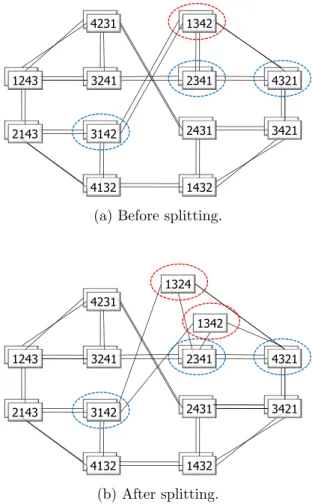
(4) Vol.2009-AL-125 No.4 2009/7/21 IPSJ SIG Technical Report. such as Chord and skip graph. 4.1 Overview Let n be the smallest integer such that |Vn | ≥ N , i.e., (n − 1)! < N ≤ n!. We use Vn as the underlying set of permutations; i.e., each digit of a string corresponding to a bag in B is drawn from set {1, 2, . . . , n}. Let k be an integer such that (k − 1)! < n − 1 ≤ k!. We will construct a set of bags B such that each bag in B corresponds to a prefix of a vertex in Vn of length either n − k or n − k + 1. Note that it holds 1 ≤ n − k and n − k + 1 ≤ n − 1, since 2 ≤ k ≤ n − 1 for any n ≥ 3. In addition, by construction, |Bn,j | > N for any j < k; i.e., Bn,k−1 contains sufficiently large number of bags even if the number of bags in Bn,k is smaller than N . An outline of the proposed scheme is described as follows. We start our construction from graph G(Bn,k ) consisting of n!/k! (≤ N ) vertices, and will try to mark bags in such a way that: 1) the number of marked bags is at least ⌈(N − |Bn,k |)/(k − 1)⌉ and at most ⌈(2N − |Bn,k |)/(k − 1)⌉, and 2) each unmarked bug is adjacent with at most one marked bag. We then split each marked bag into k sub-bags, by increasing the length of the associated string from n − k to n − k + 1. See Figure 3 for illustration (in this figure, bag 13 is split into two sub-bags 132 and 134, which increases the degree of adjacent blue bags from three to four, but does not increase the degree of red sub-bags). Each sub-bag is adjacent with n − 1 (sub)bags in the resultant graph, since the degree of bags in G(Bn,k−1 ) is n − 1 as was claimed in Remark 2, and a contraction of vertices does not increase the degree of uncontracted vertices. Thus, the above splitting certainly increases the number of bags in the resultant graph, and by construction, for each unmarked bag, the number of adjacent bags increases by at most k − 1; i.e., we can bound the degree of each bag in the resultant graph by at most n + k − 2. 4.2 Class of Bags Before describing the details of the proposed scheme, we introduce several notations. Definition 3 (Class of bags) Let x be a bag of length n′ (≤ n), and k be. 4213 4 213 4231. 1324 1342. 1234 1243. 3214 3 214 3241. 2314 2 314 2341. 4312 4 312 4321. 2134 2 134 2143. 3124 3 124 3142. 2413 2 413 2431. 3412 3 412 3421. 4123 4 123 4132. 1423 1432. (a) Before splitting.. 1324 4213 4 213 4231 1342 1234 1243. 3214 3 214 3241. 2314 2 314 2341. 4312 4 312 4321. 2134 2 134 2143. 3124 3 124 3142. 2413 2 413 2431. 3412 3 412 3421. 4123 4 123 4132. 1423 1432. (b) After splitting. Fig. 3 Split of a bag into k (= 2) sub-bags.. an integer satisfying 1 ≤ k ≤ n′ . Bag x is said to be of class Ci1 ,i2 ,...,ik , if value j appears at the ith j digit of x for any 1 ≤ j ≤ k, where ij takes value 0 if j does not appear in x. In general, each bag belongs to different classes. For example, bag 123 belongs to three classes C1 , C1,2 , and C1,2,3 , and bag 234 belongs to three classes C0 , C0,1 , 4. c 2009 Information Processing Society of Japan ⃝.
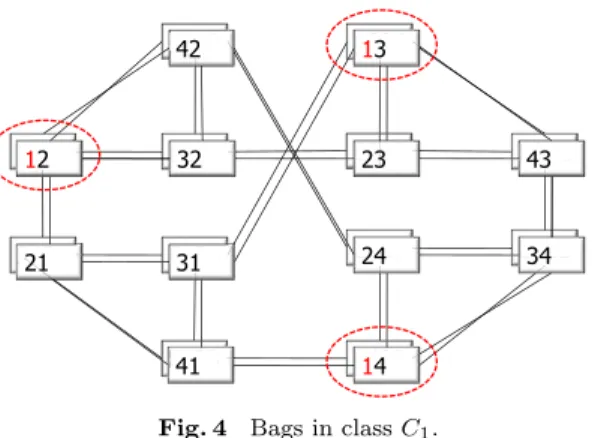
(5) Vol.2009-AL-125 No.4 2009/7/21 IPSJ SIG Technical Report. and C0,1,2 . Note that the number of integers in the subscript does not exceed the length of the string corresponding to the bag. In the following, to simplify the exposition, we often represent a sequence of integers as α and β (including an empty sequence); e.g., Ci1 ,i2 ,...,ij is represented as Cα,ij and Cβ,ij−1 ,ij using symbols α and β instead of sequences “i1 , i2 , . . . , ij−1 ” and “i1 , i2 , . . . , ij−2 ,” respectively. Lemma 1 Let x and y be bags belonging to classes Cα,i and Cα,j , respectively, for some sequence α. If i ̸= 0, j ̸= 0, and i ̸= j, then any two vertices belonging to x and y are not adjacent with each other in Sn . Lemma 2 Let x and y be bags belonging to classes Ci and C0 , respectively. If i ̸= 0 and i ̸= 1, then any two vertices belonging to x and y are not adjacent with each other. 4.3 Marking Algorithm Recall that: 1) |Bn,k | = n|Bn−1,k |, 2) the number of bags in class C0 is k|Bn−1,k |, and 3) the number of bags in class Ci , 1 ≤ i ≤ n − k, is |Bn−1,k |. Our proposed marking scheme is described as follows.. 4213 4 213 4231. 1324 1342. 1234 1243. 3214 3 214 3241. 2314 2 314 2341. 4312 4 312 4321. 2134 2 134 2143. 3124 3 124 3142. 2413 2 413 2431. 3412 3 412 3421. 4123 4 123 4132. 1423 1432. Fig. 4 Bags in class C1 .. class C1 in Step 2 increases the degree of bags in Ci , i ̸= 0, by at most k − 1, and does not increase the degree of bags in C1 . See Figure 4 for illustration. • Marking of C0 : Bags in C0 are not adjacent with bags in Ci , for any 2 ≤ i ≤ n − k. Thus, the marking of bags in class C0 does not increase the degree of bags in Ci for 2 ≤ i ≤ n − k. In addition, since the marking of C0 is conducted only after marking of all bags in C1 , it does not increase the degree of (sub)bags generated from bags in C1 . See Figure 4 (a) for illustration. • Marking of other bags: Bags in class Ci , 2 ≤ i ≤ n − k, are not adjacent with bags in class Cj , for any 2 ≤ j ≤ n − k and j ̸= i. Thus, the marking of bags in class Ci does not increase the degree of bags in Cj , if C1 has already been marked. See Figure 4 (b) for illustration. By construction, we immediately have the following claim. Lemma 3 For any N , the proposed scheme marks vertices in G(Bn,k ) in such a way that each unmarked bag in G(Bn,k ) is adjacent with at most one marked bag. 4.4 Splitting After completing the marking of bags in G(Bn,k ), we split each marked bag into k sub-bags in order to align the number of resultant sub-bags to given N . Thus, we have the following theorem. Theorem 1 The proposed scheme generates a contracted graph of Sn such that: 1) the length of strings associated with each vertex is either n−k or n−k+1,. Algorithm Step 1: Let m = ⌈(N − |Bn,k |)/(k − 1)⌉; i.e., m is the number of bags which should be marked by this algorithm. Step 2: At first, we mark bags in class C1 . If m < |Bn−1,k |, then we stop the algorithm after marking any m bags in C1 . Otherwise, update m as m := m − |Bn−1,k | and proceed to Step 3, after marking all bags in C1 . Step 3: If m > k|Bn−1,k |, then go to Step 4 after marking all bags in classes C0 and letting m := m − k|Bn−1,k |. Otherwise, simply go to Step 4. Step 4: We mark bags in classes C2 , C3 , . . ., and Cn−k , in the following manner: Let p = ⌊m/|Bn−1,k |⌋ and q = m − p × |Bn−1,k |. Note that 0 ≤ p ≤ n − k − 1, and q = 0 must hold if p = n − k − 1. We then mark all bags contained in classes C2 , C3 , . . . , Cp+2 . The correctness of the above marking scheme is certified by the following three observations: • Marking of C1 : Each bag in Ci , i ̸= 0, is adjacent with exactly one bag in C1 , and any two bags in C1 are not adjacent. Thus, the marking of bags in 5. c 2009 Information Processing Society of Japan ⃝.
(6) Vol.2009-AL-125 No.4 2009/7/21 IPSJ SIG Technical Report 4213 4 213 4231. 1324 1 324 1342. 1234 1 234 1243. 3214 3 214 3241. 2314 2 314 2341. 4312 4 312 4321. 2134 2 134 2143. 3124 3 124 3142. 2413 2 413 2431. 3412 3 412 3421. 4123 4 123 4132. 1423 1 423 1432. resultant graph, in the range of n!/k! to n!/(k − 1)!, in a distributed manner (probably we need to introduce a kind of management peer, in order to keep the current values of n and k). • How to decrease the value of k when N increases to n!/(k − 1)!, and how to increase the value of k when N decreases to n!/k!. • How to increase the value of n, when N increases to n!. • How to realize an efficient routing in the resulting network, including permutation routing, broadcasting, and multicasting. References 1) S. Akers, D. Harel, and B. Krishnamurthy, “The Star Graph: An Attractive Alternative to the n-Cube,” In Proc. 1987 Int’l Conf. Parallel Process. (ICPP) 1987, pages 393-400. 2) J. Aspnes and G. Shah, “Skip graphs,” In Proc. Annual ACM-SIAM Symp. on Discrete Algorithms (SODA), January 2003, pages 384-393. 3) H.-L. Chen and N.-F. Tzeng, “Enhanced Incomplete Hypercube,” In Proc. 1989 Int’l Conf. Parallel Process. (ICPP), vol. 1, 1989, pages 270-277. 4) T.-S. Chen and J.-P. Sheu, “Broadcasting on Incomplete Star Graph Interconnection Networks,” High Performance Computing on the Information Superhighway, 1997. HPC Asia ’97 , April 1997, pages 67-72. 5) T.-S. Chen and N.-C. Wang, “Optimal Broadcasting on Incomplete Star Graph Interconnection Networks,” Journal of Systems Architecture, 51(2): 143-150, February 2005. 6) Available at http://www.gnutella.com/. 7) D. Guo, J. Wu, H. Chen, and X. Luo, “Moore: An Extendable Peer-to-Peer Network Based on Incomplete Kautz Digraph with Constant Degree,” In Proc. IEEE Int’l Conf. Computer Communications (INFOCOM), May 2007. 8) T. Iwasaki and K. Kaneko, “A New Configuration of an Incomplete Star Graph and its Routing Algorithm,” In Proc. Int’l Conf. Parallel and Distributed Processing Techniques and Applications (PDPTA), July 2008, pages 116-122. 9) H. P. Katseff, “Incomplete Hypercubes,” IEEE Trans. Comput., 37(5): 604-608, May 1988. 10) C.P. Ravikumar, A. Kuchlous, and G. Manimaran, “Incomplete Star Graph: An Economical Fault-tolerant Interconnection Network,” In Proc. Int’l Conf. Parallel Process. (ICPP), August 1993, pages 83-90. 11) I. Stoica, R. Morris, D. Karger, M.F. Kaashoek, and H. Balakrishnan, “Chord: A Scalable Peer-to-Peer Lookup Service for Internet Applications,” ACM SIGCOMM Computer Communication Review , 31 (4): 149-160, 2001. 12) N.-F. Tzeng, “Structural Properties of Incomplete Hypercube Computers,” In. (a) C0 . 4213 4 213 4231. 1324 1 324 1342. 1234 1 234 1243. 3214 3 214 3241. 2314 2 314 2341. 4312 4 312 4321. 2134 2 134 2143. 3124 3 124 3142. 2413 2 413 2431. 3412 3 412 3421. 4123 4 123 4132. 1423 1 423 1432. (b) C2 . Fig. 5 Bags in classes C0 and C2 .. and 2) the degree of each vertex is at most n + k and at least n − 1. Finally, since a split of bag into sub-bags does not increase the diameter of the network, the diameter of the resultant network does not exceed the diameter of Sn , i.e., at most 3(n − 1)/2. 5. Concluding Remarks Future problems are listed below: • Given n and k, how to increase or decrease the number of vertices in the 6. c 2009 Information Processing Society of Japan ⃝.
(7) Vol.2009-AL-125 No.4 2009/7/21 IPSJ SIG Technical Report. Proc. 10th Int’l Conf. Distributed Computing Systems (ICDCS), May 1990, pages 262-269. 13) N.-F. Tzeng and H.-L. Chen, “Structural and Tree Embedding Aspects of Incomplete Hypercubes,” IEEE Trans. Comput., 43(12): 1434-1439, December 1994. 14) N.-F. Tzeng and G. Lin, “Efficient Determination of Maximum Incomplete Subcubes in Hypercubes with Faults,” IEEE Trans. Comput., 45(11): 1303-1308, November 1996. 15) N.-F. Tzeng and H. Kumar, “Traffic Analysis and Simulation Performance of Incomplete Hypercubes,” IEEE Trans. Parallel and Distributed Systems, 7(7): 740754, July 1996.. 7. c 2009 Information Processing Society of Japan ⃝.
(8)
図

関連したドキュメント
It is then natural to ask whether the analogue of Dahlberg’s the- orem ([Da]) holds for the heat equation in Ω. Of course, the graph of a function of class C 1/2 is in general
There is also a graph with 7 vertices, 10 edges, minimum degree 2, maximum degree 4 with domination number 3..
An integral inequality is deduced from the negation of the geometrical condition in the bounded mountain pass theorem of Schechter, in a situation where this theorem does not
Then it follows immediately from a suitable version of “Hensel’s Lemma” [cf., e.g., the argument of [4], Lemma 2.1] that S may be obtained, as the notation suggests, as the m A
We remark that, while the identity ⌊ Φ 2 n ⌋ − 1 = ⌊ Φ ⌊ Φn ⌋⌋ , and hence the connection with the iterated Beatty partition construction, is closely tied to properties
Then, since S 3 does not contain a punctured lens space with non-trivial fundamental group, we see that A 1 is boundary parallel in V 2 by Lemma C-3 (see the proof of Claim 1 in Case
We note that in the case m = 1, the class K 1,n (D) properly contains the classical Kato class K n (D) introduced in [1] as the natural class of singular functions which replaces the
If the inequality defined by (1.1) holds for all nonnegative functions f, then {S n , n ≥ 1} is a sub- martingale with respect to the natural choice of σ-algebras.. A martingale
