Attitudinal Correlates in Residential Location
- - A Case Study in
Malaysia--LEE
Boon Thong*
I Introduction
Residential segregation along both income and ethnic lines in Southeast Asian cities is a concomitant feature of rapid urban growth in the region.I ) This phenomenon is especially vivid in the capital cities where colonial policies had been directed towards the compartmentalization of various ethnic groups and/or socio-economic groups as witnessed in Manila in 1571,2) Singapore in 1822,3) Batavia (now Jakarta) in the 1740s,4) and Kuala Lumpur in the 1880s.5) In the latter, for instance, the colonial administrators, in order to be isolated from the Asians had resided on the hilly west bank of the River Klang becoming today the exclusive homes of the upper echelons of society. On the east bank, colonial policies which encouraged the ethnic polarization of the lower-income Malays and Chinese have led to the perpetuation of a distinct Chinatown and a Malay settlement. Rapid urban population growth since the 1950s coupled with the enlargement of the middle-class community have intensified these socio-spatial arrangements.6) The reasons for the accentuation of distinct ethnic pockets in this city have been discussed elsewhere.7)
II EconoDlic and Ethnic Factors
Generally, however, reasons explaining residential segregation In cities may be
*
Department of Geography, University of Malaya, Malaysia1) See McGee, T. G. (1967), The Southeast Asian City: A Social Geography of the Primate Cities of Southeast Asia.London: Bell& Sons; Fryer, D. W. (1953), "The 'million city' in Southeast Asia," Geographical Review, Vol. 43, 474-494; and Ginsburg, N. (1955), "The great city in Southeast Asia," Americ. Journ. Sociology,Vol. 60, 455-462.
2) Doeppers, D. F. (1972), "The development of Philippine cities before 1900," Journ. of Asian Studies,
N. Y., Vol. 31, 769-792.
3) Hodder, B. W. (1953), "Racial groupings in Singapore," Mal. Journ. Trop. Geog., Vol. 1, 25-36. 4) Cobban,
J.
L. (1971), "Geographic notes on the first two centuries of Djakarta," Journ. Mal. Br.Royal Asiatic Soc., Vol. 44, 121-128.
5) Gullick,
J.
M. (1955), "Kuala Lumpur 1880-1895," Journ. Mal. Br. Royal Asiatic Soc., Vol. 28, 7-172. 6) For a detailed analysis, see Lee Boon Thong (1976), "Patterns of urban residential segregation: thecase of Kuala Lumpur," Journ. of Trop. Geog.,Vol. 43, 41-48.
7) See Lee Boon Thong (1976), op. cit.; Lee (1976A), Residential Patterns in Kuala Lumpur. Unpubl. Ph. D. thesis, Univ. of Hull; and McGee, T. G. (1963), "The cultural role of cities: a case study of Kuala Lumpur," Joum. of Trop. Geog., Vol. 17, 178-196.
grouped into two main approaches viz. - economic and ethnic factors.
Many studies, particularly those of western cities,8) have sought to explain
reSI-dential patterning through the first approach, that is, purely economic reasons. They
perceived an impersonal but orderly process of competition for locations with fixed differential values, in which, because of differences in costs and resources, the ability
to pay for certain localities becomes the most important determinant.9) In other
words, transport costs, land values, competition between residential and non-residential land uses as well as the type and location of houses are all important factors governing the operation of the classical economists' "invisible hand" in residential patterning.
The second approach seeks to explain the distribution of residential types in terms
of the agglomerative tendencies among the different· ethnic groups. Studies can be
quoted in support of this viewpoint particularly those of Canadian and American cities
where ethnic segregation between coloureds and whites is highly perceptible.10) Based
on works in Africa,ll) Friedmann and Wulff have suggested that ethnic status IS a powerful determinant of residential polarization in Third World cities which are
sur-rounded by a polyethnic hinterland.12) This has also been pointed out in parts of
Southeast Asia like Jakartal3) and Makasarl4 ) (now Ujungpandan). As a matter of
fact, evidence from Malaysia tend to substantially support the ethnic approach where, for example, a strong segregation pattern exists between the Chinese and Malays in
Kuala Lumpur (as shown by a negative correlation coefficient of-0.88).15)
8) See for instance, Alonso, W. (1960), "A theory of the urban land market," Papers & Prol-'. Reg. Sc. Assoc., Vol. 6, 149-158; Cassetti, E. (1967), "Urban population density patterns: an alternative explanation," Canadian Geographer, Vol. 11, 96-100; and Kain, ], F. (1962), A Multiple Equation Model of Household Locational and Tripmaking Behavior. Santa Monica: The Rand Corp.
9) For a brief and clear exposition of the economic approach, see Feldman,A. S. & Tilly, C. (1960), "The interaction of social and physical space," Americ. Sociological Rev., Vol. 25, 877-874; and Moriarty, B. M. (1970), "A test of alternative hypotheses of urban residential growth." Proc. qlthe Assoc. q[ Americ. Geographers,Vol. 2, 97-101.
10) See Darroch, A. G.,& Marston, W. G.(1971), "The social class basis of ethnic residential segregation: the Canadian case," Americ. .lourn. Sociology, Vol. 77, 491-510; and Taeuber. K. E. (1965), "Res-idential segregation," Scientific Americall,Vol. 213, 12-19.
11) Based on works by McElrath, D. (19G8), "Societal scale and social differentiation: Accra, Ghana." eds. Greer, S., McElrath, D., Minar, D., and Orleans, P., The New Urbanization, N. Y.: St. l\lartin,s Press, 32-52; and Hanna, W.]. & Hanna, ].L. (1971), Urban Dynamics in Black Africa. Chicago: Aldine - Atherton.
12) Friedmann,]. & Wulff, R. (1976), "The urban transition: comparative studies of newly industri-alizing societies," eds. Board, C., Chorley, R.]., Haggett, P., and Stoddart, D. R., Progress in Geography: international reviews ofcurrent research,London: Edward Arnold, Vol. 8,4-93.
13) Versluys, ]. D. N. (1964), "Urbanization in Southeast Asia," ed. Anderson, N., Urbanism and Urbanization, Brill, Lciden: Internat. Studies in Sociology and Soc. Anthrop., Vol. 2,47.
14) Chabot, H.T. (1964), "Urbanization problems in South East Asia," Trans. of the Fifth World Con-gress of Sociology,Louvain: Internat. Sociological Assoc., Vol. 3, 125-131.
There are, however, limitations in both approaches.16) On the one
hand,al-though a causal relationship exists between accessibility, land values and residential land uses, it is also quite clear that this relationship is not strong enough to dictate the location of residence to individuals and households.l 7) Its apparent inadequacy lies in its ability to explain lower-income ethnic polarity within a spatial continuum as seen in the case of Kuala Lumpur.1S) Studies in the United States, too, have shown tha.t economic differences explained only a small proportion of segregation in American cities.19) On the other hand, the ethnic approach cannot account for the fast rising ethnically-mixed residential suburbs of Southeast Asian cities such as those found in Kuala Lumpur.20) In fact it would be naive to even compare the residential distri-bution of different groups on the basis of ethnic status alone.21 ) It is clear, therefore, that although evidence can be marshalled in support of both the economic and ethnic factors of residential segregation, neither approach operates singly but both complement each other.
m
Attitudelil and BehaviourlilHowever, these two factors may seem too simplistic but it is obvious that a broad constellation of variables such as occupation, income, religion, educational level and medium of education are subsumed under these approaches and they are, in turn, expressed through the attitudes and behavioural differences of the rich and the poor or between the diverse ethnic groups. In fact, it is argued that the actual motivational syndrones in residential patterning may be more readily understood through attitudes and social behaviours that stem from cultural differences, socio-economic disparities and other related aspects.
The relevence of differences in attitudes and behaviours in sorting out residential areas in Southeast Asian cities has been pointed out by McGee22) and Ginsburg23).
Even in other parts of the Third World, for instance in Latin America, class distinctions
16) See for instance, Duncan, O. D., & Duncan, B. (1955), "Residential distribution and occupational stratification," Americ. Journ. Sociology, Vol. 50, 493-503; Feldman, A.S. & Tilly, C. (1960), op•. cit.; and Lieberson, S. (1963), Ethnic Patterns in American Cities. N. Y.: The Free Press of Glencoe. 17) Tansey, P. A. (1973), Residential Patterns in the Nineteenth Century Ciry: Kingston Upon Hull, 1851.
Unpubl. Ph. D. thesis, Univ. of Hull., 9. 18) Lee Boon Thong (1976A), op. cit. 19) Lieberson, S. (1963), op. cit., 83-91.
20) Lee Boon Thong (1974), "Urban growth and the development of residential areas," Geographical Bull., Nat. Geog. Assoc. of Malaysia, Vol. 1, 23-27.
21) Lee, T. R. (1973), "Ethnic and social class factors in residential segregation: some implications for dispersal," Environment and Planning,Vol. 5, 478.
22) McGee, T. G. (1967),op. cit., 148.
23) Ginsburg, N. (1972), "Planning the future of the Asian city," ed. Dwyer, D.]., The Ciry as a Center ofChange in Asia, H. K.: Hong Kong Univ. Press, 272-273.
in residential patterning were predominant largely because elites deliberately attempted to protect their own life styles by putting as much distance as possible between their own residences and the shanty towns of the proletariat. 24) Clearly then, the sharp socio-economic cleavages and the poly-ethnic structure of Southeast Asian urban community tend to create behavioural and attitudinal traits that are not only predictable but are also remarkably similar within each group. This does not suggest a simple stereotype of households or individuals in each ethnic or socio-economic groups. Indeed atti-tudinal and behavioural differences are subject to considerable arbitrary variation at sub-group or individualleve1s.25) Nevertheless, sufficient evidence exists to indicate that people tend to live in areas characterised by a similar identity to themselves. In other words, choice of residential location depends greatly on individual values, needs, and desires and these forces tend to create homogeneous social areas which are occupied by neighbours who are perceived to be compatible because they share the same needs, values, and desires. This process may be termed as 'social agglomeration'26). Chabot noted in Makasar, for instance, that "people migrating from the countryside to town, tend to go to somebody they know from their own district, or subdistrict, and, preferably, to a relative, however remote"27). Similar predilection for 'birds of a feather to flock together' was exhibited in Kuala Lumpur as observed by McGee28) and Lee29). In the latter study, a simple model was developed to show the directional biasnesses of the in-migrants to the city in which Malay enclaves tend to be swollen by Malay in-migrants from the rural areas; and Chinese zones tend to be favoured by Chinese in-migrants from the smaller towns.30) It is apparent that the 'like-me' hypothesis in which people tend to move into areas of similar characteristics is in operation.
Numerous correlates seek to explain this behavioural tendencies in residential selection chief among which are income level, ethnicity, educational level, medium of
education, occupational status and religion. This paper attempts a multi-variate analyses of the correlates of attitudes in a case study in Malaysia with the objective of highlighting the nature of their relationship in the choice of residential location.
24) Amato, P.W. (1970), "Elitism and Settlement Patterns in the LatinAmerican City," Journ. Americ. Inst. of Planners,Vol. 36, 96-105.
25) Regarding this aspect, for instance, see the work done in Canada by Ryder, N. (1955), "The inter-pretation of origin statistics," Ganad. Journ. of Econ. and Pol. Sc., Vol. 21, 466-469.
26) Evans,A. W. (1973), The Economics of Residential Location. London: Macmillan Press Ltd., 130. 27) Chabot, H. T. (1964), op. cit., 127.
28) McGee, T. G; (1963), op. cit.
29) Lee Boon Thong (l976B), "Changing ethnic patterns and the residential structures of urban areas in Peninsular Malaysia," paper pres. at the Inst. of Br. Geographers' Conference, Coventry (January).
30) For a study of small-town migration to metropolitan areas, see Lee Boon Thong (1977), "Metropolitan growth in Southeast Asia: the role of small toWns in a caSe study of Peninsular Malaysia," paper pres. at the Conference on Southeast Asian Studies, Kota Kinabalu, Sabah (November).
IV A Case Studyin Malaysia
Two attitudinal questions namely, "Would you mind living in an area of another income group?" and "Would you mind living in an area dominated by another ethnic group?" were asked as part of a larger questionnaire survey on households in Kuala Lumpur.
3o
The sampling stratification involves the selection of interviewees from six types of residential areas:-Area 1: high-income, ethnically mixed, Area 2: middle-income, ethnically mixed, Area 3: lower-income Malay settlement, Area 4: lower-income Chinese squatters, Area 5: lower-income flat-dwellers,
Area 6: lower-income central city Chinese area.
Table 1 presents the responses of the household heads to the two environmental conditions. Regarding living in areas of a predominantly different ethnic group, it is interesting to note that a very high proportion of those in Areas 1 and 2 would not mind. This attitude reflects the characteristically mixed residences of the middle and upper income suburbs. The lower income areas, particularly Areas 4 and 6 were less favour-able to living in areas of different ethnic groups. This vivid differentiation is confirmed by Yules Q analysis with a very strongly correlated zero-order coefficient (QXY= -0.70; p=O.OOI) between incomes (more than M$600 per month) and objections to living in such areas. While household heads of the lower-income areas generally would not prefer areas of another ethnic group, the Malays (Area 3) displayed less objections (Qxy=-0.40; p=O.OOI) than when compared with the Chinese (Qxy=+0.73; p= 0.001 ).
Table 1 Per Cent Distribution of Household Heads according to their Responses to Living
in Two Environmental Conditions
Area 1 Area 2 Area 3 Area 4 Area 5 Area 6
Would Not Mind Area of 90.5% 73.3%
53.3% 13.3% 58.9% 16.7%
Another Ethnic Group
n= 42 60 60 60 56 60
Would Not Mind Area of 45.2% 38.3%
23.7% 1.7% 23.2% 13.6%
Another Income Group
n= 42 60 59 60 56 59
In response to whether they would mind living in areas of another income group, more than half of the respondents in each of the areas revealed that they would mind.
(A) Income (B) Educational level (C) Ethnic 1
(D)
Ethnic 2 (E) Occupation (F) Medium of education(G)
Religion(Y)
PreferenceIn other words, of the overall total, 77 per cent prefer to live in areas of similar socio-economic status. It appears, too, from the table that the lower-income groups express greater desires to be living with people of their own income levels, particularly the squatter residents in Area 4 (Table 1). The better residential areas (Areas 1 and 2) had slightly larger proportions of household heads who would not mind living in areas of l<;>wer incomes. The zero-order coefficient between income levels (M$400 per month and above) and objections to living in areas of another income group was -0.52 (p
=0.001).
Thus, it is clear that there are perceivable differences in opinions expressed by members of different ethnic and income groups. It is of interest then to test the characteristics that are associated with the respondents who expressed these opinions and how these correlates account for the differences in opinions.
V Descriptive Variables of Attitudes
Basically, this involves the inter-correlations between each of the variables that are deemed to have an influence on attitudes and opinions. In the first case involving the respondents' reactions to living in an area of another ethnic group, the potential variables chosen are:
(l= more than M$400 per month; O=less than M$400 per month),
(1 = attended secondary school or university; O=attended primary school or no education), (1= Chinese;
O=non-Chinese) , (1 =Malay;
o
= non-Malay) ,(1 = Sales and production workers; O=Others),
(1= English; O=Others), (1= Christian;
O=non-Christian), and
( 1=would not prefer area of another ethnic group;
O=would not mind living in an area of another ethnic group).
The inter-correlations among the potential variables are shown III Table 2. The
Table 2 Inter-Correlation Matrix of Variables Describing Household Heads Who Would Not Mind Living in an Area of Another Ethnic Group
P,edic,o,
I
Test VariablesA B C D E F G Y Variables A +0.78 -0.41 -0.07 -0.50 +0.73 +0.94 -0.61 B +0.78 -0.60 +0.15 --0.68 +0.93 +0.97 -0.61 C -0.41 -0.60 +0.34 +0.70 -0.55 -0.71 +0.72 D -0.07 +0.15 +0.34 --0.49 -0.09 +0.14 -0.40 E -0.50 -0.68 +0.70 -0.49 -0.57 +0.31 +0.60 F +0.73 +0.93 -0.55 -0.09 -0.57 -0.29 -0.62 G +0.94 +0.97 -0.71 +0.14 +0.31 -0.29 -0.77 " _ .
-pluses and minuses) for the purpose of'reflecting'32) the variables. Correlation values which were not significant at 0.05 level were excluded. In this process, C, E, and Y were, in turn, reflected. After reflecting
C, E, Y,
the final matrix is shown in Table 3.Table 3 Final Matrix for Data in Table 2
A B C A +0.78 -+-0.41 B +0.78 +0.60 C +0.41 +0.60 D +0.34 E +0.50 -+-0.68 +0.70 F +0.73 +0.93 +0.55 G +0.94 +0.97 +0.71 Y +0.61 +0.61 +0.72 D +0.34 +0.49 +0.40 E F G Y +0.50 +0.73 +0.94 +0.61 +0.68 +0.93 +0.97 +0.61 +0.70 +0.55 +0.71 +0.72 +0.49 +0.4{}· +0.57 -0.31 _ +0.60 +0.57 -0.29 +0.62 -0.31 -0.29 +0.77 +0.60 +0.62 +0.77
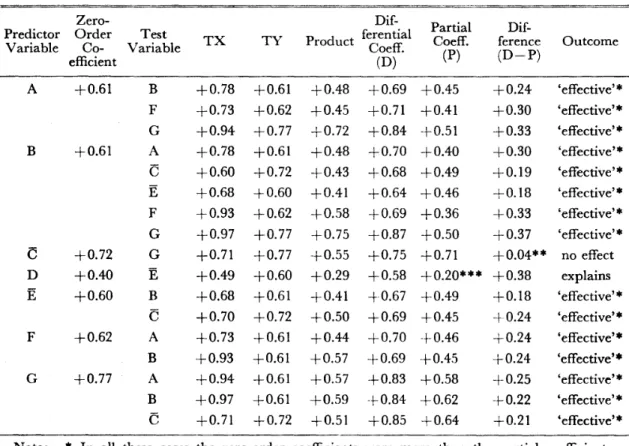
-The promising test variables for each predictor variable (each row) were then selected on the basis of the product of the correlation of the predictor variable with the test variable and the correlation of the test variable with Y (see columns 4, 5, 6 of Table 4). Product values exceeding ±0.50 were automatically accepted for the analysis but for those products less than ±0.50, they should not exceed20 units below the QXY correla-tion values. These two conditions are, of course, arbitrary but necessary to allow concentration on a smaller number of more important variables. Each variable selected was then subjected to a three-variable test to see its effect on the predictor variable. Table 4 shows the final analysis and a verbal translation of Table 4 is presented in Table 5.
From Table 5, the correlates of respondents who stated that they would not mind
32) The procedure of 'reflecting' involves finding the difference between the total number of pluses and the total number of minuses in each row. Where an excess of negatives over positive occurs, as in rows C, E, and Y in this case, the symbols of these variables are therefore reversed. See Davis,
J.
A. (1971), Elementary Survf)l Analysis. N.J.:
Prentice-Hall, 179-180.Table 4 Summary of Multivariate Analysis of Variables Describing Household Heads Who Would Not Mind Living in an Area of Another Ethnic Group
Zero- Dif- Partial
Dif-Predictor Order Test TX TY P d t ferential Coeff. ference Outcome
Variable Co- Variable ro uc Coeff. (P) (D-P)
efficient (D) A +0.61 B +0.78 +0.61 +0.48 +0.69 +0.45 +0.24 'effective' * F +0.73 +0.62 +0.45 +0.71 +0.41 +0.30 'effective' * G +0.94 +0.77 +0.72 +0.84 +0.51 +0.33 'effective' * B +0.61 A +0.78 +0.61 +0.48 +0.70 +0.40 +0.30 'effective' * C +0.60 +0.72 +0.43 +0.68 +0.49 +0.19 'effective' * E +0.68 +0.60 +0.41 +0.64 +0.46 +0.18 'effective' * F +0.93 +0.62 +0.58 +0.69 +0.36 +0.33 'effective' * G +0.97 +0.77 +0.75 +0.87 +0.50 +0.37 'effective' * C +0.72 G +0.71 +0.77 +0.55 +0.75 +0.71 +0.04** no effect D +0.40 E +0.49 +0.60 +0.29 +0.58 +0.20*** +0.38 explains E +0.60 B +0.68 +0.61 +0.41 +0.67 +0.49 +0.18 'effective' * C +0.70 +0.72 +0.50 +0.69 +0.45 +0.24 'effective' * F +0.62 A +0.73 +0.61 +0.44 +0.70 +0.46 +0.24 'effective' * B +0.93 +0.61 +0.57 +0.69 +0.45 +0.24 'effective'· G +0.77 A +0.94 +0.61 +0.57 +0.83 +0.58 +0.25 'effective' * B +0.97 +0.61 +0.59 +0.84 +0.62 +0.22 'effective' * C +0.71 +0.72 +0.51 +0.85 +0.64 +0.21 'effective' *
Note:
*
In all these cases the zero-order coefficients were more than the partial coefficients.Itis assumed that further refinement of the test variables will reduce the partial to negligible and therefore 'explains' the relationship.
$III D-P is less than 10 units.
*.. Negligible partial coefficient.
living in an area of another ethnic group revealed that the most highly correlated variable was religion (predictor variable G; QXY= +0.77; p=O.OOI). Christian house-hold heads are more likely not to mind living in areas of another ethnic group and this relationship was affected by income, educational level, and ethnicity; that is they tended to be of the better income group and to have attended at least secondary school. Interestingly, they are also likely to be non-Chinese (Europeans, Indians, Eurasians, Malays, etc.). In fact, non-Chinese household heads (predictor variable C) are strongly related to a positive opinion regarding ethnically-mixed residential areas (+0.72, significant at 0.001 level). Religion, though correlated, had no effect on the relationship. The third important correlate of respondents who would not mind living in ethnically different areas was medium of education (predictor variable F). English-educated household heads tend to be more tolerant to living in such areas largely because they are better educated, that is they have been to, at least, secondary schools or universities. Most of them also tended to be better-income earners. Two other predictor variables were equally correlated to tolerant attitudes - educational level and income (+0.61,
Table 5 Correlates of Household Heads Who Would Not Mind Living in an Area of Another Ethnic Group
Predictor Variable G (Religion: Christian) +0.77 C (Ethnic I: non-Chinese) +0.72 F
(Medium of education: English) +0.62
B
(Educational level: attended secondary school or university)
+0.61
A
(Income: more than M$400 per month)
+0.61
E
(Occupation: non-sales and non-production workers)
+0.60
D
(Ethnic 2: Malay) +0.40
Influential Test Variables
High income
High educational level Non-Chinese High income High educationallevd High income Non-Chinese Non-sales and non-production workers English educated Christian
High educational level English educated Christian
High educational level Non-Chinese Non-sales and non-production workers No Effect Test Variables Religion
significant at 0.001 level). Better-income and better-educated persons are more likely to be associated with tolerance to living in different ethnic areas, and they also tended to be Christians and English-educated. It is also interesting to note that better-educated household heads who were tolerant to living in different ethnic areas also tended to be non-Chinese and non-sales or non-production workers. Predictor variable
E
is also substantially associated with tolerance to living in different ethnic areas. Higher educational levels and the non-Chinese character account for the greater tendency of non-sales and non-production workers to express no dislike for living in different ethnic areas. Lastly, Malay household heads (predictor variable D) showed the least corre-lation in the present set of variables (Qxy=+OAO; p=O.OI).The· quintessential features of respondents who expressed no objections to living
In ethnically different areas, it seems, were of better income, with better education;
English educated, Christian, non-Chinese, and non-sales. or production workers-features which may be said to be characteristics of the better socio-economic status groups. Put in another way, household heads who expressed disapproval of the idea of
living in residential areas of another ethnic group tended to be of lower income, lower education, non-Christian, and were likely to be Chinese engaging in retailing and industrial manual work. It appears from Tables 4 and 5 that although educational level was not the most important predictor variable, it accounted for four of the six predictor-variable relationships with tolerance to living in different ethnic areas. The probable implication that follows is that this variable can most logically explain the differences in opinion, particular when the more highly correlated predictor variables (predictor variables G and F in Tables 4 and 5) are explained in some ways by better educational levels. Before commenting further, it is perhaps appropriate to examine the correlates of those respondents who would not mind living in an area of different socio-economic status. Preference Medium of education Educational level Religion Occupation Ethnic 2 Occupational prestige ratings33) Ethnic 1 (F) (E) (B) (G) (C)
(D)
(H)
(Y)
The following potential variables were selected to highlight the correlates of those household heads who would not mind living in areas of different income
status:-(A) Income (1 = more than M$600 per month;
O=less than M$600 per month),
(1 = attended secondary school or university; O=attended primary school or no education), (1 = more than score of 50;
O=less than score of 50), (1 = Chinese;
0= non-Chinese) , (l=Malay;
o
= non-Malay) ,(l=professional and administrative workers; O=Others),
(1= English; O=Others) , (1 = Christian;
0= Others), and
(1 =would not prefer living in different income status areas;
O=would not mind living in such areas).
The inter-correlations among the variables are shown in Table 6. It was found necessary in the sign matrix (not shown) to 'reflect' two variables in turn:
Y
andD.
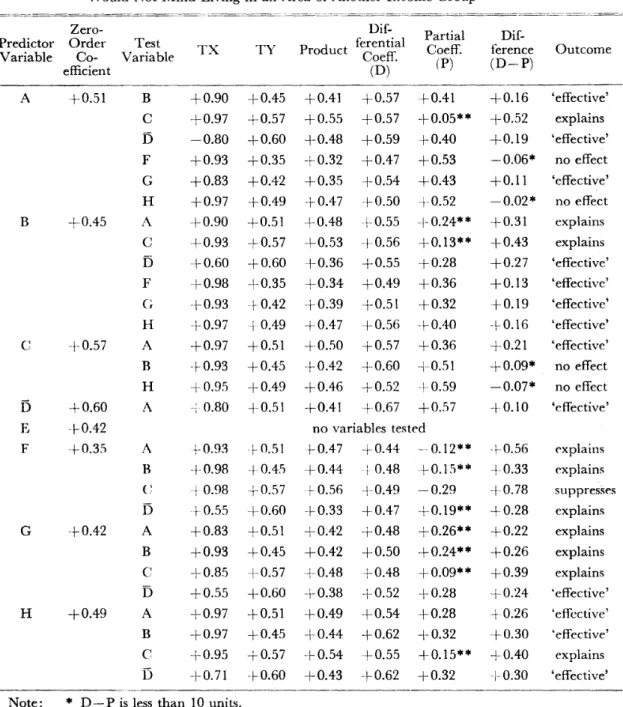
33) The occupational prestige ratings are derived by using a version of the Duncan Prestige Ratings (see Reiss, A.J. ed., Occupations and Social Status. Glencoe, Illinois: The Free Press, pp. 263-275, 1961) which has been modified to suit Malaysian conditions (see Lee Boon Thong, op. cit., pp. 319-321,The final matrix is presented in Table 7. Again promising test variables were selected using the same criteria as before and the results of the three-variable analyses are shown in Table 8 of which a verbal translation is given in Table 9.
Table 6 Inter-Correlation Matrix of Variables Describing Household Heads Who Would Not Mind Living in Areas of Another Income Status
B C D E F G H i y A +0.90 +0.97 +0.80 -0.13 +0.93 +0.83 +0.97 -0.51 B +0.90 +0.93 -0.60 -j-0.15 +0.98 +0.93 +0.97 -0.45 C +0.97 +0.93 -0.43 -0.28 +0.98 +0.85 +0.95 -0.57 D +0.80 -0.60 -0.43 -0.34 --0.55 --0.55 -0.71 +0.60 E -0.13 +0.15 -0.28 -0.34 -0.18 -0.09 +0.14 -0.42 F +0.93 +0.98 +0.98 -0.55 -0.18 +0.11 0.22 -0.35 G +0.83 +0.93 +-0.85 --0.55 -0.09 +0.11 0.29 -0.42 H +0.97 +0.97 +0.95 -0.71 +0.14 --0.22 --0.29 I -0.49
Table 7 Final Matrix for Data in Table6
~ .;::..-=-==~=:::-:..,=:.:=.=:::::--"::::::.,....;:::::"=-==::::-:;;::;.::--=:;;=.,.c==-:::'-'-:;::"::::-_==-~~ A B C D E F G H Y A +0.90 +0.97 -0.80 +0.93 +0.83 +0.97 +0.51 B +0.90 +0.93 +0.60 +0.98 +0.93 +0.97 +0.45 C +0.97 +0.93 +0.43 -0.28 +0.98 +-0.85 +0.95 +0.57 D -0.80 +0.60 +0.43 +0.34 +-0.55 +0.55 +0.71 to.60 E -0.28 +0.34 +0.42 F +0.93 +0.98 +0.98 +0.55 0.22 +0.35 G +0.83 +0.93 +0.85 -I-O.55 --0.29 +0.42 H +0.97 +0.97 +0.95 +0.71 -- 0.22 --0.29 +0.49 Y +0.51 +0.45 +0.57 +0.60 +0.42 +0.35 -t-0.42 +0.49
The most important characteristics of household heads who stated that they would not mind living in areas of another socio-economic status were non-Chinese household heads (predictor variable
D;
+0.60; p=O.OOI), who were earning more than M$600 per month. In other words, low-income Chinese household heads prefer to live in areas of similar income status. The second variable was occupational prestige ratings (pre-dictor variable C; +0.57; p=O.OOI). High occupational prestige rating respondents were more likely to be associated with the attitude that the income status of the resi-dential areas does not matter. Educational level and religion had no impact on the relationship between occupational prestige and attitude. The third important variable was income (predictor variable A; +0.51; p=O.OOI). Better income earners were more likely to express positive attitudes to living in different economic status areas partly because of their better education and English medium of education. An interesting point is that it was the non-Chinese with high occupational prestige who were moreTable 8 Summary of Multivariate Analysis of Variables Describing Household Heads Who Would Not Mind Living in an Area of Another Income Group
Zero-Predictor Order Test Variable Co- Variable
efficient TX TY Dif-P d t ferential ro uc CoefI'. (D) Partial CodI'. (P) Dif-ference (D-P) Outcome no variables tested A B C E F G H +0.51 +0.45 +0.57 +0.60 -1-0.42 +0.35 +0.42 +0.49 B C D F G H A
c
D F G H A B H A A B D A B C D A B C 15 +0.90 +0.97 -0.80 +0.93 +0.83 +0.97 +0.90 +0.93 +0.60 +0.98 +0.93 +0.97 +0.97 -1-0.93 +0.95 0.80 t-0.93 +0.98 [0.98 to.55 +0.83 +0.93 +0.85 +0.55 +0.97 +0.97 +0.95 +0.71 +0.45 +0.57 +0.60 +0.35 +0.42 +0.49 +0.51 -+-0.57 +0.60 +0.35 j-0.42+
0.49 +0.51 +0.45 +0.49 +0.51 f-O.5! +0.45 +0.57 +0.60 +0.51 +0.45 +0.57 +0.60 +0.51 +0.45 +0.57 +0.60 +0.41 +0.55 +0.48 +0.32 +0.35 +0.47 +0.48 +0.53 +0.36 +0.34 +0.39 +0.47 +0.50 +0.42 +0.46 +0.41 +--0.47 +0.44 0.56 +0.33 +0.42 +0.42 +0.48 +-0.38 +0.49 +0.44 +0.54 +0.43 +0.57 +0.57 +0.59 +0.47 +0.54 +0.50 +0.55 -j-0.56 +0.55 +0.49 +0.51 +0.56 +0.57 +0.60 +0.52 +0.67 +0.44 ; 0.48 +0.49 +0.47 +0.48 +0.50 +0.48 +0.52 +0.54 +0.62 +0.55 +0.62 +0.41 +0.05** +0.40 +0.53 +0.43 +0.52 +0.24** +0.13** +0.28 +0.36 +0.32 +0.40 +0.36 --1-0.51 -\-0.59 +0.57 0.12** +0.15** --0.29 -+--0.19** +0.26** +0.24** +0.09** +0.28 +0.28 +0.32 +0.15** +0.32 +0.16 +0.52 +0.19 -0.06* +0.11 -0.02* +0.31 +0.43 +0.27 +0.13 +0.19 +0.16 +0.21 +0.09* -0.07* +0.10 -to.56 +0.33 -+0.78 +0.28 +0.22 +0.26 +0.39 +0.24 +0.26 -+0.30 +0.40 -1-0.30 'effective' explains 'effective' no effect 'effective' no effect explains explains 'effective' 'effective' 'effective' 'effective' 'effective' no effect no effect 'effective' explains explains suppresses explains explains explains explains 'effective' 'effective' 'effective' explains 'effective' Note:*
D-P is less than 10units.*'"
Negligible partial coefficient.associated with the relationship, whilst occupation and religion had no impact
what-soever. Christian household heads (predictor variable H) also tended to be positive
in their opinions largely because they were non-Chinese. The same set of descriptive
variables as for predictor variable A, except medium of education affected the relationship
between Christians and positive attitudes. Educational level (predictor variable B)
was also significantly related to positive attitude regarding living in different status areas (+-0.45; p=O.OOI). Itappears that the more educated the household head the greater
Table 9 Correlates of Household Heads Who Would Not Mind Living in an Area of Another Income Group
- - - --- - -Predictor Variable D (Ethnic 1: non-Chinese) +0.60 C
(Occupational prestige ratings: more than score of 50)
+0.57
A
(Income: more than M$600 per month) +0.51 H (Religion: Christian) +0.49 B (Educational level:
attended at least secondary school or university) +0.45 E (Ethnic 2: Malay) +0.42 G (Medium of education: English) +0.42 F (Occupation: professional and administrative workers)
+0.35
Influential Test Variables
High income
High income
High educational level High occupational prestige Non-Chinese
English educated
High income
High educational level High occupational prestige Non-Chinese
High income
High occupational prestige Non-Chinese
Professional and administrative workers
Christian English educated
High income
High educational level High occupational prestige Non-Chinese
High income
High educational level High occupational prestige Non-Chinese No Effect Test Variables Educational level Religion Occupation Religion
the willingness to mIX. Apparently, these better-educated persons were also better income earners with better occupations. They tended to be non-Chinese and educated in the English medium. Surprisingly, Malay household heads (predictor variable E) were also more likely not to mind living in areas of another income status.34) English-educated household heads (predictor varibale G) and those working in administrative and professional capacities (predictor variable F) were also more likely not to mind, though the latter was the least correlated (+0.35; p=O.OI). This is probably because 34) Features associated with the Malays were indeterminate.
high income, for instance, acted to suppress the relationship (see Table 8). The tendency of the English-educated respondents to react favourably towards living in such areas was explained by high income, high educational level, and high occupational prestige ratings. High educational level also explained why professional and adminis-trative workers would not mind living in areas of another income group. In short, the salient features of the household heads who would not mind living in an area of a different income status were the non-Chinese, holding good jobs with higher salaries. They also tended to be Christians and to have attended at least secondary schools in the English medium of instruction.
Comparing this set of variables with the characteristics of those respondents who would not mind living in different ethnic areas, it is interesting to note that the attitude of the higher income household heads was accommodative to living in either different ethnic or different income areas.35) While the Malays appeared to be favourable to living in different ethnic and income areas, the Chinese did not favour either situation. I t may be said that Chinese sales workers of the traditional religious beliefs were generally not in favour of living in areas that were of another ethnic group, while low-income Chinese as a whole prefer to live in areas of similar income status.
VI Conclusions
Considering only the three most important predictor variables in both sets of analyses, it appears that in the first set, attitudes towards residence in different ethnic areas were related to social and cultural factors like religion, ethnicity and medium of formal instruction. In the second case, it seems that residential predilection of different income status areas tended to be associated with economic differences like occupational prestige ratings and income (Although ethnicity was the most important predictor variable, it is invariably influenced by high income. - see Table 8). However, when the correlates of these relationships are examined, an interesting observation is the role of education in affecting or explaining these relationships. Although educational level was not the most highly correlated predictor variable with value preferences, it appears as the most important correlate in the first set of variables by accounting for four of the six possible relationships. In other words, it may be said that the level of education is consistently affecting the attitude of certain respondents towards ethnic residential mIxmg. In the second set of variables, the income factor was the most consistent correlate associated with the predictor variable relationships. Nonetheless, it is clear that when both sets of data are compared, it appears that the off and better-educated respondents (perhaps more 'westernised') were more willing to mix ethnically 35) Compare this finding, for instance, with a finding in Detroit, United States where high-income house-holds who expressed favourable attitudes towards an ethnic group were not favourable to lower-class residence. See Ratt, P. K. (1948), "Class and ethnic attributes," Americ. Soc. Review, Vol. 13,43.
than across income lines. For example, although English-educated household heads were willing to mix across class lines, they were even more willing to mix ethnically.36) This suggests, in other words, the non-English educated respondents were less willing to mix across ethnic lines. This is particularly true in the lower-income areas and may be explained by the practical functions of congregating in ethnically-segregated areas in order to obtain a sense of belonging and moral support where indigeneous languages served as a common means of communication.
The present observation implies that without corresponding changes in other variables, whatever occurs in the levels of income or the proportion of the ethnic groups in the city - an inevitable consequence of the Third Malaysian Plan - they will have little impact on changing the gross patterns of residential occupance. However, when ethnicity or poor incomes coincide with low education there may be a compounding of economic and cultural factors creating barriers towards residential mixing.
References
Alonso, W. (1960), "A theory of the urban land market," Papers and Proceedings of the Regional Science Association, Vol. 6, 149-158.
Amato, P. W. (1970), "Elitism and Settlement Patterns in the Latin American City," Journal American Institute of Planners,Vol. 36, 96-105.
Anderson, N. (1964) ed., Urbanism and Urbanization. Brill, Leiden: International Studies in Sociology and Social Anthropology, Vol. 2.
Board, C., Chorley, R.J., Haggett, P., & Stoddart, D. R. (1976), Progress in Geograp~v: International Reviews of Current Research. Vol. 8.
Cassetti, E. (1967), "Urban population density patterns: an alternative explanation," Canadian Ge-ographer, Vol. 11, 96-100.
Chabot, H. T. (1964), "Urbanization problems in South East Asia," Transactions of the Fifth World Congressqf Sociology, Louvain: International Sociological Association, Vol. 3, 125-131.
Cobban,
J.
L. (1971), "Geographic notes on the first two centuries of Djakarta," Journal of the Malayan Branch Royal Asiatic Society,Vol. 44, 121-128.Darroch, A. G. & Marston, W. G. (1971), "The social class basis of ethnic residential segregation: the Canadian case," American Journal of Sociology,Vol. 77, 491-510.
Davis, J. A. (1971), Elementary Survey Ana(ysis. New Jersey: Prentice-Hall.
Doeppers, D. F. (1972), "The development of Philippine cities before 1900," Journal qf Asian Studies,
New York, Vol. 31, 769-792.
Duncan, O. D., & Duncan, B. (1955), "Residential distribution and occupational stratification," American
Journal of Sociology,Vol. 50, 493-503.
Dwyer, D. J. (1972) ed., The City As a Center of Change in Asia. Hong Kong: Hong Kong University Press.
Evans, A. W. (1973), The Economics of Residential Location. London: Macmillan Press Ltd.
Feldman, A. S. & Tilly, C. (1960), "The interaction of social and physical space," American Sociological Review, Vol. 25, 877-884.
Friedmann,
J.
& Wulff, R. (1976), "The urban transition: comparative studies of newly industrializing societies," eds. Board, C., Chorley, R.J., Haggett, P., and Stoddart, D. R., Progress in Geography:international reviews q! current research, London: Edward Arnold, Vol. 8,4-93. 36) Comparing predictor variable F of Table 5 and predictor variable G of Table 9.
Fryer, D.W. (1953), "The 'million city' in Southeast Asia," Geographical Review, Vol. 43,474-494. Ginsburg, N. (1955), "The great city in Southeast Asia," American Journal of Sociology,Vol. 60, 455-462. Ginsburg, N. (1972), "Planning the future of the Asian city," ed. Dwyer, D.J., The City as a Center
of Change in Asia,Hong Kong: Hong Kong University Press, 269-283.
Greer, S., McElrath, D., Minar,D., & Orleans, P. (1968) eds., The New Urbanization. New York: St. Martin's Press.
Gullick,J. M. (1955), "Kuala Lumpur 1880---1895," Joumal of the Malayan Branch Ro.yal Asiatic Society,
Vol. 28, 7-172.
Hanna,W.J. & Hanna, J. L. (1971), Urban Dynamics in Black Africa. Chicago: Aldine-"--Atherton. Hatt, P. K. (1948), "Class and ethnic attributes," American Sociological Review,Vol. 13, 36-43.
Hodder, B.W. (1953), "Racial groupings in Singapore," Malayan Journal of Tropical Geography, Vol. 1,25-36.
Kain, J.F. (1962), A Multiple Equation Model of Household Locational and Tripmaking Behavior. Santa Monica: The Rand Corporation.
Lee Boon Thong(1974), "Urban growth and the development of residential areas," Geographical Bulletin,
National Geographical Association of Malaysia, Vol. 1, 23-27.
Lee Boon Thong (1976), "Patterns of urban residential segregation: the case of Kuala Lumpur," Journal ofTropical Geograpft.-v,Vol. 43, 41-48.
Lee Boon Thong (19761\), Residential Patterns in Kuala Lumpur. Unpublished Ph. D. thesis, University of Hull.
Lee Boon Thong (1976B), "Changing ethnic patterns and the residential structures of urban areas in Peninsular Malaysia," paper presented at the symposium on The City in the Third World, Institute of British Geographers' Conference, Coventry (.January).
Lee Boon Thong(1977), "Metropolitan growth in Southeast Asia: the role of small towns in a case study of Peninsular Malaysia," paper presented at the Conference on Southeast Asian Studies, Kota Kinabalu, Sabah (November).
Lee, T. R. (1973), "Ethnic and social class factors in residential segregation: some implications for dis-persal," Environment and Planning,Vol. 5, 477-490.
Lieberson, S. (1963), Ethnic Patterns in American Cities. New York: The Free Press of Glencoe.
McElrath,D. (1968), "Societal scale and social differentiation: Accra, Ghana," cds. Greer, S., McElrath, D., Minar, D., and Orleans, P., The New Urbanization, New York: St. Martin's Press, 32-52. McGee, T. G. (1963), "The cultural role of cities: a case study of Kuala Lumpur," Journal qf Tropical
Geography,Vol. 17, 178-196.
McGee, T. G. (1967), The Southeast Asian City: A Social Geography of the Primate Cities of Southeast Asia.
London: Bell& Sons.
Moriarty, B.M. (1970), "A test of alternative hypotheses of urban residential growth," Proceedings <?f the Association of American Geographers,Vol. 2,97-10 1.
Reiss,A.J. (1961) ed., Occupations and Social Status. Glencoe, Illinois: The Free Press.
Ryder, N. (1955), "The interpretation of origin statistics," Canadian Journal of Economic and Political Science,Vol. 21, 466-469.
Taeuber, K. E. (1965), "Residential segregation," Scientific American, Vol. 213, 12-19.
Tansey, P. A. (1973), Residential Patterns in the Nineteenth Century City: Kingston Upon Hull, 1851. Unpub-lished Ph. D. thesis, University of Hull.
Versluys,J.D. N. (1964), "Urbanization in Southeast Asia," ed. Anderson, N., Urbanism and Urbanization,