
A study on complex decision tree construction for getting the rules of contig binding in DNA double assembly
7
0
0
全文
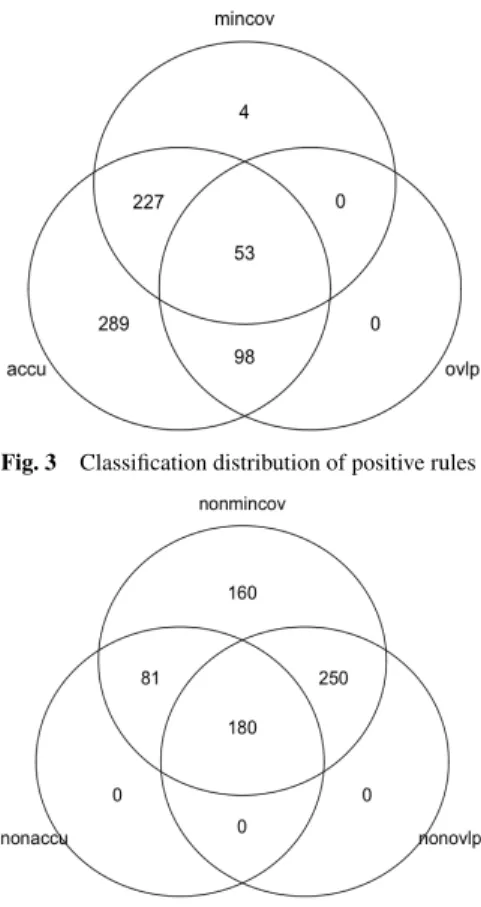
(2) Vol.2014-BIO-39 No.3 2014/9/19. IPSJ SIG Technical Report. Table 1. Explanatory variables with p-value’s distribution of k-mer’s coverage. f,l Coe fwav Gradient of waveform f,l Rinc Rate of increase value f,l Fluctuation Fhigh High-frequency component of Fourier transform S umFf,l Powered value of Fourier transform f,l Flow Low-frequency component of Fourier transform f,l pnull p-value with null frequency value Distribution S umFf,lf req Powered value of Fourier transform for frequency distribution CC Correlation coefficient CC f req Correlation coefficient of frequency distribution CCF f req Maximum cross-correlation function for Fourier transform of frequency distribution F Mcc f Maximum cross-correlation function for Fourier transform Correlation Mcc f Maximum cross-correlation function Dham Hamming distance of frequency distribution Mccf req Maximum cross-correlation function for fref quency distribution |p f,l | Norm value of end point of former and start point of latter. Fig. 1. Fig. 2. Distribution of mincov for correct and incorrect binded contigs. Distribution of ovlp for correct and incorrect binded contigs. than 0.1, and Fig.2 shows most ovlp of incorrect contigs are lower than 10 bases. We can find that the larger mincov and larger ovlp, more correct binded contigs. Secondly, we observed about the classification distribution about multiple objective variable, by applying mincov, ovlp, accu to same test data. Fig.3-4 shows classification distribution by positive and negative rules correctly. Fig.3 shows that 4 binded contigs were correctly obtained by mincov rules, but accu and ovlp rules couldn’t obtain and 289 binded contigs were correctly obtained by accu rules but mincov and ovlp rules couldn’t obtain. 53 binded contigs were correctly obtained by accu, mincov, ovlp rules. In a similar way, Fig.4 shows that 180 binded contigs were eliminated as incorrect binded contigs, with accu, mincov, ovlp rules and 160 binded contig were able to eliminate with mincov rules but accu and ovlp rules couldn’t. We can find that decision tree will be improved using multiple objective variables because they are in a complementary style each other. We considered about the addition of. c 2014 Information Processing Society of Japan. Fig. 3. Classification distribution of positive rules. Fig. 4. Classification distribution of negative rules. discriminator as mincov, ovlp to traditional decision tree, accu. As considering that each of two train data is constructed by mincov or ovlp as objective variable and distribution of k-mer’s coverage value as explanatory variable, we used multiple regression analysis to get discriminant function. Multiple regression analysis outputs discriminant function by parameter selection with AIC, multiple correlation coefficient and determination coefficient, which represents the fitness to the discriminant functions. Table.2 shows the selected variables for a regression function named variables, partial regression coefficient named Coe freg , multiple correlation coefficient named Multiplecor coe f and determination coefficient named Coe fdet , AIC for the discriminant function of mincov and ovlp. Table 2. Discriminant function of variables, Coe freg , Multiplecor coe f , Coe fdet for mincov and ovlp. variables F mincov Mcc f CC Intercept F ovlp Mcc f CCF f req l Coe fwav f Rinc Rlinc S umFf S umlF f Fhigh l Fhigh Intercept. Coe freg -6.230e-06 5.141e-06 1.191e+01 -2.144e-07 5.558e-08 -4.299e-03 -3.893e-01 -3.242e-01 6.061e-05 7.211e-05 -1.409e-04 -1.700e-04 4.461e-01. Multiplecor coe f 0.01161. Coe fdet 0.008545. 0.2143. 0.2032. AIC -1829.74. The Multiplecor coe f and Coe fdet were closer to 1.0 and AIC is larger, the fitness of discriminant function were higher. From Table.2, we could find that each Multiplecor coe f of mincov and ovlp 2.
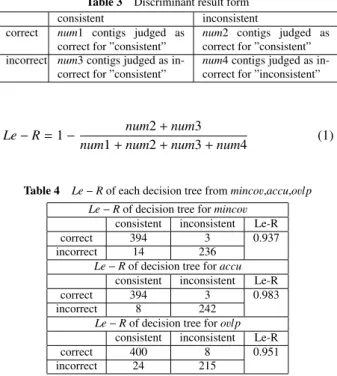
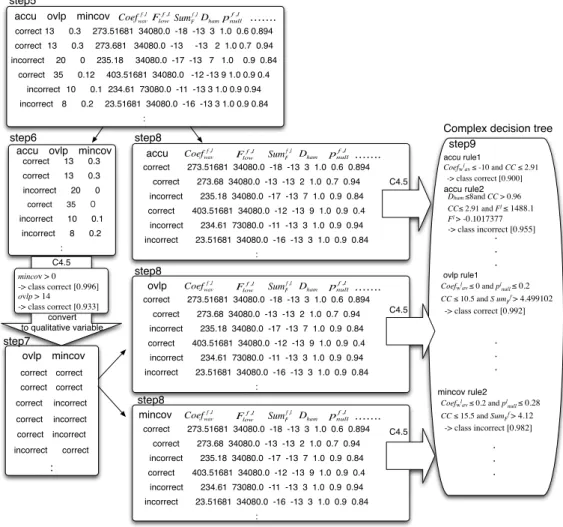
(3) Vol.2014-BIO-39 No.3 2014/9/19. IPSJ SIG Technical Report. were 0.01161 and 0.2143, each Coe fdet of mincov and ovlp were 0.008545 and 0.2032, adequacy of discriminant functions for mincov and ovlp were not high. We can consider that the reason of it is high variance of objective variable, and it is difficult to represent discriminator by linear classifier. Therefore, we need to reconsider about the treatment of objective variables by converting to qualitative variables. Decision tree requires objective variables as qualitative variable, we convert the qualitative variable to quantitative variable. We generated decision tree composed of accu as objective variables, mincov, ovlp as explanatory variable. Detail of generating process is described in section 3. To check the fitness of rules, in similar to Multiplecor coe f or AIC about multiple regression analysis, we observed learning ability for rule about decision tree from accu, mincov and ovlp. Table.3 shows discriminant result form and we defined learning ability as formula (1). Table.4 shows the learning ability of contig binding rule by C4.5 for training data about decision tree of accu, mincov and ovlp. Table 3 Discriminant result form consistent inconsistent correct num1 contigs judged as num2 contigs judged as correct for ”consistent” correct for ”consistent” incorrect num3 contigs judged as innum4 contigs judged as incorrect for ”consistent” correct for ”inconsistent”. Le − R = 1 −. Table 4. num2 + num3 num1 + num2 + num3 + num4. (1). Le − R of each decision tree from mincov,accu,ovlp. Le − R of decision tree for mincov consistent inconsistent correct 394 3 incorrect 14 236 Le − R of decision tree for accu consistent inconsistent correct 394 3 incorrect 8 242 Le − R of decision tree for ovlp consistent inconsistent correct 400 8 incorrect 24 215. Le-R 0.937. Table 5 Species Escherichia coli. Detail of reference sequence Length 30000. read length 50. number of reads 30000. Le-R 0.983. Le-R 0.951. We could find that each Le − R of decision trees for accu, mincov, ovlp was larger than 0.93, so it has high fitness for training data. When considered in term of fitness, we decided to apply of decision tree with multiple objective variable named complex decision tree.. 3. Complex Decision Tree with Multiple objective variables for double assembly :(CDTwM) In this section, we discuss about construction of CDTwM (Complex Decision Tree with Multiple objective variables in double assembly). In order to construct complex decision tree by C4.5, it is necessary to generate training data composed with accu, mincov, ovlp and distribution with k-mer’s coverage value of binded contigs. We obtained training data from binded contigs with overlap region more than 5 bases, and determined accu,. c 2014 Information Processing Society of Japan. mincov, ovlp of them. After getting rules from the complex decision tree with train data, we applied them to target binded contigs. The actual process for generating complex decision trees is described as follows and Fig.5. step1 Prepare the whole sequence and read dataset whose base allocation is known. step2 Obtain contigs from traditional assembly methods for some k-mers. step3 Extract all the pairs of contigs with more than 5 bases overlap region. step4 Distinguish binded contigs as accuracy named accu to correct or incorrect by comparing to the original sequence step5 Generate training data constructed explanatory variable as Table.1, and overlap length named ovlp and minimum coverage value named mincov among each contigs. step6 Obtain rules of decision tree from C4.5 constructed by accu as objective variable and mincov, ovlp as explanatory variables, they are quantitative variables. step7 Convert mincov, ovlp to qualitative variable accordance with decision tree obtained at the step6. step8 Derive contig binding rules by C4.5 with training data that consists of explanatory variables as step4 about accu, ovlp, and mincov. step9 Output rules from decision tree about accu, ovlp, and mincov as complex decision tree. step10 Obtain binded contigs from the result of judgement by complex decision tree. We used E.coli data as Table.5 and generated a different short read set with the same combination of k-value and traditional assembly method as Table.6.. Train and test data Combination of Method ABySS Velvet Combination of k-mer 16,18 15,17 Table 6 Detail of experimental datasets from different short reads with the same reference. It the process of step6, we got the decision tree constructed by accu as objective variable and ovlp, mincov as explanatory variables, as Table.7. For example, rule1 means that when the mincov is more than 0, binded contig is correct with a probability of 99.6 %. Table 7 Decision tree composed of ovlp and mincov as explanatory variable, and accu as objective variable rule1 rule2 rule3. mincov > 0 -> class correct [0.996] ovlp > 14 -> class correct [0.933] ovlp <= 14 and mincov <= 0 -> class incorrect [0.728]. We converted mincov larger than 0 and ovlp larger than 14 to the positive rule as correct, and mincov lower than 0 and ovlp 3.
(4) Vol.2014-BIO-39 No.3 2014/9/19. IPSJ SIG Technical Report. step5 f ,l f ,l f ,l accu ovlp mincov Coefwav Flow ……. SumFf ,l Dham pnull. correct 13 0.3 273.51681 34080.0 -18 -13 3 1.0 0.6 0.894 correct 13 0.3 273.681 34080.0 -13 incorrect. 20 0 235.18. -13 2 1.0 0.7 0.94. 34080.0 -17 -13 7 1.0. 0.9 0.84. correct 35 0.12 403.51681 34080.0 -12 -13 9 1.0 0.9 0.4 incorrect 10 0.1 234.61 73080.0 -11 -13 3 1.0 0.9 0.94 incorrect 8 0.2 23.51681 34080.0 -16 -13 3 1.0 0.9 0.84 :. step6 accu ovlp mincov correct 13 0.3 correct 13 0.3 incorrect 20 0 correct 35 . 0. incorrect 10 0.1 incorrect 8 0.2 :. accu. f ,l Coefwav. SumFf ,l Dham. f ,l Flow. f ,l pnull. …….. correct 273.51681 34080.0 -18 -13 3 1.0 0.6 0.894 correct 273.68 34080.0 -13 -13 2 1.0 0.7 0.94. C4.5. incorrect 235.18 34080.0 -17 -13 7 1.0 0.9 0.84. accu rule1 Coefwlav ≤ -10 and CC ≤ 2.91 -> class correct [0.900]. accu rule2. Dham ≤8and CC > 0.96 CC≤ 2.91 and Fl ≤ 1488.1 Fl > -0.1017377. correct 403.51681 34080.0 -12 -13 9 1.0 0.9 0.4 incorrect 234.61 73080.0 -11 -13 3 1.0 0.9 0.94. -> class incorrect [0.955]. . . .. incorrect 23.51681 34080.0 -16 -13 3 1.0 0.9 0.84 :. C4.5. step8. mincov > 0. -> class correct [0.996] ovlp > 14 -> class correct [0.933] convert to qualitative variable. step7. ovlp. f ,l Coefwav. SumFf ,l Dham. f ,l Flow. f ,l pnull. ovlp rule1 Coefwlav ≤ 0 and plnull ≤ 0.2. …….. CC ≤ 10.5 and S umFf > 4.499102. correct 273.51681 34080.0 -18 -13 3 1.0 0.6 0.894 correct 273.68 34080.0 -13 -13 2 1.0 0.7 0.94. C4.5. -> class correct [0.992]. incorrect 235.18 34080.0 -17 -13 7 1.0 0.9 0.84. . . .. correct 403.51681 34080.0 -12 -13 9 1.0 0.9 0.4. ovlp mincov . incorrect 234.61 73080.0 -11 -13 3 1.0 0.9 0.94 incorrect 23.51681 34080.0 -16 -13 3 1.0 0.9 0.84. correct correct. :. correct correct correct. Complex decision tree step9. step8. . incorrect. correct incorrect correct incorrect incorrect. . correct. :. mincov rule2. step8 mincov. Coefwlav ≤ 0.2 and plnull ≤ 0.28. Coef. f ,l wav. f ,l low. Sum. F. f ,l F. Dham. f ,l null. p. …….. correct 273.51681 34080.0 -18 -13 3 1.0 0.6 0.894. CC ≤ 15.5 and SumFf > 4.12. C4.5. -> class incorrect [0.982]. correct 273.68 34080.0 -13 -13 2 1.0 0.7 0.94. . . .. incorrect 235.18 34080.0 -17 -13 7 1.0 0.9 0.84 correct 403.51681 34080.0 -12 -13 9 1.0 0.9 0.4 incorrect 234.61 73080.0 -11 -13 3 1.0 0.9 0.94 incorrect 23.51681 34080.0 -16 -13 3 1.0 0.9 0.84 :. Fig. 5. Flow of generating complex decision tree after obtaining of training data. lower than 14 as a negative rule as incorrect from Table.5. In this experiment, we got 37 positive rules from 9 accu rules, 10 ovlp rules and 18 mincov rules and 29 negative rules from 14 accu rules, 6 mincov rules and 9 ovlp rules and Table.8 shows some of rules from a complex decision tree with accu, ovlp and mincov. We defined accu, ovlp, and ovlp correct rules as positive rules. In a similar way, we defined accu, ovlp, and ovlp incorrect rules as negative rules. Some of rules from complex decision tree with ovlp and mincov, and accu l ovlp rule1 Coe fwav ≤ -10 and CC ≤ 2.91 -> class correct [0.900] l Positive mincov rule1 Coe fwav ≤ 0 and plnull ≤ 0.2 CC ≤ 10.5 and S umFf > 4.499102 -> class correct [0.992] f accu rule1 |p f,l | ≤ 0.1 and Fhigh >708.6 -> class correct [0.976] ovlp rule2 Dham ≤ 8 and CC > 0.96 l Negative CC≤ 2.91 and Fhigh ≤ 1488.1 l Flow > -0.1017377 -> class incorrect [0.955] l mincov rule1 Coe fwav >0 and S umlF ≤4.658966 -> class incorrect [0.989] f,l accu rule2 pnull > 0.1 and CCF f req > 6787.5 CC > 2.91 and CC ≤ 182.32 Rlinc ≤ 0.2365952 -> class incorrect [0.986]. Table 8. Next, in order to evaluate the suitability of complex decision. c 2014 Information Processing Society of Japan. trees to double assembly, we had a comparative experiment about the performance of double assembly method with rules by traditional decision tree, and without rules. We defined double assembly method without rules as DA, applying traditional rules DT DT as DAcor and DAincor , complex decision tree rules as DACDT positive , CDT DAnegative . We defined 5 indices to evaluate the performance of double assembly. corR means the rate of correct binded contigs for the output binded contigs and covR means the ratio of mapped binded contigs to the reference. When all output binded contigs are correct, corR become 1.0 and output contigs mapped entire of reference, covR become 1.0. In addition, large correct binded contigs are most ideal output, and large incorrect binded contigs are not most ideal. Mcor and Mincor means the longest correct or incorrect binded contigs among output. Table.9 shows the comparative result of double assembly methods.. Table 9 Method Output corR N50 covR Mincor Mcor. Comparative result of DA without rules, DA with rules by traditional C4.5, DA with rules by complex decision tree DA 671(c412) 0.614 7849 0.99 15767 15767. DT DAcor 338(c234) 0.69 7849 0.96 15767 15767. DT DAincor 444(c315) 0.71 7906 0.99 15767 15767. DACDT positive 512(c350) 0.68 7356 0.96 15767 15767. DACDT negative 20 1.0 0.62. 4.
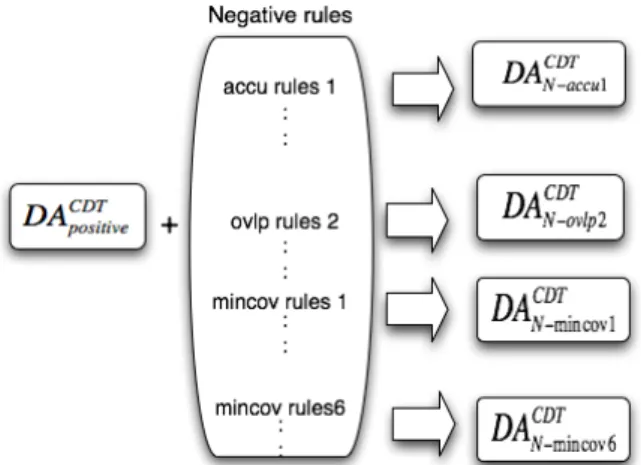
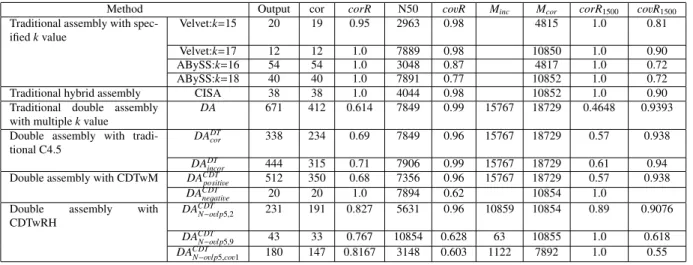
(5) Vol.2014-BIO-39 No.3 2014/9/19. IPSJ SIG Technical Report. From Table.9, we can find the effect of the discriminator for double assembly method with contig binding rules. For double assembly method with negative rules, especially DACDT negative , the output is all correct binding contigs. However, 392 correct binded contigs are removed by comparing DA and covR was decreased by 0.37 points. On the other hand, for double assembly method with positive discriminator, corR of DACDT positive was improved by DT comparing to DA but worse to DAcor . Because the complex decision tree is constructed from multiple positive and negative rules as Table.8、we can expect that the combination of each of positive and negative rules will improve them. Furthermore, incorrect large contigs represented as Mincor are treated as maximum noisy data in the assembly process, it is necessary to apply negative rules that can remove such as Mincor .. 4. Complex Decision Tree by positive and negative Rules with Heuristic for double assembly :(CDTwRH) In this section, we discuss about the possibility of a complex decision tree with the combination of each of positive and negative rules, in order to improve assembly evaluation value. Firstly, in order to confirm the effect about each of negative rule, we applied them to the result of DACDT positive as Fig.6 and evaluated performance of them.. Fig. 6. improved but Mcor . And corR of DACDT N−cov6 was higher, but it removed too much correct binded contigs, so the suitability of double assembly is not high. Therefore, as high corR and high covR, the result of DACDT N−ovlp5 has high performance better than that of DACDT . negative Secondly, we extracted negative rules these could remove large incorrect binded contigs, treated as maximum noise in the assembly. By considering the length of the reference length as 30000base, we extracted rules that could remove more than 10000 bases incorrect binded contigs as Table.11. Table 11 The list of rules that could remove large incorrect binding contigs Length of removed incorrect contigs 15767 15767 12695 10872 10860 10859. Negative rules ovlp5,ovlp9,cov6 ovlp4,ovlp5,ovlp6,ovlp7,ovlp9,cov6 ovlp4,ovlp5,ovlp6,ovlp7,ovlp8,ovlp9,cov6 ovlp2,ovlp4,ovlp5,ovlp7,ovlp9,cov6 ovlp2,ovlp7,ovlp9,cov1 ovlp9,cov1. We considered the rules that could remove multiple large incorrect binded contigs as high usability. From Table.11, we decided to apply ovlp5, ovlp9 and mincov.1 rule, to DACDT positive . According to the experimental result, we defined the combination of negaCDT tive rules for complex decision tree as DACDT N−ovlp5,2 , DAN−ovlp5,9 , CDT and DAN−ovlp5,cov1 . Furthermore, because getting of large correct binded contigs is ideal output, and most binded contig’s length of double assembly is more than 1500 as Fig.7.. Flow of generating complex decision tree after obtaining of training data. Table.10 shows the effect of each of the negative rule by complex decision tree. Table 10 Results of complex decision tree with combination of positive rules and negative rules Method DACDT negative DACDT N−ovlp5 DACDT N−ovlp7 DACDT N−ovlp8 DACDT N−cov2 DACDT N−cov6. Outout 20 236 498 478 494 59. cor 20 194 350 330 350 50. corR 1.0 0.82 0.70 0.69 0.708 0.847. N50 7891 5658 6585 7357 7899. covR 0.62 0.96 0.96 0.96 0.96 0.81. Minco 10860 15767 15767 15767 10860. Mcor 10854 10855 18729 18729 18729 10855. We could find that corR for CDTwRH decreased by comparing to DACDT negative , but covR of that improved as 0.81 to 0.96 by TaCDT ble.10. About Minco of CDTwRH, DACDT N−ovlp5 and DAN−cov6 were c 2014 Information Processing Society of Japan. Fig. 7. Length distribution of binded contigs with double assembly. From Fig.7, we added evaluation indices in order to evaluate corR and covR in the large binded contig group. We considered the binded contigs with more than 1500 bases as a large binded contig group and defined their corR and covR as corR1500 and covR1500 .. 5. Comparative study To confirm the effect of proposed method, we carried out comparative experiments of double assembly method with traditional C4.5, double assembly with a complex decision tree with multiple objective variables in section 3(CDTwM), double assembly with complex decision tree by positive and negative rules with heuristic in section4 (CDTwRH), traditional assembly method Velvet, 5.
(6) Vol.2014-BIO-39 No.3 2014/9/19. IPSJ SIG Technical Report. ABySS and CISA. From the comparative experiment, we defined the combination of negative rules for complex decision tree as CDT CDT DACDT N−ovlp5,2 , DAN−ovlp5,9 , and DAN−ovlp5,cov1 . From Table.12, we could find that corR of DA, DA with C4.5 and complex decision tree were decreased, but Mcor are improved by comparison to traditional assembly method. corR of CDTwRH was increased by comparing to DA or DA with traditional C4.5 and we could verify that contig binding rules from complex decision trees removed incorrect binded contigs that traditional C4.5 couldn’t. Because N50 and corR1500 of DACDT N−ovlp5,cov1 was increased by comparison to traditional assembly method that were Velvet, ABySS and CISA. DACDT N−ovlp5,cov1 outputs many large correct binded contigs. covR of traditional assembly method depends on specific k value, but assembly method with hybrid or double, those were CISA, DA and DAincor were CDT CDT improved. corR1500 of DACDT negative , DAN−ovlp5,9 , DAN−ovlp5,cov1 were 1.0, that means they output large correct binded contigs and Mcor of them are improved by comparison to traditional double assemDT bly methods. Furthermore, covR1500 of DAincor were the highest CDT DT and DAcor , DA positive were improved by comparison to traditional assembly method, that means double assembly method with complex decision tree output correct binded contigs.. 6. Conclusion In order to improve accuracy of double assembly by use of contig binding rules, we proposed complex discriminator with multiple objective variables. At the pre-experiment, we confirmed the possibility of using multiple objective variable by addition of ovlp, mincov to traditional objective variable accu by applying same data. We used multiple regression analysis and decision tree to obtain complex discriminator with multiple objective variable for applying candidate to double assembly. From comparative experiment result, we found that decision tree’s leaning ability was higher than multiple regression analysis and proposed complex decision tree. In order to generate training data to apply decision tree, we converted ovlp, mincov those were quantitative variables to qualitative variables. In this way, we constructed complex decision tree with multiple objective variables named CDTwM. From experimental results, corR was improved, but covR was decreased. Therefore, because we can obtain positive rules and negative rules from each of decision trees of ovlp, mincov, accu, we constructed complex decision tree by a combination of positive and negative rules, named CDTwRH. Furthermore, we extracted rules that could longest incorrect binded contigs, that is treated large noise contig in the assembly process. From comparative experiments, we could obtain larger correct binded contigs Mcor and covR were improved than traditional assembly method, ABySS, Velvet, and CISA but corR were decreased. We confirmed the possibility of improvement of contig binding rules from decision tree by use of complex decision tree. And we found the possibility of improvement of accuracy of double assembly by a combination of positive and negative rules with heuristic approach.. [2] [3] [4] [5] [6] [7]. [8] [9] [10] [11] [12] [13]. [14] [15] [16] [17] [18] [19]. [20] [21] [22] [23] [24]. Lincoln D Stein : The case for cloud computing in genome informatics. Genome Biology, vol.11 (2010). Jared T. Simpson, kim Wong, Shaun D. Jackman, et al : ABySS: A parallel assembler for short read sequence data, Genome Research, vol.19, pp.1117- 1123, (2009) Daniel R. Zerbino and Ewan Birney : Algorithms for de novo short read assembly using de Bruijn graphs, Genome Research, vol.18, pp.821- 829, (2008) Rene L. Warren , Granger G. Sutton , Steve J. M. Jones and Robert A. Holt : Assembling millions of short DNA sequences using SSAKE, Bioinformatics, vol.23 no.4, pp.500-501, (2007) Anthony M. Bolger, Marc Lohse and Bjoern Usadel: Trimmomatic: A flexible trimmer for Illumina Sequence Data, Bioinformatics , (2014) Xiaohong zhao, Lance E. Palmer, Randall Bolanos, Cristian Mircean, Dan Fasulo, and Gayle M. Wittenberg : EDAR: An Efficient Error Detection and Removal Algorithm for Next Generation Sequencing Data, vol.17, No 11, pp.1549―1560, (2010) Wei-Chun Kao, Andrew H. Chan and Yun S. Song : ECHO: A reference-free short-read error correc- tion algorithm Genome Res. 21,1181-1192 April 11, (2011) Yun Heo, Xiao-Long Wu, Deming Chen, Jian Ma and Wen-Mei Hwu, : BLESS: Bloom filter-based error correction solution for highthroughput sequencing reads, pp1354-1362, vol.30, no.10, (2014) Kelley DR, Schatz MC, Salzberg SL, et al: Quake: quality-aware detection and correction of sequencing errors. Genome Biol vol.11, (2010) Mark Howison, Felipe Zapata, Erika J. Edwards, Casey W. Dunn : Bayesian Genome Assembly and Assessment by Markov Chain Monte Carlo Sampling, vol.9, Issue 6, e99497, (2014) Xiaohu Shen, Manohar Shamaiah, and Haris Vikalo : Iterative Learning for Reference- Guided DNA Sequence Assembly from Short Reads: Algorithms and Limits of Performance ,vol.22 (2014) Yu Peng, Henry Leung, S.M. Yiu, Francis Y.L. Chin : IDBA - A Practical Iterative de Bruijn Graph De Novo Assembler, Research in Computational Molecular Biology, 14th Annual International Conference, RECOMB 2010, Lisbon, Portugal, April 25-28, 2010. Vol. 6044, pp.426-440, (2010) Jurgen Nijkamp, Wynand Winterbach, Marcel van den Broek,JeanMarc Daran, Marcel Reinders, and Dick de Ridder : Integrating genome assemblies with MAIA, Vol.26 ECCB 2010, pp433―439 Guohui Yao. Liang Ye, Hongyu Gao, Patrick Minx, Wesley C. Warren, George M. Weinstock : Graph accordance of next-generation sequence assemblies, Vol. 28 no. 1, pp13-16, (2012) Shin-Hung Lin, Yu-Chieh Liao : CISA: Contig Integrator for Sequence Assembly of Bacterial Genomes, Vol.8, Issue 3, e60843, (2013) Boisvert S, Laviolette F, Corbeil J : Ray simultane- ous assembly of reads from a mix of high-throughput sequencing technologies. J Comput Biol. 17 (11): 1519―1533, (2010) Marcel H. Schulz, Daniel R. Zerbino, Martin Vingron and Ewan Birney : Oases: robust de novo RNA- seq assembly across the dynamic range of expression levels, BIOINFORMATICS, Vol.28, no.8, (2012) Ayako OHSHIRO, Takeo OKAZAKI, Morikazu NAKAMURA:Double assembly method with characteristics of k-mer’s coverage for contig, IJCSNS International Journal of Computer Science and Network Security, VOL.14 No.2,(2014) J. Ross Quinlan Morgan Kaufmann, San Mateo,CA: C4.5:Programs for Machine Learning, (1993) LEO BREIMAN. : Bagging Predictors, Machine Learning, vol.24, pp.123-140, (1996) LEO BREIMAN : Random Forests, Machine Learning, vol.45, pp.532, (2001) Wei-Yin Loh : Classification and regression trees, Vol.1, WIREs Data Mining and Knowledge Discovery, (2011) J.R.Quinlan : Bagging, boosting, and C4.5, Proceedings of the Thirteenth National Conference on Artificial Intelligence, pp.725-730, (1996). References [1]. Staden, R. ’A new computer method for the storage and manip- ulation of DNA gel reading data.’ Nucl. Acids Res. 8: pp3673-3694.(1980). c 2014 Information Processing Society of Japan. 6.
(7) Vol.2014-BIO-39 No.3 2014/9/19. IPSJ SIG Technical Report. Table 12 Comparative performance of proposal and traditional methods Method Traditional assembly with specified k value. Traditional hybrid assembly Traditional double assembly with multiple k value Double assembly with traditional C4.5 Double assembly with CDTwM Double CDTwRH. assembly. with. c 2014 Information Processing Society of Japan. Velvet:k=15. Output 20. cor 19. corR 0.95. N50 2963. covR 0.98. Velvet:k=17 ABySS:k=16 ABySS:k=18 CISA DA. 12 54 40 38 671. 12 54 40 38 412. 1.0 1.0 1.0 1.0 0.614. 7889 3048 7891 4044 7849. 0.98 0.87 0.77 0.98 0.99. DT DAcor. 338. 234. 0.69. 7849. DT DAincor DACDT positive DACDT negative CDT DAN−ovlp5,2. 444 512 20 231. 315 350 20 191. 0.71 0.68 1.0 0.827. DACDT N−ovlp5,9 DACDT N−ovlp5,cov1. 43 180. 33 147. 0.767 0.8167. Minc. Mcor 4815. corR1500 1.0. covR1500 0.81. 15767. 10850 4817 10852 10852 18729. 1.0 1.0 1.0 1.0 0.4648. 0.90 0.72 0.72 0.90 0.9393. 0.96. 15767. 18729. 0.57. 0.938. 7906 7356 7894 5631. 0.99 0.96 0.62 0.96. 15767 15767. 0.61 0.57 1.0 0.89. 0.94 0.938. 10859. 18729 18729 10854 10854. 0.9076. 10854 3148. 0.628 0.603. 63 1122. 10855 7892. 1.0 1.0. 0.618 0.55. 7.
(8)
図
+2
関連したドキュメント
In Section 4, we use double-critical decomposable graphs to study the maximum ratio between the number of double-critical edges in a non-complete critical graph and the size of
We recall here the de®nition of some basic elements of the (punctured) mapping class group, the Dehn twists, the semitwists and the braid twists, which play an important.. role in
It is suggested by our method that most of the quadratic algebras for all St¨ ackel equivalence classes of 3D second order quantum superintegrable systems on conformally flat
We present a Sobolev gradient type preconditioning for iterative methods used in solving second order semilinear elliptic systems; the n-tuple of independent Laplacians acts as
Section 2 introduces some set-partition combi- natorics, describes the parabolic subgroups that will replace Young subgroups in our theory, reviews the supercharacter theory of
We mention that the first boundary value problem, second boundary value prob- lem and third boundary value problem; i.e., regular oblique derivative problem are the special cases
Then it follows immediately from a suitable version of “Hensel’s Lemma” [cf., e.g., the argument of [4], Lemma 2.1] that S may be obtained, as the notation suggests, as the m A
0.1. Additive Galois modules and especially the ring of integers of local fields are considered from different viewpoints. Leopoldt [L] the ring of integers is studied as a module
