神戸市外国語大学 学術情報リポジトリ
Historical Present in the Cotton Nero A.x.
Poems : Authorship Reconsidered
著者
家入 葉子
journal or
publication title
The Kobe Gaidai Ronso : The Kobe City
University Journal
volume
49
number
6
page range
65-83
year
1998-11-30
URL
http://id.nii.ac.jp/1085/00001512/
Creative Commons : 表示 - 非営利 - 改変禁止 http://creativecommons.org/licenses/by-nc-nd/3.0/deed.jaHistorical Present in the Cotton
Nero A.x. Poems:
Authorship Reconsidered
Yoko Iyeiri
'
1. Introduction
MS Cotton Nero A.x., produced around 1400 and now localized in
1)
Cheshire, includes four alliterative poems, whose authorship has long
been disputed: Pearl, Cleanness, Patience, and Sir Gawain and the
Green Knight. Although it is often assumed that the four poems were
all written by a single poet, some existing studies propose the
possibility of multiple authorship for them. Clark (1949, 1950a, 1950b,
and 1951), for example, casts doubt particularly upon common
authorship between Cleanness and Sir Gawain. While Tajima (1978) excludes Sir Gawain from the other three poems, Tajima (1989)proposes the possible existence of three poets: (1) the poet of Pearl,
(2) the poet of Cleanness and Patience, and (3) the poet of Sir Gawain.
I have studied negation and the periphrastic use of con "did" in
the four poems and concluded that at least the author of Pearl is 2)different from the author(s) of the other poems. There are some other
scholars who are particularly doubtful about the suggestion to include
Pearl into the same authorship group. Kjellmer (1975) is one of them.
He studies vocabulary, length of clauses, length of sentences,
conjunc-tive methods, subordinate clauses, passive forms, alliteration, and
then infers that Pearl alone was perhaps produced by a different
1 ) The manuscript is now localized in Cheshire by Mclntosh, Samuels, & Benskin (1986,
I: 106). . •
'
author. Nakamichi (1982), who examines the historical present in the manuscript at issue, is another to raise the possible existence of a
different poet of Pearl.
Since the principal purpose of Nakamichi (1982) was to
investi-gate the use of the historical present in the four poems, he deals with
the issue of authorship as a by-product. His discussion, however,
provides some interesting material in relation to the 4uthorship of the
Cotton Nero A.x. poems. He notices the following four points in
which Pearl alone deviates from Cleanness, Patience, and Sir Gawain: (1) the conversational part (rather than the narrative part) is much more voluminous in Pearl than in Cleanness, Patience, and Sir Gawain; (2) the historical present is much less common in Pearl than in the
other three poems; (3) the historical present in Pearl is mainly
related to the exigency of rhyme whereas this is not the case with
Cleanness, Patience, and Sir Gawain; and (4) the historical present in
Pearl does not occur with verbs of saying, verbs of emotion, or verbs of wish and request, while in Cleanness, Patience, and Sir Gawain,
these verbs display the historical present. Although Nakamichi's
discussion is not centred upon the authorship issue, he maintains that
one cannot wipe away the impression that Pearl alone is different in nature froM the other three poems.
The present paper intends to focus the discussion of the historical
present upon the authorship of the Cotton Nero A.x. poems, and for this purpose, examines and amplifies some of the arguments presented by Nakamichi. He already provides fairly substantial material which is in favour of multiple authorship of the manuscript under discus-sion. To link the material with the authorship issue, however, the second and the third points raised by him (i.e. (2) and (3) above) should be extended. The conclusion that I have reached is that Pearl should indeed be excluded from the same authorship group.
2. General baekgrounds
The historical present is a device, by the use of which present-tense
verbs refer to events in the past. Examples are found copiously in the
3)
Cotton Nero A.x. poeTns:Pat gracios gay wythouten galle,
So smoPe, so smal, so seme slyst, Rcrse3 vp in hir araye ryalle,
A precios pyece in perles pyst (Pearl, 189-92)
And Nabugodenosar makes much ioye (Cleanness, 1304)
be whal wendes at his wylle and a warPe fyndes,
And Per he brake3 vp Pe buyrne as bede hym oure lorde
(Patience, 339-40)
Ho cornrnes to Pe cortyn, and at Pe knyst totes.
Sir Wawen her welcumed worPy on fyrst, And ho hym seldez asayn ful 3erne of hir wordez,
Sette2 hir softly by his syde, and swybely ho la3ez,
And wyth a luflych loke ho layde hym Pyse wordez
(Sir Gawain, 1476-80).
Here the verbs in the present tense (italicized above) all refer to
events in the past.
Since the historical present is available in Present-day English, one
tends to feel familiar with the device. However, the device was not
t
always common in the history of the English language. It gainedground only in the thirteenth century and came to be abundant from
the middle of the fourteenth century, at Ieast as far as written
materials are concerned (Steadman 1917: 44; Trnka 1930: 17; Mustanoja 1960: 486). In this sense, it is one of the good scales with which to
discuss the authorship issue of the Cotton Nero A.x. poems, since they
3) Examples in the present paper are cited from: (1) Pearl, ed, Gordon (1953); (2)
Cleanness, ed. Anderson (1977); (3) Patience, ed. Anderson (1957); and (4) Sir
Gawain and the Green Knight, ed. TQIkien & Gordon, and revised by Davis, 2nd edn.
were produced in late ME, when the historical present was still in the process of development, or at least in the process of being established
in written materials. It is possible that the use of the historical
present could differ from author to author or from text to text before
it was fully established. In other words, the investigation of the
device in the Cotton Nero A.x. poems can reveal some interesting
hints as to the authorship issue.
The frequency of the historical present in the Cotton Nero A.x. poems differs depending upon scholars. Nakamichi (1982: 173-4) states that there are 351 examples of the historical present in Sir Gawain,
while Steadman (1917: 20) finds 252 examples in the same text,
Mizutori (1968 : 2) 372 examples, Zimmermann (1973 : 536) 340 instances,
and Wada (1978 : 2) 383 instances. The deviations among scholars tend
to be large, but the data given by them suggest that there are perhaps
well over 300 examples of the historical present in Sir Gawain.
Similarly, Nakamichi (1982: 183) finds 26 examples of the device in
PearL, whereas Steadman (1917: 19) maintains that there are fewer
than 20 clear examples in the same poem. I have also come across 26 examples of the historical present, although I am not certain whether
all the exarnples that I have identified are the same as those found by
Nakamichi. As far as I recognize, it is only Nakamichi (1982) who
investigates all four of the alliterative poems in MS Cotton Nero A.x. I have, therefore, decided to connect my discussion with his figures so
far as the number of the historical present is concerned. Needless to say, he does not specify all the locations where the device occurs. Therefore, it is quite possible that the present paper includes those
examples which he does not regard as illustrating the historical
present. The discussion below incorporates my own interpretation of examples which may not necessarily be the same as his.
3. The historical present and rhyme
Visser (1964: 137) maintains that the principal motive of the device
of the historical present in verse is the exigency of rhyme and metre,
whereas he also notices t,h)e existence of the historical present which
reports events "vividly" and which are not relevant to rhyme or
metre. He considers that the historical present of the former type and that of the latter type are different in nature and should be
distin-guished. The former, i.e. the historical present strongly related to
rhyme and metre, he calls the "substitutive present", while the latter he calls the "vividly reporting present" (1966: g779).
As for the Cotton Nero poems, Nakamichi demonstrates that the
historical present in Pearl is much more closely connected with rhyme
than in the other poems. Having analyzed the data given by him, I
would suppose that the nature of the historical present in Pearl is fundamentally different from that of the other three poems. In other
words, the historical present used in Pearl is in most cases what
Visser calls the "substitutive present'l, while the historical present in
Cleanness, Patience, and Sir Gawain is unlikely the "substitutive
present" but the "vividly reporting one".
It is rather straightforward that rhyme scheme is irrelevant to the occurrence of the historical present in Cleanness and Patience,
since these texts are not rhymed. Still the historical present occurs in
them fairly frequently. Indeed, the occurrence of the device in the
texts is too frequent to be accidental. It is therefore reasonable to
infer that the device in Cleanness and Patience had a different function from "substitution". Thus the abundant occurrence of the
historical present in the texts itself proves that the type of the
historical present in them is not the "substitutive" one.
As for Sir Gawain, which is rhymed partly, Nakamichi (1982:
180) shows that only eleven examples are in rhyme (3.IO/o) out of the total of 351 instances of the historical present in the text. In other words, as many as 96.90/o of the examples of the historical present in
the text are irrelevant to rhyme. The large proportion of the device outside rhyme again confirms that the principal function of it in Sir
4 ) Whether or not the historical present describes events "vividly" is another matter, which the present paper does not intend to discuss,
Gawain was not at all "substitutive". Since the historical present is in
any case frequent in Sir Gawain, even the occurrence of the eleven
examples in rhyme may not necessarily mean that the rhyme scheme
was the decisive factor in their occurrence. Thus the relationship between rhyme and the historical present in Cleanness, Patience, Sir Gawain is extremely weak. It is clear that the device in the three
poems other than Pearl is fundamentally not the type which Visser
callS the "substitutive present".
In the case of Pearl, Nakamichi (1982: 180) shows that eleven
examples (42.30/o) out of the total of 26 are found in the line-end position and thus rhymed, as illustrated below:
So al wats dubbet on dere asyse
Pat fryth Per fortwne forth me fere6. Pe derPe Perof for to deuyse
Nis no wy3 worP6 Pat tonge beres (Pearl, 97-100).
Here the present-tense form fere3(1. 98) is in rhyme with bere3(1. 100).
42.30/o is certainly much larger than the proportion in Sir Gawain (3.10/o), but this also means that more than half of the examples in Pearl are found outside rhyme. A closer examination of the examples, however, reveals that the relationship between rhyme and the histori-cal present in Pearl is even stronger than the proportion of 42.30/o suggests. This is related to the fact that examples of the historical present in Pearl are, in fact, condensed in the following passage,
which tells the vineyard parable in the Bible:
bat date of 3ere wel knawe Pys hyne. be lorde ful erly vp he ros
To hyre werkmen to hys vyne,
And fynde3 Per summe to hys porpos.
Into acorde bay con declyne
For a pene on a day, and forth bay got3, • Wryfoen and worchen and don gret pyne,
Keruen and caggen and man hit clos. Aboute vnder be lorde to marked tots,
And ydel men stande he fovnde3 berate. `Why standes ydel?' he sayde to Pos.
`Ne knawe 3e of Pis day no date?' (Pearl, 5e5-l7).
5)
Not only gots and tots, both in rhyme, but also other surrounding
verbs are in the present tense. The small number of the examples of
the historical present (26Å~) in Pearl are not evenly distributed in the poem, but rather collective in respect to their appearance. Indeed, this may partly be ascribable to the content matter of the text. The above
is one of the major narrative parts in Pearl. However, it is not the
poet's constant policy to employ the historical present even in
narration. The vineyard parable itself is much longer in Pearl than the passage cited above and continues well after line 517. And, the lines after the above passage contain the historical present only sparingly or never. The condensed use of the device as illustrated above is rather exceptional in PearZ.
According to Visser (1964: 137), the historical present is inclined to occur in a mass. Once an example of the present tense is introduced
perhaps for the sake of rhyme, one tends to find some other examples in the preceding and following lines. The passage cited above from
Pearl is a clear case of this. Got3 and tots introduced for the sake of
rhyme have instigated neighbouring verbs also to show the historical
present. In this sense, the examples in 11. 505-17 in Pearl are directly
or at least indirectly related to rhyme scheme. Outside the passage,
the occurrence of the historieal present is extremely restricted in the
poem unless it is clearly linked with rhyme. Thus the relationship between rhyme scheme and the device of the historical present is much
closer than the proportion given by Nakamichi (42.30/o) suggests. This is in clear contrast to the relationship between the historical present
and rhyme in Cleanness, Patience, and Sir Gawain. In Visser's
5) According to Gordon (1953: 19), Holthausen reads the end of line 513 as rnarhet
language, the "substitutive" nature of the historical present is dominant only in Pearl. '
'
4. The frequency pf the historical present
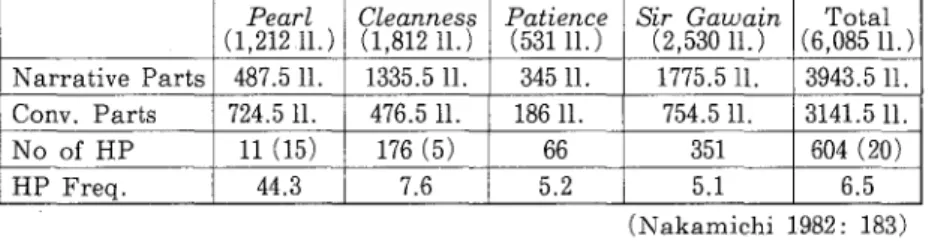
One of the reasons Nakamichi (1982) casts doubt upon single author-ship of the four poems is that Pearl shows a markedly limited use of the historical present in contrast to Cleanness, Patience, and Sir Gawain. Thig) is the third point he raises, which is based upon the
table below:
'
'
Table 1: The overall situation of the historical present in the Cotton Nero
A.x. poems
Pearl
(1,212,11.) Cleanness(1,812IL) Patience(53111.) SirGaLvain(2,53011.) (6,08511.)Total
NarrativeParts 487.511. 1335.511. 34511. 1775.511. 3943.511.
Conv.Parts 724.5ll. 476.511. 18611. 754.511. 3141.5II.
NoofHP
11(15) 176(5) 66 351 604(20)HPFreq.
44.3 7.6 5.2 5.1 6.5(Nakamichi 1982: 183)
First of all, the table given by him needs some explanation. Since the
historical present occurs mainly in the narrative, the numbers of the
examples in the conversational part are in round brackets in his table. Pearl, for example, provides eleven examples of the historical present in the narrative part and fifteen examples in the conversational part.
The frequency of the historical present in his table (i.e. HP Freq.)
refers to the frequency in the narrative part only. 44.3 in the case of
Pearl signifies that one example of the historical present occurs in
every 44.3 lines of its narrative part. Indeed, the table shows that the historical present is distinctively sparse in Pearl in contrast to the
other three poems, which provide an example in approximately every
six to eight lines. .
I would assume that his argument is exposed to some possible
6) I have expanded some of the abbreviations in his table and removed the notes
attached to the table.
contentions which can militate against multiple authorship of the
poems, and that it needs therefore to be supplemented. First of all, one could argue that there is no harm in a poet deciding not to use
the historical present, since it is a literary device. One could assert-on
this ground that the exceptionally infrequent use of the historical
present in Pearl should not necessarily arise from the difference of the author. Secondly, the limited occurrence of the historical present in
Pearl itself can be much dependent upon the eontent matter or the
genre of the text. At least, it has been observed that the overal! frequency of the historical present varies even among works produced
by a single author. For example, Chaucer -is known to display the
historical present frequeritly in some of his works and infrequently in
some other works of his (Benson 1961: 67). Furthermore, ,Veldhoen (1993: 113) describes Sir Gawain as a work of an action-based
narrative, which can encourage the relatively frequent occurrence of
the device in the poem, since the historical presient occurs commonly
with verbs of motion (Benson l961:67; Nakamichi 1982: 182). Perhaps
the way the story of Sir'Gawain proceeds is particularly suitable for
'
the use of the historical present. • • • ' •
Acknowledging these possible counter arguments, I would stillargue that Nakamichi's table provides some important information in
relation to the authorship of the Cotton Nero A.x. poems. Indeed, the
historical present is markedly sparse in Pearl than in Cleanness,
Patience, and Sir Gawain, but Pearl is not• an exceptional text in'
comparison to some other ME texts, as far as this particular literary device is concerned. In the context of ME texts in general, it is not
Pearl but Cleanness, Patience, and Sir Gatvain that are rather
exceptional. The frequent occurrence of the historical present in the
three poems other than Pearl is outstanding.
Chaucer is known to employ the historical present rather
com-monly, but according to Benson (1961: 67), there are at least 1,345
examples in his works. In contrast to this, the occurrence of the 351
Chaucer produced an enormous amount. The Canterburbl Tales alone is
five times longer than Sir Gawain. Steadman (1917) also gives the
frequencies of the historical present in some ME texts, none of which provides the literary device as frequently as Cleanness, Patience, and
Sir Gawain. To give an example, Cursor Mundi (MS Cotton
Vespasian), according to him, provides 53 instances. The text is again
an enormous work with almost 30,OOO Iines. .
. As mentioned above, the narrative in Sir Gawain is action-based,
which is strongly in favour of the use of the historical present, but Cleanness and Patience, both different in genre from Sir Gawain, also show approximately the same rate of the historical present. In• a way, the religious seriousness in Cleanness and Patience is most unsuitable
for the use of the historical present, if the device belonged to the
T)
register of popular household expressions as often suggested. However,
the historical present is abundant in Cleanness and Patience, as well
as in Sir Gawain, and in fact more abundant than the ME standard.
If a single author has produced Cleanness, Patience, and Sir Gawain, he is a poet who shows a particular favour for the employment of the
historical present. By contrast, the device is extremely sparse in Pearl, where in fact it is reserved almost exclusively as a metrical device.
If a single author, who is exceptionally fond of the historical
present, had produced all four poems, he could have used the device
more frequently in Pearl than he did. The author of Pearl was
certainly aware of the dramatic effect of the device as the examples
below illustrate: .
tt
• 1•
Penne veres ho vp her fayre frount, •
Hyr vysayge whyt as playn yuore (Pearl, 1778)>at gracios gay wythouten galle, So smoPe, so smal, so seme slyst,
Ryse3 vp in hir araye ryalle,
'
7) The issue is diseussed under Section 6.
A precios pyece in perle3 pyst (Pearl, 189-92).
However, he limits its use virtually to cases related to rhyme. He does
not display exceptionally frequent use of the device as found in
Cleanness, Patience, and Sir Gawain.
5. The other points raised by Nakamichi
Among the four points raised by Nakamichi (1982), two have been left aside so far: (1) the conversational part (as opposed to the
narrative part) is much more substantial in Pearl than in Cleanness,
Patience, and Sir Gawain; and (2) the historical present in Pearl does
not occur with verbs of saying, verbs of emotion, and verbs of wish and request, whereas these verbs present examples of the historical present in Cleanness, Patience, and Sir Gawain. The present section
discusses these issues.
It is true indeed that the conversational part is much larger in Pearl than in the other three poems. This is shown in Table 1 above, from which I have extracted the relevant part below:
Table 2: The overall situation of the historical present in the Cotton Nero
A.x. poems
Pearl
(1,21211.) Cleanness(1,812IL) Patience(53111,) SirGatvain(2,530II.) (6,08511.)Total
NarrativeParts 487.5II. 1335.511. 34511. 1775.511, 3943.511.
Conv.Parts 724.511. 476.511. 18611. 754.5ll. 3141.5II.
As Table 2 shows, the conversational part in Pearl (724.5 lines) is
much larger than its narrative part (487.5 lines), whereas the relationship
between the conversational and the narrative parts is reversed in the other texts.
I would maintain, however, that this is rnuch due to the difference
of the nature of the text and the content matter between Pearl and the other three poems. Pearl is presented in the first person. The
fundamental characters that appear in Pearl are Pearl herself and her
father (i.e. "I"), whereas most of the other characters appear indirectly
inside the conversations between them. In other words, not only the
poet but also characters inside the poem are story-tellers in the case of Pearl. In a way, the conversational part functions as an
outstand-ing foreground of the poem, and the development of the story is
heavily dependent upon the conversation in the poem. The historical
8}present, therefore, occurs in conversation as well. This is how the
proportion of the 'conversational part is larger in Pearl than in the
other three poems, and therefore, the first point raised by Nakamichi is perhaps a matter of the nature of the texts involved.
The final point raised by Nakamichi (i.e. the absence of• the
historical present with verbs of saying, verbs of emotion, and verbs of wish and request in Pearl),I find, is very interesting, since it shows
the difference of the nature of the historical present between Pearl and the other three poems. The table given by him to show the point
9)
has 'been .rearranged below:
tt
'
Table 3: The historical present with particular verbs
verbsof'saymg verbsof-emotlon
verbsofwish
andrequest --- Totals
Pearl none none none
--- 26(looo/,)
Cleanness 20(11.oo/,) 3(1.60/o) 7(3.90/o)
--- 181(looo/,)
Patience 9(13.60/o) 3(4.50/o) 4(6.10/o)
--- 66(10oo/.)
SirGauvain 32(9.10/o) 2(O.6o/,) 11(3.10/o)
--- 3s2(looo/,)
for
8)
Indeed, Pearl does not provide examples of t.he historical present
verbs of saying, verbs of emotion, or verbs of wish and request.
The historical present in Pearl, though not frequent, occurs in the narrative and the conversational parts alrnost equally. The table below shows the frequencies of the historical present I have calculated on the basis of Nakamichi (1982: 183):
Table: The frequency of the historical present in every lOO Iines '
Pearl Cleanness Patience SirGawain
'narratlve 2,26 13.18 19.13 19,77
conversational 2.07 1,05 o o
9) I have extracted only the relevant portion of
saying, verbs of ernotion,
Nakamichi (1982: 182). and verbs of' wish
(76)
his and table ( request) i,e. the , For part of the full verbs table, of seeUnfortunately, however, one cannot entirely eliminate the possibility
that this is rather accidental. Especially, the cases of verbs of emotion and verbs of wish and request are difficult to judge. The
proportions of these verbs are, even in Cleanness, Patience, and Sir
Gawain, just around 5 O/o or much less than that. In the case of Pearl, where there are only 26 examples of the historical present ,in all, one
could expect only one example at the maximum, even if the literary
device were to occur with these verbs at the same rate as in Cleanness,
Patience and Sir Gawain. ' ' .
'
In the case of verbs of saying, their proportions in Cleanness,
Patience and Sir Gawain are 11.00/o, 13.60/o and 9.IO/o respectively.
Since Pearl provides the total of only 26 examples of the historical
present, one could again expect only a few examples of verbs of
saying, even if Pearl were to show the use of the historical present with these verbs at the same rate as in Cleanness, Pdtience, and Sir Gawain. The absence of examples in Pearl can therefore be due to the limited occurrence of the historical present itself in the poem. •
• The other point that enhances the difficulty is that .Pearl provides some examples of verbs of saying in the present tense, though they are
not counted by Nakamichi as examples of the historical present:
'
Anende rystwys men 3et sapt3 a gome, ''
Dauid in Sauter, if euer 3e sys hit (Pearl, 697-8)
'
"I seghe", says John, "Pe Loumbe hym stande
On be mount of Syon ful bryuen and Pro, '
Q:gy.y.tP,hg.ep.?Weg."s3,.%",,h".ngr"e\%,to,7,sz",g.ei,,.
gSeg.ililLU.S:,"a,ke ,h8 ,C:X,e,i7,.UPi8h.,z", iei"8,ko,wwke, sB2L?ge.e"t is made
' It is perhaps better to treat these examples separately as
Nakamichi does, since the use has a longer history in written' (77)
literature than the historical present of the ordinary type. Visser (1966: g781) states that this use of the present tense was available
from the OE period onwards, while the historical present of the
ordinary type increases only in later ME (Visser 1966 : g 760). However,
simply because of the nature of the content matter of Pearl, most
verbs of saying in the text are connected with subjects such as John, Matthew, and Paul in the Bible. If they are not regarded as
illustrat-ing the historical present, it would be natural that verbs of sayillustrat-ing
cannot provide the historical present in Pearl as much as in Cleanness,
Patience, and Sir Gawain. Hence the final point raised by Nakamichi,
though interesting, cannot be proved easily.
6. Additional comments
The origin of the historical present has been controversial. While some advocate the Old French influence upon English, others argue that the
10)
hiStorical present is essentially native in origin. Among the latter
group, Trnka (1930: 17) asserts that the historical present is a common feature in all living Germanic languages, although he does
not necessarily deny the influence of Old French on the expanded use
of the device in written English. He considers that it was essentially in popular register in OE.
The historical present, however, is not limited only to Germanic languages or French, but it also occurs in Japanese. Wada (1978: 33)
notices an extensive use of the historical present in the Japanese oral tradition. The device itself is possible or at least inherent in a number
of languages. The origin in the ultimate sense can, therefore, be considered native, though examples are not really attested in OE
written materials. Jespersen (1924: 258) states that the historical present fundamentally belongs to the class of everyday expressions. Even in OE, it was possible to use the present tense while "referring
10) For example, Moss6 (1952: g125.2) and Mustanoja (1960: 48) are for the Old
French influence, whereas Steadman (1917: 21 & 44), Jespersen (l909-49, IV: 19) and Trnka (1930: 17) are for the native origin.
to or quoting sayings of eminent men living in the past" (Visser 1966: g781). Also, the present tense was used in chronicle tables even in OE
(Visser 1966: g784). Thus it was at least possible in OE to employ
the present tense even when reference was to things in the past. In this
way, OE was not entirely devoid of the capacity for the use of the
historical present. ' ' •• • .
Even so, the suddenly expanded use of the device in English from
the middle of the ME period needs to be explained in one way or
another. Steadman (1917) argues that the historical present develops,
once the periphrastic future forms (i.e. those with will and shall)
establish themselves in English. In OE, the present tense also referred to events in the future and therefore it would have been awkward also
to refer to events in the past. I do not necessarily understand,
however, why the use of the present-tense form for the future in OE
militates against the use of the historical present. In Japanese, the use of the hiseorical present is possible even though the same verb forms
can be used both for present and future events. I also do not
understand why the development of the periphrastic future should lead to the development of the historical present. There is no need for the present tense suddenly to start referring to events in the past simply because it has stopped referring to events in the future. Moreover, the
historical present is available in present-day German, where presen" tense verb forms can refer to future events as well. In fact, German
and English are similar in respect to the development of the historical
present. As Frey (1946: 46) states, the thirteenth century was the turning point in German, before which the device was hardly
'
The factors can possibly include both the popularization of ME
literature and the influence of Old French. The influence of Old French literature becornes particularly strong in the ME period, and especially
at the court, where French was dominantly used. In the mean time,
English literature sees the rise of romance literature. Romances are
under strong influence of the continental literary tradition where the
'
historical present was available, while they often include extended
narration, which is also an ideal condition for the use of the historical
present. Furthermore, as Waldron (1957: 793) states, romance
"flourished for the most pare as oral poetry, and only incidentally found its way into writing", which is again favourable for the use of the historical present. Although religious themes were continuous in
literary materials, active human beings with clear personality came to
be introduced in ME literature. Chaucer and the poet of Sir Gawain
are representative in this respect. The central stage of literature was
partly given up to human beings. In other words, literature was
popularized, though it was often still within the framework of the courtly tradition in essence. Supposing that the historical present
belonged to popular register as Jespersen suggests, the change of
literary conditions in late ME was perhaps more favourable for the
extended use of the device. In short, the change of the literary
tradition in the latter half of the ME period facilitated an,ideal
condition for the occurrence of the historical present in written
11)
materials. .
As far as the Cotton Nero A.x. poems are concerned, the use of
the historical present differs, as discussed above, much between Pearl
and the other three poems. This means that at least the attitude
towards the newly developed literary device was different between the poet 'of Pearl and the poet of Cleanness, Patience, and Sir Gawain. The poet of Pearl is hesitant in its use. Most probably he knew the
12)
historical present as an effective narrative device, but in actuality, he reserves it more or less as a poetical device for the rhyme scheme. In
contrast, Cleanness, Patience, and Sir Gawain employ the newly
established device willingly, and ,in fact, much more willingly than most ME' authors. It would perhaps be easier to propose the existence
11) Yasui (1960: 194-200) alse refers to the change of the literary tradition in English, although his contention is slightly different from mine. He states that the West.-Saxon literary tradition in OE was not in favour of the device and that the termination of the tradition after the Norman Conquest led to the -rise of the historical present in English.
12) See seetion 4 above.
of two authors at least, who display different attitudes towards the
use of the historical present.
7. Conclusions
The present paper has discussed the use of the historical present in the
Cotton Nero A.x. poems. The nature of the historical present differs
much between Pearl and the other three poems. In Pearl, it is strongly dictated by rhyme, and appears only sparingly. In Cleanness, Patience,
and Sir Gawain, by contrast, the poetical factor is not at all strong
or non-existent. In the three poems, the historical present is used, not
as a poetical device, but often as a narrative device. As far as the
narrative part is concerned, the frequent use of the device in the three
poems is outstanding in contrast to Pearl, and even in contrast to ME
literature in general. Their author is a person who is particularly in favour of the device. He uses it in the three works equally often, even
though the genre differs. Thus, one can most reasonably be hesitant
about including Pearl into the same authorship group as the other
three poems.
According to Nakamichi, there are two more features which
eliminate Pearl from the group of Cleanness, Patience, and Sir Gawain.
Firstly, the proportion of the conversational part in Pearl is much
larger than in the other three texts. This can, however, arise from the difference of the content matter of the text. Secondly, the historical
present in Pearl does not occur with verbs of saying, verbs of
emotion, and verbs of wish and request, although these verbs present
examples of the historical present in the other three poems, This is an
interesting point to make, but unfortunately, the small number of the examples in the poems cannot prove it.
Finally, some comments were made upon the origin of the
historica} present. Most probably it was a device in popular register in OE, which came into written materials in ME, when literature was
REFERENCES
Anderson, J. J. (ed.) 1969. Patience. Manchester: Manchester University
Press.
(ed.). 1977. Cleanness. Manchester: Manchester University Press. Benson, L. D. 1961. "Chaucer's Historical Present-Its Meaning and Uses" . English Studies 42: 65-77.
Clark, J.W,1949. "Observations on Certain Differences in Vocabulary
between Clean'ness and Sir Gawain and the Green Knight".
Philological Quarterly 28: 261-73.
. 1950a. "Paraphrases for `God' in the Poems Attributed to `the
Gaopain-Poet'". Modern Language IVotes 65: 232-6.
. 1950b. "`The Gawain-Poet' and the Substantival Adjective". JEGP 49: 60-6,
. 1951. "On Certain `AIIiterative' and `Poetic' Words in the Poems Attributed to `the Gawain-Poet'" . Modern Language Quarterly 12: 387-98.
Frey, J.R. 1946. "The Historical Present in Narrative Literature,
Particularly in Modern German Fiction". JEGP 45: 43-67.
Gordon, E.V. (ed.) 1953. Pearl. Oxford: Clarendon Press.
Iyeiri, Y. 1996. "The Periphrastic Use of Con Reconsidered : The Authorship
of the Cotton Nero A.x. Poems". Studia Neophilologica 68: 3-8.
. 1998. "MS Cotton Nero A.x. Poems Once Again: A Study of
Contracted Negative Forms", in English HistoricaZ Linguistics and Philology in Japan, ed. J. Fisiak & A. Oizumi, pp. 79-89.
Berlin & New York: Mouton de Gruyter.
Jespersen, O. 1909-49. A Modern English Gramrnar on Historical Principles. 7 vols. Heidelberg: Carl Winter.
. 1924. The Philosopdy of Granirnar. London: George Allen and '
Unwin. '
Kjellmer, G. 1975. Did the "Pearl Poet" VVrite "Pearl"? G6teborg: Acta Universitatis Gothoburgensis.
Mclntosh, A., M. L. Samuels, & M. Benskin. 1986. A Linguistic Atlas of
Late Mediaeval English. 4 vols. Aberdeen: Aberdeen University Press.
Mizutori Y. 1968-9. "Historical Present in Sir Gabvain and the Green
'
Knight" (in Japanese). Jimbun Kenkblu: Studies in the Humanities (Osaka City University) 19(7): 1-26; 20C7): 76-90.
Mosse, F. 1952. A Handbook of Middle EngZish, translated by J. A. Walker. Baltimore & London: The Johns Hopkins University
'
Press. '
Mustanoja, T.F. 1960. A Middle English Sblntax, I: Parts of Speech.Helsinki: Soci6t6 N6ophilologique.
Nakamichi, Y. 1982. "On the Use of the Historical Present in the
Poems". The Geibun-Kenkblu: Journal of Arts and Letters (Keio
University) 43: 19-30.
Steadman, J.M. 1917. "The Origin of the Historical Present in English". Studies in Philologbl 14: 1-46.
Tajima, M. 1978. "Additional Syntactical Evidence against the Common
Authorship of MS. Cotton Nero A.x.". English Studies 59: 193-8.
. 1989. "Gengo Buntai to Authorship: Cotton Nero Shigun wo
ChUshin ni [`Language, Style and Authorship: The Case of the Cotton Nero Poems']", in Cha-eigo Toin-shi no Gengo to Buntai
[`The Language and Style of Middle English Alliterative Poetry'],
ed. E. Suzuki, pp. 98-135. Tokyo: Gakushobo.
Tolkien, J. R. R. & E. V. Gordon (eds.). 1967. Sir Gawain and the Green
Knight, revised by N. Davis. 2nd edn. Oxford: Clarendon Press.
Trnka, B. 1930. 0n the Syntax of the English Verb frorn Caxton to Dryden. Travaux du Cercle Linguistique de Prague 3. Prague:
Jednota Ceskoslovenskuch Matematiku a Fysiku.
Veldhoen, B. 1993. "Psychology and the Middle English Romances", in Companion to Middle English Rornance, ed, H. Aertsen & A. A. MacDonald, pp. 101-28. Amsterdam: VU University Press. Visser, F.T. 1964. "The `Historical Present' in Middle English Verse
Narrative". EngZish Studies, Zandvoort Festschrift, 135-42. . 1966. An .Elistorical Syntax of the English Language, II. Leiden:
t
E. J. Brill.
Wada, Y. 1978. "The Historic Present in Sir Gatvain and the Green
Knight". Senriyama Cornments on Literature by the Council of
Graduate Courses of the Department of Literature (Kansai
University) 19: 1-35.
Waldron, R.A. 1957. "Oral-Formulaic Technique and Middle English
Alliterative Poetry". Speculum 32: 792-804.
Yasui, M. 1960. Eigogaku Kenkyu [`English Linguistics']. Tokyo:
'
'
sha.
'
Zimmermann, R. 1973. "Verbal Syntax and Style in Sir Gawain and the
Green Knight". English Studies 54: 533-43.