論文
Teaching and Learning World Languages at Elementary School Level in the U.S. – The Challenge of Becoming Multilingual
Theresa Austin, Ph.D.
Professor Language, Literacy & Culture School of Education, Teacher Education and Curriculum Studies Department
University of Massachusetts, Amherst
Both the growing diversity of the US population and a widespread US international presence would naturally lead to an assumption that multilingualism in the US has been seen as an important part of education that is therefore already well developed. However, the actual case is that few US learners ever reach high levels of proficiency in world languages. In fact, the state of learning world languages has been deemed a “crisis” at more than one period throughout US history, most frequently in times of war.
In this article1 I would like to introduce the social context of bilingualism in the US at a national perspective to present some of the challenges faced in creating multilingual capacity through public education. Drawing on my personal and professional
experiences, as well as current research literature, I will identify types of programs, and provide several representative examples of current activities and assessments. Next I will delineate further directions to develop bilingualism and the challenges entailed. I conclude with some promising developments on our local horizons.
Bilingualism as a result of social contact- Globalizing factors and border crossings In the US, we are blessed with a diversity of immigrants, refugees and migrants who have chosen to rebuild their lives in the US. They bring with them labor, skills, language, and culture that support daily life almost anywhere you turn. Particularly those that establish families begin an arduous task of participating in public institutions, from heath care, education, and public service. In addition we have a small number of indigenous populations, some of whom have bravely cultivated their tribal languages.
Moreover we have the legacy of slavery that continues through racism and has all but eliminated the African languages formerly spoken. However, the multilingualism that each group has contributed has not received high status or welcome arms, much less equitable treatment under the law. Nonetheless the children of these groups attend schools where, if they are fortunate, they can potentially receive instruction in their first language (L1), as well as second language (L2). However the vast majority of students are in classrooms where a teacher may exclude the use of their first language or English variety and present lessons exclusively in their second language (English), making them vulnerable to missing the content at the expense of learning English. This process often results in subtractive bilingualism. Subtractive bilingualism is defined as removing the non-dominant language from public institutional support. As a consequence of this move, many learners do not continue to develop as bilinguals, most commonly remaining instead at varying levels on a continuum of oral proficiency in the
L1(Hornberger,2004). Very few of these learners develop literacy in L1. In addition, often it is the case that their L2 literacy depends on the level they achieved in L1 prior to their arrival in the US. Similarly, English language varieties are likely to find support when concentrated in areas where there are large communities of such varieties. Most public schools do not offer opportunities to engage in developing non-English L1 literate practices, leaving very few learners with high levels of biliteracy. Often when these learners enter middle and high school, they are required to start from the
beginning to learn a standard variety of their L1 taught to them as a ‘foreign language’, despite their accumulated experience using their primary home language and knowledge of this heritage language. It is worth pointing out that heritage learners are those who are so designated because they are learning a language that has been used in their family.
However this designation is not generally used in reference to those who maintain non- dominant varieties of English, eg.: African American English, Chicano English or Hawaiian English. Nonetheless where populations of heritage language learners are substantial, courses may be created to serve their particular needs. Even heritage language schools have become more widespread in the last ten years constituted by community-based as well as school-based after school programs.
In addition to the lack of support in schools for developing adult bilingual and biliterate skills, immigrants face discrimination and bias in society because their English literacy levels are lower than that of native speakers of mainstream English. They typically end up employed in working class jobs that are often made possible by the current surge in transnational business. So it is easy to understand how becoming bilingual or biliterate in the US is a struggle against many odds.
In contrast, the general orientation to world language instruction in kindergarten- twelfth grade (K-12) public institutions in the US primarily focuses on the middle-class monolingual English speaker who will travel to or most likely vacation in the countries where the focal languages are used. A few even go on study abroad or short exchange sojourns to another country. However a greater number of students perceive very little use for world languages. Many actively resist learning and some exhibit even more resistance by only taking the minimum requirements and not persisting to reach established fluency levels. Even those that are engaged in learning another language find it difficult to transition to more formal academic instruction in higher levels when their elementary ACCELA curriculum has been more geared to motivational games and songs. Therefore a struggle exists between teachers trying to build proficiency in
another language and learners resisting the need to learn any other world language (Alexandru, 2008). The spread of English across the world and the growing numbers of English users also unfortunately affects the widespread perception that learning other languages is not as important because English is ubiquitous.
At the national level, priorities for learning a language have been recognized for defense, and therefore limited to selected languages such as Arabic, Chinese, Russia,
commonly taught languages still have low priority in public schools. In recent years many schools have actually curtailed or eliminated language study given the pressure to meet annual academic achievement goals in math and English reading scores on
standardized tests. Meanwhile the world language profession advocates for earlier and longer duration of language study. Thus schools that are supportive of world languages, and who still have not met their annual progress goals in reading, math, and now
science must choose between programs that aim at these competing annual academic achievement goals. In response to the lack of support in mainstream school curricula, long term resident immigrants and ethnolinguistic groups frequently build communities that support world language learning on Saturdays in community-based schools and churches or in afterschool programs.
While classroom foreign language pedagogies are resisted by some students they are still taken up by many others who engage in using technology and mass media to pursue interests which also offer opportunities for language learning. Many learners of
Japanese as a world language become interested in popular cultural texts including anime or manga. Learners of Chinese are interested in martial arts and use this cultural connection to learn language. Most often the students enrolled in study of Romance languages of Spanish, French, and Italian have access via technology to participate in activities in social networks where these languages are used to some degree. It would be interesting to see how many actually engage and learn language in these venues.
In my own history, my father’s military career obligated us to crisscross the US from coast to coast. However in the public and private schools that I attended, I did not have foreign languages included in my study until the 8th grade, a very common experience for those attending schools in the 60’s. Had it not been for my father’s assignment to Panama, I would not have been instructed in any other language in school. This fact underscores how little other languages were regarded. Even my mother was convinced that speaking her own second language, Japanese, much less her first language
Okinawan, was deleterious to our learning English. With this limited preparation is it not likely that many learners given even this minimal support of foreign languages in schools could develop bilingualism. Only with strong family ties, communities and social networks that use another language could someone with effort become bilingual.
Pavlenko & Lantolf (2000;163) wrote that learners normally construct local & personal meanings, “A learner’s struggle to participate in the lifeworld of other L2 users and may result in the reshaping of the self – which comprises, among other things, agency”. In his or her use of these meaning creating processes, the language learner explores, creates, and revises linguistic identities which are unique in relation to those of monolingual users of both L1 and L2.
To become bilingual, a learner draws on the first language as well as what is being learned in a second language (Cook, 1991). In fact a bilingual is not just two monolinguals merged into one person (Haugen, 1981). More accurately a bilingual becomes so through a creative construction of the experiences that they have engaged in and continue to cultivate. As their activities using the language within social contexts shape what they can do, their competence develops and functions as creative reflections of a multicompetent learner reality “that no monolingual text could capture”
(McGroarty, 1998: 614). So when an emerging bilingual is given the opportunity to develop L1 and L2, they make choices based on localized preferences as opposed to the emulation of the idealized monolingual L2 linguistic norm. The choices are influenced by emotionally salient past uses of language. Their feelings developed in relation
toward physical aspects of the L2 such as sound, shape, or rhythm, as well as feelings of what is appropriate or inappropriate language use. In a study conducted by Beltz (2002) with multilingual German learners, an interactive task was set up to see how they described pictures.
In the following excerpt we see how Danny draws on various languages:
—(7) Dieses mußt du ja wissen [German]: each petal was coloured differently. One was a light shade of Farbe [German],another dark and splotchy with hue [English], while a third was almost reddish with kleur [Dutch], and the undersides were all tinted delicately con tutti i colori possibili [Italian].
(DANNYTXT Lines: 31–47) ‘This you must know: each petal was coloured differently. One was a light shade of colour, another dark and splotchy with hue, while a third was almost reddish with colour, and the undersides were all tinted delicately with every possible colour.’
Danny had English as a mother tongue, 5 semesters of German language study at the university and a varied learning history of Flemish, French, Italian and Spanish. We see how his description reveals his history by his spontaneous use of German, English, Dutch and Italian. His history as a learner shapes his beliefs about language, and language learning. As well it affects his identity as a user of multiple languages. Most likely his experiences affect how he favors certain teaching contexts or methods for his learning about the world. Since he cannot relive his life in each language, his language learning constitutes intersections of part learning and new learning, making his
bilingualism a veritable social work of art.
If we see bilingualism as a process that takes a lifetime of experiences, then we cannot hold onto mythical notions that there is a “balanced” bilingual. In the next section, I will elaborate on how national organizations are trying to support language-learning
experiences in the schools to provide an earlier start the processes of learning another language.
NATIONAL PICTURE
I mentioned earlier how the US government has encouraged language learning in certain languages. In fact, a total of $8.7 million in grants have been awarded for Critical
Foreign Language Instruction: Arabic, Chinese, Russia, Hindi, and Farsi among other languages in 2007. "With our increasing global economy and national security needs, it's crucial that we have as many citizens as possible who can communicate in languages such as Arabic, Chinese, Russian, Korean and Hindi," said U.S. Secretary of Education Margaret Spellings. This is a considerable amount of money for language education, yet for k-12 the amount was reduced to 2.2 million in 2008. It is not surprising that three other government agencies were involved in securing the initial large amount of
funding: State Department (which handle foreign affairs), Defense Department (military operations) and Office of the Director of National Intelligence (which handle espionage and counterintelligence operations). This is very scary because these funds shape what languages are taught, where courses are offered, and who gets to learn. The Defense Department’s program called National Security Language Initiative, gave priority to
state and local proposals to provide instruction in critical foreign languages, such as Arabic, Chinese, Japanese, Korean, and Russian, as well as languages in the Indic, Iranian, and Turkic families. The amount was $21.8 million in 2006 and 2007, 23.8 million requested in 2008. They also sponsored STARTALK - a project to expand foreign language education in critical languages in the public schools.
Also two national organizations have become significant partners, American Council on Teaching of Foreign Language Learners (ACTFL) and National Council for
Accreditation of Teacher Education (NCATE). ACTFL has established the Performance Guidelines for K–12 learning and NCATE has used ACTFL’s guidelines for K–12 world language teacher education.
Together these national organizations tackle the larger problem that less than one percent of American high school students study Arabic, Chinese, Farsi, Japanese, Korean, Russian or Urdu, according to the State Department (Bradshaw, 2007). Less than eight percent of U.S. college undergraduates take foreign language courses. Fewer than two percent study abroad in any given year. Foreign language degrees account for only one percent of undergraduate degrees conferred in the United States.
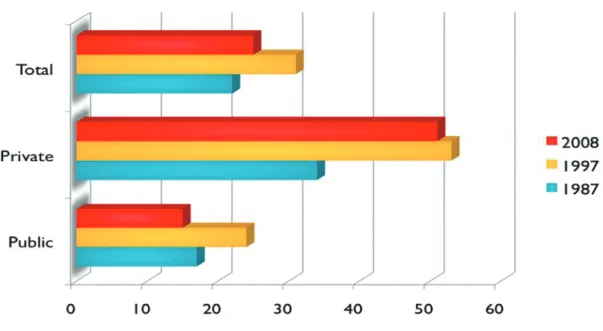
Now you might ask, where does one study world languages? According to the Center for Applied Linguistics (Washington Times, 2006) 31% of all US elementary schools offer this. Private schools offer 7% of these programs and 24% of public schools offer the rest. Not surprising is that 79% of these schools are geared towards building basic language exposure, not towards building proficiency. The same source reveals that elementary world language programs in public schools decreased between 1997-2008 from 24 to 15% while the private schools’ teaching world language has remained about the same.
Figure 1 Percentage of elementary schools that offer world language instruction- Private vs. public
Preliminar
Preliminary
Results from the National K–12 Foreign Language Survey indicates that in most schools in the US. Spanish is the most popular language taught - 88% elementary and 92% of secondary schools.
While Chinese and Arabic are offered at more elementary and secondary schools than a decade ago, they still are taught at only a fraction of a percent. What is encouraging is that programs for heritage learners have increased offering the following languages:
Arabic, Chinese, Greek, Haitian Creole, Hupa, Navajo, Salish, Spanish, and Yup’ik. See the chart below:
Figure 2 Percentage of elementary schools that offer world language instruction - Languages offered
Figure
Given this picture of language instruction at the national level, in the next paragraph we can appreciate the types of programs that develop bilingualism.
BILINGUAL PROGRAMS
If we consider the development of bilingualism important we understand that a schools’
responsibility is to develop bilingualism into biliteracy, so that the language learning also becomes a vehicle for learning subject matter as well as more sophisticated language use. Four models are explained below: Two-way immersion program, Late exit transitional program, Early exit bilingual program, and the Heritage/Indigenous language program.
The most ambitious program model is the ‘Two-way immersion program’ or ‘Two-way bilingual program,’ which therefore may also be called a dual language program. The goal of this program is to develop strong skills and proficiency in both home language (L1) and English (L2). The model includes students from L2 background and students with L1 background. Instruction is conducted in both languages, typically starting with a smaller proportion of instruction in L2, and gradually moving to half of the instruction in each language. Students typically stay in the program throughout elementary school.
Another model is the “late exit transitional program” or also known as Maintenance bilingual education. Its goal is to develop some skills and proficiency in L1 and strong skills and proficiency in L2 (English). The subject matter is taught in both languages, with teachers fluent in both languages. Instruction at lower grades is in L1, gradually transitioning to English; students typically transition into mainstream classrooms with their English-speaking peers. Curriculum variations focus on different degrees of literacy in L1, but students typically continue to receive some degree of support in L1 after the transition to L2 classrooms where their remaining education is in English (L2).
A third model is the “Early exit bilingual program,”or “Early exit transitional program.”
In this program the goal is to develop English (L2) proficiency skills as soon as possible, without delaying learning of academic core content. Typically instruction begins in L1, but rapidly moves to English (L2). Students often are transitioned into mainstream classrooms with their English-speaking peers as soon as possible.
A fourth model is the Heritage/Indigenous language program. It takes into consideration that students may live in communities where they have been supported by use of a language other than English and some of these communities have been of indigenous peoples who have long been underserved by the public education system, among other sufferings. In these programs the goal is also similar to Dual immersion in literacy in two languages and content being taught in both languages by teachers fluent in both languages. However the Indigenous program typically focuses on learners with weaker literacy skills in L1 and or L2. Known by the name, Indigenous Language Program, it is almost exclusively offered in American Indian educational communities. The program supports endangered languages and serves students with weak or no receptive and
productive skills in both languages. The Heritage learner programs focus on students whose range of academic literacy varies dramatically: from those whose schooling in another country may have provided them with strong academic preparation to those whose have little to no schooling in a language that has been used in their family. Thus programs are varied; some focusing on language as the only content area taught or in immersion programs some content areas may be taught in the heritage language.
These models mentioned here have been distinguished from other types of programs in which primarily world language goals are sought. In the next section, I discuss the language-focused programs that introduce learners to other languages.
TYPES OF ELEMENTARY FOREIGN LANGUAGE PROGRAMS
In these programs, as mentioned earlier, most of the learners are seen as new to learning another language. Generally they are expected to be monolinguals. Thus three types of programs are offered: foreign language experience (FLEX), foreign language in the elementary school (FLES), and immersion.
FLEX programs aim at providing students with general exposure to language and culture while FLES programs aim to help students acquire listening, speaking, reading, and writing skills in addition to an understanding of culture. A smaller percentage of schools offer immersion programs, in which the target language is used for instruction at least 50% of the day and the goal is for students to achieve a high level of proficiency in the target language. As mentioned earlier on the national level, there is a difference between public and private school program offerings. It is most evident in the types of programs offered. In the chart below the majority (56%) of private elementary school programs were FLES programs while the majority of public elementary school programs were FLEX. Only 2% of private school programs provided language
immersion, while immersion programs accounted for 13% of public school programs.
Figure 3 Distribution of types of programs found in private and public schools
References
Bradshaw, J. (2007)
For schools to receive federal funding, language classes are recommended to meet at least 4 days per week for no less than 45 minutes per class to meet the goals of the national standards and federal funding (Foreign Language Incentive Program). In a content-enriched program, a daily one-hour language class is strongly recommended. In partial or total immersion program, 50-100% of class time is conducted in the target language. Also assessments are needed to show development.
ASSESSMENTS IN ELEMENTARY LANGUAGE PROGRAMS
While all elementary schools are subject to the standardized tests in each state, given the limitations on this paper, it is not feasible to discuss such assessment tools here.
However there are several recent assessments that have been developed by the Center for Applied Linguistics for use in elementary language programs. In my presentation, participants were given a chance to take some sections of these. Here I describe the
three that are increasingly being used to gauge learners’ oral proficiency, CAL Oral Proficiency Examination (COPE), Simulated Oral Proficiency Interview (SOPA) and Early Language Listening and Oral Proficiency Assessment (ELLOPA). Next I critique some of the problems with these instruments and then conclude.
The first of the three assessments, CAL Oral Proficiency Examination (COPE) is identified as appropriate for use in 5th and 6th grade immersion programs for students to demonstrate second language proficiency. Here proficiency is measured through role- playing situations typically encountered at school. It provides activities utilizing
manipulatives, familiar objects and situations, and culturally related materials. A rating scale was designed drawing on the nine-level ACTFL Proficiency Guidelines (1986).
The second, the Student Oral Proficiency Assessment (SOPA, 1991) was designed to assess the oral language proficiency of immersion students in Grades 1–4. It measures five developmentally appropriate language tasks: 1) identifying, naming, and following instructions, 2) answering informal questions, 3) identifying and describing a
sequence,4) retelling a story (speaking in longer discourse, using tenses) and 5)
supporting an opinion (presenting a convincing argument and using appropriate register).
The third instrument is the Foreign Language in the Elementary School SOPA (ELLOPA), designed for students in programs where less intensive foreign language instruction is provided. It measures ability to describe and place objects and people in a familiar scene, and following instructions.
From these brief descriptions you can see that there are several shared features of among the COPE, SOPA, and ELLOPA. All are 1) “interview ” genre based, 2) have sequence–warm up, task, wind down, 3) require coordinated pair work, but are
individually assessed, 4) in the rating there is an attempt to reach a “ceiling”, that is, a point at which the learner cannot perform independently, 5) use the same rating rubric.
The differences among these three are that the COPE uses role-play format exclusively and the main interaction is between students. On the other hand, both the SOPA and ELLOPA ask informal questions, require a description, narration, and also include a
If we think about what bilingual learners do, we can see an immediate discrepancy.
There is an absence of student-initiated topics. In other words, students do not get to start or end a conversation, or even to change the conversational topic. There are no provisions in the rating to take into consideration uneven levels of interactions due to the students’ relationship to each other—even in something as basic as control over turn taking. As in most tests there is variable quality of performance due to the learner’s topic familiarity. But in oral tests this familiarity will affect dramatically the degree to which the students can orally display what they know. The language that is rated is
‘transactional’ rather than the ‘interactional’ language normally used to in building relationships with partners or audience, an essential ingredient to make conversations work between people in society. Thus using language to build relationships through talk is not recognized, nor is using language to create new knowledge, nor is there
acceptance of a creation of new language terms, such as using phrases like, “What do you think?”; “This reminds me of…”;“This sounds like ….”; “How do you say….I invented a word……” More importantly this does not capture a child’s growing development of critical language awareness, of how language works to influence themselves and others. We cannot see how they are using language to accomplish goals that require this type of language use. We cannot see how they use their proficiency to collaborate with others on common goals. These limitations reveal that the assessment of language learning is still not focused on what bilingual learners need to learn and do, but rather remains focused on features of the language itself.
At a local level in a town near my university, there is a Chinese dual immersion school that is directing its efforts to assess children’s bilingual development. I invite you to visit and compare their requirements with what these national assessments require.
Please visit:
http://www.nflrc.iastate.edu/Chinese/documents/Kindergarten_Curr_Scope_and_Seq.pdf In Massachusetts, political restrictions on providing instruction to bilingual learners in a non-English language were recently passed in a referendum called Question 2. It
restricted the use of non-English language in instruction in all public schools unless the school is a dual immersion language program. So there is a perception that it barely supports bilingualism in dual language programs by funding state sponsored elementary
projects. Since there are only a few of these and they are supported by local bilingual communities, they bring hope in that by being successful they might inspire more ambitious school districts to follow them.
CONCLUSION & CHALLENGES AHEAD
I have discussed how bilingualism in the US is very much a struggle that is alive because of several factors. On an individual level, bilingual learners draw on life
experiences that can foster their bilingualism and biliteracy. These experiences naturally draw on family and community languages as resources if they are available, used, and permitted to be developed in academic settings. This growth is inherently one that
creates a hybridity of language practices if the individual is allowed to use all languages.
We can see this in code switching abilities and creative multilingual use. In fact bilingualism has stages where language boundaries are blurred and should not be compared to two monolingual developments in separate languages.
The larger federal and state level policies influence possibilities of becoming bilingual through resources and legislation. National defense supports certain languages and not others. Politically active communities that have non-English languages can be a resource and advocate for having their languages included in schools in a number of types of programs. On the other hand, assessments may narrowly focus on linguistic features that don’t capture what is actually needed to become biliterate.
I see that our challenges ahead need to be conceived of both at the macro and micro levels. At the macro level, we need to examine our orientations to bilingualism to understand what type of bilingualism is desired for whom, by whom. We also need to check if these goals are well articulated across our programs to reach our desired goals.
This means an alignment is needed across K-16. Do we as teachers look ahead of the grades our learners are currently in order to prepare them for broader success, or are we too narrowly focused on grade-level details in language learning?
a resource for thinking and identity building (to create, to think, to engage with others to inquire and do things). We as language teachers and researchers have a wide range of bilingual activity to draw on. If only our courses allowed and encouraged this range of language and literacy use, we might be able to reach our bilingual goals and help our learner create bilingual identities through their activities.
REFERENCES
Alexandru, A.(2008).“Miss, do we really have to pass this class?" Current discourses in the middle school students' foreign language classroom. Saarbrücken,
Germany:VDM Verlag Dr. Müller
Belz,J.A.(2002).The myth of the deficient communicator.Language Teaching Research;
6(1), 59–82.
Center for Applied Linguistics.(2008). World language teaching in U.S. schools.
Preliminary results from the National K–12 Foreign Language Survey. Accessed 5/25/09. http://www.cal.org/flsurvey/prelimbrochure08.pdf
Center for Applied Linguistics.(N.D.)
http://www.cal.org/about/Presentations/oral_proficiency_cal.pdf
Cook, V.(1991).The poverty of the stimulus argument and multi- competence. Second Language Research,7,103–17.
Haugen, E.(1987).Blessings of Babel. Bilingualism and language planning, pp. 54-55.
Berlin: Mouton de Gruyter.
Hornberger, N.(2004).The continua of biliteracy and the bilingual educator: Educational linguistics in practice. Journal of Bilingual Education and Bilingualism, 7(2&3),155- 171.
Lantolf, J.P. & Pavlenko, A. (2001).(S)econd (L)anguage (A)ctivity theory:
Understanding second language learners as people. In Breen, M.,(Ed.).Learner
contributions to language learning: New directions in research. London and New York:
Longman, 141–58.
McGroarty,M.(1998).Constructive and constructivist challenges for applied linguistics.
Language Learning, 48(4): 591–622.
US State Department.(2006).Teaching language for national security and global competitiveness: U.S. Department of State. Press Release. January 5. Accessed 2/15/07 http://www2.ed.gov/news/pressreleases/2006/01/01052006.html
Valdes, G. & Figueroa, R.(1994).Bilingualism and testing: A special case of bias.
Norwood, NJ:Ablex.
Teaching and Learning World Languages at Elementary School Level in the U.S. –The Challenge of Becoming Multilingual
Theresa Austin, Ph.D.
Professor Language, Literacy & Culture School of Education, Teacher Education and Curriculum Studies Department
University of Massachusetts, Amherst Abstract
This article introduces the social context of US bilingualism from a national perspective to present some of the challenges faced in building multilingual capacity through public education in world languages. Drawing on current research literature, as well as my own past personal and professional experiences, I describe the major varieties of currently existing programs, and provide several representative examples of their corresponding activities and assessments. Next a discussion of the directions to develop bilingualism and ensuing challenges are provided. I conclude with a description of several promising developments.
米国の小学校段階での世界の言語の教育と学習
-多言語話者となる課題
テレサ オースティン マサチューセッツ大学アマースト校 教育学研究科 教師教育・カリキュラム研究学科 言語・リテラシー・文化
要旨
本論文は、世界の言語の教育を通して、多言語能力を育てる中で直面する課題を明示するこ とで、米国の国家的見地からみた二言語併用の社会的状況について紹介するものである。最 新の研究や論者の公私にわたる経験に言及しながら、今現在米国で行われている主要なプ ログラムを説明し、その活動や評価の代表的な例を紹介する。次に、二言語併用を発展させる 様々な方法とその実施上の課題について論じる。最後は、有望な結果が期待できる方向性を 示して締めくくる。本論文は 2009 年 6 月 26 日に行った愛知県立大学での講演「多言語話者 を育てるアメリカ合衆国の小学校における世界言語の教育と学習」の内容に加筆したものであ る。