• 検索結果がありません。

TRANSLATE CHALLENGE AS AN OPPORTUNITY: VISUALIZING OPTIONS OF SUSTAINABLE AGRICULTURE IN SEMI-­‐ARID AREA OF TURKEY Erhan Akça

N/A
N/A
Protected

Academic year: 2021

シェア "TRANSLATE CHALLENGE AS AN OPPORTUNITY: VISUALIZING OPTIONS OF SUSTAINABLE AGRICULTURE IN SEMI-­‐ARID AREA OF TURKEY Erhan Akça"

Copied!
3
0
0

読み込み中.... (全文を見る)

全文

(1)

TRANSLATE  CHALLENGE  AS  AN  OPPORTUNITY:  VISUALIZING  OPTIONS  OF  SUSTAINABLE   AGRICULTURE  IN  SEMI-­‐ARID  AREA  OF  TURKEY  

Erhan  Akça

1

,  Kume  Takashi

2

,  Hikmet  Bozaklı

3

,  Shizue  Miura

4


1

Adıyaman  University,  Vocational  School  of  Technical  Sciences,  02040  Adıyaman,  Turkey  

2

Ehime  University,  Matsuyama  City,  790-­‐8566  Ehime,  Japan  

3

Karapınar  Agricultural  Chamber,  Karapınar,  42400  Konya,  Turkey  

4

İstanbul  University,  Faculty  of  Letters,  34459  İstanbul,  Turkey    

ABSTRACT  

  Amalgamating   or   integrating   needs   of   society   and   scientific   endeavors   is   the   biggest   challenge   of   21

st

  century.   Prior   to   21

st

  century,   public   demands   and   pressure   on   natural   resources  did  not  considered  as  a  threat  to  environment  and  human  health  even  acknowledged   as  development.  However,  activities  including  agriculture  caused  catastrophic  results  all  around   the  globe.  Science,  then  shifted  from  its  “development  oriented  aim”  to  “sustainable  oriented   goals”.     This   paradigm   shift   of   science   created   serious   conflicts   between   society   and   itself.    

Particularly   agricultural   activities   mostly   based   on   economic   basics   rather   than   environmental   priorities,  demanded  high  input  of  agrochemicals  and  irrigation  along  with  tillage  for  cultivating   cash   crops   which   all   tools   (chemical   fertilizers,   pesticides,   large   capacity   irrigation   pumps,   irrigation   equipment,   tractors   etc)   are   introduced   by   science.   But,   alike   irrigation,   new   techniques   (?)   enabled   semi-­‐arid   and   arid   land   farmers   to   triple   even   quadruple   increases   in   agricultural   production.   The   excess   use   of   agro-­‐tools   induced   salinity   built-­‐up,   loss   of   plant   nutrients   from   soil   profile,   erosion   and   ultimately   desertification.   For   example   6000   m

3

  groundwater  is  pumped  for  irrigation  at  every  second  from  100.000  groundwater  wells  in  Konya   Basin  (C.  Turkey)  from  April  to  Late  August  for  irrigating  ever  thirsty  maize,  sugar  beet,  alfalfa   and  potatoes.    All  stakeholders  in  Konya  Basin  aware  of  this  problem  but  no  common  solution   has  been  set  due  to  varying  expectations  ie  farmers  do  not  want  to  lose  their  income,  politicians   do   not   want   to   lose   public   support,   governmental   officers   do   not   want   to   lose   their   position,   scientists   do   not   except   alternative   measures   presented   by   other   stakeholders.     Moreover,   farmers   are   generally   reluctant   to   implement   environmental   protection   measures   without   compensation  (Posthumus  et  al.  2011).  

Scientist  in  1970s  initiated  projects  by  omitting  local  demands  by  merely  thinking  nature.  

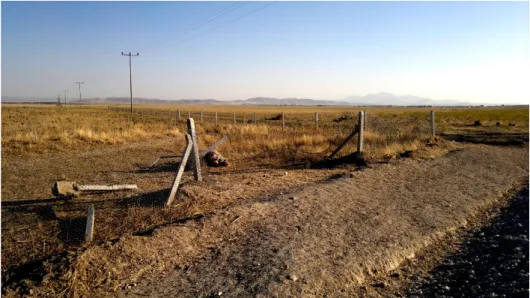
Barbed  wired  areas  were  established  for  conserving  nature.  However,  humans  did  not  support  

this  approach  and  generally  trespass  these  areas  (Figure  1).    

(2)

Figure  1.  Erosion  control  area  in  Karapınar,  C.  Turkey  invaded  by  shepherds      

Recent   approaches   which   integrate   human   dimension   to   conservation   by   considering   local   values   fruit   promising   results   (Egan   et   al.   2011).   This   kind   of   approach   at   first   needs   paradigm  shift  of  scientists  orthodox  beliefs  which  may  be  achieved  by  integrating  to  the  target   society.  Along  with  natural  properties  cultural  and  traditional  values  should  be  absorbed  by  the   scientists.  The  goals  of  the  projects,  such  as  less  water  use  without  losing  income,  will  be  realized   by  modification  of  local  and  proven  land  use  managements  other  than  theory  based  solutions.  

The  challenge  in  Karapınar  is  to  establish  a  land  management  for  reduce  groundwater  use  which   induce  sinkhole  formation  (Figure  2).    


Figure  2.  Sinkhole  formation  in  Seyit  Hacı  Village,  Karapınar,  C.  Turkey      

In   Karapınar,   with   10   to   12   irrigation,   13.5   tons   of   maize   can   be   produced.   The   net  

income  of  maize  per  hectare  as  of  2014  is  3.030  USD.  Whereas,  15  ton/ha  traditional  melon  for  

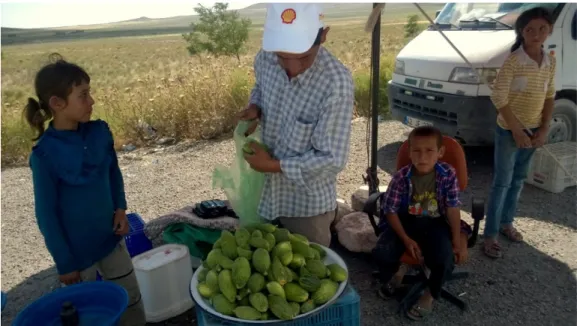
pickle   making   (Figure   3)   may   be   produced   with   2-­‐3   irrigation.   The   net   income   as   of   2014   is  

20.300  USD/ha.  As  a  scientist,  it  is  not  needed  to  inform  farmer  that  melon  use  less  water  than  

maize,   the   crucial   point   is   to   inform   farmer   that   no   economic   loss   will   happen   following   less  

water  demanding  melon  since  farmers  are  driven  by  economic  values.    

(3)

Farmers   although   aware   of   high   income   from   melon,   they   complain   about   high   labor   demand  of  melon  production.  Also,  the  total  of  140.000ha  arable  land  cannot  be  converted  to   melon   cultivation.   But,   farmers’   do   not   like   crop   pattern   plans   alike   sugar   beet   quota.   They   overcome   this   quota   by   purchasing   poor   farmers’   sugar   beet   cultivation   permission   or   registering  idle  land  for  sugar  beet  production  although  they  cultivate  in  owned  lands.      

Another  option  for  sustaining  high  income  of  farmers’  is  animal  husbandry  in  Karapınar   where  is  famous  for  its  rich  fodder  flora  in  Turkey.  But,  overgrazing  in  1960s  almost  converted   Karapınar  to  desert,  and  following  30  years  of  mitigation  studies  cultivation  and  sheep  breeding   became   feasible   in   Karapınar   because   animal   husbandry   in   Karapınar   depends   on   carrying   capacity  of  natural  grasslands  which  are  hosting  more  than  40  fodder  plants.  Initially  grasslands   should  be  seeded  with  natural  plant  species  for  increasing  meat  and  dairy  quality  of  sheep.    


Figure  3.  Melon  for  pickle  making    


  Thus,   instead   of   repeating   unsuccessful   project   approaches   in   Karapınar,   traditional   income   tools   which   are   proven   to   be   successful   for   society’s   economic   activities   for   millennia       should  be  modified  by  the  participation  of  stakeholders’  views  and  demands.  This  may  be  only   achievable  by  regular  meetings  and  workshops  since  stakeholders  are  complaining  about  one-­‐

time  events  during  various  projects  ie  they  want  to  keep  the  issues  hot.  The  regular  meetings  let   people  to  understand  different  stakeholders’  approaches  that  may  be  amalgamated  in  a  melting   pot   for   satisfaction   of   all   members   of   the   society   by   securing   common   understanding   for   designing  future  of  the  society  itself.      

References  

Egan,   D,   Hjerpe,   EE.   and   Abrams,   J   (Eds).   2011.   Human   Dimensions   of   Ecological   Restoration:  

Integrating  Science,  Nature,  and  Culture.  Island  Press.  410  P.    

Posthumus,   H,   Deeks,   LK,   Rickson,   RJ.   and   Quinton,   JN.   2013.   Costs   and   benefits   of   erosion   control  measures  in  the  UK.  Soil  Use  and  Management.  DOI:  10.1111/sum.12057            


Figure   1.   Erosion   control   area   in   Karapınar,   C.   Turkey   invaded   by   shepherds           
Figure   3.   Melon   for   pickle   making       

参照

関連したドキュメント

We show that a discrete fixed point theorem of Eilenberg is equivalent to the restriction of the contraction principle to the class of non-Archimedean bounded metric spaces.. We

In particular, we consider a reverse Lee decomposition for the deformation gra- dient and we choose an appropriate state space in which one of the variables, characterizing the

This paper develops a recursion formula for the conditional moments of the area under the absolute value of Brownian bridge given the local time at 0.. The method of power series

Then it follows immediately from a suitable version of “Hensel’s Lemma” [cf., e.g., the argument of [4], Lemma 2.1] that S may be obtained, as the notation suggests, as the m A

Applications of msets in Logic Programming languages is found to over- come “computational inefficiency” inherent in otherwise situation, especially in solving a sweep of

Shi, “The essential norm of a composition operator on the Bloch space in polydiscs,” Chinese Journal of Contemporary Mathematics, vol. Chen, “Weighted composition operators from Fp,

[2])) and will not be repeated here. As had been mentioned there, the only feasible way in which the problem of a system of charged particles and, in particular, of ionic solutions

This paper presents an investigation into the mechanics of this specific problem and develops an analytical approach that accounts for the effects of geometrical and material data on