9
Trends in Distributed Power Sources
H
IROSHIU
TSUNOMIYA Environment and Energy Research Unit9.1 Introduction
The energy supply system of Japan has entered a crucial turning point in response to the recent progress in liberalization of the electricity market and the need to reduce greenhouse gases. The Law Concerning the Promotion of the Measures to Cope with Global Warming, which provides an over view of measures to achieve the Kyoto Protocol’s target (a 6% reduction in greenhouse- gas emissions), has been revised recently to incorporate measures included in the previous version of the law — i.e., additional measures for promoting energy conservation, new energy sources and the conversion of conventional fuels to other fuels. In the meantime, the extent of the liberalization and applicable systems are currently under review; the Electric Utility Law will also be revised with an eye toward phase-in liberalization.
Under these circumstances, distributed power sources are receiving attention as a measure to cut
down energ y costs. However, achieving reductions in energ y costs and creating environmentally ef ficient systems are indispensable for promoting these power sources, which are expected to become widespread in the future.
This repor t provides an over view of the circumstances surrounding distributed power sources, turning the spotlight on how much they have been adopted, trends in technological development and specific efforts being made by the government, municipalities, enterprises and the public, while bringing up challenges that need to be addressed.
9.2 Classification of
distributed power sources
In general, large-scale centralized power sources distribute electricity through grids. Distributed power sources, on the other hand, refer to small- to-medium-scale local facilities (e.g., diesel
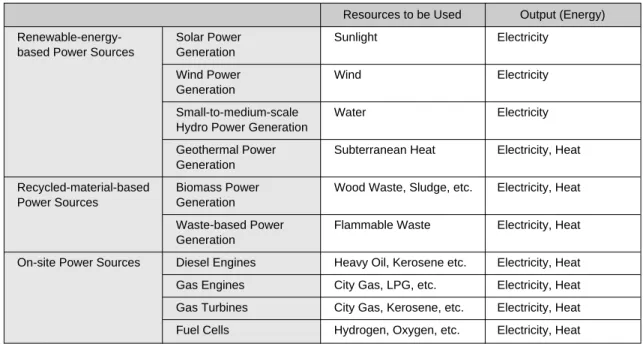
Table 1: Classification of distributed power sources
Resources to be Used Output (Energy)
Renewable-energy- Solar Power Sunlight Electricity
based Power Sources Generation
Wind Power Wind Electricity
Generation
Small-to-medium-scale Water Electricity
Hydro Power Generation
Geothermal Power Subterranean Heat Electricity, Heat Generation
Recycled-material-based Biomass Power Wood Waste, Sludge, etc. Electricity, Heat
Power Sources Generation
Waste-based Power Flammable Waste Electricity, Heat Generation
On-site Power Sources Diesel Engines Heavy Oil, Kerosene etc. Electricity, Heat Gas Engines City Gas, LPG, etc. Electricity, Heat Gas Turbines City Gas, Kerosene, etc. Electricity, Heat Fuel Cells Hydrogen, Oxygen, etc. Electricity, Heat
engines, gas engines and gas turbines) that supply electricity to local markets. However, there is no clear domestic and international definition of these power sources in terms of generating capacity, types of facilities, etc.
Distr ibuted power sources fall into three categories in terms of the fuel sources they use: 1) renewable-energ y-based power sources; 2) recycled-material-based power sources; and 3) on- site power sources (see Table 1).
Renewable-energy-based powers sources make use of natural energy typified by solar and wind power energy. Unlike oil, coal and other fossil fuels, renewable energy sources are unlimited and clean, having less of a load on the environment (CO
2emissions, etc.). The drawback: their supply capacity tends to f luctuate, being subject to natural conditions.
Recycled-material-based power sources reuse resources and exhaust heat — energy sources that have hitherto been disposed of.
On-site power sources refer to power systems (diesel engines, gas engines, gas turbines, etc.) and fuel cells. Being located near local markets, these power sources involve less transmission loss; they make the most of the associated exhaust heat, a byproduct of power generation.
Meanwhile, patterns of energy being supplied
can be categorized into co-generation, where total energy efficiency is improved by utilizing exhaust heat associated with power generation, and mono- generation where only electricity is supplied.
In this report, distributed power sources are considered eco-friendly power sources because they emit less pollutants (nitrogen oxides, sulfur oxides, particulates, etc.) and greenhouse gases (CO
2, etc.). Specifically, eco-friendly power sources include renewable-energy-based power sources (solar power generation, wind power generation, etc.), biomass power generation and co-generation using fuel cells and power systems such as gas turbines and gas engines. The promotion of these distributed power sources will thus contribute to promoting renewable energy and improving the efficiency in energy use.
9.3 Present state of and targets for distributed power sources
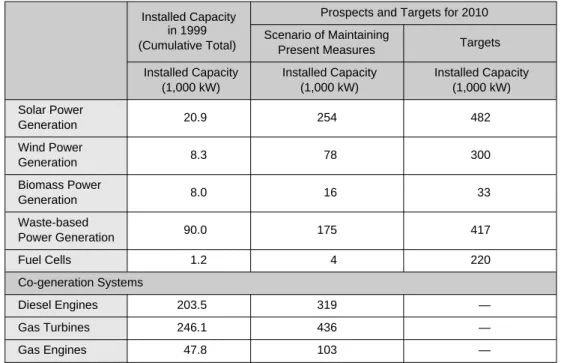
Table 2 shows targets for introducing eco-friendly distributed power sources by 2010: solar power generation (4.82 million kW), wind power generation (3.0 million kW), biomass power generation (0.33 million kW) and fuel cells (2.2 million kW).
Table 2: Present state of and targets for distributed power sources Installed Capacity Prospects and Targets for 2010
in 1999 Scenario of Maintaining
Targets (Cumulative Total) Present Measures
Installed Capacity Installed Capacity Installed Capacity
(1,000 kW) (1,000 kW) (1,000 kW)
Solar Power
20.9 254 482
Generation Wind Power
8.3 78 300
Generation Biomass Power
8.0 16 33
Generation Waste-based
90.0 175 417
Power Generation
Fuel Cells 1.2 4 220
Co-generation Systems
Diesel Engines 203.5 319 —
Gas Turbines 246.1 436 —
Gas Engines 47.8 103 —
Source: "Future Energy Policies," (Jul. 2001) prepared by the Total Supply and Demand Subcommittee of the Advisory Committee on Natural Resources and Energy, and "The Present State of and Prospects for Co-generation," (Jan. 2001) prepared by the 1st New Energy Subcommittee.
The government has been supporting these new energy sources by means of measures such as subsidies and low-interest loans, making up for their higher costs compared with those of conventional energy sources. However, there is a large gap between the scenario of maintaining the present measures and targets — a situation that necessitates further political assistance.
There are quite a few problems to be addressed in promoting distributed power sources: the quality of electricity may deteriorate as a growing number of distr ibuted power sources are connected to grids; the cost of maintaining connections with grids could increase; large-scale wind power plants produce noise and impair landscapes; waste disposal facilities indispensable for operating waste-based power generation could have negative impacts on the environment; and above all, there is a need to convince local residents that distributed power sources are beneficial to their communities.
The installed capacity of co-generation systems such as diesel engines (DE), gas turbines (GT) and gas engines (GE) increased four times more than that of other distr ibuted power sources (renewable-energy-based power sources, recycled- material-based power sources, etc.) in 1999. These co-generation systems and mono-generation systems that produce only electricity are currently the mainstay of distributed power sources.
9.3.1 Present state of co-generation systems
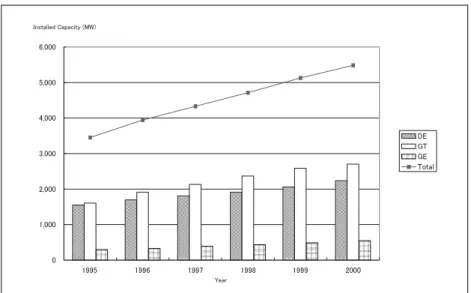
The total installed capacity of co-generation systems stands at 5,485 MW as of fiscal 2000 (GT:
2,702 MW, DE: 2,233 MW and GE: 549 MW), with 3,364 facilities or 5,603 units operating across the country. This amount constitutes some 2% of the total installed capacity of power generation facilities in Japan. Co-generation systems are growing steadily, with a total of 350-400 MW being added annually thanks to governmental subsidies and low-interest loans (see Figure 1).
Large-scale units with the installed capacity of multi-thousand kW command a large share of co- generation systems that have been introduced primarily to industrial facilities such as plants, hospitals and hotels, each of which consumes a large amount of electricity and heat. However, co- generation systems are becoming increasingly smaller thanks to the advance of waste heat recovery technology, improvements in power generation efficiency and lower generation costs;
compact systems are becoming widespread among small-scale commercial establishments such as supermarkets and family restaurants that have hitherto been considered inappropriate for these systems.
9.3.2 Present state of independent power generation facilities
While there are no accurate statistics on the installed capacity of independent power
Figure 1: Co-generation systems: year-by-year total of installed capacity
Source: The Japan Co-generation Center
generation facilities using DE, GE and GT, the Japan Engine Generator Association surveyed the actual shipments of domestic manufacturers.
According to the results of this survey, a total of 2,420 MW had been installed during the period between 1997 and 2000, which corresponds to an increase of some 600 MW a year (see Figure 2).
Specifically, DE increased from 249 MW to 477 MW, and GE, from 31 MW to 90 MW. DE registered remarkable growth, commanding a 65% share of the total installed capacity in 2000. Meanwhile, growth of GT varied from year to year, standing at 207 MW in 1998 and 103 MW in 1999. The capacity of GT units usually exceeds 500 kW, which in turn brings about fluctuations in their installed capacity each year.
The revision of the Electric Utility Law, which was carried out in 1995, spurred the promotion of these kinds of distributed power sources — i.e., any third party who carries out private power generation for its clients no longer needs to obtain authorization as long as the job is done within the precinct of the clients’ facilities. Thus, full-service systems taking on private power generation for clients are becoming the mainstay of the distributed power source business. Specifically, these systems provide comprehensive services ranging from consulting services to the installation of units, monitoring, the supply of fuel and making arrangements for licensed engineers.
9.4 Trends in technological development of
distributed power sources
On-site distributed power sources usually take the form of co-generation, a system in which power balances with heat at the respective locations. If operated with high overall efficiency, the system will outperform conventional systems that use commercial power and auxiliary facilities such as boilers.
According to a survey conducted by the Japan Engine Generator Association, 55.8% of the total installed capacity of distributed power sources comes from co-generation (GT facilities: 92.8%, GE facilities: 88.4% and DE facilities: 39.4%). DE facilities lag behind the other two because: 1) temperatures of their exhaust heat are too low to make efficient use of the heat; and 2) the costs of small-scale mono-generation systems are becoming lower, making the recovery of capital investment easier.
If mono-generation systems that give first priority to cost effectiveness, or co-generation systems that make poor use of exhaust heat become widespread among distributed power sources, they might underperform conventional systems in terms of CO
2emissions. It is thus important to promote co-generation systems that work with higher overall efficiency. The government is now
Figure 2: Independent power generation facilities: year-by-year total of installed capacityNote: Facilities directly imported from overseas makers are not included.
Source: The Japan Engine Generator Association
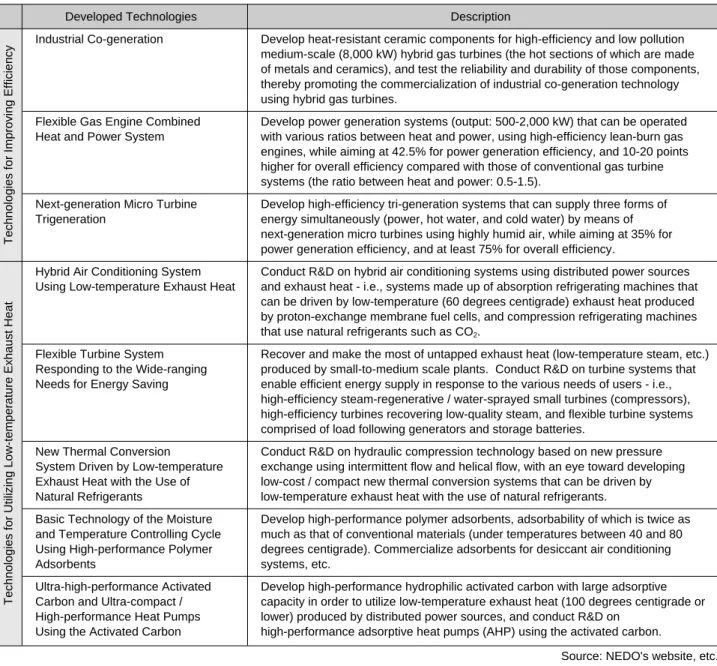
in the process of reviewing the standards for evaluating overall efficiency in the framework of the Energy-saving Law, strengthening its subsidies and other supports. In addition to these measures, there is a need to push ahead with R&D of technologies for improving efficiency and making use of low-temperature exhaust heat. Table 3 shows some of these technologies being pursued by NEDO (the New Energ y and Industr ial Technology Development Organization).
With regard to co-generation systems for internal combustion engines, a project for developing technologies of ceramic gas turbines for 300 kW- cogeneration systems had been carried out during the period between 1988 and 1998 as part of the New Sunshine Program. The project came up with high-strength structural ceramics resistant to high
temperatures and corrosion, obviating the need to air-cool the hot sections of the 300 kW-gas turbines, which had been too small to be air- cooled. Through this breakthrough, energy loss in cooling was reduced, NOx in exhaust gas was cut down dramatically, and both durability and ser viceability improved substantially — achievements that brought about heat efficiency of 42.1%.
Another project for developing technologies for industrial co-generation systems is underway; it started in 1999 and is slated for completion in 2003. This project aims to verify the reliability of 8,000 kW-hybrid gas turbines (the hot sections of which are made of metals and ceramics) through a series of tests for applicable components and their durability, thereby promoting the
Table 3: Development of technologies for improving efficiency and utilizing low-temperature exhaust heat by NEDO
Developed Technologies Description
Industrial Co-generation Develop heat-resistant ceramic components for high-efficiency and low pollution medium-scale (8,000 kW) hybrid gas turbines (the hot sections of which are made of metals and ceramics), and test the reliability and durability of those components, thereby promoting the commercialization of industrial co-generation technology using hybrid gas turbines.
Flexible Gas Engine Combined Develop power generation systems (output: 500-2,000 kW) that can be operated Heat and Power System with various ratios between heat and power, using high-efficiency lean-burn gas
engines, while aiming at 42.5% for power generation efficiency, and 10-20 points higher for overall efficiency compared with those of conventional gas turbine systems (the ratio between heat and power: 0.5-1.5).
Next-generation Micro Turbine Develop high-efficiency tri-generation systems that can supply three forms of Trigeneration energy simultaneously (power, hot water, and cold water) by means of
next-generation micro turbines using highly humid air, while aiming at 35% for power generation efficiency, and at least 75% for overall efficiency.
Hybrid Air Conditioning System Conduct R&D on hybrid air conditioning systems using distributed power sources Using Low-temperature Exhaust Heat and exhaust heat - i.e., systems made up of absorption refrigerating machines that
can be driven by low-temperature (60 degrees centigrade) exhaust heat produced by proton-exchange membrane fuel cells, and compression refrigerating machines that use natural refrigerants such as CO2.
Flexible Turbine System Recover and make the most of untapped exhaust heat (low-temperature steam, etc.) Responding to the Wide-ranging produced by small-to-medium scale plants. Conduct R&D on turbine systems that Needs for Energy Saving enable efficient energy supply in response to the various needs of users - i.e.,
high-efficiency steam-regenerative / water-sprayed small turbines (compressors), high-efficiency turbines recovering low-quality steam, and flexible turbine systems comprised of load following generators and storage batteries.
New Thermal Conversion Conduct R&D on hydraulic compression technology based on new pressure System Driven by Low-temperature exchange using intermittent flow and helical flow, with an eye toward developing Exhaust Heat with the Use of low-cost / compact new thermal conversion systems that can be driven by Natural Refrigerants low-temperature exhaust heat with the use of natural refrigerants.
Basic Technology of the Moisture Develop high-performance polymer adsorbents, adsorbability of which is twice as and Temperature Controlling Cycle much as that of conventional materials (under temperatures between 40 and 80 Using High-performance Polymer degrees centigrade). Commercialize adsorbents for desiccant air conditioning
Adsorbents systems, etc.
Ultra-high-performance Activated Develop high-performance hydrophilic activated carbon with large adsorptive Carbon and Ultra-compact / capacity in order to utilize low-temperature exhaust heat (100 degrees centigrade or High-performance Heat Pumps lower) produced by distributed power sources, and conduct R&D on
Using the Activated Carbon high-performance adsorptive heat pumps (AHP) using the activated carbon.
Technologies for Improving EfficiencyTechnologies for Utilizing Low-temperature Exhaust Heat
Source: NEDO's website, etc.
commercialization of industrial co-generation technology using hybrid gas turbines, while reducing CO
2emissions by means of efficient energy use.
Moreover, next-generation micro-turbine trigeneration technology is being developed.
Combining a micro-turbine generation system using highly humid air with an absorption refr igerating system using exhaust gas, this particular technology can utilize three forms of energy simultaneously; namely, power, hot water (90 degrees centigrade) and cold water (7 degrees centigrade).
Foreign and domestic companies are also developing and commercializing a variety of technologies relevant to distr ibuted power sources in a bid to further improve efficiency and reduce costs as well as possible impacts on the environment — e.g., micro gas turbines, flexible gas turbines, miller cycle gas engines, and lean- burn gas engines.
9.5 Approaches to the
promotion of eco-friendly distributed power sources
9.5.1 Commitments of users, companies and other organizations
Although renewable energy (new energy) has yet to be improved in terms of its cost efficiency and stability in supply, it has the great advantage of
being eco-friendly. For this very reason, users, companies and organizations concerned have been promoting this energy by taking part in relevant projects conducted by civil groups, customer groups and research institutes. Electric power companies, meanwhile, have been purchasing surplus electricity from the producers.
The awareness among consumers and companies of environmental issues is changing, with most of them committed to voluntarily contributing to the environment. On the other hand, the development of wind power generation is progressing dramatically in specific regions, local economy of which is booming. Certain electric power companies in these regions are thus forced to shoulder the burden of purchasing surplus electricity. With this situation as a backdrop,“The Green Power System” was adopted in 2000 as a measure to promote renewable energ y domestically. This system is comprised of two subsystems, each of which responds to the specific needs of users. One is “The Green Power Fund,” which is designed to collect contributions from electric power companies and general consumers (by means of electricity bills), thereby providing aid to renewable energy facilities. And the other one is “The Green Power Certification System,” which separates the value of power generation into the value of electricity itself and the environmental value added; electric power companies purchase the electricity itself produced
Figure 3: Mechanism of green power certification systemSource: The website of Japan Natural Energy Company Limited
by electric power suppliers, whereas companies or organizations determined to contribute to the environment purchase the por tion of the environmental value added (see Figure 3). Any company or organization planning to consume energy can reduce CO
2emissions by purchasing these certifications.
The number of items of the Green Power Fund stood at 39,294 as of June 2001 (¥500 per item, or
¥100 per item in some areas), and the fund is being appropriated to wind power and solar power generation.
With respect to the Green Power Certification System, 27 companies including Sony (a total of 4.5 million kWh) and Koshigaya City (1 million kWh) have signed contracts, with a growing number of companies and organizations following on. In fact, many environment-conscious municipalities like Koshigaya City are taking part in the system in succession.
9.5.2 Commitments of the government and municipalities
As mentioned earlier, the government is beefing up its support for developing and promoting new- energy technologies through measures such as subsidies and low-interest loans. Pushing forward with these measures, and in accordance with a series of relevant laws and plans, namely the New Energ y Law (enforced in 1997), the Law Concerning the Promotion of the Measures to Cope with Global Warming (endorsed in 1998), the Effective Implementation Plan based on the Basic Environment Plan (enforced in 1995) and the Green Purchasing Law (enforced in 2001), the government is expected to take the initiative in introducing new energy (solar power generation devices, etc.) into public facilities such as government offices and schools in order to fulfill its responsibilities as an energy user.
On the other hand, municipalities are developing new regional energy visions in consideration of regional characteristics such as their respective natural environment. Based on these visions, new energ y sources such as solar/wind power generation making use of natural advantages are being introduced into government offices and schools, each of which could play an important role in educating local residents. In addition to
municipalities, moreover, an increasing number of citizens are installing solar power generation devices in their houses. Municipalities are thus supporting these environment-conscious people financially, offering additional subsidies, and low- interest loans.
9.6 Conclusion
The users of electricity such as companies and public institutions are increasingly making use of the services provided by ESCO (Energy Service Companies); comprehensive energy-saving efforts including the introduction of co-generation systems are progressing as intended.
The suppliers of electricity, meanwhile, will be mandated to purchase a cer tain amount of renewable energ y in line with the RPS (Renewables Portfolio Standard: standards for introducing renewable energ y based on certifications) system. With this system in place, the electr ic power supplier s will have to introduce renewable energy systematically, based on the prospects for supply-demand situations in energy toward 2010.
However, distributed power sources that put a burden on the environment are also becoming widespread in response to the need of users to further reduce energy costs. The liberalization of the electricity market, moreover, will extend the range of choices for these users — e.g., the installation of distr ibuted power sources, competitive bidding for electricity, and respective contracts for electricity.
Under these circumstances, the following three stages are indispensable for promoting eco- friendly distributed power sources:
1. Provide environment-conscious users with subsidies and other suppor ts, thereby encouraging them to introduce distributed power sources that pr ior itize their principles above cost efficiency.
2. Encourage organizations serving the public
interest (government institutions, local
public bodies, etc.) to adopt eco-friendly
facilities or to choose eco-friendly power
sources through competitive bidding,
thereby creating the basis for the
environment industry.
3. Promote distributed power sources in the general market.
In order to achieve long-term security of energy supply, the government and the private sector must cooperate with each other in promoting distributed power sources. Japan has just entered the Stage 2 mentioned above. Organizations serving the public interest should therefore take the initiative in selecting and introducing power sources, considering not only reductions in energy costs but also environmental aspects such as reductions in CO
2emissions, in order to create technological and industrial foundations.
References
[1] “Explanatory Diagrams of Technologies: Next Generation Energy” (2000) by Hitoshi Iguma and Tomohiko Iwasaki (Toyo Keizai).
[2] Materials for “The 6th Workshop for New Power Supply System Technologies” (Mar.
2002) by the Institute of Applied Energy.
[3] “Survey of Long-term Technological Strategy for Energ y: Trends in Natural Gas Technologies” (Mar. 2001) by the Institute of Energy Economics, Japan.
[4] “Suggestions for Measures to Promote New Energy” (Jun. 2001) by the New Energy Subcommittee of the Advisory Committee on Natural Resources and Energy.
[5] “Outline of the Green Power System” (Jul.
2001) by the Federation of Electric Power Companies and the New Energ y Subcommittee of the Advisory Committee on Natural Resources and Energy.
[6] “Recommendations to be Self-sufficient in Energy” (Oct. 2001) by Yoshihisa Yamamoto and Kenji Kaneko (Nikkei Ecology).
(Original Japanese version: published in May 2002)