1
Food Poisoning and Infectious Disease caused by Norovirus Situation of the Outbreaks and Countermeasures in Japan
H IROMI O MOE Life Science Research Unit
1
2
Introduction
In Japan, the circumstances surrounding food has drastically changed due to development of the social economy and technological progress in recent years. A variety of food is on the market thanks to the improvement of production and processing technologies, as well as expansion of the area for distribution and globalization of food to contribute to diversification of our diets.
However, on the other hand, people have anxieties for food further because of various problems as the outbreak of bovine spongiform encephalopathy (BSE), pesticide residue detected from import farm products, detection of toxic chemical substances from imported food and tableware, contamination to food of the genetically-modified crops which the safety is not assessed, and scandals of camouflage of production areas and ingredients of food products. Moreover, extensive outbreaks of food poisoning caused by new pathogenic microorganisms have presented problems with public health management.
Recently, norovirus has gained a lot of attention concerning the safety management of food. This is mainly because the number of infected persons tends to increase, due to the virus transmission via not only food (so-called food poisoning) but also feces and vomit of infected persons (so-called a infectious disease). Another reason of the attention is the microbiological characteristics of the virus, which leads the difficulty to multiply the virus in cultured cells. The reason is the barrier to hinder the studies about norovirus, resulted in lack of scientific information about the virus, such as how the virus would be distributed in our daily lives and the inactivation of the virus. Therefore, the researchers have failed to develop the necessary
and sufficient measures to prevent the virus infection. As the extensive outbreaks of food poisoning or infectious disease caused by norovirus have become remarkable around the world, various research and development for the virus control have been actively conducted. However, it is still too soon to make the result. The lack of sufficient countermeasures against norovirus is in contrast to the established measures to prevent and control the food poisoning caused by salmonella spp. and so on.
Accordingly, preventative measures against food poisoning and infectious disease caused by norovirus should greatly contribute to the improvement of the public health of the world in the future. If a new measure to control the virus is invented, it should be valuable in the viewpoint of microbiology. This paper outlines the food poisoning and infectious disease cause by norovirus, focusing on the outbreaks and the trend of research and development for the virus control in Japan in order to take future preventative measures against the virus.
Microbiological characteristics of norovirus [1,2]
2-1 Name
Norovirus was discovered in the gastroenteritis patients from the mass-poisoning in an elementary school of Norwalk, Ohio, the United States in 196.
It was called SRSV , a small round structured
virus (Figure 1) first based on a morphologic
classification observed by the electron microscope,
or sometimes called Norwalk-like virus. The name
of the virus “norovirus” was authorized by the
International Committee on Taxonomy of Viruses
(ICTV). Subsequently, the name has been used as
Q U A R T E R L Y R E V I E W N o . 3 0 / J a n u a r y 2 0 0 9
[NOTE 1]
Study on the experimental infection with norovirus in pig-tailed macaques showed that the infected animals had symptoms similar to the ones in human cases. Additionally the infection in pigs was reported, however, valid animal model for norovirus infection has not been established yet.
the common name in the world.
2-2 Virus structure and type
Norivirus has the cupped surface and single- stranded RNA as the genome, encoding two kinds of structural protein, VP1 and VP2 (virus particle). Although the virus structure is simple, the genotype of the virus is diversified. Norovirus is classified into GI and GII in general and the groups are respectively classified into 15 and 1 or more genome types. Therefore, it is considered that 30 or more norovirus genotypes currently exist. In addition, it is assumed that norovirus has the high mutation rate, which is a characteristic of RNA viruses. New genotypes of norovirus have been detected even now, and the total number of the virus genotypes may be quite large.
2-3 Virus growth and situation of study
Norivirus is thought to multiply only in the human intestinal tract. From the previous studies, it is considered that a large amount of the virus could be egested with feces from the human body after the virus growth in the intestinal tract. The number of virus particles in the feces is speculated as hundreds of millions per gram in terms of feces.
Norovirus can cause human infection only with 10-100 of the virus particles. The virus does not multiply in food or the environment, which is one of the characteristics of viruses, while it has the
strong infectivity in humans. In addition, the virus is thought to retain the infectivity for relatively a long time in river or sea water. In the experiment with feline calicivirus related to norovirus, as to be mentioned below in 2-4, it was revealed that the virus retained the infectivity under the temperature of 4°C for 2 months, a room temperature for 2 weeks and 37 °C for about one week. The result of the experiment shows that rivers and sea water provide good conditions for maintaining the virus infectivity.
There is no report about the system for replication of norovirus in cultured cells (living cells outside the tissues of humans or animals from which they were obtained) and the animal models of human norovirus infection are under development.
[NOTE 1]Therefore, the previous studies failed to obtain the native virus that has the infectivity to humans. In addition, the methods of experiments to analyze the details of either the vital dynamics or pathogenicity to human have not been established yet. Moreover, the distribution of the virus in human body or our living environment has not been fully analyzed.
Regarding antiviral drugs, it is also difficult to develop them because of its simple virus structure.
The difficulty is due to the limitation of the possible sites of the virus which the antiviral drug targets for inhibiting the synthesis of the virus structural proteins. Furthermore, the development of antiviral drugs and vaccines which are effective in all virus genotypes is difficult since the number of the genotypes is large.
2-4 Virus infectivity
As explained above, the methods for in vitro replication of norovirus are unavailable since the virus cannot multiply in cultured cells at this moment. The condition on inactivation of the virus has been presumed from the experiments in which
Figure 1 : An electron microscopy image of norovirus
Source : Provided by Dr. Osamu Nishio,
the National Institute of Infectious Diseases
,FRVDKHGURQ LQGLDPHWHURIQP
the viruses related to norovirus are applied. To take feline and dog caliciviruses as examples, the conditions on the inactivation of the viruses have been already demonstrated, because the viruses can multiply in cultured cells. Therefore, the conditions on the inactivation of the calciviruses are extrapolated to the one of norovirus. According to the experimental data on the above caliciviruses, norovirus is assumed to be completely inactivated under the temperature 5 °C for one minute or more.
Norovirus is also thought to be partially resistant to chlorine agents. Therefore, it is recommended to use sodium hypochlorite solution containing around 1,000ppm of chlorine to inactivate the virus in feces of infected persons and on livingwares.
Specifically, it is considered that the feces and livingwares should be soaked in the solution containing 1,000ppm of chlorine for one minute and 200ppm for 5 minutes. For feces and vomit in which a lot of organic matters are contained, the solution containing 1,000ppm of chlorine should be appropriate.
[3]Furthermore, 70% ethanol solution, which is used for general sterilization, is thought to need the soaking for 5 minute or more to inactivate norovirus. Therefore, the spraying of 70%
ethanol solution is considered to be insufficient to completely inactivate the virus. On the other hand, cationic soap is thought to have little effects to inactivate the virus. However, hand wash with the soap can eliminate the virus, which is a quite effective measure for preventing virus infections in general.
2-5 Method for detection
Since a large amount of norovirus exists in feces of the infected persons, the electron microscopic observation on the virus particles has been applied popularly to detect the virus. On the other hand, the methods based on genetic engineering
technique have also applied to detect virus genes and virus structural proteins in recent years. The characteristics, issues and situation of research and development of the methods are described in 5-1.
Characteristics of food poisoning and infectious disease caused by norovirus
As described above, the knowledge about the dynamics and pathogenicity of norovirus in humans has been insufficient. Most of the below information are based on the reports about the analysis of virus genes.
3-1 Factors affecting virus infection in humans When a virus infects humans, the virus binds first to the surface of human cells. The site of human cells to bind to the virus is called "receptor". In the case of norovirus, the experiments with norovirus structural proteins suggest that the sugar chains existed in the human intestinal epithelial cells might be the receptor.
[NOTE 2]The sugar chains exist also on the erythrocytes and in the saliva of human, known as the histo-blood group antigens to determine the blood group of human. Therefore, the blood group and the infectivity of norovirus are speculated to have a close connection.
[4,5]3-2 Route of infection to human
Norovirus is known to be transmitted in several ways. The routes via food and water are also assumed as well as human feces. The former is considered as a food poisoning
[NOTE 3]and the latter is an infectious disease.
The routes are shown below and Figure 2 (the numbers in Figure 2 corresponds to each item (1)-(4).
[6,7][NOTE 2]
The term ‘sugar chain’ refers to a compound which consists of covalently-added monosaccharide. It is bonded with protein and lipid. As shown in 2-3, norovirus does not multiply in cultured cells established currently and its structural proteins cannot be extracted, therefore the virus structural protein was synthesized by genetic engineering technique, based on the reports about the analysis of virus genes in the study.
[NOTE 3]
A term “food poisoning” is defined by the Food Sanitation Law (the latest revision: June 7, 2006, Law No.
53), as “a poisoning attributable to food, food additives, apparatus or containers or packages”.
3
Q U A R T E R L Y R E V I E W N o . 3 0 / J a n u a r y 2 0 0 9
(1) Norovirus exists in feces and vomit of infected persons. The virus is transmitted from person to person via hands washed insufficiently after using the bathroom, or the droplets of the vomit or fecal matters of the infected persons (an infectious disease). It is possible for the virus to be excreted in feces of infected persons for about one week to more than one month, even after the persons recovered from symptomatic infection.
(2) Norovirus is transmitted via food which is contaminated with norovirus by infected food handlers (food poisoning). A food handler refers to people in a cooking service, cooks at mass feeding facilities such as restaurants and schools and people who cook at home.
(3) Norovirus is transmitted by eating raw or uncooked bivalves which are contaminated with norovirus (food poisoning). Bivalves have a possibility of norovirus contamination because the virus is transmitted from sewage, river water, seawater to bivalves, resulted in accumulation of the virus into the mid-gut gland of the bivalves.
This phenomenon is affiliated with lack of efficiency of the current sewage treatment system for completely excluding norovirus.
(4) Norovirus is transmitted by the intake of well water or water tapped from a portable water-supply system (food poisoning).
Norovirus cannot multiply in the environment and the amount of the virus is relatively small except in the sewage water containing human feces.
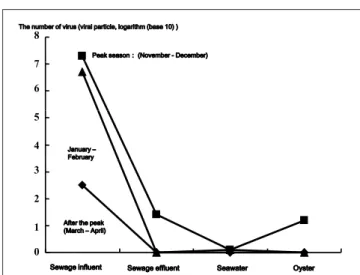
Therefore, it is difficult to conduct a survey of the contamination of the virus in the environment. On the other hand, the distribution of norovirus in the environment such as above (3) and (4) has been gradually clarified by applying the method to detect virus genes.
[]The amount of the virus existed in the environment is assumed to vary depending on the status of human norovirus infection in a sewage area, the difference of the water treatment capacity of each sewage treatment facility, and the increase/
decrease of river water or the shift in ocean current.
Figure 3 shows some examples.
[9]Generally speaking, the overall picture of norovirus contamination in Japan has not been fully identified. In parallel with the surveillance of human norovirus infection, the long term and nationwide study on norovirus contamination in the environment should be promoted in the future.
Figure 2 : Route of norovirus infection in humans
Prepared by the STFC based on the documents issued by the Ministry of Health, Labour and Welfare
[6]and the National Institute of Infectious Diseases
[7]Figure 2. Route of norovirus infection in humans g
$SHUVRQLQIHFWHGWRQRURYLUXV
ೈ)RRGVLQJHQHUDO
)DFHVYRPLW
)RRGKDQGOHUV
& NL
6HZDJH
'ULQNLQJZDWHU
&RRNLQJ HTXLSPHQWV
5LYHUZDWHU
%LYDOYHV
PLGJXWJODQGVೈ 6HDZDWHU
Source: Prepared by the STFC,based on the documents issued by the Ministry of Health, 6) 7)
Humans
Labour and Welfare6)and the National Institute of Infectious Diseases7)
※ 1 Starting point as for the infected person
※ 2 One of Molluscous organ
3-3 Clinical symptom
[2]and treatment for food poisoning and infectious disease
There are little knowledge about the relation b e t w e e n t h e a m o u n t o f n o r o v i r u s a n d t h e appearance or the severity of the symptoms in food poisoning and infectious disease caused by norovirus.
It is generally considered that the symptoms of norovirus infection usually appear within 24 to 72 hours after the initial infection. The prominent symptoms are vomiting, diarrhea and abdominal pain and most of them recovered naturally within a few days. The symptoms may sometimes be like a mild cold such as headache, fever, chills, muscle aching, pain of the throat, and fatigue or a so-called inapparent infection without certain symptoms.
However, it was reported that young children and elderly people had more serious symptoms than the ones shown above.
Since the duration of immunity against norovirus is considered to be relatively short as 6-14 weeks after the infection and there are many norovirus genotypes, people tend to be infected with the virus many times. The effective antiviral drugs and vaccines are not currently available and the medical treatment for the virus infection is limited to fluid replacement and so on. Therefore, the particular medical care for the infection would be needed for young children and elderly people who have
potential to be suffered from a serious symptom by norovirus infection.
Situation in food poisoning and infectious disease caused by norovirus
As described in Chapter 3, norovirus infection can be considered as food poisoning and infectious disease. Regarding the food poisoning, the disease has been surveyed at national level in Japan, while the disease has not been surveyed systematically in foreign countries. In the countries, most of norovirus infection have been reported to be included in the category of infectious disease.
4-1 Situation of food poisoning in japan – food poisoning statistics
[10]The outbreak of food poisoning caused by norovirus has been compiled as the "Food Poisoning Statistics" by the Ministry of Health, Labour and Welfare, which is obligated by the
"Food Sanitation Law" (the latest revision: June 7, 2006, Law No. 53). This statistics has reported the cases of food poisoning caused by norovirus as one of the targets.
The statistics revealed that there were many cases of food poisoning caused by norovirus. As shown in Figure 4 and 5, the food poisoning caused by norovirus accounts for 13.9- 33.5% of the total number of the outbreaks of food poisoning during the period in 2001-2006. The ratio of the patients infected with norovirus out of all persons affected by food poisoning is 2.5- 70.% for that period.
Compared to the cases caused by other agents of food poisoning, the outbreaks caused by norovirus are third-most in 2001-2003, second-most in 2004 and the most in 2006. The number of the patients is the highest during 2001-2006. For instance of the year 2006, the outbreaks caused by norovirus account for 33.5% (499 cases out of 1,491) and the patients for 71% (27,616 patients out of 39,026 in the total number). There are no dead from the food poisoning caused by norovirus in the same year.
As the source of the food poisoning caused by norovirus, composite food products provided by restaurants or hotels and lunch boxes are reported.
In 2005, about 56% of all the cases caused by norovirus was attributed to composite food
Prepared by the STFC based on documents issued by the Food Safety Commission, Microbe/Virus Joint Meeting
[9]Figure 3 : Existence of norovirus in the environment (Survey on the amount of virus in water and oysters collected in a designated area in Japan,
by the method to detect virus genes)
Figure 3. Existence of norovirus in the environment
7 8
3HDNVHDVRQ᧶ 1RYHPEHU 'HFHPEHU 7KHQXPEHURIYLUXVYLUDOSDUWLFOHORJDULWKPEDVH
6 7
4 5
-DQXDU\ದ )HEUXDU\
2 3
)HEUXDU\
0
1 $IWHUWKHSHDN 0DUFKದ $SULO
6HZDJHLQIOXHQW 6HZDJHHIIOXHQW 6HDZDWHU 2\VWHU
(Survey on the amount of virus in water and oysters collected in a designated area in Japan, by the method to detect virus genes)g )
Source: Prepared by the STFC,based on documents issued by the Food Safety Commission, Microbe/Virus Joint Meeting 9)
4
Q U A R T E R L Y R E V I E W N o . 3 0 / J a n u a r y 2 0 0 9
products. In this cases, Sushi, bread, sandwiches, sashimi (raw fish), which people might touch directly during cooking, are reported frequently.
Therefore, direct or indirect contamination of the virus from food handlers in the process of cooking or serving is assumed as the main cause for food poisoning caused by norovirus. Oysters are also known to be the causative agent of the food poisoning, however, the ratio of the outbreaks out of all cases of norovirus food poisoning has reduced significantly year by year; about 54%
in January 2001 to October 2003 (154 of 27 cases), about 11 % in October 2003 to October 2005 (30 of 265 cases) and about 2.2% (11 of 499 cases) in 2006. Two reasons may be assumed for this trend. First, the monitoring of norovirus has been promoted in the process of production and processing of oyster breeding by the Ministry of Agriculture, Forestry and Fisheries, local governments and the related business, leaded to the decreased number of contaminated raw oysters on the market.
[11]Secondly, the practice of appropriate cooking recipes of oysters has become popular among people due to the active guidance of the Ministry of Health, Labour and Welfare, local institutes for public health or the related corporations.
Regarding the outbreaks of norovirus food poisoning per facility, the majority of the outbreaks
was reported from restaurants. The data in 2006 shows that about 5% of food poisoning caused by norovirus is reported from restaurants, about 34% from catering or offices, and about 2% from hospitals and schools.
Although the food poisoning caused by norovirus has been reported anytime of the year, the disease has the seasonal variation. The outbreaks of the disease tend to increase from around November and are peaked in December and January. The seasonality is in contrast with the frequent outbreaks of bacterial food poisoning such as salmonellosis in early summer to autumn.
A shown in Figure 5, the food poisoning caused by norovirus tends to increase. The reason is assumed to be not only an increase of the number of the outbreaks of norovirus food poisoning, but also the development of the methods to detect the virus described in Chapter 5 and an increase of the reports on the cases due to proliferation of the knowledge concerning the virus infection.
[6]4-2 Situation of Infectious Disease Outbreaks in Japan – Infections Disease Surveillance Report
The outbreaks of infectious disease caused by norovirus have not been surveyed independently, but as one of infectious gastroenteritis. The infectious gastroenteritis is the disease with
Figure 4 : Outbreak of food poisoning in Japan (Top 3 causative microbes)
Prepared by the STFC based on the Food Poisoning Statistics by the Ministry of Health, Labour and Welfare
[10]Source: Prepared by the STFC, based on the Food Poisoning Statistics by the Ministry of Health, Labour and Welfare10)
Figure 4. Outbreak of food poisoning in Japan (Top 3 causative microbes)
Food poisoning as a
whole norovirus Salmonellaspp.
Campylobactor jejuni/coli 0
1XPEHURI FDVHV
Figure 5 :Number of food poisoning patients in Japan (Top 3 causative microbes)
Prepared by the STFC based on the Food Poisoning Statistics by the Ministry of Health, Labour and Welfare
[10]Figure 5. Number of food poisoning patients in Japan (Top 3 causative microbes)
Source: Prepared by the STFC, based on the Food Poisoning Statistics by Ministry of Health, Labour and Welfare 10)
Food poisoning as a
whole norovirus Salmonella spp.
Campylobactor jejuni/coli 0
1XPEHURI 3DWLHQWV
symptoms of vomiting and diarrhea, which is stipulated as one of Category V infectious disease under the Law Concerning the Prevention of Infectious Diseases and Medical Care for Patients with Infectious Diseases (the latest revision: May 2, 2008, Law No. 30, hereinafter the Infectious Disease Control Law).
[NOTE 4]The persons suffered from the disease are reported from about 3,000 pediatric medical institutions, though the report does not show the total number of the patients in specific. According to the report, 74,241- 1,14,95 people were suffered from the disease during 2001-2006.
[6]4-3 Situation of food poisoning/infectious disease outbreak in other countries
The systems for surveying food poisoning or infectious disease caused by norovirus vary among countries. Food poisoning or infectious disease are considered to be often caused by not only norovirus but also other pathogenic microorganisms in Africa or part of Asian countries, where the sanitary control is insufficient. In the regions, it is difficult to obtain the reports on the outbreaks of such diseases because the surveillance has not been systemized yet.
On the other hand, many cases of the infectious gastroenteritis cause by norovirus have been reported from European countries and the U.S., but the survey methods are different among the countries. Therefore, it should be noted that the below results cannot be compared simply among the countries.
In Europe, the Food Borne Viruses in Europe Network (FBVE) has summarized and disclosed the outbreaks of infectious gastroenteritis caused by norovirus in 14 member nations.
[12,13]According to the report, the number of epidemic outbreaks and people suffered from the disease remarkably increased in October and November in nine countries including Hungary, Germany,
Netherlands, Denmark, Ireland, Finland, Norway, U.K. and Sweden, in comparison with the same period in 2004 and 2005 in the nations (Table 1).
In the United States, the outbreaks of infectious gastroenteritis caused by norovirus have not been surveyed regularly before 2006, however they have been surveyed currently by the Centers for Disease Control and Prevention (CDC), because of the concern of frequent outbreaks of the disease in the country.
[14]The survey showed that 32 cases of 1316 acute gastroenteritis outbreaks in 24 states in October to December in 2006 were caused by norovirus. It also showed that the virus caused 69 cases of the gastroenteritis in California, 47 cases in Minnesota and 37 cases in Michigan.
The outbreaks increased for 1-00% in 22 states, compared to the same period of 2005. The highest is 00% in Michigan, 490% in New York, and 445% in California.
Countermeasures against food poisoning/infectious disease caused by norovirus
Regarding the countermeasures against food poisoning and infectious disease caused by norovirus, it is necessary to control the virus in human and food as well as sewage, river and sea water by thought of the microbiological characteristics and routes of infection. The virus control has two aspects to consider: personal and public hygiene.
The personal hygiene means that people should cook food well, wash their hands thoroughly, keep cooking equipments clean and properly treat feces and vomit of persons infected with norovirus in order to eliminate the virus from the living environment. As shown in 4-1, more than half of the outbreaks of food poisoning caused by norovirus have been reported from restaurants.
Therefore, food handlers in the facilities are [NOTE 4]
In the Law Concerning the Prevention of Infectious Diseases and Medical Care for Patients with Infectious Diseases, about 100 infectious diseases were categorized in Category I-V on the basis of the infectivity or severity of the diseases, as well as to define the designated infectious disease, new infectious disease and other infectious diseases such as new type of influenza. The infectious diseases of Category V should be prevented by the disclosure of information to Japanese nationals and health professionals, based on the results of surveillance of the diseases conducted by the government.
5
Q U A R T E R L Y R E V I E W N o . 3 0 / J a n u a r y 2 0 0 9
required to place strict sanitary control rules for keeping the facilities clean. Furthermore, the countermeasures against both food poisoning and infectious disease should be enhanced in nursery schools, schools, nursing facilities which provide accommodation for young children and elderly people who are likely of being severely affected from the virus. It is also important for the individuals including food handlers in the facilities to voluntarily keep the area clean in order to prevent the epidemic infection among people. The daily sanitation management by individuals is the key to control norovirus infection. The importance of the preventative measures taken by individuals has been known in Japan, due to the guidance by the related ministries and medical institutions.
[6,15]Meanwhile, the public hygiene means the understanding of the situation of norovirus
contamination in human population, food, sewage, river and sea water and the elimination of the virus. Promotion of the countermeasures against norovirus infection requires the development of both comprehensive method to detect norovirus and effective and efficient method to eliminate or inactivate the virus. In Chapter 5, the trend of such research and development for the countermeasures is outlined to extract the technical requirements to control norovirus in the future. Moreover, the risk assessment of human norovirus infection, which is necessary for summarize the countermeasures against food poisoning and infectious disease caused by norovirus, is described. General information about the countermeasures can be also seen in reference.
[16]Country N orovir us ac tivit y increased
Number of cases or clinical specimens in subject countries
※12006 2005 2004
Germany Yes 604 outbreaks 184 outbreaks 514 outbreaks
Denmark Yes 249 samples 38 samples 222 samples
Spain No 2 cases 6 cases 12 cases
Finland Yes Up to 120 cases Up to 10 cases Up to 10 cases
France No 3 outbreaks 1 outbreak 2 outbreaks
U.K. Yes 768 outbreaks
756 samples
83 outbreaks 281 samples
374 outbreaks 682 samples
Hungary Yes 81 outbreaks 17 outbreaks 24 outbreaks
Ireland Yes 7 outbreaks No outbreak 22 outbreaks
Italy Unknown No report No report No report
The Netherlands Yes 36 outbreaks 5 outbreaks 68 outbreaks
Norway Yes Up to 160 cases Up to 65 cases Up to 35 cases
Sweden Yes Up to 400 cases Up to 50 cases Up to 350 cases
Slovenia Yes
※27 outbreaks 6 outbreaks 5 outbreaks
Table 1 : Norovirus infection in Europe
Prepared by the STFC based on the Reports from the Food Borne Viruses in Europe Network, FBVE
[12,13]This survey is based on the email questionnaire to 13 FBVE member countries (the number of current member countries are 14, including Austria) . The research institutes designated by the governments made the report.
※ 1 The reports vary depending on countries, assuming because one outbreak or case may include multiple patients (samples).
※ 2 The report shows the tendency of increase, though it is not so remarkable.
5-1 Research and development for detection of norovirus
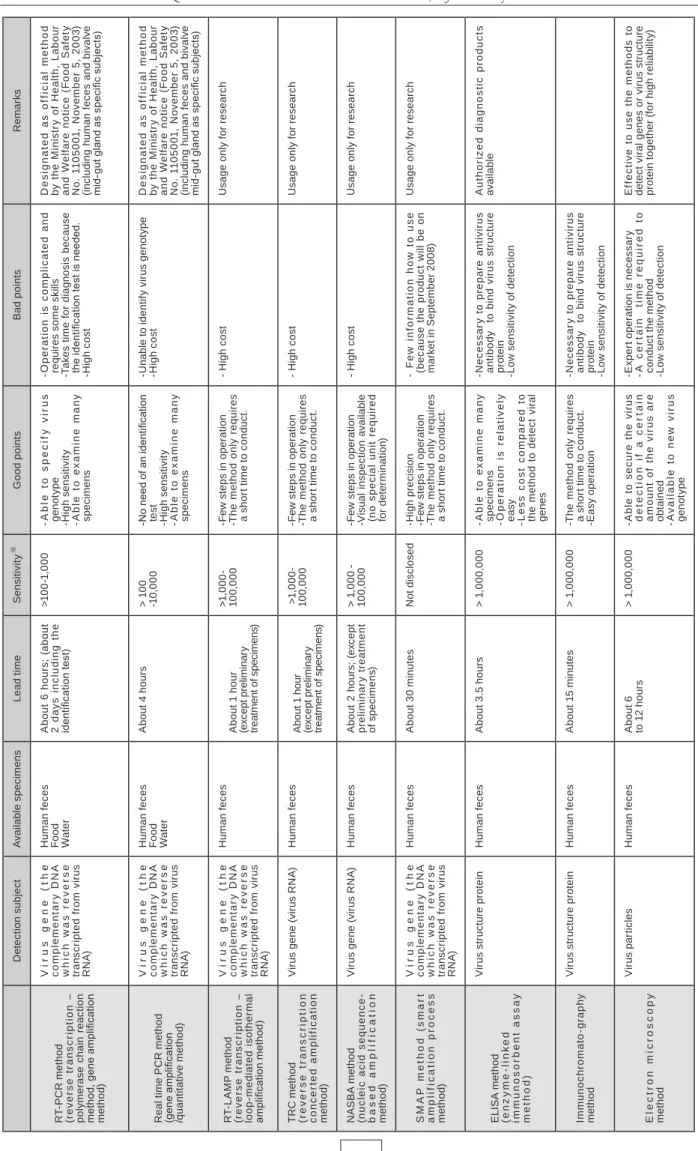
Table 2 shows the major methods to detect norovirus.
[17-22]The method to detect virus particle by use of electron microscope was developed first, which enables the detection of the virus without fail in the case of existing one million virus particles or more per milliliter of feces sample. The method is used as highly credible and popular measure for detection of norovirus by the experts.
The methods to detect virus genes have also been widely used for the diagnosis of food poisoning and infectious disease caused by norovirus and for the specification of the causes of the disease.
Reverse transcription polymerase chain reaction (RT-PCR) and the real time PCR methods are also used as official methods designated by the Ministry of Health, Labour and Welfare. However, the method to detect virus genes is not available for all cases. As the specific condition settings for each genotype of norovirus are required, more than 30 genotypes and new ones, as shown in 2-2, might not be detected by a uniform method.
Other methods such as enzyme-linked immunosorbent assay (ELISA) and immunochromatography have been used to detect the virus structural proteins. ELISA has been authorized as diagnostic medicine. The method applies the antibodies against the virus structural proteins which are synthesized by genetic engineering technique, in order to detect the virus proteins. The method has become popular because of the lower cost relatively less than that of other methods and its simple operability. However, an attention for false negative cases is needed since the sensitivity to detect the virus structural proteins is relatively low in comparison with the other methods.
Generally for the reliable detection of norovirus, the method by use of electron microscope is preferred. The method to detect virus genes is better in viewpoint of sensitivity. With regards to the cost and convenience, ELISA and immunochromatography are superior to other methods. Therefore, the above methods are used depending on the situation and demands, however, the methods should be further improved to enhance the credibility of the assessment results. It is also necessary to pay attention to a possibility of overestimation of the amount of the virus detected
by the method for virus genes, because the methods detect the parts of virus genome, not measure the level of the infectivity. In order to eliminate the possibilities, a virus detection system with higher credibility should be urgently established by the combination of developing the method to detect infectious virus using cultured cells and the current methods to detect virus genes. In this case, the method to detect virus genes is expected to be used for screening of many specimens while the method to detect infectious virus is used for concrete diagnosis in the future. Additionally, the virus detection system is desired to be further simplified in operation so that it can be widely used for human, food and environment water.
Fur ther more, a new method to eff iciently detect a very small amount of norovirus in the environment should be developed and applied for the virus detection system described above. As shown in 2-3, since norovirus dose not multiply in the environment and the amount of the virus in the environment might be very small, it is difficult to efficiently detect the virus under such conditions. In order to detect the virus from a large area of environmental water such as river or ocean, another method to filter a large amount of the water and make high concentration of the water should be developed. Currently, the membrane treatment system is widely applied. As examples, there are the method using positively charged membranes and the one to concentrate the virus by adsorption to and elution from a negatively charged membrane, with the insertion of an acid rinse step.
[NOTE 5]However, the methods have good and bad points so that it should be selected depending on the purposes.
[19]Thus, a new method which has broad utility and detects the virus more effectively and simply should be developed in the future.
5-2 Research and development for elimination and inactivation of norovirus
As described above, norovirus multiplies only
in the human intestinal tract and is transmitted to
other people or spread in the environment through
feces and vomit of persons infected with the
virus. Therefore, the countermeasures against the
food poisoning and infectious disease caused by
norovirus require the elimination and inactivation
Q U A R T E R L Y R E V I E W N o . 3 0 / J a n u a r y 2 0 0 9
D e te c ti o n s u b je c t A v a il a b le s p e c im e n s L e a d t im e S e n s it iv it y
※G o o d p o in ts B a d p o in ts R e m a rk s R T -P C R m e th o d (r e v e rs e t ra n s c ri p ti o n – p o ly m e ra s e c h a in r e a c ti o n
method, gene amplificationm e th o d ) V i r u s g e n e ( t h e c o m p le m e n ta ry D N A w h ic h w a s r e v e r s e tr a n s c ri p te d f ro m v ir u s R N A ) H u m a n f e c e s F o o d W a te r A b o u t 6 h o u rs ; (a b o u t 2 d a y s i n c lu d in g t h e
identification test)> 1 0 0 -1 ,0 0 0 - A b le to s p e c if y v ir u s g e n o ty p e -H ig h s e n s it iv it y - A b le t o e x a m in e m a n y s p e c im e n s -O p e ra ti o n i s c o m p li c a te d a n d re q u ir e s s o m e s k il ls -T a k e s ti m e fo r d ia g n o s is b e c a u s e
the identification test is needed.-H ig h c o s t
D e s ig n a te d a s o ff ic ia l m e th o d b y t h e M in is tr y o f H e a lt h , L a b o u r a n d W e lf a re n o ti c e ( F o o d S a fe ty N o . 1 1 0 5 0 0 1 , N o v e m b e r 5 , 2 0 0 3 ) (i n c lu d in g h u m a n fe c e s a n d b iv a lv e
mid-gut gland as specific subjects)R e a l t im e P C R m e th o d
(gene amplification/q u a n ti ta ti v e m e th o d )
V i r u s g e n e ( t h e c o m p le m e n ta ry D N A w h ic h w a s r e v e r s e tr a n s c ri p te d f ro m v ir u s R N A ) H u m a n f e c e s F o o d W a te r A b o u t 4 h o u rs > 1 0 0 -1 0 ,0 0 0
-No need of an identificationte s t -H ig h s e n s it iv it y - A b le t o e x a m in e m a n y s p e c im e n s
-U n a b le t o i d e n ti fy v ir u s g e n o ty p e -H ig h c o s t D e s ig n a te d a s o ff ic ia l m e th o d b y t h e M in is tr y o f H e a lt h , L a b o u r a n d W e lf a re n o ti c e ( F o o d S a fe ty N o . 1 1 0 5 0 0 1 , N o v e m b e r 5 , 2 0 0 3 ) (i n c lu d in g h u m a n fe c e s a n d b iv a lv e
mid-gut gland as specific subjects)R T -L A M P m e th o d (r e v e rs e t ra n s c ri p ti o n – lo o p -m e d ia te d i s o th e rm a l
amplification method)V i r u s g e n e ( t h e c o m p le m e n ta ry D N A w h ic h w a s r e v e r s e tr a n s c ri p te d f ro m v ir u s R N A ) H u m a n f e c e s A b o u t 1 h o u r (e x c e p t p re lim in a ry tr e a tm e n t o f s p e c im e n s)
> 1 ,0 0 0 - 1 0 0 ,0 0 0 -F e w s te p s i n o p e ra ti o n -T h e m e th o d o n ly r e q u ir e s a s h o rt t im e t o c o n d u c t.
- H ig h c o s t U s a g e o n ly f o r r e s e a rc h T R C m e th o d (r e v e r s e tr a n s c r ip ti o n c o n c e rt e d a m p li fi c a ti o n m e th o d )
V ir u s g e n e ( v ir u s R N A ) H u m a n f e c e s A b o u t 1 h o u r (e x c e p t p re lim in a ry tr e a tm e n t o f s p e c im e n s) > 1 ,0 0 0 - 1 0 0 ,0 0 0 -F e w s te p s i n o p e ra ti o n -T h e m e th o d o n ly r e q u ir e s a s h o rt t im e t o c o n d u c t.
- H ig h c o s t U s a g e o n ly f o r r e s e a rc h N A S B A m e th o d (n u c le ic a c id s e q u e n c e - b a s e d a m p li f ic a t io n m e th o d )
V ir u s g e n e ( v ir u s R N A ) H u m a n f e c e s A b o u t 2 h o u rs ; (e x c e p t p re li m in a ry t re a tm e n t o f s p e c im e n s)
> 1 ,0 0 0 - 1 0 0 ,0 0 0 -F e w s te p s i n o p e ra ti o n -V is u a l in s p e c ti o n av a il a b le (n o s p e c ia l u n it r e q u ir e d fo r d e te rm in a ti o n )
- H ig h c o s t U s a g e o n ly f o r r e s e a rc h S M A P m e th o d (s m a r t a m p li fi c a ti o n p r o c e s s m e th o d )
V i r u s g e n e ( t h e c o m p le m e n ta ry D N A w h ic h w a s r e v e r s e tr a n s c ri p te d f ro m v ir u s R N A ) H u m a n f e c e s A b o u t 3 0 m in u te s N o t d is c lo s e d -H ig h p re c is io n -F e w s te p s i n o p e ra ti o n -T h e m e th o d o n ly r e q u ir e s a s h o rt t im e t o c o n d u c t.
- F e w i n fo rm a ti o n h o w t o u s e (b e c a u s e t h e p ro d u c t w il l b e o n m a rk e t i n S e p te m b e r 2 0 0 8 )
U s a g e o n ly f o r r e s e a rc h E L IS A m e th o d (e n z y m e - li n k e d im m u n o s o r b e n t a s s a y m e th o d )
V ir u s s tr u c tu re p ro te in H u m a n f e c e s A b o u t 3 .5 h o u rs > 1 ,0 0 0 ,0 0 0 - A b le t o e x a m in e m a n y s p e c im e n s - O p e ra ti o n i s r e la ti v e ly e a s y -L e s s c o s t c o m p a re d t o th e m e th o d t o d e te c t v ir a l g e n e s -N e c e s s a ry t o p re p a re a n ti v ir u s a n ti b o d y to b in d v ir u s s tr u c tu re p ro te in -L o w s e n s it iv it y o f d e te c ti o n
A u th o ri z e d d ia g n o s ti c p ro d u c ts av a il a b le Im m u n o c h ro m a to -g ra p h y m e th o d
V ir u s s tr u c tu re p ro te in H u m a n f e c e s A b o u t 1 5 m in u te s > 1 ,0 0 0 ,0 0 0 -T h e m e th o d o n ly r e q u ir e s a s h o rt t im e t o c o n d u c t. -E a s y o p e ra ti o n
-N e c e s s a ry t o p re p a re a n ti v ir u s a n ti b o d y to b in d v ir u s s tr u c tu re p ro te in -L o w s e n s it iv it y o f d e te c ti o n E le c tr o n m ic r o s c o p y m e th o d
V ir u s p a rt ic le s H u m a n f e c e s A b o u t 6 to 1 2 h o u rs > 1 ,0 0 0 ,0 0 0 -A b le t o s e c u re t h e v ir u s d e te c ti o n if a c e r ta in a m o u n t o f th e v ir u s a re o b ta in e d - A v a il a b le to n e w v ir u s g e n o ty p e -E x p e rt o p e ra ti o n i s n e c e s s a ry - A c e r ta in ti m e r e q u ir e d to c o n d u c t t h e m e th o d -L o w s e n s it iv it y o f d e te c ti o n E ff e c ti v e t o u s e t h e m e th o d s t o d e te c t v ir a l g e n e s o r v ir u s s tr u c tu re p ro te in t o g e th e r ( fo r h ig h r e li a b il it y )
T able 2 : Major methods to detect norovirus ※ S ho ws t h e m in im u m n u mb e r o f v ir a l p a rt ic le s d e te c ta b le b y e a c h m e tho d ( p e r ml ). Prepared by the STFC based on the documents issued by the Ministry of Health, Labour and W elfare, the National Institute of Infectious Diseases, and the T okyo Metropolitan Institute of Public Health
[17-22]of the virus from infected persons, food, sewage, river and seawater.
Among the countermeasures, in particular, the treatment of sewage including a large amount of feces is extremely important. The methods to eliminate and inactivate general microorganisms in sewage are membrane filtering, chlorination, ultraviolet treatment, ozonation, and activated sludge method by use of edaphon which can absorb and resolve underwater organic matters.
These methods have contributed to the effective elimination and sterilization of Escherichia coli spp., which is used as an indicator of contamination of feces in water. However, the methods mentioned above are still inadequate for elimination and inactivation of norovirus, because the virus remains in sewage, river and seawater after applying the methods. The research and development for the
elimination or inactivation of norovirus in the process of sewage treatment have been actively promoted in recent years.
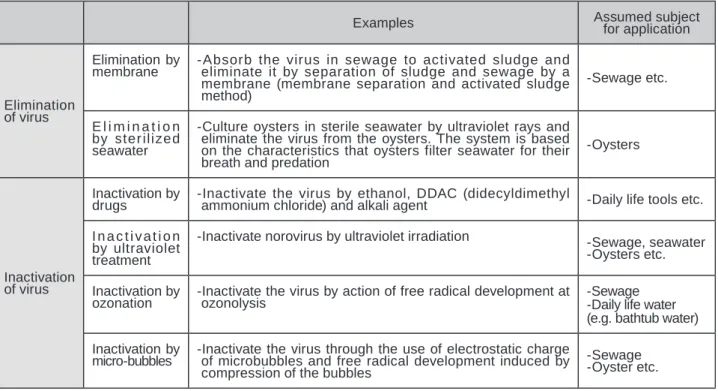
On the other hand, various methods have been developed for elimination and inactivation of norovirus, which might exist in bivalves, livingware such as clothes, cooking equipments and water used for daily life such as bathtub water. Table 3 shows the outline of the situation of research and development for the elimination and inactivation of norovirus in Japan, including the above method for the sewage treatment.
[23-27]The effectiveness of the methods shown in Table 3 is examined by using the viruses related to norovirus, as shown in 2-4 and the method to detect virus genes referred in 5-1. However, the efficacy to eliminate or inactivate infectious norovirus has not been directly verified. Therefore, the method to [NOTE 5]
Both methods make use of the phenomenon that norovirus particles are negatively charged in the environmental water. In particular, the latter is known as a method adapted to the detection of norovirus genes by PCR, with the aid of newly developed liquid which can elute the virus from the membrane. See Reference
[19]for details.
[NOTE 6]
Risk analysis means a framework for the prevention of adverse effects on the health of humans or minimize the risk of the adverse effect. The analysis consists of 3 items: risk assessment, risk management and risk communication. An interaction among the items should provide better results. The Ministry of Agriculture, Forestry and Fisheries also discloses the risk profile sheet.
[30]Examples Assumed subject
for application
Elimination of virus
Elimination by
membrane -Absorb the virus in sewage to activated sludge and eliminate it by separation of sludge and sewage by a membrane (membrane separation and activated sludge method)
-Sewage etc.
E l i m i n a t i o n by ster ilized seawater
-Culture oysters in sterile seawater by ultraviolet rays and eliminate the virus from the oysters. The system is based on the characteristics that oysters filter seawater for their breath and predation
-Oysters
Inactivation of virus
Inactivation by
drugs -Inactivate the virus by ethanol, DDAC (didecyldimethyl
ammonium chloride) and alkali agent -Daily life tools etc.
I n a c t i v a t i o n by ultraviolet treatment
-Inactivate norovirus by ultraviolet irradiation -Sewage, seawater -Oysters etc.
Inactivation by
ozonation -Inactivate the virus by action of free radical development at
ozonolysis -Sewage
-Daily life water (e.g. bathtub water) Inactivation by
micro-bubbles -Inactivate the virus through the use of electrostatic charge of microbubbles and free radical development induced by compression of the bubbles
-Sewage -Oyster etc.
Table 3 : Outline of research and development for elimination/inactivation of norovirus in Japan
Prepared by the STFC based on Reference
[23-27]Q U A R T E R L Y R E V I E W N o . 3 0 / J a n u a r y 2 0 0 9 detect infectious virus using cultured cells should
be developed in order to develop not only the virus detection system but also the effective method to eliminate and inactivate the virus.
Next, the research and development for the medical treatment and preventative measures against food poisoning and infectious disease caused by norovirus, should be promoted. The pathogenicity of norovirus has not been fully analyzed, because valid animal models for the virus infection have not been established. Additionally, effective antiviral drugs and vaccines have not been developed yet, as described in 2-3. Therefore, the research and development for the medical treatment of persons infected with the virus and preventative measures against the virus infection should be promoted by developing the animal model for the virus infection or the alternative method for the animal model.
5-3 Trial on risk assessment - development of risk profile by the foodsafety commission As one of the comprehensive preventative measures against food poisoning and infectious disease caused by norovirus, the Food Safety Commission under the Cabinet Office in Japan has drafted the “Risk Profile for Risk Analysis of Norovirus Infection” (draft)
[2][NOTE 6]to promote the analysis of the degree and ratio of negative impacts on human health caused by norovirus infection. This is one of the projects for the assessment of the effects on human health due to food intake under the Food Safety Basic Law (the latest revision: March 30, 2007, Law No. 8). The risk profile will contribute to assess the risk for human health regarding food intake and to reflect the results to the risk management conducted by the related administrative organizations, leaded a comprehensive promotion of the food safety policies.
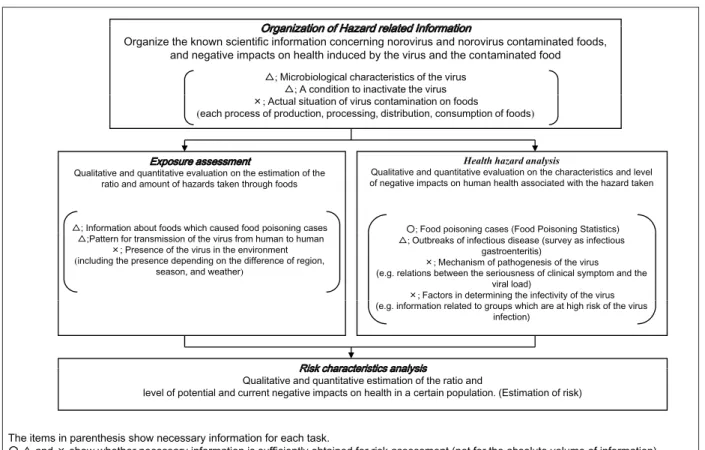
[29]The above risk profile shows the summary of the information which is needed for the risk analysis of food poisoning and infectious disease caused by norovirus. In the profile, there is the information about the three items including “Hazard Related Database”, “Exposition Evaluation” and “Health Hazard Analysis”. According to the profile, the Food Safety Commission has collected and consolidated the information necessary for the risk
analysis.
Figure 6 shows that the information of the risk profile is still insufficient for the risk assessment of food poisoning and infectious disease caused by norovirus. In order to gain the information, it is essential to elucidate the distribution of the virus in human population, food and the environment by developing a highly sensitive and effective virus detection system, in combination with the method to detect the infectious virus using cultured cells and animal models for the virus infection. In addition, the surveillance specific for norovirus infection needs to be conducted to identify the distribution of the virus in human population, in addition to the current survey on the infectious gastroenteritis including norovirus infection. Effective preventative measures against food poisoning and infectious disease caused by norovirus will be available when the risk of the virus infection will be assessed by the sufficient information and the result of the assessment will be reflected to the risk management conducted by the administrative organizations.
Conclusion
Norovirus multiplies only in the human intestinal tract and continues to exist in human society in the case where human lives in a high density and there are water environments conducible to help the virus to maintain the infectivity for a long time. The overcrowded population that is forecasted worldwide shows a risk of accelerating the circulation of norovirus in the human society as well as a wide distribution of the virus in the environment. Thus, it is necessary to identify the distribution trend of norovirus in human population, food and the environment and take appropriate measures for elimination and inactivation of the virus. At the same time, the pathogenecity of norovirus should be also clarified, for the future development of the methods for effective prevention and medical treatment of the virus infection. The norovious control requires the development of the virus detection system and the methods for elimination and inactivation of the virus. These methods should not be accomplished without the method to detect the infectious virus using cultured cells or animal model for the
6
infection. The fundamental studies on norovirus, directly linked to its control, should cross the fields as microbiology, public health, food hygiene, water service engineering and will require a joint activity by the administration, research institutes including universities, medical institutes and the related business. As well as the fundamental studies, a partnership between the related organizations as above should be also enhanced in usual and emergent situation, ranging from the prevention of the infection to the medical treatment for both normal and emergency situations.
Acknowledgement
I would like to express my sincere gratitude to Mr. Osamu Nishio, an affiliate fellow of the National Institute of Infectious Diseases for valuable opinions in general and Dr. Nobuhiko Okabe, a director of the Infectious Disease Surveillance Center, the National Institute of Infectious Diseases for many reference materials in writing this report.
References
[1] Infectious Diseases Weekly Report (IDWR), Infectious Disease Surveillance Center, National Institute of Infectious Diseases, Norovirus Infection,revised March 16, 2007 : http://idsc.nih.go.jp/idwr/kansen/k04/
k04_11/k04_11.html (Japanese)
[2] Nishio O., Norovirus Infection, Public Health vol71,No.12, 2007 (Japanese)
[3] Infectious Disease Surveillance Center, National Institute of Infectious Diseases, Norovirus infection and its countermeasures/
prevention (for health professionals and staffs worked for healthcare center):
http://idsc.nih.go.jp/disease/Norovirus/taio-b.
html (Japanese)
[4] Huang P et al., noroviruses bind to human ABO, Lewis, and secretor histo-blood group antigens: Identification of 4 distinct strain- specif ic patter ns. Jou r nal of Infectious Diseases 188:19-31, 2003.
[5] Rockx BH, et al., Association of histo-blood antigens and susceptibility to norovirus infections. Journal of Infectious Diseases
Figure 6 : Component and implementation procedure of risk assessment concerning food poisoning and infectious disease caused by norovirus
Prepared by the STFC based on the documents issued by the Food Safety Commission,Microbe/Virus Joint Meeting
[28]7KHLWHPVLQSDUHQWKHVLVVKRZQHFHVVDU\LQIRUPDWLRQIRUHDFKWDVN
䂾,䂦
DQG㬍
VKRZZKHWKHUQHFHVVDU\LQIRUPDWLRQLVVXIILFLHQWO\REWDLQHGIRUULVNDVVHVVPHQWQRWIRUWKHDEVROXWHYROXPHRILQIRUPDWLRQ䂾
1HFHVVDU\LQIRUPDWLRQVXIILFLHQW䂦
,QIRUPDWLRQDYDLODEOHEXWQRWVXIILFLHQW㬍
VHYHUHO\ODFNRILQIRUPDWLRQ5LVNFKDUDFWHULVWLFVDQDO\VLV
4XDOLWDWLYHDQGTXDQWLWDWLYHHVWLPDWLRQRIWKHUDWLRDQG
OHYHORISRWHQWLDODQGFXUUHQWQHJDWLYHLPSDFWVRQKHDOWKLQDFHUWDLQSRSXODWLRQ (VWLPDWLRQRIULVN
2UJDQL]DWLRQRI+D]DUGUHODWHG,QIRUPDWLRQ
2UJDQL]HWKHNQRZQVFLHQWLILFLQIRUPDWLRQFRQFHUQLQJQRURYLUXV DQGQRURYLUXV FRQWDPLQDWHGIRRGV DQGQHJDWLYHLPSDFWVRQKHDOWKLQGXFHGE\WKHYLUXVDQGWKHFRQWDPLQDWHGIRRG
䂦;
0LFURELRORJLFDOFKDUDFWHULVWLFVRIWKHYLUXV䂦;
$FRQGLWLRQWRLQDFWLYDWHWKHYLUXV㬍;
$FWXDOVLWXDWLRQRIYLUXVFRQWDPLQDWLRQRQIRRGV(HDFKSURFHVVRISURGXFWLRQSURFHVVLQJGLVWULEXWLRQFRQVXPSWLRQRIIRRGV)
([SRVXUHDVVHVVPHQW
4XDOLWDWLYHDQGTXDQWLWDWLYHHYDOXDWLRQRQWKHHVWLPDWLRQRIWKH UDWLRDQGDPRXQWRIKD]DUGVWDNHQWKURXJKIRRGV
䂦;,QIRUPDWLRQDERXWIRRGVZKLFKFDXVHGIRRGSRLVRQLQJ FDVHV
䂦;3DWWHUQIRUWUDQVPLVVLRQRIWKHYLUXVIURPKXPDQWRKXPDQ 㬍;3UHVHQFHRIWKHYLUXVLQWKHHQYLURQPHQW (LQFOXGLQJWKHSUHVHQFHGHSHQGLQJRQWKHGLIIHUHQFHRIUHJLRQ
VHDVRQDQGZHDWKHU)
Health hazard analysis
4XDOLWDWLYHDQGTXDQWLWDWLYHHYDOXDWLRQRQWKHFKDUDFWHULVWLFVDQGOHYHO RIQHJDWLYHLPSDFWVRQKXPDQKHDOWKDVVRFLDWHGZLWKWKHKD]DUGWDNHQ
䂾;)RRGSRLVRQLQJFDVHV)RRG3RLVRQLQJ6WDWLVWLFV 䂦;2XWEUHDNVRILQIHFWLRXVGLVHDVHVXUYH\DVLQIHFWLRXV
JDVWURHQWHULWLV
㬍;0HFKDQLVPRISDWKRJHQHVLVRIWKHYLUXV
HJUHODWLRQVEHWZHHQWKHVHULRXVQHVVRIFOLQLFDOV\PSWRP DQGWKH YLUDOORDG
㬍;)DFWRUVLQGHWHUPLQLQJWKHLQIHFWLYLW\RIWKHYLUXV HJLQIRUPDWLRQUHODWHGWRJURXSVZKLFKDUHDWKLJKULVNRIWKHYLUXV
LQIHFWLRQ Figure 6. Component and implementation procedure of risk assessment concerning food poisoning and infectious disease caused by norovirus
2UJDQL]DWLRQ RI +D]DUG UHODWHG ,QIRUPDWLRQ 2UJDQL]DWLRQRI+D]DUGUHODWHG,QIRUPDWLRQ
2UJDQL]HWKHNQRZQVFLHQWLILFLQIRUPDWLRQFRQFHUQLQJQRURYLUXV DQGQRURYLUXV FRQWDPLQDWHGIRRGV DQGQHJDWLYHLPSDFWVRQKHDOWKLQGXFHGE\WKHYLUXVDQGWKHFRQWDPLQDWHGIRRG
䂦; 0LFURELRORJLFDOFKDUDFWHULVWLFVRIWKHYLUXV 䂦; $FRQGLWLRQWRLQDFWLYDWHWKHYLUXV 㬍
;$FWXDOVLWXDWLRQRIYLUXVFRQWDPLQDWLRQRQIRRGV
(HDFKSURFHVVRISURGXFWLRQSURFHVVLQJGLVWULEXWLRQFRQVXPSWLRQRIIRRGV)
([SRVXUH DVVHVVPHQW
Health hazard analysis([SRVXUHDVVHVVPHQW
4XDOLWDWLYHDQGTXDQWLWDWLYHHYDOXDWLRQRQWKHHVWLPDWLRQRIWKH UDWLRDQGDPRXQWRIKD]DUGVWDNHQWKURXJKIRRGV
䂦;,QIRUPDWLRQDERXWIRRGVZKLFKFDXVHGIRRGSRLVRQLQJFDVHV
Health hazard analysis
4XDOLWDWLYHDQGTXDQWLWDWLYHHYDOXDWLRQRQWKHFKDUDFWHULVWLFVDQGOHYHO RIQHJDWLYHLPSDFWVRQKXPDQKHDOWKDVVRFLDWHGZLWKWKHKD]DUGWDNHQ
䂾;)RRG SRLVRQLQJ FDVHV )RRG 3RLVRQLQJ 6WDWLVWLFV
; S J
䂦;3DWWHUQIRUWUDQVPLVVLRQRIWKHYLUXVIURPKXPDQWRKXPDQ
㬍;3UHVHQFHRIWKHYLUXVLQWKHHQYLURQPHQW (LQFOXGLQJWKHSUHVHQFHGHSHQGLQJRQWKHGLIIHUHQFHRIUHJLRQ
VHDVRQDQGZHDWKHU)
䂾;)RRGSRLVRQLQJFDVHV)RRG3RLVRQLQJ6WDWLVWLFV 䂦;2XWEUHDNVRILQIHFWLRXVGLVHDVHVXUYH\DVLQIHFWLRXV
JDVWURHQWHULWLV
㬍;0HFKDQLVPRISDWKRJHQHVLVRIWKHYLUXV
HJUHODWLRQVEHWZHHQWKHVHULRXVQHVVRIFOLQLFDOV\PSWRPDQGWKH YLUDOORDG
㬍;)DFWRUVLQGHWHUPLQLQJWKHLQIHFWLYLW\RIWKHYLUXV
5LVN FKDUDFWHULVWLFV DQDO\VLV
HJLQIRUPDWLRQUHODWHGWRJURXSVZKLFKDUHDWKLJKULVNRIWKHYLUXV LQIHFWLRQ

![Figure 3 shows some examples. [9]](https://thumb-ap.123doks.com/thumbv2/123deta/6927269.2265978/4.892.160.731.83.495/figure-shows-some-examples.webp)