数学と化学の学際共同研究と福井プロジェクト XIII
有本 茂1* Massoud Amini 2* 福田信幸3* 森島 績4* 村上達也5* 成木勇夫6*
斎藤恭司7* Mark Spivakovsky8* 竹内 茂9*
Keith F. Taylor 10* 山中 聡11* 横谷正明12* Peter Zizler13*
Mathematics and Chemistry
Interdisciplinary Joint Research and the Fukui Project XIII
Shigeru ARIMOTO, Massoud AMINI, Nobuyuki FUKUDA, Isao MORISHIMA
Tatsuya MURAKAMI, Isao NARUKI, Kyoji SAITO, Mark SPIVAKOVSKY, Shigeru TAKEUCHI Keith F. TAYLOR, Satoshi YAMANAKA, Masaaki YOKOTANI and Peter ZIZLER
This is the 13th part of the series of articles that records and further develops essentials of the Mathematics and Chemistry Interdisciplinary Symposium 2013 Tsuyama, whose main themes were symmetry, periodicity, and repetition.
The symposium was held on April 5th and 6th in Tsuyama city, Okayama, Japan, in conjunction with the Fukui Project and was devoted to the memory of the late Professor Kenichi Fukui (1981 Nobel Prize) who initiated the project. The present series also provides challenging cross-disciplinary problems which are directly related to the Fukui conjecture and to recent carbon nanotube research. Some of these problems are formulated using mathematical language of unique factorization domains (UFD) and related notions, which are not well known among chemists despite the importance of these notions in elucidating additivity and high-speed asymptotic phenomena in molecules having many repeating identical moieties. Some problems are formulated in terms of Fourier analysis connected to the theory of analytic curves, other problems are formulated in connection with the Science-Art Multi-angle Network (SAM Network) Project, which seeks to bridge Science and Art (visual, audible, and conceptual art) for a creative collaboration, and is an important part of the Fukui Project.
Key Words: the Fukui conjecture, Memoir of Prof. K. Fukui, Unique factorization domain (UFD), Carbon nanotube, Fourier analysis
I Introduction
10. Proof of the Asymptotic Linearity Theorem Extension Conjecture (ALTEC)
CBV(I)-version Shigeru Arimoto
10. 1. Introduction
This is a direct continuation of the preceding paper entitled
‘Proof of the Asymptotic Linearity Theorem Extension Conjecture (ALTC)’ published in the JOMC, in which the Asymptotic Linearity Extension Conjecture (version C(I)) was proved by using two types of continuous fractal
原稿受付 平成27年9月24日
1*, 12* 一般科目 3*, 11* 一般科目非常勤講師
2* Dept. of Math.Tarbiat Modares University, Iran 4* 京都大学名誉教授
5* 京都大学 物質−細胞統合システム拠点 (iCeMS) 6* 立命館大学 理工学部・数学物理学系・数理科学科 7* 東京大学 カブリ数物連携宇宙研究機構
8* CNRS and Institute de Mathématiques deToulouse, France 9* 岐阜大学 教育学部・数学科
10* Dept. of Math. and Stat., Dalhousie University, Canada 13* Dept. of Math., Phys., and Eng., Mount Royal University, Canada
− 73 −
functions. Here, by using the Cantor function, we provide a stronger version of proof of the ALTEC by proving the Asymptotic Linearity Theorem Extension Conjecture (version CBV(I)). The Asymptotic Linearity Theorem (ALT), which proves the Fukui conjecture in a broader context, plays a significant role in the repeat space theory (RST), which is the central unifying theory in the first and the second generation Fukui Project (New Frontier Project).
Proving the Asymptotic Linearity Theorem Extension Conjecture (ALTEC) is a fundamental problem in the repeat space theory. In the present paper, we give a proof of the ALTEC (version CBV(I)) by using inwardly repeating fractal structures of the Cantor function. For heuristic and instructive purposes, two-dimensional analogues of the Cantor function have been used in Matrix Art from the Niagara Project, which is part of the second generation Fukui Project. In recent years, the Niagara Project has been extended to the broader project of Science-Art Multi-angle Network, which seeks to connect natural science, art (visual, audible, conceptual), literature, and philosophy for a creative collaboration in the future.
In what follows, we prove the following:
Asymptotic Linearity Theorem Extension Conjecture (ALTEC CBV(I)-version) The Asymptotic Linearity Theorem (ALT) cannot be extended from AC(I) to CBV(I), where AC(I) denotes the functional space of all real-valued absolutely continuous functions defined on the closed interval I and CBV(I) denotes the functional space of all real-valued continuous functions of bounded variation defined on the closed interval I.
This conjecture is a stronger version of the ALTEC C(I)-version, which is reproduced below and was recently published in the J. Math. Chem. (Springer) by the author of this section (S.A.) in ref. 1):
Asymptotic Linearity Theorem Extension Conjecture (ALTEC C(I)-version) The Asymptotic Linearity Theorem (ALT) cannot be extended from AC(I) to C(I), where AC(I) denotes the functional space of all real-valued absolutely continuous functions defined on the closed interval I, and C(I) denotes the functional space of all real-valued continuous functions defined on the closed interval I.
The reader is asked to refer to ref. 1) for the definitions of symbols and the prototypal general methodology of proving this type of conjectures.
The main purpose of this section is to prove the above conjecture ALTEC CBV(I) in a unifying manner by which one can view the proofs of ALTEC C(I) and ALTEC CBV(I) in a single perspective.
10.2. Preparation of Two Lemmas
Throughout, let +, 0+, and denote respectively, the set of all positive integers, nonnegative integers, and real numbers. In this section we establish two lemmas, Lemmas A1 and A2, which will be used to prove the Asymptotic Linearity Theorem Extension Conjecture (ALTEC) version CBV(I) in Section 10.3.
Recall that a real sequence EN is said to have an asymptotic line if there exist α, β∈ such that EN – (αN + β) → 0 as N → ∞, i.e., if there exist α, β∈ such that EN
= αN + β + o(1), as N → ∞, where o(1) denotes the Landau notation.
In the present paper, a real sequence EN is said to be on a line if there exist α, β∈ such that EN – (αN + β) = 0 for all N ∈ +.
Notation 1. Let I = [a, b] (a, b ∈ , a < b) denote a closed interval.
VI (ϕ): the total variation of a real-valued function ϕ on I, i.e.,
VI (ϕ) = supΔ
1 n
∑i= |ϕ(ti) – ϕ(ti- 1)|.
(Δ: a = t0 ≤ t1 ≤ . . . ≤ tn = b)
C(I): the Banach space of all real-valued continuous functions on I equipped with the norm given by
||ϕ|| = sup {|ϕ(t)|: t ∈ I }.
In what follows, C(I) is often denoted by C[a, b].
AC(I): the Banach space of all real-valued absolutely continuous functions on I equipped with the norm given by
||ϕ|| = sup {|ϕ(t)|: t ∈ I} + VI(ϕ).
CBV(I): the Banach space of all real-valued continuous functions of bounded variation on I equipped with the norm given by
||ϕ|| = sup {|ϕ(t)|: t ∈ I} + VI(ϕ).
− 74 −
B(X, Y): the normed space of all bounded linear operators from a normed space X to a normed space Y.
B(X): = B(X, X).
Before recalling the following practical version of the Asymptotic Linearity Theorem (Practical ALT) established in ref. 2), the reader is referred to refs. 2),4)-6) for the definition of the repeat space Xr(q).
Practical ALT (Xr(q) version). Let {MN} ∈ Xr(q) be a fixed repeat sequence, let I be a fixed closed interval compatible with {MN}. Then, for any ϕ ∈ AC(I), there exist α(ϕ), β(ϕ) ∈ such that
Trϕ(MN) = α (ϕ)N + β (ϕ) + o(1) as N → ∞.
Let g: [0, 1] → [0, 1] be a continuous monotone increasing function defined by
g(x) = sin2(πx/2).
Then, we have:
g-1∈ C[0, 1]. (1) Recall {KN} ∈Xr(1) given by (2.2) in ref. 6), and define {MN} ∈ Xr(1) by
MN = (1/4)KN.
Notice that the jth eigenvalue λj(MN) of MN, arranged the in the increasing order, is given by
λj(MN) = sin2((j – 1)π/(2N)),
and that if f is a real-valued function defined on [0, 1] then
Tr f (MN) =
1 N
∑j= f(λj(MN)) = [∑kN=1 fοg (k/N)] + f(0) – f(1). (2) We need the following lemmas to prove the Asymptotic Linearity Theorem Extension Conjecture (ALTEC) CBV(I) version:
Lemma A1. If there exists a ϕ ∈ CBV[0, 1] such that the
real sequence EN(ϕ) :=
1 N k=
∑ ϕ(k/N) does not have an asymptotic line, then the Asymptotic Linearity Theorem Extension Conjecture (ALTEC) CBV(I) version is true.
Proof. Suppose that for ϕ ∈ CBV[0, 1] the real
sequence EN(ϕ ) :=
1 N k=
∑ ϕ (k/N) does not have an asymptotic line. Recalling (1), set f = ϕοg-1 and note that f
∈ CBV[0, 1]. Then, by (2), we have Tr f (MN) =
1 N
∑j= f(λj(MN)) = [∑k=N1 ϕ(k/N)] + f(0) – f(1).
This implies that the real sequence Tr f (MN) does not have an asymptotic line. Hence the ALTEC CBV(I) version is true.
//
Lemma A2. Let f: +→ be a real sequence. Suppose that there exist a positive integer m ≥ 2 and a real number A such that the equality
f(mN) = f(N) + AN
holds for all N ∈ +. The following statements are equivalent:
(i) The sequence f(N) has an asymptotic line.
(ii) The sequence f(N) is on a line.
Proof. This was proved in paper 1). //
10.3. Proof of the ALTEC CBV(I) Version
In this section, after recalling some notation, we establish a key theorem, Theorem 1. By Theorem 1, Lemmas A1 and A2 given in Section 10.2, we can get a proof of the ALTEC CBV(I) version.
Notation 2. In what follows, we use the following notation.
J := [0, 1]. (3)
Let Ca ∈ CBV(J) be the Cantor function defined on J. Let G
∈ CBV(J) be the function defined by G(x) = Ca 2
3
⎛ x⎞
⎜ ⎟
⎝ ⎠. (4)
(Remarks: The above function G is more easily handled for our purpose than the original Cantor function, which is usually nicknamed ‘Devil’s Staircase’. One of the co-authors of this series of papers, Prof. K.F. Taylor, Dalhousie University, gave it another nickname ‘Buddha’s Staircase’
from a different perspective of each man’s development in life. The capital G has been selected for the function defined by (4) recalling the fact that Cantor’s first name was Georg.)
For each N ∈ +, let EN: C(J) → be the bounded linear functional defined by
− 75 −
EN (ϕ) =
1 N
∑k= ϕ(k/N). (5)
Theorem 1. The notation and the assumptions being as above, for each N ∈ + we have
E3N(G) = EN(G) + 3
4N. (6)
Moreover, the sequence EN(G) is not on a line.
Proof. One obtains relation (6) from the definitions of G and Ca, and by the straightforward computation of E3N(G).
To see that EN(G) is not on a line, note that E1(G) = 1 ,
2 E2(G) = 1, E3(G) = 5 , 4 and
1( ) 3( ) 2( ).
2
E G +E G ≠E G //
In Theorem 1, put Beta(N) := βN(G) = EN(G) − 3 8N.
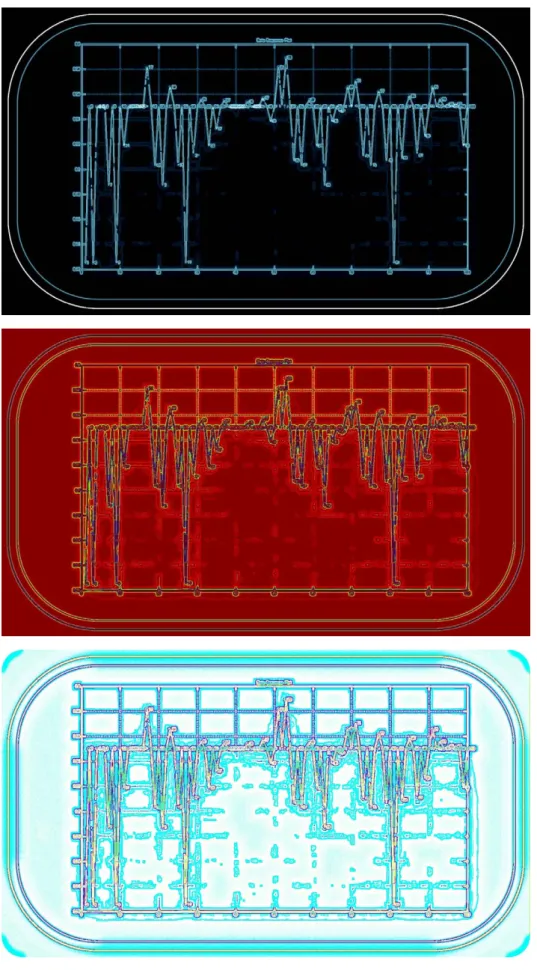
Then, we have the following graph (Fig. 1) of the sequence Beta, which indicates that EN(G) does not have an
asymptotic line. Fig. 2 provides Matrix Art pictures of βN (G). The reader is invited to visit the link given in ref. 12) and to follow the sub-link therein called Matrix Art related to ALTEC.
Theorem 2. The ALTEC (CBV(I)-version) is true.
Proof. The conclusion follows from Theorem 1 and
Lemmas A1 and A2. //
We give another proof:
The second proof of Theorem 2: Let F(N) = EN(G).
Consider the subsequences F(2 )N and F(3 )N . Then one can get, via straightforward computations, the following two equalities valid for all N ∈ +
3 1
(2 ) 2
8 4
N N
F = + ,
3 1
(3 ) 3
8 8
N N
F = + ,
which directly shows that F(N) does not have an asymptotic line. The conclusion follows. //
Figure 1. Sequence βN(G)
− 76 −
Figure 2. Matrix Art pictures of the sequence βN(G). Observe the rhythmic pattern of the oscillation.
− 77 −
Acknowledgements of this section. The author of this section (S.A.) would like to express his sincere thanks to Dr.
Hiromu Ohno, formerly in Kobe University, who was a member of the First Generation Fukui Project and who introduced the powerful computational tool MATLAB to the author. The proofs of the ALTEC C(I) and CBV(I) would not have been possible without using this powerful heuristic computational tool. The author is also grateful to Prof. K.F.
Taylor and Prof. P. Zizler for stimulating discussions on absolutely continuous functions and on the theory of Legesgue Integral while the author was at the University of Saskatchewan, Canada. Special thanks are due to Prof.
Zizler and Prof. Yokotami, who prompted the author of this section (S.A) to publish the proof of the ALTEC CBV(I) version immediately after his publication of ALTEC C (I) version in the J. Math. Chem.
References
1) S. Arimoto, Proof of the Asymptotic Linearity Theorem Extension Conjecture (ALTEC), accepted for publication in: J. Math.
2) S. Arimoto and K.F. Taylor, Practical Version of the Asymptotic Linearity Theorem with Applications to the Additivity Problems of Thermodynamic Quantities, J. Math. Chem. 13 (1993) 265-275.
3) S. Arimoto, Open problem, Magic Mountain and Devil's Staircase swapping problems, J. Math. Chem. 27 (2000) 213-217.
4) S. Arimoto, New proof of the Fukui conjecture by the Functional Asymptotic Linearity Theorem, J. Math. Chem. 34 (2003) 259.
5) S. Arimoto, Repeat space theory applied to carbon nanotubes and related molecular networks. II, J. Math. Chem. 43 (2008) 658-678.
6) S. Arimoto and M. Spivakovsky, The Asymptotic Linearity Theorem for the study of additivity problems of the zero-point vibrational energy of hydrocarbons and the total pi-electron energy of alternant hydrocarbons, J.
Math. Chem. 13 (1993) 217.
7) S. Arimoto, M. Spivakovsky, E. Yoshida, K.F. Taylor, and P.G. Mezey, Proof of the Fukui conjecture via resolution of singularities and related methods. V, J. Math. Chem. 49 (2011) 1700.
8) S. Arimoto, Tsuyama-castle Function and Matrix Art, Bulletin of Tsuyama National College of Technology, 53E (2011) 1-5.
9) S. Arimoto, Multidimensional Magic Mountains and Matrix Art for the Generalized Repeat Space Theory, J. Math. Chem. 50 (2012) 1210-1223.
10) S. Arimoto, Fukui Conjecture and New Frontier Project (in Japanese),
‘Kagaku’ (Chemistry), Kagaku doujin, Vol. 68 No.11, (2013) 24-27. Short URL: http://bit.ly/1QNGwX3 Full URL:
http://www.kagakudojin.co.jp/kagaku/web-kagaku03/c6811/c6811-arimoto/i ndex.html
11) S. Arimoto, <Mathematics and Sciences> Fukui Conjecture and New Frontier Project Interdisciplinary Research (in Japanese), accepted for publication in the journal ‘Sugaku’ (Mathematics), Mathematical Society of Japan.
12) S. Arimoto, Science-Art Multi-angle Network, LINK:
http://bit.ly/1Mrbd2R
13) M. Hata and M. Yamaguti, Japan J. Appl. Math., 1(1984)183.
14) M. Yamaguti and M. Hata, in: Computing Methods in Applied Science and Engineering, VI, ed. R. Glowinski and J.-L. Lions (Elsevier Science Publishers B.V., North-Holland) 1984, pp.139-147.
11.Concluding Remarks
Shigeru Arimoto
On behalf of the co-authors and myself, I would like to express sincere gratitude to all who helped in enhancing the Fukui Project. Special thanks are due to Professor T. Yamabe and Professor J. LeBlanc, who have been recent collaborators in the program related to the Fukui conjecture, carbon nanotube, and visual Matrix Art. In recent years, as a complementary aspect to the visual Matrix Art, we began to target heuristic and innovative sonification (audiolization) of various scientific data and their Fourier analysis with the help of computer scientists and musicians.
However, by the 100th anniversary of the birth of Professor Kenichi Fukui in 2018, heuristic visualization and sonification programs in the Fukui Project currently separated as modular units shall be united. The Science-Art Multi-angle Network (SAM Network) Project, which is an important part of the Fukui Project, will be playing a central role for this unification. The reader is referred to the link:
http://bit.ly/1Mrbd2R and sub-links therein especially http://bit.ly/1MtyN1q for referential data of the SAM Network, which seeks to bridge natural science, art, literature, and philosophy for a creative collaboration.
Acknowledgements
The first author (S.A) was supported by the Tsuyama College President Fund. The second author (M.A.) was partially supported by Iran National Science Foundation (INSF Grant No. 88002044).
On behalf of the authors of this series of papers, the first author (S.A.) would like to express sincere gratitude to Dr. T.
Noritsugu, President of Tsuyama National College of Technology, his predecessor Dr. H. Inaba, and members of the Fukui Project Association for their help in holding our Symposium 2013 Tsuyama and promoting our interdisciplinary and international collaborations. The Symposium was also supported by the Tsuyama City and the Tsuyama City Educational Board, which we would also like to thank cordially.
− 78 −