• 検索結果がありません。

Design and implementation of Electrical Double Layer Capacitor (EDLC) Based 1U CubeSat Electrical Power System (EPS).

N/A
N/A
Protected

Academic year: 2021

シェア "Design and implementation of Electrical Double Layer Capacitor (EDLC) Based 1U CubeSat Electrical Power System (EPS)."

Copied!
11
0
0

読み込み中.... (全文を見る)

全文

(1)

Design and implementation of Electrical Double Layer Capacitor (EDLC) Based 1U CubeSat Electrical Power System (EPS).

O Tamer Abu Rouk, Sangkyun Kim, and Mengu Cho (Kyushu Institute of Technology, LaSEINE)

Key words: CubeSat, EDLC, EPS, Software, Power profile, SAS.

Abstract

Nowadays CubeSats projects are growing rapidly for supporting basic missions such as educational, data exchange or experimental missions. The CubeSats are depending on rechargeable batteries as a source of power. However simplicity, robustness, reliability and safety of Electrical Power System (EPS) are required for harsh space environment rather than the advantages that rechargeable batteries provide. The Electrical Double Layer Capacitors (EDLCs) could be a solution, since they can provide the EPS with more robustness, reliability, simplicity, safety, and more cost effectivities. Thus the purpose of this study is to design, and build a new ELDC-based 1U CubeSat EPS, conduct EDLCs charging and discharge cycle tests, generating realistic power, load, voltage and current profiles

1. Introduction

Nowadays CubeSats projects are growing rapidly for supporting space researches, space education, and even commercial businesses. The CubeSats are built for simple and basics missions, such as education, data exchange and scientific experiments, The CubeSats are mainly developed in universities, institutes, and small companies due to low cost, short building time, small sizes, and mass.

The CubeSat size categorized under a (U-class spacecraft), however the standard size is 1U (10×10×10 cm), with mass of 1.33kg per unit. The CubeSats are most commonly put in the orbit by International Space Station (ISS), or launched on rockets as a secondary payload [1].

The CubeSat has a complete Electrical Power System (EPS), and considered an example of power distribution system with all units, power generation, voltage step-up, power storage, protection, voltage regulation and distribution unit.

On the Fig.1, typical EPS is explained as a schematic diagram. The Solar arrays are the main component for power generation. They are connected in series and parallel to generate the required DC power for the each subsystem. DC/DC boost converter is used as voltage step-up component, it’s working as a bump to push the charges into the batteries. Rechargeable batteries are used for power storage, they are also considered as a secondary source of electrical power during the eclipse periods. The rechargeable batteries are always required protection unit, to protect it from, over charging, and maintaining the required operating temperature. DC/DC voltage regulator

is used to regulate, and step down the bus voltage between 3.3V, and 5V for the each subsystem. A pin port is used for power distribution, it delivers the regulated voltages of 3.3V, 5V, and other unregulated voltages to the different CubeSats subsystems.

Fig.1 EPS main Components.

Although, CubeSats EPS can deliver the required electrical power to the different subsystems, it is still required to build much more simple system, and more robust, reliable, safe, and cost effective. Thus it’s decided in our laboratory to design, and build a 1U CubeSat EPS, replaced the rechargeable batteries with Electrical Double Layer Capacitors (EDLCs).

EDLCs, also called Ultra capacitors, or Super Capacitors,

are electrical components, capable of holding hundreds of

times more electrical charge quantity than a standard

capacitor. Its maximum charge voltage lies between 2.5

and 2.7 volt. The EDLCs are polar components, which

means they have positive and negative terminals, and

shall be connected correctly in circuits. [2][3]

(2)

The EDLCs have following advantages.

The Robustness: long life usage up to 15 years, more than 1 million charge and discharge cycles, wide operating temperature range(-40 ℃ to +65 ℃ ), strong structure, light weight.

The Reliability: High charge and discharge rate, rapid charging, deep charge and discharge, fast transient response (~ 20 micro seconds), high specific power [4], The Simplicity: Simple charging method by direct energy transfer (DET), free of maintenance, easy installation, interface, and fixable mounting, rated cell voltage 2.7V which is equal to 3-junction solar cell voltage.

The safety: Environmental friendly, since it’s Free of toxic materials, no explosive hazards since it’s free of explosive materials, and no chemical reactions, no hazards with little over charging or discharging, No protection circuits are required. [5][6]

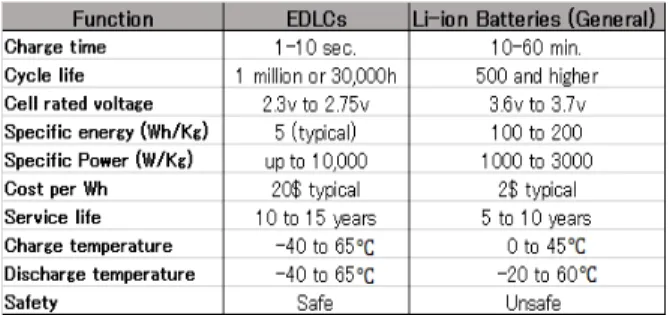
Table 1 shows a comparison between EDLCs and general rechargeable Li-Ion Batteries.

Table 1 EDLC & Li-Ion Battery comparison [5].

The purpose of this study, is to verify the possibility of implementing EDLCs in CubeSats through various tests, and replace the rechargeable batteries with EDLCs for simple 1U CubeSats missions. After the achievement, the next step is to design, and build an ELDC-based 1U CubeSat EPS, to be implemented in future 1U CubeSat mission.

Various steps have been followed to achieve the purpose of this study. First step was studying the orbital parameters of the sun, and calculate the exact sunlight, and eclipse periods of the proposed CubeSat. The sunlight period is equal to the charging period of EDLCs, and the eclipse period is equal to the discharging period of EDLCs. The eclipse, and sunlight periods are varies depends on the orbit condition. ISS orbit condition is assumed for this study because of its availability of CubeSats. Second step was simulating the attitude of the CubeSat, and estimates the angles between the solar cells, and sunlight to calculate the generated power by the solar

cells. This step impact on EDLC charging, to insure that the generated power by solar cells is enough for EDLCs charging, and other subsystems operation. We assumed, that the proposed CubeSat is stable around Z-axis, having 2 solar cells on each 5 sides, all solar cells in the CubeSat are connected in parallel, and the 6

th

side will be spared for the mission system. At this study we used, a simulated solar cell developed in our laboratory instead of using real solar cells, or commercial solar array simulator devises (SAS),

Third step was selecting the most suitable EDLCs for this study considering, quality, size, capacitance, and rated voltage. We implemented various tests on EDLCs such as, charging and discharging, and calculate the capacitance, charging and discharge periods. Such tests are implemented to insure the capacitor qualification for this study

Fourth step was to calculate, the CubeSat load power consumption, and subsystems working scenario, during eclipse, sunlight, and at both periods. This step impact on EDLCs discharging, and it’s important to insure that EDLCs are going to stand or not for supplying the required power for all subsystems during eclipse period.

Fifth step was generating various profiles of the EPS for two orbital cycles, such as generated power, load consumption, EDLCs voltage and currents, simulated SAS voltage and current profiles.

In our laboratory, we developed a software by LabVIEW

®

program to calculate, simulate, and test all previous steps.

The software connected with external devices, such as electronic load, and DC power supply, through Data acquisition (DAQ) for controlling, reading, and monitoring the required load conditions with voltages, and currents

2. Software Development.

The software that we have developed by LabVIEW

®

environment in our laboratory, has the capability to calculate orbital parameters including orbital periods, attitude estimation, generated Power, load consumption, and working scenario, and various power, voltage and current profiles.

2.1 The Orbital parameters

With this part of the developed software, the exact

periods of eclipse, and sunlight are calculated, because

these values will impact on EDLCs charging and

discharging periods. With just CubeSats height,

inclination, right ascension angle at epoch, and the date of

(3)

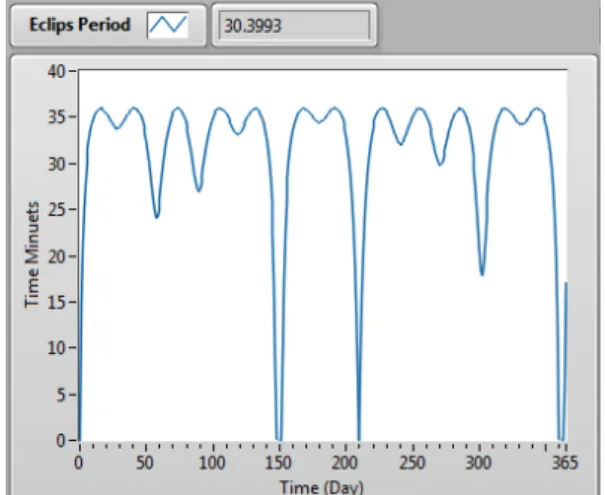
the study (the date required to calculate exact eclipse, and sunlight periods), the software will provide the exact sun declination, sun right ascension, CubeSat right ascension, beta angle β, eclipse, and sunlight periods. In our study we supposed that our CubeSat put on the ISS orbit. Thus it has the same orbital parameters with ISS, height 415.8 km, inclination angle 51.64 ゜ , right ascension angle 177.3゜at epoch, and the date of the study was 30 Sep 2016 [7]. The output results from the software was that Sun declination is -2.84°, Sun Right ascension is 186.55°, CubeSat right ascension is 267.21°, Beta angle is 47.91°, Eclipse period is 30.34 minutes, Sunlight period 62.26 minutes. The total orbital period is 92.65 minutes, which is equal to the sum of eclipse period and sunlight period.

The total orbital period (T) can also be calculated by,

(1)

μ: Standard gravitational parameter = 3.986 × 10

-14

m

3

S

-2

a: Satellite altitude.

Eclipse period (T

E

) can be calculated by, T

E

= T ׃

E

(2) Sunlight period (T

L

) can be calculated by,

(3) Eclipse fraction ƒ

E

[13].

(4)

R is earth radius, h is satellite height, and β is beta angle

Fig.2 Beta Angle annual Profile & on 30

th

Sep 2016

Fig.3 Eclipse period annual profile & on 30

th

Sep 2016

Fig.4 Sunlight period annual profile & on 30

th

Sep 2016

2.2 CubeSat Attitude Estimation

At this part of the developed Software, we can estimate the attitude of the CubeSat, and calculate angle, which is the angle between the sunlight and the solar cell surface, as shown in the Fig.5. We assumed in our study that the CubeSat is stable around z-axis.

Fig. 5 the angle

The angle is calculated with following equation.

(5)

Where β is beta angle = 47.91, and i is the inclination

angle = 51.64 ゜ . angle is calculated by equation (5)

which is equal (-9.54 ) for the top face, the left and right

faces angles can be considered 45 for each, because at

any moment the total for left and right faces are 90 .

(4)

2.3 Generated Power

As mentioned earlier, one purpose of this study is to reduce the cost of the new EPS. Thus we developed a simulated 3-junction solar cell by using LabVIEW

®

programing, and we implemented it in the various tests, replacing expensive commercial Solar Array Simulators devices (SAS), or the physical 3-junction Solar cells.

With this simulated solar cell we can control the normal DC power supply to behave as a solar array, build solar arrays in series and parallel easily, within the same environment of LabVIEW

®

. [8][9]

The developed Simulated Solar Cell has the following specifications, Isc = 0.6A, Voc = 2.7V, Pm = 1.25W at Imp = 0.5A and Vmp = 2.5V, Tem = 25℃ and Area = 0.0037 m

2

Fig. 6 Simulated Solar Cell build by LabVIEW

®

. The capabilities of simulated solar cell are: efficiency of 28% exactly, same the cells used in CubeSats projects. It can be connected with a DC power Supply to take the readings to the reality. Simulated solar cell can be connected in series and parallel to build solar arrays as much as required within LabVIEW

®

environment. It gives the option to select (Short circuit current, Open circuit voltage, Working temperature, Light intensity, Maximum voltage), and gives the option to read (Voltage data, Current data, Power data, V-I curve, and V-P curves). In our study, we connected all solar cells in parallel, thus at any moment during the sunlight period there are at maximum 6 numbers solar cells receiving sun light, as shown in Fig. 7

Fig. 7 3 faces receiving sunlight during sunlight period

The Generated Power part of the software, will calculate the power at each face depending on the following equation,

(6) A: The solar cell area, equal 0.0037 m

2

S: The light intensity, equal 1000 W/m

2

, as recommended by Solar cell manufacturers [10]

: The solar efficiency, equal 28%

: Top face equal -9.54°

: Right face equal 45°

: Left face equal 45°

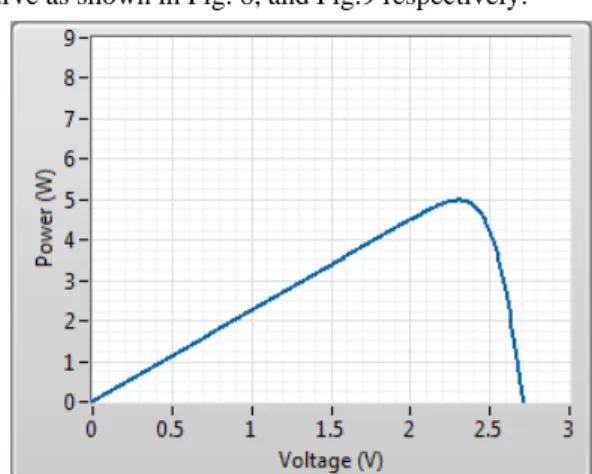
The software calculated the generated power, and it was as follow, on top face 2.04W, left face 1.46 W, right face 1.46W, and the total power generated is 4.98W, the total maximum voltage Vmp = 2.3V, and the total maximum Current Imp = 2.16A, all reading on 30

th

Sep 2016. The software provides the total equivalent P-V curve, and V-I.

All 6 solar cells are connected in parallel. The Total configurations of Solar Cells, Isc = 2.26A, Voc = 2.7V, Pm = 4.98W at Vmp = 2.3V, Imp = 2.16A.

Curve as shown in Fig. 8, and Fig.9 respectively.

Fig.8 P-V curve for 6 solar cells connected in parallel

Fig.9 V-I curve for 6 solar cells connected in parallel

(5)

2.4 Load & working scenario

After we calculated the eclipse, sun light periods, and maximum generated power by the proposed CubeSat, and in order to generate realistic power profiles, it’s important to determined CubeSat load consumption in both Eclipse, and sunlight periods, and subsystem usage periods. Table 2 summarizes subsystems with its functions, time usage, load consumption in watt, either in eclipse or sunlight periods, and working periods in minutes.

Table 2, Subsystems, Functions, Usage Period. Load Consumption and working periods

Form Table 2, the proposed CubeSat load consumption during eclipse is 0.920W. Load consumption during Sunlight is 0.970W. Load consumption during mission (camera shots) is 1.33W. Load consumption during data transmission is 2.67W.

3. EDLCs Electrical Testing

An EDLCs bank consist of 4 numbers of 400F EDLCs, connected in parallel, is going to provide the electrical power to the load (0.92W), and it will keep discharging for 30.34 minutes (eclipse period). The EDLCs Bank will be charged back during sunlight period for 62.26 minutes.

Thus implementing EDLCs charging, and discharging tests, will verify if EDLCs are able to provide the required power to the load during all eclipse period, and fully charged back before the end of sunlight period. The EDLCs used in this study are just commercial type, thus it’s important to check their performance by charging, and discharging tests, and to check their qualifications such as capacitance, and tolerance.

In this study, we build an array of 6 solar cells all connected in parallel by using our developed software, and LabVIEW-base SAS. The simulated SAS connected with DC voltage power supply [type: GWINSTEK, and model: PSW 80-13.5] through DAQ to turn it to behave as SAS device. The DC power supply is connected directly to 4 numbers parallel EDLCs bank, and just a Diode in between, this method of connection called

Direct Energy Transfer (DET), which is providing the required simplicity, efficiency and reliability to our system. In this simple direct connection method, the losses are only in the diode, we used a new diode technology with only voltage drop 0.012V.[14] The EDLCs connected direct with load device [type:

KIKUSUI, and model: PLZ164WA] to simulate the load.

The DAQ, will provide a full control, and monitor all connected devices. Figure 10 shows the experiment connection.

Fig. 10 circuit connection for experiment The EDLCs used in our study has the specification listed in Table 3.

Table 3 EDLCs specifications used in this study [11]

Fig. 11 The EDLC used in our study [11]

3.1 Charging All Capacitors (1, 2, 3, 4) in parallel

In this test, EDLCs bank will charge gradually by direct

connection of LabVIEW-Based SAS, with following

configurations, Isc = 2.26A, Voc = 2.7V, Pm = 4.98W

at Vm = 2.3V, Imp = 2.16A.

(6)

Fig. 12 Charging test circuit connection

Results:

- EDLC initial voltage = 0.32V.

- EDLC maximum voltage = 2.6V.

- Total charging time to maximum voltage = 26.1 mins.

Which is smaller than Sunlight period. Thus the EDLCs bank can fully charge within sunlight period.

Fig. 13 Charging EDLCs Voltage & Current curves

Fig. 14 V-I curve of SAS during charging test

3.1.1 DC/DC boost Converter

After charging the EDLCs bank, we connected a controller DC/DC boost converter to regulate the EDLCs voltage, as shown in figure 15. LTC3425 model is used, manufactured by linear technology. It’s a multiphase synchronous converter type, and up to 95% efficiency, 3A continuous output current, 0.5 to 4.5v input voltage, which is suitable for EDLC rated voltage, adjustable

output voltage between 2.4 to 5.25v, wide temperature operating range, and extremely small in size 5×5mm.

Fig. 15 circuit connection with DC/DC converter

Fig. 16 LTC3425 Boost converter chip [15]

In this test, we adjusted the regulator output voltage to 5v, and load device to 2.67W, to simulate the transceiver while sending the mission data to the ground station.

Fig. 17 Regulated voltage, during data transmission

Results:

- DC/DC input voltage Vin = EDLC initial voltage 2.5v - DC/DC input current Iin = 1.24A

- DC/DC input power Pin = 3.1W

- DC/DC output regulated voltage Vout = 5.06v - DC/DC output regulated current Iin = 0.53A - DC/DC input power Pout = 2.67W

- DC/DC efficiency = = 86.13 %

3.2 Discharging All Capacitors (1, 2, 3, 4) in parallel We applied 3 discharging tests on the EDLCs bank, connected all in parallel, with total capacitance 1600F.

First discharge test was by connecting EDLCs bank

directly with electronic load device. Second discharge test

(7)

was by connecting EDLCs bank with electronic load device through 3.3v DC/DC boost converter. Third discharge test was by connecting EDLCs bank with electronic load device through 5v DC/DC boost converter.

3.2.1 Discharge EDLCs directly electronic load device Connecting all EDLCs in parallel, and change the configurations of load device to 1W constant power as shown in figure 18. A DAQ has been connected to monitor the readings by PC, with LabVIEW

®

.

Fig. 18 Discharging test circuit connection

Results:

- Initial Capacitors Voltage = 2.56V.

- Minimum Capacitor Voltage = 0.39V.

- Initial Current = 0.493A.

- Total Discharge time = 59.26min.

- Tested Capacitance C = 1588.76F.

- Tested tolerance – 0.7%

For the method of the capacitance test, it should be over a constant current, thus we repeated the discharge experiment, and changed the configuration of electronic load device from constant power (CP) mode to 1A constant current (CC) mode, then we calculated the time constant T which is equal to the time that capacitor spend to reach 36.8% from initial voltage. From the result we got, T = 1493.43 sec, R = V/I, where,

V = 0.368V

(initial)

= 0.94V, I = 1A, thus R = 0.94/1 = 0.94Ω,

Tested Capacitance C= T/R, = 1493.43/0.94 = 1588.76 F

Fig. 19 discharging voltage and current curves for 4nos.

EDLCs connected in parallel.

From the results we found, the total discharge time is 59.2 minutes, which is much bigger than the eclipse period, thus the EDLCs bank can provide power to the load comfortably. The tested capacitance is 1588.76F which is very close to the rated capacitance 1600F. The tested tolerance is very small -0.7%.

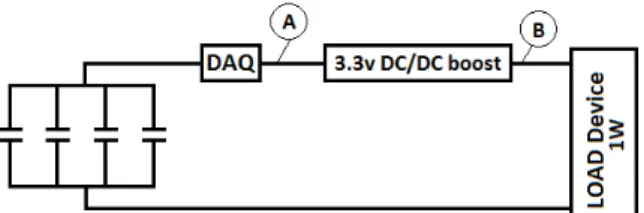
3.2.2 Discharge EDLCs with 3.3v DC/DC converter We repeated the discharge test, connecting all EDLCs in parallel, with 3.3v DC/DC boost converter, the same model mentioned in fig. 15, then connected the DC/DC converter with load device. The below figure shows the connections between the components.

Fig. 20 Discharging with 3.3v DC/DC boost converter Point A is the input of DC/DC converter, and EDLCs bank’s voltage and current.

Point B is the output point of DC/DC converter, and Load’s voltage and current.

Results:

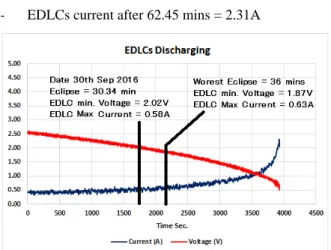
As shown in figure 21, we kept the EDLCs discharging, and watching the regulated output at the same time, as shown in figure 22, then we checked the results at three major points. First at the end of eclipse period of our study date 30th Sep. 2016. Second at the longest eclipse period of the year. Third at the lowest voltage EDLCs can provide while DC/DC converter is still regulating the voltage to 3.3v.

1) Results At 30.34 mins Eclipse period - EDLCs initial voltage = 2.54v

- EDLCs voltage after 30.34 mins = 2.02v - EDLCs current after 30.34 mins = 0.58A 2) Results At 36 mins longest Eclipse period - EDLCs initial voltage = 2.54v

- EDLCs voltage after 36 mins = 1.87v - EDLCs current after 36 mins = 0.63A

3) Results At 62.45 mins at the lowest EDLCs voltage - EDLCs initial voltage = 2.54v

- EDLCs voltage after 62.45 mins = 0.51v

(8)

- EDLCs current after 62.45 mins = 2.31A

Fig. 21 discharging voltage and current curves for 4nos.

EDLCs connected in parallel with 3.3v DC/DC converter.

Fig. 22 regulated 3.3v voltage, and 0.29A constant current From the results, we can confirm that EDLCs can provide a regulated voltage of 3.3v, and constant current of 0.29A, for 62.45 mins and average efficiency of 92%.

3.2.2 Discharge EDLCs with 5v DC/DC converter We repeated the discharge test, connecting all EDLCs in parallel, with 5v DC/DC boost converter, the same model mentioned in fig. 15, then connected the DC/DC converter with load device. The below figure shows the connections between the components.

Fig. 23 Discharging with 5v DC/DC boost converter Results:

As shown in figure 24, we kept the EDLCs discharging, and watching the regulated output at the same time, as

shown in figure 25. Here we just toke one reading, at the lowest voltage EDLCs can provide while DC/DC converter is still regulating the voltage to 5v.

- EDLCs initial voltage = 2.59v

- Maximum discharging time = 51.25 mins, while DC/DC converter still regulating 5v, and 0.2A - EDLCs lowest voltage = 1.08V

- EDLCs current after 51.25 mins = 1.9A - DC/DC output voltage = 5V

- DC/DC output current = 0.2A

Fig. 24 discharging voltage and current curves for 4nos.

EDLCs connected in parallel with 5v DC/DC converter.

Fig. 25 regulated 5v voltage, and 0.2A constant current From the results, we can confirm that EDLCs can provide a regulated voltage of 5v, and constant current of 0.2A, for 51.25 mins and average efficiency of 86%.

Notes:

- A fluctuations in 5V DC/DC converter input current has been noted, due to the sudden changes in EDLC voltage, these fluctuations won’t be harmful since output is always regulated.

- Due to these fluctuation, it’s not easy to draw the

DC/DC converter efficiency curve, however the

efficiency of the DC/DC at fixed input readings

showed 92.23% at low input currents, and 90.32% at

high input currents.

(9)

3.3 Profiles

Following same connection in figure 10, and from software we selected profiles for 2 cycles.

Results:

Figure 26 shows the temporal profiles of power generation simulated by SAS, and the load consumption.

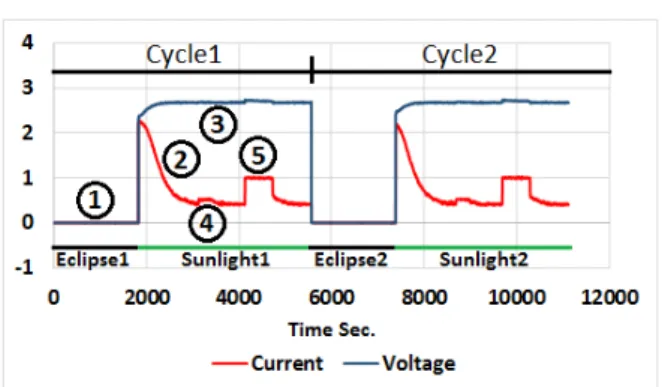
Fig.27 shows the current and voltage simulated by SAS.

In the figures. Figure 28 shows the EDLCs voltage cycles during discharge, charging, and saturation, at the same time as Fig.26. The numbers marked by circles have the following meanings for Fig.26;

① Eclipse load consumption 0.92W.

② Charging EDLCs in 12.75 mins.

③ Sunlight load consumption 0.97W.

④ Camera working period 5 mins.

⑤ Data transmission period 10 mins.

From Fig.27 we can observe.

① Eclipse period, no voltage and current generated from SAS.

② Current during charging EDLCs. Current reduce while voltage of EDLCs increasing.

③ Voltage of SAS increasing gradually, while EDLCs charging then reach the saturation.

④ Current during camera mission.

⑤ Current during Transmission From Fig.28, we can observe

① EDLCs Discharge during eclipse periods, the minimum voltage reached 2.07V.

② EDLCs charging during sunlight, the maximum voltage 2.65V, in 16.3 mins.

③ EDLCs are in full charge and stable for 45.96 mins.

Fig. 26 Generated power, and Load consumption, for 2 cycles.

Fig. 27 SAS Voltage & Current

Fig. 28 EDLCs Voltage profile for 2 cycles.

4. Circuit and PCB design

There were 3 major challenges during the design stages.

First the space management of the PCB board, since the available size is only 9×9 cm, and EDLCs equipped most of the space. However we were able to solve this issue by using small components, and use the dead spaces as much as possible, figure 29 shows the PCB 2d design including dimensions in mm. The second challenge was the voltage drop. Since all solar cells are connected in parallel, it is very important to save the generated voltage as much as possible, to be able to charge the EDLCs up to the rated voltage, and the DC/DC regulators can receive sufficient voltage to operate. Thus we used for the first time a unique diode component called “smart bypass diode”.

This diode has an extreme low voltage drop, only 12mv, at 2 A, which is far better than stocky diode that we normally use, which has voltage drop around 400mv. [14].

The third challenge, was regulating the Low EDLC

voltage to 3.3v, and 5v with higher output current, and

higher efficiency. We tried different DC/DC boost

converters, we connected many DC/DC converters in

parallel in order to get higher output current, but the

efficiency was awful. Finally we used LTC3425 boost

4-phase controller, which mentioned in section 3.1.1. This

converter provides the system with the required power,

(10)

and high efficiency. There are three major points shall be considered during designing DC/DC converter circuits to achieve the best efficiency. Using Power class winding inductors, wide copper regions and paths between components, and select the right operating frequency.

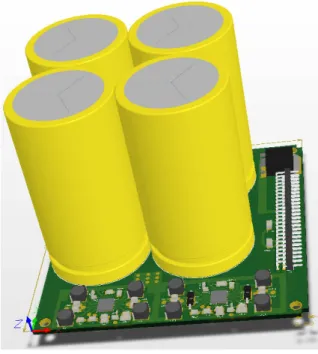
For the new EPS, Altium CircuitMaker is used for all design stages, such as schematic, 2D PCB, 3D PCB as shown in figure 30. Table 4 shows the system component list.

Fig. 29 2D double layer PCB with dimensions Table 4 list of components used in design

Fig. 30 PCB 3D view

5. Conclusion

The results of the tests, and profiles shows that a capacitor bank of 4 EDLCs connected in parallel, and with total capacitance of 1600F is suitable, to build an EDLC-Based EPS for 1U CubeSat of simple missions.

Power and voltage profiles for 2 orbital cycles shows that CubeSat will not shutdown.

By using LTC3425 multiphase boost converter controller type, we were able to regulate the EDLC voltage to 3.3V and 5V, and provide the subsystems with required currents, even if EDLCs have only 0.5V.

The future tasks are, to build the design by fabrication company, repeat charging, and discharging tests, apply mechanical and thermal test, and finally make it ready for future CubeSat mission.

6. References

[1] Mehrparvar, Arash. February 2014, “CubeSat Design Specifications”, The CubeSat Program, CalPoly SLO [2] Capacitor guide, Super Capacitors [Online].

Available:“http://www.capacitorguide.com/supercap acitor”

[3] A brief history of supercapacitors, 2007, Batteries &

Energy Storage Technology. [Online].Available:

“http://www.cantecsystems.com/oldsite/ccrdocs/brief -history-of-supercapacitors.pdf”

[4] Muhammad Alkali, Mohamed Yahia Edries, and

Mengu Cho. September 2015, International Journal

of Electrical Energy, Vol. 3, No. 3.

(11)

[5] Meet Gidwani, Anand Bhagwani, Nikhil Rohra, October 2014,“Supercapacitors: the near Future of Batteries”, Department of Computer Engineering, Vivekanand Education Society’s Institute of Technology, Chembur, Mumbai-400 071, Maharashtra, India, International Journal of Engineering Inventions, Volume 4, Issue 5.PP:22-27 [6] FaraDigm, Advantages of Ultra capacitors, [Online].

Available:“http://www.faradigm.com/faqs/ultracapa citors“.

[7] Wolframalpha, 30 Sep 2016, Computational Knowledge engine, “International Space Station, Position on 30 Sep 2016 at 00:00:00 EST.”

[8] Dr. J. Abdul Jaleel, Nazar. A, Omega A R, Sep 2012,

“Simulation on Maximum Power Point Tracking of the Photovoltaic Module using LabVIEW®, Dept. of Electrical and electronics Engineering”, TKM College of Engineering, Kollam, Kerala, India.

International Journal of Advanced Research in Electrical, Electronics and Instrumentation Engineering Vol.1, Issue 3.

[9] Hegazy Rezka, El-Sayed Hasaneen, September 2015,

“A new MATLAB/Simulink model of triple-junction solar cell and MPPT based on artificial neural networks for photovoltaic energy systems”, Electrical Engineering Dept., Minia University, Minia, Egy, Electrical Engineering Dept., Aswan University, Aswan, Egypt, Ain Shams Engineering Journal, Volume 6, Issue 3, Pages 873–881.

[10] PV Education.org, Measurement of Solar cell efficiency, [Online]. Available:

”http://www.pveducation.org/pvcdrom/characterisati on/measurement-of-solar-cell-efficiency”

[11] PowerStore XV series, October 2014, “Snap-in cylindrical supercapacitor”, Technical Datasheet 4424,

[12] Earl D. Gates, Introduction to Electronics, 5

th

edition, Chapter 11, “11-3 RC time constant”, page 120.

[13] Massachusetts Institute of Technology, Cambridge, Massachusetts 02139, “Power System Design and Trade Study for a Satellite Killer Spacecraft”.

[14] Texas Instruments, may 2016 “SM74611 Smart

bypass diode”, Technical Datasheet SNVS903B

[15] Linear Technology, “LTC3425”, Technical Datasheet

Table 1 shows a comparison between EDLCs and general rechargeable Li-Ion Batteries.
Fig. 5 the angle
Fig. 7 3 faces receiving sunlight during sunlight period
Fig. 11 The EDLC used in our study [11]
+6

参照

関連したドキュメント