Introduction
We previously reported that radiotherapy was useful for the treatment of mucosa-associated lymphoid tissue (MALT) lymphoma of the ocular adnexa1). MALT lymphoma was first described by Isaacson and Wright in 1983 as an extranodal B-cell lymphoma arising in the marginal zone of mucosa- associated lymphoid tissue and was established in the new WHO classification2-3). Radiotherapy is useful for the treat- ment of MALT lymphoma of the ocular adnexa and is the first choice for this disease. We investigated the long-term follow-up results of radiotherapy for MALT lymphoma of the ocular adnexa.
Methods and Materials
Twenty-one patients with MALT lymphoma of the ocu- lar adnexa treated with radiotherapy alone at Hiroshima Prefectural Hospital between 1998 and 2010 were retro- spectively analyzed (Table 1). In 15 patients the disease arose from the conjunctiva, and in 6 patients, it originated from the retrobulbar space. Bilateral conjunctival involve- ment was found in 9 patients, and involvement of the bilat- eral retrobulbar space was found in 1 patient.
The median follow-up of the surviving patients was 86 months (range, 11-157).
The histological diagnoses obtained via an incisional bi- opsy in all cases were categorized according to the criteria Acta Med. Nagasaki56: 49−52
Address correspondence:Yoshio Monzen, M.D. Department of Radiology, Hiroshima Prefectural Hospital, 1-5-54 Ujinakanda Minami-ku, Hiroshima 734-8530 Japan
TEL:+81-082-254-1818, Ext. 1000, FAX:+81-082-253-8274, E-mail:[email protected] Received May 12, 2011; Accepted July 12, 2011
MS#AMN 07086
Radiotherapy for mucosa-associated lymphoid tissue lymphoma of the ocular adnexa
Yoshio MONZEN1, Koichi WADASAKI1, Haruyuki HASEBE2, Takashi NISHISAKA3, Toshiyuki FUKUHARA3
1Department of Radiology, Hiroshima Prefectural Hospital
2Department of Ophthalmology, Hiroshima Prefectural Hospital
3Department of Pathology, Hiroshima Prefectural Hospital
Objectives: We investigated the results of radiotherapy for mucosa-associated lymphoid tissue (MALT) lymphoma of the ocular adnexa.
Methods: Twenty-one patients with MALT lymphoma of the ocular adnexa were treated with radiotherapy alone at a dose ranging from 30 to 54Gy. The disease arose from the conjunctiva in 15 patients (9 with bilateral involvement), and from the retrobulbar space in 6 patients (1 with bilateral involvement).
Results: All patients with MALT lymphoma achieved a CR or unconfirmed CR (CRu). The 5-and 10-year overall survival rates of all patients with MALT lymphoma were 100% and 90%, respectively. The 5-and 10-year cause-specific survival rates were 100% and 100%, respectively. In all patients with delayed toxicity, the radiation dose was more than 40Gy.
Conclusions: Excellent local control and survival can be achieved for patients with MALT lymphoma of the ocular adnexa using radiotherapy alone.
ACTA MEDICA NAGASAKIENSIA 56: 49−52, 2011 Keywords: Radiotherapy, Mucosa-associated lymphoid tissue lymphoma, Ocular adnexa
Yoshio Monzen et al.: Radiotherapy for MALT lymphoma of the ocular adnexa
established by the WHO classification. During the staging work-up, gallium scans, computed tomography of the chest and abdomen, and FDG-PET were performed for all patients.
Patients with IAEor IAE2disease according to the American Joint Committee on Cancer TNM Classification were treated with radiotherapy alone (Table 2)4). Lesions confined to the conjunctiva were treated with a single anterior direct field using a 6-12 MeV electron beam. The entire bulbar and palpebral conjunctiva were treated. Retrobulbar tumors were irradiated with 18 MeV electron or 6-MV X-rays. The clinical target volume was the entire orbital cavity. The field ar- rangement was the anterior field, wedged anterior and oblique fields, or opposing lateral fields. A median dose per frac- tion of 2.0Gy (range 1.8-2.5) was administered, with the total dose ranging between 30 and 54Gy (median, 38Gy).
Lead eye shields were used for radiotherapy of conjunctival lymphoma. Lens protection was not used for radiotherapy of retrobulbar lymphoma except for one patient (case 16).
Complete regression of the tumor mass after treatment was considered a complete remission (CR). The absence of regrowth after a follow-up period of more than 3 months indicated an unconfirmed CR (CRu)5).
50
Characteristic No. of patients Stage
IAE
IAE2
Age (years) Range Median Gender Male Female Location Conjunctiva Retrobulbar space
Involved site Unilateral
Bilateral
11 10
29-83 55
9 12
15 6
12 9
Table 1.Characteristics of 21 patients with ocular- adnexal MALT lymphoma
Patient Site Beam energy Dose, Gy Results I.D.C.L Survival months
1 2 3 4 5 6 7 8 9 10 11 12 13 14 15 16 17 18 19 20 21
bilateral conjunctiva bilateral conjunctiva
R conjunctiva bilateral conjunctiva
R conjunctiva bilateral conjunctiva bilateral conjunctiva bilateral conjunctiva bilateral conjunctiva
L conjunctiva L conjunctiva bilateral conjunctiva
L conjunctiva L conjunctiva bilateral conjunctiva L conjunctiva, L retrobulbar mass
R retrobulbar mass bilateral retrobulbar mass
L retrobulbar mass R retrobulbar mass L retrobulbar mass
6MeV electron 6MeV electron 6-9 MeV electron
6MeV electron 6MeV electron 6MeV electron 6MeV electron 6MeV electron 6MeV electron 6MeV electron 6MeV electron 6MeV electron 6MeV electron 12MeV electron 6MeV electron 18MeV electron 6MV X-ray 6MV X-ray 6MV X-ray 6MV X-ray 6MV X-ray
48 R, 40 L 41.5 R, 50 L
40 40 R, 40 L
38 38 R, 38 L 38 R, 38 L 38 R, 38 L 38 R, 38 L
36 38 30.6 R, 30.6 L
30.6 30.6 30.6 R, 30.6 L
40 54 30 R, 30 L
40 40 38
CR CR CR CR CR CR CR CR CR CR CR CR CR CR CR CRu
CR CRu
CR CR CR
28d R, 28d L 10d R, 8m L
26d 0d R, 0d L
1m 9m R, 39d L
0d R, 8m L 3m R, 3m L 14m R, 14m L
47d 11d NA NA NA NA
−
−
−
−
−
−
NED 157 NED R 151, L 132
NED 129 NED 103 NED 104 NED 73 NED 73 NED 49 NED 56 NED 53 NED 48 NED 33 NED 17 NED 17 NED 11 DOOD 125
NED 139 NED 109 DOOD 98 NED 103 NED* 67 Table 2.Treatment methods and results
R=right eye, L=left eye, I.D.C.L=interval of disappearance of conjunctival lymphoma, m=month, d=day
*=Although local retrobulbar lymphoma disappeared, a right submandibular mass 21 months after radiotherapy.
Histological examination of the resected mass showed follicular, mixed, B cell type lymphoma.
NED=no evidence of disease DOOD=die of other disease NA=data not available
Yoshio Monzen et al.: Radiotherapy for MALT lymphoma of the ocular adnexa
Results
Fifteen patients with conjunctival lymphoma achieved a CR. There have been no signs of recurrence or metastasis in any of these patients, with a follow-up ranging from 11 to 157 months after treatment (Table 2). Conjunctival lym- phoma disappeared within 14 months after therapy.
Six patients with lesions of the retrobulbar space achieved a CR or CRu. There have been no signs of recurrence or metastasis in any of these patients, with follow-up ranging from 67 to 139 months after treatment. Two patients died of other diseases. One patient died of lung cancer (case 16), and another patient died of progressive supranuclear palsy (case 19). Although local retrobulbar lymphoma disappeared, a right submandibular mass was observed 21 months after radiotherapy in case 21. The patient underwent a tumorectomy.
A histological examination of the resected mass showed a follicular mixed B cell type lymphoma. The 5-and 10-year overall survival rates of all patients with MALT lymphoma were 100% and 90%, respectively (Fig. 1). The 5-and 10- year cause-specific survival rates were 100% and 100%, re- spectively (Fig. 2).
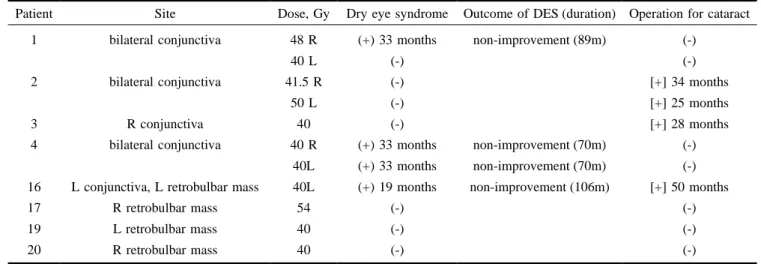
Seven eye-balls developed delayed toxicity (Table 3).
Four eye-balls with conjunctival lymphoma experienced dry
eye syndrome, and four eye-balls developed cataracts. One patient with retrobulbar lymphoma experienced both dry eye syndrome and cataracts (case 16). The vision of pa- tients with cataracts was restored by surgery. In seven eye- balls, the radiation dose had been 40Gy or more.
51
Fig. 1.Overall survival rate
Fig. 2.Cause-specific survival rate
Patient Site Dose, Gy Dry eye syndrome Outcome of DES (duration) Operation for cataract 1
2 3 4 16 17 19 20
bilateral conjunctiva bilateral conjunctiva
R conjunctiva bilateral conjunctiva L conjunctiva, L retrobulbar mass
R retrobulbar mass L retrobulbar mass R retrobulbar mass
48 R 40 L 41.5 R
50 L 40 40 R
40L 40L 54 40 40
(+) 33 months (-) (-) (-) (-) (+) 33 months (+) 33 months (+) 19 months
(-) (-) (-)
non-improvement (89m)
non-improvement (70m) non-improvement (70m) non-improvement (106m)
(-) (-) [+] 34 months [+] 25 months [+] 28 months
(-) (-) [+] 50 months
(-) (-) (-) Table 3.Summary of delayed toxicity
(+) : the interval between radiotherapy and diagnosis of dry eye syndrome.
[+] : the interval between radiotherapy and operation for cataract.
DES=dry eye syndrome m=month R=right eye, L=left eye
Yoshio Monzen et al.: Radiotherapy for MALT lymphoma of the ocular adnexa
Discussion
Most MALT lymphomas originate from the stomach and lung, which represents 5-16% of malignant lymphomas.
Orbital MALT lymphoma accounts for 11-27% of MALT lymphomas6-8).
In all of the present cases, MALT lymphoma of the ocu- lar adnexa was well-controlled after radiotherapy. Suh et al.
reported 52 eye lesions with orbital MALT lymphoma that were treated with radiotherapy. The radiation doses ranged from 5.4 to 30.6Gy (median, 30.6Gy). Forty-six of their le- sions showed a complete response, while the remaining six lesions demonstrated a partial response. Three patients ex- perienced local recurrences. The 10-year actuarial relapse- free survival, cause-specific survival, and overall survival rates were 93%, 98%, and 87% respectively, in that study9). Nevertheless, when 30-54 Gy was delivered as in our study, the local control of MALT lymphoma of the ocular adnexa was excellent. This indicates that the tumor dose in MALT lymphoma of the ocular adnexa does not always participate in local control. Letschert et al. advocated a tumor dose of 30Gy with a local control rate of more than 90% achieved for MALT lymphoma of the ocular adnexa10). Bayraktar et al. reported that radiation doses of 30.6Gy should be given in Ann-Arbor stageⅠdisease, since lower doses may be more frequently associated with relapse, including CNS relapses11). Suh et al. suggested that 30Gy may be sufficient for the treatment of MALT lymphoma in the ocular adnexa9). A dose of less than 30Gy does not develop dry eye syndrome which represents the delayed adverse event of the lacrimal gland. Dry eye syndrome develops 5-25% by a dose of 30- 40Gy, rapidly increases by a dose of more than 40 Gy, and develops 100% by a dose of more than 57Gy12). As a dose of more than 30Gy develops dry eye syndrome or cataract, the dose must not exceed 30Gy for safe treatment of MALT lymphoma of the ocular adnexa.
At present, based on our study and these previous stud- ies, we administer a radiation dose of 30.6Gy with a frac- tion size of 1.8Gy for MALT lymphoma of ocular adnexa treatment.
References
1) Monzen Y, Hasebe H. Radiotherapy for localized orbital mucosa- associated lymphoid tissue lymphoma. Ophthalmologica 221: 233- 237, 2007
2) Isaacson PG, Wright DH: Malignant lymphoma of mucosa-associated lymphoid tissue. A distinctive type of B-cell lymphoma. Cancer 52:
1410-1416, 1983
3) Jaffe ES, Harris NL, Stein H (eds): WHO Classification of Tumours.
Pathology and Genetics of Tumours of Haematopoietic and Lymphoid Tissues. IARC Press, Lyon, 2001
4)The American Joint Committee on Cancer: AJCC Cancer Staging Manual, ed 6. New York, Springer, pp. 393-405, 2002
5) WHO Handbook for Reporting Results of Cancer Treatment, WHO Offset. Publication No 48. Geneva, World Health Organization, 1979 6) Thieblemont C, Bastion Y, Berger F et al. Mucosa-associated lym- phoid tissue gastrointestinal and nongastrointestinal lymphoma behav- ior: analysis of 108 patients. J Clin Oncol 15: 1624-1630, 1997 7) Thieblemont C, Berger F, Dumontet C et al. Mucosa-associated lym-
phoid tissue lymphoma is a disseminated disease in one third of 158 patients analyzed. Blood 95: 802-806, 2000
8) Tsang RW, Gospodarowicz MK, Pintilie M et al. Stage I and II MALT lymphoma: results of treatment with radiotherapy. Int J Radiat Oncol Biol Phys 50: 1258-1264, 2001
9) Suh CO, Shim SJ, Lee SW, Yang WI, Lee SY, Hahn JS. Orbital mar- ginal zone B-cell lymphoma of MALT: radiotherapy results and clini- cal behavior. Int J Radiat Oncol Biol Phys 65: 228-233, 2006 10) Letschert JGJ, Gonzalez G, Oskam J et al. Results of radiotherapy in
patients with stage I orbital non-Hodgkin's lymphoma. Radiother Oncol 22: 36-44, 1991
11) Bayraktar S, Bayraktar UD, Stefannovic A, Lossos IS. Primary ocular adnexal mucosa-associated lymphoid tissue lymphoma (MALT): sin- gle institusion experience in a large cohort of patients. Br J Haematol 152: 72-80, 2011
12) Nguyen LN. The orbit. In Radiation Oncology (Cox JD, Ang KK eds;
Mosby, St. Louis) pp 282-292, 2003 52