LESSONS LEARNED AFTER TWENTY YEARS OF PANCREAS TRANSPLANTATION AT UCSF
Chris E. Freise, MD, FACS
AbstractThe University of California at San Francisco (UCSF), initiated a pancreas transplant program in 1989. Since that time, nearly 500 procedures have been performed, with the majority being simultaneous pancreas kidney transplants (SPK). More recently, pancreas after previous kidney transplant (PAK), as well as pancreas transplant alone (PTA), have been performed in greater numbers. The procedure has been modified over time, with all cases now having systemic venous drainage, and exocrine drainage into the distal small bowel. Immunosuppression has changed as well, with all patients now receiving thymoglobulin induction, tacrolimus and mycophenolate mofetil maintenance, and prednisone with sirolimus in the PTA and PAK patients, as well as the highly sensitized SPK patients. However, low immunologic risk SPK patients are routinely managed with a steroid free maintenance protocol with excellent short and long term results, as well as rejection rates under 10%. Prophylaxis against immunosuppression related infections has also been an important part of the success, and more recently careful monitoring for polyoma infection has improved outcomes as well. Graft and patient survival for SPK and PTA/
PAK continue to be excellent, and this review will discuss the evolution of our program over the last twenty years, reviewing the current approaches that have resulted in this success.
Hirosaki Med.J. 64, Supplement:S9―S18,2013
Key words: Pancreas Transplant; Kidney Transplant; Immunosuppression
Chris E. Freise, MD, FACS Professor of Surgery
UCSF, San Francisco, CA, USA
Corresponding Author: Chris E. Freise [email protected]
Introduction
The pancreas transplant program was initiated at the University of California, San Francisco, in 1989. The original series of patients all received simultaneous pancreas- kidney transplants (SPK), with the introduction of pancreas after kidney (PAK) and pancreas transplant alone (PTA) in the late 1990’s. There have been several changes in the approach to pancreas transplant in terms of patient selection, operative technique, immunosuppression, management of complications and antibiotic prophylaxis. Fortunately these changes in practice over the years have resulted in steadily improving results. This article will discuss the evolution of the use of pancreas transplant in patients with insulin dependent diabetes, and
review in detail our current approaches, which have been refined over the last twenty years.
Lesson #1 Choosing an appropriate recipient using a team approach.
It is well recognized that pancreas transplant
is not appropriate for every patient with diabetes,
and proper patient selection is crucial to ensure
good outcomes. The evaluation process begins
with a visit to the transplant center, where the
patient meets with a pancreas surgeon, a nurse
coordinator, a financial counselor, and a social
worker. The purpose of this visit is to educate
the patient about the issues involved in pancreas
transplant, to evaluate their medical suitability,
and to ensure that they understand what the
aftercare involves, including the expense for
S 10 Chris E. Freise
medications. Following this half day evaluation, further testing is ordered, consisting of basic health care maintenance (colonoscopy, PAP smear and mammograms for females, PSA for males) as well as a cardiac evaluation that typically consists of a cardiac catheterization and echocardiogram. Lastly, other tests may be ordered depending on the candidate’s medical condition, such as pulmonary function testing, vascular assessment (CT angiogram, Doppler evaluation of lower extremity vessels, or possibly a conventional angiogram), urology evaluation and possibly further imaging if there is any history of a past malignancy.
Our criteria for acceptance have fluctuated somewhat over the last 20 years, but currently Type 1 diabetics age 18- 55 will be considered.
Patients over age 50 must demonstrate very little in the way of other comorbidities. Any patient who is found to have significant coronary vascular disease is declined, although patients who have had successful coronary artery bypass grafting or coronary stent procedures will be considered. Diffuse vascular disease is another reason for turndown. Active infections or recent malignancies (except for skin cancer) may delay activation on the list. One exception is a patient infected with HIV, as long as their viral load is undetectable on therapy. Of course patients must demonstrate that they can participate in the cares needed after the transplant, and have adequate insurance to cover the medications.
In our area, the waiting time on the list is between 6 months and 3 years for a simultaneous kidney and pancreas (SPK). If a recipient has a suitable living donor, and chooses to undergo a living donor kidney transplant followed by pancreas after kidney (PAK), wait times for a suitable deceased donor pancreas can be as short as 6 months. Occasionally, for a patient who might be at a slightly higher risk for SPK, we will recommend first undergoing a living donor kidney transplant to make certain
they will tolerate the immunosuppression. If they recover well form that procedure, pancreas after kidney transplant can occur as soon as six months after the living donor kidney transplant.
Staging the two transplants in this fashion seems to be less of a stress on the patient, with nearly equivalent outcomes in pancreas survival rates
1). If patients wait more than two years on the list, their testing is repeated, especially the cardiac evaluation. If patients become more ill while they are waiting, we may decide that kidney transplant alone, or just continuing with dialysis, is more appropriate.
Lesson #2 Choosing the proper donor is important.
Despite the large number of patients with diabetes, the waiting list for simultaneous pancreas kidney transplant is relatively short, at least compared to the kidney alone list.
Recipients of an SPK are also given priority on the waitlist over kidney alone recipients.
Therefore, transplant surgeons can be somewhat selective in choosing the optimal deceased donor.
Our program generally will use a donor between 14 year of age and 45 years. The younger donors should have a weight of at least 45 kg, and generally for larger donors the BMI should be less than 30. Studies have documented the increased chance of early and late graft loss with obese donors and donors over age 45
2). Nearly all of the transplants performed at UCSF utilized pancreata recovered from brain dead donors, although organs from ideal donation after cardiac death (DCD) donors have been used successfully.
Besides the simple age and size criteria,
donors must have been in good health before
declaration of brain death. A short history of
hypertension (< 5 years) is acceptable, but
certainly there can be no evidence of end organ
damage. Donors must also be stable while they
are being prepared for the donation process, with a good blood pressure on minimal pressor support, good oxygenation, and no evidence of active infection. It is better to decline a donor who is outside of these criteria, than to expand the criteria and risk compromising the outcome of the transplant, since demand for pancreas transplant is not at the level of kidney transplant.
Potential pancreas donors who are outside of these criteria may prove to be good donors for islet recovery for transplant, especially donors with higher BMI.
Once a suitable donor has been identified, a final crossmatch is done between the donor and recipient. For patients who are not sensitized and are undergoing their first transplant, a standard cytotoxicity crossmatch is performed, using relatively recent serum from the recipient.
If the potential recipient is known to have an elevated calculated panel reactive antibody level
(cPRA), indicating the presence of donor specific antibodies, a flow cytometry (FACS) T cell and B cell crossmatch are performed. If these studies are negative, the recipient is prepared for surgery.
The recovery of a pancreas has been detailed elsewhere
3). Our team generally will remove the liver and pancreas en bloc, and then separate the organs on the back table. Great care must be taken in preparation of the pancreas, and back bench work can take upwards of two hours.
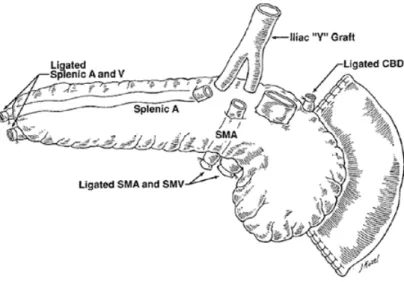
During the back bench, the spleen is removed, the vessels in the root of the mesentery are re- ligated, all peri-pancreatic tissue is carefully removed, the duodenal segment is shortened, the bile duct is ligated, and lastly the vascular reconstruction is completed. It is important not to leave the portal vein of the graft too long, to avoid kinking in the recipient. For the arterial reconstruction, a Y graft of donor iliac artery is utilized, with an anastomosis of the internal iliac of the Y graft to the splenic artery of the pancreas, and anastomosis of the external iliac artery of the Y graft to the proximal superior mesenteric artery (FIG 1 and FIG 2). This is usually done with 6-0 suture under loupe magnification. Once the reconstruction is completed, cold preservation solution (Viaspan)
is flushed through the arterial graft to look for leaks. This step will help to prevent significant
Figure 1. Schematic diagram of reconstruction of pancreas arterial supply, utilizing Y graft of donor iliac vessel.
The spleen has been removed from the pancreas, and the duodenal segment shortened. Reconstruction is done with fine vascular suture and loupe magnification.
S 12 Chris E. Freise
bleeding after reperfusion. The kidney is also prepared, and generally the recipient team will request the left kidney for SPK recipients, since the vein is longer and this makes implantation into the left iliac fossa easier.
Lesson #3 There is no room for error in the recipient operation.
The pancreas in relatively unforgiving when it comes to surgical complications. Clotting of the vascular supply, duodenal anastomotic leak, or graft pancreatitis are all complications that can result in loss of the graft in the early post- transplant period. Therefore, great care must be taken when implanting the pancreas. All of the pancreas transplants done at our center have been implanted into the right iliac fossa, with the duodenum oriented towards the bladder, and venous drainage to the external iliac vein after it had been mobilized to lie lateral to the artery. This is done by taking all of the deep branches of the iliac venous system, from the level of the inguinal ligament to the bifurcation of the vena cava. The common iliac portion of the reconstructed Y graft is anastomosed
caudal to the vein anastomotic site on the external iliac artery. It is important to orient the reconstructed vessel so that there is no kinking of twisting of the splenic artery. Once the organ has been re-perfused, the duodenal segment is anastomosed to the small bowel, usually about 100 cm proximal to the cecum. Early in our experience the duodenal segment was drained into the bladder. Although this would allow for monitoring of urinary amylase to detect rejection; the fluid losses, recurrent infections and urethral irritation make this type of exocrine drainage less desirable, and it is rarely done today. The kidney is then implanted into the left iliac fossa in a standard fashion. Care must be taken to avoid any injury to the newly implanted pancreas by the retractor placement for the kidney transplant. A drain is usually left around the pancreas to drain any amylase which may leak off the surface of the gland.
The postoperative care starts in the intensive care unit for the first 24 hours. Given that the donors are usually optimal, delayed graft function of the kidney is unusual, and urine output is typically brisk. Fluid replacement is important to avoid hypotension and poor
Figure 2. Photograph of prepared pancreas. The portal vein is held with forceps. The Y graft is seen to the right of the portal vein, and the shortened duodenal segment is to the left.
perfusion of the pancreas. Our standard routine in SPK transplants is to have the patient on aspirin lifelong, with the use of dipyridamole in the first 2-3 weeks post-transplant. For all pancreas alone transplants (PAK or PTA), patients also receive heparin infusion, which is started just before implantation of the organ, and typically continues until post-operative day three. Target PTT is usually 40-50 sec.
Monitoring for bleeding is also important, with a need for re-exploration in about 5% of cases.
Melena can also be seen related to bleeding at the bowel anastomosis, but will usually stop once the anticoagulation is held. The Foley catheter is removed on post-operative day 3, and the nasogastric tube is removed when there is evidence of some bowel activity. Once the patient is eating, medications can be converted to the oral route, and discharge can take place as soon as post-operative day 6. Prior to discharge, patients need to demonstrate that they can stay adequately hydrated, and it is important not to over treat any hypertension—otherwise the chance of graft thrombosis increases.
Once discharged, patients are instructed to have their labs checked twice a week, and are seen in clinic week 1, 2, 4, 8, 12, 24 and at yearly intervals thereafter. Eventually, patients need their labs drawn only once a month.
Lesson #4 Prophylaxis against infection is critical.
An important reason for the increased success rate of pancreas transplantation in the last twenty years is the improvement in immunosuppression, with more potent maintenance drugs and better induction therapies. Unfortunately with more intense immunosuppression, infection complications increase. Therefore, strategies to prevent opportunistic infections have also had to improve over the last decade.
All patients receive antibacterial prophylaxis for the surgery itself, usually piperacillin- tazobactam, for five days postoperatively. In addition, fluconazole at 200 mg per day is started for anti-fungal prophylaxis. Duodenal cultures are taken at the time of back bench preparation of the organ, and if cultures are positive for fungus or bacterial organisms, prophylaxis may continue for up to a month. If cultures are negative, the antibacterial prophylaxis is stopped, and fluconazole is converted to once a week dosing to prevent oral thrush. Adjustment of the tacrolimus dosing is necessary as the fluconazole dose is changed.
Other standard prophylaxis consists of lifelong trimethoprim/co-trimoxazole for pneumocystis carinii, oral valganciclovir for six months to prevent cytomegaloviral infections, and more recently ciprofloxacin for one month to decrease the chance of polyoma viral infection
4).
Vigilance for infection is as important as prophylaxis, especially for polyoma virus. Of all the potential infections post-transplant, polyoma is currently the most difficult to treat, and was a leading cause for early kidney loss in SPK recipients
5). We currently monitor urine PCR for polyoma, and if it is elevated serum PCR is performed. If viremia is detected, immunosuppression is first decreased. If this is not effective, leflunomide may be added to the immunosuppression protocol, and if biopsy of the kidney reveals pathologic changes from the virus, cidofovir therapy is initiated. With this approach of monitoring for polyoma and early treatment, the rate of kidney graft loss to polyoma has decreased markedly.
Lesson #5 Potent immunosuppression is necessary, but in low immunologic risk patients, steroid sparing achieves
excellent results.
The advances in the field of pancreas
S 14 Chris E. Freise
transplant have paralleled the improvement in immunosuppression drugs. The earliest patients in our experience received either Minnesota Anti-lymphocyte Globulin (mALG)
or OKT-3, followed by maintenance therapy with cyclosporine, azathioprine and prednisone.
Although results were acceptable, rejection rates in the early post-transplant period approached 80%. With the introduction of tacrolimus and mycophenolate mofetil, as well as the replacement of mALG with thymoglobulin
(rabbit anti- thymocyte preparation), short and long term results improved markedly, with a drop in early rejection rates to less than 20%.
With these improved results, the concept of eliminating steroids as part of the maintenance immunosuppression became popular in the last decade. The theoretic advantage of a steroid free protocol relates to the fact that steroids are toxic to islets, and can worsen lipid profiles and cardiovascular disease progression—
problems which are already significant in these patients who have had years of diabetes. Our program initiated a steroid free maintenance immunosuppression protocol for low immunologic risk patients in the year 2001
6). Candidates for
this protocol were limited to patients undergoing a first transplant, who had low levels of panel reactive antibody (PRA< 20%), and were non African-American. Approximately 75% of patients undergoing SPK were eligible for this protocol. We did learn early on that patients receiving a solitary pancreas, either as part of a PAK or as a PTA, had much higher rejection rates, and currently are not eligible for a steroid free protocol.
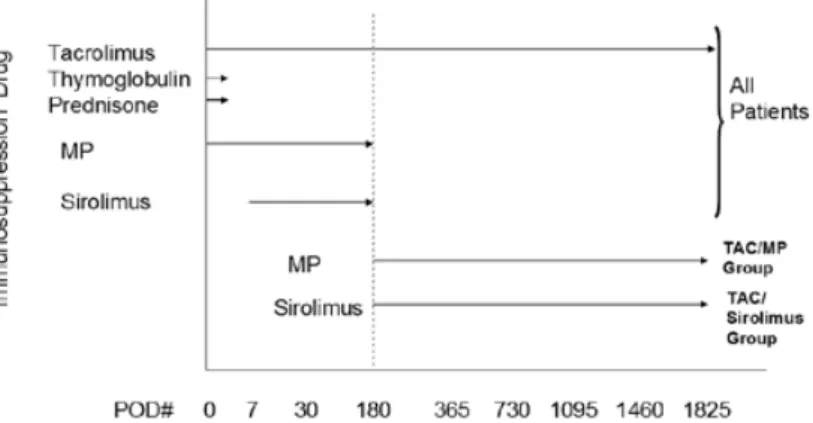
The immunosuppression strategy is shown in FIG 3. Basically thymoglobulin is used for induction, at a target dose of 6 mg/kg, dosed over 3-5 days, with the first dose administered in the operating room at 1.5 mg/kg. Patients receive 500 mg solumedrol at the time of this first thymoglobulin dose, and the solumedrol dose is quickly tapered and then discontinued when the thymoglobulin is completed. Post- operatively, mycophenolate mofetil (Cellcept, Roche pharmaceuticals) is given intravenously at 500 mg twice a day until the thymoglobulin is completed. At that time, the dose is increased to 1000 mg twice a day, and more recently patients have been place on mycophenolic acid (Myfortic, Novartis pharmaceuticals) at a dose of 720 mg
Figure 3. Overview of two different steroid free maintenance immunosuppression protocols that have been used at UCSF.
Two study groups were identified depending on whether they received ongoing Sirolimus/TAC after six months
(N=75) or mycophenolate/TAC (N=25). All patients in this study were maintained on a steroid free protocol after discharge from their index transplant admission, and received thymoglobulin induction. MP=mycophenolate.
twice a day. Tacrolimus is started when there is evidence of a drop in serum creatinine, usually by post-operative day 2, and dose adjusted to reach a trough target level of 10-12 ng/ml. This target level is decreased to 8-10 ng/ml by month 6, and further lowered to 6-8 ng/ml by year one and beyond.
The initial steroid free protocol also added sirolimus into the maintenance medications by three weeks postoperatively, at a dose to achieve a level of 10 ng/ml. With our early experience, patients were typically on tacrolimus, mycophenolate and sirolimus beyond six months post-transplant by design. Unfortunately we saw a number of problems with bone marrow suppression and significant leukopenia, as well as mouth ulcers and a high rate of polyoma viral infections. This observation led to a change in the protocol, whereby mycophenolate was discontinued at month six, and patients remained on dual therapy with tacrolimus and sirolimus.
A report from the Northwestern group indicated
that this strategy may result in worse outcomes for the kidney
7), and we therefore converted to a protocol that discontinued the sirolimus at six months and left patients on dual therapy with tacrolimus and mycophenolate.
We have thoroughly reviewed the graft and patient outcomes, as well as complications, in our steroid free immunosuppression group. For the most part, outcomes are excellent with one year pancreas and kidney survival rates in excess of 90%. When we compared longer term outcomes between patients continued on sirolimus/
tacrolimus to patients on mycophenolate/
tacrolimus, rejection free survival of the kidney and pancreas are similar (FIG 4). However, it is clear that a higher wound complication rate, in the form of hernias, was present in the patients maintained on sirolimus. Therefore, our current protocol uses the long-term tacrolimus/mycophenolate combination with the discontinuation of the sirolimus at six months post-transplant, in low immunologic risk SPK
Figure 4. Kaplan-Meier plots of rejection free survival of the kidney (4a) and pancreas (4b) in patients who received either Sirolimus/Tacrolimus or MMF/tacrolimus. Rejection free survival was similar for both protocols, but patients receiving sirolimus long term had a significantly higher rate of incisional hernias.
Difference between Curves – p-value 0.44 Survival Numbers
Sirolimus – 100%(30d), 100%(180d), 100%(1yr), 96%(2yr), 88%(3yr), 84%(4yr) 80%(5yr)
MM - 100%(30d), 100%(180d), 96%(1yr), 89%(2yr), 89%(3yr), 85%(4yr), 85%(5yr)
Difference between Curves – p-value NS Survival Numbers
MM– 100%(30d), 100%(180d), 100%(1yr), 96%(2yr), 96%(3yr), 93%(4yr), 93%(5yr)
Sirolimus - 100%(30d), 100%(180d), 97%(1yr), 92%(2yr), 91%(3yr), 88%(4yr), 87%(5yr)
Fig 4a Fig 4b
S 16 Chris E. Freise
recipients.
Lesson #6 Patients with a successful pancreas transplant are extremely
grateful.
Restoring normal glycemic control and eliminating the worries about hypoglycemia or hyperglycemia, as well as removing the burden of dialysis is a truly life-changing event for these patients. The other advantages to the patient include a better sense of wellness, less complaints of pain, an increased ability to socialize and potentially return to the workplace. Patients who lose a graft at some point are usually anxious to be considered for re-transplant, once they have experienced normal glycemic control.
The improvements of psychological well-being are well documented. There is more debate on the impact of a successful transplant on the secondary complications of diabetes. With a successful pancreas transplant, certainly the concern about the transplanted kidney being damaged from diabetes is eliminated. In fact, there are data that some of the glomerular changes in the native kidneys can be reversed after several years of normoglycemia in patients who receive a solitary pancreas. There is also evidence that retinopathy is at least stabilized, and may improve after several years of normoglycemia
8-13). Autonomic dysfunction is also stabilized, and there may be some improvement in neuropathy.
The impact on cardiovascular disease is less clear, since many patients already have advanced disease at the time of transplant. In addition, lipid abnormalities related to immunosuppression may negate some of the potential improvement in vascular disease that could come with successful transplant. Certainly careful attention to control of lipids and other metabolic abnormalities
(ie. patient weight, hypertension, fitness) are important in maintaining good overall health of
the patient. We establish a lifelong relationship with patients and their primary physicians in an effort to optimize their complete health, once they have successfully been transplanted.
Lesson #7 Whole organ pancreas transplantation may not be necessary in
the future.
Although currently pancreas transplantation delivers the best form of glycemic control of any other therapy available, it comes with the price of exposing patients to chronic immunosuppression. Additionally, there is a limited organ supply, and not all patients with diabetes can be considered candidates. Therefore, approaches to improve glucose management that can be applied to a greater number of patents have focused on better forms of insulin delivery. These strategies include newer longer acting insulin preparations, insulin pumps that can be adjusted to carbohydrate intake, and better devices for glucose monitoring. To date there has been no direct comparison of these newer methodologies to whole organ pancreas transplant, but one could envision this type of study in the future. Certainly for the patient that has already developed kidney failure and needs a kidney transplant with the accompanying immunosuppression, the addition of a pancreas transplant makes sense.
The other approach to controlling glucose
utilizes beta cell replacement in the form of islet
transplantation. Again only limited numbers of
patients are eligible for this therapy, due to size
constraints and pancreas availability for islet
processing, but the procedure does avoid the
morbidity associated with the surgical procedure
of pancreas transplant. Our program has been
active in developing a successful islet transplant
program, and currently offers the option of islets
to patients who need a pancreas transplant alone
or who have had a previous successful kidney
transplant. With the current outcomes, we still consider whole organ pancreas transplant to be the preferred therapy for patients with Type 1 diabetes and renal failure.
Conclusion.
The field of pancreas transplant has made significant strides since the first report of a successful transplant in the 1960’s. Although the procedure of simultaneous pancreas kidney transplant is a complex operation with a potential for significant morbidity, with proper recipient and donor selection, outstanding outcomes are possible. The wider application of this therapy is unfortunately limited by suitable donor availability. However, with newer immunosuppression strategies, and better prophylaxis and surveillance of immunosuppression related complications, many patients are enjoying long term graft survival of greater than 75% at five years. This has decreased the demand for re-transplant, making more organs available for first time transplants.
The future of whole organ pancreas transplant is unclear, as newer approaches to diabetes management are evaluated and refined. However, at the present moment, simultaneous pancreas kidney transplantation is the best therapy available for patients with Type 1 diabetes and renal failure.
References:
1)Larson TS, Bohorquez H, Rea DJ, et.al. Pancreas- after-kidney transplantation: an increasingly attractive alternative to simultaneous pancreas- kidney transplantation. Transplantation 2004;
77:838-43.
2)Neidlinger NA, Odorico JS, Sollinger HW, Fernandez LA. Can 'extreme' pancreas donors expand the donor pool? Curr Opin Organ Transplant 2008;13(1):67-71.
3)Fridell JA, Powelson JA, Sanders CE, Ciancio G, Burke GW III, Stratta RJ. Preparation of the pancreas allograft for transplantation. Clin Transplant 2011;25:E103–E112.
4)Gabardi S, Waikar SS, Martin S, et.al. Evaluation of fluoroquinolones for the prevention of BK viremia after renal transplantation. Clin J Am Soc Nephrol 2010 (7):1298-304.
5)Lipshutz GS, Mahanty H, Feng S, Hirose R, Stock PG, Freise CE. BKV in simultaneous pancreas- kidney transplant recipients: a leading cause of renal graft loss in first 2 years post-transplant.
Am J Transplant 2005;5(2):366-73.
6)Freise CE, Kang SM, Feng S, Hirose R, Stock P. Excellent short-term results with steroid-free maintenance immunosuppression in low-risk simultaneous pancreas-kidney transplantation.
Arch Surg. 2003 Oct;138(10):1121-5; discussion 1125-6.
7)Kaufman DB, Leventhal JR, Koffron AJ, Gallon LG, Parker MA, Fryer JP, Abecassis MM, et al. A prospective study of rapid corticosteroid elimination in simultaneous pancreas-kidney transplantation: comparison of two maintenance immunosuppression protocols: tacrolimus/
mycophenolate mofetil versus tacrolimus/
sirolimus. Transplantation 2002 Jan 27;73(2):169-77.
8)Ramsey RC, Goetz FC, Sutherland DER, Mauer SM, Robison LL, Cantrill HL, Knobloch WH, Najarian JS: Progression of diabetic retinopathy after pancreas transplantation for insulin- dependant diabetes mellitus. NEJM 1988;318:208-14.
9)Sutherland DER: Effect of pancreas transplants on secondary complications of diabetes:
review of observations at a single institution.
Transplantation Proc 1992;24:859-60.
10)Laftavi MRA, Chapuis F, Vial C, Rahbar M, Lefrancois N, Feitosa LC, Dubernard JM, et al.
Diabetic polyneuropathy outcome after successful pancreas transplantation:1 to 9 year follw up.
Transplantation Proc 1995;27:1406-9.
11)Trojaborg W, Smith T, Jakobsen J, Rasmussen K. Effect of pancreas and kidney transplantation on the neuropathic profile in insulin-dependent diabetics with end-stage nephropathy. Acta Neurologica Scandinavica 1994;90:5-9.
S 18 Chris E. Freise 12)Muller-Felber W, Landgraf R, Scheuer R, Stefan
W, Reimers CD, Nusser J, Abendroth D, et al.
Diabetic neuropathy 3 years after successful pancreas and kidney transplantation. Diabetes 1993;42:1482-6.
13)Navarro X, Kennedy WR, Loewenson RB, Sutherland DER. Influence of pancreas trans- plantation on cardiorespiratory reflexes, nerve conduction, and mortality in diabetes mellitus.
Diabetes 1990;39:802-5.