Control of DF/DHF Vector, Aedes Mosquito, with Insecticides
Takaaki ITOH
Takarazuka Research Center of Sumitomo Chemical Co. Ltd.
4-2-1, Takatsukasa, Takarazuka, Hyogo 665, Japan
Abstract: Aedes aegypti, the principal vector of DF/DHF, mainly breeds in household water jars. The breeding sites are definite and, thus, the larviciding will become the most effective
measures as well as source reduction. However, the following facts make it difficult. 1) Water in the jars is used and refilled. The replenishment of water leads to dilution of larvicides. 2) Many small breeding sites are overlooked, such as water at the bottom of household plant pots.
To solve these problems, two newlarval control methods were examined. The first was the slow release formulation containing the insect growth regulator, pyriproxyfen, which highly inhibited adult emergence of mosquitoes. The formulation kept concentration enough to inhibit adult emergence, even after replacing water in the container. The second was the utilization of blood-fed females as a vehicle of pyriproxyfen to small larval habitats. When the black-color adult resting traps treated with pyriproxyfen were kept inside a house, it was confirmed that the mosquitoes contacted with pyriproxyfen and carried it to small containers with water.
Permethrin-incorporated bednet was introduced as a tool for preventing of further virus dispersion from patients by mosquito bitings. Momentary contact of the females with the netting resulted in high mortality. However, early diagnosis method of patients will be essential. For a self-protection, inhibitory effect of a mosquito coil on host-seeking behav- iour of Aedes aegypti was demonstrated.
Key words : Insecticide, Aedes aegypti, Vector control INTRODUCTION
The space sprays of adulticides during an epidemic period and the applications of larvicides to breeding sites have been employed as measures of vector control with insecti- cides for many years (Gratz, 1993). These could be mainly executed by a municiparity in co-operation with communities. If the coverage area and timing for space spray is correctly determined, effective control of epidemic can be expected. In addition, adminis- trative demonstration effect to the communities might be also expected, because of noisy sound caused by spray machine and rapid reduction in mosquito density. Since the main larval habitats of Aedes aegypti are definite place such as household water jars, the
larviciding is the most effective measure of vector control. However, manysmall and inconspicuos breeding sites such as water at the bottom of household flower pots should be also covered with larvicides. Use of mosquito coils and mats is very familliar to Asian peopole for a self protection, but improvement of economical conditions in community is essential to make use possible.
In this paper, a slow release formulation containing an insect growth regulator (IGR) and an utilization of adults of Aedes aegypti as a vehicle of IGR were presented as a new approach to vector control. An insecticide-incorporated bednet for patients and inhibi- tory effect of a mosquito coil on host-seeking behaviour of the females were also present-
ed.
Slow release formulation containing IGR, pyriproxyfen, for control of larvae
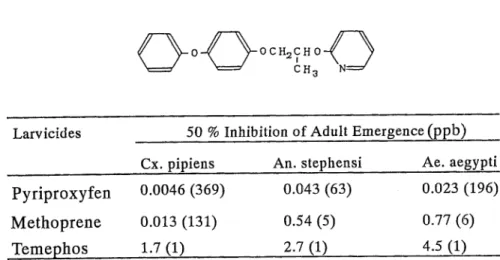
The chemical structure of pyriproxyfen, which is a juvenile hormone mimic and inhibits adult emergence of mosquitoes, is shown in Fig. 1 with the inhibitory activity of adult emergence against mature larvae of Anopheles, Gulex and Aedes mosquitoes (Hatako- shi et alt 1987). The IC50 value, which is the concentration to be required for 50%
inhibition of the emergence, of pyriproxyfen is 0.023 ppb against Aedes aegypti, while that of temephos, which is an organophosphorus insecticide, is 4.5 ppb. Thus, it is evident that pyriproxyfen has about 200 times higher activity than temephos.
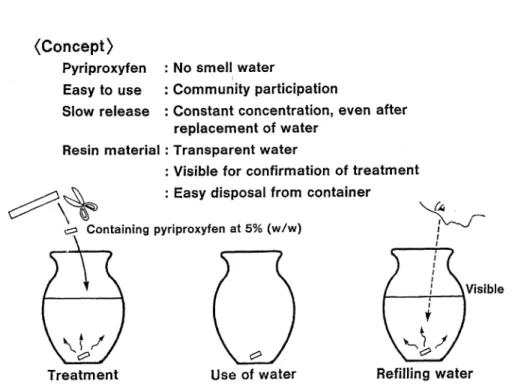
Fig. 2 shows the concept of the slow release formulation containing pyriproxyfen.
The formulation was made of a synthetic polymer incorporated with pyriproxyfen at 5%
by a new technology. Even though all of water in a jar is replaced after the treatment, the active ingredient is continuously released from the formulation and its concentration in the
Pyriproxyfen ( Insect growth regulator )
)_/ \_OCH2CHO-/ ?
\=/ V\=/*3
Larvicides 50 % Inhibition of Adult Emergence (ppb)
Cx. pipiens An. stephensi Ae. aegypti
Pyriproxyfen 0.0046 (369) 0.043 (63) 0.023 (196)
Methoprene 0.013 (131) 0.54 (5) 0.77 (6)
Temephos 1.7 (1) 2.7 (1) 4.5 (1)
Fig. 1. The chemical structure of the new insect growth regulator, pyriproxyfen, and the inhibi- tory activity of adult emergence of mosquitoes
refilled water will reach to effective level to inhibit adult emergence. Additional advan- tages are as follows ; 1) Since the active ingredient has no odor, the treated water do not smell odor, 2) The shape of the formulation is slender strip type to be cut with a scissor for use and this easiness of use will make community participation possible, 3) Since materials except for the active ingredient is not dissolved in water, the treated water will keep transparent, 4) Momentary recognition of the formulation in a jar will make confirmation of treatment easy.
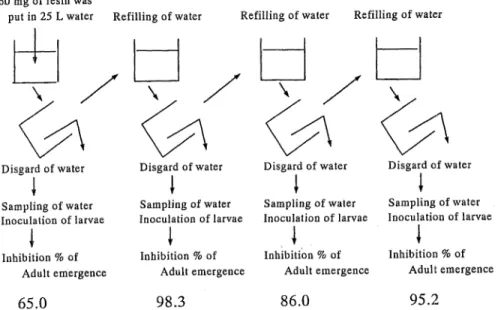
The laboratory experiment under the simulated condition assuming replenishment of water in a jar was conducted (Fig. 3). Sixty mg of the formulation was cut with a scissor and put into water of 25 litres in a container. When all amount of the active ingredient was.dissolved at once in the water, its concentration could be calculated to be 0.2 ppm.
The water of small volume was sampled from the container to be inoculated with last instar larvae of Aedes aegypti after 7 days. The remaining water was discarded, followed by refilling fresh water of 25 litres. The same procedure was repeated at 7 days interval.
As shown in Fig. 3, the adult emergence from the larvae inoculated in the sampled water was highly inhibited at every sampling times. It was evident that pyriproxyfen was continuouly released from the formulation into the refilled water. Practical assessment of the formulation against Aedes aegypti is under field trial at Bangkok.
(Concept)
Pyri proxy fen Easy to use Slow release
No smell water
Community participation
Constant concentration, even after replacement of water
Resin material : Transparent water
: Visible for confirmation of treatment : Easy disposal from container
c^ Containing pyriproxyfen at 5% (w/w)
<f^^f
vAAt/, .Vl/V
Visible
Treatment Use of water Refilling water
Fig. 2. The concept of the slow release formulation (streched micro porous resin molding)
60 mg of resin was
putin25Lwater Refillingofwater
U -
Disgard of water Sampling of water Inoculation of larvae Inhibition % of
Adult emergence 65.0
Refilling of water Refilling of water
x>x>x>
> <^\ <^ <^
Disgard of water I Sampling of water Inoculation of larvae
I Inhibition % of
Adult emergence 98.3
Disgard of water I
Sampling of water Inoculation of larvae
1 Inhibition % of
Adult emergence 86.0
Disgard of water I Sampling of water Inoculation of larvae
I Inhibition % of
Adult emergence 95.2
Fig. 3. Inhibitory activity of adult emergence of the new formulation containing pyriproxyfen against Aedes aegypti under the simulated condition assuming replenishment of water in ajar
Utilization of adults of Aedes aegypti as a vehicle of pyriproxyfen
The main resting place of Aedes aegypti is well known as dark place inside houses.
When a black color resting trap treated with pyriproxyfen is placed in a house, the adults will rest and contact with pyriproxyfen on the trap. Among them, blood-fed females are
expected to transfer the chemical from the body surface to small larval habitats, when they lay eggs there (Fig. 4).
In a laboratory, we could observe that the adult emergence from the larvae kept in a container with water in a cage was highly inhibited, when a blood-fed female, which had contacted with pyriproxyfen at 1 g/m2 for 30 min, was liberated into the cage. It was
obvious that pyriproxyfen was transfered from body surface of the female to the water, when the female laid eggs (Itoh et al., 1993). Then, transmissibility of pyriproxyfen was
assessed in a field at Bangkok. Black nylon netting was treated with pyriproxyfen at 1.5 g/m2 and hold inside a black color bamboo basket. These adult resting traps and ovipositional cups with water for confirmation of the transmissibility were arranged in a house (Fig. 5). Brown color paper with rough surface was lined inside the cups for ovipositional place. The cups were kept in the house for 4 days and brought back to the laboratory of Mahidol University near the experimental site to be inoculated with the last instar larvae of Aedes aegypti. Table 1 shows the number of eggs laid and inhibition % of adult emergence from larvae in each cup. The adult emergence from some cups was highly inhibited. For instance, the number of eggs laid was 52 and the inhibition % of adult emergence was 72 in the cup No. 8 on 2nd 4 day. Even though no evidence of
Blood-fed Adult mosquito
Oviposition
Resting
I^A^I ^
v#p£i«i°n
^!S^iti0n
Water at the bottom of flower pot , (Larvae existing) /
Empty can with water
(Larvae existing) Black color resting-trap treated with pyriproxyfen
Fig. 4. Utilization of adults of Aedes aegypti as a vehicle of pyriproxyfen for small and inconspic- uous larval habitats
N A
D
itc h
Water container
Entrance
C onfectionary factory
Water containgr^^
Bath room Entrance
Shelf Tnilet
\ Refrigerator
n
_Shelf Neighboring hofoseofos
Pa: sage
Wooden bench
Step to 2F
, A
©
Wardrobe ©
Cupboard
<D
I 6m
2 0m
10m
Fig. 5. Diagram of the experimental house in Bangkok (Black triangle : Resting trap, White circle : Oviposition cup)
Table 1. Inhibition of adult emergence from larvae inoculated into cup-water which was kept inside the house for 4 days
Cup No.
Observationitems 1 2 3 4 5 6 7 8 9 10
1st 4 days
No,ofeggslaid 42 0 0 31 23 0 41 0 0 0
Inhibition% 62 0 14 0 0 0 57 6 0 0
2nd 4 days
No.ofeggslaid 0 0 0 79 18 32 ll 52 4 7
Inhibition% 16100 44 2 0 0 2 72 37 0
3rd 4 days
No.ofeggslaid 23 0 36 21 12 63 9 0 0 0
Inhibition% 5 5 ll 0 0 5 5 30 5 5
4th 4 days
No.ofeggslaid 0 0 0 15 29 39 1 0 0 0
Inhibition% 84 92 7 0 36 3 19 76 84 3
oviposition was observed, the adult emergence was also highly inhibited. For instance, the number of egg was 0 and the inhibition % was 100 in the cup No. 2 on 2nd 4 day. The latter result suggests possibility that any adults played as the vehicle of the chemical to the ovipositional cups. In fact, dead males could be observed in some cups. Further large field trial of pyriproxyfen-treated resting trap become interested.
Permethrin-incorporated bednet for patients
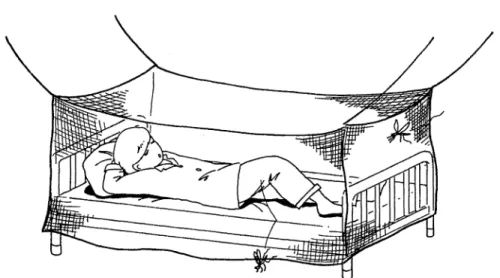
The concept of a new approach with the bednet is prevention of further virus dispersion from patients by mosquito bitings (Fig. 6). However, establishment of an early diagnosis of patients is essential for this approach. The netting was made of a synthetic polymer incorporated with permethrin at 2%. The mesh size of the netting was wide to provide good air-ventilation, and was adopted from the following reason. When the size was less than width of wing expance of flying mosquitoes, the mosquitoes rested on the netting before passing through, thus allowing them time to pick up a lethal amount of permethrin (Itoh et al. 1986).
Fig. 7 shows short contact test results. Females of Aedes aegypti was confined on the netting for 3 and 7 min, and transfered in a cup with cotton soaked with sugar solution for observation of mortality after 24 hrs. Mortality was 100% in both exposure times of 3 and 7 min. If an early diagnosis become possible, this bednet will be a promissing tool for prevention of virus dispersion.
Concept : Prenvention of virus dispersion from patients : Ready use
: Good air-ventilation
tfl
(I a
Fig. 6. Permethrin-incorporated bednet for patients
i -
(1.5cm t
3 .6cm
LOcm
I _*__
/
I >
Netting
Feamles were confined for 3 or 7 min.
Experimental results
Exposure time Mortality % after 24 hr.
3 min 100
7 min 100
Fig. 7. Efficacy of permethrin-incorporated netting against females of Aedes aegypti
Effect of mosquito coil on host-seeking behaviour of mosquitoes.
A mosquito coil is an effective measure for self-protection from mosquito bitings.
Mosquito behaviour on biting cycle is shown in Fig. 8 (Chadwick, 1975). Biting behaviour starts from host-seeking, followed by landing, palpation, probing and sucking-blood.
When a mosquito coil disturbes host-seeking, mosquitoes can not bite.
A mosquito coil was ignited in 28 m3 chamber, of which air was ventilated 5 times per hour. A volunteer sat down in the chamber and one female of Aedes aegypti was released into the chamber. The length of time until the female landed on the volunteer was recorded for 3 min. When the blank coil without active ingredient was ignited, the female could land on the volunteer after 1.2 min (Fig. 9 : Teshima, 1992). When BPMC, which is a carbamate insecticide, coil was ignited, the female could land after 1.5 min.
However, ^-allethrin, which is a pyrethroid insecticide, coil at 0.2% was ignited, no female could arrive at the host within 3 min. Thus, rf-allethrin as an active ingredient of coil formulation is desireble in comparison with BPMC. Improvement of economical condi-
Resting
Sucking-blood
Mosquito behaviour Host-seeking
Ovipositionl
Proving
Smoke of coil
Fig. 8. Biting behaviour of mosquitoes
L anding
Palpation
Active ingedient Cone. Landingi Time required to land on man llCTSO
on man I 1 2 . I (min)
55 39 17
>60
>60
>60
d-aJIethrin 0.1 61
0.2 0
0.3 0
No mosquito land No mosquito land
1.4
BPMC 1.5 89
Blank coil Untreated
90 100
1.2 J0.9
1.5
Fig. 9. Inhibitory effect of mosquito coil on host-seeking behaviour of Aedes aegypti (KT50 means time to be required for 50% knocked-down of mosquito)
tions in community will be necessary for wide spread use of mosquito coil.
Conclusion
Vector control strategy with insecticides should be concentrated to both the space spray of adulticides and larvicidings to the main breeding sites. These should be executed by municiparity. The new formulation of pyriproxyfen make community participation possible, due to easiness of treatment. Pyriproxyfen-treated resting trap and permethrin
-incorporated bednets can be performed as supplementary measures in co-operation with community. As a self-protection, use of a mosquito coil will become more important with improvement of economical conditions in the community.
ACKNOWLEDGEMEN T
The author wishes to thank Prof. A. Igarashi, Institute of Tropical Medicine of Nagasaki University, for his giving the oppotunity for the presentation at The Interna- tional Symposium on Current Situation of Dengue Virus Infection and Its Control. The author is also grateful to Drs. S. Sucharit, Y. Rongsriyam and all of stuffs of Mahidol University at Bangkok for their co-operations in field evaluation on utilization of Aedes
aegypti as a vehicle of pyriproxyfen to larval habitats.
Part of this study was supported by Grant-in Aid for the International Scientific Research Program, the Ministry of Education, Science and Culture, Japan (Research Grant
No. 0404182).
REFERENCE
1 ) Chadwick, P. R. (1975) : The activity of some pyrethroids, DDT and lindane in smoke from coils for biting inhibition, knock down and kill of mosquito (Diptera, Culicidae). Bull. ent. Res., 65, 97-107 2 ) Gratz, N. G. (1993) : Lessons of Aedes aegypti control in Thailand. Med. & Vet. Entomol., 7, 1-10 3 ) Hatakoshi, M., Kawada, H., Nishida, S., Kishida, H., & Nakayama, I. (1987) : Laboratory evaluation
of 2-[l-methyl-2~(4-phenoxyphenoxy)-ethoxy] pyridine against larvae of mosquitoes and housefly.
Jpn. J. Sant. Zool., 38, 271-274
4 ) Itoh, T.} Shinjo, G. & Kurihara, T. (1986) : Studies on wide mesh netting impregnated with insecticides against Culex mosquitoes. J. Am. Mosq. Control Assoc., 2, 503-506
5 ) Itoh, T., Kawada, H., Abe, A., Eshita, Y., Rongsriyam, Y. & Igarashi, A. (1993) : Utilization of blood -fed females of Aedes aegypti as a vehicle of the insect growth regulator, pyriproxyfen, to larval habitats. Submitted to J. Am. Mosq. Control Assoc.
6 ) Teshima, H. (1992) : Effects of mosquito colis on feeding behavior of mosquitoes. The 3rd Convention of International Mosquito Spiral Manufactures Association at held at Shanghai on October.