The Study for the Tax System of Cross‑border Corporate Reorganizations : Focusing on the EU Merger Tax Directive for Considering the
Future Direction in Japan
著者 Nakamura Shigetaka
journal or
publication title
Journal of accountancy, economics and law
volume 14
page range 13‑29
year 2020‑03
URL http://hdl.handle.net/10112/00019925
The Study for the Tax System of Cross-border Corporate Reorganizations
- Focusing on the EU Merger Tax Directive for Considering the Future Direction in Japan -
Shigetaka Nakamura
JOURNAL of ACCOUNTANCY, ECONOMICS and LAW, No.14, March 2020 School of Accountancy, Graduate School of Kansai University, OSAKA, JAPAN
The Study for the Tax System of Cross-border Corporate Reorganizations
Abstract:
- Focusing on the EU Merger Tax Directive for Considering the Future Direction in Japan -
Shigetaka Nakamura*
This article concludes that the legal framework of the EU Merger Tax Directive (here- inafter; MTD) can be an option other than the legal framework of cross-border corporate reorganizations in U.S. tax law as the future direction for the tax system of cross-border corporate reorganizations in Japan (hereinafter; TSCCR).
From this study, it followed that the TSCCR in Japan had five issues: (I) Lack of the criterion for applying the TSCCR in Japan; (2) Inadequacy of the definition of qualified corporate reorganizations covered; (3) Inadequacy of the definition of persons covered; (4) Inadequacy of tax deferral requirements; (5) Lack of the anti-tax abuse provision. Based on each implication, this article recommends some amendments to the TSCCR in Japan.
It's also worth noting that this article will be expected to bring not only the trigger of arguments for the TSCCR in Japan as academic significance, but also the prospective increase of inbound investment in Japan through cross-border corporate reorganizations as social significance.
Keywords:
cross-border corporate reorganizations, EU, merger tax directive, tax neutrality, anti-tax abuse provision
I. Introduction
The application of international aspects for the tax system of cross-border corporate reorganizations (hereinafter; TSCCR) in Japan is currently limited, because the general view of the Japanese Companies Act states that direct reorganizations between domestic corporations and foreign corporations is not possible1). The application, however, has been gradually expanded within the limit for the Japanese Companies Act, such as international triangular mergers.
It is said that the tax system for corporate reorganizations in Japan is getting closer to
* Professor of Tax Law at Kansai University school of Accountancy [mailto: [email protected]]
Journal of Accountancy, Economics and Law, No. 14 (March 2020)
it in U.S. tax law2). However, there is big differences between Japanese tax law and U.S.
tax law in the TSCCR for the reason of the above-mentioned restriction3). Rather, I think that the legal framework of the EU Merger Tax Directive (hereinafter; MTD4)) is more useful for the TSCCR in Japan5).
This article examines whether the legal framework of the MTD can be an option other than the legal framework of U.S. tax law as the future direction of the TSCCR in Japan, assuming that the TSCCR in Japan will be more internationally expanded in the future. It's also worth noting that this article will be expected to bring not only the trigger of argu- ments for the TSCCR in Japan as academic significance, but also the prospective increase of inbound investment in Japan through cross-border corporate reorganizations as social significance.
The method of this article is based on an approach of comparative law. This article proceeds as follows. Part II of this article explains the legislative history and legal frame- work of the TSCCR in Japan. Part m analyzes not only the MTD, but also its amendment, cases of the European Court of Justice(hereinafter; ECJ) and so on as research materials.
Part N shows results for this article and discussion for such results. Part V provides concluding remarks.
II. Taxation of Cross-Border Corporate Reorganizations in Japan
1. Legislative History
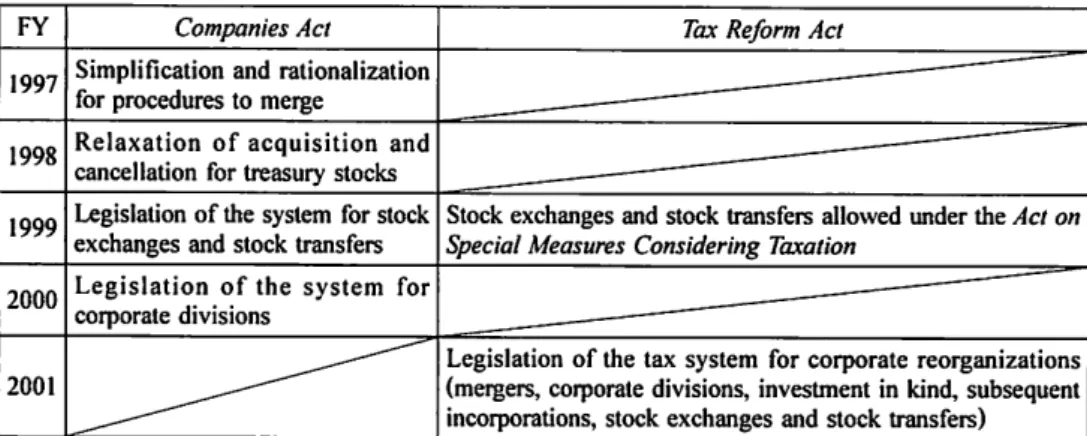
The tax system for corporate reorganizations in Japan was legislated by the FY 2001 Tax Reform Act. There was movement of the Japanese Companies Act behind the legisla- tion6). Table 17) shows the background of the legislation, contrasting the Tax Reform Act with the Japanese Companies Act. On the base of improvement for infrastructure of corpo- rate reorganizations in the Japanese Companies Act, the tax system for corporate reorgani-
Table 1 Legislative History until the FY 2001
FY Companies Act
1997 Simplification and rationalization for procedures to merge
1998 Relaxation of acquisition and cancellation for treasury stocks
Tax Reform Act
1999 Legislation of the system for stock Stock exchanges and stock transfers allowed under the Act on exchanges and stock transfers Special Measures Considering Taxation
2000 Legislation of the system for corporate divisions
2001
Legislation of the tax system for corporate reorganizations (mergers, corporate divisions, investment in kind, subsequent incorporations, stock exchanges and stock transfers)
The Study for the Tax System of Cross-border Corporate Reorganizations
zations in Japan was legislated in the response to structural changes in the Japanese economy8>.
As mentioned above, the general view of the Japanese Companies Act states that direct reorganizations between domestic corporations and foreign corporations is not possible.
However, the application of tax law has been gradually expanded within the limit of the Japanese Companies Act.
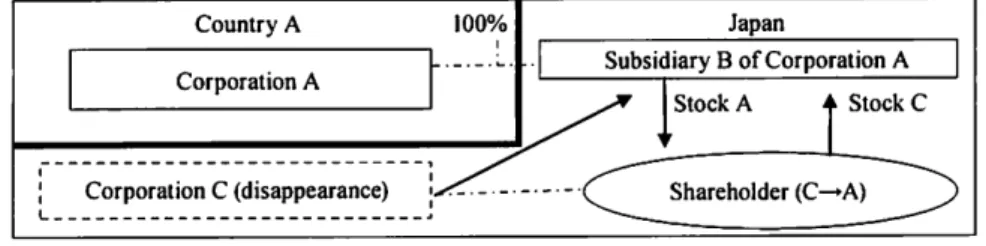
The FY 2007 Tax Reform Act added so-called international triangular mergers as qualified corporate reorganizations [Article 2(xii}-8 of the Corporation Tax Act [Hojin Zei Ho(CTA)] before the FY 2019 Tax Reform Act], for enjoying tax benefits under the TSCCR in Japan (for example, deferral of tax liability at the time of cross-border corporate reorga- nizations to the later moment of realization, by way of a carry-over of the tax value of the assets and liabilities transferred, and the stocks exchanged). Figure I shows that the Japa- nese subsidiary B of the corporation A merges with the Japanese corporation C in exchange of the Stock A for the Stock C of shareholder.
Country A JOO% Japan
I . ~. -. -. ~. . Subsidiary B of Corporation A
. Corporation A I
Figure 1 International Triangular Merger
The FY 2017 Tax Reform Act added so-called spin-off transactions as qualified corpo- rate reorganizations [Article 2(xii)-11 and 2(xii)-15(iii) of the CTA]. Spin-off transactions are composed of the spin-off transaction of the partial business and the spin-off transaction of the subsidiary. The former transaction was added to Article 2(xii)- I I of the CTA for qualified corporate divisions. The latter transaction was legislated to Article 2(xii}- I 5(iii) of the CTA as qualified stock distributions. Figure 2 shows that the corporation X distributes the stock of the subsidiary B to shareholders of the corporation X as stock distributions.
Non-resident shareholders may be taxed for capital gains from the stock X if such share- holders get the stock B distributed in accordance with amount of the owed number
Country A
Shareholder
Distribution of the Stock B
Corporation X
Japan
Shareholder
Figure 2 Distribution of the Subsidiary Stock
Journal of Accountancy, Economics and Law, No.14 (March 2020)
[Article 37-14-3 of the Act on Special Measures Considering Taxation].
Moreover, the FY 2019 Tax Reform Act relaxed requirements for considerations of triangular mergers. Until the FY 2019 Tax Reform Act, 100% directly owned parent corpo- ration stocks were only allowed as the considerations for qualified corporate reorganiza- tions. However, by the FY 2019 Tax Reform Act, 100% indirectly owned parent corporation stocks were also allowed as the consideration for qualified corporate reorganizations.
As mentioned above, the application of tax law has been gradually expanded within the limit of the Japanese Companies Act. It's also worth noting that international triangular mergers are rarely used in Japan. In 2008, international triangular stock exchange was only carried out by Citigroup to Nikko Cordial Group.
2. Legal Framework (A) Basic Theory
The basic theory of the tax system for corporate reorganizations in Japan is so-called 'substance principle'. We can see it in the Tax Commission Paper in October 3, 20009>.
This paper states for tax deferral in the corporate level as follows: When there is nothing really changing in substance before and after the transfer of assets by corporate reorgani- zations, it is appropriate to continue the same tax situation as before. Accordingly, if there is a continuity of control to the transferred assets after corporate reorganizations, corpora- tions could defer the gain or loss of the transferred assets.
This paper also states for tax deferral in the shareholder level as follows: When share- holders keep continuing their investment, on the base of the reasons mentioned above, the gain or loss could be deferred.
According to the Tax Commission, two continuities, namely "continuity of control to the transferred assets" in the corporate level and "continuity of investment" in the share- holder level, are the reasons for tax deferral treatment10>. These seem to be based on neutrality of taxation11>.
The above-mentioned theory also applies to the TSCCR in Japan.
(B) Persons Covered and Corporate Reorganizations Covered
Firstly, the scope of persons covered is limited to 'corporation' for enjoying tax benefits under the TSCCR in Japan. Since, however, there is no definition of 'corporation' in the CTA and the Income Tax Act (Shotoku Zei Ho) in Japan, there are a lot of arguments about the concept of 'corporation'. Although the supreme court of Japan on July 17,
201512> held a two-step approach for suitability of a limited partnership under Delaware
law to 'corporation' for tax purposes, it is not clear whether this decision of the supreme court extends to the TSCCR in Japan or not13>.
Secondary, the scope of corporate reorganizations covered is each corporate reorgani- zation in qualified corporate reorganizations listed up in Article 2 of the CTA. Concretely speaking, it covers mergers, corporate divisions, investment in kind, stock exchanges and
The Study for the Tax System of Cross-border Corporate Reorganizations
stock transfers, distribution in kind, spin-off. It's worth noting that the scope of qualified corporate reorganizations covered is not separated from the Japanese Companies Act and narrower than the scope of it14).
It's also worth noting that the current TSCCR in Japan has no criterion for applying the TSCCR in Japan. This is probably because direct reorganizations between domestic corporations and foreign corporations is not possible in the current TSCCR in Japan due to the above-mentioned restrictions on the Japanese Companies Act. That means that the current TSCCR in Japan is only applied to cross-border transfers in the shareholder level.
Therefore, I think that the current TSCCR in Japan need not to have criterion for applying the TSCCR in Japan.
(C) Tax Deferral Treatment
In the current TSCCR in Japan, unqualified corporate reorganizations are general for tax treatment and qualified corporate reorganizations are exceptional. Namely, the current TSCCR taxes transfers of assets both in the corporate level and in the shareholder level due to corporate reorganizations as transfers at the fair market value of such assets, if such reorganizations are unqualified corporate reorganizations. On the other hand, if such reor- ganizations are qualified corporate reorganizations, the current TSCCR in Japan taxes transfers of assets both in the corporate level and in the shareholder level as transfers at the book value of such assets (as a result, tax deferral treatment). I would like to explain tax deferral treatment in the current TSCCR in Japan by using Table l in detail.
Firstly, transactions in Table l must meet either requirements for group reorganiza- tions 15), or requirements for joint businesses16) for falling within qualified corporate reor- ganizations. If transactions fall within qualified corporate reorganizations, Corporation C is treated as transfers of its assets at the book value of assets by Article 62-2( 1) of the CTA.
Shareholder C is treated as the transfer of its stock at the book value of the stock A by Article 61-2(2) of the CTA (if Shareholder C is a corporate shareholder). Accordingly, income both in the corporate level and in the shareholder level is not recognized for tax purposes (namely, tax deferral treatment).
Secondary, it is necessary to meet additional requirements if shareholders are non- resident shareholders in Japan. The non-resident Shareholder C can take tax deferral treat- ment only if the Stock A falls under requirements of the foreign stock managed in its permanent establish in Japan (if Shareholder C is a corporate shareholder17)).
(D) General Anti-Tax Avoidance Provision
The current tax system for corporate reorganizations in Japan has two types of anti- tax avoidance provisions. The former provisions are set in each provision [for example, Article 57(2) of the CTA limits the utilization of carry-over losses]. The latter provision is set in Article 132-2 of the CTA. Article 132-2 of the CTA is a general anti-tax avoidance provision. One of planners of the tax system for corporate reorganizations in Japan
Journal of Accountancy, Economics and Law, No.14 (March 2020)
explained that two types of anti-tax avoidance provisions work together, for stabilizing application of the former provisions and combatting abuse or avoidance of the former provisions by the latter provision18>.
The supreme court of Japan on February 29, 2016 (Hereinafter; Yahoo case19>) held standards for 'improper decrease of the burden of corporation taxes' in Article 132-2 of the CTA in the first. As the criterion for judgment of 'improperness', it held whether multiple articles are abused unreasonably for getting specific tax consequences or not. Since, however, Yahoo case is not a case for cross-border corporate reorganizations, it remains unclear how Article 132-2 of the CTA is applied to the cross-border corporate reorganiza- tions.
It's also worth noting that Article 132-2 of the CTA is not an anti-tax 'abuse' provision but an anti-tax 'avoidance' provision. Professor Iwasaki has already pointed out that it was difficult to deny international transactions as tax avoidance transactions and to tax them on the way of denial of tax avoidance transactions20>.
Therefore, I conclude that it would be difficult to deny cross-border corporate reorga- nizations as tax avoidance transactions based on the current Article 132-2 of the CTA, assuming the TSCCR in Japan will be more internationally expanded in the future21>.
3. Point at Issue of Japanese law
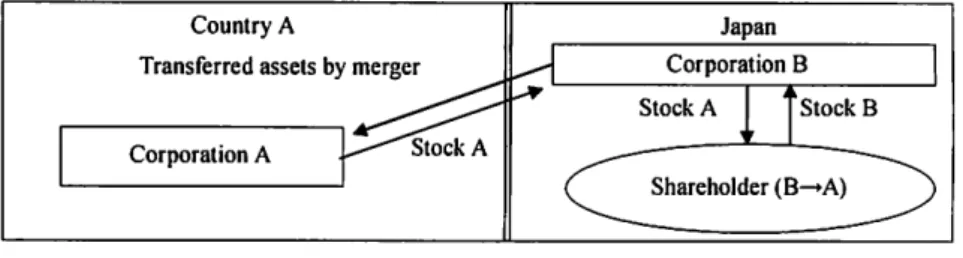
As mentioned above, direct reorganizations between domestic corporations and foreign corporations is not possible (See Figure 3). Namely, transfers of assets in the corporate level are out of the scope of the current TSCCR in Japan.
Country A
Transferred assets by merger
Corporation A
Figure 3 Cross-border Merger
Accordingly, this article needs to assume that the CCRTS in Japan will be more inter- nationally expanded in the future. Under the assumption, this article examines whether the legal framework of the MTD can be an option other than the legal framework of U.S. tax law as the future direction of the TSCCR in Japan.
In my opinion, the effectiveness of the MTD for the TSCCR in Japan is mainly based on two points as follows: (I) The reason or purpose of the MTD is similar to the TSCCR in Japan. The reason or purpose means neutrality of taxation and safeguard of tax rights in cross-border corporate reorganizations; (2) Arguments for the MTD was precedent to the legislation of corporate law. A proposal for the MTD had already been launched in 1969.
The Study for the Tax System of Cross-border Corporate Reorganizations
Then the Statute for a European company22J wasn't adopted. This article also examines above-mentioned issues precedent to arguments of the Japanese Companies Act.
Therefore, there would be no problem to examine above-mentioned issues precedent to arguments of the Japanese Companies Act as a kind of thought triaJ23).
4. Preceding Studies and their Limits
Firstly, regarding positioning of this article with the respect to the whole research in Japan, Ryoichi Ikeda has picked up on the MTD in his book24). Though this book is a preceding study for this article, it is different on the way of treatment of the MTD. The former mainly introduces the system of the MTD as one of the common system of taxa- tion in EU. On the other hand, the latter (namely, this article) solely utilizes the MTD as a research material.
Secondary, regarding positioning of this article with the respect to the whole research except for Japan, a preceding study is a book25> described by Frederik Boulogne. This book shows problems and revised proposals for the current MTD. Naturally, however, it describes nothing about the TSCCR in Japan. Therefore, this article examines above- mentioned issues in the light of this survey by Frederik Boulogne to the TSCCR in Japan.
Therefore, this article could be positioned to Japanese version arranging this survey by Frederik Boulogne.
III. Taxation of Cross-Border Corporate Reorganizations in EU
1. Legislative History in the Merger Tax Directive
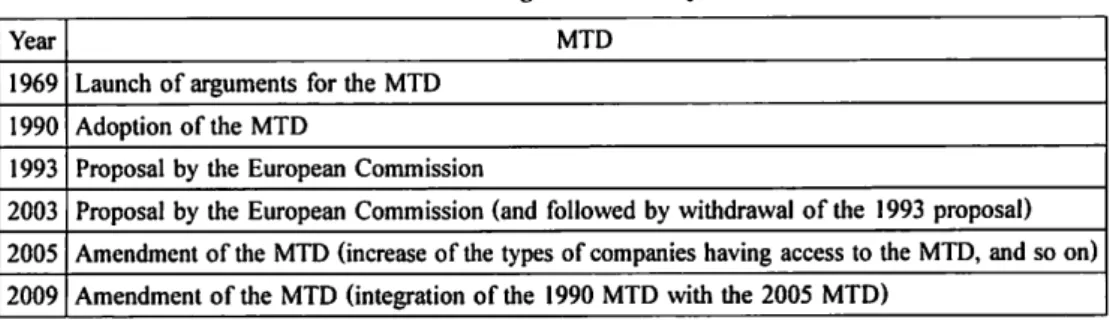
The MTD was adopted on 23 July 1990, although a proposal for the MID had already been launched in 1969. However, soon after its adoption in 1990, the European Commis- sion saw the need to improve the MTD and in 1993 it submitted a proposal for its amend- ment26l. Though it took a lot of time, the MTD was amended on 4 May 200527>. The current MTD is amended in 2009 for the integration of the 1990 MTD with the 2005 MTD. Table 2 shows the legislative history of the MTD briefly.
Table 2 Legislative History
Year MTD
1969 Launch of arguments for the MTD 1990 Adoption of the MTD
1993 Proposal by the European Commission
2003 Proposal by the European Commission (and followed by withdrawal of the 1993 proposal) 2005 Amendment of the MTD (increase of the types of companies having access to the MID, and so on) 2009 Amendment of the MID (integration of the 1990 MTD with the 2005 MTD)
Journal of Accountancy, Economics and Law, No.14 (March 2020)
2. Legal Framework (A) Basic Theory
Basic theory of the MTD is shown at the recitals in the preamble to the MTD. The third and fourth recitals in the preamble to the MTD state the removal of tax obstacles to cross-border restructuring operations as the objective of the MTD. The fifth recital in the preamble to the MTD also states safeguarding the financial interests of the Member States as the objective of the MID.
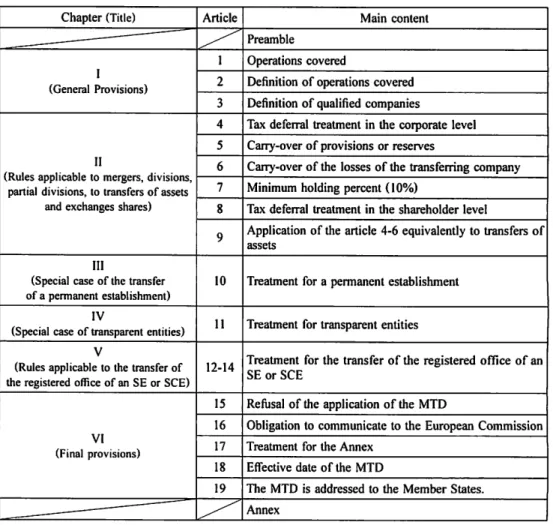
Table 3 shows the structure of the current MTD briefly.
Table 3 Structure of the MTD
Chapter (Title) Article Main content
--- ~ 1 Preamble Operations covered
I 2 Definition of operations covered
(General Provisions)
3 Definition of qualified companies
4 Tax deferral treatment in the corporate level
s Carry-over of provisions or reserves
II 6 Carry-over of the losses of the transferring company (Rules applicable to mergers, divisions,
7 Minimum holding percent ( I 0%) partial divisions, to transfers of assets
and exchanges shares) 8 Tax deferral treatment in the shareholder level
9 Application of the article 4-6 equivalently to transfers of assets
III
(Special case of the transfer IO Treatment for a permanent establishment of a pennanent establishment)
IV 11 Treatment for transparent entities (Special case of transparent entities)
V Treatment for the transfer of the registered office of an (Rules applicable to the transfer of 12-14
the registered office of an SE or SCE) SE or SCE
15 Refusal of the application of the MTD
16 Obligation to communicate to the European Commission
VI 17
Treatment for the Annex (Final provisions)
18 Effective date of the MTD
19 The MTD is addressed to the Member States.
- I ~ Annex
(B) Persons Covered and Corporate Reorganizations Covered
Firstly, the scope of persons covered is composed of four requirements28). The first
The Study for the Tax System of Cross-border Corporate Reorganizations
requirement is set in Article 1 (a) of the MTD. This requires that 'companies from a Member States' involve corporate reorganizations such as merger as participating parties.
Accordingly, this 'involving requirement' is the criterion for applying the MTD29). This also means the criterion is judged in the corporate level, not in the shareholder leveP0>.
The residual requirements are related to the definition of 'companies from a Member States', which Article 3 of the MTD defines. The second requirement is called 'listed form requirement'31), which Article 3(a) of the MTD defines. The third requirement is called 'residence requirement'32), which Article 3(b) of the MTD defines. The fourth requirement is called 'subject-to-tax requirement'33 ), which Article 3(c) of the MTD defines.
Secondary, the scope of corporate reorganizations covered is set in Article 2 of the MTD. Table 4 shows comparison the MTD with the current TSCCR in Japan for the scope of corporate reorganizations covered34>.
Table 4 Comparison TSCCR in Japan with the MTD
TSCCR in Japan Mergers
Corporate Divisions Spin-off (of the partial business)
Investment in kind Stock exchanges and stock transfers
Distribution in kind·Spin- off ( of the subsidiary)
MTD Mergers [Article 2(a)]
Divisions [Article 2(b)]
Partial Divisions [Article 2(c)]
Transfers Assets [Article 2(d)]
Reference
Mergers of the TSCCR in Japan include squeeze-out transactions.
The MTD has no rule on the spin-off of the partial businesses. Though partial Divisions include split-off, spin-off of the TSCCR in Japan has no rule on it.
Stock exchanges of the TSCCR in Japan Exchanges of Shares [Article 2(e)] includes squeeze-out transactions. The
MTD has no rule on stock transfers.
Transfer of the registered office of an SE or SCE [Article 2(k)]
(C) Tax Deferral Treatment
Firstly, the MID imposes two conditions to enjoy tax deferral in the corporation leveP5>.
The first condition is set in Article 4(2)(b) of the MTD. It curtails the benefit conferred by Article 4(1) of the MTD by defining the term 'transferred assets and liabilities'36) as:
(t)hose assets and liabilities of the transferring company which, in consequence of the merger, division or partial division, are effectively connected with a permanent establishment of the receiving company in the Member State of the transferring company and play a part in generating the profits or losses taken into account for tax purposes.
Journal of Accountancy, Economics and Law, No.14 (March 2020)
The second condition is set in Article 4(4) of the MTD. It requires the (permanent establishment of the) receiving company to replace the transferring company as far as its computation of any new depreciation and gains or losses in respect of the transferred assets and liabilities is concemed37>:
(p]aragraphs 1 and 3 shall apply only if the receiving company computes any new depreciation and any gains or losses in respect of the assets and liabilities transferred according to the rules that would have applied to the transferring company or companies if the merger, division or partial division had not taken place.
Secondary, tax deferral treatment in the shareholder level is set in Article 8 of the MID.
It has nine provisions. Table 5 shows four groups, which the author tried to classify for a viewpoint of content38>.
Table 5 MTD Article 8
Group Number of Article 8 of the MTD Content
I Article 8 (1)-(3), (9) Tax deferral treatment in the Shareholder Level
2 Article 8 (4)-(5), (8) Carry-over of the value the securities exchanged had imme- diately before the reorganizations
3 Article 8 (6) Taxation on the transfer of securities representing the capital of the acquiring company after reorganizations
4 Article 8 (7) Definition of 'tax value'
Group 1 is a group of provisions, which provide tax deferral treatment in the shareholder level on the time of cross-border corporate reorganizations. As a main rule, Article 8(1) and 8(2) of the MTD provide that the allotment of securities representing the capital of the receiving or acquiring company to a shareholder of the transferring or acquired company in exchange for securities representing the capital of the latter company does not lead to taxation39>.
Group 2 is a group of provisions, which provide a carry-over of the value the securi- ties exchanged had immediately before cross-border corporate reorganizations.
Group 3 is Article 8(6) of the MTD. It provides taxation on the transfer of securities representing the capital of the receiving or the acquiring company after the cross-border corporate reorganizations.
Group 4 is Article 8(7) of the MTD. It provides the definition of 'tax value'.
(D) General Anti-Tax Abuse Provision
The MTD has a general anti-tax abuse provision in Article 15(1)(a). Though a proposal for the MTD in 1969 did not have such provision, the 1990 MTD introduced it in Article 11 (I )(a). Some previous researchers estimate this adoption of the MTD as a necessary compromise for Germany and Netherland to accept for the viewpoint of preventing tax benefits of the MTD from abusing40>. The provision was moved to Article 15( 1 )(a) in
The Study for the Tax System of Cross-border Corporate Reorganizations
2009.
Article 15(1 )(a) of the MTD has two components41>. The first component is the option to refuse to apply or withdraw the benefit of the MTD if an operation has as its principal objective or as one of its principal objectives tax avoidance42). The second component is a presumption of guilt: the fact that the operation is not carried out for valid commercial reasons may imply that the operation has tax avoidance as its principal objective or as one of its principal objectives43>.
In another article44>, the author has analyzed Article 15( I }(a}[including the former 11 (I}
(a}, hereinafter Article 15( 1 )(a)] of the MTD from the two point of view for understanding how it is interpreted. Table 6 shows ECJ decisions for Article 15(l)(a) of the MTD.
Table 6 Cases of the ECJ for Article 15(1)(a) of the MTD
Case Fonn of Reorganizations Interpretations for Article 15(1 )(a)
Leur-Bloem Domestic Exchange •valid commercial reason' concept involving more than the attainment of a purely fiscal advantage. Carrying out a general (1997)45 ) of Stock
examination of each particular case.
Kofoed Cross-border Exchange This Article reflects the general Community law principle that (2007)46) of Stock abuse of rights is prohibited.
A.T. Cross-border Exchange Judgment in accordance with the Leur-Bloem decision and the (2008)47 ) of Stock Kofoed decision
Z wijnenburg This Article must be subject to strict interpretation, regard being (2010)48) Domestic Merger had to its wording, purpose and context (see the Leur-Bloem
decision and the Kofoed decision).
Foggia A merger operation can constitute a 'valid commercial reason', (2011)49) Domestic Merger provided that tax considerations are not predominant in the
context of the proposed transaction.
Pelati It is possible for A Member state to impose time limit to obtain (2012)50) Domestic Division an advance approval of the tax authorities in the domestic tax
law for the interpretation of this article.
The first point in Table 6 is feature for the form of reorganizations. Two of six cases are cross-border corporate reorganizations and residual cases are domestic corporate reor- ganizations. There is still room for discussion on whether the MTD may apply to domestic corporate reorganizations. However, as the ECJ held in the Leur-Bloem decision that the MTD also may apply to domestic corporate reorganizations, the ECJ have held similar decisions to the Leur-Bloem decision in the cases after the Leur-Bloem case,
The second point in Table 6 is interpretations for Article 15( 1 }(a} of the MTD. The Leur-Bloem decision is a standard of interpretations for Article 15( 1 }(a} of the MTD.
However, there is an opinion that the Foggia decision goes beyond the Leur-Bloem deci- sion regarding interpretations for Article 15(1 )(a) of the MTD. It's also worth noting that the ECJ held nothing about it in the Pelati decision after the Foggia decision because the
24
Journal of Accountancy, Economics and Law, No.14 (March 2020)
main issue of the Pelati case was a procedural problem for introducing the MTD into domestic tax law in a Member State.
IV. Result and Discussion
1. Result
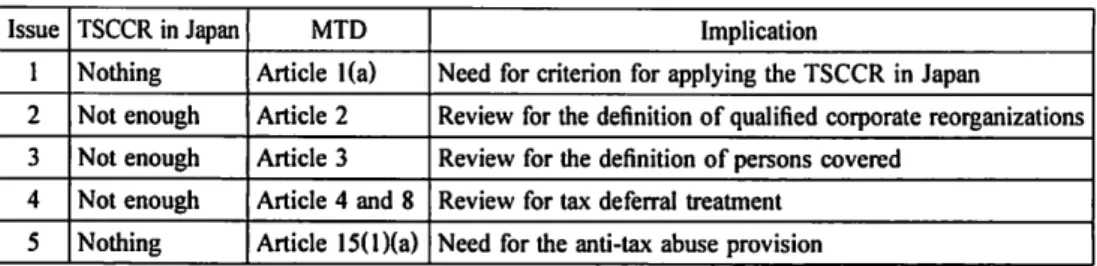
From this study, it follows that the TSCCR in Japan has five issues: ( 1) Lack of the criterion for applying the TSCCR in Japan; (2) Inadequacy of the definition of qualified corporate reorganizations covered; (3) Inadequacy of the definition of persons covered; (4) Inadequacy of tax deferral requirements; (5) Lack of the anti-tax abuse provision.
Table 7 shows comparison between the TSCCR in Japan and the MTD for each issue.
By the way, the author has published five articles on the TSCCR in Japan by utilizing the MTD as a main research material. Accordingly, Table 7 also shows implications (which each result of five articles confirmed) for the TSCCR in Japan. Recommends based on each implication are shown in the next section.
Table 7 Comparison behveen the TSCCR in Japan and the MTD
Issue TSCCR in Japan MTD Implication
1 Nothing Article I (a) Need for criterion for applying the TSCCR in Japan
2 Not enough Article 2 Review for the definition of qualified corporate reorganizations 3 Not enough Article 3 Review for the definition of persons covered
4 Not enough Article 4 and 8 Review for tax deferral treatment 5 Nothing Article 15( I )(a) Need for the anti-tax abuse provision
It's also worth noting that this article focuses on main parts of the MTD to get the full picture of the MTD. Accordingly, this article does not cover special parts such as trans- parent entities (Article 11 of the MTD). I would like to publish another paper on special parts of the MID.
2. Discussion
(A) Finding I-Legislation of Criterion for Applying the TSCCR in Japan (Respond to the First Issue)
The MID has 'involving requirement' in Article 1 (a) of the MTD as the criterion for applying the MTD. On the other hand, the TSCCR in Japan has no criterion for applying the TSCCR. It is one of possible methods to adopt 'involving requirement' as the criterion for applying the TSCCR in Japan51l. However, a previous researcher argues cancellation or relaxation of 'involving requirement'52l. Therefore, as the author's article53l has examined, the TSCCR in Japan should adopt the criterion like relaxed 'involving requirement'54) as the criterion for applying the TSCCR in Japan.
The Study for the Tax System of Cross-border Corporate Reorganizations
(B) Finding 2- Amendment of the Definition of Qualified Corporate Reorganizations Covered (Respond to the Second Issue)
The scope of qualified corporate reorganizations covered is not separated from the Japanese Companies Act55 ). Therefore, it is difficult for the TSCCR in Japan to maintain the current method, especially in the case of cross-border corporate reorganizations involving foreign corporations56).
On the other hand, the MTD has the definition of corporate reorganizations based on their essential elements, It is important for the TSCCR in Japan to adopt a similar method in the future57).
( C) Finding 3-Amendment of the Definition of Persons Covered (Respond to the Third Issue)
The scope of persons covered is limited to 'corporation' for enjoying tax benefits under the TSCCR in Japan. In the case of cross-border corporate reorganizations involving foreign entities, however, the current method will cause problems for the concept of 'corporation'. Therefore, the TS CCR in Japan should adopt the concept of 'corporation', which is provided in Article 3(l)(b) of the OECD Model Tax Convention58). Further, the TSCCR in Japan also should adopt 'subject-to-tax requirement' of Article 3(c) of the
MTD59).
(D) Finding 4-Strengthening of Tax Deferral Requirements (Respond to the Fourth Issue)
The current MTD adopts a different standard of tax deferral treatment in the corpora- tion and in the shareholder level. Frederik Boulogne has pointed out a lack of 'taxable
income requirement'60) of Article 4(2)(b) in the shareholder level and has recommended to add such requirement into Article 8 of the MTD, which provides tax deferral treatment in the shareholder level, to safeguard taxing rights61). This'taxable income requirement' means the second half of Article 4(2)(b):
... play a part in generating the profits or losses taken into account for tax purposes.
This 'taxable income requirement' also can be applied to the TSCCR in Japan62).
(E) Finding 5-Legislation of the Anti-Tax Abuse Provision (Respond to the Fifth Issue) Article 132-2 of the CTA is not an anti-tax 'abuse' provision but an anti-tax 'avoidance' provision. As mentioned above, professor Iwasaki has already pointed out that it was diffi- cult to deny international transactions as tax avoidance transactions and to tax them on the way of denial of tax avoidance transactions63). Therefore, the TSCCR in Japan should adopt anti-tax abuse provision similar to Article 15( I )(a) of the MTD64).
26
Journal of Accountancy, Economics and Law. No.14 (March 2020)
V. Conclusions
This article concludes that the legal framework of the MTD can be an option other than the legal framework of U.S. tax law as the future direction of the TSCCR in Japan.
Because results of this article confirm there is a stage or level for the TSCCR in the future.
In other word, it is easier for the TSCCR in Japan to adopt the legal framework of the MTD as step-by step approach.
From this study for the MTD, it follows that the CCRTS in Japan has five issues: (I) Lack of the criterion for applying the TSCCR in Japan; (2) Inadequacy of the definition of qualified corporate reorganizations covered; (3) Inadequacy of the definition of persons covered; (4) Inadequacy of tax deferral requirements; (5) Lack of the anti-tax abuse provi- sion.
For five issues, this article recommends as follows.
(1) Legislation of criterion for applying the CCRTS in Japan
(2) Amendment of the definition of qualified corporate reorganizations covered (3) Amendment of the definition of persons covered
(4) Strengthening of tax deferral requirements (5) Legislation of the anti-tax abuse provision
It's also worth noting that the TSCCR in Japan has need to get support of other fields, especially the Japanese Companies Act, to enable cross-border corporate reorganizations, as much as the relation between MTD and the Statute for a European company.
(This work was supported by JSPS KAKENHI Grant Number JP16K03312. Any options, findings, and conclusions or recommendations expressed in this material are those of the author and do not necessarily reflect the views of the author's organization, JSPS or MEXT.)
Notes
I) See Takayasu Okushima, Seiichi Ochiai and Michiyo Hamada (eds), Shin Kihon Ho Konmentaru Kaisha Ho 3 [New Basic Law Commentary Companies Act 3] (2th edn), 239 Hougaku Seminar Bessatsu, 344 (Junko Ueda), 2015. Professor Junko Ueda describes as follows: Regarding the possi- bility of mergers or stock exchanges between foreign corporations and domestic corporations, we may consider analogy by reciprocal interpretation or review for provisions of the Japanese Compa- nies Act when the subordinate law of such foreign corporations recognizes such corporate reorgani- zations with foreign corporations.
2) Kaneko Hiroshi, Sozei Ho [Tax Law] (23th edn), 490, 2019.
3) Shigetaka Nakamura,"Supinohu Zeisei no Kongo no Hokosei-Partial Division he Kakucho sareta
27
The Study for the Tax System of Cross-border Corporate Reorganizations
EU Gappei Sozei Shirei ni yoru Kento- [The Future Direction of Spin-Off Tax System-Research by the EU Merger Tax Directive Expanded to Partial Division-]", I Sogo Ho Seisaku Kaishi[The Jour- nal of Comprehensive Law and Policy Research Association], 22, 2018.
4) Council Directive 2009/133/EC of 19 October 2009 on the common system of taxation applicable to mergers, divisions, partial divisions, transfers assets and exchanges of shares concerning companies of different Member States and to the transfer of registered office of an SE or SCE between Member States, OJ L 310, 25 November. 2009, 34-46.
5) Shigetaka Nakamura, supra note 3, 22.
6) Kaisei Zeiho no Subete [Everything on Tax Reform] FY 2001 version, 132.
7) Table I is made by the author, referring to Kaisei Zeiho no Subete, supra note 6, 132.
8) See Kaisei Zeiho no Subete, supra note 6, 132.
9) The second general meeting of Tax Commission, "Kaisha Bunkatsu-Gappei tou no Kigyo Soshiki Saihensei ni kakaru Zeisei no Kihonteki Kangaekata [The Basic Theory for the Tax System of Cor- porate Reorganizaitons such as Mergers and Corporate Divisions]", 3 October, 2000.
IO) Tetsuya Watanabe,"Tax-Free Treatment for Corporate Reorganizations in Japan", Procedings from the 2009 Sho Sato Conference on Tax Law, 20, 2009.
II) Id.
12) The Supreme Court of Japan, judgment of 17 July 2015, Saiko Saibansho Minji Hanrei Shu, vol. 69, no. 5, 1253.
13) Shigetaka Nakamura,"Kokusaiteki Soshiki Saihensei ni okeru Jinteki Taisho Hani-EU Gappei Sozei Shirei to sono Shusei An wo Sanko ni shite- [The Scope of Persons Covered in the Tax System for Cross-border Corporate Reorganizations in Japan-In the Light of the EU Merger Tax Directive and its Amendment-]", 3 Sogo Ho Seisaku Kaishi[The Journal of Comprehensive Law and Policy Re- search Association], 2, 2019.
14) Shigetaka Nakamura, "Kokusaiteki Soshikisaihen Zeisei ni okeru Taisho Torihiki no Teigi-EU Gap- pei Sozei Shirei to CCCTB Shirei An kara no Kento- [71,e Definition of Qualified Transaction in the Cross-Border Corporate Reorganization Tax System-Research from EU Merger Tax Directive and Proposals for a Council Directive on a Common Consolidated Corporate Tax Base-], Gendaishakai to Kaikei[The Journal of Modem Society and Accounting], no. 12, 58, 2018.
15) Article 2(xii)-12 I and Ro of the CTA.
16) Article 2(xii)-12 Ha of the CTA.
17) Article 184(4) of the Corporation Tax Act Enforcement Order. Article 37-14-3(3) of the Act on Spe- cial Measures Considering Taxation.
18) Hideki Tomonaga, Hokatsu Hinin Sosho wo meguru Kosatsu-Soshiki Saihensei wo meguru Hokatsu Hinin to Zeimu Sosho [A Study with Lawsuits for General Denial-General Denial and Tax Lawsuits with Corporate Reorganizations], Seibunsha, 35, 2014.
19) The Supreme Court of Japan, judgment of 29 February 2016, Saiko Saibansho Minji Hanrei Shu, vol. 70, no. 2, 242.
20) See Masaaki Iwasaki, "Sozei Ho ni okeru 'Ranyo 'Gainen-Kokusai Kazei ni okeru Sozei Kaihi Hinin to EU ni okeru Ranyo Kinshi Gensoku [The Concept of 'Abuse' in Tax Law-Denial of Tax Avoidance
Journal of Accountancy, Economics and Law, No.14 (March 2020)
in International Taxation and Principle of Prohibition against Abuse in EU]", in Hiroshi Kaneko (ed), Sozei Ho no Hatten [The Development of Tax Law], Yuhikaku, 394, 2010.
21) See Shigetaka Nakamura, "Kokusaiteki Soshikisaihensei to Ippanteki SozeiKaihi-Hinin Kitei-EU Gappei Sozei Shirei 15 Jo 1 Ko (a) ni Chakumoku shite- [Cross-Border Corporate Reorganization and general Anti-Avoidance Rule-Focusing on Article 15(1)(a) of the EU Merger Tax Directive-], Gendaishakai to Kaikei[fhe Journal of Modern Society and Accounting], no. 10, 95-97, 2016.
22) Council Regulation (EC) No 2157/2001 of 8 October 2001 on the Statute for a European company (SE).
23) Tax treatment for the TSCCR in Japan will affect the parties involved for such cross-border corpo- rate reorganizations. I understand results of this article may affect other fields (for example, the Jap- anese Companies Act).
24) See Ryoichi Ikeda, Oshu Bijinesu no tameno EU Zeisei-Huka Kachi Zei-lten Kakaku Zeisei·PE Mon- dai [The European Tax Sytem-Value Added Tax-Transfer Pricing-PE Problem] (Revised edition), Zeimukeirikyokai, 157-169, 2017.
25) Frederik Boulogne, Shortcomings in the EU Merger Directive, Wolters Kluwer, 2016.
26) Proposal for a Council Directive amending Directive 90/434/EEC of 23 July 1990 on the common system of taxation applicable to mergers, divisions, transfers assets and exchanges of shares concern- ing companies of different Member States, COM (1993) 293, final, Official Journal of the European Communities C 225/3, 20 August. 1993.
27) Council Directive 2005/19/EC of 17 February 2005 amending Directive 90/434/EEC 1990 on the common system of taxation applicable to mergers, divisions, transfers of assets and exchanges of shares concerning companies of different Member States, OJ L 58, 4 May. 2005, 19-27.
28) Harm van den Broek, Cross-Border Mergers within the EU, Wolters Kluwer, 2012, 150.
29) Frederik Boulogne, supra note 25, 62.
30) Id.
31) Frederik Boulogne, supra note 25, 23.
32) Frederik Boulogne, supra note 25, 51.
33) Frederik Boulogne, supra note 25, 58.
34) See Shigetaka Nakamura, supra note 14, 60-61, Table 3.
35) Frederik Boulogne, supra note 25, 145.
36) Id.
37) Frederik Boulogne, supra note 25, 145-146.
38) See Shigetaka Nakamura,"Kokusaiteki Soshiki Saihensei ni okeru Kabunushi Dankai Kazei-EU Gap- pei Sozei Shirei 8 Jo ni yoru Kento- [Taxation at Shareholder Level in the Cross-border Corporate
Reorganization Tax System-Research by the Article 8 of EU Merger Tax Directive-]", Gendaishakai to Kaikei[fhe Journal of Modern Society and Accounting], no. 13, 50-52, 2019.
39) Frederik Boulogne, supra note 25, 181-182.
40) Prof. S. van Thiel, "Christine Rattrli and Michael Meer, Corporate Income Taxation and the Internal Market Without Frontiers: Adoption of the Merger and Parent-Subsidiary Directives", 30 European Taxation (November 1990), 331.
The Study for the Tax System of Cross-border Corporate Reorganizations
41) Frederik Boulogne, supra note 25, 265.
42) Id.
43) Id.
44) See Shigetaka Nakamura, supra note 21, 95-97.
45) Case C-28/95, Leur-Bloem [ 1997] ECR 1-4161.
46) Case C-321/05, Kofoed [2007] ECR 1-5795.
47) Case C-285/07, AT v Finanzamt Stullgart-Korpershaflen [2008] ECR 1-9329.
48) Case C-352/08, Modehuis A. Zwijnenburg [20 IO] ECR 1-4303.
49) Case C-126/10, Foggia [2011] ECR 1-10923.
50) Case C-603/10, Pe/ati ECLI:EU:C:2012:639.
51) Shigetaka Nakamura, supra note 13, 31.
52) Frederik Boulogne, supra note 25, 70-73.
53) Shigetaka Nakamura, supra note 13, 31.
54) This means to rephrase •involving companies from two or more Member States' into "involving companies and/or shareholders from two or more Member States or where the assets transferred in- clude a permanent establishment of the transferring company which is situated in a Member State other than that of the transferring company'. See Frederik Boulogne, supra note 25, 73.
55) Shigetaka Nakamura, supra note 14, 58.
56) Shigetaka Nakamura, supra note 14, 69.
57) See Shigetaka Nakamura, supra note 3, 22.
58) See Shigetaka Nakamura, supra note 13, 30.
59) Id.
60) Frederik Boulogne, supra note 25, 150.
61) Frederik Boulogne, supra note 25, 192.
62) For the corporate level, see Shigetaka Nakamura, supra note 3, 22. For the shareholder level, see Shigetaka Nakamura, supra note 38, 61.
63) See Masaaki Iwasaki, supra note 20, 394.
64) See Shigetaka Nakamura, supra note 21, 97.