311
Failure and Chronic Kidney Disease
Takamasa Sato,1 MD, Hiroyuki Yamauchi,1 MD, Satoshi Suzuki,1 MD, Akiomi Yoshihisa,1 MD, Takayoshi Yamaki,1 MD, Koichi Sugimoto,1 MD, Hiroyuki Kunii,1 MD, Kazuhiko Nakazato,1 MD,
Hitoshi Suzuki,1 MD, Shu-ichi Saitoh,1 MD, and Yasuchika Takeishi,1 MD
Summary
Impaired renal function is a strong predictor of mortality in chronic heart failure (CHF). However, the impact of chronic kidney disease (CKD) on prognostic factors has not been rigorously examined in CHF. The purpose of this study was to compare prognostic factors between CHF patients with and without CKD. Consecutive 505 patients with CHF, who performed cardiopulmonary exercise testing before discharge, were enrolled. Patients were divided into two groups:
CKD group (eGFR < 60 mL/minute/1.73m2, n = 213) and non-CKD group (eGFR ≥ 60 mL/minute/1.73m2, n = 292).
The patients were followed up to register cardiac events including cardiac death and re-hospitalization due to worsening heart failure. There were 115 events during the follow-up period (746 ± 238 days), and the cardiac event rate was higher in the CKD group than in the non-CKD group (34% versus 14%, P < 0.001). Multivariate Cox hazard analysis demon- strated that body mass index (P < 0.001), log BNP (P < 0.001), peak VO2 (P < 0.05), and left atrial dimension (P < 0.05) were independent parameters to predict cardiac events after discharge in the non-CKD group. In contrast, peak VO2 (P <
0.01), log BNP (P < 0.01), and the concentrations of hemoglobin (P < 0.05) and uric acid (P < 0.05) were independent prognostic factors in the CKD group. Prognostic factors were different between CHF patients with and without CKD, and this should be considered when managing CHF patients with CKD. (Int Heart J 2013; 54: 311-317)
Key words: Clinical outcome, BNP, Cardio-renal syndrome, Exercise capacity
I
mprovement in the treatment of heart failure results in pro- gressive effects on outcome at the population level. How- ever, prognosis still remains poor in heart failure.1) Many factors including cardiac functional parameters, exercise ca- pacity, pulmonary function, biomarkers from bloods samples, and other clinical characteristics have determined the progno- sis of patients with chronic heart failure (CHF).2)Recent studies have demonstrated that chronic kidney disease (CKD) increases the risk of cardiovascular events.3) In CHF, a high incidence of renal dysfunction has been reported, and impaired renal function is a strong predictor of mortality and other clinical outcomes.4)
The impact of CKD on prognostic factors of CHF, how- ever, has not been rigorously examined. Therefore, the purpose of this study was to compare prognostic factors between CHF patients with and without CKD.
Methods
Study subjects and study protocol: We examined consecutive 553 patients admitted to Fukushima Medical University Hos- pital for treatment of worsening CHF between 2007 and 2010.
Written informed consent was obtained from all study sub-
jects. The study complied with the Declaration of Helsinki, and the study protocol was approved by the ethical committee of Fukushima Medical University. We diagnosed CHF based on the Framingham criteria, including symptoms, physical ex- aminations, chest x-rays, and echocardiographic findings. All patients received optimal medications and were in stable con- dition before discharge. They underwent echocardiography and cardiopulmonary exercise (CPX) testing on the same day when in stable condition within 3 to 5 days prior to discharge.
Blood samples were obtained just prior to CPX testing. In the present study, patients with decompensated heart failure after treatment, end-stage renal disease (estimated glomerular filtra- tion rate (eGFR) < 15 mL/minute/1.73m2), malignant diseases, acute coronary syndrome, active infection diseases, and those who were unable to undergo CPX testing (n = 48) were ex- cluded. Thus, a total of 505 patients (408 males and 97 fe- males, mean age 60.4 ± 13.8 year) were analyzed. Out of these 505 patients, 126 were in New York Heart Association (NYHA) functional class IIm, 275 in NYHA III, and 104 in NYHA IV at admission. There were 71 patients in NYHA class I, 199 patients in IIs, 174 patients in IIm, and 63 patients in III at CPX testing. The baseline clinical characteristics of the study patients are shown in Table I.
Patients were followed up after discharge to register car-
From the 1 Department of Cardiology and Hematology, Fukushima Medical University, Fukushima, Japan.
This study was supported in part by a grant-in-aid for Scientific Research (No. 23700613) from the Japan Society for the Promotion of Science.
Address for correspondence: Takamasa Sato, MD, Department of Cardiology and Hematology, Fukushima Medical University, 1 Hikarigaoka, Fukushima, Fukushima 960-1295, Japan.
Received for publication February 20, 2013.
Revised and accepted April 16, 2013.
diac events. The endpoints were cardiac death and re-hospitali- zation due to worsening heart failure. The follow-up period was 746 ± 238 days (mean ± SD) and was completed for all patients. Follow-up and events were adjudicated using medical records, death certificates, and a questionnaire method for home doctors and patient themselves.
We compared blood sampling data, exercise capacity, systolic and diastolic function, and prognosis between patients with and without CKD. CKD was defined as an estimated glomerular filtration rate (eGFR) < 60 mL/minute/1.73 m2 from the Modification of Diet in Renal Disease (MDRD) equation in Japan (recommendation of Japanese Society of Nephrology).
Cardiopulmonary exercise testing: All subjects underwent in- cremental symptom limited exercise testing using an upright cycle ergometer with a ramp protocol (Strength Ergo 8, Fuku- da Denshi Co. Ltd., Tokyo). Breath by breath oxygen con- sumption (VO2), carbon dioxide production (VCO2), and
minute ventilation (VE) were measured during exercise using an AE-300S respiratory monitor (Minato Medical Science, Osaka, Japan). Peak VO2 was measured as an average of the last 30 seconds of exercise. Ventilatory response to exercise (expressed as a VE/VCO2 slope) was calculated as the regres- sion slope relating VE to CO2 from the start of exercise until the respiratory compensation (RC) point (the time at which ventilation is stimulated by CO2 output and end-tidal CO2 ten- sion begins to decrease).5,6)
Echocardiography: Left ventricular end-diastolic and end- systolic volumes (LVEDV and LVESV) and left ventricular ejection fraction (LVEF) were measured by the modified Simpson’s method. Standard measurements of left atrial diam- eter (LAD) were also obtained in the parasternal long axis view.7) Pulsed-wave Doppler recordings of the mitral flow ve- locity at the tip of mitral leaflets were obtained from the apical 4 chamber view during quiet respiration. From the Doppler profile, the peak velocities of the early (E) wave and late (A) Table I. Clinical Characteristics of Study Subjects
Total n = 505
CKD (-) n = 292
CKD (+)
n = 213 P
Age (years) 60.4 ± 13.8 56.0 ± 14.3 66.4 ± 10.7 < 0.001
Male, n (%) 408 (80.8%) 226 (77.4%) 182 (85.4%) < 0.05
BMI (kg/m2) 23.4 ± 4.2 23.6 ± 4.1 23.1 ± 4.3 NS
Ischemic etiology, n (%) 202 (40.0%) 109 (37.3%) 93 (43.7%) NS
AF, n (%) 130 (24.0%) 42 (14.2%) 81 (38.0%) < 0.001
NYHA class (I/IIs/IIm/III) (71/199/174/63) (61/123/83/25) (8/76/91/38) Laboratory data
Hb (g/dL) 12.9 ± 1.9 13.3 ± 1.6 12.4 ± 2.1 < 0.001
BUN (mg/dL) 19.7 ± 9.7 15.2 ± 4.6 26.0 ± 11.2 < 0.001
Creatinine (mg/dL) 1.00 ± 0.37 0.78 ± 0.13 1.31 ± 1.37 < 0.001
eGFR (mL/minute/1.73m2) 64.7 ± 21.9 79.1 ± 15.8 44.9 ± 10.8 < 0.001
Na (mEq/L) 139.6 ± 3.0 139.7 ± 2.8 139.2 ± 3.0 NS
Uric acid (mg/dL) 6.47 ± 1.85 6.01 ± 1.51 7.16 ± 1.93 < 0.001
T.Bil (mg/dL) 0.83 ± 0.46 0.84 ± 0.48 0.81 ± 0.43 NS
BNP (pg/mL) 146.5 112.0 205.0 < 0.001
(51.6-314.5) (30.5-249.5) (94.5-368.0)
Log BNP 4.82 ± 1.28 4.51 ± 1.34 5.23 ± 1.07 < 0.001
Echocardiographic parameters
LVEF (%) 45.1 ± 15.6 47.3 ± 16.0 42.6 ± 111.1 < 0.01
LVEDV (mL) 121.9 ± 59.0 120.1 ± 61.7 123.3 ± 55.4 NS
LVESV (mL) 72.8 ± 53.2 69.6 ± 56.2 77.3 ± 48.7 NS
LAD (mm) 43.8 ± 10.7 42.6 ± 11.1 45.4 ± 9.8 < 0.05
DcT (msec) 202.9 ± 69.6 200.4 ± 61.3 206.2 ± 79.3 NS
E/E’ 12.3 ± 6.5 11.4 ± 5.9 13.5 ± 7.1 < 0.001
CPX parameters
Peak VO2 (mL/kg/minute) 15.6 ± 4.8 16.9 ± 4.9 13.8 ± 4.1 < 0.001
Peak HR (bpm) 119.0 ± 28.6 125.6 ± 28.1 110.0 ± 26.9 < 0.001
VE/VCO2 slope 33.1 ± 7.3 32.0 ± 7.0 34.6 ± 7.5 < 0.001
Pharmacotherapy
Digitalis, n (%) 55 (10.9%) 29 (9.9%) 26 (12.2%) NS
ACE inhibitor or ARB, n (%) 427 (84.6%) 239 (81.8%) 188 (88.3%) NS
β-blocker, n (%) 409 (81.0%) 224 (76.7%) 185 (86.9%) < 0.05
CCB, n (%) 97 (19.2%) 60 (20.5%) 37 (17.4%) NS
Statin, n (%) 244 (48.3%) 134 (45.9%) 110 (51.6%) NS
Aldosterone antagonist, n (%) 278 (55.0%) 155 (53.1%) 123 (57.7%) NS
Diuretics, n (%) 304 (60.2%) 148 (50.7%) 156 (73.2%) < 0.001
BMI indicates body mass index; AF, atrial fibrillation; NYHA, New York Heart Association, Hb, hemoglobin; BUN, blood nitrogen urea; eGFR, estimated glomerular filtration rate; Na, sodium; T.Bil, total bilirubin; BNP, B-type natriuretic peptide ; LVEF, left ven- tricular ejection fraction; LVEDV, left ventricular end-diastolic volume; LVESV, left ventricular end-systolic volume; LAD, left atrial dimension; DcT, deceleration time; E/E’, ratio of mitral peak velocity of early filling (E) to early diastolic annular mitral velocity (E’);
Peak VO2, peak oxygen uptake; peak HR, peak heart rate; VE/VCO2 slope, rate of increase in ventilation per unit increase in carbon dioxide production; ACE, angiotensin-converting enzyme; ARB, angiotensin-receptor blocker; CCB, calcium channel blocker; and NS, not significant.
wave were calculated, together with the deceleration time of the E wave (DcT), taken as the time interval between the peak E wave and the zero intercept of the slope of the deceleration profile.8) From the tissue-Doppler imaging, the mitral annulus velocity (E’) was measured and the ratio of peak E wave ve- locity to E’ wave velocity (E/E’) was accepted for analysis.
Statistical analysis: Results are presented as the mean ± SD for continuous variables and as numbers and percentages for categorical variables. Student’s t-test was used to compare con- tinuous variables. If data were not distributed normally, the Mann-Whitney U test was used. The chi-square test was used to compare categorical variables. A P value < 0.05 was consid- ered statistically significant. The Cox proportional hazard re- gression models determined which variables were associated with a cardiac event. We examined 11 variables known to re- lated to the prognosis of CHF (body mass index, uric acid, he- moglobin, eGFR, sodium, log B-type natriuretic peptide (BNP), LVEF, LAD, DcT, peak VO2, and diuretic use) adjusted for age and gender in each group. Significant variables selected in the univariate analysis were entered into the multivariable analysis. The cardiac event-free rates were calculated using the Kaplan-Meier analysis, and the log-rank test was used to com- pare the results. The receiver operating characteristic (ROC) curve was constructed to evaluate the cut-off values. All statis- tical analyses were performed using SPSS statistics version 17.0 (SPSS Inc, Chicago, IL).
Results
Clinical characteristics, laboratory, echocardiographic and CPX data: Out of the 505 CHF patients, 213 patients (42.2%) had CKD (defined as eGFR < 60 mL/minute/1.73 m2). Com- parisons of clinical characteristics, laboratory data, and echocardiographic and CPX findings between the study sub- jects with and without CKD are shown in Table I. Patients with CKD were older than those without CKD. Higher frequencies of male and atrial fibrillation were associated with patients with CKD. Patients with CKD had lower hemoglobin concen- trations, higher concentrations of blood urea nitrogen (BUN), creatinine and uric acid, lower eGFR, and higher plasma BNP levels than those without CKD. In echocardiography, patients with CKD had a lower LVEF, larger LAD, and higher ratio of E/E’ compared to those without CKD. The results of CPX re- vealed that patients with CKD had lower peak VO2, lower peak HR, and higher VE/VCO2 slope than those without CKD. Pa- tients in the CKD group were more frequently given β-blockers and diuretics (Table I).
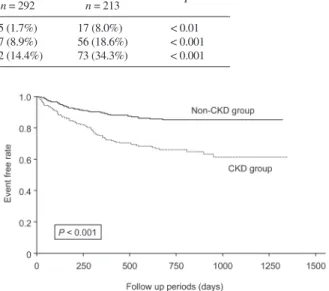
Cardiac events in study subjects: A total of 115 cardiac events were registered, including 22 cardiac deaths and 93 re-hospi- talizations due to worsening heart failure, during the follow-up period (746 ± 238 days) as shown in Table II. Patients with CKD had higher rates of cardiac death and re-hospitalization
due to worsening heart failure than those without CKD (Table II). This was also clearly demonstrated by Kaplan-Meier anal- ysis (Figure 1).
Prognostic factors for cardiac events in the non-CKD group:
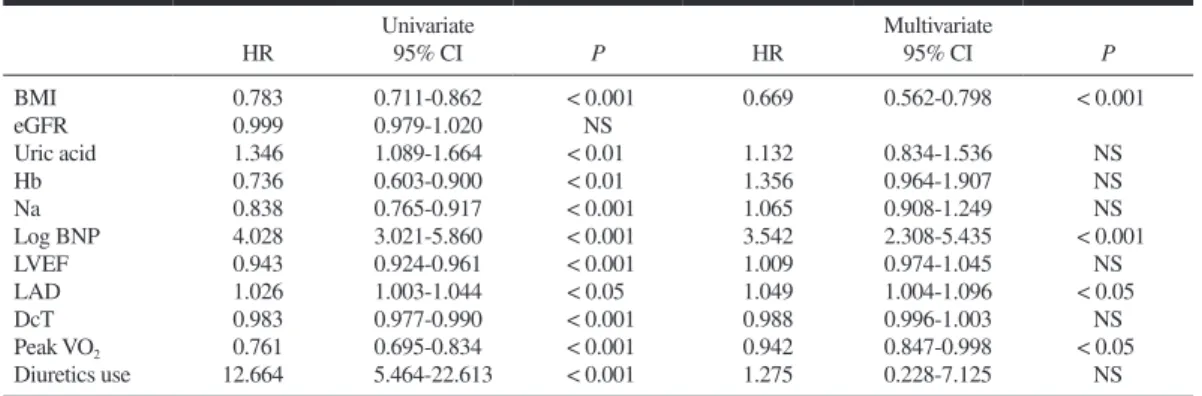
The ability of variables including data for blood examination, echocardiography, and CPX to predict cardiac events in the non-CKD group was examined by univariate and multivariate Cox proportional hazard analyses (Table III). Univariate analy- sis revealed significant associations between body mass index, uric acid, hemoglobin, sodium, log BNP, LVEF, LAD, DcT, peak VO2 and diuretic use with cardiac events. These variables with a P value less than 0.05 by univariate analysis were en- tered into the multivariate Cox proportional hazard regression model. As presented in Table III, body mass index, log BNP, LAD, and peak VO2 were independent prognostic factors to predict future cardiac events in the non-CKD group.
Prognostic factors for cardiac events in the CKD group: Simi- larly, the ability of variables to predict cardiac events in the CKD group was examined by univariate and multivariate Cox proportional hazard analyses (Table IV). Univariate analysis revealed significant associations between hemoglobin, eGFR, uric acid, sodium, log BNP, LVEF, LAD, DcT, peak VO2, and diuretic use with cardiac events. These variables with a P value less than 0.05 by univariate analysis were entered into the mul- tivariate Cox proportional hazard regression model. As pre- sented in Table IV, hemoglobin, uric acid, log BNP, and peak VO2 were independent prognostic factors to predict future car- diac events in the CKD group.
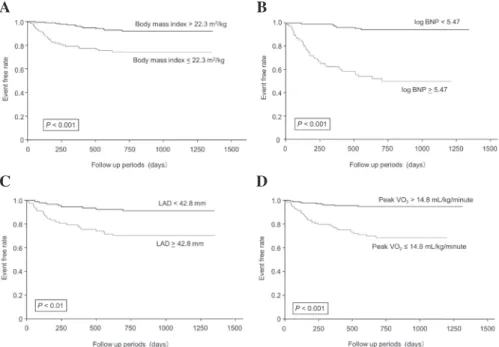
Risk stratification of CHF patients in the non-CKD group: In the non-CKD group, patients with CHF were risk-stratified by independent prognostic factors, body mass index, log BNP, LAD, and peak VO2, obtained by the multivariate Cox propor- tional hazard analysis. Cut-off values for each factor were de- termined by receiver operating characteristic (ROC) analysis.
For body mass index, the best cut-off value was 22.3 kg/m2 Table II. Cardiac Events After Discharge of Study Subjects
Total n = 505
CKD (-) n = 292
CKD (+)
n = 213 P
Cardiac deaths, n (%) 22 (4.4%) 5 (1.7%) 17 (8.0%) < 0.01
Re-hospitalization, n (%) 93 (18.4%) 37 (8.9%) 56 (18.6%) < 0.001 Total cardiac events, n (%) 115 (22.8%) 42 (14.4%) 73 (34.3%) < 0.001
Figure 1. Kaplan-Meier survival analysis between patients with and with- out CKD. Event free rate was significantly lower in the CKD group (P <
0.001 by a log-rank test).
(sensitivity: 0.698; specificity: 0.660; area under the curve, AUC: 0.734). In Kaplan-Meier analysis, patients with a body mass index ≤ 22.3 kg/m2 had significantly higher cardiac event rates than those with a body mass index > 22.3 kg/m2 (Figure 2A). The cut-off value for log BNP was similarly determined by ROC analysis as 5.47 (sensitivity: 0.833; specificity: 0.827;
AUC: 0.907). Patients with higher log BNP (≥ 5.47) had sig- nificantly higher cardiac event rates than those with < 5.47 as demonstrated by Kaplan-Meier analysis (Figure 2B). The best cut-off values for LAD and peak VO2 were 42.8 mm and 14.8 mL/kg/minute, respectively, in the ROC analysis (sensitivity:
0.718; specificity: 0.632; AUC: 0.688 and sensitivity: 0.791;
specificity: 0.712; AUC: 0.818). As shown in Figure 2C, pa- tients with a larger LAD (≥ 42.8 mm) had significantly higher cardiac event rates than those with a smaller LAD (< 42.8 mm). Compared to patients with peak VO2 > 14.8 mL/kg/
minute, patients with peak VO2 ≤ 14.8 mL/kg/minute had sig- nificantly higher cardiac events (Figure 2D).
Risk stratification of CHF patients in the CKD group: In the CKD group, patients with CHF were risk-stratified by inde- pendent prognostic factors, namely uric acid, hemoglobin, log BNP, and peak VO2, obtained by the multivariate Cox propor- tional hazard analysis. The best cut-off values determined by the ROC analysis for uric acid, hemoglobin, log BNP, and peak VO2 were 7.12 mg/dL (sensitivity: 0.625; specificity:
0.550; AUC: 0.602), 12.1 g/dL (sensitivity: 0.600; specificity:
0.650; AUC: 0.650), 5.45 (sensitivity 0.667; specificity 0.620;
AUC: 0.679), and 13.5 mL/kg/minute (sensitivity: 0.775; spe- cificity: 0.629; AUC: 0.773), respectively. In Kaplan-Meier
analysis, patients with higher uric acid (≥ 7.12 mg/dL) had sig- nificantly higher cardiac event rates than those with lower uric acid (< 7.12 mg/dL) as demonstrated in Figure 3A. Compared with patients with Hb > 12.1 g/dL, patients with Hb < 12.1 g/
dL had significantly higher cardiac events by Kaplan-Meier analysis (Figure 3B). Patients with higher log BNP (≥ 5.45) had significantly higher cardiac event rates as shown in Figure 3C. Patients with peak VO2 ≤ 13.5 mL/kg/minute had signifi- cantly higher cardiac event rates than patients with peak VO2 >
13.5 mL/kg/minute (Figure 3D).
Discussion
In the present study, cardiac event rates were significantly higher in the CKD group than in the non-CKD group as previ- ously reported. In the non-CKD group, Cox proportional haz- ard regression analysis demonstrated that body mass index, log BNP, LAD, and peak VO2 were independent parameters for predicting cardiac events. In contrast, uric acid, hemoglobin, log BNP, and peak VO2 were independent prognostic factors in the CKD group.
Impact of plasma BNP level and exercise capacity in CHF:
Plasma BNP levels and peak VO2 are well known strong prog- nostic factors in CHF.9-11) In the present study, plasma BNP levels and peak VO2 were independent prognostic factors in both the CKD and non-CKD groups. However, it has been shown that the plasma BNP level is affected by many factors that include age, gender, body mass index, cardiac hypertro- Table III. Cox Proportional Hazard Analyses in the Non-CKD Group
Univariate Multivariate
HR 95% CI P HR 95% CI P
BMI 0.783 0.711-0.862 < 0.001 0.669 0.562-0.798 < 0.001
eGFR 0.999 0.979-1.020 NS
Uric acid 1.346 1.089-1.664 < 0.01 1.132 0.834-1.536 NS
Hb 0.736 0.603-0.900 < 0.01 1.356 0.964-1.907 NS
Na 0.838 0.765-0.917 < 0.001 1.065 0.908-1.249 NS
Log BNP 4.028 3.021-5.860 < 0.001 3.542 2.308-5.435 < 0.001
LVEF 0.943 0.924-0.961 < 0.001 1.009 0.974-1.045 NS
LAD 1.026 1.003-1.044 < 0.05 1.049 1.004-1.096 < 0.05
DcT 0.983 0.977-0.990 < 0.001 0.988 0.996-1.003 NS
Peak VO2 0.761 0.695-0.834 < 0.001 0.942 0.847-0.998 < 0.05
Diuretics use 12.664 5.464-22.613 < 0.001 1.275 0.228-7.125 NS
Abbreviations as in Table I. The data were adjusted for age and gender.
Table IV. Cox Proportional Hazard Analyses in the CKD Group
Univariate Multivariate
HR 95% CI P HR 95% CI P
BMI 0.967 0.899-1.031 NS
Hb 0.785 0.694-0.889 < 0.001 0.920 0.889-0.988 < 0.05
eGFR 0.965 0.946-0.985 < 0.01 1.106 0.989-1.031 NS
Uric acid 1.161 1.025-1.316 < 0.05 1.160 1.0011-1.282 < 0.05
Na 0.873 0.812-0.938 < 0.001 0.976 0.8497-1.062 NS
log BNP 1.818 1.407-2.350 < 0.001 1.452 1.117-1.889 < 0.01
LVEF 0.980 0.964-0.996 < 0.05 0.993 0.974-1.012 NS
LAD 1.027 1.003-1.052 < 0.05 1.015 0.980-1.050 NS
DcT 0.994 0.991-0.998 < 0.01 0.996 0.989-1.237 NS
Peak VO2 0.758 0.696-0.824 < 0.0001 0.844 0.741-0.962 < 0.01
Diuretics use 2.779 1.424-5.425 < 0.01 1.190 0.659-2.821 NS
Abbreviations as in Table I. The data were adjusted for age and gender.
phy, and renal function, in addition to cardiac overload and dysfunction. Decreased clearance of BNP from the kidney has been found to affect plasma BNP levels to a lesser extent than NT-pro BNP in CHF patients with renal dysfunction.12) There- fore, we should pay attention when interpreting plasma BNP levels in CHF patients with CKD.
In the present study, peak VO2 similarly showed impor-
tant prognostic values in both groups. These findings suggested that peak VO2 may be an important factor for predicting cardi- ac events in both CHF and CKD.
Distinct prognostic factors between CHF patients with and without CKD: It is now widely accepted that CHF and CKD share a number of common risk factors and pathophysiological pathways such as activation of the renin-angiotensin- aldoster- A
C
B
D
Figure 2. Comparisons of event free rates by body mass index (A), log BNP (B), LAD (C), and peak VO2 (D) with Kaplan-Meier survival analysis in patients without CKD. Cut-off values were determined by ROC analysis.
Event free curves were compared using a log-rank test.
A
C
B
D
Figure 3. Comparisons of event free rates by uric acid (A), hemoglobin (B), log BNP (C), and peak VO2 (D) with Kaplan-Meier survival analysis in patients with CKD. Cut-off values were determined by ROC analysis. Event free curves were compared using a log-rank test.
one system, sympathetic nervous system, inflammation, oxida- tive stress.4) Also, recent studies have demonstrated that CKD increases the risk of cardiovascular events.3) In CHF, a high in- cidence of renal dysfunction has been reported, and impaired renal function is a strong predictor of mortality.13) These find- ings indicate that CHF and CKD were each capable of causing or worsening the other. They form a vicious linkage that can lead to their progression, supporting the concept of the cardio- renal syndrome.14) In this study, prognostic factors were differ- ent between CHF patients with and without CKD. Therefore, we should consider these data when managing CHF patients with CKD.
Hemoglobin was an independent prognostic factor of car- diac events in CHF and CKD in the present study. Lower he- moglobin concentration is reported to be associated with in- creased mortality in patients with CHF.15) In addition, worsening renal function leads to lower hemoglobin concen- tration.16) Anemia, CHF and CKD are each capable of causing or worsening each other, and form a vicious circle which can result in progressive them?? (cardio-renal anemia syndrome).17)
In the present study, uric acid level was an independent prognostic factor of cardiac events in CHF patients with CKD.
It has been shown that high levels of uric acid are associated with mortality in CHF.18) Moreover, serum uric acid is an index of impaired oxidative metabolism in CHF. In CHF patients, hyperuricemia is explained by not only renal function and diu- retic use, but also by activation of xanthine oxidase.19) On the other hand, hyperuricemia independently worsens renal func- tion in normal subjects. Renal urate anion exchanger regulates the blood urate level.20) Xanthine oxidase activity and impaired renal excretion lead to high serum uric acid levels in CHF and CKD. It has been reported that therapeutic interventions with xanthine oxidase inhibitors like allopurinol lead to a favorable clinical outcome.21)
BMI has been reported to be an independent risk factor for mortality in CHF.22) However, in the present study, BMI was an independent predictor related to cardiac events in the non-CKD group, but not in the CKD group. One possible rea- son for this may be that patients with CKD developed fluid overload in early phase,23) and fluid accumulation and wasting possibly coexisted in the CKD group.
Study limitations: This study was performed in a single cent- er, and may not reflect the general population of patients with CHF and CKD. All subjects underwent cardiopulmonary exer- cise testing, and CHF patients who could not perform exercise testing were excluded. Therefore, the subjects in this study were from a relatively younger population and had preserved exercise tolerance, and thus cardiac event rates might be lower than previous studies, including those with exercise intoler- ance. In addition, our conclusions might not be totally applica- ble to patients with poor renal function as patients with end- stage renal disease were excluded.
Conclusions: Peak VO2 and plasma BNP levels were inde- pendent factors for predicting cardiac events in both the CKD and non-CKD groups. However, LAD and body mass index were independent prognostic factors in the non-CKD group, but not in the CKD group. On the other hand, levels of uric acid and hemoglobin were prognostic factors related to cardiac events in the CKD group, but not in the non-CKD group.
Therefore, we should take these discrepancies into considera- tion when managing CHF patients with CKD.
References
1. Jhund PS, Macintyre K, Simpson CR, et al. Long-term trends in first hospitalization for heart failure and subsequent survival be- tween 1986 and 2003: a population study of 5.1 million people.
Circulation 2009; 119: 515-23.
2. Zipes DP, Libby P, Bonow RO. Clinical aspects in heart failure. In
“Prognosis in Braunwald’s Heart Disease (7th ed)” 2005; Elsevier Saunders. Pennsylvania, 551-5.
3. Go AS, Chertow GM, Fan D, McCulloch CE, Hsu CY. Chronic kidney disease and risk of death, cardiovascular events, and hospi- talization. N Engl J Med 2004; 351: 1296-305.
4. Hillege HL, Girbes AR, de Kam PJ, et al. Renal function, neuro- hormonal activation, and survival in patients with chronic heart failure. Circulation 2000; 102: 203-10.
5. Chua TP, Ponikowski P, Harrington D, et al. Clinical correlates and prognostic significance of the ventilatory response to exercise in chronic heart failure. J Am Coll Cardiol 1997; 29: 1585-90.
6. Ponikowski P, Francis DP, Piepoli MF, et al. Enhanced ventilatory response to exercise in patients with chronic heart failure and pre- served exercise tolerance: marker of abnormal cardiorespiratory reflex control and predictor of poor prognosis. Circulation 2001;
103: 967-72.
7. Lang RM, Bierig M, Devereux RB, et al. Recommendations for chamber quantification: a report from the American Society of Echocardiography’s Guidelines and Standards Committee and the Chamber Quantification Writing Group, developed in conjunction with the European Association of Echocardiography, a branch of the European Society of Cardiology. J Am Soc Echocardiogr 2005; 18: 1440-63.
8. Garhard-Herman M, Gardin M, Jaff M, Mohler E, Roman M, Naqvi TZ. Guidelines for noninvasive vascular laboratory testing:
a report from the American Society of Echocardiography and the Society of Vascular Medicine and Biology. J Am Soc Echocardi- ogr 2006; 19: 955-72.
9. Maeda K, Tsutamoto T, Wada A, et al. High levels of plasma brain natriuretic peptide and interleukin-6 after optimized treatment for heart failure are independent risk factors for morbidity and mortal- ity in patients with congestive heart failure. J Am Coll Cardiol 2000; 36: 1587-93.
10. Mancini DM, Eisen H, Kussmaul W, Mull R, Edmunds LH Jr, Wilson JR. Value of peak exercise oxygen consumption for opti- mal timing of cardiac transplantation in ambulatory patients with heart failure. Circulation 1991; 83: 778-86.
11. O’Neill JO, Young JB, Pothier CE, Lauer MS. Peak oxygen con- sumption as a predictor of death in patients with heart failure re- ceiving beta-blockers. Circulation 2005; 111: 2313-8.
12. Tsutamoto T, Wada A, Sakai H, et al. Relationship between renal function and plasma brain natriuretic peptide in patients with heart failure. J Am Coll Cardiol 2006; 47: 582-6.
13. Hillege HL, Nitsch D, Pfeffer MA, et al. Renal function as a pre- dictor of outcome in a broad spectrum of patients with heart fail- ure. Circulation 2006; 113: 671-8.
14. Ronco C, McCullough P, Anker SD, et al. Cardio-renal syn- dromes: report from the consensus conference of the acute dialysis quality initiative. Eur Heart J 2010; 31: 703-11.
15. Horwich TB, Fonarow GC, Hamilton MA, MacLellan WR, Bo- renstein J. Anemia is associated with worse symptoms, greater im- pairment in functional capacity and a significant increase in mor- tality in patients with advanced heart failure. J Am Coll Cardiol 2002; 39: 1780-6.
16. Astor BC, Muntner P, Levin A, Eustace JA, Coresh J. Association of kidney function with anemia: the Third National Health and Nutrition Examination Survey (1988-1994). Arch Intern Med 2002; 162: 1401-8.
17. Silverberg D, Wexler D, Blum M, Wollman Y, Iaina A. The cardio- renal anemia syndrome: does it exist? Nehprol Dial Transplant 2003; 18: viii7-12. (Review)
18. Anker SD, Doehner W, Rauchhaus M, et al. Uric acid and survival in chronic heart failure: validation and application in metabolic,
functional, and hemodynamic staging. Circulation 2003; 107:
1991-7.
19. Leyva F, Anker S, Swan JW, et al. Serum uric acid as an index of impaired oxidative metabolism in chronic heart failure. Eur Heart J 1997; 18: 858-65.
20. Enomoto A, Kimura H, Chairoungdua A, et al. Molecular identifi- cation of a renal urate anion exchanger that regulates blood urate levels. Nature 2002; 417: 447-52.
21. Doehner W, Schoene N, Rauchhaus M, et al. Effects of xanthine oxidase inhibition with allopurinol on endothelial function and pe-
ripheral blood flow in hyperuricemic patients with chronic heart failure: results from 2 placebo-controlled studies. Circulation 2002; 105: 2619-24.
22. Anker SD, Ponikowski P, Varney S, et al. Wasting as independent risk factor for mortality in chronic heart failure. Lancet 1997; 349:
1050-3.
23. Pecoits-Filho R, Gonçalves S, Barberato SH, et al. Impact of re- sidual renal function on volume status in chronic renal failure.
Blood Purif 2004; 22: 285-92. (Review)