Fukushima Medical University
福島県立医科大学 学術機関リポジトリ
This document is downloaded at: 2021-11-07T23:24:22Z
Title Clinical application of L-menthol in the upper gastrointestinal endoscopic procedure
Author(s)
Kikuchi, Hitomi; Hikichi, Takuto; Takagi, Tadayuki; Suzuki, Rei; Watanabe, Ko; Nakamura, Jun; Sugimoto, Mitsuru;
Waragai, Yuichi; Konno, Naoki; Asama, Hiroyuki; Takasumi, Mika; Watanabe, Hiroshi; Obara, Katsutoshi; Ohira, Hiromasa Citation Fukushima Journal of Medical Science. 61(2): 160-166
Issue Date 2015
URL http://ir.fmu.ac.jp/dspace/handle/123456789/495
Rights © 2015 The Fukushima Society of Medical Science
DOI 10.5387/fms.2015-18
Text Version publisher
[Original Article]
CLINICAL APPLICATION OF L
-MENTHOL IN THE UPPER GASTROINTESTINAL ENDOSCOPIC PROCEDURE
HITOMI KIKUCHI
1), TAKUTO HIKICHI
2), TADAYUKI TAKAGI
1), REI SUZUKI
1), KO WATANABE
2), JUN NAKAMURA
1), MITSURU SUGIMOTO
1), YUICHI WARAGAI
2), NAOKI KONNO
1), HIROYUKI ASAMA
1), MIKA TAKASUMI
1), HIROSHI WATANABE
1),
KATSUTOSHI OBARA
3), and HIROMASA OHIRA
1)1)Department of Gastroenterology and Rheumatology, Fukushima Medical University School of Medicine,
2)Department of Endoscopy, Fukushima Medical University Hospital, 3)Department of Advanced Gastro- enterological Endoscopy, Fukushima Medical University, Fukushima-city, Fukushima, Japan
(Received July 1, 2015, accepted October 15, 2015)
Abstract: Aim: Peppermint oil, which suppresses gastric peristalsis during esophagogastroduo- denoscopy (EGD), is effective for determining the margin of a gastric tumor. This study was conducted to evaluate the utility of an L-menthol preparation for suppressing gastric peristalsis and for diagnosing gastric tumors.
Methods: The study examined 124 patients who underwent EGD between January and April 2012. After 20 mL of 0.8% L-menthol was sprayed directly onto the mucosal surface of the gastric antrum, the degree of peristalsis suppression in the antrum was evaluated. The effectiveness of L- menthol for identifying new gastric tumors and determining tumor margins was also evaluated.
Results: Gastric peristalsis was suppressed in 88.5% (69/78) of patients, with complete suppres- sion of peristalsis achieved in 78.2%. L-menthol exerted a higher peristalsis-suppressive effect in patients with endoscopic gastric mucosal atrophy (93.3%, 56/60) than in patients without atrophy (72.2%, 13/18) (p = .014). L-menthol application caused the detection of new gastric tumors in 1.6% (2/124) of patients and clarification of the margin of three lesions (in 3 patients) identified as having an unclear margin before L-menthol application.
Conclusion: These results suggest that L-menthol is effective for suppressing gastric peristalsis during EGD and suggest that it is useful for identifying gastric tumors and for determining tumor margins.
Key words: L-menthol, peppermint oil, antispasmodics, gastric cancer, esophagogastroduodenos- copy
INTRODUCTION
Antispasmodics such as butylscopolamine bro- mide and glucagon have been used to suppress gas- trointestinal peristalsis during esophagogastroduo- denoscopy (EGD). However, the use of anti spas modics is restricted in patients with comorbidities such as cardiac disease, glaucoma, prostatic hypertrophy, and diabetes, leading to an increasing number of patients contraindicated for these drugs in an aging society.
The inability to use antispasmodics might increase the risk of overlooked gastric tumors because of vig- orous peristalsis. Moreover, conventional antispas- modics are administered by intramuscular injection, exposing healthcare professionals to the risk of nee- dle
-stick injury and exposing patients to the burden of pain.
Since the efficacy of peppermint oil
-containing enteric capsules in treating irritable bowel syndrome was reported by Rees et al. in 1979
1), peppermint oil
Corresponding author : Takuto Hikichi, M.D., Ph.D. E-mail : [email protected]https://www.jstage.jst.go.jp/browse/fms http://www.fmu.ac.jp/home/lib/F-igaku/
161 CLINICAL APPLICATION OF L-MENTHOL IN EGD
has also been shown to be effective as an antispas- modic for use during lower gastrointestinal endosco- py
2)and barium enema examination
3). In 2003, a Japanese group led by Hiki et al.
4)compared the effi- cacy and safety of 1.6% peppermint oil suspension administered through a forceps channel of an endo- scope into the stomach during EGD with those of butylscopolamine bromide administered intramuscu- larly in a double
-blind study. They demonstrated that peppermint oil suspension was more effective in suppressing the contraction motion of the pyloric ring and caused fewer adverse reactions. Based on these findings reported by Hiki et al., we started in
-hospital prescription of 1.6% peppermint oil from 2008. This report describes its efficacy for peri- stalsis suppression and its high acceptance by pa- tients
5), as well as its usefulness in identifying new gastric tumors and determining tumor margins
6). However, several problems arise when using inter- nally prescribed peppermint oil, such as inconsisten- cy in the contents of the main ingredient L
-menthol and phase separation into aqueous and oil phases oc- curring over time after preparation. An L
-menthol preparation that overcame these shortcomings was launched in Japan in January 2011. It has been made available for use during EGD. This product contains L
-menthol as the active ingredient at a con- centration of 0.8%, which is lower than that of our internally prescribed peppermint oil. This study was conducted to verify the usefulness of the L
-menthol preparation as an antispasmodic for EGD, as reported previously by Hiki et al.,
7)in addition to its effectiveness for detecting and diagnosing gastric tumors.
METHODS
Patients
This study examined 124 consecutive patients who underwent EGD between January and April 2012 performed by an endoscopist (T.H.), a board
-certified instructor of the Japan Gastroenterological Endoscopy Society, who met the inclusion criteria presented below. Data for these patients were ana- lyzed retrospectively between March and July 2014.
To be included, patients had to be at least 20 years old, without known hypersensitivity to L
-menthol.
Patients were excluded from the study if they had a previous history of gastric surgery, any disease that might cause reduced gastric peristalsis (e.g. diabe- tes), or if they had known hypersensitivity to L
-menthol. This study was conducted based on Fuku-
shima Medical University Ethics Committee Approval No. 1954.
Endoscopic procedure
Each patient was instructed to drink a mixture of 20,000 units of pronase (Pronase MS
®; Kaken Pharmaceutical Co. Ltd., Tokyo, Japan), 80 mg di- methicone (Balgin Antifoaming Oral Solution 2%
®; Kaigen Pharma Co. Ltd., Osaka, Japan), and 1 g so- dium bicarbonate in 80 mL of water 10 min before scope insertion. Immediately before insertion of the endoscope (GIF
-H260 ; Olympus Medical Sys- tems Corp., Tokyo, Japan), 40 mg lidocaine (Xylo- caine Pump Spray 8% ; AstraZeneca K.K., Osaka, Japan) was sprayed into the oral cavity for pharynge- al anesthesia
8).
Gastric peristalsis suppressing effect
The endoscope was inserted into the gastric antrum, at which gastric peristalsis was observed for 20 s. Gastric peristalsis was evaluated based on the Niwa classification
9)into Grade 1 (no peristalsis), Grade 2 (peristalsis not involving the pyloric ring), or Grade 3 (peristalsis involving the pyloric ring).
After peristalsis evaluation, 20 mL of 0.8% L
-men- thol (Mincrea
®; Nihon Pharmaceutical Co. Ltd., To- kyo, Japan) was sprayed directly through a forceps channel of the scope onto the gastric antrum.
Then, peristalsis was observed again for 20 s in the antrum to evaluate the peristalsis
-suppressive effect of L
-menthol in the antrum. The degree of peri- stalsis suppression was defined as “complete sup- pression” if peristalsis was stopped after L
-menthol application, “mild suppression” if peristalsis was not suppressed completely but reduced compared to the pre
-application state, or “no suppression” if no difference in peristalsis was observed between states before and after application. For patients with a pre
-application peristalsis Grade of 2 or 3, the degree of peristalsis suppression was evaluated ac- cording to the presence or absence of endoscopic gastric mucosal atrophy. After EGD, each patient was instructed to rest for 1 hr in the examination room, where they were monitored for adverse events.
Effectiveness in diagnosing gastric tumors
The L
-menthol effectiveness was evaluated for
the identification of new gastric tumors in the gas-
tric antrum that were not recognized before EGD or
identified before L
-menthol application. The effec-
tiveness was also evaluated for clarifying the mar-
gins of gastric tumors that were identified before EGD with an unclear margin.
Statistical evaluation
For analysis of patient characteristics, the pa- tient age was expressed as mean ± standard devia- tion. The degrees of peristalsis suppression in pa- tients with and without endoscopic gastric mucosal atrophy were analyzed using chi
-square tests, with significant difference inferred for p < .05. All sta- tistical analyses were conducted using software (Ex- cel Statistics ; OMS Publishing Inc., Saitama, Japan).
RESULTS
Patient characteristics
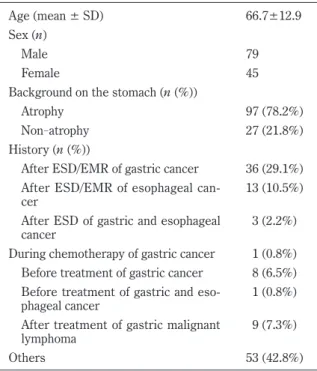
Table 1 presents characteristics of the 79 male and 45 female patients. Their mean age was 66.7
± 12.9 years. With regard to underlying disease, half of the patients (62/124) had treated or untreated gastric or esophageal cancer. Regarding back- ground gastric mucosal findings, 78.2% (97/124) of the patients were diagnosed endoscopically as hav- ing atrophic gastritis.
Gastric peristalsis suppressing effect
In the evaluation of gastric peristalsis before L
-menthol application, 37.1% (46/124) of the patients
were classified as Grade 1, 13.7% (17/124) as Grade 2 and 49.2% (61/124) as Grade 3 (Fig. 1). Of 78 pa- tients classified as Grade 2 or 3, 69 (88.5%) patients had their gastric peristalsis suppressed by L
-men- thol, with complete suppression achieved in 78.2%
(61/78) and mild suppression in 10.3% (8/78) (Fig. 2).
The 78 patients classified as having Grade 2 or 3 peristalsis before L
-menthol application were di- vided into 60 (76.9%) patients with and 18 (23.1%) patients without endoscopic gastric mucosal atrophy.
In those with mucosal atrophy, peristalsis was sup- pressed completely in 80.0% (48/60), mildly sup- pressed in 13.3% (8/60), and not suppressed in 6.7%
(4/60). The corresponding percentages in those without mucosal atrophy were 72.2% (13/18), 0%
(0/18), and 27.8% (5/18) (Fig. 3). This result pres- ents a higher peristalsis
-suppressive effect exerted in those with gastric mucosal atrophy than in those without (p = .014).
Adverse events included nausea and a generally bad feeling experienced by one patient (0.8%) after EGD.
Effectiveness in diagnosing gastric tumors
L
-menthol application led to the detection of
Table 1. Patient characteristics (n=124)
Age (mean ± SD) 66.7±12.9
Sex (n)
Male 79
Female 45
Background on the stomach (n (%))
Atrophy 97 (78.2%)
Non-atrophy 27 (21.8%)
History (n (%))
After ESD/EMR of gastric cancer 36 (29.1%) After ESD/EMR of esophageal can-
cer 13 (10.5%)
After ESD of gastric and esophageal
cancer 3 (2.2%)
During chemotherapy of gastric cancer 1 (0.8%) Before treatment of gastric cancer 8 (6.5%)
Before treatment of gastric and eso-
pha geal cancer 1 (0.8%)
After treatment of gastric malignant
lymphoma 9 (7.3%)
Others 53 (42.8%)
ESD, endoscopic submucosal dissection ; EMR, endo- scopic mucosal resection
Fig. 2. Degree of peristalsis suppression by L-men- thol application in patients classified as peristalsis Grade 2 or 3.
Fig. 1. Distribution of peristalsis grades before appli- cation of 0.8% L-menthol.
163 CLINICAL APPLICATION OF L-MENTHOL IN EGD
new gastric tumors in 1.6% (2/124) of the patients in whom no tumor had been identified in the gastric antrum before EGD. The 20
-s endoscopic obser- vation performed before L
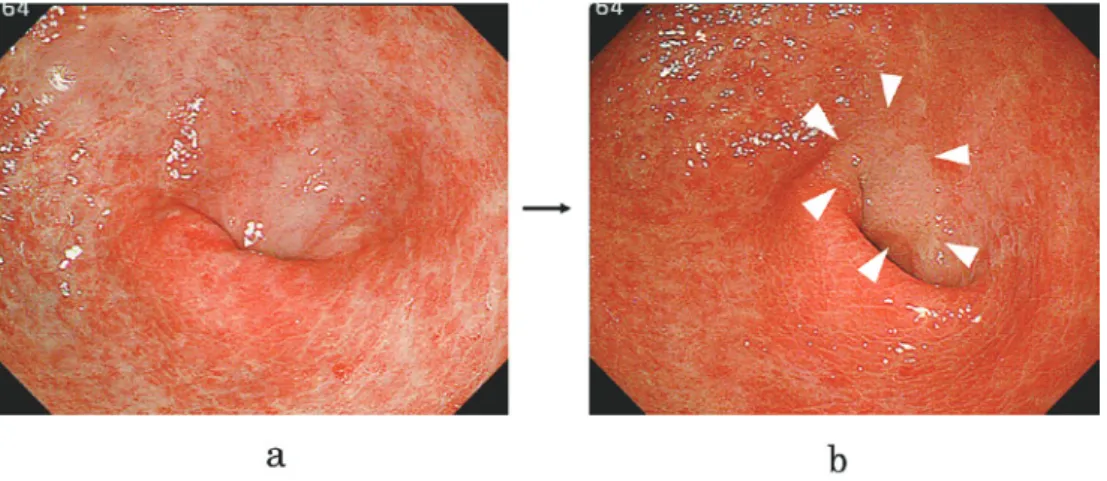
-menthol application failed to detect any tumor. In both cases, tumors were detected before the scope was advanced into the du- odenum. One tumor, found in the lesser curvature of the antrum as a depressed type cancer (0
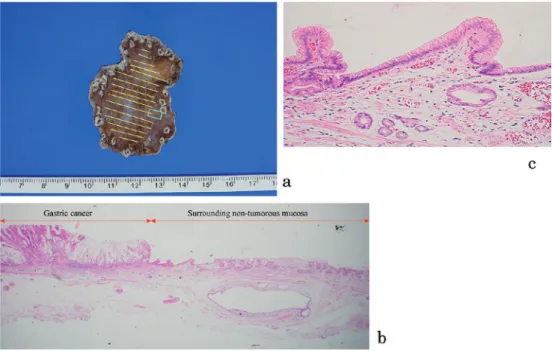
-IIc), was diagnosed as well differentiated adenocarcinoma (tub1) based on results of biopsy (Fig. 4). The tub1 lesion was treated later by endoscopic submucosal dissection (ESD) (Fig. 5). The other tumor, found in the posterior wall of the antrum as a raised lesion,
was diagnosed as an adenoma based on results of bi- opsy (Fig. 6).
In terms of its effectiveness in determining tu- mor margins, L
-menthol sprayed directly on gastric tumors clarified their margins in three patients in whom lesions were identified with an unclear margin before L
-menthol application, including one patient with type 0
-IIc cancer in the gastric antrum (Fig. 7) and two patients with type 0
-IIc cancer in the gastric corpus. L
-menthol application caused an edema- tous change of the non
-tumorous gastric mucosa, which clarified the tumor margin.
Fig. 3. Degree of gastric peristalsis suppression in patients with and without gastric mucosal atrophy.
A significantly higher peristalsis-suppressive effect was observed in patients with gastric mucosal atrophy (p = .014).
Fig. 4. Detection of a new gastric tumor using L-menthol application : Case 1.
a) Endoscopic view of the gastric antrum before L-menthol application.
b) Endoscopic view of the antrum after L-menthol application, showing a faded-colored type 0-IIc lesion in the anterior wall of the antrum near the pyloric ring (arrowheads).
DISCUSSION
During endoscopy, gastric peristalsis is ob- served mainly in the antrum. In the presence of vigorous peristalsis, small gastric carcinomas and ul- cers can be masked and overlooked. The difficulty in advancing the scope through the pyloric ring into the duodenum engenders a prolonged operation time. Therefore, the absence of gastric peristalsis is a pre
-requisite for better diagnostic accuracy and reduced pain experienced by a patient during EGD.
As a substitution for the conventional antispasmod- ics, such as butylscopolamine bromide and glucagon, that are administered by intramuscular injection, an L
-menthol preparation has been developed recently for direct application to gastric mucosa through a forceps channel of an endoscope.
L
-menthol has been shown to inhibit contrac- tion of gastrointestinal smooth muscles in experi- ments using guinea pig ileum
10,11), rabbit jejunum
11,12), and the human colon
13). L
-menthol has also been shown to suppress spontaneous contraction of rabbit
Fig. 5. Histopathological findings after endoscopic submucosal dissection : Case 1.a) Resected specimen after formalin fixation. Orange lines mark the adenocarcinoma invading the mucosa. A blue square is shown in Fig. 5b.
b) Margin between adenocarcinoma and non-tumorous mucosa (hematoxylin–eosin staining ; × 40).
c) Surrounding non-tumorous mucosa shows intestinal metaplasia (hematoxylin-eosin staining ; × 100).
Fig. 6. Detection of a new gastric tumor by L-menthol application : Case 2.
a) Endoscopic view of the gastric antrum before L-menthol application.
b) Endoscopic view of the antrum after L-menthol application, showing a raised lesion in the greater curvature of the antrum (arrowheads), which was diagnosed as an adenoma based on biopsy results.
165 CLINICAL APPLICATION OF L-MENTHOL IN EGD
jejunum smooth muscle dose
-dependently and to exert an immediate and sustained suppressive effect on gastric peristalsis in dogs and monkeys
12). Actu- al ly, L
-menthol is believed to bind to L
-type voltage
-dependent calcium channels present on the cell membrane of gastrointestinal smooth muscle cells.
Thereby, it blocks the influx of calcium ions into cells, resulting in the loss of membrane potential generation and the subsequent relaxation of smooth muscles
10, 11).
In this study, L
-menthol application caused sup- pressed gastric peristalsis in 88.5% of patients in whom peristalsis was observed before L
-menthol application. Moreover, complete suppression of peristalsis was achieved in 78.2% of patients, dem- onstrating a strong gastric peristalsis
-suppressive effect of the L
-menthol preparation. This effect was particularly pronounced in patients with gastric mucosal atrophy compared to those without atrophy.
A possible explanation for this difference is that, al- though we conducted no histological evaluation of the atrophied region or intestinal metaplasia, in the presence of gastric mucosal atrophy, progression from atrophic gastritis to intestinal metaplasia in- creases the number of absorptive cells at the affect- ed site, thereby resulting in increased absorption of L
-menthol and subsequent enhancement of its peri- stalsis
-suppressive effect. Although Hiki et al.
7)re- ported that the rate of complete suppression of gas- tric peristalsis was 37.5%, it was 78.2% in the present study. This difference is regarded as attributable to the differences in the evaluation time of the gastric peristalsis-suppressive effect. Hiki et al. evaluated the gastric peristalsis-suppressive ef-
fect twice immediately after L-menthol application and at the end of EGD. Each of the evaluation times was 45 s. In contrast, it was 20 s after L
-menthol application in this study. In fact, the peri- stalsis of the stomach is a problem during obser va- tion only from the antrum to pylorus. Therefore, 20 s of observation time is sufficient to determine gastric peristalsis suppression, although 45 s was regarded as painful for the patients.
New tumors were detected in the gastric an- trum in two patients in whom no tumor had been identified before L
-menthol application, probably be- cause the application of the L
-menthol preparation to gastric mucosa affected by atrophic gastritis or in- testinal metaplasia caused edematous change of the background mucosa around the tumor, making the surface irregularity more prominent and thereby making tumor detection easier. It is also likely that the same mechanism underlies the additional effec- tiveness of L
-menthol in determining the tumor margin. Mori et al.
14)reported that L
-menthol ap- plication causes an edematous change of gastric mu- cosa and thereby clarifies the margin of gastric le- sions, such as erosion, ulcer, and early stage cancer, which we have also demonstrated in a study using peppermint oil
6).
The results reported herein demonstrate that the L
-menthol preparation is useful as a safe and convenient suppressor of gastric peristalsis and also that it is useful for identifying new gastric tumors and determining the margin of gastric tumors. This study includes some limitations. First, the study was conducted at a single institution by a single op- erator. It included only a few patients. The addi-
Figure 7. Clarification of the margin of a gastric tumor by L-menthol application.a) Endoscopic view of the antrum before L-menthol application, showing a reddish type 0-IIc lesion of about 10- mm diameter in the posterior wall at the lesser curvature of the antrum. The lesion had an unclear margin (ar- rowheads).
b) After L-menthol application, the surface irregularity of the surrounding intestinal metaplastic mucosa became prominent, clarifying the margin of the 0-IIc lesion (arrowheads).
tional efficacy of L
-menthol in tumor diagnosis was based on a subjective evaluation by a single operator.
The evaluation of background gastric mucosa was done only by endoscopy. No histological evaluation was performed. No examination of Helicobacter py- lori infection was performed in most cases.
Additional studies are being planned for histo- logic examination of the changes in gastric mucosa caused by L
-menthol application and for an objective demonstration of differential image contrast between a gastric tumor and surrounding non
-tumorous mu- cosa.
ACKNOwLEDGEMENT
We express our gratitude to all endoscopy med- ical staff for their collaboration and assistance with endoscopic procedures.
CONFLICT OF INTEREST
The authors have no conflict of interest in rela- tion to this study.
REFERENCES
1. Rees WD, Evans BK, Rhodes J. Treating irritable bowel syndrome with peppermint oil. Br Med J, 6: 835-836, 1979.
2. Leicester RJ, Hunt RH. Peppermint oil to reduce colonic spasm during endoscopy. Lancet, 2: 989, 1982.
3. Sparks MJ, O’Sullivan P, Herrington AA, Morcos SK. Does peppermint oil relieve spasm during barium enema? Br J Radiol, 68: 841-843, 1995.
4. Hiki N, Kurosaka H, Tatsutomi Y, et al. Pepper- mint oil reduces gastric spasm during upper endoscopy : a randomized, double-blind, double- dummy controlled trial. Gastrointest Endosc, 57: 475-482, 2003.
5. Mizuno Y, Hikichi T, Suzuki T, et al. Peppermint oil is useful as an antispasmodic agent in esophago-
gastro-duodenoscopy. Fukushima Med J, 57: 9- 16, 2007. (in Japanese with English abstract) 6. Hikichi T, Irisawa A, Sato M, et al. Utility of pep-
permint oil for endoscopic diagnosis of gastric tu- mors. Fukushima J Med Sci, 57: 60-65, 2011.
7. Hiki N, Kaminishi M, Tanabe S, et al. An open-la- bel, single-arm study assessing the efficacy and safety of L-menthol sprayed onto the gastric mu- cosa during upper gastrointestinal endoscopy. J Gastroenterol, 46: 873-882, 2001.
8. Mizuno Y, Hikichi T, Itabashi M, et al. A compara- tive study of the effect and discomfort produced by pharyngeal anesthesia with viscous lidocaine solu- tion and with lidocaine spray in esophagogastrodu- odenoscopy. Fukushima Med J, 61: 12-17, 2010.
(in Japanese with English abstract)
9. Niwa H, Nakamura T, Fujino M. Endoscopic ob- servation on gastric peristalsis and pyloric move- ment. Gastroenterol Endosc, 17: 236-242, 1975.
(in Japanese with English abstract)
10. Hawthorn M, Ferrante J, Luchowski E, Rutledge A, Wei XY, Triggle DJ. The actions of peppermint oil and menthol on calcium channel dependent pro- cesses in intestinal, neuronal and cardiac prepara- tions. Aliment Pharmacol Ther, 2: 101-108, 1988.
11. Hills JM, Aaronson PI. Mechanism of action of peppermint oil on gastrointestinal smooth muscle.
An analysis using patch clamp electrophysiology and isolated tissue pharmacology in rabbit and guinea pig. Gastroenterology, 101: 55-65, 1991.
12. Ishikawa M, Nakajima K, Ohno Y, Tanaka H, Kaneko K. Suppressive effects of NPO-11 on gastric motility. J New Rem & Clin, 59: 1845- 1858, 2010. (in Japanese)
13. Taylor BA, Luscombe DK, Duthie HL. Inhibitory effect of peppermint oil and menthol on human iso- lated coli. Gut, 25: A1168-1169, 1984.
14. Mori A, Hachiya H, Yumura T, et al. L-Menthol sprayed on gastric mucosa causes edematous change. Endoscopy International Open, 2: E51- 57, 2014.