Online Structural Analysis
in the Processing of L1 Japanese and L2 English
March 2013
Chie Nakamura
A Thesis for the Degree of Ph.D. in Engineering
Online Structural Analysis
in the Processing of L1 Japanese and L2 English
March 2013
Graduate School of Science and Technology Keio University
Chie Nakamura
© Copyright by Chie Nakamura 2013 All Rights Reserved
This thesis examines how Japanese EFL learners comprehend English, more specifically, how they draw upon various kinds of linguistic information for structural analysis and how it differs from that of native English speakers. Since Japanese is a head-final language and is considered to be typologically different from head-initial languages such as English, it is possible that Japanese speakers use linguistic information differently in processing syntactic structures. Past research demonstrated that in English, comprehenders can immediately use many kinds of information such as prosody and context in parsing. However, it is relatively little known whether the same kinds of linguistic information are immediately used in online structural analysis in Japanese. For example, it is known that English speakers use lexically specific meaning of a verb to make a prediction about an upcoming structure but this may not be the case in Japanese because the verb in Japanese does not appear until the end of a sentence.
Using eye-tracking technique, the first three experiments reported in this thesis investigated the influences of (1) prosody, (2) syntactic priming, and (3) semantic information and clause length respectively in processing temporarily ambiguous sentences in Japanese. With a relative clause sentence ishi-ga hakui-o motteiru koukousei-o awatete oikaketa (‘the doctor hastily chased the high-school student who had a white coat’), readers tend to initially adopt an incorrect main clause analysis at the first verb motteiru (i.e., ‘the doctor had a white coat’) and are later forced to reanalyze it as the relative clause structure. The results of the experiments showed that (1) listeners predicted an upcoming structure using prosodic information before the sentence was disambiguated, (2) listeners were more likely to predict the same structure as in a
revision. These results provided evidence that Japanese speakers construct syntactic structures online using various sources of linguistic information without delay.
This thesis next examined how Japanese EFL learners process English sentences in a reading experiment. Specifically, the experiment asked whether Japanese EFL learners resolve syntactic ambiguity using verb subcategorization information in the same way as native speakers do. The results showed that the EFL learners tend to incorrectly analyze the noun following an intransitive verb as its direct object. The results from a sentence completion test also revealed that the EFL learners were more likely to violate the subcategorization constraint for intransitive verbs. These results suggested that Japanese EFL learners did not possess the complete knowledge about intransitivity information and thus did not resolve the syntactic ambiguity in the same way as native speakers did.
The results of the experiments in this thesis together showed that various kinds of linguistic information are immediately used in processing temporarily ambiguous sentences in Japanese in a similar way as in English. However, in processing English as a second language, Japanese EFL learners process structural ambiguity differently from native English speakers possibly because they do not possess the complete form of these kinds of linguistic information.
I would like to express my gratitude to all those who gave me the possibility to complete this thesis. Firstly, I would like to sincerely thank my advisor, Professor Hiroaki Saito, for his insightful comments and support both in my work and in this thesis. I consider myself to be fortunate to have an advisor who gave me the freedom to explore on my own, and at the same time the guidance when I needed. I also would like to thank my thesis committee members, Professors Shun Ishizaki, Kyoko Ohara, and Shingo Takeda, for spending their time on careful reading of my thesis as well as for their valuable comments, which were immensely helpful in improving this work.
There are many others whose help was invaluable to my research. First, I thank Professor Yasunari Harada for providing me with a great environment to conduct experiments at Waseda University. He was abundantly helpful and offered invaluable assistance, support and guidance throughout my graduate studies. The work presented in Chapter 5 in this thesis would not have been possible without his assistance. Also, I would like to thank Professor Reiko Mazuka, for having me as a student trainee at the laboratory for language development at RIKEN. She gave me the opportunity to participate in her research projects and meet and work with many researchers in Japan and overseas. I am grateful for her continuous advice and encouragement over the past 3 years. I am also thankful to the researchers at the laboratory for language development at RIKEN for their valuable comments on my research at a lab seminar. Also, I would like to express my deep gratitude and respect to Professor Yuki Hirose, who has been extremely supportive in allowing me to conduct many experiments at the University of Tokyo. Without her help and support the works presented in Chapter 2, 3, and 4 would
Most importantly, I would like to express my sincerest gratitude to Dr. Manabu Arai, for his valuable guidance, understanding, consistent encouragement and support throughout my graduate studies. He has always made himself available to clarify my doubts and to answer my questions, no matter how busy he was and how inept some of my questions were. I simply do not know how to thank him enough for his patience and warmth. I have been amazingly fortunate to do my research work under his guidance.
In addition, I take this opportunity to thank my friends, Noburo Saji, Takehiro Teraoka, Yayoi Tajima, Hiroi Kubota, Vo Ho Bao Khanh, Mamiko Arata, Junko Kanero, and Sho Tsuji for being there in a supportive way. Talking to them always inspired me in many ways and thinking back on all the fun I have had with them helped me to carry on. I am fortunate to have these great researchers as friends.
I am also very much grateful for the financial support form Japan Society for the Promotion of Science that funded all the research discussed in this thesis.
Finally, I thank my family for their unconditional love and support throughout my life. Their unwavering faith and confidence in me is what has shaped me to be the person I am today. I am more grateful for that than I could ever express here. And lastly, I thank Tomoyuki Shikanai, who has been a constant source of love and strength all these years.
None of this would have been possible without him always being there for me.
Page
ABSTRACT... iii
ACKNOWLEDGEMENTS ...v
LIST OF TABLES...x
LIST OF FIGURES ... xi
CHAPTER 1. INTRODUCTION ...1
1.1 Introduction ...1
1.2 Chapter highlights ...4
2. IMMEDIATE USE OF PROSODY AND CONTEXT IN PREDICTING A SYNTACTIC STRUCTURE ...8
2.1 Introduction ...8
2.2 Experiment: Visual world eye-tracking study using contrastive intonation ...13
2.2.1 Method ...13
2.2.2 Data analysis and results ...16
2.3 General discussion ...23
3. EFFECT OF SYNTACTIC PRIMING IN PREDICTING A SYNTACTIC STRUCTURE ...26
3.1 Introduction ...26
3.2 Pretest ...33
3.3 Experiment 1: Study with the repetition of the verb between prime and target sentences ...34
3.3.1 Method ...35
3.3.2 Data analysis and results ...38
3.3.2.1 Reading times in prime trials...38
3.3.2.2 Eye-movements in target trials ...40
3.3.3 Discussion ...48
3.4.2 Data analysis and results ...49
3.4.2.1 Reading times in prime trials...49
3.4.2.2 Eye-movements in target trials ...50
3.4.3 Discussion ...52
3.5 General discussion ...52
4. EFFECTS OF SEMANTIC INFORMATION AND CLAUSE LENGTH ON THE PERSISTENCE OF THE INITIAL MISANALYSIS ...57
4.1 Introduction ...57
4.2 Pretest ...61
4.3 Experiment 1: Self-paced reading study with short relative clauses ...63
4.3.1 Method ...63
4.3.2 Data analysis and results (Experiment 1) ...65
4.4 Experiment 2: Self-paced reading study with long relative clauses ...67
4.4.1 Method ...67
4.4.2 Data analysis and results (Experiment 2) ...68
4.5 Experiment 3: Eye-tracking study with short and long relative clauses ...70
4.5.1 Method ...71
4.5.2 Data analysis and results (Experiment 3) ...72
4.6 General discussion ...76
5. THE USE OF VERB SUBCATEGORIZATION INFORMATION IN L2 SENTENCE PROCESSING ...79
5.1 Introduction ...79
5.2 Experiment 1: Study on the processing of native speakers of English ...83
5.2.1 Method ...84
5.2.2 Results ...88
5.2.2.1 Comprehension accuracy...89
5.2.2.2 Reading times ...90
5.3.1 Method ...95
5.3.2 Results ...96
5.3.2.1 Sentence completion test ...96
5.3.2.2 Comprehension accuracy...98
5.3.2.3 Reading times ...99
5.3.2.4 Additional analysis ...102
5.3.3 Discussion ...104
5.4 General discussion ...105
6. CONCLUSIONS ...112
6.1 Summary of the results ...112
6.2 Conclusions and implications ...116
REFERENCES ...118
APPENDIX A. EXPERIMENTAL MATERIAL IN CHAPTER 2 ...126
APPENDIX B. EXPERIMENTAL MATERIAL IN CHAPTER 3 ...131
APPENDIX C. EXPERIMENTAL MATERIAL IN CHAPTER 4 ...143
APPENDIX D. EXPERIMENTAL MATERIAL IN CHAPTER 5 ...148
Table 2.1 Analysis of looks to the RC-head entity from 100 ms to 800 ms
following the RC verb onset ... 19 Table 2.2 Analysis of looks to the RC-head entity from 100 ms to 800 ms
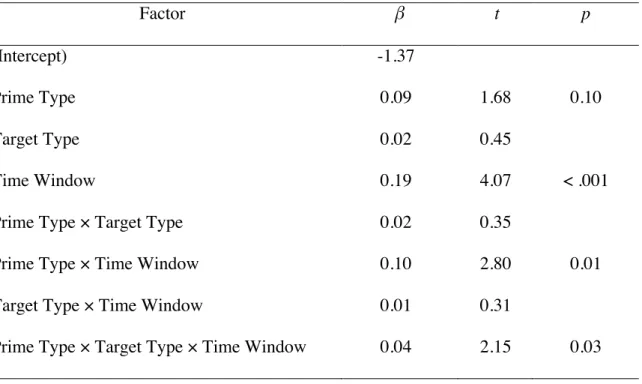
following the case-marker onset ... 22 Table 3.1 Mean reading times (Standard Eroor) in prime sentences ... 39 Table 3.2 Analysis of the looks to the RC-head entity for the 200 ms – 1100 ms
interval following the onset of the first verb (Experiment 1) ... 44 Table 3.3 Analysis of the looks to the RC-head entity for the 200 ms – 1100 ms
interval following the onset of the first verb (Experiment 2) ... 51 Table 4.1 Percentage of correct answers for the comprehension questions
(Experiment 1) ... 67 Table 4.2 Percentage of correct answers for the comprehension questions
(Experiment 2) ... 70 Table 4.3 Mean reading times for first-pass and second-pass ... 74 Table 5.1 Raw number and percentages of each type of completions (Native
speakers of English) ... 87 Table 5.2 Percentage of correct answers for the comprehension questions
(Native speakers of English) ... 89 Table 5.3 Raw number and percentages of each type of completions (Japanese
EFL learners) ... 97 Table 5.4 Percentage of correct answers for the comprehension questions
(Japanese EFL learners) ... 98
Figure 2.1: Example visual scenes for Non-Contrastive context (a) and
Contrastive context (b)... 11
Figure 2.2: F0 contour of the sentence (2.1) without contrastive intonation (a) and with it (b)... 14
Figure 2.3: Probability of gazes to the RC-head entity from the RC verb onset to 1300 ms... 17
Figure 2.4: Probability of gazes to the RC-head entity from the RC-head onset to 1700 ms... 21
Figure 3.1: An example target picture ... 31
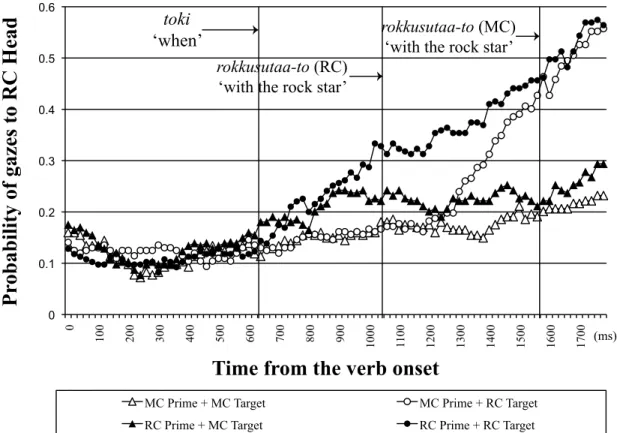
Figure 3.2: Probability of gazes to the RC-head entity for 1800 ms following the onset of the first verb (Experiment 1) ... 42
Figure 3.3: Probability of gazes to the RC-head entity for 1000 ms preceding the onset of the head noun of the RC target... 46
Figure 3.4: Probability of gazes to the Distracter entity for 1800 ms following the onset of the first verb ... 47
Figure 3.5: Probability of gazes to the RC-head entity for 1800 ms following the onset of the first verb (Experiment 2) ... 50
Figure 4.1: Plausibility rating for the nouns in each condition as a nominative subject of the verb phase... 62
Figure 4.2: Mean reading times for each condition (Experiment 1)... 66
Figure 4.3: Mean reading times for each condition (Experiment 2)... 69
Figure 4.4: Eye-tracking reading measure ... 73
Figure 5.1: Illustration of the moving-window self-paced reading paradigm ... 88
Figure 5.2: Mean reading times in each region (Native speakers of English)... 92
Figure 5.3: Mean reading times in each region (Japanese EFL learners)... 100
CHAPTER 1 INTRODUCTION
1.1 Introduction
It is fairly common for one to speak more than one language. In one typical case, a person speaks one language as the first language (L1) and another language as a foreign or second language (L2). A great deal of research has so far looked at how L1 is processed and also how L2 is acquired but there have been relatively few attempts to compare the processing of L1 and L2 directly. One important question in the field of language research is how the processing of L2 differs from that of L1. In particular, it is not known whether there is any fundamental difference in how sentence structures are processed between L1 and L2 beyond the difference in the level of general language proficiency. To address this issue, this thesis examines native Japanese speakers’
processing of Japanese as L1 and of English as L2.
In investigating the underlying mechanism of how humans understand language, a large number of studies have looked at the processing of syntactically ambiguous sentences, especially a particular kind of sentence in which an initially preferred analysis later turns out to be incorrect and thus readers experience processing difficulty for the revision of the incorrect analysis, known as garden-path sentence (Frazier & Fodor, 1978; Frazier & Rayner, 1982). This type of sentences has attracted researchers’ attention and led to an understanding of how language comprehenders construct a syntactic analysis. Previous studies in English revealed influences of various kinds of linguistic information such as prosody (Schafer, Speer, Warren, & White, 2000; Snedeker &
Trueswell, 2003), syntactic priming (Ledoux, Traxler, & Swaab, 2007; Traxler &
Pickering, 2005), discourse context (Tanenhaus, Spivey-Knowlton, Eberhard, & Sedivy, 1995), and meaning of individual words (McRae, Spivey-Knowlton, & Tanenhaus, 1998;
Garnsey, Pearlmutter, Myers, & Lotocky, 1997) on parsing processes and provided evidence that English speakers draw upon these types of linguistic information to construct syntactic structures in real time comprehension.
On the other hand, it is relatively unknown whether speakers of Japanese, a language that is typologically different from English, also use the same types of linguistic information as English speakers do. For example, past research on English demonstrated an influence of verb information on online structural analysis and showed that English speakers use lexically specific information of a verb to construct a syntactic structure (Arai & Keller, 2012; Garnsey, Pearlmutter, Myers, & Lotocky, 1997; Staub, 2007;
Trueswell, Tanenhaus, & Kello, 1993). However, this may not be the case for the speakers of Japanese, as the main verb in Japanese appears at the end of a sentence. This suggests the possibility that the types of linguistic information that influence online structural analysis may differ across languages. Specifically, this thesis asks whether speakers of Japanese use the same kinds of linguistic information as English speakers do in processing structurally ambiguous sentences.
In order to investigate whether speakers of Japanese use the same kinds of linguistic information that are used by English speakers in online sentence comprehension, the studies in this thesis first examines immediate effects of prosody, syntactic priming, and meaning of lexical items as well as clause length in processing Japanese relative clause sentences. The results from these studies demonstrate that Japanese speakers use these kinds of information immediately to construct sentence
structures, suggesting that Japanese speakers access the same kinds of linguistic information as the ones accessed in the processing of English without delay. Following the results of the studies on Japanese sentence processing, this thesis next examines whether such information can be used to guide comprehenders’ structural analysis when processing a second language, by testing Japanese learners of English as a foreign language (Japanese EFL learners, henceforth) for the use of verb subcategorization information in comprehending English. As mentioned earlier, past research on the use of verb information showed that English speakers use verb specific argument structure information to guide their initial analysis but such information may possibly not play a major role in the processing of Japanese. As a consequence, it suggests the possibility that the Japanese EFL learners’ processing of English sentences may be less constrained by verb specific information compared to that of native English speakers.
The results from the study on the processing of English as L2 reveals that Japanese EFL learners process structural ambiguity differently from native English speakers do; the EFL learners tended to incorrectly analyze the noun following an intransitive verb as its direct object whereas the native speakers did not show such a tendency. The results from a sentence completion test reveal also that the EFL learners were more likely to violate the constraint of subcategorization information for intransitive verbs. These results indicate that the difference in processing temporarily ambiguous sentences is most likely due to the fact that Japanese EFL learners do not possess the complete knowledge of verb subcategorization.
To conclude, the research conducted in this thesis shows the immediate effects of prosody, syntactic priming, and meaning of lexical items as well as clause length on
online structural analysis in Japanese. The results are comparable with previous studies on English, which showed that English speakers immediately use these kinds of linguistic information in building sentences structures. On the other hand, the study on the processing of structurally ambiguous sentences in English as L2 shows that Japanese EFL learners use verb information differently from native English speakers do and this is due to the EFL learners’ lack of complete knowledge about verb subcategorization information for intransitive verbs, perhaps because of EFL learners’ shortfall of linguistic input compared to native speakers.
1.2 Chapter highlights
In this thesis, Chapter 2, 3, and 4 report the results of the studies on immediate influences of prosody, syntactic priming, and semantics of lexical items as well as clause length on online syntactic analysis with structurally ambiguous sentences in Japanese. Chapter 2 reports the study that focuses on prosodic information. Numerous studies have reported the effect of prosodic information on parsing (Schafer, et al., 2000; Snedeker &
Trueswell, 2003) but whether prosody can impact even the initial parsing decision is still not clear. In a visual world eye-tracking experiment, the study in Chapter 2 investigates the influence of contrastive intonation and visual context on processing temporarily ambiguous relative clause sentences in Japanese. The results from the study show that listeners used the prosodic cue to make a structural prediction before hearing disambiguating information. Importantly, the effect was limited to cases where the visual scene provided an appropriate context for the prosodic cue, thus eliminating the explanation that listeners have simply associated marked prosodic information with a less
evident following disambiguating information, in a way that reflected the initial analysis.
The results from this experiment demonstrate that prosody, when provided with an appropriate context, influences the initial syntactic analysis and also the subsequent cost at disambiguating information. The results also provide first evidence for pre-head structural prediction driven by prosodic and contextual information with a head-final construction.
Chapter 3 reports the study on syntactic priming. A number of previous studies showed that access to a particular syntactic structure is facilitated by past experience with the same structure (Bock, 1986, 1989; Bock & Loebell, 1990; Bock, Loebell, & Morey, 1992; Pickering & Branigan, 1998). This phenomenon, called syntactic priming, is known to influence the processing cost that is associated with structural ambiguity.
However, it is still not known exactly how this facilitatory effect is caused. In particular, the study in Chapter 3 investigates whether the facilitatory effect is, at least partly, driven by the prediction of an upcoming structure. The study reports the results from two eye- tracking visual world experiments, in which the predictive effect of syntactic priming in the processing of Japanese main clause and relative clause structure was tested. The results show that participants predicted a relative clause structure more at the verb, viz.
prior to any disambiguating information, when they had experienced a relative clause sentence in an immediately preceding sentence. Crucially, the anticipatory priming effect was observed only when the verb was repeated between the prime and target sentences.
The results demonstrate that comprehenders of Japanese access the syntactic representation for the relative clause structure at the verb and the representation is accessed in a lexically associated manner at least in comprehension.
Chapter 4 reports the study on the influences of semantics of lexical items and clause length. Previous research reported that language comprehenders tend to preserve the initial incorrect analysis with temporarily ambiguous sentences following structural reanalysis (Christianson et al., 2001; van Gompel et al., 2006). One possible criticism is that the sentences tested in previous studies allow comprehenders to pragmatically infer that the initial misanalysis may be true. It is thus unclear whether the tendency can still be observed where such inferences are not possible. The study in Chapter 4 therefore tests the relative clause sentences in Japanese, which are temporarily ambiguous between the main clause and relative clause analysis. Crucially, the sentences differ from those in the past studies in that the correct interpretation following reanalysis makes an interpretation of the initial analysis pragmatically incompatible. The results demonstrate that an interpretation of the initial analysis persists even without pragmatic inference and that such incomplete syntactic representation occurs most likely due to large processing load.
Following the findings of the immediate effects of various types of linguistic information in Japanese sentence processing, Chapter 5 reports the study that investigates whether language learners can use such linguistic information in processing an L2 in the same way as native speakers do. Specifically, the study in this chapter explores the difference between Japanese EFL learners and native English speakers in the use of verb subcategorization information in processing ambiguous syntactic structures in English. In the experiment, sentences with early or late closure ambiguity with two types of verbs, optionally transitive verbs and intransitive verbs are tested, and the reading times are measured using a self-paced reading paradigm. The results show that the EFL learners experienced processing difficulty due to structural ambiguity following both types of
verbs, which contrasted the results of the native speakers who experienced such difficulty only following the optionally transitive verbs. In addition, the response accuracy of the questions about subordinate clause interpretation differed depending on the verb type for the native speakers but not for the EFL learners. Furthermore, an additional analysis reveals that the EFL learners who got higher scores on the questions about subordinate clause interpretation were more similar to the native speakers in the use of verb subcategorization information compared to those who got lower scores. For the participants with higher scores, the processing cost due to structural ambiguity was greater in the optionally transitive verb condition than in the intransitive verb condition.
On the other hand, for the participants with lower scores, the cost did not differ depending on the verb type. Together with the results from the sentence completion test, the study in this chapter demonstrate that the difference in processing temporarily ambiguous sentences between native English speakers and Japanese EFL learners is due to EFL learners’ incomplete intransitivity information, which lead them to often adopt, or coerce, a transitive analysis with the intransitive verbs and to experience processing difficulty at disambiguating information.
In the final chapter, brief summaries of the findings in each study and their implications are provided.
CHAPTER 2
IMMEDIATE USE OF PROSODY AND CONTEXT IN PREDICTING A SYNTACTIC STRUCTURE
2.1 Introduction
To comprehend spoken language, listeners need to analyze the speech signal according to the language-specific structure of prosody, which includes cues such as tone, intonation, rhythm, and stress. Previous research showed that speakers provide prosodic cues to disambiguate structures and that listeners use these cues to guide their structural analysis (Schafer et al., 2000; Snedeker & Trueswell, 2003). For instance, Snedeker and Trueswell (2003) found that speakers prosodically distinguish between the alternative structures of globally ambiguous phrases such as Tap the frog with the flower and that the location of the prosodic boundary directly affects listeners’ syntactic analyses (see also Kjelgaard & Speer,1999; Schafer et al., 2000; Speer, Kjelgaard & Dobroth, 1996;
Snedeker & Casserly, 2010). Schafer, Carter, Clifton and Frazier (1996) demonstrated that focal accent influences how listeners resolve attachment ambiguity of a complex NP followed by a relative clause modifier such as the propeller of the plane that…. These results demonstrate that prosodic information is used online in resolving structural ambiguities (see also Marslen-Wilson, Tyler, Warren, Grenier, & Lee, 1992). However, it is not yet certain whether it is used immediately for predicting a syntactic structure prior to disambiguating information. The current study addresses this issue by examining the influence of contrastive intonation in combination with contextual information on predictive structural processing with temporarily ambiguous relative clause sentences in
influence of prosodic information on the initial syntactic analysis. It would also provide the first evidence for pre-head structural prediction driven by prosodic and contextual information with a head-final construction (cf. Kamide, Altmann, & Haywood, 2003).
Most previous studies do not provide evidence for the immediate and truly interactive influence of prosodic information on initial syntactic analysis because they either relied on offline measures or examined the processes following disambiguating information. An exception is a study by Weber, Grice and Crocker (2006), who tested SVO and OVS structures in German. The two types of sentences were identical (thus temporarily ambiguous) up to the verb due to the case-ambiguous sentence-initial NP but carried different intonation patterns, (the nuclear stress accent was on the verb in the SVO structure whereas it appeared on the initial NP in the OVS structure). Their results revealed different patterns of eye-movements between the two structures prior to the disambiguating sentence-final NP, demonstrating the influence of prosodic information on structural prediction. However, it is possible that the different looking patterns for the two structures reflected a difference between the default looking pattern associated with the canonical SVO structure and the disrupted pattern due to the non-default (i.e., marked) intonation pattern for the less frequent OVS structure. This implies that the difference may be due to an absence of SVO prediction with the OVS-type prosody rather than the presence of OVS prediction itself. It therefore remains unclear whether prosody can indeed drive a structural prediction (see also Snedeker & Trueswell, 2003).
The current study examined the influence of contrastive intonation in predicting a syntactic structure. Previous studies showed that contrastive pitch accents evoke a notion of contrast in a discourse context and facilitate the processes of identifying an upcoming
referent in spontaneous dialogue (Ito & Speer, 2008; Ito, Jincho, Minai, Yamane, &
Mazuka, 2012; Weber, Braun, & Crocker, 2006). This study examined the impact of the contrastive intonation placed on the relative clause (underlined below) on the processing of temporarily ambiguous relative clause sentences in Japanese such as (2.1).
(2.1)
Otokonoko-ga sanrinsha-ni notteita onnanoko-o mitsumeta.
Boy-NOM [tricycle had being riding] girl-ACC stared at
‘The boy stared at the girl who had been riding the tricycle.’
In Japanese, relative clauses precede lexical heads without an overt complementizer or any grammatical marking on the verb within the relative clause (henceforth RC verb).
This creates a local syntactic ambiguity: The sentence is ambiguous between the main clause (henceforth MC) and the relative clause (RC) structures up to the RC verb. Due to the strong preference for the MC structure, people typically analyze the VP (sanrinsha-ni notteita. ‘had been riding the tricycle’) as part of the MC for which the sentence-initial NP (otokonoko-ga, ‘boy’) is the subject (Inoue & Fodor, 1995; Mazuka & Itoh, 1995)1. They are forced to revise the analysis for the RC on encountering the RC-head (onnanoko-o, ‘girl’).
In addition to prosody, visual context was also manipulated using the visual world eye-tracking technique (Cooper, 1974). It was designed either to support the use of contrastive intonation (Contrastive context, Figure 2.1b) or not to support it (Non-
!!!!!!!!!!!!!!!!!!!!!!!!!!!!!!!!!!!!!!!!!!!!!!!!!!!!!!!!
1 Japanese aspectual marker –te i- in the RC verb notteita can also indicate progressive meaning (‘was riding’) as well as resultative meaning as in the example. It is known that the choice of its meaning is highly dependent on context and verb sense (Shirai, 1998). In
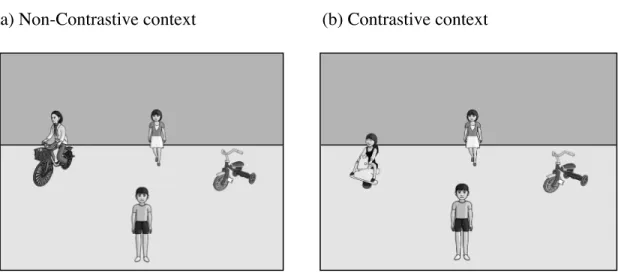
Contrastive context, Figure 2.1a). Both types of context depicted four entities, three of which corresponded to the referents in the sentence; subject (boy), RC object (tricycle), and RC-head (girl). The fourth entity in the Contrastive context stood as a contrast to the RC-head entity (another girl on a hobbyhorse, Figure 2.1b); in the Non-Contrastive context it was a distractor that did not stand as a contrast (an adult woman on a bicycle, Figure 2.1a).
(a) Non-Contrastive context (b) Contrastive context
Figure 2.1: Example visual scenes for Non-Contrastive context (a) and Contrastive context (b)
The manipulation of visual context is in essence similar to the study of Tanenhaus, Spivey-Knowlton, Eberhard and Sedivy (1995), which showed that contrastive context facilitated the processing of an ambiguous postnominal modifier, a prepositional phrase following a head noun (i.e., on the towel in ‘Put the apple on the towel in the box’). With the head-final construction, it is possible that contrastive context would drive listeners’
expectation for a prenominal modifier even before hearing the head. However, due to the strong preference for the MC structure, contextual information alone may not be able to
activate the infrequent RC analysis. Thus, it is expected that contrastive intonation on the relative clause would play a critical role: When a contrast in the visual scene is highlighted by contrastive intonation on the relative clause (i.e., emphasizing that someone had been riding a tricycle but not a hobbyhorse), the modifier interpretation (i.e., the RC analysis) may be accessed even before the referent is mentioned as it tells listeners which girl is being referred to. Therefore, anticipatory eye-movements toward the to-be-mentioned referent (i.e., the girl who is not on the hobbyhorse) would indicate the prediction of an RC-head and thus reflect the listeners’ RC analysis before the sentence was disambiguated because the alternative MC interpretation (i.e., ‘The boy had been riding the tricycle’) does not require any further linguistic material following the verb. On the other hand, it is expected that prosody would not affect eye-movements in the Non-Contrastive context because the prosodic cue in absence of a contrastive pair would likely be interpreted as a simple emphasis of the dative NP in the default MC analysis (i.e., emphasizing that the boy had ridden the tricycle but not other things).
Furthermore, the current study also investigated the influence of the prosodic cue following the disambiguating RC-head NP to see whether structural prediction would affect the subsequent cost at the disambiguating information. Such an effect is predicted by processing models such as Hale's (2001) surprisal model, which estimates processing cost based on the change in the probability distribution over possible analyses from one word to the next (see also Levy, 2008).
2.2 Experiment: Visual world eye-tracking study using contrastive intonation 2.2.1 Method
Participants
Twenty-eight native speakers of Japanese with normal visual acuity and hearing participated in the experiment for monetary compensation.
Materials
Twenty-eight experimental items were created. Each item consisted of an auditory sentence and a corresponding scene (see Appendix A for the full set of experimental items). The auditory stimuli were recorded by a female native speaker of Japanese with standard accent. Figure 2.2 shows the F0 contours of the sentence (2.1) without the contrastive intonation (Figure 2.2a) and with it (Figure 2.2b)2.
!!!!!!!!!!!!!!!!!!!!!!!!!!!!!!!!!!!!!!!!!!!!!!!!!!!!!!!!
2 The difference in F0 peaks between the sentence-initial NP and the following NP was significantly larger for the items with contrastive intonation compared to those without (t (27) = 15.17, p < .001 by a paired t-test). There was also a difference in the pause length prior to the RC between the items with contrastive intonation and those without (mean difference 52 ms; t (27) = 2.65, p = 0.01 by a paired t-test). This pause may possibly affect syntactic analysis with this structure independently of visual context. As shown in the result section, however, I found no evidence to support this. There is another possible confound for the prosodic manipulation: The pitch range is usually reset prior to a new clause in Japanese (cf. Uyeno, Hayashibe, Imai, Imagawa, & Kiritari, 1980; Venditti, 1994), which could also affect syntactic analysis independently. However, again, no supporting evidence was observed.
(a) Sentence without contrastive intonation (b) Sentence with contrastive intonation
Figure 2.2: F0 contour of the sentence (2.1) without contrastive intonation (a) and with it (b).
The visual scenes were prepared using commercial clipart images. The position of objects was counter-balanced across the pictures.
It is known that the difference across individuals and the order of presentation of experimental items can bias the outcome. Therefore, for all the experiments reported in thesis, these variables were controlled by using appropriate experimental methods and statistical analysis. First, in order to control the order effects, experimental lists in which each experimental item appears only once in a particular condition were created. For example, in an experiment of 2 x 2 design with two levels for each factor, four experimental lists were created ensuring that each item is tested equally often in each condition and that each participant receives an equal number of items in each condition.
Each experimental list also contains filler sentences that are structurally unrelated to the experimental target items in order to mask the objectives of the experiments.
Also, the individual difference was dealt with by statistical approach; participants were included as random factor for the base performance (intercept) and the sensitivity to
otokonoko-ga sanrinsha-ni notteita otokonoko-ga sanrinsha-ni notteita
experimental manipulations (slope). It is certainly likely that different populations would not produce the same results. In fact, some studies reported that older adults exhibit greater difficulty in recovering from initial incorrect analysis than younger adults, most likely due to the difference in working memory capacity (Christianson, Williams, Zacks,
& Ferreira, 2006; Yoo & Dickey, 2011). However, such group differences can in principle be regarded as of the same nature as individual differences. Therefore, the effects revealed by the statistical analysis in this thesis should be generalizable across different individuals and different groups although the magnitude of the effects may vary across them.
For the experiment in the current study, four experimental lists were created following a Latin square design including 56 fillers. The 84 items in each list were presented in pseudo-random order with a constraint that at least two fillers preceded each experimental item. In addition, 12 comprehension questions were included.
Procedure
Participants were first given a brief instruction and underwent a calibration procedure.
They were told to listen to auditory sentences carefully while paying attention to the picture on the computer monitor. In each trial, an auditory sentence was presented 2500 ms after the picture onset. Participants’ eye-movements were recorded, while the picture was presented, with EyeLink Arm Mount (SR Research) at the sampling rate of 500 Hz.
The whole experimental session took approximately 30 minutes.
2.2.2 Data analysis and results
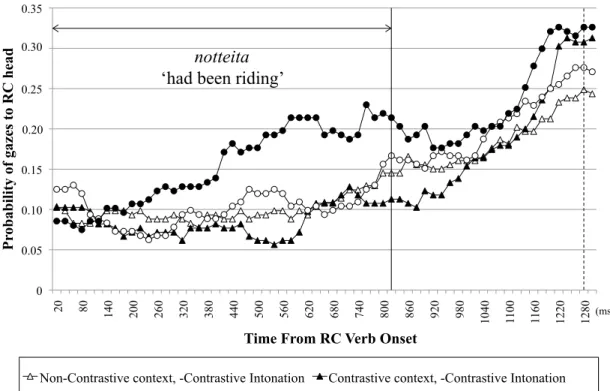
The fixation coordinates from the eye tracker were mapped onto four entities in the visual scene and were then converted to gazes. Following standard definitions, a gaze was defined as the accumulation of all consecutive fixations on an entity until another entity (or background) was fixated (Arai, van Gompel, Scheepers, 2007). The onset and offset of the RC verb (notteita, ‘had been riding’), those of the RC-head (onnanoko, ‘girl’), and the onset of the case-marker for the RC-head (-o) in each target sentence were manually marked. Firstly, the gazes to the RC-head entity for the duration of the RC verb were analyzed. Figure 2.3 shows the probability of gazes to the RC-head entity from the RC verb onset until 1300 ms. The first vertical line marks the mean offset of the verb (822 ms, SD = 133) and the second line (dotted) the mean onset of the RC-head (1289 ms, SD = 131).
Figure 2.3: Probability of gazes to the RC-head entity from the RC verb onset to 1300 ms
For the analysis, the gazes to each object in the scene, which were sampled every 20 ms, for the 700 ms time interval of 100-800 ms following the RC verb onset were summed and the logit of looks to the RC-head entity out of looks to all the objects in a scene (including background) was calculated3 and the statistical analysis was conducted.
All the statistical analyses reported in this thesis used Linear Mixed-Effects (LME) models (e.g., Baayen, Davidson, & Bates, 2008). The analysis using LME models provides several advantages over the traditional analysis of variance. First, there is no need to conduct two separate statistical tests on means for participants (F1) and those for
!!!!!!!!!!!!!!!!!!!!!!!!!!!!!!!!!!!!!!!!!!!!!!!!!!!!!!!!
3 The empirical logit using the function η’ = ln (y + 0.5)
(n - y + 0.5) was calculated where y is the number of looks to the RC-head entity and n is the total number of looks to all the objects in a scene and background (Barr, 2008).
0 0.05 0.10 0.15 0.20 0.25 0.30 0.35
20 80 140 200 260 320 380 440 500 560 620 680 740 800 860 920 980 1040 1100 1160 1220 1280
Probability of gazes to RC head
Time From RC Verb Onset
Non-Contrastive context, -Contrastive Intonation Contrastive context, -Contrastive Intonation Non-Contrastive context, +Contrastive Intonation Contrastive context, +Contrastive Intonation
notteita
‘had been riding’
(ms)
items (F2), as both subjects and items can be included in a model simultaneously as random variables at separate levels. Second, LME models are robust in handling missing data points resulting in unbalanced design between the conditions, which are fairly common in eye-movement measures. For all analysis reported in this thesis, coefficients (β), t-values (t), and p-values (p) for all the fixed factors and interactions are reported. P- values are computed based on Markov-chain Monte Carlo sampling. When the variance of the data is binomial (e.g., for the analysis on comprehension questions), generalized linear mixed effects models are used and z-values (z) are reported instead of t-values.
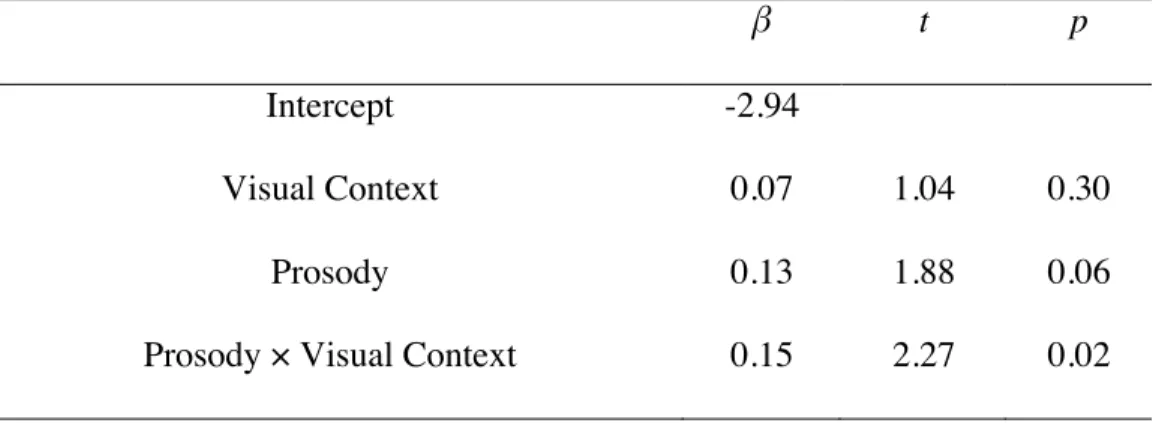
For the statistical analysis using LME models in the current study, Prosody (with or without contrastive intonation) and Visual Context (Contrastive or Non-Contrastive) were included as fixed effects with the interaction between the two factors allowed;
participants and items were random factors. All the fixed factors were centered with deviation coding. It was also checked whether the model improved its fit by adding random slopes for each participant and item with a forward-selection approach. Table 2.1 shows coefficients (β), t-values, and their p-values from the model. Exact values for p are reported except when it is less than 0.001.
Table 2.1: Analysis of looks to the RC-head entity from 100 ms to 800 ms following the RC verb onset.
β t p
Intercept -2.94
Visual Context 0.07 1.04 0.30
Prosody 0.13 1.88 0.06
Prosody × Visual Context 0.15 2.27 0.02
The results showed that there was a marginal effect of Prosody (p = 0.06), suggesting a tendency for participants to look more at the RC-head entity with contrastive intonation than without. Most importantly, there was a significant interaction between Prosody and Visual Context. Separate analyses for each context type revealed that the effect of Prosody was significant in the Contrastive context (β = 0.28, t = 2.86, p = 0.005) but not in the Non-Contrastive context (β = -0.03, t = 0.28, p = 0.78). This demonstrates that participants looked more at the RC-head entity with contrastive intonation only in the Contrastive context. Furthermore, separate analyses for each prosody pattern revealed a significant effect of Visual Context with contrastive intonation (β = 0.22, t = 2.22, p = 0.03) but not without (β = 0.08, t = 0.91, p = 0.37). Since an additional analysis revealed no difference in the looks to the distractor/contrastive entity in this time interval across conditions (β = -0.02, t = 0.99, p = 0.33 for Visual Context, β = -0.00, t = 0.08, p = 0.94 for Prosody, β = -0.02, t = 0.87, p = 0.39 for their interaction), this provides evidence for an effect of visual context on the prediction of a syntactic structure, which has not been demonstrated previously. In previous studies, the influence of referential context was observed only after a head NP and a following modifier were encountered but not in
prediction (Tanenhaus, et al., 1995; Trueswell, Sekerina, Hill, & Logrip, 1999; Spivey, Tanenhaus, Eberhard, & Sedivy, 2002). It is important to note that the finding cannot be an artifact due to the referential ambiguity for the RC-head entity in the Contrastive context (two girls in Figure 2.1). If participants had difficulty in identifying the correct RC-head entity, there should have been fewer looks to the RC-head in the Contrastive context than in the Non-contrastive context. The results however showed the opposite pattern. It also does not explain the effect of prosody in the Contrastive context as it occurred for the identical visual context.
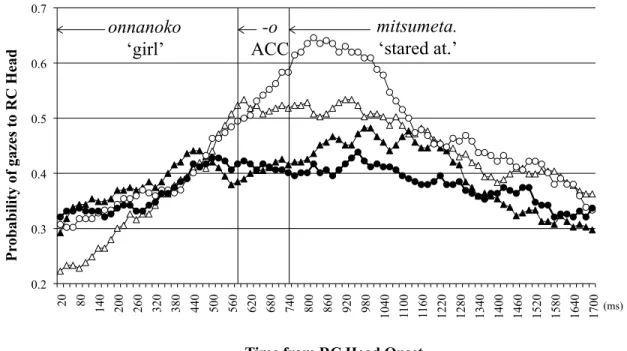
The current study next analyzed the gazes following the RC-head onset to examine the influence of the prosodic cue at the disambiguating information. Figure 2.4 shows the probability of gazes to the RC-head entity from the RC-head onset to 1700 ms.
The first vertical line marks the mean onset of the head noun case-marker (565 ms; SD = 183), and the second line that of the MC verb (719 ms; SD = 197).
Figure 2.4: Probability of gazes to the RC-head entity from the RC-head onset to 1700 ms.
Following the same procedure, the logit of looks to the RC-head entity was analyzed using the same function as in the earlier analysis, for the duration of the RC-head noun (100–600 ms interval following the onset). The results showed no effects or interaction of the two factors (β = -0.01, t = 0.32, p = 0.76 for Visual Context, β = -0.01, t = 0.29, p = 0.81 for Prosody, β = -0.05, t = 1.46, p = 0.14 for their interaction). One possibility is that participants may have delayed structural (re)analysis until they heard a case-marker as it informs the grammatical role of the RC-head NP in a matrix clause. This is consistent with previous studies that showed that case-markers play a critical role in pre-head
0.2 0.3 0.4 0.5 0.6 0.7
20 80 140 200 260 320 380 440 500 560 620 680 740 800 860 920 980 1040 1100 1160 1220 1280 1340 1400 1460 1520 1580 1640 1700
Probability of gazes to RC Head
Time from RC Head Onset
Non-Contrastive context, -Contrastive Intonation Contrastive context, -Contrastive Intonation Non-Contrastive context, +Contrastive Intonation Contrastive context, +Contrastive Intonation
onnanoko
‘girl’
mitsumeta.
‘stared at.’
-o ACC
(ms)
syntactic analysis in Japanese (e.g., Miyamoto, 2002)4. Therefore, another analysis on the logit of looks to the RC-head entity from 100 ms to 800 ms following the case-marker onset was conducted. The 700 ms interval was selected for compatibility with the earlier analysis for the RC verb duration. Table 2.2 summarizes the results.
Table 2.2: Analysis of looks to the RC-head entity from 100 ms to 800 ms following the case-marker onset.
β t p
Intercept -0.06
Visual Context -0.43 4.50 <.001
Prosody -0.02 0.16 0.88
Prosody × Visual Context -0.21 2.20 0.03
The results showed a main effect of Visual Context, suggesting that participants looked at the RC-head entity more in the Non-Contrastive context than in the Contrastive context. This likely reflects the fact that there was only one entity that matches the RC- head noun in the Non-Contrastive context whereas there were two in the Contrastive context (i.e., two girls in the scene). This was supported by an additional analysis on the gazes to the distractor/contrastive entity for this duration, which showed a main effect of Visual Context (β = 0.72, t = 5.04, p < .001) but neither an effect of Prosody (β = 0.09, t
!!!!!!!!!!!!!!!!!!!!!!!!!!!!!!!!!!!!!!!!!!!!!!!!!!!!!!!!
4 Another possibility is that syntactic analysis was delayed until the MC verb was encountered. Although this view is consistent with a head-driven parsing model (Pritchett, 1991), it is clear from Fig. 2.4 that gaze probabilities across conditions started to diverge
= 1.15, p = 0.25) nor an interaction (β = -0.04, t = 0.52, p = 0.60)5. Most importantly, the analysis of looks to the RC-head entity for this time window revealed an interaction between Prosody and Visual Context. Separate analyses for each context type showed that neither of the simple effects of Prosody reached significance although they showed trends in opposite directions and the effect for the Contrastive context was somewhat stronger (β = 0.20, t = 1.45, p = 0.16 for Non-Contrastive context; β = -0.23, t = 1.72, p = 0.08 for Contrastive context)6. The coefficients suggest that in the Contrastive context, participants looked less at the RC-head entity with contrastive intonation than without, which inversely reflected more anticipatory looks to the same entity with contrastive intonation in the earlier time period. In contrast, they looked more at the RC-head entity with contrastive intonation than without in the Non-Contrastive context. This likely indicates that participants interpreted the cue as a simple emphasis in this context, leading to a stronger commitment to the MC analysis in the earlier time period, and that they were more surprised to hear the disambiguating information.
2.3 General discussion
The current study demonstrated that participants used contrastive intonation to predict a syntactic structure when processing relative clause sentences in Japanese. Crucially, the influence of the prosodic cue was observed only when the visual scene provided an
!!!!!!!!!!!!!!!!!!!!!!!!!!!!!!!!!!!!!!!!!!!!!!!!!!!!!!!!
5 The best-fit model included a by-item random slope for Prosody. P-values were computed using the likelihood-ratio (LR) tests.
6 In contrast with the further analyses, Figure 2.4 appears to show a larger difference for the Non-contrastive context than for the Contrastive context. This possibly reflects the difference in temporal location for the effect of Prosody between the two visual contexts;
it occurs earlier in the Non-contrastive context than in the Contrastive context. One possible reason is that the eye-movements in the Contrastive context relate to the shift away from the RC-head entity whereas those in the Non-contrastive context relate to the shift toward it (hence the former occurring later than the latter).!
appropriate context. In the contrastive context, participants made more anticipatory eye- movements toward the RC-head entity immediately on hearing the RC verb when the relative clause had contrastive intonation than when it did not. This suggests that the relative clause analysis was accessed because the manipulated prosodic cue was interpreted in light of the appropriate visual context and not because the cue was marked and thus associated with a less preferred structural analysis (cf. Snedeker and Trueswell, 2003; Weber et al., 2006).
Furthermore, the results also showed a late influence of the prosodic cue after disambiguating information was encountered. The pattern of results was the opposite of what was observed in prediction for the contrastive context: In the Contrastive context, participants looked less at the RC-head entity when the relative clause had contrastive intonation than when it did not. This demonstrates that participants experienced less difficulty at the head as the relative clause structure was already anticipated. This indicates that the probability of the relative clause analysis was inversely correlated with its processing difficulty and thus provides empirical support for processing models that employ predictions to calculate processing cost (Hale, 2001; Levy, 2008). On the other hand, in the Non-Contrastive context, there were more looks to the RC-head entity following the disambiguating head NP when the relative clause carried contrastive intonation than when it did not. This most likely reflects the stronger commitment to the main clause analysis in the earlier time period; the prosodic cue in absence of a contrastive pair was initially interpreted as a simple emphasis but not as contrastive, which corroborated the main clause analysis, and participants experienced more difficulty at the disambiguating information, resulting in more looks to the head entity.
To conclude, the current study provides evidence for the influence of contrastive intonation in both predicting and integrating the RC-head with the relative clause structure in Japanese. The results demonstrate that listeners can use prosody in combination with visual context to make a structural prediction and also that such a prediction is related to the processing cost at the disambiguating information. This study also provides the first evidence for pre-head structural prediction driven by prosodic and visual information in a head-final language.
CHAPTER 3
EFFECT OF SYNTACTIC PRIMING IN PREDICTING A SYNTACTIC STRUCTURE
3.1 Introduction
There is a large body of research investigated how language users correctly analyze the syntactic structure during online sentence comprehension. In particular, research objectives of many previous studies have centered on whether the initial structural analysis is guided primarily by grammatical category information of linguistic input or it is also influenced by other types of information such as lexically-specific information.
This issue is often framed as the evaluation of two influential sentence processing models; the garden-path model and lexicalist constraint-based models (Frazier, 1987;
MacDonald, Pearlmutter, & Seidenberg, 1994). The former posits that only grammatical category information can guide the initial structural building while the latter does that any types of linguistic information such as lexically-specific structural frequency information as well as non-linguistic information such as discourse context can influence the process of determining the initial structural analysis. For example, using an eye-tracking reading method, Trueswell, Tanenhaus, and Kello (1993) investigated the influence of verb- specific structural preference in processing temporarily ambiguous sentences such as (3.1).
(3.1) The student hoped the solution was in the back of the book.
Their results showed that the processing of this structure was easier when the verb prefers a sentence complement over a direct object such as hope than when the verb has an opposite preference such as forget. Trueswell et al. (1993) thus argued in support of constraint-based models that lexically-specific information can immediately influence online structural analysis. There are many reports with similar findings but at the same time there are quite a few studies that found contradictory results (for similar findings, Clifton, Frazier, & Connine, 1984; Garnsey, Pearlmutter, Myers, & Lotocky, 1997;
Stowe, Tanenhaus, & Carlson, 1991; Trueswell & Kim, 1998; Trueswell, Tanenhaus, &
Kello, 1993, for contradictory findings, Ferreira & Henderson, 1990; Frazier, 1987;
Kennison, 2001; Pickering & Traxler, 2003; Pickering, Traxler, & Crocker, 2000;
Mitchell, 1987). The presence of these mixed results makes it somewhat difficult to make a strong claim so as to the immediate access of lexically-specific information.
Another approach to this issue is to exploit the phenomenon of syntactic priming.
It has been shown that after experiencing particular syntactic structure comprehenders tend to access the same syntactic structure in subsequent processing. For example, Ledoux et al., (2007) reported that the ERP response that can be attributed to processing cost due to structural ambiguity (P600) with reduced relative clause sentences such as (3.2) was attenuated when it was proceeded by another reduced relative clause sentence (e.g., The speaker proposed by the group would work perfectly for the program) compared to when it was by a main clause sentence (e.g., The speaker proposed the solution to the group at the space program.)
(3.2) The manager proposed by the directors was a bitter old man.
Importantly, most of previous studies demonstrated that syntactic priming in comprehension is dependent on the repetition of the verb between prime and target sentences (Arai et al., 2007; Branigan et al., 2005; Ledoux et al., 2007; Traxler &
Pickering, 2005; Tooley, Traxler, & Swaab, 2009; Traxler & Tooley, 2008, but see Thothathiri & Snedeker, 2007). This suggests that the representation of syntactic structures are activated in relation with individual verbs and accessed via identifying the same verb, providing evidence for the influence of lexically-specific information on online structural analysis. However, the results from these studies are based on the processing difficulty at disambiguating information (e.g., was in (3.2)), not an effect at the verb where the access to its lexically-specific information should take place.
Therefore, these results are unclear regarding when exactly the effect of priming occurred, to be more precise, it is unclear whether priming influenced the initial structural analysis or only the later integration process in revising an incorrect analysis. The objective of the current study is to investigate an influence of priming on the initial structural analysis in sentence comprehension.
There is some evidence that an effect of syntactic priming occurs as early as it influences the prediction of upcoming argument structures. Arai, van Gompel, and Scheepers (2007) showed that comprehenders predicted the same structure (either prepositional object or double objects structure) as in the prime as soon as they heard the verb. Since they observed the effect only when the verb was repeated between prime and target sentences but did not when it was not, their results indicate that the syntactic representations that were accessed through priming are associated with individual verbs.
Also, since the effect was observed before hearing any postverbal element, their study
provides evidence for the influence of priming on the initial structural analysis. There, however, has been no study so far that reported a similar immediate priming effect with garden-path sentences. One possibility, which was originally implied by Traxler and Tooley (2008), is that the effect of syntactic priming, especially in comprehension, is relatively weak so that it is unlikely to cause comprehenders to immediately access the structurally dispreferred structure before a sentence is disambiguated. Alternatively, however, it is also possible that previous studies did not use an appropriate experimental setting as well as did not test an appropriate structure for this purpose. To investigate this, the current study adopted the visual world paradigm and tested relative clause sentences in Japanese. The visual world paradigm provides an excellent environment to investigate predictive processes, with a number of studies showing the influence of various sources of information on predictions of syntactic structures such as verb semantics (Altmann &
Kamide, 1999), postpositional case-markers (Kamide, Altmann, & Haywood, 2003), prosody (Nakamura, Arai, & Mazuka, 2012; Weber, Grice, & Crocker, 2006), and verb- specific frequency information (Arai & Keller, 2012). Japanese is a head-final language and unlike English, the grammatical head appears following its relative clause, which can provide an ideal setting to investigate an immediate effect of syntactic priming prior to the disambiguation of the sentence structure.
The study in this chapter tested relative clause sentences in Japanese such as (3.3).
(3.3)
Joyuu-ga shanpan-o nondeiru rokkusutaa-to ikitougoushita.
actress-NOM [champagne-ACC drinking] rock star-ACC clicked
‘The actress clicked with the rock star who was drinking the champagne.’
As discussed in Chapter 2, relative clauses in Japanese precede lexical heads without an overt complementizer or any grammatical marking on the verb within the relative clause (nondeiru, ‘drinking’; henceforth RC verb), creating a local syntactic ambiguity between the main clause (MC) and the relative clause (RC) structures on hearing the RC verb. It is known that people typically analyze the verb phrase (shanpan-o nondeiru, ‘drinking champagne’) as a part of the MC structure and are later forced to revise the analysis for the RC analysis on encountering the RC head noun (rokkusutaa-to, ‘rock star’ in (3.3)) (Inoue & Fodor, 1995; Mazuka & Itoh, 1995). Given the results in Chapter 2 that a prosodic cue, provided in an appropriate context, can lead listeners to predict an RC structure as soon as they listened to the first verb in similar RC sentences, it is predicted that if listeners previously experienced the RC structure, they would become more likely to predict the same structure in subsequent processing.
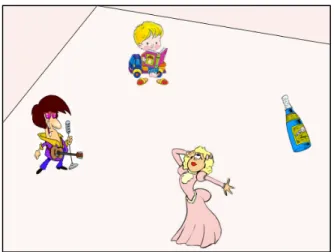
In the current study, predictions in a visual world setting was measured by recording eye-movements of listeners within visual scenes such as Figure 3.1 while listening to auditorily presented sentences. Each picture depicted four objects in a scene, three corresponding to the referents mentioned in the sentence (i.e., actress, champagne, and rock star) and one distractor (toddler).
Figure 3.1: An example target picture.
The visual scene contained a distractor that is implausible as an RC-head candidate (the toddler in the above example as toddlers do not drink champagne). Therefore, the anticipatory looks toward the plausible RC-head candidate but not to the implausible candidate would reflect the prediction of the RC structure. On the other hand, if a listener predicted the MC structure instead, there should not be such a bias because the RC-head entity and the distractor are both perfectly plausible as a continuation following the conjunction toki ‘when’ (e.g., Joyuu-ga shanpan-o nondeiru toki, otokonoko ha hon-o yondeita, ‘When the actress was drinking the champagne, the boy was reading the book’).
The current study asked whether the prediction is modulated by the type of the structure that comprehenders previously experienced. Of course, it is possible that listeners only predict a grammatical category of the relative clause head, not considering the thematic fit between the grammatical head and the relative clause. If this is the case, any difference in looks between the plausible and implausible candidates would be observed even if listeners anticipated a relative clause head. This possibility was checked by examining the looks to the implausible candidate entity (i.e., distractor).
Furthermore, the current study also examined whether the effect of priming is dependent on the repetition of the verb between prime and target sentences. As mentioned above, an effect of priming was often observed only when the verb was repeated between prime and target sentences but not when it was not. Also, previous research showed that the repetition of the verb but not of others is crucial for observing syntactic priming (Traxler & Tooley, 2008). Following these results, some argued that this reflects relatively bottom-up nature of processing in comprehension (Arai et al., 2007). If this holds true for typologically different languages, the same pattern of results should be found in the current study. An alternative possibility is that lexical dependence of syntactic priming is a consequence of the head-initial word order of languages such as English. In these languages, the verb arrives prior to its complements constraining upcoming post-verbal constituents and thus plays an important role in syntactic processing. On the other hand, in head-final languages like Japanese, the verb arrives after the complement phrases. Therefore, other source of information such as case is informative for the pre-head structural analysis (e.g., Miyamoto, 2002; Kamide et al., 2003). This may predict that the repetition of the verb across trials may matter less in priming of syntactic structures in Japanese compared to that in English and that priming may be observed in the absence of lexical repetition as well as in its presence.
Finally, the current study further examined the processing of prime sentences in order to explore the source of a priming effect. It has been argued that syntactic priming underlies the process of implicit learning (Bock & Griffin, 2000; Chang, Dell, & Bock, 2006). In particular, Chang et al.’s SRN-based computational model implemented an error-based learning mechanism and successfully simulated the results of various studies
on syntactic priming. Although theirs is in principle a production model, Fine and Jaeger (in press) demonstrated that a comparable error-based learning model can account for the effect of syntactic priming in comprehension. Thus, if priming with the relative clause structure occurs due to the prediction error in processing prime sentences, evidence that relative clause prime sentences caused larger error than main clause prime sentences should be found.
In order to address these issues, the current study conducted two experiments; in Experiment 1, the first verb was always repeated between prime and target sentences and it was not in Experiment 2.
3.2 Pretest
A sentence completion test was conducted to examine the preference for the main structure over the relative clause structure. Participants were required to come up with continuations to sentence fragments, taken from the experimental items used as target sentences in the experiments. The sentence fragments were composed of a nominative NP, a NP with an accusative marker o, and a verb without morphological inflection such as (3.4).
(3.4) ……
Joyuu-ga shanpan-o nondei…..
Actress-NOM champagne-ACC drink
The verb was not presented in complete form (i.e., nondeiru ‘is drinking’ or nondeita
‘was drinking’) to avoid participants from simply adding a punctuation mark to complete