Pattern Classification Using A Fuzzy Immune Network Model
Weidong SUN Zheng TANG Hiraki TAMURA Masahiro ISHII
(Toyama University, [email protected]) (Toyama University, [email protected]) (Toyama University, [email protected]) (Toyama University, [email protected])
Abstract: It is generally believed that one major function of immune system is helping to protect multicellular organisms from foreign pathogens, especially replicating pathogens such as viruses, bacteria and parasites. The relevant events in the immune system are not only the molecules, but also their interactions. The immune cells can respond either positively or negatively to the recognition signal. A positive response would result in cell proliferation, activation and antibody secretion, while a negative response would lead to tolerance and suppression. Depending upon these immune mechanisms, an immune network model (here, we call it the binary model) based on biological immune response network was proposed in our previous work. However, there are some problems like input and memory in the binary model. In order to improve the binary model, in this paper we propose a fuzzy immune network model.
In the proposed fuzzy immune model, we add a normalization B cell layer for normalizing the large-scale antigen information on the base of the binary model. Meanwhile, a fuzzy AND operator (/\) and a normalization procedure called complement coding were employed in the proposed fuzzy immune model. Compute simulations illustrate that the proposed fuzzy model not only can improve the problems existing in the binary model but also is capable of clustering arbitrary sequences of large-scale analog input patterns into stable recognition categories.
Keywords: Immune Response, Fuzzy immune theory, Immune Network, Pattern Classification
1 Introduction
The biological immune system is highly complicated and appears touned to the problem of detecting and elimi
nating infections; it provides a compelling example of a massively parallel adaptive information processing sys
tem [1]. The immune discipline has attracted biologists who are interested in modeling biological immune net
works and physicists who envisage analogies between im
mune network models and the nonlinear dynamical sys
tems. The theoretical development of immune networks was initiated by Jerne, who constructed a differential equation to describe the dynamics of a set of identical lymphocytes [2]; After that, several theoretical investi
gations and modeling of the immune· system have taken the approach of mapping into coupled nonlinear dynam
ical systems and solving differential equations of motion of corresponding parameters [3]-[6]; Three examples of application about an immune system in an engineering system were given while Fujita et al. described the im
mune system [6]; there are several efforts seeking corre
spondence between GA and the immune system [8]-[12].
However, in these researches the details how an immune response was concretely applied on an engineering sys
tem were not seen.
In our previous work, an immune network model (here, we call it the binary model)based on biological immune response network was proposed [13]. A class of immune networks has since been characterized as a system of
recognition to binary or multiple-valued input patterns [14]-[18]. However, the models of those immune networks were only used for the pattern recognition with an input either 0 or 1 in many cases although the application has been performed with the former various networks. Fur
thermore, they have the problem that they cannot be applied to the large-scale analog pattern classification because not only the consumption of memory becomes remarkably large, but also it is a problem that long time is required for the processing of pattern classification.
On the other hand, to perform its tasks the immune system must be capable of distinguishing self cells and molecules, which it should not destroy, from foreign cells and molecules (antigens), which it should destroy. The enormity of this task has not been fully quantified, but Inman [19] has calculated that the immune system ap
pears to be able to recognize at least 1016 foreign molecules.
Therefore, it is necessary to consider the recognition sys
tem to apply to the large-scale antigen inputs.
Therefore, in order to improve the binary model, in this research we propose a fuzzy immune network model and apply it to pattern classification. The results of simula
tions illustrate that the proposed fuzzy model not only can improve the problems existing in binary model but also is capable of clustering arbitrary large-scale input patterns into stable categories corresponding to large
scale antigen in immune system.
2 Fuzzy Immune Network Model
IL+
TH Cell Layer (Recognition Layer)
B Cell Layer (Comparison Layer)
1-.---II:
Ts Cell Layer t
(Suppresser Layer) t---...-Ab (Error) t
Figure 1: The Model of Fuzzy Immune Network In our previous binary model, we restrict our discus
sion on the interaction between B cells and T cells only, although various cells participate in the immunity mech
anism. The principle cells related to this action are B cells (B), T cells (T), help T cells (TH), suppressor T cells (Ts), antigen (Ag) and antibody (Ab).
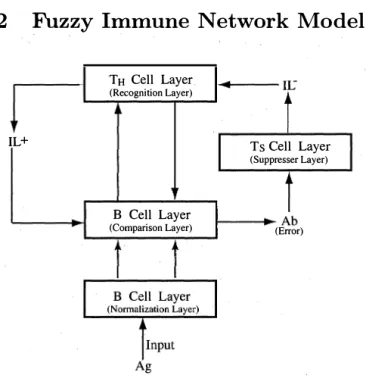
At this time, a normalization layer of B cell is employed in the proposed fuzzy immune model. Fig.1 illustrates the proposed fuzzy immune network model. Here, B cell layer not only involves comparison layer but also involves normalization layer.
In the following simple scheme, we describe the information
processing flow about one cell within immune system.
( 1) Ag( input) ---+ B cell (normalization layer-+ compar
ison layer)-+ Output
When antigen (Ag) invades living bodies, it can be regarded as an input to the immune network and taken in by B cell. Firstly, the information about antigen is normalized in the normalization layer of B cell.
An alternative normalization rule, called complement coding, achieves normalization while preserving ampli
tude information. Complement coding represents both the on-cell and the off-cell to a (see Fig.2, here we let
a present the antigen Ag). To define this operation in its simplest form, let a itself represent the on-response.
The complement of a, denoted by ac, represents the off
response, where
(1) The complement coded input Ag to the recognition sys
tem is the 2N-dementsional vectors:
When normalized information about input Ag is re
ceived at the recognition layer of B cell , it is transformed
into a pattern of activation across the B cells and trans
ferred to the next stage of TH cell layer.
(2) Output ---+ TH cell ---+ IL+
TH cell can recognizes the antigen information from B cell and secretes the interleukin (IL+) that activates the immune response.
(3) IL+---+ B cell---+ Antibody (Ab)
The interleukin (IL+) becomes the second signal to the B cell. Once B cell recognizes this signal,· it divides into antigen synthetic cells (plasma cells), and then synthe
sizes and secretes the antibody finally. Here, B represents both the B cell and plasma cell.
( 4) Antibody ---+ Ts ---+ IL-
If the antibody excludes the antigen, we can say that the immune of living body is effective. At this time, the suppressor Ts cell will be stimulated to secrete suppress
ing interleukin (IL-) to suppress the immune response.
The immune response is finished as long as the genera
tion of the antibody stops.
According to the immune response process mentioned above we can obtain an important features about the proposed fuzzy model: the normalization layer plays an important role on the antigen information processing in the system. This makes the proposed fuzzy model to be possible for applying to large-scale antigen inputs.
B Cell ( I = a, ac )
(Comparison Layer)
B Cell (a )
(Normalization Layer)
Here, let Ag be a. a= a1, az , ... ,aN ( ) Ag
Figure 2: Complement Coding Uses On-Cell and Off-Cell Pairs to Normalize Input Vectors
3 Algorithm
We resume that the number of B cell in B cell layer is N and the number of T cell in TH cell layer is M.
In the proposed fuzzy model, the antigen corresponds to input; B cell corresponds to attention subsystem as a feature representation field; TH cell corresponds to ori
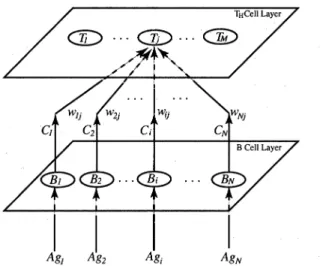
enting subsystem as a category representation field; Ts cell corresponds to suppressing layer and antibody (Ab) to the error between the input pattern and the memory pattern. The network is connected by connection circuits between B cell layer and TH cell layer:w1 (j = 1, 2 ... M)
(weight vector) .It is worth noting that the weight vector in this fuzzy model subsumes both the weight vectors from B cell layer to TH cell layer and the weight vectors
Figure 3: Weight Connections From B Cells To TH Cells.
from TH cell layer to B cell layer. The initial values for these weights are chosen to be equal to 1, so for all j:
W1 = . . . = Wj = . . . = WN = 1 (3) The value is also critical; if it is too small there will be no matches at the B cell layer and no training.
When antigen (Ag) is received at the stage B cell layer, it can be regard as input of our model. This is called anti
gen presentation. Each input Ag is an N-dimensional vector(Ag1, Ag2, . . • AgN ) , where each component Agi(i = 1, 2, . . . N) is in the interval [0, 1]. The information about antigen is normalized according to equations (1) (2).
When normalized information is received at the recog
nition layer of B cell, each B cell whose activity is suffi
ciently large generates excitatory signals along pathways to target cells at the next processing stage TH cell layer
(see Fig. 4). When a signal from a B cell in B cell layer is carried along a pathway to TH cell layer, the signal is multiplied, or gated, by the pathway's Trace Wj. The gated signal, we let it u, reaches the target: TH cells.
Namely, for j = 1, 2, ... M:
(4)
where o: is a choice parameter o: > 0, the fuzzy AND operator 1\ is defined by
(zl\y)i =min(zi,Yi)
and where the norm I Dl is defined by
IZI = .L":N Izil
i=l
(5)
(6) In the following process TH cell will choose the cell, which receives the largest input by competition interac
tion. That is to say, the TH cell that received the largest stimulus can be chosen and we let it Ujmax.
Ujmax = max{ Uj : j = 1, 2, ... M} (7)
Pattern Classification Using A Fuzzy Imm u n e Network Model
At this time TH cell which has the value of Ujmax can secrete interleukin (IL+). The interleukin (IL+) is then weighted and sent back to B cells once again by the path
way of w1 (see Fig. 5). We call it memory pattern.
The interleukin (IL+) becomes the second signal to the B cell. Once B cell recognizes this signal, it divides into antigen synthetic cells (plasma cells), and then synthe
sizes and secretes the antibody finally. Here, antibody is regarded as the error between the input pattern and memory pattern. We use the fuzzy AND operator to compute the error as follow.
Ab( error ) _ - lAg 1\ Wjmax I
IAgl < p (8)
where, p, which is called vigilance parameter, is set in the range of 0 to !,depending upon the degree of mismatch that is to be accepted between the memory vector and the input vector. The input pattern mismatch occurs if the inequality (equation (8)) is true.
If the error is less than the vigilance parameter, a re
set signal is sent to disable the firing unit in the TH cell layer. The effect of the reset is to force the output of the TH cell layer back to zero, disabling it for the duration of the current classification in order to search for a better match. Namely, in this case inhibitory interleukin (IL-)
is secreted from the Ts cells. The inhibitory interleukin (IL-) tends to suppress the TH cells that secrete the ex
citatory interleukin. Thus, a new competition in TH cell layer occurs. The same process will be repeated while the error is decreased below the vigilance parameter.
If the error is bigger than the vigilance level, the mem
ory pattern must be searched, seeking one that matches the input vector more closely, or failing that, terminating on an uncommitted cell that will then be trained. That is to say, the winner jmax is accepted and it represents the category of this kind of antigen, i.e., the recognition for this kind of antigen of immune network is success
ful. And then the network enters a training cycle that modifies the weight w1.
Training is the process in which a set of input vectors are presented sequentially to the input of the network, and the network weights are so adjusted that similar vee-
Figure 4: Weight Connections From TH Cells To B Cells.
tors activate the same TH cell. If the same antigens in
vade once again, the immune response can be activated by the network recognition rapidly; a large quantity of antibodies is generated in a very short period (the sec
ondary immune response). The adjusting weight equa
tions can be given
(new) _ (3(A (old) ) (1 (3) (old)
wjmax - g 1\ wjmax + - wjmax (9) where, (3 is a learning rate parameter, (3 E [0, 1], it defines how· quickly prototypes converge to the common mini
mum of all input patterns assigned to the same cluster.
Input Pattern 0 Category I
Trial I 0={0.1,0.7} _,._ (Ab = 1.0 1 {0.1, o.7} > 0.8) 1
Input Pattern P Category I
P={0.7, 0.9} .... 1 {0.1, o.7} 1
Trial
' (Ab = 0.5 < 0.8)
2 Category 2
1 {0.7, o.9} 1
(Ab = 1.0 > 0.8) Input Pattern Q Category I
Q={0.5, 0.9} .... 1 {0.1, o.7} 1
' (Ab = 0.57< 0.8)
Trial Category 2
3 1 {0.7, o.9} 1
(Ab = 1.0 > 0.8) Upgrade+
1 {0.68, o.9} 1
Adjusted Category 2
Figure 5: The Matching Process of Input Patterns.
4 Simulations
Simulations on the proposed fuzzy immune network are described in this section. Antigen is regarded as an input in our simulations.
4.1 Matching process
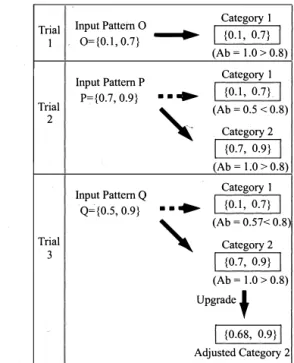
Firstly, in Fig. 5 we give the matching process of pat
terns 0, P and Q in detail to illustrate the effectiveness of the proposed fuzzy immune network model. It consists of two columns: input pattern on the left column and category on the right column. On the left column, the top equations show the original input pattern 0, P and Q. On the right column, memory pattern in the middle, category number on the top and ·the Ab (error) com
puted by the equation (8) on the bottom are presented respectively. In addition, system vigilance pis set to 0.8.
The first row on trial 1 shows that pattern 0 estab
lishes the category 1 when there is no any other pattern
in the system and the computed error is bigger than sys
tem vigilance. The second row on matching 2 shows the response of memory pattern 0 (category 1) to the input pattern P. The input pattern and memory pattern are matched and the value of error between them is com
puted to be 0.5. Because the system vigilance is 0.8, the
error (0.5) is less than vigilance (0.8). It suggests that the input pattern P is not belong to category 1. There
fore, category 1 is suppressed, namely IL- is secreted.
Then pattern P establishes its new category 2. In the third row on matching 3, category 1 and category 2 re
sponse to the stimulus of input pattern Q. When the error is computed to be 0.57, category 1 is suppressed.
In category 2, the error is computed to be 0.9 which is bigger than the system vigilance (0.8). Thus, the input pattern Q is classified into this category 2. And then the memory pattern in category 2 is adjusted.
4.2 The Difference Between Two Immune Network Models
In the proposed fuzzy immune network model, a fuzzy AND operator is employed, while in the binary immune network this kind of operator is not used. In the binary immune network [13], the input pattern for learning is restricted in either 0 or 1. When we employ the fuzzy AND operator, it becomes to be possible for the proposed fuzzy immune network model to learn and cluster the arbitrary sequences of large-scale analog input patterns as well as binary patterns.
In this simulation we compare the system action be
tween the binary immune network and the fuzzy immune network. System vigilance is set to 0.8 in each model.
Parameter e is set to 0.001 in the fuzzy immune net
work. The values of input vectors are either 0 or 1 in the binary immune network, but in the fuzzy immune network the values of input vectors are varieties in the interval [0.0, 1.0].
10
Binary Inumme Network
Fuzzy Inumme Network
1000 2000 3000 4000
fuput Pattern Nwnber
Figure 6: The Change Situation of Vector Size.
Fig.6 shows the change of vector size with the input pattern number. When input patterns increase, the vec
tor sizes also increase in both the binary immune network and fuzzy immune network. But under the same input
300
Blnary hnmune Networl<
1000 2000 3000 4000.
Input Pattern Nmnber
Figure 7: The Relation Between Input Pattern Number And The Category Number.
1600 '""
-::; i:
� 800
1000
Binary Model
2000 3000
Input Pattern Nwnber
4000
Figure 8: The Change Situation of Clustering Speed.
pattern number, the vector size of the binary immune network is larger than that of fuzzy immune network.
This is because the input value of variety dimension is only 0 or 1 and if there is no lar_ger size then it can
not work for the input pattern in the binary immune network. In contrast, in the fuzzy immune network the input value of variety dimension is variety in the interval [0.0, 1.0], it can work for the input pattern even if there is smaller size only.
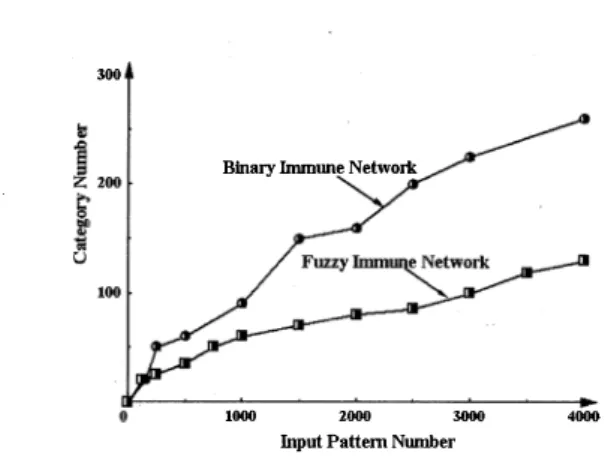
Fig. 7 shows the relation between input pattern number and category number. It illustrates that under the same input pattern number, the category number in the fuzzy immune network is less than that in the binary immune network.
In Fig.8, the Y-axis presents the clustering time until the classification finishes; the X-axis presents the input pattern number. It represents the change of clustering speed with the increase of category number. When the input pattern number is around 500, the difference of speed between two immune networks is almost zero. But, when the input pattern number is over 500, the remark
able difference can be seen between two immune net
works. It suggests that the clustering time is shortened in the fuzzy immune network. It can be considered as
Pattern Classification Usi n g A Fuzzy Immune Network Model
that the size of used memory in the simulation is remark
able smaller because both category number and vector size are smaller in the fuzzy immune network than that in the binary immune network.
4.3 The clustering performance of fuzzy model
This section presents clustering examples for the pro
posed fuzzy model discussed in the previous section. A pattern set, consisting of 100 different patterns, is used to analyze and compare clustering performances. Pat
tern values are taken from the interval [0.1,1.0] to fit the input restriction. Patterns are presented in different random orders. For definiteness, let the input I consist of two-dimensional vectors a preprocessed into the four
dimensional complement coding form. Thus, a formula of the concrete normalized input pattern can be given as following:
Thereby, the size of weight vector becomes doubles. Among these normalized input patterns the portion (portion of a) of the first half is performing fuzzy AND operation and the portion (portion of ac) of the second half is per
forming fuzzy OR(XVY =max( xi, Yi)) operation in the operation with a weight vector. In this case, as shown in Fig.6, each category j has a geometric representation as a rectangle Rj. The weight vector can be written in complement coding form:
(11) where Uj and Vj are two-dimensional vectors. Let vector Uj define one corner of a rectangle Rj and let Vj define another corner of Rj. The size of Rj is defined to be
(12) which is equal to the height plus the width of Rj in Fig.9.
1
I Rj r
uj
0 1
Figure 9: Each Weight Vector Wj Has A Geometric In
terpretation As A Rectangle Rj with Corners ( Uj, Vj).
In our simulations, portion of a is presented in X-axis and portion of ac is presented in Y-axis. Thus,the simu
lation results can be presented in two-dimensional graph (see Fig.10).
W1 = (0.1, 0.4.0.4, 0.2)
= ((0.1, 0.4), (0.6, 0.8)c)
W2 = ((0.7, 0.2), (0.9, 0.9)c)
W3 = ((0.3, 0.1), (1.0, 0.3)c)
W4 = ((0.3, 0.9), (1.0, l.O)c) w5 = ((0.1, 0.1), (0.2, 0.3n
W6 = ((1.0, 0.4), (1.0, 0.8n
W7 = ((0.1, 0.9), (0.2, l.O)c)
With higher learning rate f3 = 1.0, the first adaptation of a category toward an input pattern not yet lying within its area, stretch,the according rectangle to the minimum area, covering all patterns assigned to the same category for at least one time. With f3 = 1.0, a stable system network state is reached as soon as all training patterns have been presented just one time.
Second, we let the learning rate f3 = 0.1, namely, the system is in the slow-learning rate mode. In this case, the category rectangles do not tend to overlap that often.
Fig.10(c) shows the clusters with same vigilance, but lower learning rate than in Fig.10(a), after adaptation to the same random training sequence. Because training stopped when each pattern was presented at least one time, category is in a non-stable state. Fig.10(d) shows the clusters when pattern presentation is continued until each pattern is processed at least ten times. Categories now reached their stable values. The number of cate
gories increases from four to seven. This illustrates that with learning rate f3 < 1.0 the number of categories, as well as the distribution of patterns to clusters, might vary through out pattern presentation as long as cate
gories have not yet reached their stable equilibrium. In Fig.10(e), system vigilance parameter p is raised to 0.6 and the other parameters are the same with those used in Fig.10(d). The number of categories increases from 7 in Fig.10(d) to 10 in Fig.10(e). This illustrates that at a high value of p the network makes fine distinctions; on the other hand, a low value causes the grouping of in
put patterns that may be only slightly similar. Fig.10(f) uses the same values for parameters f3 and pas Fig.10(e).
Each pattern is again presented at least ten times, but in a different order. The example demonstrates that even lower vigilance do not necessarily prevent category from overlapping. The number of resulting clusters depends not only on vigilance parameter p but also on the order of pattern presentation.
Continuously, we gave the trials of clustering perfor
mance for higher dimensional data with the proposed immune algorithms. Here, the task is to discover the bi
ological immune system states by analyzing the shapes of specific time dependent variety signals. Input patterns in
this case do not cover the whole multidimensional input space, but tend to form groups in geometrically sepa
rated areas.
We focus whether our algorithm based on the proposed fuzzy immune model has the ability or not to either dis
cover stable categories of patterns with a minimum re
quired similarity or to set up recognition maps of an in
put space. In the meantime, we also observed the effects of noise to the clustering performance, since input pat
terns will always vary, even when representing exactly the system state.
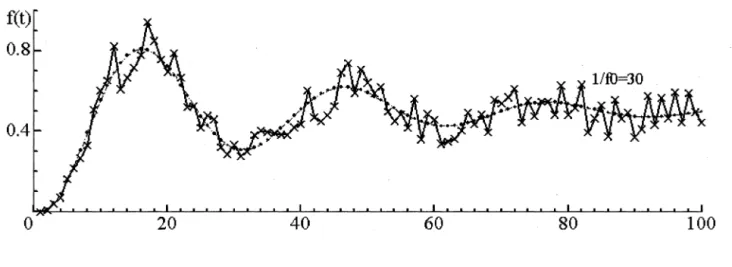
As shown in Fig.ll as an example for a more general signal shape, we examined the clustering capabilities of our network by using step response of second-order sys
tems. The response function is normalized so that the resulting converges around a value of f(t) = 0.5.
f(t) = 0.5[1-e-(wot(cos g(t)
g(t)
c
+c sin g(t))] (13)
wo ty'1=(2
( (14) (15)
Input vectors are formed out of 100 consecutive values of f(t) with t = 1, 2, . . . 100. A useful property of the step response is the fact that it is completely defined by two physical parameters, eigenfrequency fo = w0/2n and damping(. Therefore, input patterns as shown in Fig.ll, as well as clusters, can be depicted in a two-dimensional PT2-parameter plane to illustrate the influence of dif
ferent network-parameter variations. The period length of the step responses in terms of inverse eignfrequency is varied from 10 to 100 time intervals in steps of ten.
The damping is varied from 0.1 to 0.9. Step responses of the training-pattern set are equally distributed over this physical parameter plane, but represent points in discrete subareas of a 100-dimensional pattern space. So in contrast to the two-dimensional pattern set of the pre
viously, there are geometrical preferences for clustering, which should be discovered independently of the random order in pattern presentation. Since exclusively damping and eigenfrequency determine the shape of the trained step responses, networks are expected to set up clusters, including shapes referenced by neighboring points in the parameter plane. The training set is presented in random orders, as with the two-dimensional pattern set.
Generalization capabilities of our network are tested by classifying the pattern set with previously trained net
works and learning rate f3 = 0, after any pattern has been corrupted with a random white noise (see Fig.13).
The more noisy patterns are assigned to the clusters of their undisturbed origins, the higher is the quality of generalization.
Fig.13 shows clustering examples of step responses in fast-learning mode, learning rate f3 = 1.0, and slow
learning mode, f3 = 0.01. The random pattern sequences
Pattern Classification Usi n g A Fuzzy I m mune Network Model
r = 1.0, p=O.S r = 1.0, p=0.5
a2���--���--r-�-.--r-.-�
1.0 0.8 0.6 0.4 0.2
0
·"-
a?
1.0 0.8 0.6 0.4 0.2
0
a2
1.0 0.8 0.6 0.4 0.2
0
0.2
I [II [II [II 4 [II
li!l @
[II @
[II ®
[II @
@ @
li!l ® [II [II [II li!l I
0.2
0.2
0.4 0.6
(a) 0.8
r = 0.1, P =0.5, iteration=!
I I I
li!l [II [II 1!!1 1!!1 1!!1
[II li!l li!l 1!!1 ® li!l
• • • 1 • • •
@ @ @ @ 1!!1 •
® 2 ® ® liil li!l 1!!1
® ® ® ® li!l li!l
@ @ @ @ li!l •
® • • li!l li!l li!l
® ® li!l li!l li!l li!l
li!l liil li!l 1!!1 liil liil
I I I
0.4 (c) 0.6 0.8
t· = 0.1, P =0.6, iteration=l 0
0.4 (e) 0.6 0.8
I
1!!1 1§1 -
li!l 1!!1 li!l 1§1 liil 1!!1
""3 li!l -
li!l li!l liil liil - li!l li!l li!l liil - liil 1§1
L
1.0 a1
1.0 a1
1.0 0.8 0.6 0.4 0.2
0 0.2 0.4 0.6
(b) 0.8 1.0 ai
a2.-����������--,-,
1.0 0.8 0.6 0.4 0.2
0 0.2 0.4
(d) 0.6 0.8 1.0 a I
a2 r = 0.1, P =6.6, iteration=lO (different order) 1.0
0.8 0.6 0.4 0.2
0 0.2 0.4
(f) 0.6 0.8 1.0 al Figure 10: The Two-Dimensional Clustering Performance of 100 Random Input Patterns for Our Fuzzy Immune Model. Variety of Marks Present The Spatial Positions of Input Patterns. Patterns Assign to A Common Cluster Are Marked With An Underlying Gray Shade.
f(t)
1/f0=90
0 20 40 60 80 100
0.8
llf0=30
0.4
0 80 100
Figure 11: Step Response of Second-order System (PT2) With Different Eigenfrequencies And Dampings. Input Patterns Consists of 100 Samples Taken At Equidistant Time.
Figure 12: PT2 Step Response With Period Length 1/ fO = 30 And Damping ( = 0.15. The Original Signal (Dotted Lline) Is Corrupted by A Random White Noise with Maximum Amplitude 0.25.
100 80 60 40 20
100 80 60 40 20
r = 1.0, P=0.7
0.10 0.15 0.25 0.35 0.45 0.55 0.65 0.75 0.85 0.90�
(a)
r = 0.0 I, p =0. 7, iieration=200
0.10 0.15 0.25 0.35 0.45 0.55
(c)
Pattern Classification Usi n g A Fuzzy Immune Network Model
100 80 60 40 20
r = 1.0, p =0. 7, (different order)
0.10 0.15 0.25 0.35 0.45 0.55 0.65 0. 75 0.85 0.90 ( (b)
r = 0.0.1, p =0.85, iteration=200
0.10 0.15 0.25 0.35 0.45 0.55 0.65 0. 75 0.85 0.90 ( (d)
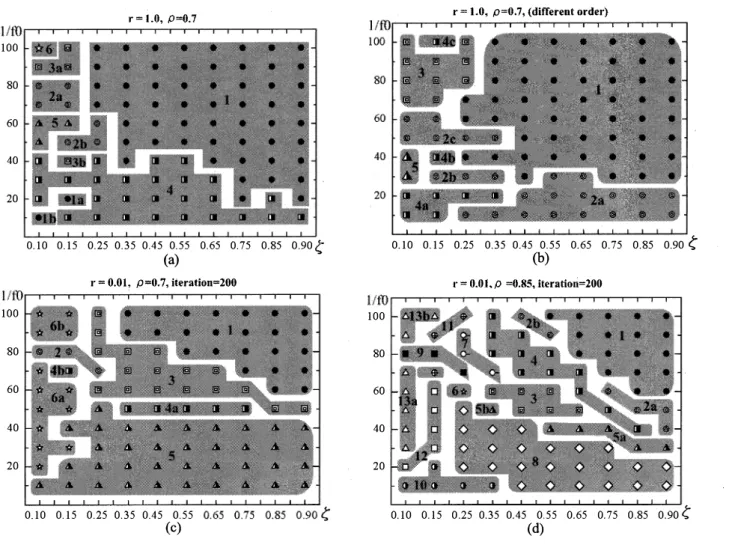
Figure 13: High-dimensional Clustering Performance of Our Fuzzy Immune Network. Step Response of Second-order System Are Defined by The Eigenfrequency and Damping(, Marked On The Parameter Plane. Gray Shades Group Neighboring Patternsin The Parameter Plane, Assigned To The Same Category.
were presented with a minimum of one presentation per pattern with {3 = 1.0, and 200 presentations per pattern with {3 = 0.01. Fig.13 (a) shows an example of fast
learning with vigilance set to p = 0. 70. The network set up six categories on the pattern set. The patterns of category 4 are distributed over up to three separate coherent areas on the parameter plane. The category numbers represent the temporal order during training in which prototypes were accessed for the first time. Cat
egories in Fig.13 (b) are set up with the same network
parameters but a different random order in pattern rep
resentation. The scene is again dominated by a huge cat
egory 1 and several additional categories, dividing the PT2-parameter plane in distinctly different categories.
Categories 1, 2 and 3 are split in up to several separate areas. This illustrates that the clustering of our network remains incoherent in the physical parameter-plane and highly dependent on the order of pattern presentation.
In Fig.13(c) slow-learning mode, six categories were set up, showing the same characteristics as with Fig.( a) and Fig.(b) in fast-learning mode. Except this property, in
Fig.13(d) the category number was raised to 13 when using high vigilance, showing the same functions of vig
ilance as with two-dimensional pattern data.
5 Conclusion
In this paper, we proposed the fuzzy immune network model for improving the binary model proposed in our previous work. In the fuzzy model we introduced the B cell normalization layer and employed the fuzzy AND op
erator A in the algorithm. Computer simulation tested the dynamic of the fuzzy network model and illustrated that the proposed fuzzy model was able to solve the problems like input and memory that exist in the binary model.
By establishing the fuzzy immune network to which the analog input pattern between 0 and 1.0 correspond from the simulation results, it changed so that application to large-scale pattern recognition could be performed and the proposed fuzzy immune model turns out to be an effective, transparent clustering algorithm.
Properties of our networks depend on two main param
eters, p and (3. Higher vigilances increase the total num
ber of categories set up on a static pattern set. Learning rate (3 regulates adaptation of stored categories toward input patterns. If no geometric preferences are given for a specific pattern set, the number of categories is also slightly dependent on the order of pattern presentation.
Two-dimensional pattern sets illustrated the geomet
ric nature of clustering. The proposed fuzzy model uses the degree of an input pattern being fuzzy subset of a stored prototype to measure the similarity between two patterns. When using complement encoded input pat
terns, prototypes converge toward the common MIN- and MAX-values of all patterns assigned to the according cat
egory. Categories separate the pattern space along the pattern space axes.
The example of sampled PT2-step responses in our simulation illustrated that the clustering of the proposed fuzzy model can even be incoherent in the physical pa
rameter space. When all training patterns are enclosed by the MIN- and MAX- bounds defined by the proto
types, all network weighs are fixed. The extension of prototypes is limited by the vigilance parameter p. Once the maximum extension of a prototype has been reached, no further patterns are assigned to the according cate
gory not lying completely within the MIN- and MAX
borders. This makes our network highly sensitive to ad
ditional noise on trained input patterns and its output unpredictable. Even if the geometric distribution of in
put patterns in pattern space gives preferences for the distribution of these patterns to categories. The clus
tering of our network remains highly dependent on the random order of pattern presentation and tends to be incoherent in pattern space.
References
[1] S. A. Hofmeyr, S. Forrest," Architecture for an Arti
ficial Immune System" ,Evolutionary Computation 7(1):45-68,by the Massachusetts Institute of Tech
nology,1999.
[2] N.K. Jerne, "Towards a network theory of the im
mune system," Ann. Immunol, vol.125c, pp.373-389, 1974.
[3] Theoretical Immunology, Parts I and II, Edited by A. S. Perelson, Addison-Wesley, Redwood City, CA, 1988.
[4] A. S. Perelson, "Immune Network Theory", Im
munology Review, 110, 5-36, 1989.
[5] Theories of Immune Networks, H. Atlan and I.R.Cohen, Eds., Springer-Verlag, Berlin, 1989.
[6] J. Faro and S. Velasco, "Studies on A Recent Class of Network Models of the Immune System", J.Theor. Bioi. 164, 271-290, 1993.
[7] Hiroyuki Fujita, Kazuyuki Aihara, "A Distributed Surveillance and Protection System in Living Or
ganisms." T. lEE Japan, Vol. 107-C, NO. 11, pp.l042-1048, 1987.
[8] R.Hightower, S, Forrest, and A.S. Perelson, "The evolution of secondary organization in immune gene libraries." Proc. Second European Conference on Artificial Life, 1993.
[9] S.Forrest, B.Jovornik, R.E. Smith, and A.S. Perel
son, "Using genetic algorithms to explore pattern recognition in the immune system." Evolutionary computation, N0.1, pp.l91-211,1993.
[10] J.D.Farmer, N.H.Packard, A.S.Parelson, "The Im
mure System, Adaptation, and Machine Learning", Physical, D 22, 187-204, 1986.
[11] J.D. Farmer, " A Rosetta Stone for Connectionism."
Physic, No. D42, pp.l53-187, 1990.
[12] H. Bersini and F. J. Varela, "The immune recruit
ment mechanism: A selective evolutionary strat
egy," Proc. ICGA-91, pp.520-526, 1991.
[13] Z. Tang, H. Hebishima, K. Tashima, D. Ishizuka and K. Tanno, "An immune network based on bio
logical immune response network and its immunity,"
IEICE Trans. Fundamentals, IEICE Trans., vol.J80- A, No.11, pp.l940-1950, Nov.1997.
[14] K. Takenaka, Z. Tang, K. Tashima, D.Ishizuka and K.Tanno," An ImmuneNetwork for Pattern Recog
nition," In Proc.NOLTA'97,vol.l,ppl89-192,1997.
[15] K. Tashima, Z. Tang, K. Takenaka, D.Ishizuka and K.Tanno," A self-organized Immune Network," In Proc.NOLTA'97,vol.l,pp.l93-196,1997.
[16] Z. Tang, T. Yamaguchi, K. Tashima, 0. Ishizuka, K. Tanno, "A Multiple-Valued Immune Network and Its Applications", IEICE Trans., Fundamentals, Vol. E82-A, N0.6 June, 1999.
[17] T. Yamaguchi , Z. Tang, 0. Ishizuka, K. Tanno,
"Adaptive Multi-Valued Immune System", I.IEE Japan. Vol.121-C, No.11, pp.l747-1754, 2001.
[18] Z. Tang, K. Tashima, Q. P. Cao, "A Pattern Recog
nition System Using Clonal Selection-Based Im
mune Network", IEICE Trans., vol. J84-D, No. 12, pp. 2615-2622, Dec. 2001.
[19] Inman, J. K., The Antibody Combining Re
gion: Speculations on the Hypothesis of Gen
eral Multispecificity. In G.I.Bell, A.S.Perelson, and J.G.H.Pimbley (Eds.), Theoretical immunology, pp.243-278. NY: Marcel Dekker, 1978.