The Journal of Social Sciences and Humanities (Jimbun Gakuho), No.514-2 (Social Anthropology 11) Graduate School of Humanities, Tokyo Metropolitan University, March 2018
65
For a Man Who Never Dies and Who Eats His Revival of Clan in Local Communities of the Igembe
Own:
in Kenya
Department of Social Anthropology,
Shin-ichiro Ishida Tokyo Metropolitan University I. Introduction
On Thursday, 11 August 2016, I observed a collective cursing ceremony (Case 1) in Mwithune village') of the Kirimampio Location in the northeastern part of the Igembe Southeast Division') of Meru County in the Kenyan central highlands. The event was organised by the Antuambui clan31, and attended by its members, their neighbours, their ichiaro men4>, and administrative officers. People in the clan community had experienced various misfortunes and problems they thought were caused by unknown ill-wishers or sorcerers hiding in their neighbourhood. The aim of cursing was to remove all these sources of harm from the village.
The cursing ceremony involved killing and burning a sacrificial sheep (ewe) of a single colour (mwiiri yumwe)5>, after which every person in the neighbourhood was required to prove his/her innocence of bringing harm to the village by jumping over the body of the dead animal. This ceremony was called utaara ngeere in the KimiIru language . On 11 August, I watched as a small nulliparous ewe (kamwati)—all of whose orifices (tukutho) had been stitched up61—was wrapped in dried banana leaves (ndaara), tied with grass fibre ropes (mirii), and placed in a fire in front of the people who were attending the ceremony. Some people cursed the body in the fire, while others sang and danced in groups. While the corpse was being burnt to ashes, ichiaro men interrogated every person in attendance (see note 4) as to whether he/she practiced witchcraft. After replying 'no', each person was required to jump over the sheep's remains, to prove his/her innocence in the presence of the ichiaro men .
All the people who lived in the neighbourhood were informed in advance that with the exception of pregnant women or young children , everyone was obliged to attend the ceremony, and any person who failed to attend might be regarded as a suspect responsible for misfortunes and damages that had been reported in the community . They were also required to surrender, bring, or report any suspicious items known to be in someone's personal possession or found in their neighbourhood, to elders designated as ichiaro men, before jumping over the sheep. Interestingly, some people did bring different items such as accessories or animal horns that they thought might be regarded as something harmful to themselves and their neighbours.71
As I describe in this paper, the utaara ngeere collective cursing is an organised event that must involve all members of a concerned clan community, and thus requires strong leadership.
It may only work temporarily for remedial purposes, or it may entail the clan's revival, after which it is eligible to become a permanent welfare group. This paper observes that the above Antfiambui clan community experienced a revival of clanship while organising the collective cursing, and after it had been completed. On the other hand, the Anjaru and Antuambeti clans in the neighbouring Athiru Gaiti Location in the same Igembe Southeast Division organised two cases of utaara ngeere in May 2016 (Case 2) and September 2015 (Case 3) respectively, but only for remedial purposes.
In my previous paper on homicide compensation in Muringene village8> (Ishida 2017), I observed that the agnatic clan of Athimba had continued to develop its clanship over the previous fifteen years—while other people in the Igembe community had become less conscious of their clanship after the land distribution process was completed in the early 2000s—and in this regard the Athimba clan in the Muringene village was, in my observation, an exception. However, as this paper illustrates, other clans in the Igembe Southeast Division began to enhance their governance arrangements in the changing socio-political environment that developed under the new leadership of the Miriti age group9). The revival of clanship in Mwithune village was consonant with the community-policing programme initiated by the government, which aimed to enhance security at the grass roots, and also, it seems, to foster political autonomy in local communities. This paper shows how the Antuambui clan would be `a man who never dies', and 'a man who eats his own'—with reference to the common greeting used to address all members of a clan community as one10). For comparative purposes, this paper also observes another revival attempt in the Akachiu clan in the same Kirimampio Location (Case 4).
1I. Utaara Ngeere on 11 August 2016: Case 1
At the cursing meeting on 11 August 2016 in Mwithune village, the host Antuambui clan invited sixteen elders, called ichiaro men' hereafter in this paper, each of whom had reciprocal ichiaro counterpart(s) living in the clan community, such as Antuambui clan agnates, their wives, or migrants from a clan with a different clan origin. In another case of group cursing observed in Muringene village in September 2012 (Ishida 2014), the host invited six ichiaro men to attend the meeting. The two cases were not only different in terms of the number of ichiaro men who were invited, but in their purposes; While the Muringene's case was intended to solve problems within a single family, the Antuambui's case was intended to restore peace in the entire village of Mwithune—which had many more inhabitants. Nevertheless, the two cases were similar in the sense that ichiaro men were selected with due consideration given to the biological status of every member of the community in question. Theoretically speaking, every woman who had married into the Antuambui clan of Mwithtine village, for example, should ideally be interrogated as to whether or not she had any harmful items by her biological (her natal clan's) ichiaro man,
Revival of Clan in Local Communities of the Igembe 67
rather than by her husband's ichiaro counterpart. This local theory of biological determinism (Ishida 2014) was also applied to migrants in the community.
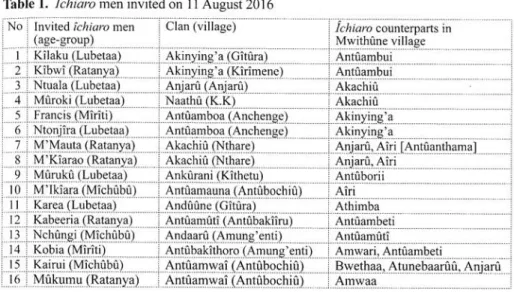
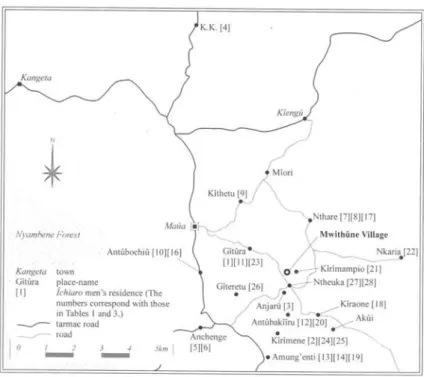
People of the Antuambui clan consulted well-informed elders, who figured out the biological status of every member in the village, to help them decide who should be invited to attend in the capacity of Ichiaro men. Table 1 provides the list of the ichiaro men who attended the 11 August ceremony, which was slightly different from an earlier one made in the consultation with the elders. Two men from the Akinying'a clan visited the village as ichiaro to Antuambui, while the others were invited to serve as ichiaro for their wives and migrants with different clan origins.
Table 1. Ichiaro men invited on 11 August 2016 No
1 2 3 4 5 6 7 8 9 10 11 12 13 14 15 16
Invited ichiaro men (age-group) Kilaku (Lubetaa) Kibwi (Ratanya) Ntuala (Lubetaa) Muroki (Lubetaa) Francis (Miriti) Ntonjira (Lubetaa) M'Mauta (Ratanya) M'Kiarao (Ratanya) Muruku (Lubetaa) M'Ikiara (Michubu) Karea (Lubetaa) Kabeeria (Ratanya) Nchungi (Michubu)
---
Kobia (Miriti) Kairui (Michubu) Mukumu (Ratanya)
Clan (village)
Akinying a (Gitura) Akinying'a (Kirimene) Anj aru (Anj aru) Naathu (K.K)
Antuamboa (Anchenge) Antuamboa (Anchenge) Akachiu (Nthare) Akachiu (Nthare) Ankurani (Kithetu) Antilamauna (Antfbochiii) Anduune (Gitura) Antuamuti (Antubakiiru) Andaaru (Amung'enti) Antubakithoro (Amung'enti) Antfamwai (Antiiboch1U) AntUamwai (Ant0bochi(1)
Ichiaro counterparts in Mwithune village Antuambui Antuambui Akachiu Akachiu Akinying a
Akinying'a
Anjaru, Airi [Antuanthama]
Anjaru, Airi
Antuborii Airi Athimba Antuambeti Antuamuti
Amwari, Antuambeti
Bwethaa, Atunebaaruu, Anjaru
Amwaa
According to James, the clan secretary, the Antuambui clan had accommodated and initiated a migrant family with Antuborii clan origins into its village/clan community in the 1950s. The father of the Ithalii age group from the Antuambui clan had been the assistant chief of the then Thaichu Sublocation (the present Igembe Southeast Division) under colonial administration in the late 1950s, while his successor was from the migrant family just mentioned with the Antuborii origin. The federation of the two clans under the Antuambui name has grown over the years to form the current political leadership of the village and the surrounding area.
Three out of sixteen invited ichiaro men, Kibwi [2] of the Ratanya age group from the Akinying'a clan, Francis [5] of the Miriti age group from the Antuamboa clan, and Muruku [9] of the Lubetaa age group from the Ankurani clan, assumed leading roles in the day's events. While Kibwi [2] and Francis [5] were members of the Njuriincheke council of elders"), Muruku [9], on the other hand, was not. Francis and Kibwi led collective cursing in
the kwiita rwIi style to conclude the day's events, as described below. Muruku refused to be involved in any cursing, because of his Christian faith and profession as a Methodist preacher.
He was, nevertheless, invited as an Ichiaro to the Antuborii clan, and also as one of the above three ichiaro leaders, because of his reputation as an upright man and an excellent speaker.
Muruku only made remarks at the opening ceremony, and then led a prayer to bring back the people who had left the community. He left the village before the other ichiaro men started the cursing ceremony by placing the sheep on the fire.
At 10:40 on that day, one hour before beginning the opening ceremony, Kibwi, together with several other members of the Njuriincheke council, began stitching up the orifices of the sacrificial sheep. While this was happening out of public view, Francis and some other ichiaro men reviewed all the troubles that had been reported by residents to identify which were caused by sorcery or witchcraft, and which were not, since only those caused by witchcraft were to be solved by collective cursing on that day. Table 2 shows the list of 155 alleged cases of witchcraft brought forward by 63 residents. The list had been compiled in advance by clan officials, who interviewed the residents, and then took it to Francis and other ichiaro men for inspection. They examined all the claims to identify witchcraft-related cases, and established that 127 cases out of the 155 total complaints were witchcraft-related. Among 27 cases of family member's deaths, for example, they established that 25 cases were witchcraft-related deaths, while the other two were not, since they had been caused by alcoholism and suicide, respectively. Of the five alleged cases of family breakdown caused by alcoholism, four were dismissed. It seems that alcoholism was not viewed as the outcome of a malicious attack by sorcerers, but as a problem that each one had a responsibility to overcome independently. Most cases of theft were not considered as issues that could be solved by cursing, because stealing or unauthorised use or consumption of miraa, livestock, utensils, and other items of daily use most likely occurred within the same neighbourhood.
Accordingly, Francis and other ichiaro men concluded that they should not curse the ones who `stole' those missing items. Otherwise, people might curse and harm, without their knowledge, their own family members or close relatives, who might just have `borrowed' the missing items in question.
The opening ceremony began at 11:40 a.m. with the clan chairman's greetings, which were followed by remarks made by administrative officers that included the chief and assistant chiefs. Muruku [9] began speaking as an ichiaro representative at 12:10 p.m. His speech lasted about fifteen minutes. He explained his understanding of the purpose of the meeting from his Christian point of view, and at the same time explained that he would not take part in the cursing work. The following quotation is taken from his greetings and speech. The speech was an on-going dialogue, as every comment received either a verbal response or clapping from audience, as shown below.
Revival o f Clan in LocaI Communities of the gembe
72;
'44
:,117 0 let c r c
,
`.2
4 4 2
-4
4 2
,c4
A ,
•
•
7; 2 9 .2 2.2
.r2J,
'
74- 2
,'El a:'.."
t .:, y, Ty 7, —,7,,=gte;,, ' I t g ''',71'' ,,5 S 4,7.-7'r ..-'E:F.,-0...,-0,__,..,'17.4
....0p.r..5,0,5...-,.8.9.T,-,40.r,..,05-•,,,.:,5,,,,..:::,-,-,'..fii'l'L,--':,2-,>"_,.,,,ut,•,E"1,',E7,,',1):',3';.-',.?f.li'<,'.C.'',S._57-'7.g,:l'i2d: ,,,,.,,,,L, t2
, c
•^1.
69
,
•
7a1.:3:
Figure 1. Ici
•S,,
•
Figure 1. Ichiaro men inspect the list of complaints [All photos taken by the author, unless otherwise noted]
•
Dialogue 1. An ichiaro man's opening remarks with responses from the audience
Muruku [9]:Greetings, all our chiefs, and all the members of this clan. We are, in a place for sacrifice (turi kiongwanene), and we are blessed. [All: Yes] Praise the Lord.
[All: Amen] We want to praise God because he's the one who makes us to be
alive. So, we are supposed to be praising God when we go for sacrifice (kIongwana). Now I have come, but there was something I told my brothers
(atanoba) who called me. I told them this. I won't jump over the sheep, because
I am a Christian and I do preach. I told them this. I won't hold any cursing plants
(maroo) before going back to the dais to preach. But all other things like
witchcraft and the one who will be left within the bush, let him stay with it. We shall stay because we don't want people to die, children to refuse school, or their
works to become bad. If you build a house that becomes smart, then the sorcerer comes at the night and he goes around the house, and it becomes dormant and then rats (mbia) start staying there. Would you like it? [All: No] Now children
of our people want to be educated more. Look like our leaders here. If they didn't
go to school as they were destroyed by sorcerers, who shall be with us to teach
us a good thing like this? [All: Nobody] If you are taken to an office, a computer
is kept there, you are told to operate it, and you're thought to be the one who
knows about it, but you don't know, can you do it? [All: You can't] Now sorcerers are doing a very dirty job (ngui imbii). Let's get united today. If you're
a sorcerer, even if you throw our witchcraft today, you will get it back again. All
those we shall curse. [All clapping] You have come today, but if you have
Revival of Clan in Local Communities of the Igembe 71
hidden something, and later you do the same kind of work, we shall curse, even if you are not here. We shall curse that useless work (ngui chia litheri). [All clapping] Because God is not seen, Balaam used to curse witches, and he didn't do any other kind of work. Balak saw the people of Israel being blessed very much and he was left jealous of them, and he told Balaam to come and curse the Israelites without no course, and they have done nothing. Now the sorcerer feels jealous of someone's child, feels jealous of leaders, jealous of those blessed with business. He (she) is always a servant of the devil (muraika wa nkoma). [All clapping] Now we could do this kind of work. God is helping us. The children shall go to school and God will open their job because God gives every person his presents, but the devil of witchcraft is always interrupting people. Now my name is Joseph Muruku. Now respect has got a good reputation, but sorcerers don't have respect. They have good talks and very clean mouth. [All clapping:
It's true!] Sorcerers look like prostitutes, because they don't hate any person, but in their hearts, there is a total darkness (nkorone ni kiundu). [All clapping] They will come at night for you. [All clapping] (...) At three o'clock there are two types of people. The ones who wake up with a drum (ndarama) is to fight against those who wake up naked, who are devil. Devil walks naked without clothes.
(All laughing and clapping) For sorcerers, there're magic medicines for people, which they usually have within their pockets. Now for young men, there's a thing they are familiar with12 . There's a competition in business, but don't go and look for that to protect you with. It's only God who protects you. Let you be protected by God from today. [All clapping] I am saying this. I won't jump
over the sheep or hold cursing plants. [His speech continues]
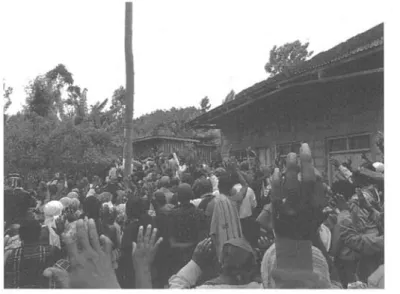
After Muruk>a's speech, clan officials assembled all the ichiaro men, except those who assumed responsibility for the sacrificial sheep, to stand in line, and asked all the people to face the sacred mountain of Nyambene in prayer, to bring back the people who had left the community. This prayer was also led by Muruku. All the people who followed him raised their hands, beckoned, and addressed each of the missing persons by saying `just come' (Fig.
2). All the ichiaro men stood on one leg during the prayer13). The prayer began at 12:26, and continued for about ten minutes.
Figure 2. The prayer to take back missing people
Dialogue 2. An ichiaro man leading the audience in prayers
Muruku [9]:The God (Ngai) of Israel. The God of Isaac. The God of Jacob. We are praying on this day today. The one who did great things and sent his sons and he was
crucified in the cross because of us. [All: God (Ngai)] This is a clan, those who have gathered here. [All: God] Because of the people who are making others mad, [All: God] witchcraft, [All: God] and they make children of other people
mad so that they can't be able to get education. [All: God] Now God, as for us
here we don't have strength (inya). [All: God] God, you are there from the
beginning. [All: God] You are the one who created this clan. [All: God] You're the one who created ichiaro. [All: God] But for witches you fight with them from heaven. [All: God] Even if you sent devil down here, [All: God] but you
sent a winner down here. [All: God] He was Jesus Christ, who fought for us.
[All: God] We don't have any debt. [All: God] That's why we have gathered
here as clan to curse this act. [All: God] Give us strength. [All: God] Some of
our people have gone. [All: God] That's why we are gathering here and felt
mercy. Now we know it's you alone, you have strength. [All: God] Now we are
calling them back to come to the clan. [All: God] Strong people can be seen in
this clan. [All: God] Let them not get lost far and even the offspring of the clan not get lost far. [All: God] Now, Kathure, we shall call her twice. Ooh Kathure...
[All: Ooh Kathure, ooh Kathure] Kathure, you are being called by the clan. Just come, even if it is for your richness (unoru)14). Just come, even if you're in a
shop. Just come, even if you were kidnapped. Just come. Don't lose your way.
Revival of Clan in Local Communities of the Igembe 73
Just come. Now come by the strength of God. The clan is waiting for you. Just come. Now, Kathure is coming. [Ululation (nkenii) by all the people]
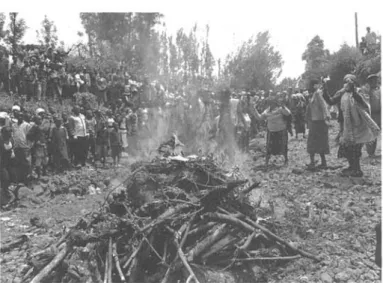
After the above prayer, Muruku left the village. At 12:37 the other ichiaro men placed the sheep on fire that had been lit in the middle of the road. People began to throw cursing plants on the body of the animal in the fire, and one after another uttered cursing words against unknown sorcerer(s) such as, 'Let him/her die like that!"Let him/her burst like the sheep!' or 'Let him/her be burnt like the sheep!' while others sang in groups. When the flames began to ebb, people poured paraffin on them to keep the fire going. Some people argued that sorcerers were the ones who tried to kill the fire.
Figure 3. People throwing cursing plants into fire
Song l:
Song 2:
Song 3:
Yll muroi aribwaa ngeere akaura yli mfiroi aribwaa ngeere...
When the sorcerer hears of a sheep, he gets lost. When the sorcerer hears of a sheep...
muroi ti weed( ni mpangaa eteerwe. Tumwitira lurftngu arllwee muthumba jwa mauru. Yii, oo III, yi%iooi...
Yes, the sorcerer is not ours, is a bad omen, which was thrown away. We have judged and cursed him to be loitering with his own legs.
Aroi nia beerwe bakaura ruui ntirf,kunda. Ni beerwe naa ngeere. Muroi ni eerwe akaura ntiri kunda. Ni eerwe na ngeere. Ni eerwe na Baibu.
Let the sorcerers be told if they cross a river, I won't take. Let them be told by use of sheep. Let the sorcerer be told if he crosses a river, I won't take. Let him be told by use of sheep. Let him be told by use of Bible.
41 Figure 4. The sacrificed sheep being exposed in the abated fire
At 13:13 the people were told to stop cursing and singing and to form a queue for individual interrogations by the ichiaro men, after which they would jump over the sheep. One after another, every person was asked to hold the piece of a cursing plant given to them by the ichiaro men, and then asked questions such as those noted below. After declaring before the ichiaro men that he or she never possessed witchcraft or any harmful items, each person was finally allowed to step over the remains of the sheep. A group of invited ichiaro men assumed the roles of interrogators, but their number was not large enough to fulfil the preferred requirements for biological determinism; theoretically speaking, Antuborii people, for example, should be interrogated by their proper or biological ichiaro from Ankurani (see Table 1). However, since Muruku [9], the representative of his clan, had already left the village, ichiaro men with a different clan origin had to interrogate Antuborii clan members.
It seemed, however, that the people did not rigidly adhere to the notion of biological determinism. The ichiaro men did interrogate people one by one, without identifying the clan affiliation of each individual. That is, each interrogator did not necessarily represent a proper ichiaro to a particular clan(s) in a narrow sense, but rather an ichiaro in a generalised sense.
The process of interrogating individuals took about one and one-half hours, and the last person was interrogated at 14:48.
Dialogue 3. Interrogation by nnt'ichiaro (an ichiaro man): Example I
Mwichiaro: Bring the witchcraft. Have you seen love potion? Bring the strong witchcraft (ithiih-P5)). Don't you have something to say? Even your eyes have not seen it?
Examinee: No.
Mwichiaro: Throw your cursing plant and pass.
Revival of Clan in Local Communities of the Igembe75
Dialogue 4. Interrogation by mwichiaro: Example 2
Mwichiaro: Bring charms, even your love potion. Have you seen it? Even the one for your business?
Examinee: No.
Mwichiaro: Are you fearing God?
Examinee: Yes.
Mwichiaro: Just pass over here.
TT'i{
....-' \
iv
IPA'
1.
.1,
' Ie.
''1
4.`.I
y}
y-
S Y
_~t:t
oP,
•
:•
.,„: v , • ,____„‘A,' '
.-..: • ...,„
t- .
4 ,,i•.
4t7-14,.._---,•1 ,---_,:;;..,:t.,&•---',.-F-71,.,-,..: -...3 ,4e. ,' ...1_ -., 7..,,a
74R..-4''''''...""tj^
,
'5.!.;,;;;04•4': T
- • ... V.,.;:: (.1,,
' '1;4113
:-.,,
s , 4
4
p.'
* I
Figure 5. People being interrogated by ichiaro men
•
-- •
`\A f
4 t_
~ k 9 ~,
~ ' J
•s 'Y.. . ~'C5
. r.7
t.t..1,.;:1 lr ,,i/,'
•1 i44,„,t /-—-2---—,;.'**-I ir-.1---:,- I i71 r . Or
?...
Figure 6. People in a queue waiting for their SNN earin, before ichiaro
-?;••• -
, -
40' le,"
•`•13i1'1 , [1_ before ichictro
At 14:50, by which time the sheep had been reduced to ashes, all the ichiaro men again assembled near the remains of the animal, which by then was surrounded by all the people who had already been tested. As noted above, Francis, who was now representing all the ichiaro men, led the collective cursing against all the unidentified perpetrators in the kwiita rwI style16> to conclude that day's meeting. James, the clan secretary, read the list of victims in the alleged cases of witchcraft that had previously been approved as reasonable claims by Francis aloud, after which the three ichiaro men—Kobia [14], Kibwi [2], and Francis [5]—
uttered cursing words together (see Table 1).
Dialogue 5. Collective cursing in the kwiita rwII style
Greetings, clan. Greetings, a person who never dies. Greetings, a person who eats his own. Greetings, a person who shoots without causing any harms.' Now listen. I believe, as we wrote down (the claim list), we can't leave them behind.
Now what we are going to do is this. We won't read each and every person's
name, because we would not sleep (spend the night) here. It is because we know
the issues of our people like our people who were killed, and because we don't
know the course of death. As our advisors have heard everything from us, we
shall follow what they say. Then, for those who go round our homestead with
wicked ways, we shall leave them here. Those who plant harmful items in our shamba, we shall curse them. That's the way we should go and also those who
throw witches into our homestead also shall be cursed. The first thing we want to start with... Where are the elders we were with?
An elder: Where are our brothers, please?
Ichiaro men: We are here.
An elder: Let them come in front here.
Another elder: Please give space for them. [Addressing people]
Francis [5]: Greetings, clan. Greetings again. Now we shall lead you like this. We are your gIchumi18) who have come to kill those who kill you. Do you see us? Do you know us? [All: No] Have you ever seen us in your place again? [All: No] Now
we are coming for [cursing] the one who kills a person with a stolen club (nchuuma ya wamba)19) and witches, or the one who hides oneself in darkness.
Now it's the person we have come to kill. Now for ourselves, we shall start with
those ones who are killed completely then you meet a person already dead. We
shall start cursing the secrecy of killing others in the darkness. Now, Mr James,
start telling us!
James: Let's start with the ones who were killed... [James carefully read out the list of the victims in alleged cases of witchcraft] The one who killed husband to A
(name of a person), the one who killed husband to B, the one who killed C, the
one who knows what killed D, the one who killed children of E, and the one
Revival of Clan in Local Communities of the Igembe 77
who killed two children of F.
An elder: My two children were killed in the year 2013. One was known as G and the other killed in July was known as H. The one who killed eight people of I's
family and also others, we don't know. Now we should put them together and
curse them. We also curse the one who killed children of J, K, L, and M.
Kobia [14]: Don't I see nobody rubbing palms?20) [The speaker and all the attendants start rubbing their palms] I will know you belong to that team, the ones who finish the clan. Yes, let him go round with the sun, the one who doesn't want to see the
prosperity of this clan and who hides himself at night. [All: Yes] Yes, his seeds of boys and girls, let them finish there. [All for a single clap (kwiita rwII; see note 16)] Now step him on the ground. [All: Uuii] Now we finished that.
James: Greetings, clan. Greetings again. Now we have come for the one who goes round other people's homesteads at night with witchcraft or what? [All: With
witchcraft] Now rub your palms. [The speaker and all the attendants start
rubbing their palms] Now the one who goes round other people's homesteads at
nights, or plants witches at other people's homesteads at night, or plants witches
at other people's shamba, or hides himself at night to cause harm or hides
himself at night to harm advisor, his seeds, his cows, boys and girls, his beehives,
his millet, let it be cut like this! [All clap]
KibwI [2]: Greetings, clan. Greetings again. Where we are going now is the one who makes other people mad. [All: Yes] Now I want everyone to rub his (her) palms. [The
speaker and all the attendants start rubbing their palms] Now let someone else
say. The one who goes round other people's homesteads at night, and the one who confuses children of other people when being at school, his seeds of boys and girls should perish here! [All clap]
Francis [5]: There're some people who make other people to live in hospital because of sickness. Now listen, here we are going, we are going with two things . The one
who feels jealous of someone's cow, he goes and meets it on the road grazing , or he sees where the grasses are cut, and he goes and plants something bad so that cow can die, or the one who looks for some witches and hides , so that he
takes back because we have left here, so that he can make people sick and always
on the hospital way because of sickness. He is fearing to die and we want to
finish him here. Let us finish him. Rub your palms . [The speaker and all the
attendants start rubbing their palms] The one who finishes people and makes
them live in hospital and making them get lost, and the one who feels jealous of
the neighbour's cow, and the cow doesn't talk, or he cuts the rope of a cow, so
that it can go to the neighbour's shamba so that they can have cases, his seeds,
his cows, his girls and boys, his beehives, let them finish here. [All clap]
Is there anything? Those who do business with witches so that they destroy other
people's business. Do you want the person set with the sun and this animal which is here? The one who gives the children bhang so that they can destroy the school instead of the child getting education and the father goes hungry. Now I say, let him take his item (bhang) alone. I want us to rub our palms for anyone with his witchcraft to be put down and we should kick him. When we finish rubbing our palms and clap, we shall step on him twice the way we do against the devil with our legs. [All clap once and step twice]
Now, Mr. Chairman, you know why we are called. We don't leave a person with a problem. The reason why we came here is to unify the clan and we want the clan to stay with peace. Chairman, there's something which has come and I don't want to be disturbed again. Every child is here or even thieves are here. The one whom we shall leave in the bush is the thief without eyes. No members of the clan shall guard miraa shamba. Do you hear me, gichumi? [All ichiaro men:
Yes, we shall guard.] We have been told when we leave here every person here who have seen with eyes. If there's a feeling (mwithua) you feel, don't feel it for seven days from today20. I want us to clap the last clap. The last clap and that's the end. Now let me show you I want all the gichumi to come forward here. Now the clan wants to clap against the one who might go back and get witches when we leave here. [All: Yes] Now rub your palms. The one who has refused to give us witchcraft, and if he (she) get it back, his seeds of boys and girls, his cow, his millet, his sorghum, let it be like this! [All clap]
-
,
1gV 01,
•;...-:,-,g J--.--:
" - re..14
eY!'ir
1,1$
°if.
i^f&
Eitioof
ITM fief
44t o: or4b
I
st:14,41
Figure 7. Collective cursing in the kwiitci rwii style
Revival of Clan in Local Communities of the Igembe 79
The collective cursing in the kwiita rwII style was concluded at 15:20, and all the invited ichiaro men identified themselves by name, clan affiliation, and village of residence. I was also asked to introduce myself and explain why I was observing the ceremony. Then, the meeting was over. Some of those who attended proposed a closing prayer, but they were told that cursing (kuruma) and blessings (kutharima) should not occur together, because prayer was for purposes of blessings, and any prayer would adulterate the power of their curses.
III. Clan Revival in Mwithune village
The Antuambui clan that organised the utaara ngeere meeting just described had its first meeting on 1 July 2016, with 55 people in attendance, at the homestead of one of the clan members. Since then, the clan has continued having general meetings on the last Friday of every month, and committee meetings every Thursday, during which time they share knowledge with each other, address different agenda items that include settling disputes and other problems in their neighbourhood, and share information. The clan's revival as an organised social group no doubt requires administrative competence from its officials to achieve sustainable management. The massive effort of recording minutes—a prerequisite for having the clan registered as a welfare group at a relevant government office—has been assumed by James, the secretary. Since its first meeting on 1 July 2016, they have heard various dispute cases that include land boundary disputes, family disputes, miraa theft cases, property damage, assaults, incriminations of neighbours, and insults. James, the secretary, records the proceedings of case hearings, including statements by the complainants , the defendants, and their witnesses, as well as the rulings made by the clan's committee members.
The records are all written in English using a standardised format, which is only possible due to his devoted efforts and competence in this line of work.
The first meeting on 1 July 2016 lasted three hours. First, an election was held to appoint clan officials who included the chairman, vice chairman, secretary, and treasurer. Then , participants discussed all the agenda items for that day. They were very concerned about the security improvements needed in their neighbourhood, such as enhancing the role of the local security committees appointed by administrative chiefs to prevent miraa theft, terrorism, drug abuse, the production of illicit brew, and child abuse. Clan members also discussed their plan to organise utaara ngeere to enhance unity within the community , and to heal `victims"
psychological wounds, as some people understood that their misfortunes and losses had been caused by witchcraft practiced . by their neighbours. To organise a utaara ngeere, the clan decided to require each adult male to contribute 200 shillings and each female to contribute 100 shillings.
The second meeting was held on 15 July, and 167 members attended . It also lasted about three hours. First, the treasurer reported that they had so far collected 25 ,290 shillings from clan members. Second, an election of clan committee members was held to strengthen the
clan's executive body. Ten committee members elected on that day included three women, two men of the Bwantai age group, five men of the Miriti age group, and two men of the Lubetaa age group. Third, the clan decided to punish those who did not attend the meeting.
Fourth, two invited advisers from the Anjaru clan described their experiences of utaara ngeere, which was organised on Saturday, 28 May 2016 (Case 2). One of the two advisors said that many of their community members did attend the clan meeting to surrender charms in their possession. The other advisor added that the clan should work together with the government administration. Receiving this advice, the clan chairman of Antuambui told the members that anybody who had used witchcraft or any harmful items could surrender these items on the night before their utaara ngeere. The next clan meeting was scheduled for Friday, 29 July 2016, with a committee meeting set for Friday, 22 July 2016. The day for the committee meeting was later changed to Thursday, 21 July.
The fifteen clan-committee members—including chairman, secretary, and treasurer—
attended the committee meeting on Thursday, 21 July to discuss their plan to organise a utaara ngeere. Three elders, including M'Imaana [17] (see the following two sections), M'Mauta [7] (also see the following sections), and Nchebere of the Lubetaa age group from the Akinying'a clan, were invited as advisors on the indigenous law of the Igembe regarding the process. The first agenda item was to make a list of the ichiaro clans to be invited to the utaara ngeere collective cursing. The advisors found that people ofthirteen clan origins lived in Mwithune village, and that they should consider all the residents' biological affiliations to confirm the complete list of ichiaro clans to be invited. The clan treasurer reported that the clan had so far collected 31,090 Kenyan Shillings from clan members, and the committee tallied their budgetary allocations as follows. A he-goat for the clan was to be slaughtered for a feast with clan members and invited ichiaro men on the day previous to the collective cursing. Allowance for the messengers shown below was made for clan members who were going to visit ichiaro men to convey a formal invitation.
A he-goat for a clan 10,000 (Kenyan shillings) A sheep for sacrifice 4,000
Allowance for advisors 200 each (600 total for three advisors) Allowance for messengers 500 each (5,500 total for eleven messengers) Committee allowance 200 each (3,000 total for fifteen committee members) Total expenditure23,100
Prior to the general meeting scheduled for Friday, 29 July, another committee meeting was organised and attended by fourteen committee members. They agreed that every invited ichiaro man should be given 700 shillings that included their transportation costs. An elder who had been told to find a sheep for sacrifice reported that the sheep cost 4,500 shillings, which was 500 shillings above the allocated budget. Other members who had been appointed
Revival of Clan in Local Communities of the Igembe 81
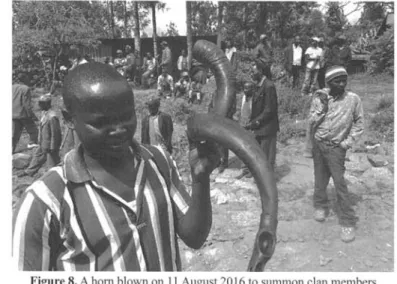
as messengers reported that they had paid money as honorariums to ichiaro men when they visited their homesteads. All those members were refunded the money they had spent. The chairman said that not only clan members who lived in the neighbourhood, but also members who lived in other villages, should contribute money (200 shillings for male members and 100 shillings for female members). The chairman also said that their daughters who been married to men in neighbouring clans should also contribute. The treasurer added that their clan should pay 1,000 shillings to obtain a horn that would be blown and used to summon clan members to assemble22t on the day of the utaara ngeere. Another agenda item that was addressed at the meeting concerned clan members who went missing for unknown reasons.
The committee members agreed that they should make a list of those missing persons for the ichiaro men, who would call them back on the day of the utaara ngeere (see Dialogue 2 shown above). Two committee members described several cases they had witnessed, in which missing people had come back after being called back by clan members.
isfa
~~ 1 r
•
r Z. i -- 1 1 q .:
Figure 8. A horn blown on 11 August 2016 to summon clan members
J .
• tq •
I - a
At the third general meeting held on 29 July 2016, 364 members attended, of which 172 were male, and 192 were female. The third meeting again lasted about three hours. As the first agenda item of the meeting, some members asked clan officials how many days the ichiaro men would stay in the village to enable people with harmful charms to surrender their items, and what other arrangements had been made. A clan official answered that a sheep had been readied for sacrifice, and that the ichiaro men would not stay more than two days for various reasons: first, it would not take many days for people to surrender all harmful items;
second, a longer stay of the ichiaro men would cost a large amount of money; and prolonged and close interaction with ichiaro men such as that involved in sharing food and water was
not preferable as it would adulterate their power. The chairman explained that the invited ichiaro men would arrive on the day before the ceremony, and that any people who had harmful charms should surrender witchcraft items on the day they arrived. As the second agenda item, the chairman announced that the utaara ngeere was fixed for 11 August 2016.
After addressing the above issues, the meeting was opened up to those willing to speak.
One of the elders said that their clan had now broken its long-standing dormancy to reinvigorate, and asked all members to help the clan remain active. Another elder advised that only the designated Njuriincheke elders—who also came to the host community as ichiaro—should receive charms from those willing to surrender them, since ordinary people never knew how to handle harmful items in the proper way. The chairman told all the clan members to report the cases they wanted to have cursed to the secretary on the day of utaara ngeere. This announcement encouraged people to bring the troubles they considered as being witchcraft-related, and the secretary prepared the list of 155 alleged witchcraft cases (see Table 2). The chairman also announced that all the missing people should be identified in advance, as the clan would call them back on that day.
The Antuambui clan performed utaara ngeere on 11 August 2016 as planned at the clan meeting. The collective cursing aimed to seek remedies for different misfortunes, damages, and other problems caused by unknown ill-wishers or sorcerers hiding in their neighbourhood, and it was not able to solve all the sufferings they had experienced. The community people were, in other words, not only fighting witchcraft, but also problems related to the production and consumption of illicit brew, drug abuse, miraa theft, and gambling. Some of the cases reported by clan members were not addressed in the utaara ngeere cursing, as they were not considered witchcraft-related matters (see Table 2). Accordingly, the clan heard and settled different cases and claims filed by community members.
Since a detailed analysis of the clan's case hearings requires another paper, I will describe only one case here, to clarify the significance of a clan revival in a local social context. This case involved a dispute between two women, X and Y, both of which lived in Mwithune village. X (the complainant) stated that Y (the defendant) had unreasonably prophesised the death of one of her children. X then took the matter of Y's unreasonable prophecy to the clan, and the clan summoned Y for investigation. Y, however, failed to appear at the clan meeting.
X later read in a public notice that the Njuriincheke council of elders had accepted Y's application for kithili against anyone who incriminated her (Y) as a sorcerer. The clan immediately issued a letter addressed to the Njuriincheke council of elders asking them to dismiss Y's case for kithili, as it had not been filed using the proper process, nor had it been filed on reasonable grounds. The clan explained in the letter that they had already performed a utaara ngeere to curse all the ill-wishers in the community, and that Y was one of the irresponsible persons who had refused to jump over the sheep. Y's case for kithili was then dismissed. Finally, Y accepted the ruling of clan, which was entered after an ex parte hearing of X's case, to take an oath before her own ichiaro, and to pay a fine called thiira and
Revival of Clan in Local Communities of the Igembe 83
mukongoro, of about 12,000 shillings, for repeatedly dishonouring the clan's summons, and for filing a case for unlawful kithili at the Njuriincheke council.
Even before this case had occurred between X and Y, there had been rumours in the neighbourhood that associated Y with witchcraft. It was said, for example, that one day a suspicious woman was found prowling around the village. People in the neighbourhood asked her where she was from. She answered that she came from Kiegoi, but she could not properly name the area chief in her reply to another question. Neither did she have any documents to confirm her identity. They decided to escort her to the main road that led to her destination. On the way, however, she suddenly disappeared at a certain place, just in front of Y's residence. People presumed that the woman was a ghost associated with Y, a `sorcerer'.
To make matters worse, on the day of the utaara ngeere in their village, as noted above, Y did not turn up to jump over the sheep. Then, a rumour began circulating among community members that Y had refused to jump over the sheep because she secretly possessed witchcraft items.
As this case and Case 1, which was described earlier shows, the clan as a social group can mobilise its knowledge and communication network to take organised approaches to the Njuriincheke council of elders and to ichiaro men with different clan origins. The revival of the clan thus meets the local need for accessible doors for claimants, as it instructs people in how to develop their claims. It is also consonant with the mandate of the state government
for local or grass-roots administration, which will be discussed in the last section of this paper.
IV. Sharing Knowledge about Utaara Ngeere in Neighbouring Communities
After the utaara ngeere in Mwithune village, another village in Gitura, where Karea [11]
came from, organised a utaara ngeere. Some of the officials from the Antuambui clan—
together with their chief advisors such as Kibwi [2]—were invited to attend and share their experiences and knowledge. I have observed that knowledge-sharing of this kind contributes to the development of the Igembe's common law. This section describes how clans of different origins within the Igembe region have shared their knowledge and experiences with each other.
Two months before the utaara ngeere in Mwithune village, the Anjaru clan organised its own utaara ngeere (Case 2) on 28 May 2016, in a village named after the same clan. The village was close to the largest commercial and administrative centre in the Igembe Southeast.
Furthermore, the Antuambeti clan also organised its utaara ngeere (Case 3) in September 2015, in another village in Antubaknru, as several other clans had done in the past ten years.
p.'4(
. t
.
{ x.
1I'
1
Figure 9. A man swearing before the Pchiaro on 28 May 2016 in Anjaru [This photo courtesy of Mr. M. Kobia]
I interviewed Kaiyo, the chairman of the Anjaru clan, about their experiences with the utaara ngeere that had been performed on 28 May 2016, one month before the first clan meeting in the Antuambui community. The Antuambui clan, as noted above, invited him and another elder to attend their second meeting on 15 July, to seek advice based on their previous experiences in the Anjaru community. Kaiyo, who is a man of the Lubetaa age-group and is knowledgeable of his clan's history, has had the experience of organising a irtaara ngeere twice in his community over the past ten years, including the first one he organised in the late 2000s (the date is not clearly remembered), and the second one in May 2016. In his speech at the Antuatnbui clan meeting, since he was known in the community as the pastor of a Christian church, he first noted that there was no conflict between the Kimiiru customs and Christianity, and gave several reasons for his interpretation. He also noted that many of their community members did attend the clan meeting to surrender charms in their possession before the day on which they jumped over the sheep. He gave the example of a person who was said to have surrendered a harmful item in his possession for which he had paid about 300,000 shillings23). Kaiyo and another elder also shared their experiences and knowledge with members of the Antuambui clan.
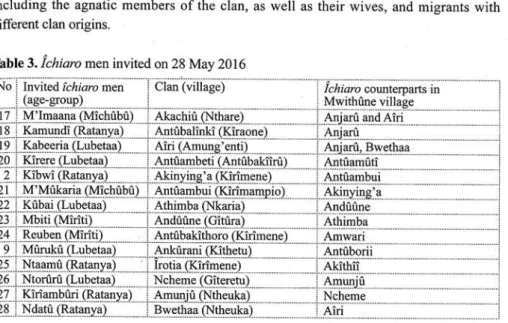
In my interview with him, Kaiyo recalled the names and clan affiliations of the ichiaro men invited to their second utaara ngeere on 28 May 2016 (see Table 3). When they finalized the invitation list for the ichiaro men during their preparations for the collective cursing, Kaiyo and other officials of the Anjaru clan had considered the biological status of the people in their neighbourhood, as their followers in Antuarbui had done. In other words, they clarified the biological clan affiliations of all the inhabitants in their village community,
Revival of Clan in-Local Communities of the Igembe
including the agnatic members of the clan, as well as their wives, different clan origins.
85
and migrants with
Table 3. Ichiaro men invited on 28 May 2016
No
17 18 19 20 2 21 22 23 24 9 25 26 27 28
Invited ichiaro men (age-group)
M'Imaana (Michubu) Kamundi (Ratanya) Kabeeria (Lubetaa) Kirere (Lubetaa) Kibwi (Ratanya) M'Mukaria (Michubu) Kubai (Lubetaa) Mbiti (Miriti) Reuben (Miriti) Muruku (Lubetaa) Ntaamu (Ratanya) Ntoruru (Lubetaa)
Kiriamburi (Ratanya) Ndatu (Ratanya)
Clan (village) Akachiu (Nthare) Antubalinki (Kiraone) Airi (Amung'enti) Antuambeti (Antubakuru) Akinying'a (Kirimene) Antuambui (Kirimampio) Athimba (Nkaria) Anduune (Gitura) Antubakithoro (Kirimene) Ankurani (Kithetu) Irotia (Kirimene) Ncheme (Giteretu) Amunju (Ntheuka) Bwethaa (Ntheuka)
Ichiaro counterparts in Mwithizne village Anjaru and Airi Anjaru
Anjaru, Bwethaa
Antuamuti Antuambui Akinying'a Anduune Athimba Amwari Antuborii Akithu
Amunjil
Ncheme Airi
Tables 1 and 3 show that Kibwi [2] and Muruku [9] were invited to participate by the Anjaru clan in May 2016, and again by the Antuambui in August 2016. Mbiti [23] of the Anduune clan and Reuben [24] of the Antubakithoro clan (both pseudonyms) were among six ichiaro men invited to attend another case of group cursing to solve problems observed in a family in the Muringene village in September 2012 (Ishida 2014: 85). These reflected the following two facts.
First, some individuals, such as the above four elders, may be regarded as more powerful mwichiaro than others, and be invited repeatedly to attend these occasions . However, as my previous paper discussed (Ishida 2014: 94-95), any person invited as a mwichiaro should not misunderstand this invitation and think that he is being invited in his private capacity , and that he can use his power for his personal interest. In other words , the power of the ichiaro men is attributed only to the person's biological status.
Some individuals such as (...) Mbiti [23], of the Anduune clan, may be appreciated as more powerful mwichiaro than others. In other words, though everyone is eligible to represent his or her clan as mwichiaro, particular individuals are more commonly invited . However, (...) ichiaro men are not supposed to identify themselves as `experts' in their private capacity. This biological determinism thus serves to depersonalise the ichiaro.
(Ishida 2014: 99 with some revision added)