<MBA Degree Thesis>
AY 2015
T HE S HIFT F ROM D ISRUPTION T O C ONNECTION I N
D IGITAL M ARKETING
35132331-5 V ANESSA L ANDRIAULT
G LOBAL M ARKETING I NNOVATION
C.E.
P
ROF. K
ENNETHA
LANG
ROSSBERGD.E.
P
ROF. S
EANM. H
ACKETT D.E.P
ROF. A
LLANS
UMIYAMASummary
In 1993, the first ever internet ad was sold in the United States1. The fact that the arrival of internet changed forever the way companies do marketing is now obvious, but after more than 20 years of online marketing, more major changes are bound to happen. With the constant evolution of technology, we went from simple online advertising to digital marketing, and more recently, social media marketing. Although the technology, tools and media changed, for companies, the overall strategy behind online marketing remained the same for many years : reaching as many internet users as possible and make sure they were exposed to the ads.
For the few last years, however, many changes in online marketing practices suggest a global shift in the way companies advertise on the internet. In this thesis, a few of these changes will be analysed in order to understand the global trend that is happening right now in the world of online marketing.
The recent trends selected for this research are : native advertising, consumer generated advertising, real-time advertising and brands interactions on social media. Analysis shows that
1Bourne, J. (September 2013).Online advertising: A history from 1993 to the present day. Retrieved from
http://www.marketingtechnews.net/news/2013/sep/11/online-advertising-history-1993-present-day-infographic/ [Last accessed May 2015]
the common point between these trends is the desire to connect with consumers, as opposed to traditional advertising, which objective was to capture consumers’ attention, sometimes in a disruptive way. As a result, we found out that a clear shift from disruption to connection is currently happening in digital marketing.
This work will examine the aforementioned trends and explain how they are used to connect with consumers. We will also have a look at current disruptive marketing strategies, and try to forecast if they will still be relevant in the near future.
This work will show that the “connection” between brands and consumers is actually a two- sided conversation, and that it became necessary for brands, no matter which strategy they use, to keep the conversation going. By observing how the latest generation of consumers and the upcoming one are communicating online, it is clear that traditional online marketing strategies have become irrelevant. Brands need to change their approach in order to reach these new consumers, which means that they also need to dedicate new resources to this task.
<Inside Cover>
T HE S HIFT F ROM D ISRUPTION T O C ONNECTION I N
D IGITAL M ARKETING
35132331-5 V ANESSA L ANDRIAULT
G LOBAL M ARKETING I NNOVATION
C.E.
P
ROF. K
ENNETHA
LANG
ROSSBERGD.E.
P
ROF. S
EANM. H
ACKETT D.E.P
ROF. A
LLANS
UMIYAMATable of Contents
INTRODUCTION ...5
CHAPTER 1 : NATIVE ADVERTISING ...7
SECTION 1 : DEFINITION ...7
SECTION 2 : EVOLUTION ...エラー!ブックマークが定義されていません。 SECTION 3 : CONTROVERSY...エラー!ブックマークが定義されていません。 SECTION 4 : THE CASE OF THE NEW YORK TIMES ...15
SECTION 5 : THE CASE OF BUZZFEED...16
CHAPTER 2 : CONSUMER-GENERATED ADVERTISING ...18
SECTION 1 : DEFINITION ...18
SECTION 2 : EVOLUTION ...20
SECTION 3 : THE CASE OF FRITO-LAY’S DORITOS ...22
SECTION 4 : THE CASE OF CHEVROLET ...25
CHAPTER 3 : REAL-TIME ADVERTISING...27
SECTION 1 : DEFINITION ...27
SECTION 2 : EVOLUTION ...34
SECTION 3 : WHEN REAL-TIME MARKETING GOES WRONG...35
SECTION 4 : THE CASE OF THE SUPER BOWL ...37
CHAPTER 4 : BRAND INTERACTIONS ON SOCIAL MEDIA ...43
SECTION 1 : INTERACTIONS BETWEEN BRANDS AND CONSUMERS ...43
SECTION 2 : INTERACTIONS BETWEEN BRANDS ...47
CHAPTER 5 : IS THERE STILL A PLACE FOR DISRUPTIVE ADVERTISING?52
SECTION 1 : DISRUPTIVE ADVERTISING ...52SECTION 2 : PUBLICITY STUNTS ...53
SECTION 3 : BEACONS ...56
CONCLUSION ...60
BIBLIOGRAPHY...65
INTRODUCTION
“A powerful global conversation has begun. Through the Internet, people are discovering and inventing new ways to share relevant knowledge with blinding speed. As a direct result, markets are
getting smarter—and getting smarter faster than most companies2”.
In 1999, as the impact of the internet on marketing and advertising was becoming more and more obvious, Rick Levine, Christopher Locke, Doc Searls, and David Weinberger released The Cluetrain Manifesto. This work was first posted on the web as a set of ninety-five theses that looked into the impact of the internet on marketing.
The Cluetrain Manifestobecame a bestseller in business literature, and it has been credited with setting out “the guiding principles of social media years before Facebook and Twitter existed.3”
The first these of the Manifesto is very simple :Markets are conversations.
By analysing the recent changes that have been happening in digital marketing and advertising, we can see a general shift from disruption to connection. More than ever before, brands are trying to communicate – some more successfully than others - with the general public. As we will see, this communication is happening in various ways, through different forms of digital advertising as well as through social media. As the Cluetrain Manifesto predicted, are markets really becoming conversations ?
2Levine, R., Locke, C., Searls, D. & Weinberger, D. (1999).The Cluetrain Manifesto. Retrieved from http://www.cluetrain.com/ [Last accessed May 2015]
3Baker, S. (December 2009). Beware Social Media Snake Oil.Businessweek. Retrieved from
http://www.bloomberg.com/bw/magazine/content/09_50/b4159048693735.htm [Last accessed May 2015]
53. There are two conversations going on. One inside the company. One with the market.
56. These two conversations want to talk to each other. They are speaking the same language. They recognize each other's voices4.
Using a few important trends that can be observed in today’s marketing and advertising world, this work will attempt to show that, while all the ideas presented by the Cluetrain Manifesto did not come true, there is a clear and definitive shift happening, from disruption to connection. We will also examine how even disruptive marketing strategies are now used to engage the conversation with consumers. The connection between brands and consumers is becoming necessary and cannot be considered a one-way conversation anymore.
19. Companies can now communicate with their markets directly. If they blow it, it could be their last chance5.
Finally, by using various case studies, this work will give some ideas about how companies can embrace the shift and join the conversation, in order to successfully reach a whole new generation of consumers.
4Levine, R., Locke, C., Searls, D. & Weinberger, D. (1999).The Cluetrain Manifesto. Retrieved from http://www.cluetrain.com/ [Last accessed May 2015]
5Ibid.
CHAPTER 1 : NATIVE ADVERTISING
S
ECTION1 : D
EFINITION“Put simply, native advertising is a sub-set of the catch-all content marketing, meaning the practice of using content to build trust and engagement with would-be customers”6.
Native advertising can take many different shapes and can be found in various places. It can be a suggested page on Facebook, or a link at the bottom of an article to a page with relevant contents.
However, all of these have something in common : they are designed and placed in a way so that they match the form and function of the user experience in which they are placed7.
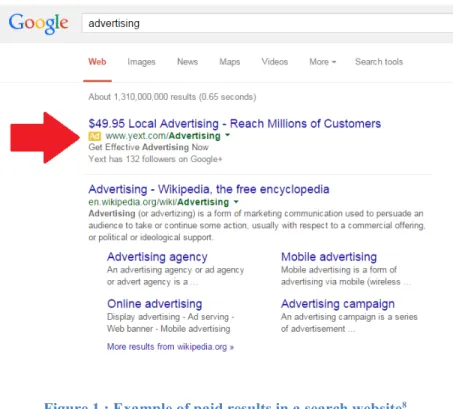
Let’s explain this by the following examples. When searching on Google, paid results will be included in the search results. They will be displayed in a similar manner than the regular search results, which will make them look and feel like regular results. Advertised results match the formof regular search results.
6Hallett, T. (2013).The Guardian. Retrieved from http://www.theguardian.com/media-network-outbrain-partner- zone/native-advertising-quality-scalability [Last accessed May 2015]
7Sharethrough. (2015).Native Advertising. Retrieved from http://www.sharethrough.com/nativeadvertising/ [Last accessed May 2015]
Figure 1 : Example of paid results in a search website8
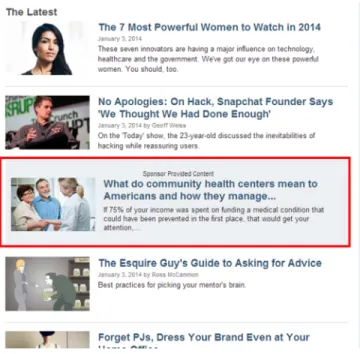
Regarding function, let’s imagine someone reading a news article about a new store opening in their area. At the bottom of the article, native ads will be placed, most likely links to articles about other store openings, about the particular company that opened the store, or maybe about business in general. All of these would be somehow related to the original article, and would therefore match thefunction(which is offering news about a business opening) of the page read by the user.
8Google (2015). Retrieved from http://www.google.com [Last accessed May 2015]
Figure 2 : Native ad example9
Native ads can be integrated into a website in many different ways. According to Sharethrough, a leading company in digital advertising technology, four native ads categories can be identified10.
1) In-Feed Native Ads
They are ads placed inside a publisher’s normal content, and they are either in story form or in ad form that links off the site. When in story form, the content has been written by or in partnership with the publisher in order to ensure it matches the surrounding stories. Commonly used language for in-feed ads includes : “sponsored contents”, “suggested post” or “featured partner”.
Included in this category are Facebook sponsored posts and Twitter promoted tweets, that appear in a user’s regular “feed” as if it was posted by one of the accounts followed by the user.
9Atkinson, J. (January 2014).The Ultimate Guide to Native Advertising.Retrieved from http://monetizepros.com/ad- sales/the-ultimate-guide-to-native-advertising/ [Last accessed May 2015]
10Sharethrough. (2015).Native Advertising. Retrieved from http://www.sharethrough.com/nativeadvertising/ [Last accessed May 2015]
2) Search and Promoted Listings
One common type of paid search ad is found above the organic search results and looks exactly like the surrounding results (with the exception of disclosure aspects). It also links to a page similar to the organic results.
Promoted listings are usually found on sites that sell products and are designed to fit seamlessly into the browsing experience. They look identical to the products or services offered and are typically bought on auction directly via the publisher.
3) Content Recommendation Widgets
According to PC Magazine Encyclopedia, a widget is “a mini app that displays a small amount of information on screen at all times and interacts with the user. Search box, clock, weather, calculator and stock market widgets are typical examples. The widget may be waiting for input from the user, such as a search box, or be "live" and actively display changes like the weather and stock market11”.In this form of native ad, paid content is delivered via a widget.
Generally, the widget unit is integrated into the page and does not mimic the appearance of the editorial content. Rather, it links to a page off the site, using language such as “recommended for you”, “you might also like”, “from around the web”, etc.
4) Custom Contents Units
In the case of custom units, advertiser and publisher work together to create content. This group includes examples that don’t neatly fit into one of the above groups, or, as in the case of custom playlists, are too platform-specific to warrant their own category.
11PC Magazine Encyclopedia. (2015).Widget Definition. Retrieved from
http://www.pcmag.com/encyclopedia/term/54456/widget [Last accessed May 2015]
S
ECTION2 : E
VOLUTIONIn April 2006, Mike Baker, then CEO of mobile marketing pioneer Enpocket (acquired by Nokia) and early believer in mobile12, was already forecasting the native advertising trend.
"Back in 1996 we started with banners, and that was not the best internet advertising. It took four years for search-related marketing to come along. My belief is that in a similar fashion, the mobile industry will have its own native advertising units and tactics, and the most effective ones are not necessarily the first ones.13”
However, native advertising began being regularly mentioned in the media from 2012. At the first, the concept appeared odd. As pointed out by John Tylee in November 2012, “The chances are you will not have heard of 'native' advertising. On the face of it, the proposition seems counterintuitive. Where conventional advertising seeks to distinguish itself from the clutter, native advertising seeks to blend into the background. In short, it is advertising that dare not speak its name.14”
Although at that time the term native advertising was widely unknown to brands and marketers, the concepts were already put into practice. Neil Hudspeth, Leo Burnett's chief digital officer for Asia, said :
"If I mentioned native advertising to my clients they would have no idea what I'm talking about. But almost all of them are talking about better branded content that engages with consumers.15"
In 2012, native advertising was defined as a strategy allowing brands to promote their content into a website in a non-interruptive, integrated way. Already then, marketers were beginning to understandthat
12DataXu, Inc. (2012).Executive Team. Retrieved from https://www.dataxu.com/about-us/team/management-team/ [Last accessed May 2015]
13Balakrishnan, R. (2006).Hard cell. Knight Ridder Tribune Business News. Retrieved from http://search.proquest.com/docview/460034740?accountid=14891 [Last accessed May 2015]
14Tylee, J. (2012).Advertising content moves under the radar. Campaign Asia – Pacific. Retrieved from http://search.proquest.com/docview/1241117913?accountid=14891 [Last accessed May 2015]
15Ibid.
as people increasingly spend time online, they are becoming less tolerant of interruption and poor content.
A study published in Business Wire in November 2012 showed that brands largely favored native advertising attributes for their content marketing strategies. Conducted by Forbes Insights and Sharethrough, it was one of the first studies of native advertising. Attributes preferred by brands included visual integration and native content placement on publisher sites. At the time of the study, 33% of respondents said they have either already begun distributing their videos through native ad placements or plan to do so in the future16.
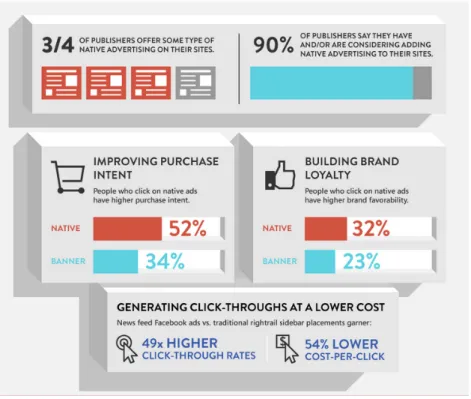
By 2013, it appeared clear that native advertising was where advertising was headed. According to a study17published in October 2013, about 75% of surveyed U.S. publishers said that they already offered native advertising on their site, and another 17% said they were considering offering it this year. Only 10% didn't have any native ad plans.
This is not surprising : according to the same study, consumers are 25% more likely to look at a native ad than at a banner, and they look at them 53% more frequently. They are also considerably more likely to share a native ad with others (32% versus 19%) and showed 18% more purchase intent after viewing them.
16Business Wire. (2012).New study shows growing preference for native advertising formats in content marketing.
Business Wire. Retrieved from http://search.proquest.com/docview/1151773673?accountid=14891 [Last accessed May 2015]
17Abramovich, G. (2013).15 Mind-Blowing Stats About Native Advertising. Retrieved from
http://www.cmo.com/articles/2013/10/21/15_Stats_Native_Advertising.html [Last accessed May 2015]
Figure 3 : Infographic comparing native ads and banner ads statistics according to a 2014 study18
Today, native advertising is widely recognized as being the key to consumer engagement. Among the reasons mentioned by companies for using native advertising are: to provide more relevant messaging, to increase consumer engagement, to generate awareness or buzz and to create word of mouth19. Native ads are efficient, profitable, they bring value to consumers and engage them, and they accurately target audiences20, all of which are necessary to connect with people.
18MDG Advertising. (2014).The Shift to Native Advertising in Marketing [Infographic]. Retrieved from
http://www.mdgadvertising.com/blog/the-shift-to-native-advertising-in-marketing-infographic/ [Last accessed May 2015]
19Ibid.
20Newstex. (2014). Adrants: 9 reasons to be thankful for native advertising.Newstex Trade & Industry Blogs. Retrieved from http://search.proquest.com/docview/1641465597?accountid=14891 [Last accessed May 2015]
S
ECTION3 : C
ONTROVERSY65. When you place a “native ad,” you’re eroding not just your own trustworthiness, but the trustworthiness of this entire new way of being with one another21.
However, everything isn’t perfect in the native ads world. It has been determined that “a majority of online adults find advertising that appears as content (so-called “native ads”) to be misleading. They feel most deceived by sponsored video ads, with 86 percent reporting they find those ads misleading.
Fifty-seven percent feel similarly about Facebook Sponsored Stories, and 45 percent about Twitter Promoted Tweets.22”
Indeed, native advertising is often considered controversial because it mimics editorial content.
News industry analysts talk about a “muddying of the waters" between news and marketing23.
“People these days don't care as much about where the story comes from as long as it tells them something.24” Companies’ owned media, for example, stories published on their corporate blogs or content marketing websites, often get picked up by newspapers and news websites. As companies need talented story-tellers to produce high quality contents, we see former journalists being hired by companies to build their content marketing strategies.
GE Reports, an online magazine published by General Electric, is a good example of this. Without being an advertising website for GE, it features interesting articles about innovation, science and
21Searls, D. & Weinberger, D. (2015)New Clues. Retrieved from http://newclues.cluetrain.com/ [Last accessed May 2015]
22Abramovich, G. (2013).15 Mind-Blowing Stats About Native Advertising. Retrieved from
http://www.cmo.com/articles/2013/10/21/15_Stats_Native_Advertising.html [Last accessed May 2015]
23Edgecliffe-Johnson, A. (2014). The invasion of corporate news.Financial Times. Retrieved from http://search.proquest.com/docview/1614226811?accountid=14891 [Last accessed May 2015]
24Ibid.
technology, which are topics relevant to GE’s target market. GE Reports has won many awards for the quality of its contents and its design, which is to be expected as its editor is a former Forbes journalist25. GE Reports’ engaging and informative articles are often picked up by other “legitimate” news websites and shared, further increasing their popularity.
The point here is that the line between real news and advertising is becoming increasingly blurred, partly because of native advertising.
S
ECTION4 : T
HEC
ASEO
FT
HEN
EWY
ORKT
IMESMany in the news industry raised eyebrows in January 2014 when The New York Times began publishing native ads on its website.
The first native ads were paid by Dell. While most native advertising uses ambiguous terms, The New York Times, concerned about the possible backlash, focused on transparency and labelled very clearly the ads to avoid any confusion.
“Dell gets a distinctly blue box on the right side of the Times' homepage that links to its native ad units, or "paid posts," as they're called on the site. Clicking the box opens a new browser window -- the URL is paidpost.nytimes.com, not nytimes.com -- where the posts reside on a page that is also clearly labeled, "Paid For and Posted by Dell." At the bottom of the page is another disclaimer: "This page was produced by the Advertising Department of The New York Times in collaboration with Dell. The news and editorial staffs of The New York Times had no role in its preparation.26"
25Edgecliffe-Johnson, A. (2014). The invasion of corporate news.Financial Times. Retrieved from http://search.proquest.com/docview/1614226811?accountid=14891 [Last accessed May 2015]
26Sebastian, M. (2014). Five Things to Know About The New York Times' New Native Ads.Advertising Age.
Retrieved from http://adage.com/article/media/york-times-debuts-native-ad-units-dell/290973/ [Last accessed May 2015]
Some argued that this strategy might put off marketers interested in native ads. Indeed, The New York Times later reduced the size of the labeling and made it less explicit27.
In November 2014, The New York Times took a step further and published its first printed native ad.
While the term native ad has been mostly limited to online media, the concept is far from being new to print media. However, more often than not, the quality of these ads didn’t match the quality level of the publication. Also, few publications as respected as The New York Times have dared make this move28.
In February 2015, The New York Times announced that its native ads “comprised inside of 10% of the company's digital-ad revenue last year29”. Although the wording used is quite ambiguous, as digital- ad revenue in 2014 reached $182.2 million, we can deduct that up to $18 million worth of native ads were sold by The New York Times in 2014. About 40 brands bought Paid Posts in 2014, and this number is likely to increase this year as CEO Mark Thompson pointed out that “there's immense further potential in Paid Posts30”.
S
ECTION5 : T
HEC
ASEO
FB
UZZFEEDBuzzfeed’s business model is almost entirely based on native advertising31. The website’s content covers a variety of topics, but keeps a fun and entertaining approach. Buzzfeed’s revenue comes from its many native ads that match its contents : it doesn’ t use any banner ads.
27Sebastian, M. (2014). New York Times Tones Down Labeling on Its Sponsored Posts.Advertising Age.Retrieved from http://adage.com/article/media/york-times-shrinks-labeling-natives-ads/294473/ [Last accessed May 2015]
28Moses, L. (2014).The NY Times runs its first print native ad. Retrieved from http://digiday.com/publishers/new- advertorial-ny-times-runs-first-print-native-ad/ [Last accessed May 2015]
29Sebastian, M. (2015). Native Ads Were 'Inside' 10% of Digital at The New York Times Last Year.Advertising Age.
Retrieved from http://adage.com/article/media/york-times-sold-18-2-million-worth-native-ads/296966/ [Last accessed May 2015]
30Ibid.
31Sebastian, M. (2014). The Year in Native Ads.Advertising Age.Retrieved from http://adage.com/article/media/year- content-marketing-native-ads/296436/ [Last accessed May 2015]
Buzzfeed has both the technology (sophisticated systems for analytics, advertising, and content management) and the creative staff. The team creates articles for brands with the same design and format used by Buzzfeed’s owned contents, so they totally blend in32. Additionally, the company’s sophisticated content management system proves to be extremely efficient, as it optimizes and promotes the posts with the most viral potential33. The objective is to ensure shareability34.
In August 2014, Buzzfeed got a $50 million investment from venture-capital firm Andreesen Horowitz. The website is now valued at $850 million35.
According to Felix Oberholzer-Gee, a Harvard Business School professor who wrote a case study about Buzzfeed, “Buzzfeed’s technology ensures that sponsored posts receive social lift — ie. organic shares by actual human beings — which in turn provides a brand lift. The reason it’s so successful is the moment we start to share things, the sharing itself is some sort of endorsement that’s hard to replicate with other forms of advertising36”.
32Constine, J. (2014).Buzzfeed’s Future Depends On Convincing Us Ads Aren’t Ads. Techcrunch. Retrieved from http://techcrunch.com/2014/08/12/buzzhome/ [Last accessed May 2015]
33Bercovici, J. (2014).Buzzfeed Is Officially A Case Study In Media Industry Disruption. Forbes. Retrieved from http://www.forbes.com/sites/jeffbercovici/2014/07/07/buzzfeed-is-officially-a-case-study-in-media-industry-disruption/
[Last accessed May 2015]
34Heaton, A. (2014).Content marketing case study: Buzzfeed. Smart Insights. Retrieved from
http://www.smartinsights.com/content-management/content-marketing-strategy/buzzfeed-case-study [Last accessed May 2015]
35Sebastian, M. (2014). The Year in Native Ads.Advertising Age. Retrieved from http://adage.com/article/media/year- content-marketing-native-ads/296436/ [Last accessed May 2015]
36Bercovici, J. (2014). Buzzfeed Is Officially A Case Study In Media Industry Disruption.Forbes. Retrieved from http://www.forbes.com/sites/jeffbercovici/2014/07/07/buzzfeed-is-officially-a-case-study-in-media-industry-disruption/
[Last accessed May 2015]
CHAPTER 2 : CONSUMER-GENERATED ADVERTISING
76. We've got some ideas for you too: some new tools we need, some better service. Stuff we'd be willing to pay for. Got a minute?37
S
ECTION1 : D
EFINITIONAccording to the Journal of Advertising, consumer-generated advertising (CGA) consists of consumer-created brand communications with the look, feel, form, and intent of traditional advertising38. CGA can take many forms : it can be blog posts, social network web pages, videos, reviews, etc. It can also be elaborate campaigns created by the brands to leverage content created by consumers.
Rohit Bhargava, marketer and author, distinguishes five types of consumer generated marketing campaigns39:
1) Reinvent a branded asset. "What's Your Version Of ….?" Better used by well-known and older brands, this type of campaign is used to ask the community to re-imagine the product or reinvent a particular aspect of the brand. Asking consumers to remake the theme song, or to create a new flavor are examples of this type of strategy.
2) Find your dream job. "What If You Were … ?"This type of campaign invite the members of the community to re-imagine themselves. It allows them to dream of being someone else and
37Levine, R., Locke, C., Searls, D. & Weinberger, D. (1999).The Cluetrain Manifesto. Retrieved from http://www.cluetrain.com/ [Last accessed May 2015]
38Lawrence, B., Fournier, S., & Brunel, F. (2013). When companies don't make the ad: A multimethod inquiry into the differential effectiveness of consumer-generated advertising.Journal of Advertising. Retrieved from
http://search.proquest.com/docview/1467989193?accountid=14891 [Last accessed May 2015]
39Bhargava, R. (2010).5 Types Of Consumer Generated Marketing (CGM) Campaigns. Retrieved from
http://www.rohitbhargava.com/2010/07/5-types-of-consumer-generated-marketing-cgm-campaigns.html [Last accessed May 2015]
doing something different. Campaigns like this often look like public auditions, when candidates are judged and eliminated. The selected person in the end may get a new job or enjoy a new found popularity.
3) Get rewarded for your creativity. "Submit your creative idea for …"For this widely used type of campaign, the community is asked to submit creative ideas that would benefit the brand. The appeal of these campaigns is generally visibility rather than a tangible prize : participants are usually eager to share their idea and hope it will become popular. Campaigns where users create their own TV spot are an example of this.
4) Share your story, win a prize. "Tell us … – and you could win!" This type of campaign can be used by any brand. Consumers are simply asked to share a particular story, most likely with the chance to win a prize. The brand then can use the received stories.
5) Share your idea to get a grant. "Get funded to change the world."This last type of campaign, which popularity is increasing nowadays, allows people to submit a beneficial project idea (environmental, social, etc) and have a chance to see the project funded by the brand. It’s a way for the company to mix corporate social responsibility with marketing.
Apart from these kinds of elaborate campaigns, there are many other ways that brands can leverage consumer generated content on a daily basis. For example, making good use of user reviews. Studies have shown that 67% of consumers search online for information about a product before purchasing it.
More precisely, among 18-24 years old consumers, 65% consider reviews and reports on social networks before buying something40. Displaying customers reviews on a shopping website, for example, give the consumers everything they need in order to make their purchase. Reviews should be easy to find and easy to input, and it should be possible to interact with them.
40Marketing-schools.org. (2012).Consumer Generated Marketing. Retrieved from http://www.marketing- schools.org/types-of-marketing/consumer-generated-marketing.html [Last accessed May 2015]
According to Bazaarvoice research published in January 2015, “companies that harness the power of networks are poised to drive significant increases in content volume, search traffic, sales conversion, and consumer insights”41. Bazaarvoice found out, for example, that page visitors who interact with reviews show an average 58% increase in conversion rate compared to those who do not interact with reviews42.
Another way is to display consumer content on the brand’s official website. It increases engagement and promote the brand’s social media accounts. Examples of this includes displaying customers’
feedback or photos43.
Some campaigns are difficult to classify, such as Ford’s initiative in 2009 : 100 so-called digital influencers received a free Fiesta for six months, and were responsible to complete monthly "challenges"
and expected to regularly post about the car on blogs, YouTube, Facebook, Twitter, etc. In the end, more than 6,000 people pre-ordered the Fiesta, while the effort accumulated 6.2 million YouTube views, 40 million Twitter impressions and 50,000 pieces of content44. This successful idea is just one example of how increasingly creative brands are becoming in their use of the consumer community.
S
ECTION2 : E
VOLUTIONPete Blackshaw, currently the global head of digital and social media for Nestle, first came out with the term consumer-generated content back in 2002. He stated :
41News Bites US – NASDAQ (2015).Bazaarvoice research reveals how network distribution increases the benefits of consumer-generated content for all market participants. Retrieved from
http://search.proquest.com/docview/1644491948?accountid=14891 [Last accessed May 2015]
42Ibid.
43Ruchko, E. (2014).8 Brands Effectively Leveraging User-Generated Content. Retrieved from
http://www.tintup.com/blog/8-brands-effectively-leveraging-user-generated-content/ [Last accessed May 2015]
44Heine, C. (2013). New Ford Fiesta Campaign Will Be Entirely User-Generated.Adweek. Retrieved from
http://www.adweek.com/news/advertising-branding/ford-campaign-will-be-all-user-generated-147384 [Last accessed May 2015]
“Listening to and leveraging such [consumer generated] media may well be the most important source of competitive advantage for companies and brands. Unlike paid media (ads), CGM is created by consumers. It’s often inspired by relevant product or service experiences and is frequently archived online for readers’ convenience and other consumers or key marketplace influencers45. “
The term consumer-generated advertising started to appear regularly in media from 2006. It was the start of the CGA boom, but also the start of many criticisms and questions coming from the advertising industry. In a 2006 Advertising Age article, Marc Brownstein described CGA as a fad and as a
“desperately seeking buzz” marketing strategy46. In a more moderate piece, Denise Lee Yohn, brand- building expert, expressed her concerns about CGA, explaining how it most likely causes brand inconsistencies. The reason for this, she says, is that while consumers know why they like a product, they don’t know what is the vision of the brand. Therefore, “actively pursuing consumer-generated advertising as a marketing strategy is a lazy and irresponsible approach to branding.47” Consumer- generated content such as blog posts, videos and reviews, will most likely be created spontaneously, so there is no need or notable advantage for the brand to request or sponsor these.
Judging from more recent literature, opinions about CGA seems to have shifted. “CGAs have emerged as a valuable component in marketing in light of a popular belief that they perform strongly versus traditional ads.48” However, many studies have demonstrated that consumer-generated ads are not perceived as more trustworthy than professional ads. Additionally, there have been numerous cases of consumer-generated campaign that turned to disaster.
45Len. (2012).What Consumer Generated Media Is And Why You Should Care. Retrieved from
http://www.authntk.com/what-consumer-generated-media-is-and-why-you-should-care/ [Last accessed May 2015]
46Brownstein, M. (2006). About Consumer-Generated Ads: Have We Gone Mad?Advertising Age. Retrieved from http://adage.com/article/small-agency-diary/consumer-generated-ads-mad/113240/ [Last accessed May 2015]
47Lee Yohn, D. (2006).Do Consumers Always Know Best?Retrieved from http://deniseleeyohn.com/wp- content/uploads/pdfs/consumer_generated_advertising_mistake.pdf [Last accessed May 2015]
48Lawrence, B., Fournier, S., & Brunel, F. (2013). When companies don't make the ad: A multimethod inquiry into the differential effectiveness of consumer-generated advertising.Journal of Advertising. Retrieved from
http://search.proquest.com/docview/1467989193?accountid=14891 [Last accessed May 2015]
Marketers do not uniformly reject CGA anymore, but rather consider it with caution. Prashant Malaviya argues that CGA can be a good strategy if consumers already have a high level of brand loyalty. New customers who do not know the brand well are more likely to be skeptical about the ad creator and the message conveyed. In summary, “marketers should continue to engage consumers and benefit from their creativity, but they should be careful as to how they publicize this fact.49”
Opinions may still be divided and marketers may still be cautious, but the trend is definitely increasing. A 2012 study demonstrated that brand engagement rises by 28% when consumers are exposed to both professional content and user-generated product videos50. Consumer generated content also helps brand awareness, as people are more likely to find out about a brand through their peers.
Why Companies Should Invest in
S
ECTION3 : T
HEC
ASEO
FF
RITO-L
AY’
SD
ORITOSDoritos’ Crash the Super Bowl campaign is always cited among the most successful consumer generated campaigns. Frito-Lay began running this annual campaign in 2006. Consumers are invited to create their own Doritos ads and at least one fan-made commercial is guaranteed to air during the Super Bowl51.
The campaign evolved through the years, but the basic winning formula stayed the same. Actually, for the second year of the contest Frito-Lay tried something else and invited aspiring musicians to compete. The winner was featured in a 60-second music video / commercial aired during the Superbowl, which performed very poorly.
49Malaviya, P. (2013). Consumer-Generated Ads: Good For Retention, Bad For Growth. Forbes. Retrieved from http://www.forbes.com/sites/onmarketing/2013/07/02/consumer-generated-ads-good-for-retention-bad-for-growth/ [Last accessed May 2015]
50comScore, Inc. (2012).ComScore Study Finds Professionally-Produced Video Content And User-Generated Product Videos Exhibit Strong Synergy in Driving Sales Effectiveness. Retrieved from http://www.comscore.com/Insights/Press- Releases/2012/3/comScore-Study-Finds-Professionally-Produced-Video-Content-And-User-Generated-Product-Videos- Exhibit-Strong-Synergy-in-Driving-Sales-Effectiveness [Last accessed May 2015]
51Wikipedia. (2015).Crash the Super Bowl. Retrieved from http://en.wikipedia.org/wiki/Crash_the_Super_Bowl [Last accessed May 2015]
From 2008 to 2012, Frito-Lay used the USA Today Super Bowl Ad Meter, a live advertising survey held every year during the Super Bowl. Prizes were attributed in relation to the ranking achieved by the ads on the Ad Meter. In this case the emphasis was not on the ad quality, but rather on the ad’s popularity. Almost every year at least one of the finalists made it to the top three and won cash prizes from $400,000 to $1,000,000.
The 2012 edition had the particularity of offering the winner a contract to work with movie director Michael Bay on the movie Transformers : Age of Extinction. Also, for the first time the contest was moved from thecrashthesuperbowl.comwebsite to Facebook, where it ran as a contest application.
For the 2013 edition, Frito-Lay started to accept international entries. Anyone living in a country where Doritos were sold could participate. The winner was decided by online vote, and not related to the USA Today Ad Meter anymore. The 2014 installment followed the same pattern, and offered a one year contract with Universal Studios in addition to the one million dollar prize.
During these nine years, Frito-Lay not only successfully leveraged the creativity and talent of its huge fan community, but it also managed to do so during one of the most mediatised events on the planet.
According to Ann Mukherjee, chief marketing officer at Frito-Lay, Crash the Super Bowl campaigns have been the most successful marketing initiatives in the brand’s history52. She mentioned five principles that have made these campaigns so successful :
1) Trust the consumer. According to Mukherjee, “when you give the freedom to the audience, when they love something, they will take care of it better than someone you actually pay.53”
52Burstein, D. (2012). 5 Lessons In Participatory Marketing From Doritos' "Crash The Super Bowl" And CMO Ann Mukherjee.Fast Company. Retrieved from http://www.fastcocreate.com/1679605/5-lessons-in-participatory-marketing- from-doritos-crash-the-super-bowl-and-cmo-ann-mukherjee [Last accessed May 2015]
53Ibid.
2) Grow with your market. CGA is not for every brand. One of the reasons why this kind of campaigns works with Doritos is because the fan community consists mainly of Millenials, a generation that wants to be heard. The strategy may not work when the next generation enter the market. Brands must evolve together with their market.
3) This is all part of a broader strategy, not the strategy itself.Crash the Super Bowl is not the only Doritos campaign that showcases the consumers. The brand is continually soliciting fans for different campaigns all year long.
4) Don’t forget about ad agencies.According to Mukherjee, the agencies’ role have shifted from
“creating the content to facilitating the content.54” For example, Frito-Lay uses an agency to design the campaign.
5) Consumers become ambassadors. Whether they make the ads, talk about the contest and share information or simply vote for the winner, consumers, through these activities, become ambassadors for the brand.
While the campaign resulted in many entertaining commercials, none of them has achieved a cult status, unlike some memorable spots made by professionals, such as The Force by Volkswagen or Wendy’s Where’s the Beef ? commercial. In this case, the content produced is actually a lot less interesting than the mechanism by which it is produced. This can become a weakness for Doritos, as its content’s quality is not up to the competitors.
54Burstein, D. (2012). 5 Lessons In Participatory Marketing From Doritos' "Crash The Super Bowl" And CMO Ann Mukherjee.Fast Company. Retrieved from http://www.fastcocreate.com/1679605/5-lessons-in-participatory-marketing- from-doritos-crash-the-super-bowl-and-cmo-ann-mukherjee [Last accessed May 2015]
S
ECTION4 : T
HEC
ASEO
FC
HEVROLETWhen debating whether CGA is good or bad, the Chevrolet Tahoe example is sure to be mentioned.
It has actually become the major example for arguing against CGA. This is not surprising : the extent to which this campaign failed has no precedent, and it probably scared the whole world’s marketing managers. However, this failure did help clarify what precautions should be taken when launching this kind of campaign.
Back in 2006, Chevrolet invited people to create online ads for the upcoming Tahoe 2007.
Participants were provided with typical video clips showing the Tahoe in different environments, a selection of eight soundtracks and the possibility to add text. Pranksters and critics used the campaign to create irreverent or highly critical ads. As Mark Ritson explains in Marketing :
“Several self-created ads, for example, use the shots of the huge vehicle to point out that SUVs account for more than 1000 deaths in the US every year. Others openly mock the 'penis envy' of potential Tahoe drivers, who assume a big car means a big man. Even more submissions juxtapose the Chevy-supplied shots of the Tahoe triumphing in desert conditions to bemoan the impact of gas-guzzling vehicles on the environment.55”
With 4 million page views and 22,000 ad submissions, the campaign was successful in raising awareness, traffic and engagement. However, more than 3,000 ads were openly hostile to SUVs and Chevrolet56, and they are of course the ones that got the most exposure.
According to marketer Jackie Huba, the campaign was designed to encourage a mass audience to spread messages. It wasn’t designed with loyal Tahoe owners in mind. The fact that video clips and
55Ritson, M. (2006). Interactivity means potential mauling.Marketing. Retrieved from http://search.proquest.com/docview/214967138?accountid=14891 [Last accessed May 2015]
56Stringer, K. (2006). Online ads blast chevy's tahoe: Contestants poke fun at 2007 SUV.Knight Ridder Tribune Business News.Retrieved from http://search.proquest.com/docview/461113309?accountid=14891 [Last accessed May 2015]
music were provided demonstrates that GM didn’t really give control to the consumers for this campaign57.
Once the problem became apparent, Chevrolet announced that it would “remove from the site ads that use profanity or defame groups, not those that slam the company58”. GM admitted having expected such a situation, and some analysts suggested that it may actually have been part of their plan. However, today this campaign is still considered as a major failure.
57Huba, J. (2006).Why Chevy Tahoe campaign was doomed before it launched. Retrieved from http://jackiehuba.com/2006/04/why_chevy_tahoe.html [Last accessed May 2015]
58Stringer, K. (2006). Online ads blast chevy's tahoe: Contestants poke fun at 2007 SUV.Knight Ridder Tribune Business News.Retrieved from http://search.proquest.com/docview/461113309?accountid=14891 [Last accessed May 2015]
CHAPTER 3 : REAL-TIME ADVERTISING
77. You're too busy "doing business" to answer our email? Oh gosh, sorry, gee, we'll come back later.
Maybe59.
S
ECTION1 : D
EFINITIONThe term real-time advertising is often used as an alternative name for real-time bidding : a “process based on auctions in which individual advertising spaces are sold within a few milliseconds after calling a website.60” However, in this paper, real-time advertising is considered as a general trend that characterizes advertising on different online platforms.
Real-time means that “time gaps between an event occurring, our ability to see or know about that event, and the feedback that comes from our reaction to that event, have been eliminated.61” This need for speed is also happening in marketing. “Instead of creating a marketing plan in advance and executing it according to a fixed schedule, real-time marketing is creating a strategy focused on current, relevant trends and immediate feedback from customers. The goal of real-time marketing is to connect consumers with the product or service that they need now, in the moment.62”
59Levine, R., Locke, C., Searls, D. & Weinberger, D. (1999).The Cluetrain Manifesto. Retrieved from http://www.cluetrain.com/ [Last accessed May 2015]
60Stange, M. & Funk, B. (2014). Real-time advertising.Business & Information Systems Engineering.
http://dx.doi.org/10.1007/s12599-014-0346-0 [Last accessed May 2015]
61Stein, G. (May 2010).What Is Real-Time Advertising?Retrieved from
http://www.clickz.com/clickz/column/2138146/what-is-real-time-advertising [Last accessed May 2015]
62TrackMaven. (n.d).Defining “Real Time Marketing”.Retrieved from http://trackmaven.com/marketing-dictionary/real- time-marketing/http://trackmaven.com/marketing-dictionary/real-time-marketing/ [Last accessed May 2015]
Real-time advertising wants to connect with consumers at the exact right time. According to Gregg S.
Lipman, it is the “New Holy Grail of marketing -- a brand generates speed-of-light positive buzz by jumping in on a timely social issue or responding to a cultural moment.63”
It is no surprise that the major vehicle used for real-time advertising is Twitter, the fastest social media network.
In 2013, Adweek identified eight types of real-time marketing64. Although classification is rather arbitrary, it covers fairly well the instances where real-time marketing is mainly used.
1. Holidays
All major brands celebrate holidays through social media networks, so in order to stand out, brands must be extremely smart or original. For July 4thin 2013, Lowe’s, an American chain of retail home improvement stores, posted a Vine stop-motion video showing tools exploding into fireworks. The artistic and original quality of the video added to the high popularity of Vine made this post a great success.
63Lipman, G. S. (January 2015).Responding to a Cultural Moment? Don't Use Deflated Creative. Retrieved from http://www.huffingtonpost.com/gregg-s-lipman/responding-to-a-cultural-_b_6571576.html [Last accessed May 2015]
64Nudd, T. (September 2013). 8 Types of Real-Time Marketing, and the Brands That Got It
Right.Adweek. Retrieved from http://www.adweek.com/news-gallery/advertising-branding/8-types-real-time-marketing- and-brands-got-it-right-152261 [Last accessed May 2015]
Figure 4 : Lowe's Vine post on the 4th of July in 201365
2. TV Events
The major event in this category is without doubt the Superbowl, and we will talk about it in more details later. However, all kinds of TV events can serve as a pretext for brands to get some visibility in the social networks. The Oscars and other awards ceremonies, sports events, season finale of a very popular TV show… if it’s popular, brands are quick to take advantage of the buzz. It is not so easy, however, to come out with a quick and clever post, so not surprisingly, except for a few winners, most brands’ efforts go unnoticed.
65Nudd, T. (September 2013). 8 Types of Real-Time Marketing, and the Brands That Got It
Right.Adweek. Retrieved from http://www.adweek.com/news-gallery/advertising-branding/8-types-real-time-marketing- and-brands-got-it-right-152261 [Last accessed May 2015]
Here is a successful example of perfect timing : during the 2014 Oscars, when winning actor
“Matthew McConaughey thanked his deceased father during his speech, he candidly said that his dad is up in heaven with a big pot of gumbo and a can of Miller Lite.66” The brand took advantage of this by posting a quick response :Miller Lite. The official beer of award winning actors’ dads. — Miller Lite (@MillerLite).
3. Celebrities
People love following celebrities’ lives and talk about it. Brands do the same, so when some celebrity event or scandal happens, social media becomes noisy. Famous stars’ marriages, divorces or child births are examples of events that will most likely make brands talk about it. For instance, when Prince George was born in 2013, British bakery Warburtons tweeted a fun picture of a bread with the text “One’s bun is done.67”
66Pfeiffer, A. (March 2014).The Top 5 Social Moments of the 2014 Oscars. Retrieved from
http://www.shoutlet.com/blog/2014/03/top-5-social-moments-2014-oscars/ [Last accessed May 2015]
67Walter, E. (June 2014). The Best And Worst Of Real-Time Marketing: 4 Lessons For Marketers.Fast Company.
Retrieved from http://www.fastcompany.com/3031542/hit-the-ground-running/the-best-and-worst-of-real-time-marketing- 4-lessons-for-marketers [Last accessed May 2015]
Figure 5 : Warbutons' tweet about the royal baby birth in the U.K.68
4. Milestones
Key dates in a brand’s history or general important milestones are good occasions for brands to communicate on social media. Although anniversaries are a good time to celebrate, tragic events anniversaries also get talked about by brands, although it’s obviously difficult to accomplish. Tweets posted on the 9/11 anniversary, for example, never go unnoticed, and many brands are under fire every year for posting what people consider distasteful tweets. Still, many major American brands feel the
68Walter, E. (June 2014). The Best And Worst Of Real-Time Marketing: 4 Lessons For Marketers.Fast Company.
Retrieved from http://www.fastcompany.com/3031542/hit-the-ground-running/the-best-and-worst-of-real-time-marketing- 4-lessons-for-marketers [Last accessed May 2015]
need to recognize the sad anniversary, for patriotic purposes. AT&T’s tweet in 2013 was well received, however : it showed an image of the new One World Trade Center displayed on a smartphone.
Figure 6 : AT&T's tweet on the anniversary of the World Trade Center tragedy69
5. Politics
Politics is another extremely risky topic. For a brand, taking a stand on political issues can cause the loss of fans, but it can also increase brand loyalty of people with similar thoughts. Obviously, not any brand can afford to take this risk. A good example of this is when in 2013, the American Supreme Court
69Nudd, T. (September 2013). 8 Types of Real-Time Marketing, and the Brands That Got It
Right.Adweek. Retrieved from http://www.adweek.com/news-gallery/advertising-branding/8-types-real-time-marketing- and-brands-got-it-right-152261 [Last accessed May 2015]
considered legalization of gay marriage. Numerous brands came out to support marriage equality, and in the process got both love and hate : the decision to take a stand in this debate is a major step for a brand70.
According to Gregg S. Lipman, brands should not try to avoid taking position. He states : “People expect brands to play an active role in their personal lives, which means participating in the conversations that are relevant to them.71” Brands need to identify their purpose, and establish their voice, which must reflect their personality : this is the key to come out with a good execution that will be relevant for the brand – and really connect with followers.
6. Times of Crisis
Real-time marketing can also be useful and use the power of social media to quickly transmit information and gather support. The American Red Cross uses Twitter wisely, effectively responding to humanitarian disasters in real time. A single tweet after the 2010 Haiti earthquake raised $33 million72.
7. Newsmakers
Some brands don’t only react to news, but they actually try to create their own newsworthy content.
In 2012, NASA created the @MarsCuriosity Twitter account, posting funny tweets from the point of view of the Mars Rover. NASA media team is tweeting from the perspective of the robot, engaging followers and informing them about the mission. According to the team, “Curiosity's Twitter account is
70Stampler, L. (Mars 2013). 15 Major Brands That Unabashedly Support Gay Marriage.Business Insider. Retrieved from http://www.businessinsider.com/major-brands-that-support-gay-marriage-photos-2013-3? [Last accessed May 2015]
71Lipman, G. S. (January 2015).Responding to a Cultural Moment? Don't Use Deflated Creative. Retrieved from http://www.huffingtonpost.com/gregg-s-lipman/responding-to-a-cultural-_b_6571576.html [Last accessed May 2015]
72Morgan, J. (January 2010). Twitter and Facebook users respond to Haiti crisis.BBC News. Retrieved from http://news.bbc.co.uk/2/hi/americas/8460791.stm [Last accessed May 2015]
a lot more than just a hook to get people interested in science, though. It's successful because [we] have created a character with a very distinctive voice.73”
Figure 7: Mars Curiosity Rover's example tweet74
8. Comebacks
Sense of humor and quick, witty responses are much appreciated in social media. When brands display humor and riposte, and when they interact with each other, posts are likely to get viral, and brand loyalty is increasing, as the brand displays a real personality. We will talk about this in more details in the next section.
S
ECTION2 : E
VOLUTIONThe idea of real-time marketing is not new : marketers have known for a long time that reaching potential customers at the right moment was crucial. Chocolate displays set up a few days before
73Newitz, A. (February 2013).How The Mars Curiosity Rover Became Science Fiction. Retrieved from http://io9.com/5980734/how-the-mars-curiosity-rover-grew-up-and-became-a-woman [Last accessed May 2015]
74Nudd, T. (September 2013). 8 Types of Real-Time Marketing, and the Brands That Got It
Right.Adweek. Retrieved from http://www.adweek.com/news-gallery/advertising-branding/8-types-real-time-marketing- and-brands-got-it-right-152261 [Last accessed May 2015]
Valentine’s Day or a flower shop advertising graduation bouquets during graduation season are just a few examples of traditional real-time marketing. However, with the growing role of social media in advertising, real-time marketing has become even more precise in targeting consumers at the right moment. What used to be a matter of seasons, or weeks, is now a matter of seconds. Information goes very fast, and a real-time ad that is a few minutes late could very well not be relevant anymore.
Advertising needs to be fast and responsive.
S
ECTION3 : W
HENR
EAL-T
IMEM
ARKETINGG
OESW
RONGWhen it comes to real time marketing, the line between success and failure is thin. The fact that online marketing can quickly reach a large number of people can be a double-edge sword as a failed effort can become viral for the wrong reasons.
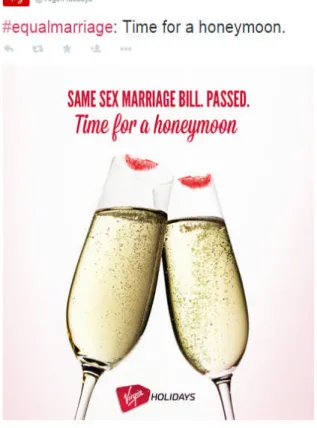
Most of the times, however, brands’ efforts just fall flat. In order for a real-time marketing attempt to succeed, it must be consistent with the brand and its strategy. For example, when the UK legalized gay marriage, Virgin Holidays’ tweet was a perfect fit for the brand :
Figure 8 : Virgin Holidays’ tweet about same sex marriage bill75
Getting the right tone may be difficult, especially when the timing is delicate. Many companies attempted to commemorate the anniversary of 9/11, but most of them ended up with a general malaise and even offended followers.
Real-time marketing must strike the right tone but at the same time differentiate the brand. In the UK, Nissan’s attempt to use the news of the royal baby was not a disaster, but it was not very imaginative and didn’t differentiate Nissan in any way.
75Miller, M. (April 2013).Real-Time Marketing Smarts: Companies Killing It with Off-the-Cuff Content. Retrieved from http://www.toprankblog.com/2013/04/real-time-marketing-smarts/ [Last accessed May 2015]
Figure 9 : Nissan’s tweet about the royal baby news in the U.K.76
Finally, real-time marketing must add some value for the customer and for the brand. Delivering useful information in real time through social media, enhancing customer service, or simply reinforcing the brand persona and its marketing strategy are all ways to provide value.
S
ECTION4 : T
HEC
ASEO
FT
HES
UPERB
OWLEveryone is familiar with the huge advertising business that goes together with the Super Bowl. The Super Bowl, the annual championship game of the National Football League, was first broadcast on American television in 1967. The game broadcast is a major event in the United States, and it’s regularly the most-watched broadcast of the year, as well as being among the most watched sporting events
76Miller, P. (October 2014). Five lessons learned from leading brands' real-time marketing efforts.The Guardian.
Retrieved from http://www.theguardian.com/media-network/media-network-blog/2014/oct/07/real-time-marketing- brands-pizza-express-samsung [Last accessed May 2015]
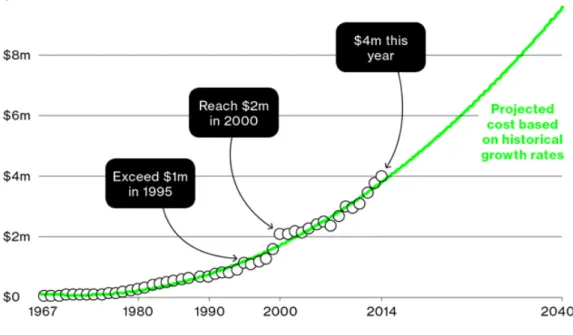
worldwide. Because of the major viewership, advertising during the Super Bowl is extremely expensive, the average cost of a 30-second ad reaching $4.5 million in 2015.
Figure 10 : Year-by-year inflation-adjusted cost for a 30-second ad as well as the total audience in every Super Bowl since the inaugural one in 196777
77Pagels, J. (January 2015). Super Bowl Ad Rates Per Viewer Are A Huge Bargain.Forbes. Retrieved from
http://www.forbes.com/sites/jimpagels/2015/01/31/super-bowl-ad-rates-per-viewer-are-a-huge-bargain/ [Last accessed May 2015]
Figure 11 : Projected Super Bowl ad rates78
The exclusivity, cost, and high viewership of the Super Bowl ads created a unique situation : Super Bowl advertising has become a cultural phenomenon of its own alongside the game itself; many viewers only watch the game to see the commercials, while national surveys (such as the USA Today Super Bowl Ad Meter) judge which advertisement carried the best viewer response79. While TV ads are often
78Chemi, E. (January 2014). Super Bowl Ad Insanity Explained in Six Charts.Businessweek. Retrieved from
http://www.bloomberg.com/bw/articles/2014-01-20/super-bowl-ad-insanity-explained-in-six-charts [Last accessed May 2015]
79Wikipedia. (2015)Super Bowl Advertising. Retrieved from http://en.wikipedia.org/wiki/Super_Bowl_advertising [Last accessed May 2015]
considered as an interruption, “Super Bowl ads are different—instead of being intruders, they are like the “must have” guests that keep a party rockin’.80”
The digital marketing boom and the increasing popularity of social media have added a whole new dimension to the Super Bowl advertising phenomenon. Due to the buzz surrounding them, ads now get international coverage, which may help justifying the increasingly high costs. But more importantly, these ads, although broadcast on television, get massive digital engagement.
Viewers comment online as soon as an ad is aired, and people from all over the world have access to the ads on the internet (once they’ve aired on television) and join the virtual discussion. Ads become viral in a matter of minutes.
Today, investing in a Super Bowl high quality commercial makes more sense than ever. Although the cost is huge and the risks are high (a poor ad will not go unnoticed ), this is one of the rare instances where a business can be sure that its ad will not only be watched, but will be talked about. According to advertiser Rob Siltanen, “the value of the PR garnered from these spots easily quadrupled the actual Super Bowl media cost.”81
However, paying millions for a few seconds of air time is not the only way brands can reap benefits from the Super Bowl. During the game, viewers use social media (especially Twitter) to comment about the game, the ads, and the ceremonies, which often featured internationally famous stars. But actually, brands do the exact same thing. Brands send tweets about what is happening, and they must do so quickly and cleverly in order to be noticed. If something special happen, it’s a great opportunity for brands to get their own moment, as a well-placed and smart tweet could become as viral as the actual TV ads.
80On Marketing. (January 2014). Yes, A Super Bowl Ad Really Is Worth $4 Million.Forbes. Retrieved from http://www.forbes.com/sites/onmarketing/2014/01/29/yes-a-super-bowl-ad-really-is-worth-4-million/
81Ibid.
During the Super Bowl XLVII, on February 3rd, 2013, play was interrupted for 34 minutes due to a 22-minute power outage. Needless to say, brands seized the opportunity and got very active on Twitter.
Walgreens, a drugstore chain, tweeted : “We do carry candles. #SuperBowl.” Then followed it up with:
“…we also sell lights. #SuperBowl.”82Audi seized the opportunity to tease Mercedes with the tweet
“Sending some LEDs to the @MBUSA Superdome right now...”83(the Super Bowl was held in the Mercedes-Benz Superdome). But the incontestable winner of this event was Oreo, who tweeted :
Figure 12 : Oreo's tweet during the Super Bowl power outage in 201384
At this time, this tweet has been retweeted more than 15,000 times, and is considered as one of the greatest tweets of all time. Oreo’s tweet had perfect timing, it was smart and it was consistent with the brand. As Nathan Golia summarized in an analysis for Insurance & Technology :
82Fell, J. (February 2013). How Oreo, Other Brands Dominated Twitter During the Super Bowl Power Outage.Entrepreneur. Retrieved from http://www.entrepreneur.com/blog/225662 [Last accessed May 2015]
83Ibid.
84Ibid.
“Yes, advertising during the Super Bowl is expensive -- but the reach and the ability to add on buzz for free using social media in a savvy way might make it easier than ever to justify the cost. There will always be a moment during an event like the Super Bowl that will spike social activity, whether an in- game play or something like the blackout or Janet Jackson's wardrobe malfunction.”85
85Golia, N. (2013). Why didn't State Farm's blackout tweet go viral like Oreo's?Insurance & Technology – Online.
Retrieved from http://search.proquest.com/docview/1283980571?accountid=14891 [Last accessed May 2015]