Chapter 3 New Elements of Theravada Buddhism Found at Western Prasat Top
Yuni SATO Nara National Research Institute for Cultural Properties
Introduction
In past studies, it was thought that Western Prasat Top was built in the 9th century, as inferred from inscriptions, and lasted until the 15th to 16th centuries, corresponding to the post-Angkor period following the fall of the Angkor period. However, no detailed archaeological studies have been made to date, and the only a few researches that is relevant is one conducted by M. Giteau and A. Thompson based on an iconographic perspective (1, 2). In recent years, Nara National Institute for Cultural Properties has launched an ongoing study of Western Prasat Top from the perspectives of archaeology, architectural history and conservation science (3). The monument deserves particular attention, as it includes buildings and architectural decorations that are associated with periods after the post-Bayon period in the last years of the Angkor period.
For example, seated Buddha images in the buhusparsa-mudra (earth-touching mudra) that are displayed on pediments and standing Buddha images depicted on the false doors of the Northern Sanctuary could be regarded as representative icons of Western Prasat Top that belong to after the post-Bayon period. It is conceivable that these icons belong to a considerably early stage of Theravada Buddhism in the Angkor region (4). Due to instability of their main structure and other such factors, the three sanctuaries of Western Prasat Top were decided and restored and the dismantling of the South Sanctuary was begun as the first step. This dismantling work yielded new discoveries, however, as introduced below.
Section 1 Sema stones discovered in the platform of the Southern Sanctuary
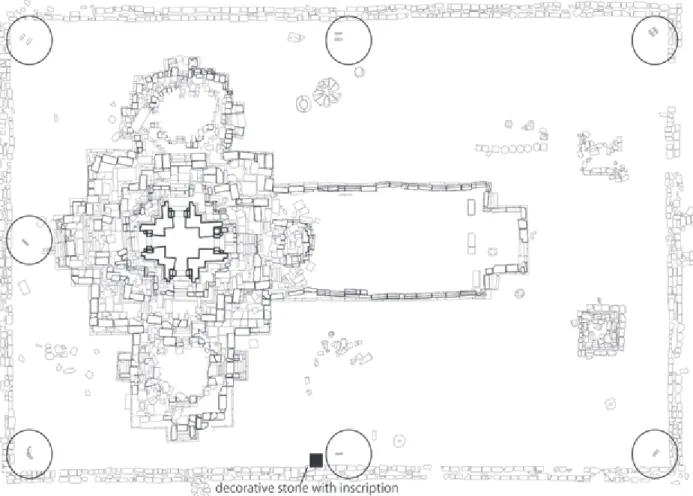
Western Prasat Top today consists of the Central Sanctuary in the center flanked by the Southern and Northern Sanctuaries, with a terrace in the east of the Central Sanctuary. Laterite enclosures and Sema stones mark the temple grounds as though to enclose the sanctuaries (Fig. 1). Surveys so far have found Sema stones placed in the four corners of the laterite enclosure and in the center of each side. A multiple number of Sema stones have also been found anew among the components of the upper and lower platforms, accompanying the series of dismantling work of the Southern Sanctuary.
From the upper foundation, these stones include three from N12 (Fig. 2), two from N14 (Fig. 3), three from N15 (Fig. 4) and five from N16 (Fig. 5). From the lower platform, two have been found in N24 (Fig. 6). Details of the dimension of each block are provided in the Annual Report on the Research and Restoration Work of the Western Prasat Top (5), but as a whole, almost all Sema stones that were recently found at the Southern Sanctuary had heads curved into three arches (Fig.
7). The parts that lay exposed aboveground were carefully shaped, but their bases that were hidden underground remained unshaped. The Sema stones that demarcate the Western Prasat Top site today do not have gouged heads into three, but are generally shaped in the form of ammunition resembling a lotus petal, and differ from the tripartite Sema stones that were recently discovered (Fig. 8).
At a glance, the Sema stones appear to be stacked randomly, but they also seem to be placed mainly in positions that are important as gateways, such as near the stairways of foundations. This trend is especially conspicuous in N24. The Sema stones found in N24 are clearly placed immediately below the bottommost stairway of the lower platform stairways of the Southern Sanctuary, and were probably placed in those positions intentionally. Sema stones are originally closely associated with Buddhism, and have religious significance to the formation of Buddhist temple and terrace sites. At the Southern Sanctuary, they are used as diverted blocks, but it is likely that they were placed and incorporated into the Southern Sanctuary in consideration of their ritualistic and religious meaning.
The fourteen Sema stones found in the Southern Sanctuary could be assumed to be diverted blocks, but from which monument they were diverted is not clear. Nevertheless, since the Southern Sanctuary was built no later than the 14th century, there is the possibility that the stones had been used in a certain Theravada Buddhist temple or Buddhist terrace some time before that. In other words, the stones suggest that Theravada Buddhism may have flowed into the Angkor region before the 14th century.
The aforementioned research by Giteau provides the only available classification of Sema stones in Cambodia (6), but it focuses mainly on highly decorative Sema stones of Theravada Buddhist temples built after the middle period, and does not provide a detailed classification of Sema stones belonging to Buddhist terraces that were seen toward the end of the Angkor
Fig. 1: Locations of Sema stones at Western Prasat Top
Pithu (Fig. 16). Two types of Sema stones were confirmed at Vihear Prampil Loven.
The recent discovery anew of more Sema stones accompanying the dismantling of the Southern Sanctuary of Western Prasat Top might perhaps provide important clues to revealing the process of formation of Theravada Buddhist temples in Angkor Thom and the state of affairs during the transition from the post-Bayon period to the post-Angkor period.
Fig. 3: Locations of Sema stones in Southern Sanctuary N14 Fig. 2: Locations of Sema stones in Southern Sanctuary N12
SE081
SS083 SE084
SE082
SS099
SS098 SS097
SS101 SS096 SS095 SS078
SS078
SS083
SS100 SS084
SS075 SF138 SF137
SW069 SW070
SW071
SS076 SE073 SW072
SS079
SS093
0 1m
SS082 SS077
Fig. 5: Locations of Sema stones in Southern Sanctuary N16
Fig. 7: Excavated state of Sema stones in Southern Sanctuary N24
Fig. 8: The actual state of Sema stones in the center of the north side of Western Prasat Top
Fig. 6: Locations of Sema stones in Southern Sanctuary N24
Fig. 11: Sema stone 1 at Vihear Prampil Loven
Fig. 15: Sema stones at Vihear Prambuon Loven
Fig. 12: Sema stones at Preah An Thep
Fig. 14: Sema stones 2 at Vihear Prampil Loven Fig. 13: Sema stones at Preah Ngok
Fig. 16: Sema stones at Preah Pithu
Section 2 Discovery of decorative sandstone block with an inscription
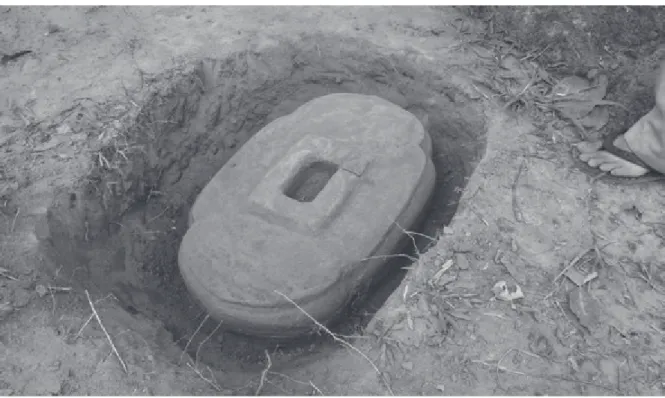
On July 24, 2012, a decorative sandstone with an inscription was found while installing a new alignment marker accompanying the restoration work. It was found in close proximity to the Sema stone in the center of the south side, placed in a 10cm or so recess in the present ground surface.
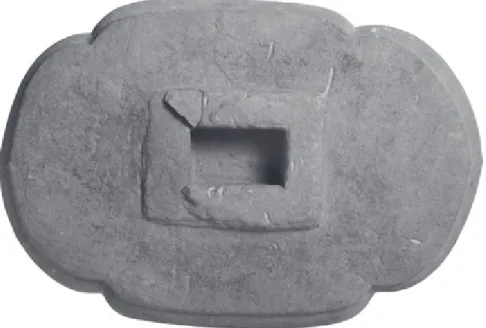
It has a decorative contour in the shape of lotus petals, and was found with a rectangular mortise in the top surface (Fig.
17). When it was carefully picked up to examine the bottom surface, a single line of inscription was found (Fig. 18). The stone measures 66.3cm at its longest, 45.3cm at its widest, 11.5cm high and approximately 40kg in weight. There is no consensus regarding its purpose, but it might have been an offering made with the inscription side facing up, or a pedestal for wooden sculpture with the morise side facing up. No other examples of similar decorative sandstones have been found so far from archaeological sites other than Western Prasat Top.
The content of the inscription is described in the previous chapter by Mr. Sovannnara, but at this stage it is interpreted as shown below.
Original inscription: dakkhin・e kassapo buddho English translation: Kassapao in the south
Judging by the character style, it is presumed to be an inscription from a period between the last years of the Angkor period and the middle period.
Kassapao Buddha is the sixth in the past seven Buddha. The first three Buddhas are Alamkarakapla and the latter four are called Buddhas of the present bhadrakalpa. The seventh Buddha is Sakyamuni, and an added eighth is Maitreya. The four past Buddhas, in particular, are frequently associated with the four directions. These four Buddhas are widely worshiped in today's Cambodia as the four past Buddha. With Maitreya in the center, the four Buddhas occupy the north, south, east and west, with Kassapao Buddha normally positioned in the south. As I mentioned above, this sandstone artifact was unearthed from near sema stones situated in the central part of the south laterite enclosure, it might have been placed there with a conscious awareness of the south direction.
With regard to the four past Buddhas, it is known that the four past Buddhas were widely worshipped in Bagan , Myanmar (7).
In Cambodia, however, no records or examples exist that indicate four past Buddhas worship flourished during the height of the Angkor period, but there is the possibility that four past Buddhas worship was widespread from the end of the Angkor period to the post-Angkor period. A prime example of this is the four Buddha images in the Bakan in the central sanctuary of Angkor Wat. Angkor Wat was originally built as a Hindu temple, but it was modified to a Theravada Buddhist temple in the middle period. The symbolic transformation brought a change in the main deity of the central temple from an image of Visnu to the four Buddha images, as also seen at Wat Nokor (8).
The inscription “Kassapao Buddha in the south” found at Western Prasat Top might perhaps also suggest the possibility that the four-Buddha philosophy was ingrained in Western Prasat Top. Although this is a theory at best at the present stage, the three sanctuaries together(the Central, Southern and Northern Sanctuaries)might have been regarded as the “center”
or as Maitreya and the four past Buddhas placed to its north, south, east and west. As discussed by Mr. Sovannnara in the previous chapter, fragments of sandstones with the same decorations as those recently discovered have been found, but the numerals and characters of their inscription are hardly legible. If the remaining fragments could be found in future surveys, it would lead to a further understanding of the content of the inscriptions. In this respect, the recent discovery can be said to be an invaluable example that provides a vestige of early Theravada Buddhism in the late years of the Angkor period and a new step toward an understanding of the overall picture of early Theravada Buddhism in Cambodia.
References
1) Giteau, Madeleine. 1975, Iconographie du Cambodge Post-Angkorien, Paris, pp. 113-116.
2) Thompson, Ashley. 1996, "The Ancestral Cult in Transition: Reflections on Spatial Organization of Cambodia’s Early Theravāda Complex." Southeast Asian Archaeology1996.
3) Nara National Research Institute for Cultural Properties. 2011. Academic Bulletin No. 88: Western Prasat Top Site Survey Report—Joint Research for the Protection of the Angkor Historic Site,
Fig. 17: Excavated decorative stone (viewed from the northwest)
Fig. 18: Inscribed face
Fig. 19: Mortise
Fig. 20: Overhead photo