Social Safety Net (SSN) in Vietnam:
Comparative analysis of two villages in the north and south
in terms of community-based SSN and the market economy wave
Juichi INADA,
Professor of Senshu University of Japan1. Objectives of research and focus of analysis1 (1) Improvement of social safety net (SSN) in East Asia
Most East Asian and Southeast Asian countries have been trying to improve their social security systems in recent years. Their increasing efforts to move toward “welfare states” had been brought about by the economic reforms and democratization movement in the 1990s, an awareness of the importance of social safety net gained through lessons drawn from the Asian financial crisis in 1997, and the rapid shift toward becoming aging societies.
The SSN serves three purposes. The first purpose is to minimize damage in the event of its occurrence. The second purpose is to prepare the system in advance to compensate for the damage. The third is to offer a sense of safety through the existence of SSN2.
SSN can be defined widely as welfare policies, including health insurance, unemployment insurance, and pension system etc. On the other hand, SSN can be defined more narrowly as support for the poor or low-income households3. In short, SSN is defined as a social system or program that helps to diminish
the risk of illness, unemployment, and poverty, and to offer protection from such risks.
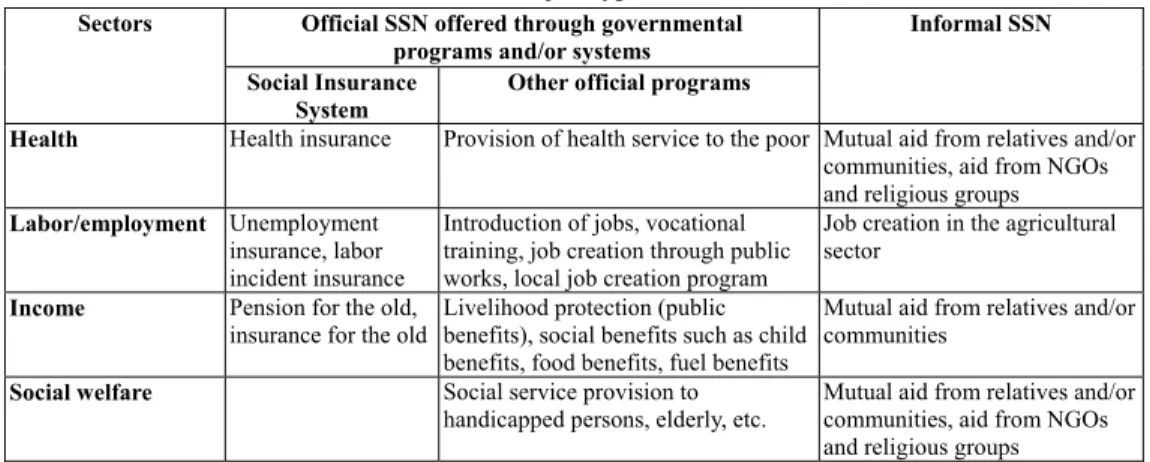
Table 1. Major Types of SSN
Sectors Official SSN offered through governmental
programs and/or systems
Informal SSN Social Insurance
System
Other official programs
Health Health insurance Provision of health service to the poor Mutual aid from relatives and/or communities, aid from NGOs and religious groups
Labor/employment Unemployment
insurance, labor incident insurance
Introduction of jobs, vocational training, job creation through public works, local job creation program
Job creation in the agricultural sector
Income Pension for the old,
insurance for the old
Livelihood protection (public benefits), social benefits such as child benefits, food benefits, fuel benefits
Mutual aid from relatives and/or communities
Social welfare Social service provision to
handicapped persons, elderly, etc.
Mutual aid from relatives and/or communities, aid from NGOs and religious groups
(Source) JICA Institute, Basic Survey on Social Safety Net: Toward establishment of SSN in developing countries, 2003, Chapter 2, p.5.
1 This research is conducted as a part of the Research Project of the Institute of Sociology of the Vietnamese
Academy of Social Sciences (VASS), funded by Vietnam National Foundation for Science and Technology Development (NAFOSTED) under grant number I3.1-2012-07.
2 Toshiaki Tachibanaki (2000), Economics of Safety Net (Seifutii Netto no Keizaigaku, Nihon Keizai Shinnbunsha,
p.1, pp.19–20.
The major types of SSN include a wide variety of support provided in the form of pension, health insurance, unemployment insurance, assistance to handicapped persons, elderly persons, children, provision of food to the poor, and public works and vocational training to create jobs. These programs reduce risks in the event of illness, unemployment, and poverty. These SSN programs are offered both through the official system by the government, as well as through informal mutual assistance systems of relatives, communities, and/or non-governmental organizations including religious groups.
Table 1 shows the major types of SSN. SSN is provided through formal systems such as government programs, and through informal networks such as mutual help systems of relatives and communities or assistance from religious groups.
Generally speaking, SSN is formulated to secure a minimal standard of living for households or individuals, corresponding to changes in industrial structure, labor structure, urbanization, family styles, population structure, and other factors. In fact, informal mutual help among relatives in the communities is considered to be diminishing in tandem with economic development, while formal SSN systems have been developed to supplement such informal traditional systems4.
To what extent does this official SSN respond to traditional risks such as poverty, hunger, economic stagnation, and to new emerging risks such as unemployment and inequality? What kind of roles are local communities, NGOs, and relatives, as well as the official SSN offered by the government, expected to fulfill? The primary focus of this article is to examine these issues using the case of Vietnam, and picks up on two local communities in the north and south of Vietnam.
(2) Situations of social safety net (SSN) in Vietnam
Categorization and detailed studies of “Asian Welfare States” have been carried out in the area of sociology and Asian Studies since the 1990s. For instance, Suehiro (Tokyo University) drew up a categorization of three SSN systems in Asia, based on the differences in the stages of economic development, trend of population, situations of social security systems, and other factors5. He also wrote
about the necessity of “mutual help” in grasping the reality of SSN in Asia. The JICA report, “Basic Study of Social Safety Net,” classifies the situation of SSN in Asia into some categories based on the stages of economic development and socio-cultural diversity6.
Vietnam was categorized as one of the “states in which social security system is limited to public servants and the military, and healthcare is offered as a public health service, in the primary stage of industrialization.” Countries such as Vietnam, Laos, Cambodia, and Myanmar are included in this group. Countries such as China, Vietnam, and Laos fall into a different category of “states of socialist or communist system (and in the process of transition to market economy).”
The aforementioned JICA report examined the situation in the three countries of Thailand, the Philippines, and Indonesia, using these as detailed case studies. However, no studies were conducted for
4 JICA Institute, Basic Survey on Social Safety Net: Toward establishment of SSN in developing countries, 2003,
Chapter 3, p.13.
5 Akira Suehiro, ed. (2014), Employment, Safety Net & Responses to New Social Risks in East Asia, Institute of
Social Sciences (Tokyo University) Research Series, No.56.
Vietnam. Therefore, the study that we conducted in 2014 would be meaningful to fill the gap in research conducted on SSN in Asia.
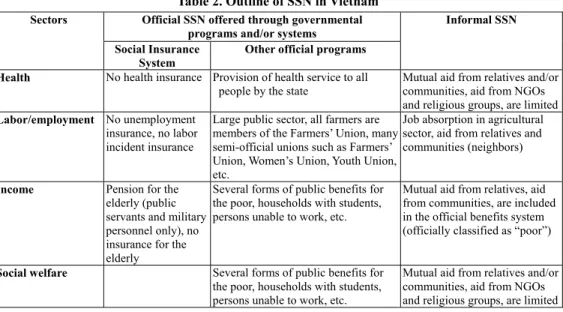
Table 2 shows a provisional summary of the situation of SSN in Vietnam.
Table 2. Outline of SSN in Vietnam
Sectors Official SSN offered through governmental
programs and/or systems
Informal SSN Social Insurance
System
Other official programs Health No health insurance Provision of health service to all
people by the state
Mutual aid from relatives and/or communities, aid from NGOs and religious groups, are limited
Labor/employment No unemployment
insurance, no labor incident insurance
Large public sector, all farmers are members of the Farmers’ Union, many semi-official unions such as Farmers’ Union, Women’s Union, Youth Union, etc.
Job absorption in agricultural sector, aid from relatives and communities (neighbors)
Income Pension for the
elderly (public servants and military personnel only), no insurance for the elderly
Several forms of public benefits for the poor, households with students, persons unable to work, etc.
Mutual aid from relatives, aid from communities, are included in the official benefits system (officially classified as “poor”)
Social welfare Several forms of public benefits for
the poor, households with students, persons unable to work, etc.
Mutual aid from relatives and/or communities, aid from NGOs and religious groups, are limited (Note) Drawn up by the author, based on Table 1.
Informal SSN is mainly offered through mutual help from relatives and communities instead of NGOs and religious groups, which have a restricted activity scope in Vietnam. Such mutual help systems among relatives and communities were examined in the study conducted by Senshu University in the earlier project of “Social Capital in Asia,” and a questionnaire survey was conducted in the Giao Tan commune in the north of Vietnam. One of the conclusions of the study was as follows;
“Social capital of agricultural communities exists to some extent. The credibility, mutual affection within communities create contact networks of internal consensus. However, in the context of the shift in labor and jobs in localities as well as that of the whole area and the whole country, current forms of contact have yet to result in important changes in community life. Social capital in fact remains weak and easy to collapse, for the members in the network of contact themselves are still in the conditions of earning their living. Forms of mutual support do exist, but they are still limited to the support of people within the family or the closest ones.”7
(3) The similarities and differences between the north and the south in Vietnamese society, and the explanation for these based on the “path dependence”
One of the useful analytical tools used to analyze socio-economic factors is the concept propounded by D.C. North, a new institution school8. He divided social systems into two categories: the first is
formal legal and official policies, and the second is informal system such as culture, social customs, and beliefs. He claimed that the formal system, established based on the informal system, affects the distribution of resources of the socio-economic system. This idea comes into play in the “comparative institutional analysis” and “historical system analysis” that follow. Another popular argument employed in historical system analysis is the theory of “dependent path,” which asserts that systems and social frameworks are restricted by historical background, and that the characteristics of a system can be explained by the differences in the historical socio-political experiences. This argument is very effective in explaining the similarities and differences between the north and the south of Vietnam, through the differences in experiences of socialism and market economy.
The Vietnamese government launched the Doi Moi (reform) policy in 1986. Initially, it partially liberalized individual agricultural production and sales, then moved on to promote reforms of state-owned companies, liberalization of private business and activities, as well as liberalization of trade and foreign investment. However, during the 1970s and 1980s, a state-led economic system was introduced, establishing agricultural cooperatives as the core of agriculture in rural areas in the north of Vietnam. On the other hand, although the capitalist market economy spread across the south of Vietnam up till 1975, the socialist system was introduced after that and free market economy became severely restricted after 1975. Nevertheless, after the Doi Moi policy was introduced in 1986, the market economic system was restarted and spread rapidly in the south. The Doi Moi policy introduced in 1986 represented the first stage of reform, while the 9th General Assembly of the communist party held in 2001 can be regarded as the second stage of further reform. It was at this point when the focus was placed on the concepts of “rule of law” and “civil society.”
In short, the north and south of Vietnam took different historical paths. In the north, governmental organizations and systems have been dominant under the long-lasting reign of the socialist system. The south experienced a market economy system, and political liberties prevailed during the era of the capitalist system. Furthermore, there are differences in the climate of Vietnam; the north has four seasons and has a temperate climate, while the south, is warm throughout a year and has a subtropical climate. The differences in climate affect the different patterns of agriculture between the north and the south. On the other hand, the Red River Delta and Mekong Delta are both famous as typical rice production areas, and the same socialist system prevails in both areas. Therefore, the two areas also share similarities.
8 D. C. North (1990), Institutions, Institutional Changes and Economic Performance, Cambridge University Press. D.
2. Overview of two communities in the north and the south of Vietnam (1) Location of the communities
As mentioned in the previous section, the focus of this survey was to compare the rural community in the north, where people have been living under a socialist system for a long time, and the rural community in the south, where people have experienced the history of an open capitalist society. Two typical communities have to be selected to elucidate the differences between them.
The Hai Van commune in Nang Dinh Province in the north, located in a typical rural area of the Red River Delta and a few hours’ drive from Hanoi, and the Thân Cửu Nghĩa commune in Tien Jiang Province, located in a typical rural area of the Mekong Delta and nearly two hours’ drive from Ho Chi Minh City, were selected as target communities for our study.
Chart 1 shows the location of the two communities on the map of Vietnam.
Chart 1. The locations of the two target communities
Hai Van commune in Nang Dinh Prov.
(2) Overview of two communes in the north and the south
The Institute of Sociology of the Vietnam Academy of Social Science (VASS) has collected basic socio-economic data of the target communes, which was shared with the author.
The population of the Hai Van (HV) commune in Nang Dinh Province was 9,807 (2,789 households), and that of the Thân Cửu Nghĩa (TCN) commune in Tien Jiang Province was 21,035 (5,149 households) in 2013. The percentage of the population employed in each sector in the HV commune was as follows: agriculture 29.5%, industry & construction 53%, and trade and services 17.5%. On the other hand, the percentage of the population employed in each sector in the TCN commune was as follows: agriculture 59.7%, industry and construction 12.2%, and trade and services 28.1%. The reason behind the large percentage employed in industry and construction in the HV commune was because the wood- processing industry had been a traditionally dominant industry in the area.
The percentage of population employed in agriculture was large in the TCN commune, but the pattern of agriculture in the area was different from that in the north. Rice was the main produce of the HV commune, while vegetable cultivation was popular in the TCN commune as the TCN commune was located in an extremely market-oriented area near Ho Chi Minh City, which has a huge consumer market.
The original assumption was that the comparison of the two communes would lead to a comparison between the traditional (socialist) social capital influenced by the formal socialist system and the modern (capitalist) social capital of the market-oriented area. In reality, based on our interviews with residents, unions, and People’s Committees, many similarities could be found between the two communes in terms of their prevailing socialistic social safety net systems.
However, the rural community that has experienced a long history of the socialist system in the north, and the rural community that has been developing as a market-oriented area in the south, especially after the launch of the Doi Moi policy and despite the introduction of the socialist system after the integration of 1975, are considered to be different from each other, and evidence of these differences could be found in our interviews with the local communities. In other words, I would like to clarify the differences in the characteristics between modernization from the top (initiated by the state) in a socialist system with a traditional society at the bottom, and modernization derived from external trends (impact of the global market economy) in the last 20 years. I will also explain the similarities and differences of social capital in Vietnam.
(3) Comparison between two communes: Photos taken in our field study
A. HV commune in the north: agriculture and distribution based on rice production
Photo 1: HV commune(1) Photo 2: HV commune(2)
Photo 3: HV commune(3) Photo 4: HV commune(4)
B. TCN commune in the south: agriculture and distribution based on vegetable production
Photo 7: TCN commune(1) Photo 8: TCN commune(2)
Photo 9:TCN commune(3) Photo 10: TCN commune(4)
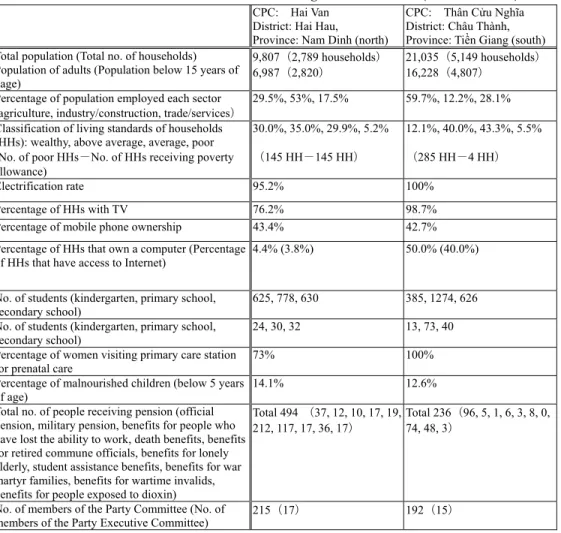
(4) Comparison of figures related to living conditions in the two targeted communities Table 3 shows the comparison of basic socio-economic data of the two targeted communities.
Table 3: Basic socio-economic data of the two targeted communities (as of June 2013)
CPC: Hai Van
District: Hai Hau, Province: Nam Dinh (north)
CPC: Thân Cửu Nghĩa District: Châu Thành, Province: Tiền Giang (south) Total population (Total no. of households)
Population of adults (Population below 15 years of age)
9,807(2,789 households) 6,987(2,820)
21,035(5,149 households) 16,228(4,807)
Percentage of population employed each sector (agriculture, industry/construction, trade/services)
29.5%, 53%, 17.5% 59.7%, 12.2%, 28.1%
Classification of living standards of households (HHs): wealthy, above average, average, poor (No. of poor HHs-No. of HHs receiving poverty allowance) 30.0%, 35.0%, 29.9%, 5.2% (145 HH-145 HH) 12.1%, 40.0%, 43.3%, 5.5% (285 HH-4 HH) Electrification rate 95.2% 100% Percentage of HHs with TV 76.2% 98.7% Percentage of mobile phone ownership 43.4% 42.7% Percentage of HHs that own a computer (Percentage
of HHs that have access to Internet)
4.4% (3.8%) 50.0% (40.0%)
No. of students (kindergarten, primary school, secondary school)
625, 778, 630 385, 1274, 626
No. of students (kindergarten, primary school, secondary school)
24, 30, 32 13, 73, 40
Percentage of women visiting primary care station
for prenatal care 73% 100%
Percentage of malnourished children (below 5 years of age)
14.1% 12.6%
Total no. of people receiving pension (official pension, military pension, benefits for people who have lost the ability to work, death benefits, benefits for retired commune officials, benefits for lonely elderly, student assistance benefits, benefits for war martyr families, benefits for wartime invalids, benefits for people exposed to dioxin)
Total 494 (37, 12, 10, 17, 19, 212, 117, 17, 36, 17)
Total 236(96, 5, 1, 6, 3, 8, 0, 74, 48, 3)
No. of members of the Party Committee (No. of
members of the Party Executive Committee) 215(17) 192(15) (Notes)Drawn up by the author, based on data offered by the Institute of Sociology, VASS
The following is the comparison between the two communities based on the data shown in Table 39.
Statistics on household income could not be obtained. Based on the classification of living standards into “wealthy”, “above average”, “average”, and “poor”, the percentage of households in the HV commune that falls into each category is 30.0%, 35.0%, 29.9%, 5.2%, respectively. (The number of poor households is 145, and the number of households receiving poverty benefits is 145.) On the other hand,
9 The data obtained from the Institute of sociology (VASS) includes ambiguous figures. For example, the number of
the percentage of households in the TCN commune that falls into each category is 12.1%, 40.0%, 43.3%, 5.5%, respectively.
The percentage of wealthy households is larger in the HV commune than in the TCN commune, but this percentage does not reflect the level of income of the people in the two communities. The wealthy households in the TCN commune are assumed to enjoy a higher level of income and living standards, judging from a comparison of the properties they own. This fact was evident in the higher electrification rate, percentage of HHs that own a TV, percentage of women visiting primary care station for prenatal care, and other statistics for the TCN commune. In particular, the rate of HHs that own a computer and have Internet access is significantly higher in the TCN commune, which is much more modernized than the HV commune.
When I visited the households in the “poor” category in both communities, the poor household (family of a widow) in the HV commune appeared to be faring better than the poor household (husband was handicapped and unemployed, wife was working in a part-time job) in the TCN commune. This was related to the fact that poor households were taken care of by the commune more comprehensively in the HV commune than in the TCM commune, because all poor households (95 HH) in the HV commune received assistance but only four among 85 households received assistance in the TCM commune. The number of households in the HV commune was less than in the TCN commune, but the number of recipients of several forms of benefits was larger in the HV commune. These included military pension, benefits to people who have lost the ability to work, death benefits, benefits for retired commune officials, benefits for lonely elderly, student assistance benefits, benefits for people exposed to dioxin (excluding official pension). The number of recipients of benefits for war martyr families and benefits for wartime invalids was large in the TCN commune, because the commune is located in an area where fierce battles were waged during the Vietnam War. The HV commune was assumed to have a close relationship with the communist party, because the number of members of the party committee (and members of the executive committee) in the HV commune was larger than that in the TCN commune, despite the fact that the population of the HV commune was only half that of the TCN commune.
3. Mutual help system of a community, and the market economy wave
I would like to summarize the results of our interviews, by illustrating the realities of the mutual help system of a community and the market economy wave, observed through our interviews conducted in the two communities.
A. HV Commune
(1) Socio-economic situation in the HV commune
・Based on the data offered by the People’s Committee of the HV commune, annual per capita income of the people in the HV commune had increased from 20 million Dong in 2008 to 29 million Dong in 201310. The increase had been brought about by the increase in income from construction works backed
by a construction boom in cities, as well as growth in the furniture and wood processing industry. Furniture produced in the HV commune was mainly for domestic consumption and not for export. One of the factors behind the growth of the furniture industry in the HV commune was the improvement in transportation infrastructure (i.e. improvement of National Road No.1).
・Small scale enterprises that have less than 30 employees constitute a major part of the furniture industry. At the point of starting a business, the Social Policy Bank and Agro Bank serve as lenders. Both of these are state-owned banks, and there are no major private banks in Vietnam.
・89% of the population in the HV commune is Catholic, and there are many churches there.
・Since the introduction of the Doi Moi policy in 1986, agricultural production has been increasing, and the HV commune has become a model “Cultural Commune” that many government leaders visit to observe and study.
・A new hospital facility was constructed by the HV commune using their own budget. Its operational cost is covered by the Ministry of Health.
・The school was divided into primary school and secondary school in 1993, and a new school was constructed in 2005. The IT classroom was constructed in 2009. About 20 students have been added every year. Tuition is free, but uniforms and textbooks are paid for by the students.
・All kindergartens are public, and there are no private kindergartens. The number of students has increased from 493 in 2008 to 621 in 2014. The cost of lunch is 8,000 Dong for a student below two years of age, and 10,000 Dong for a student between the ages of three and five. Annual government budget is 120 million Dong, which is used for management costs and for purchasing books etc.
Photo13: Wood processing industry Photo 14: A newly built hospital
(2) Benefits system (Benefits from the state, mutual benefits from the community)
・Examples of public unions under the People’s Committee include the Women’s Union and the Farmers’ Union.
total of 210,000 Dong per month11. 2.8% of the population of the HV Commune was classified as “poor”
in 2014.
・All farmers are members of the Farmers’ Union, which was established in 1956 in the HV Commune. The Farmers’ Union was transformed in 1997 from an organization of the Communist Party, to an independent organization that provides services for its members, but it is still under the supervision of the Ministry of Agriculture.
・The Farmers’ Union has 1,800 members, about 40% of whom are women. The role of the Farmers’ Union is to assist in agricultural production (purchase of fertilizers, technical assistance and seminars, etc.), collection of water usage fees (24,000 Dong per square meter every half year [one season]), sale of agricultural machines (30% cheaper than market prices), and provide other forms of support. A new law was enacted in 2012, which allowed the Union to provide micro financing services.
・The leaders of the Farmers’ Union are not public servants but representatives of farmers. The Farmers’ Union is a non-profit organization that has become increasingly similar to a private company in recent years, and now undertakes activities such as the sale of vegetables to private companies, and the purchase of vehicles for collecting and selling produce. The Farmers’ Union is also eligible to receive low interest rate loans from the Social Policy Bank.
・The Women’s Union has been putting efforts into reducing the poverty of women. Once recommended as a “poor household”, the women in the household will be eligible to receive poverty benefits of up to 1 million Dong per month. The number of members (all women) of the Union is 2,108, and 96.9% of them are farmers. In other words, most farmers are women.
・The Women’s Union launched its micro financing project in 2008 in collaboration with a Belgian University which offers 100 million Dong as its fund. The fund had increased to 110 million Dong in 2014. The micro financing scheme lends women classified as “poor” 2 million Dong per year (0.5% interest rate per half year), and 49 women have taken loans under the scheme. The money borrowed is used for the purchase of livestock such as chickens, pigs, and running small businesses. A management
11 1 thousand Dong is about 5.4 Japanese Yen in 2014.
committee has been established, and the head of commune is the supervisor of the Union. Three to four experts provide support for their activities, audit the results, and report the situation to the Union once a year.
(3) Support from (state-owned) banks
・The Social Policy Bank had originally been a part of the Agro Bank, but became an independent bank in 2003 to raise its poverty reduction programs to the international level. Its activities include: (1) Provision of low interest rate loan to improve the living conditions of poor households (30-50 million Dong for three years, 0.6% interest rate), (2) Loan for education to households with children and/or university students (11 million Dong per year), and (3) Loan to improve sanitary conditions such as toilets.
・The number of users of the Social Policy Bank was 303 households (including 67 “poor” and 15 “near poor” households, 102 households with university students, and 104 borrowers for improving sanitary conditions). The Bank began to provide loans to poor households in 2003, and began to provide loans to households with university students in 2006. It is increasing its loans for improving sanitary conditions. The percentage of poor households has decreased from 6.9% in 2003 to 2.9% in 2014, marking a drop of about 4 %.
・The Social Policy Bank is managed by the district authority. The Farmers’ Union collects information on the properties (houses, lands, etc.) of borrowers and reports them to the district authority. Land deeds are necessary, but no collateral is required at the time of borrowing. A group lending scheme (1 million Dong per person at 1% interest rate, with the amount of loan differing among groups) is also available, and is popular in the northern area.
・Loans to support small businesses is offered by the Agro Bank (0.95% interest rate per year, 0.8% special interest rate in the cases of improvement of sanitary conditions and construction of new houses). 293 households have taken out loans, mostly for running handicraft businesses. The maximum amount of a loan is 5 billion Dong, and borrowers are required to present certificates of capability for running a business. A typical example of the scheme is the loan to furniture factories.
B. TCN Commune
(1) Socio-economic situation in the TCN Commune
・The TCN commune has about 5,000 households and population of about 20,000, many of whom own middle-sized parcels of land for agriculture. There were three hamlets in the French colonial era, and today, there are seven hamlets in the TCN commune.
・A leader of the People’s Committee explained that the following major changes occurred in the last 10 years: (1) Economic growth and increase in income, (2) Improvements in infrastructure such as road, houses, and irrigation system, (3) Advancements in culture such as spread of TV and mobile phones, travel, participation in festivals, sports, and shows, and on the other hand, (4) Increase in fights especially among the younger generation.
2010 to 25.45 million Dong in 2014. 4.5% of the population is classified as poor, which means that their income level is below 400,000 Dong per month.
・It normally takes three months to harvest rice and one month to harvest vegetables; therefore, vegetable cultivation is more profitable. The rice, vegetables and coconuts that is harvested or produced are sold to private buyers who come to the farmers, and most of these buyers are from Ho Chi Minh City. The selling price for these agricultural products depends on negotiations, and fluctuates every month. A new breed of coconuts in the southern part of Vietnam is sold at a higher price (15,000 Dong each) than normal Thai coconuts (6,000 - 7,000 Dong each), because the quality of the former is better than that of the latter.
・A new industrial zone was constructed in 2009, located about 4 km away from the TCN People’s Committee. This has contributed to growth in employment to some extent (most workers come from Ho Chi Minh City). The wage at the factories is about 4.5 million Dong per month.
・The revenue of TCN Commune has been increasing every year from 1.7 billion Dong in 2010 to 3 billion Dong in 2014. The revenue is transferred to the provincial government and distributed to communes based on its budget plans. For example, a primary school and kindergarten were constructed (total cost of 20 billion Dong), and 10 local roads were improved (total cost of 9 billion Dong) under the provincial budget. The TCN commune paid 15% of the cost of improvement for roads between the hamlets. The irrigation system has been improved, especially after 2000.
Photo 17: Road connecting hamlets Photo 18: TCN commune People’s Committee
(2) Benefits system (Benefits from the state, mutual benefits from the community)
・Examples of public unions under the People’s Committee are the Women’s Union, Farmers’ Union, and the Youth Union.
・One of the activities undertaken by the Women’s Union is providing micro financing to members, through a fund (Fund for Women) of 1.2 billion Dong with the support of the Norwegian Organization. The fund is managed by the province, and each commune participates in the management committee. 12 communes selected out of 22 communes have been using this Fund.
million Dong, the household can borrow an additional 6 - 7 million Dong the next time. At the time of interview in 2014, 378 households had borrowed and used the money for the purchase of livestock, construction of fisheries, and other activities. Some staff from the Women Union check on progress every few months, and the Union also conducts seminars three or four times per year.
・The classification of “poor households” is decided by members of each commune every year, based on standards drawn up by the Ministry of Labor and Local Affairs. The chief of each hamlet draws up a list of candidates that qualify for the category of “poor households,” as well as an official list after voting by residents at a hamlet meeting. The list is finalized after verification by the commune authority (People’s Committee).
・Poor households can receive electricity benefits, poverty benefits from the commune, and benefits for handicapped persons, in addition to the loan from the Social Policy Bank. There are food benefits in case of illness (1,000 Dong per day) and death benefits for members of the Elderly Union. (Neighbors also provide assistance during difficult times, on a personal basis.)
・The role of the Farmers’ Union includes: (1) Publicize the “New Community Plan”, (2) Promote understanding of joint activities such as the provision of land for water usage, (3) Provide support for agricultural production such as diversion to vegetable cultivation from rice production, and organic cultivation, and (4) Conduct training seminars (a few times a year).
・At the time of the interview in 2014, 2,811 households were members of the Farmers’ Union, of whom 816 members were women. The Farmers’ Union has established its own fund for poor farmers by collecting contributions from richer farmers. Farmers classified as “poor” and “nearly poor” can take loans of 3 to 5 million Dong for three years from the Union (at 0.65% interest rate), and about 50 households are currently on this loan. Contributions to the fund are made by richer famers, who can receive “excellent farmer” certificates by contributing 1 to 1.5 million Dong to the fund. Richer farmers typically increase their income through vegetable cultivation, straw hat making, fish farming, chicken farming, and other activities. Income in the agricultural sector in the TCN commune has been rising in general, as a result of improvements in transportation infrastructure and better access to credit.
(3) Support from (state-owned) Banks
・The role of the Social Policy Bank include: (1) Provide support for improvement of livelihood of poor households, (2) Bring about the realization of “Happy Families,” which means stable economy, gender equality, women’s participation in the Union, and improvements in education for children, and (3) Improve education. The Social Policy Bank provides loans not only to poor households, but also to 488 households of the Women’s Union.
・The Social Policy Bank provides loans to “poor” households (at 0.45% interest rate) and “nearly poor” households (at 0.95% interest rate), and the number of borrowers is 313 in total. The Bank loans are used for the purchase of livestock, construction of houses, provision of assistance to persons looking for jobs (10 - 20 million Dong), provision of assistance to households with university students (10 - 11 million Dong per year), provision of assistance to nearly poor households (5 - 20 million Dong), and improvement of sanitary conditions (toilets, water supply system, etc.)
・There are other state-owned banks such as the People’s Credit Bank and the Agro Bank. The People’s Credit Bank offers credit at 11% interest rate without review of personal properties. The Agro Bank offers credit at 10% interest rate with review of personal properties. The Agro Bank normally provides loans of 700 - 800 million Dong, after checking the land owned by the applicants as collateral for loan. The number of borrowers was about 400 households in 2014.
・The ADB (Asian Development Bank) has been offering technical assistance for organic cultivation to farmers since 2013, in cooperation with the Ministry of Agriculture and the Ministry of Rural Development. The total amount of assistance is 50 billion Dong, and 13 billion Dong is allocated to the Chat Tran District where two communes are active; the TCN commune is one of the two active communes. Two agro-processing centers were under construction as an ADB pilot project in 2014. This project is expected to contribute to increasing farmers’ income and providing a stable supply of environment-friendly foods in the future.
4. Conclusions
In the previous sections, the current situation of social safety net in Vietnam and the differences between the north and the south were described. The summary is as follows.
(1) Although differences exist between the north and the south, the basic framework of the SSN system is almost the same. The most significant common characteristic is that a socialist government-led system of mutual benefits has been constructed in both communes. Unions under the supervision of People’s Committee such as the Women’s Union and Farmers’ Union play key roles in providing support to poor households. They provide benefits to poor households under the systems that are socialist, community- based, and participatory, which are common features in both communes in the north and the south.
increased. In the TCN commune in the south, growth in vegetable cultivation and fruits production have contributed to an increase in the income of farmers and the revenue of the commune, and the number of rich farmers is on the rise. Improvements in infrastructure of roads and irrigation in the area is another factor contributing to the development of the area that the TCN commune is located in.
(3) On the other hand, one of the major differences between the northern commune and the southern commune is that a stronger wave of market economy can be observed in the south. Agricultural production and distribution system of rice, vegetables, coconuts, and other products take place in a capitalist manner based on a market economic system. The value chain of agricultural products, the price decision mechanism of the products, farmers’ preferences and incentives in the selection of products and farming, are based on a free market system as well as the demand and supply mechanism. One of the factors behind the characteristics of the TCN commune is the presence of Ho Chi Minh City as a huge market, but the previous experiences of the capitalist market economy is considered as another factor contributing to the progress of the market economy in the south.
(4) In spite of the steady development of the regional economy, the growth in people’s income both in the north and the south, and rapid progress of the market economy even in the agricultural sector in the south, the socialist social safety net system that prevails both in the north and the south are very similar. The socialist mutual benefits system offered by communities seems to function even under conditions of rapid economic development, especially as a social safety net for poor households and socially vulnerable persons. This should be highly evaluated as an effective mechanism so far.
On the other hand, there are almost no private systems that can supplement the public SSN system, which has been observed in other advanced countries and some emerging economies. Direct assistance to the poor and the vulnerable by foreign NGOs is still restricted by the government, except in the case of collaboration with official governmental organizations such as the Women’s Union.
(5) We should monitor the progress of the SSN system in Vietnam and check if the official SSN system continues to be effective in a changing society that is experiencing rapid economic development. We have observed that emerging middle income citizens and/or rich households are beginning to look for new or supplemental systems for their pension, health care, etc.12 It would be beneficial for researchers
of Vietnam, Japan, and other countries to have the opportunity to exchange knowledge and experiences of effective SSN systems in each country, and to come up with ideas for better SSN systems that are suitable for Vietnam in the future.