Metacognitive Reading Strategy Use and Reading Comprehension
in English of First-Year Students at a Japanese University
1. Introduction
Responding to differing student needs in the English as a Foreign Language (EFL) classroom requires teachers to understand how students learn, construct knowledge, and improve their comprehension skills in order to effectively integrate this knowledge into curricula to support effective reading strategy use.
Effective readers can be characterized as employing a range of strategies that help knowledge construction and recall of reading material (Klingner, Vaughan, & Boardman, 2015). Interestingly, effective readers are not characterized by how much they know, or the range of strategies they report knowing, but their ability to strategically employ both knowledge and strategies to achieve optimal results (Newby & Ertmer, 1996). Therefore, if teachers are able to critically assess which strategies effective readers are using in classrooms it will help in creating beneficial and innovative solutions for every student.
One particular means of critical assessment is the Survey of Reading Strategies (SORS) developed by Mokhtari & Sheorey (2008). Through self-report, the survey helps highlight ways which students use self-monitoring and employment of cognitive strategies, in an effort to better understand the actions students take when reading in a foreign language. One concern though is that these reports may diverge from what students actually do when reading due to false beliefs (Frith, 2012).
Nevertheless, whether reports are entirely accurate or not, they can still be an important source of information for classroom teachers. An understanding of which cognitive and psychological aspects of effective classroom learning (Dunlosky, Rawson, Marsh, Nathan, & Willingham, 2013) is essential for teachers to create better classroom conditions that facilitate learning
(Tokuhama-Espinosa, 2014).
One consideration for university teachers in Japan is that the techniques students have used to learn English in junior and senior high school may no longer be effective, or even desirable, when studying at university. With this in mind, it is significant that few studies have looked at the relationship between reported metacognitive strategy use and reading comprehension scores using surveys.
As a contribution to this apparent gap in the literature, the SORS was used with a view to further illuminate an under-represented area of inquiry into student thinking. Two main research questions are the focus of this current study.
1. To what extent to do non-English major first-year students use metacognitive strategies for reading in Japan?
2. To what extent is there a relationship between metacognitive strategy use and reading comprehension scores on the commercial item referenced test, Global Test of English College Edition (GTEC) ?
2. Methodology
2.1 Participants
Non-English major first-year students majoring in Science, Teacher Education, Agriculture, and Mechanical Engineering at Ehime University (n=109; male=69 and female=40) were purposively selected. The rationale for selecting these students was to investigate the general level of strategy use in the author s own classes to better understand the nature of metacognitive strategy use employed by students. At the time of this study, all students had completed at least nine years of formal English education as part of their general courses of study at junior and senior high school.
According to university data from the GTEC 2016 test
Glenn Amon
M
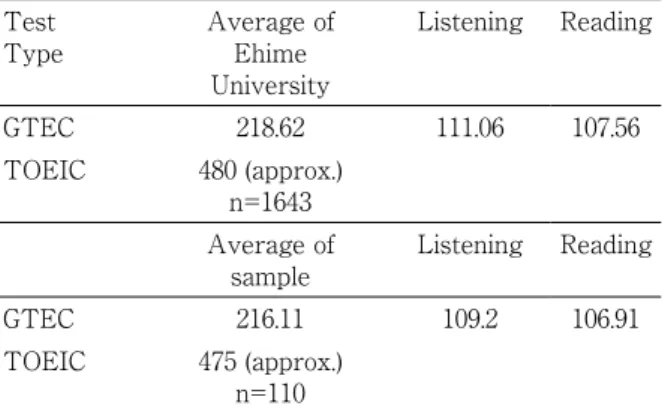
AGEEperiod, most students fall between a combined GTEC Listening and Reading score of 205 to 236. These figures translate to an average TOEIC Listening and Reading Score between 445 and 530. In terms of the Common European Framework of References for Language (CEFR), this places students in an average range of A1 to A2, beginner or elementary respectively. Students who score higher than the average, 280 on the GTEC Listening and Reading test fall within the CEFR category B1 and have achieved a TOEIC score of 660 or over in Listening and Reading. In my own sample, the average GTEC score for students was 216.11 which equates to a TOEIC score of 475. The table below outlines the representativeness of the participant sample to the wider student population of Ehime University.
Table 1. Ehime University GTEC Scores
Test
Type Average of Ehime University
Listening Reading
GTEC 218.62 111.06 107.56
TOEIC 480 (approx.)
n=1643 Average of
sample Listening Reading
GTEC 216.11 109.2 106.91
TOEIC 475 (approx.)
n=110
(1) TOEIC scores are an approximation based on the conversion chart produced by the Benesse Corporation (GTEC-LR SCORE, 2017)
2.2 Instruments
In order to explore students metacognitive strategy use, one survey and one test were used.
1. A bilingual version of the Survey of Reading Strategies (SORS), created by Mokhtari and Sheorey (2008), was used to better understand students overall use of metacognitive strategies. Adaptations were made to a translation of SORS that appears in Shikano s (2015) paper because several questions were considered easier to understand after adaptation. A Japanese translation of the original English questions was given to students due to the complexity of the original English questions and in consideration of the general proficiency level of high-beginner to low-intermediate of most students. 2. The Global Test of English Communication (GTEC),
developed by the Benesse Corporation, was used to calculate individual participants reading comprehension scores. Test results provide results for both listening and reading separately and in a combined form.
2.3 Data collection procedures
Ehime University ethics protocols were followed for the collection and analysis of data (Ethics reference: 16-003, accepted June 28th, 2016). During the first class of the course, students were given a concise explanation of the research in English with a bilingual translation in Japanese on a handout. The teacher also explained verbally to students the purpose for the survey as part of informed consent. The teacher also stressed to students that their responses would in no way affect their grades for the course. All students completed the questionnaire, which is a 5-point Likert scale measure for a 30-item survey. Students that did not fill in answers, or filled in more than one answer, or missed writing their student ID numbers on the survey were excluded from the final data analysis. GTEC results were obtained toward the end of the 15-week course after students took the computerized listening and reading comprehension test as part of their regular course of study at the university.
2.4 Data analysis procedure
Data was compiled using EXCEL and the analyzed using the statistical package EXCEL toukei ( エクセル 統計 ) developed by Social Survey Research Information Company, Ltd (SSRI). To begin with, descriptive statistics were used to determine the extent to which students using reading strategies.
As the survey and test include a large number of variables, further Exploratory Factor Analysis was used to determine basic groupings of factors that can explain several of the survey data variables. Finally, regression analysis was performed to see if there was a significant relationship between the survey questions and test score variables.
3. Results and discussion
3.1 Research question 1: To what extent to do non-English major first-year students use metacognitive strategies for reading in Japan?
2.4 represent low use, 2.5 to 3.4 moderate use, and 3.5 or above high strategy use.
In contrast to other studies (Shikano, 2013; Sheorey, Kamimura, & Freiermuth, 2008) students in this study were not divided into high and low proficiency groups based on self-reporting, as determining the level of ability in this way is problematic. Specifically, students reporting will change depending on the text type provided and their own perceptions of their ability may be skewed positively or negatively depending on their personal self-concept (Dweck, 2017).
Furthermore, in Shikano s (2013) study, students were divided into high and low proficiency based on a single practice passage provided by the author. It is unlikely that a single reading would be sufficient for students to make a reasoned self-report. Moreover, students may also fall prey to negative self-evaluation (Iwamoto, 2007) which could skew the results obtained in that study, with students who scored lower over-estimating their ability and placing themselves in the range of the higher group.
With regard to the three subscales of SORS, students in this study reported a moderate use of all three subcales. Global strategies (M=3.50), Problem-solving strategies (M=3.50), and Support strategies (M=3.33), with an overall reported use of (M=3.33). These results are similar to other Japan-based studies shown in Table 2.
Table 2. Japan-based studies
Study Overall reported Use
Sheorey, Kamimura, and Freiermuth. (2008) Shikano (2013) Shikano (2015)
2.91 (Moderate)
3.53 (Moderate) 3.38 (Moderate)
Students preference for problem solving strategies is also consistent with previous studies both within and outside of Japan. With regard to the most and least used strategies reported by students there is a noticeable difference from the study by Sheorey, Kamimura, and Freiermuth (2008).
Table 3. Most and least used strategies (n=109)
Most preferred strategies M SD
I use tables, figures, and pictures in text I underline or circle information I re-read, when text is difficult I guess meanings and phrases I pay attention, when text is difficult
4.08 4.07 3.96 3.95 3.94
(.94) (1.02) (.90) (.75) (.76)
Least preferred strategies M SD
I try to picture or visualize information I read aloud, when text is difficult I think about whether the reading fits my purpose
I critically analyze and evaluate information
I ask myself questions I like to have answered
2.36 2.37 2.4 2.56 2.92
(.97) (1.19) (.92) (.96) (1.03)
Whereas Sheorey, et.al. (2008) claim that Japanese learners are visually oriented, citing Reid (1987), the data from this cohort of students shows that picturing or visualizing information is reported as the least preferred strategy. This echoes the lowest frequency reported by Shikano (2015), but differs from the results reported in Shikano s (2013) paper. We can surmise that descriptive statistics are relational to individual student cohorts, and should not be generalizable to a claim of preferred learning styles. Over the last decade there has been a growing body of research that has debunked the notion of learning styles, as a neuro-myth, see Pashler, McDaniel, Rohrer, & Bjork (2008), and Coffield, Moseley, Hall, Ecclestone (2004) for a fuller review and discussion. Portraying students as a particular “type” of learner obfuscates individual differences and constrains the wide range of learning activities that could be used by teachers.
3.2 Principal Components
aids a better understanding of what is being read. The third component consists of six factors, three positive and three negative. The positive factors relate to strategic action at the time of reading. For example, taking a note of textual features or taking an overview of the text. These are categorized as predictive actions taken by a student while reading. The three negative factors include translation from English to Japanese, and thinking in Japanese, or reading slower to understand. These factors are categorized as relational as they suggest an attempt to relate reading material to student knowledge in their mother tongue. These three components account for 30.08% of the data.
Table 4
Extracted Factors from Principal Components Analysis
Strategy
Self-monitoring Analysis Predictive/relational
PRO25 GLO23 PRO9 PRO14 GLO24 PRO16 SUP22 SUP26 GLO27 SUP30 GLO17 SUP5 GLO12 GLO4 GLO8 PRO7 SUP29 SUP13 Cumulative contribution ratio .693 .601 .577 .529 .514 .484 .483 -.082 .137 .334 .472 .010 .162 -.002 .169 .365 .263 .279 12.39% .058 .368 .099 .334 -.020 .301 .012 .683 .548 .495 .485 .481 .368 .175 .186 .088 .167 .245 22.2% -.015 .152 -.063 .000 .361 -.145 -.095 .137 .084 .028 .135 .052 .594 .569 .526 -.400 -.465 -.512 30.08%
(1) Rotation method: Varimax (2) Rotation converged in 14 iterations.
(3) Values over 4.00 and under -4.00 (in bold) are noted for consideration.
Within the first component of self-monitoring, problem-solving strategies 25 and 9 (re-reading, and getting back on track when losing attention) are strongly correlated. Strategy 14, “paying attention when reading difficult text” is also correlated with self-monitoring, the difference between the factors being (0.195). Within the global strategies, strategy 17, “Using context clues”, is of particular interest as the factor loading for self-monitoring is less than the factor for analysis. To understand this, we can consider that making inferences from textual passages requires observation, an analytical action, and a
reflective check of background knowledge, a form of self-monitoring.
The second component, analysis, consists of four items. Three of these items belong to the support subscale. Strategy 26,“I ask myself questions I like to have answered in the text,” strategy 5, “I read aloud when text is difficult,”and strategy 30, “I think in English and Japanese when reading.” Strategies 5 and 26 both appear in the least reported strategies used by students, and relate to the way students analyze what they are reading cognitively and phonologically. Strategy 30, “thinking in English and Japanese” is also close to the factor of self-monitoring, with a difference of (0.161). Global strategy 27, “I check if my guesses are right or wrong” refers to how Japanese students generally check all their answers by writing in everything they either missed or did not understand correctly. This close-attention to detail is a common feature of classrooms from junior high through to university.
3.3 Research Question 2: To what extent is there a relationship between metacognitive strategy use and reading comprehension scores on commercial item referenced test, Global Test of English College Edition (GTEC) based?
Multiple regression analysis was performed to find the goodness of fit from the data. The variance was explained by the regression formula (R2=.296), which indicates that the effect size predicts approximately thirty percent of the variance. The ANOVA shows that the formula is significant at (p<0.001) to predict the dependent variable (GTEC test score) from the independent variables (survey items) I assumed.
Three strategies in particular revealed a significant correlation with student test scores. Only one strategy though indicates a positive correlation with test scores, the other two reveal a negative correlation.
Strategy 14, “When text becomes difficult, I pay closer attention to what I am reading.” (p<0.0048**) has a positive correlation with the students test scores. Strategy 14 is part of the SORS sub-scale of Problem-Solving strategies which are described as the deliberate things students do when encountering difficulty in a text Mokhtari, Sheorey, & Reichard (2008). We can conceive that paying closer attention acts as a gateway to the use of other strategies such as rereading (strategy 25), and guessing the meaning of words (strategy 28).
Strategy 22, “I go back and forth in the text to find relationships among ideas in it” (p<0.0071**) while having a strong correlation with the self-monitoring component, had an overall negative correlation with test scores for students that reported using this strategy. The GTEC test is a time-based test taken on a computer. A negative correlation for skipping back and forth in a text to find relationships suggests that students could be taking too long to read passages. As students read they are likely to stop to think about what they are reading. They may re-read parts of a text to see if they have missed important information, or how previous information is connected to information later in the text. On one hand, this is a technique used in constructively responsive reading (Pressley & Gaskins, 2006), however, on a timed test this lessens the time available to complete all the questions. Another potential cause for needing to jump back and forth in a text stems from the generally weak development of phonological processing skills by students while studying at senior high schools in Japan. One particular study has noted that students’ ability to read
core English words decreases (Coulson, 2014, cited in Coulson, Ariiso, & Tanaka, 2013) from junior high school through to the end of senior high school in this respect.
Strategy 29, “When reading, I translate from English into my native language” (p<0.001***) also had a negative correlation with test scores for students who reported using this. It is common knowledge that translation is the dominant method of English instruction in Japanese junior and senior high schools, focusing on understanding English grammatical constructions at the sentence level. Based on their experiences in secondary education, students construe new information through this Japanese cultural lens which impacts negatively on texts that are longer than a sentence.
Translation forces students to take longer to answer exam questions. In time-bound tests such as the GTEC test, lengthy textual deconstruction using translation is likely to cause students to be unable to answer all questions, thereby impacting negatively on results. In addition, students may misconstrue conceptual ideas by attaching Japanese conventional meanings to language, rather than the conventional meanings attached to them in English. Although construal differs even in native speaker understanding of language meaning (Driven & Verspoor, 2004), it is greatly magnified when meanings are associated more with the mother tongue than with the target language of English.
Thus, directing students away from translation as a sole strategy for reading comprehension is likely to assist in helping students construe the target language through the target culture. Indeed, as one recent study from Japan reports, a reduced amount of translation can also have positive effects on not only reading speed, but reading comprehension as well (Sakurai, 2015). Moreover, echoing Coulson s (2014) research, there is a substantial body of research that indicates that phonological processing skill has a significantly positive relationship with English literacy (Stephens, 2016) and is also associated with successful L2 word learning (Yang, J., Gates, K. M., Molenaar, P., & Li, P. (2015).
(Stephens, 2016).
In this present study, through observation of student textbooks, most students had not removed the textbook CD from the sealed folder on the back of their textbooks by the end of the 15 class course which indicates that students may not believe in listening while reading as an effective strategy.
Whilst the question of using audio materials as a strategy while reading is not explicitly on the current version of the SORS survey in this study, one of the questions, number 5, “I read aloud when text becomes difficult” draws on relates to the necessity for phonological processing when reading to aid comprehension. As this was also one of the least reported strategies students use, it suggests that students are likely to benefit from explicit instruction on how to use audio materials while reading.
4. Limitations and direction for further
studies
Questionnaires provide insights into how students make strategic decisions, and are an effective way to quickly make assessments. However, they do not allow us to access which strategies students use in the process of reading and therefore the results of this exploratory study, whilst illuminating, would be better situated alongside other measures. For example, interviews, would help understand different approaches to reading, and observations would help to understand what students do when reading, as opposed to what they report doing.
5. Conclusion
The purpose of this study was to better understand the level of strategy use by students, and to explore possible connections between strategy use and reading comprehension scores on the GTEC test. The SORS survey provided a particular way of looking at the areas students perform well in, and those areas which are in need of more support.
Student comprehension utilizing this approach can be assessed by teachers as a way to understand, plan for, and support student learning. Utilizing statistical data from multiple regression analysis suggests that a stronger focus on developing close reading skills might help students achieve higher levels of achievement on the GTEC test, whereas overuse of translation will have a
negative effect on test scores.
Statistical data from surveys and tests are clearly useful for instructional design and decision making (see Klingner, 2004 for a comprehensive overview of different forms of assessment). Indeed, further research in this area could combine quantitative survey reports with think-aloud protocols. One drawback though would be large class sizes, and the ability to effectively monitor thinking. Therefore, a more attractive alternative could be to combine survey data with checklists that students check whilst in the process of reading different kinds of text which could allow teachers to better understand individual differences between learners.
References
Coffield, F., Moseley, D., Hall, E., and Ecclestone, K. (2004).
Learning Styles and Pedagogy in Post 16 Learning: A Systematic
and Critical Review. London: Learning and Skills Research
Centre.
Coulson, D., Ariiso, M., and Tanaka, M. (2013). Difficulties in Reading English Words: How Do Japanese Learners Perform on a Test of Phonological Deficit?. Vocations and Learning. 2. 55-62. 10.7820/vli.v02.1.coulson.et.al.
Coulson, D. (2014). The development of word reading skill in secondary schools in East Asia. Focusing on EFL Reading: Theory and Practice. Newcastle upon Tyne: Cambridge Scholars
Publishing, 62.
Driven, R., & Verspoor, M. (2004). Cognitive Exploration of
Language and Linguistics. Amsterdam: The Netherlands. John
Benjamins Publishing Co.
Dweck. C. (2017). Mindset: changing the way you thinN to ful¿l your
potential. Hachette UK.
Dunlosky, J, Rawson, K.A., Marsh, E.J., Nathan, M.J., Willingham, D.T. (2013). Improving students’ learning with effective learning techniques: promising directions from cognitive and educational psychology. Psychological Science in the Public Interest. 14(1) 4-58.
Frith, C.D. (2012). The role of metacognition in human social interactions. Philosophical Transactions of The Royal Society, B
(2012) 367, 2213-2223.
www.benesse.co.jp/gtec/entry/group3/pdf/GTEC-LR_ GTEC_SCORE.pdf
Iwamoto, Kyoko. (2007). Is self-assessment possible?: Japanese students’ self-assessment in their course work. 日本英語英 文学, (17), 65-79.
Klingner, J. K. (2004). Assessing reading comprehension.
Assessment for eৼective intervention, 29(4), 59-70.
Klingner, J. K., Vaughn, S., & Boardman, A. (2015). Teaching
reading comprehension to students with learning di৽culties, 2E.
Guilford Publications.
Mokhtari, K., & Sheorey, R. (Eds.), (2008). Reading strategies of first-and second-language learners: See how they read. Christopher-Gordon Pub.
Murphy, R. S., & Sin, H. H-Y. (2014). Neuroscientific benefits of including culture and emotion into the second language learning classroom: Teaching for the DATC. 基盤教育セン ター紀要, (20), 53-69.
Pashler, H., McDaniel, M., Rohrer, D., and Bjork, R. (2008). Learning styles: concepts and evidence. Psychol. Sci. Public
Interest 9, 105‒119. doi: 10.1111/j.1539-6053.2009.01038.x
Pressley, M., Gaskins, I.W. (2006). Metacognitively competent reading comprehension is constructively responsive reading: how can such reading be developed in students?
Metacognition Learning, 1:99-113.
Reid, J. M. (1987). The learning style preferences of ESL students. TESOL quarterly, 21(1), 87-111.
Sakurai, N. (2015). The influence of translation on reading amount, proficiency, and speed in extensive reading. Reading
in a Foreign Language, (27)1, 96-112.
Sheorey, R., Kamimura, Y., & Freiermuth, M. (2008). Reading strategies of users of English as a library language: The case of Japanese ESP students. Reading strategies of ¿rst-and
second-language learners, 175-184.
Shikano, M. (2013). A quantitative survey on metacognitive awareness of reading strategy use in English by Japanese university students. International Education Center Journal, 14,
11-24.
Shikano, M. (2015). Second Language Readers’ Gender, Major,
and Reading Strategy Use. アカデミア . 文学・語学編 :
Journal of the Nanzan Academic Society, (98), 41-59.
Stephens, M. (2016). Response to Sakurai: the influence of translation on reading amount, proficiency and speed in extensive reading. Reading in a foreign language, (28)1, 151-154.
Tokuhama-Espinosa, T. (2014). Making classrooms better: 50
practical applications of mind, brain, and education science. New
York, NY: Norton.