1
A Research Report on the Development of the Test of English for Academic Purposes (TEAP) Speaking Test for Japanese University Entrants – Study 1 & Study 2
Dr. Fumiyo Nakatsuhara
Centre for Research in English Language Learning and Assessment (CRELLA), University of Bedfordshire, UK
© 2014 Eiken Foundation of Japan. All rights reserved.
2
Table of Contents
Executive Summary ... 3
1. Introduction ... 5
1.1 The TEAP Speaking Test ... 5
1.2 Background to the Studies: Designing the TEAP Speaking Test ... 7
2. The Two Studies ... 17
2.1 Scope of the Two Studies ... 17
2.2 Research Questions ... 17
2.4 Research Design: Study 2 ... 23
3. Results and Discussion: Study 1 ... 26
3.1 Language Functions (RQ1) ... 26
3.2 Linguistic and Discourse Features of Test Takers’ Output in Relation to the Proficiency Levels of the Candidates (RQ2) ... 35
3.3 Interlocutors’ and Students’ Feedback (RQ3) ... 54
3.4 Raters’ Feedback (RQ4) ... 59
3.5 Summary of Study 1 and Modifications Made to the Test Materials and Rating Scales ... 65
4. Results and Discussion: Study 2 ... 67
4.1 Test Scores (RQ5) ... 67
4.2 Raters’ Feedback (RQ4) ... 71
5. Final Remarks ... 75
Acknowledgements... 75
References ... 76
Appendix 1: Language Function Survey Results ... 79
Appendix 2: Transcription and Segmentation Protocols for Transcription and Segmentation of the TEAP Speaking Trial Speech Samples ... 84
Appendix 3: Rater Discussion Summary (By Jamie Dunlea) ... 86
3
Research Report on the Development of the Test of English for Academic Purposes (TEAP) Speaking Test for Japanese University Entrants
Executive Summary
• Rigorous and iterative test design, accompanied by systematic trialing procedures, produced a pilot version of the test which demonstrated acceptable context and cognitive validity for use as an English for academic purposes (EAP) speaking test for students wishing to enter Japanese universities.
•
体系的なトライアル実験をしながらテストデザインが綿密に繰り返し修正され、日本の大学受験の 英語スピーキングテストとして相応しい「テストの内容、背景に関する妥当性」と「認知的妥当性」(
context and cognitive validity
)のあるパイロット版が作り出された。• Four test tasks were designed to reflect language functions considered important in high school and university education in Japan. Examinations of language functions elicited via different parts of the test confirmed that targeted functions were elicited by the relevant parts of the test as intended.
•
日本の高校、大学教育において重要とされる言語機能を反映する4つのテストタスクが考案された。受験者の発話の言語機能の分析により、それぞれのタスクが引き出すべき言語機能を引き出してい ることが検証された。
• A study carried out into the scoring validity of the rating of the TEAP Speaking Test indicated acceptable levels of inter- and intra-marker reliability and demonstrated that receiving institutions could depend on the consistency of the results obtained on the test.
• TEAPスピーキングテストの「スコアに関する妥当性」( scoring validity
)に関する実験が行われ、評定者間信頼性、評定者内信頼性(
inter- and intra-marker reliability
)が大学受験として使わ れるに十分であることが検証され、大学側がこのテストの結果を信頼し得る指標として使用できるこ とが立証された。• Linguistic features of test takers’ output were quantified in relation to key assessment features specified in the five draft analytical rating scales. All examined features of test-taker output varied according to the assessed proficiency level, providing evidence that the rating scales are differentiating test takers’ performance in a way congruent with the test designers’ intention.
•
5つの評価基準に記述された重要な項目において、TEAP
スピーキングテストで実際に受験者が使 用した言語が、評価官に評価されたレベルと整合性があるかどうか分析された。検証された全ての 言語指標において、受験者の使用言語は点数に応じて高度になっていることが立証され、評価表 がテストの出題者の意図に沿って、受験者のスピーキング能力を測っていることが証明された。4
• Questionnaire surveys and a focus group discussion were carried out to understand the participating students’, interlocutors’, and raters’ perceptions of the test content and the test procedures. In general, students perceived the test content and the test procedures positively.
Interlocutors found the interlocutor training session useful, and felt that the task timings, instructions, questions, and general test administration were appropriate. Raters found the training session and rating scales useful and effective, and the training session gave them confidence in using the rating criteria to assess test-taker performance.
•
受験者、面接官、評価官のTEAPスピーキングテストの経験後の意見、感想がアンケートとフォー カスグループディスカッションにより調査された。受験者はテストの内容と実施方法について、面接官は面接の方法のトレーニング、タスクの時間、面接の指示、質問事項、実施方法について、
評価官は評価方法のトレーニングや評価基準について、肯定的な意見、感想を述べた。
5
1. Introduction
This report describes two a priori validation studies of the speaking component of the Test of English for Academic Purposes (TEAP), a new test of academic English proficiency for university entrance purposes in Japan. Drawing on Weir’s socio-cognitive framework for validating speaking tests (Weir, 2005; further elaborated in Taylor [Ed.], 2011), this project has collected different types of a priori validity evidence during the development of the speaking test, which informed test design and contributed to a validity argument prior to the administration of the operational tests.
The two studies presented in this report involve:
• Study 1: A small-scale trial test with 23 first-year university students, three interlocutors, and three raters
• Study 2: A large-scale pilot test with 120 third-year high school students, five interlocutors, and six raters
Study 1 examined how well the test materials and rating scales operationalized the test construct described in the draft test specifications in terms of certain aspects of context validity and scoring validity. Different analyses were carried out on linguistic and functional features of test takers’
output language; test scores; feedback questionnaires from test takers, interlocutors, and raters; and a post-marking focus group discussion of raters. All of these sources of empirical validity evidence have offered useful information to verify or modify the draft test specifications and rating scale descriptors for Study 2. Study 2 focused mainly on scoring validity, to confirm that changes made after the trial test functioned in ways that the test designers intended.
In this section, we will first provide a brief overview of the aims of the TEAP Speaking Test and then describe background information regarding how the draft test specifications, rating scales, and test materials were developed prior to the two studies presented in this report.
1.1 The TEAP Speaking Test
The TEAP test, which includes separate papers on four skills (reading, listening, writing, and speaking)
1, was designed to measure the language ability of Japanese high school students intending to study at Japanese universities. While specifically taking into account the needs of students intending to study at Sophia University, which is a partner in the development of the test, from the outset the test has been intended to have the potential for wider application beyond one institution. A more long-term aim of the TEAP is to have a positive impact on English education in Japan by revising and improving the widely varying approaches to English tests used in university admissions and by serving as a model of the English skills needed by Japanese university students to study at the university level in the English as a foreign language (EFL) context of Japan.
The TEAP is a collaborative test development project being undertaken by the Eiken Foundation of Japan (Eiken), which administers the EIKEN Test in Practical English Proficiency (EIKEN) to over two million test takers a year, and Sophia University, one of the leading private universities in Japan. Following the involvement of Professor C. J. Weir in the TEAP writing project, Dr. Fumiyo Nakatsuhara at the Centre for Research in English Language Learning and Assessment (CRELLA)
1 The reading and listening tests are offered as in a combined test which provides separate scale scores for each skill as well as a composite score. The writing and speaking tests are optional components of the testing program.
6 at the University of Bedfordshire in the UK was contracted to provide specialist assistance to the TEAP speaking project.
In the first year of the TEAP speaking project (April 2010 to March 2011), the role of Dr.
Nakatsuhara as a consultant—drawing on her previous experience in researching speaking assessment in Japan (2009, 2011, forthcoming)—was to provide a literature review on the assessment of speaking for English as a foreign/second language (EFL/ESL) learners and to develop draft test specifications while communicating with the Eiken and Sophia University project teams. In the second year (April 2011 to March 2012), her consultancy involved developing draft rating scales while communicating with the other project team members, providing advice on various aspects of the TEAP Speaking Test (e.g., test tasks, test administration, interlocutor frame, rater and interlocutor training materials and procedures), planning two a priori validation studies, and analyzing the data from these studies: Study 1 (trial test) and Study 2 (pilot test). These studies were designed to provide a priori validity evidence during the development of the speaking test (see Section 1.2 for details on a priori validity). Such evidence was intended to inform test design and validation prior to the introduction of the test on an operational basis.
The TEAP is intended to evaluate the preparedness of high school students to understand and use English when taking part in typical learning activities at Japanese universities. The target language use (TLU) tasks relevant to the TEAP are those arising in academic activities conducted in English on Japanese university campuses. The TLU domain is defined by Bachman and Palmer (1996) as a
“set of specific language use tasks that the test taker is likely to encounter outside of the test itself, and to which we want our inferences about language ability to generalize.” Like the TEAP Writing Test, the TEAP Speaking Test would thus cover academic contexts relevant to studying at university in the EFL context of Japan. It is related directly to studying and learning, rather than general, everyday activities or interactions that fall in the personal/private domain.
The TEAP is a test of academic English proficiency which it is envisaged will be used for the purpose of university admissions, and, as such, results must be able to discriminate between an appropriate range of student ability levels. At the same time, the program is intended to make a positive contribution to English-language learning and teaching in Japan by providing useful feedback to test takers beyond the usual pass/fail decisions associated with Japanese university entrance examinations. Following the decision made for the TEAP Writing Test through consultation with the main stakeholders in light of guidelines published by the Ministry of Education, Culture, Sports, Science and Technology (MEXT) (2002), it was decided that for the TEAP Speaking Test as well, the main area of interest would be whether students attain a level of proficiency relevant to the B1 level of speaking ability defined in the Common European Framework of Reference (CEFR) (Council of Europe, 2001) (see Weir, 2012 for details).
It should be noted here that the CEFR played a central role in the whole TEAP project as a source for identifying criterial features of the different ability levels to be targeted by different test tasks.
The CEFR descriptors were also useful starting points for developing the necessarily more specific descriptors needed for use in rating scales. It was felt that bringing the CEFR into the test design from the beginning would facilitate stakeholders’ understanding of the test scores and task requirements. It should also be useful to report scores not only as scale scores but in bands which can indicate to test takers their approximate level in terms of some external criterion, and the CEFR offered possibilities here.
Following the decision made for the TEAP Writing Test, it was decided that the TEAP Speaking
Test should also be able to provide useful feedback to students at the A2 level of proficiency, as this
is one of the benchmark levels of ability recommended by MEXT, and one that is probably closer to
7 reality for a large number of high school students. In this way, the TEAP program from the outset placed the typical test takers at the center of the test design, both in terms of what can realistically be expected of high school students and in terms of providing useful feedback. At the same time, in order to look forward to the more demanding TLU domain of the academic learning and teaching context of Japanese universities, it was decided that the test should contain tasks capable of discriminating between students at a B1 level and the more advanced B2 level appropriate to the TEAP TLU domain, and be able to provide useful feedback for students at this more advanced level of ability.
As mentioned above, a long-term aim of the TEAP is to foster a positive impact on English education in Japan. As described in Sasaki’s (2008) summary of the 150-year history of English-language education and assessments in Japan, greater emphasis is now placed on the teaching of speaking skills as practical communication abilities. The current course of study for high schools encourages the use of communicative speaking activities in the classroom, a trend also emphasized in the Action Plan to Cultivate Japanese with English Abilities (MEXT, 2003). The new course of study (MEXT, 2008), which will be implemented from 2013, maintains this focus, encouraging the use of integrated tasks for both speaking and writing. To achieve the goal of equipping students with practical communication abilities, some innovations in English education have been made in recent years, such as the inclusion of a listening component in the National Center Test for University Admissions administered by the National Center for University Entrance Examinations (NCUEE) from 2005.
Nevertheless, despite these recent innovations, practical information on how to assess students’
speaking abilities has not been made sufficiently accessible to classroom teachers. That is, the revised course of study, as with the current version, does not provide guidelines or a rating scale for speaking assessment in high schools, and there is no plan for introducing a speaking component into the National Center Test for University Admissions (personal communication with the chief researcher at the NCUEE, Ishizuka, 2004). Although no reliable figures are available on the number of universities, either public or private, which at present use a speaking test as part of their entrance examinations, such cases are rare and usually restricted to the final screening stage for specific departments, such as Foreign Languages. A significant gap, therefore, still remains between policy goals and changes to actual practice on the ground. As already noted, the TEAP project has from the outset placed importance on creating positive washback, and the TEAP development team strongly hopes that the introduction of a standardized TEAP Speaking Test with transparent test specifications could help to promote the testing of speaking abilities in Japan and provide a transparent model for designing a speaking test suitable for the context in which the TEAP will be used.
1.2 Background to the Studies: Designing the TEAP Speaking Test
MEXT Guidelines
An initial background survey was conducted by one of the Eiken project team members, Kazuaki
Yanase (in Japanese). The survey examined the new Ministry of Education curriculum guidelines
for high schools (MEXT, 2008) regarding the types of compulsory and optional English modules
and example language-use situations and example language functions to be focused on in these
modules. This review provided valuable information for understanding trends in the Japanese
education sector relevant to the TEAP.
8 Background Review Report
As part of the first preparatory work undertaken prior to drafting test specifications and deciding on speaking test formats, the consultant provided the TEAP development team with a background review report (Nakatsuhara, November 2010; in Japanese). The report included a review of the assessment literature on speaking ability and incorporated the results of a survey of 760 high school students and 172 high school teachers previously undertaken by the consultant (Nakatsuhara, 2010).
This was to establish a common understanding among the TEAP development team before a face- to-face meeting to discuss the most appropriate speaking tasks and associated criteria for use in the TEAP Speaking Test. An overview of the contents of the report is presented below.
Chapter 1: Socio-cognitive framework for validating speaking tests Chapter 2: Test-taker characteristics
2.1 Japanese high school students’ experiential characteristics
2.2 Japanese high school students’ psychological and physical/physiological characteristics
Chapter 3: Context validity and cognitive validity
3.1 Discourse features and language functions elicited via different speaking test formats
3.2 Speaking tasks used for classroom activities and assessments in Japanese high schools
3.3 Different types of speaking test tasks Chapter 4: Scoring validity and criterion-related validity
4.1 Comparison of scoring validity in different speaking test formats 4.2 Different rating criteria used for the assessment of speaking Chapter 5: Consequential validity
5.1 Conditions for fostering positive washback
5.2 Japanese high school teachers’ and students’ perceptions of the use of speaking tests in the classroom and as part of university entrance examinations
The report illustrated the socio-cognitive framework for validating speaking tests presented in Weir (2005) and further elaborated in Taylor (Ed., 2011). O’Sullivan and Weir (2011, p. 20) describe the framework as “the first systematic attempt to incorporate the social, cognitive and evaluative (scoring) dimensions of language use into test development and validation.” Weir (2005) provides versions of the framework adapted for each of the four skills, and the framework for speaking has been applied and refined in Taylor (2011). Taylor (2011, p. 25-28) provides a useful overview of the benefits of using the framework. The framework for speaking, as shown in Figure 1, represents a unified approach to gathering validation evidence for a speaking test. It is particularly valuable that the framework conceptualizes different aspects of validity in terms of temporal sequencing, thus offering test developers a clear plan of what validity evidence should be collected at what stage.
The framework comprises context validity and cognitive validity, which should be established before the test becomes operational (i.e., a priori validation), as well as scoring validity, consequential validity, and criterion-related validity, which are usually examined and reported after the test event (i.e., a posteriori validation).
Using the socio-cognitive validation framework, the report touched upon different aspects of
validity while referring to how they relate to the target Japanese context and what critical questions
the TEAP development team should be addressing in applying this framework to the development
of the TEAP Speaking Test.
9 Figure 1: The socio-cognitive framework for conceptualizing speaking test validity
(Taylor, 2011, p. 28; adapted from Weir, 2005, p. 46)
TEST-TAKER CHARACTERISTICS
- Physical/physiological - Psychological - Experiential
CONTEXT VALIDITY COGNITIVE VALIDITY
SETTING:
TASK - Purpose
- Response format - Known criteria - Weighting - Order of items - Time constraints SETTING:
ADMINISTRATION - Physical
conditions - Uniformity of administration - Security
DEMANDS:
TASK Linguistic - Channel - Discourse mode - Text length - Nature of information - Topic familiarity - Lexical range - Structural range - Functional range Interlocutor - Speech rate - Variety of accent - Acquaintanceship - Number
- Gender
LEVELS OF PROCESSING - Conceptualization - Grammatical encoding
- Morpho-phonological encoding
- Phonetic encoding/
articulation - Self-monitoring
INFORMATION SOURCES Conceptualization
- Speaker’s general goals - World knowledge
- Knowledge of listener/situation - Recall of discourse to date - Rhetoric/discourse patterns Grammatical encoding - Recall of ongoing topic - Syntax
- Pragmatic knowledge
- Knowledge of formulaic chunks - Combinatorial possibilities Phonological encoding - Lexical knowledge - Phonological knowledge Phonetic encoding
- Syllabary: knowledge of articulatory settings
Self-monitoring
- Speaker’s general goals - Target utterance stored in buffer - Recall of discourse so far
RESPONSE
SCORING VALIDITY Rating
- Criteria/rating scale - Rating process - Rating conditions - Rater characteristics - Rater training - Post-exam adjustment - Grading and awarding
SCORE/GRADE
CONSEQUENTIAL VALIDITY CRITERION-RELATED VALIDITY
Score interpretation
- Washback on individuals in classroom/workplace
- Impact on institutions and society
Score value
- Cross-test comparability
- Comparison with different versions of the same test
- Comparison with external standards
10 Early Version of the Draft Test Specifications and Language Function Surveys
Based on the literature review in the report and a number of discussions with the TEAP development team via Skype, the consultant prepared an initial draft of the test specifications that drew on the socio-cognitive framework for validating speaking tests (Weir, 2005; further elaborated in Taylor (Ed., 2011).
During the development of the initial draft, the survey results reported in the background review report (Nakatsuhara, 2010) regarding the language functions that Japanese high school teachers want their students to acquire were found to be very informative and useful in selecting appropriate task types. The survey results were taken from a questionnaire study (Nakatsuhara, 2010) in which 172 Japanese high school teachers were given a list of language functions, and were asked to judge (yes or no) whether they would want their students to master each of the language functions by the end of their high school study. The language function list used was a slightly modified version of O’Sullivan, Weir, and Saville’s (2002) function checklist, and the details of the list are provided in Section 3.1.
At the same time, considering the role of the TEAP as a university entrance examination, it was also felt that the test specifications should reflect the language functions that university teachers consider to be important for a student to be successful in first-year undergraduate classes. For this reason, a questionnaire survey was carried out in January 2011 with 24 English teachers at Sophia University who were teaching first-year students at the time of the data collection. Their teaching experience in tertiary education ranged from 3 years to 35 years. Using the same language function checklist described above based on O’Sullivan et al. (2002), the 24 teachers were asked to rate the extent to which they thought each language function would be important for a student to be successful in their first-year undergraduate classes. The rating was undertaken using a four-point scale (4: very important, 3: important, 2: somewhat important, 1: not important). The results for both high school teachers and Sophia University teachers are provided in Appendix 1. Below is a brief summarization of the results of both surveys.
Sophia university teachers (N=24)
• Informational and interactional functions were in general considered to be more important than managing interaction functions.
• All types of informational functions were considered to be “very important” or “important,” but the following five functions were especially thought to be essential:
Justifying opinions Expressing opinions Comparing
Elaborating
Providing personal information
• Among the range of interactional functions, the following four functions were rated higher than others:
Agreeing
Negotiating meaning Asking for information Asking for opinions
• Regarding the managing interaction functions, only one was thought to be especially important:
Reciprocating
11 High school teachers (N=167)
• Informational and interactional functions were in general considered to be more important than managing interaction functions.
• Over 80% of the participating teachers reported that the functions they would want their students to achieve were:
Providing personal information, expressing opinions/preferences, justifying opinions (informational functions)
Agreeing, disagreeing, asking for information (interactional functions)
• From 60% to 80% of the participating teachers reported that the functions they would want their students to achieve were:
Elaborating, staging, describing, summarizing, suggesting (informational functions) Asking for opinions (interactional function)
Reciprocating (managing interaction function)
• From 40% to 60% of the participating teachers reported that the functions they would want their students to achieve were:
Comparing, speculating (informational functions)
Commenting/modifying, persuading, negotiating meaning (interactional functions) Initiating, changing, deciding (managing interaction functions)
Focus Group Meeting for Key Project Staff Convened at Sophia University
With the early version of the draft test specifications and the survey results, a one-day, face-to-face meeting was held at Sophia University in March 2011, including the key project staff members from Eiken and Sophia University and the consultant. The draft specifications included the following points, and each point was extensively discussed until a full consensus was reached:
• Test purposes
• Theoretical framework and empirical support: socio-cognitive framework
• TLU domain
• Administration schedule
• Ability levels targeted
• Actual level of test takers
• Rating criteria
• Interlocutors’ and raters’ roles
• Interlocutor and rater training / interlocutor frame
• Preparation of the test handbook
• Duration of the test
• Verbal/written prompts for each task
• Contextual factors that need special attention in the development and administration of the test as a whole and of each task
• Cognitive demands that need special attention in the development and administration of the test as a whole and of each task
• Test structure
• Sample tasks
• The CEFR scales and descriptors relevant to each task in relating each task to the CEFR levels
In discussing the above points, a set of contextual parameters to be addressed by the test developers
was recurrently referred to, as recommended by Weir (2005), Taylor (Ed., 2011, Chapter 1), and
Galaczi and ffrench (2011). They include:
12
• Setting (task) Purpose
Response format Known criteria Weighting Order of items Time constraints
• Setting (administration) Physical conditions
Uniformity of administration Security
• Demands (task)
Linguistic (input and output) - Discourse mode
- Channel - Length
- Nature of information - Content knowledge - Lexical
- Structural - Functional Interlocutor - Speech rate - Variety of accent - Acquaintanceship - Number
- Gender
Furthermore, when discussing the types of tasks, it was repeatedly emphasized that consideration should be given to the cognitive demands that each task would make on the test takers. Following Field’s (2011) model of grading cognitive demands of speaking tasks, the development team paid attention to cognitive demands in relation to grammatical encoding and conceptualization.
Grammatical encoding: Field (2011) argues that linguistic content and the degree of cognitive demands in relation to grammatical encoding can be specified in the form of language functions to be performed by test takers. He identified two possible criteria for grading the functions in terms of cognitive demands:
• The semantic complexity of the function to be expressed
• The number of functions elicited by a particular task
The language function survey results were used in conjunction with this cognitive discussion to
make an informed decision regarding task formats. Although some members of the project team
were initially keen to include paired or group oral formats to elicit richer informational and
managing interaction functions (ffrench, 2003), in light of the survey results, it was agreed that a
role-play task, where candidates could demonstrate their ability to ask for information and to ask for
opinions, would be more appropriate.
13 Conceptualization: Field (2011, p. 87-88) suggests that in L2 speaking tests, conceptualization can be considered under two main headings—provision of ideas and integrating utterances into a discourse framework:
• Provision of ideas: The complexity of the ideas which test takers have to express and the extent to which the ideas are supplied to them. The task demands can be increased or decreased by the type of support that may help the test takers to build ideas to express, and the provision of pre- task planning time will also affect the demands.
• Integrating utterances into a discourse framework: The extent to which test takers are assessed on their ability to relate utterances to the wider discourse. Different cognitive challenges could be posed by different interactional patterns elicited by test formats: interviewer-candidate (I-C), candidate-candidate (C-C), solo candidate (C), and three-way exchange (I-C-C).
The provision of pre-task planning time and how specific and complex the task cues should be were discussed for each task, considering the demands made by different interactional patterns.
Here, it is also important to note that, given the central role of the CEFR in the TEAP project, the development team constantly referred to the CEFR scales and descriptors appropriate for each task type when selecting task formats. This was thought to be vital, as linking the test to a widely used outside criterion would increase transparency and interpretability and give added value to feedback for test takers and other stakeholders.
Another significant issue discussed during the meeting was the role of interlocutors and raters. At all stages of the development process, the team explicitly took into account the high-stakes nature of the decisions that will be made based on the test. To maintain fairness and consistency in the testing procedures, it was decided that interlocutors in the TEAP Speaking Test would concentrate only on interviewing the candidates. This would allow them to efficiently manage the various tasks in the test and to focus on applying the task instructions in a consistent way to elicit appropriate samples of speech from candidates. The team agreed that all test performances would be video- recorded and the recorded performances would be assigned marks by raters. The team also considered the possibility of allowing raters to watch videos more than once, when necessary, so as to increase the reliability of the test.
By the end of the one-day discussion, the development team had agreed on a draft test structure, as illustrated in Table 1.
Several features of the test structure are worth mentioning at this point. As can be seen, different
tasks were designed to be appropriate for eliciting different levels of performance. The tasks
gradually increase in difficulty (in terms of their cognitive demands), beginning with tasks designed
to be accessible to A2/B1-level candidates. The final two tasks are aimed at higher proficiency
levels, specifically the B2 level, thought to be appropriate for the TLU domain of university
undergraduate classes. This structure is consistent with the overall aims of the test to provide useful
feedback to students across these ability levels. A2-level candidates may indeed find the B2-level
tasks inaccessible, but useful feedback will still be available to these students. This structure also
allows a kind of probing and hypothesis-testing approach to evaluating a candidate’s performance
through the accumulation of evidence derived from performances across the various tasks.
14 Table 1: Test Structure
Part Task (Target Level)
Time Cognitive Demands:
Grammatical Encoding
Cognitive Demands:
Conceptualization
Example Topics
1 Interview (A2–
lower B1)
2 min. e.g.:
-Providing specific personal information at different temporal frames (present, past, future)
a) Ideas Low b) Discourse framework (I-C) Low
e.g.: Study, languages, career, high school life, university life
2 Role play (B1)
2 min. e.g.:
-Initiating interaction -Asking for information/opinions -Commenting
a) Ideas Low b) Discourse framework (C-I) High
e.g.: Interviewing a high school teacher, interviewing a university student who has come back from study abroad
3 Monologue (B1–B2)
2 min.
(incl. 30 sec. for prep.)
e.g.:
-Agreeing/disagreeing -Justifying opinions -Elaborating
a) Ideas
Mid – with prep. time b) Discourse framework (C) Mid–high
A topic related to the one discussed in Part 2
4 Extended interview (B2)
4 min. e.g.:
-Expressing opinions -Justifying opinions -Comparing -Speculating -Elaborating
a) Ideas High b) Discourse framework (I-C) High
Two subject areas that are more topical and abstract than those in the previous parts. e.g.: Means of transportation, festivals, health, studying and traveling abroad;
education system
The different levels targeted by the tasks operationalize key concepts in the criterial features of each ability level described in the CEFR. For example, Part 1 in particular is restricted to the kind of
“familiar matters regularly encountered in work, school, leisure, etc.” contained in the B1 descriptor of the Global Scale (Council of Europe, 2001, p. 24). Parts 3 and 4, on the other hand, aim to operationalize the more complex, abstract elements of language use described in various scales of the CEFR for the B2 level. Parts 2, 3, and 4 are clearly relevant to the TLU domain for the TEAP test described earlier. Part 1, while talking about school and school events, does not quite comply with the TLU definition provided earlier, which explicitly restricted tasks to those relevant to teaching and learning contexts. However, in order to provide useful feedback to test takers at an A2 level of ability, it was felt appropriate to design Part 1 around topics that would “require a simple and direct exchange of information on familiar and routine matters” that characterize the A2 level (Council of Europe, 2001, p. 24).
As described earlier, Part 2 was designed to be a role play in which candidates would specifically have to ask questions. Candidates are provided with a topic card which explains the situation and gives a set list of topics about which the test takers must ask questions (information they must obtain from the interlocutor). The task card instructs candidates that they may ask extra questions.
While the task is limited in scope, it was also felt to be a significant step in the context of language testing in Japan to incorporate such a task. While students are accustomed to asking questions in information gap activities, etc., in oral communication classes at school, it was anticipated that students would not be familiar with such a format in the context of a test. As such, this aspect was specifically focused on in interviews and questionnaires with test takers during subsequent data collection in trialing and piloting.
Based on the meeting minutes and a few post-meeting email exchanges, draft test specifications
were revised and submitted to the TEAP project teams at Sophia University and Eiken in April
2011.
15 Rating Scale Development
After the task types and rating categories were agreed upon in the face-to-face meeting, the consultant started drafting rating scales. Given the vital role of the CEFR in designing the TEAP test, the CEFR descriptors from the most relevant scales were used as the criterion benchmarks from which the TEAP, TLU-specific descriptors were developed. This was done with the explicit intention of building the CEFR into the rating scales and test design for the purposes of reporting the results to test takers. Alongside consideration of the CEFR descriptors, other established rating scales such as the Cambridge ESOL Common Scale for Speaking (Galaczi, ffrench, Hubbard, &
Green, 2011) and rating scales that were developed for Japanese learners of English—like the Standard Speaking Test (SST) rating scales (ALC, 2006) and Kanda English Proficiency Test (KEPT) rating scales (Kobayashi & Van Moere, 2004)—also informed the rating scale development.
Moreover, a number of changes to the CEFR performance descriptors were made where the scales were either inadequate or not sufficiently comprehensive, well calibrated, or transparent.
Once an early version of the rating scales was drafted, the scales were discussed within Eiken, within Sophia University, and within CRELLA separately, and comments and suggestions for changes were shared in several Skype meetings. Based on these discussions, draft rating scales were revised and submitted to the TEAP development team in June 2011.
The draft scales contained five analytical categories (grammatical range and accuracy, lexical range and accuracy, fluency, pronunciation, and interactional effectiveness), each of which had four levels (0 = below A2, 1 = A2, 2 = B1, and 3 = B2). The development team decided to use an analytic scoring approach, considering its advantage in helping raters to focus on the aspects of language to be measured, thus resulting in better scoring validity, and in enabling score reporting for diagnostic purposes (Taylor & Galaczi, 2011). At this stage, the development team was still investigating two different approaches to scoring: part-scoring, in which raters apply each scale to each part of the test, resulting in analytic scale scores for each part, or overall scoring, in which raters assign one mark for each analytic scale based on performance across the whole test. The issue of part-scoring and overall scoring is revisited and discussed in more detail later in this section and in Section 3.4.
In the meantime, project members at Eiken drafted an interlocutor frame and task prompt cards and prepared interlocutor and rater training materials. All the materials were reviewed by the project team and the consultant, and draft versions were finalized through several Skype meetings.
All of the materials were piloted in a mini-trial test carried out by TEAP project members with three first-year university students from Sophia University who were at approximately A2, B1, and B2 levels. The performances were video-recorded by the project team to review all elements of the testing procedures and the potential to apply the rating scales. The three students were interviewed in Japanese by a project member after taking the test. The interviews provided an opportunity to pilot questions that would be used in the questionnaire for test takers in later trials, but also to take the opportunity to talk in more depth about their impressions of the testing procedures.
The mini-trial provided the opportunity to make adjustments to elements of the testing procedures
and the wording of task instructions and questions to be asked in the test. Feedback from the
students regarding Part 2 was instructive and confirmed that this task type is both relevant to the
TLU domain for the TEAP as well as relevant to the actual experience of test takers in real-life
language-use situations. Two of the three students mentioned that they had experience in conducting
interviews in high school in both English and Japanese, and the third had experience doing this in
Japanese. All felt the task was relevant and realistic.
16 After reviewing the three performances, a decision was made at this stage to employ overall scoring rather than part-scoring for the trial in Study 1. This decision was taken for three reasons. First, the development team felt that the amount of language elicited in some parts, particularly parts 1 and 2, would not be sufficient for independently scoring these sections. Second, for parts 1 and 2, which are designed to be accessible to students at an A2/B1 level, task constraints may create an artificial ceiling effect, in which test takers with potentially higher ability than the task aims to elicit are not able to display their ability. Third, it was felt that the test structure with four different parts, eliciting different types of language functions and gradually increasing in difficulty, lent itself to a system of probing a test taker’s ability. This would allow the raters to form a hypothesis on the approximate level of the test taker based on their performance on preceding parts of the test, and then to test that through the accumulation of evidence across all parts of the test. In this view, the different parts of the test all provide necessary evidence to contribute to a final decision on a test taker’s performance.
This approach was in fact built into the training procedures for raters and also had an impact on the wording of descriptors for some scales. For example, parts of descriptors for “lexical range and accuracy” are displayed below. It can be seen that it would be possible to form an initial impression of whether a candidate has met the requirements for A2 or B1 based on parts 1 and 2. Indeed these parts of the test would be most appropriate for investigating this level, as the topics are designed to elicit language that is familiar and everyday. If a test taker had comfortably displayed the ability to meet the requirements of B1 by the end of Part 2, the rater would then consider whether the candidate is capable of moving beyond that and examine their performance in Part 3, finally confirming the judgement made there by evaluating the performance on the B2-level task in Part 4.
The decision to employ overall scoring was validated by examining feedback from raters after the Study 1 trial, and will be discussed again later.
B2: Uses a range of vocabulary sufficient to deal with the full range of topics presented in the test.
B1: Uses a range of vocabulary sufficient to manage most everyday topics.
A2: Vocabulary is limited to routine, everyday exchanges.
After the mini-trial, some minor modifications were also made to the testing and data-collection procedures prior to the Study 1 trial, such as the use of the timer and video recording equipment and the seating plan for the interlocutor and the test taker.
Thus far, we have described how the draft test specifications, rating scales, and test materials were
developed, drawing on the socio-cognitive framework, on the basis of some empirical data (i.e.,
language function surveys) and through iterative discussions in the TEAP development team at
Eiken, Sophia University, and CRELLA.
17
2. The Two Studies
2.1 Scope of the Two Studies
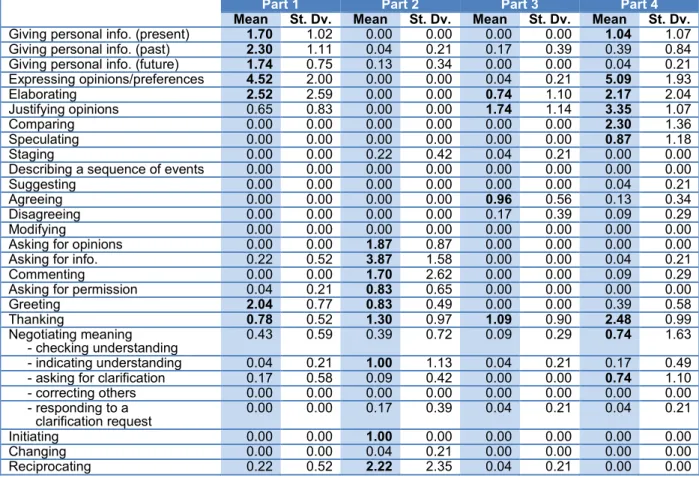
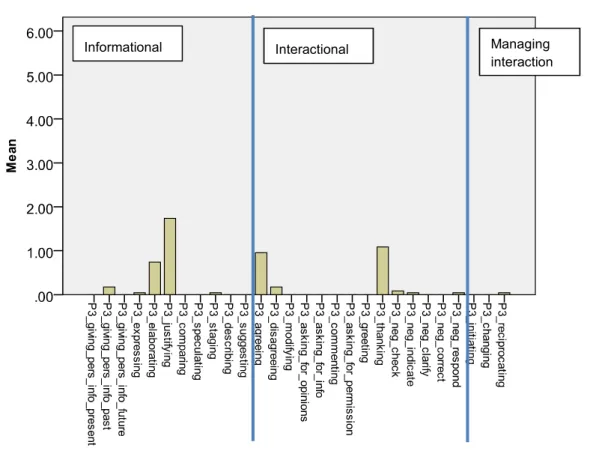
As mentioned previously, the draft specifications for the TEAP Speaking Test were developed drawing on the updated version of Weir’s socio-cognitive framework for validating speaking tests (Taylor, Ed., 2011). The test consists of four parts: interview, role play, monologue, and extended interview. These tasks were selected to offer different levels of cognitive demand in terms of conceptualization and grammatical encoding, and to elicit the types of language functions that were considered important by educators at Japanese high schools and Sophia University teachers. Tasks were designed to elicit language functions that were congruent with the results of the two surveys as well as those that were considered relevant based on the literature review (see Table 1 for the test structure).
We now move on to reporting the two a priori validation studies carried out in July 2011 (Study 1) and December 2011 (Study 2). As mentioned in Section 1.2, establishing validity evidence should start at the before-the-test event stage, and the studies described here did so by collecting data for context validity (which also gave some indication of the cognitive demands placed on the candidates) and scoring validity.
Study 1 aimed to examine how well the draft test materials and rating scales operationalized the test construct in terms of certain aspects of context validity and scoring validity. Based on the findings from Study 1, some modifications were made to the test materials and rating scales. Study 2 investigated how well the test functioned in terms of scoring validity after incorporating the modifications suggested by Study 1.
2.2 Research Questions
Five research questions were investigated through Study 1 and/or Study 2:
• RQ1: To what extent does the test elicit intended language functions in each task? (Study 1)
• RQ2: Is there any evidence from test takers’ output language that validates the descriptors used to define the levels on each rating scale? (Study 1)
• RQ3: What are the participating interlocutors’ and students’ perceptions of the testing procedures? (Studies 1 and 2)
• RQ4: What are the participating raters’ perceptions of the testing and rating procedures?
(Studies 1 and 2)
• RQ5: How well does the test function in terms of scoring validity, after incorporating
modifications suggested in Study 1? (Study 2)
18
2.3 Research Design: Study 1
2.3.1 Participants
Study 1 involved 23 university students, three trained interlocutors, and three trained raters. The 23 students were recruited from different English classes at Sophia University, so as to cover a wide range of proficiency levels. They were all first-year students, who had spent only three months at Sophia University at the time of the data collection. This was a convenience sample, with students recruited on campus through various avenues. As such, issues such as gender balance were not able to be taken into account in the research design. The final sample consisted of 15 females and 8 males.
The three interlocutors were recruited from English teachers at Sophia University. One was a bilingual speaker of English and Japanese, and the other two were native speakers of English. All of them were experienced university teachers (with 37 years, 19 years, and 7 years of experience), but their experience in acting as an interlocutor in standardized speaking tests was limited. They all attended an interlocutor training session prior to the test event. It was considered that the profiles of the three interlocutors selected for Study 1 would reflect those of prospective interlocutors in the operational TEAP Speaking Test. Studies 1 and 2, then, both provided the opportunity to investigate important validity aspects beyond the actual task structure and rating scales, such as the efficacy of interlocutor training procedures and the physical aspects of administering the test.
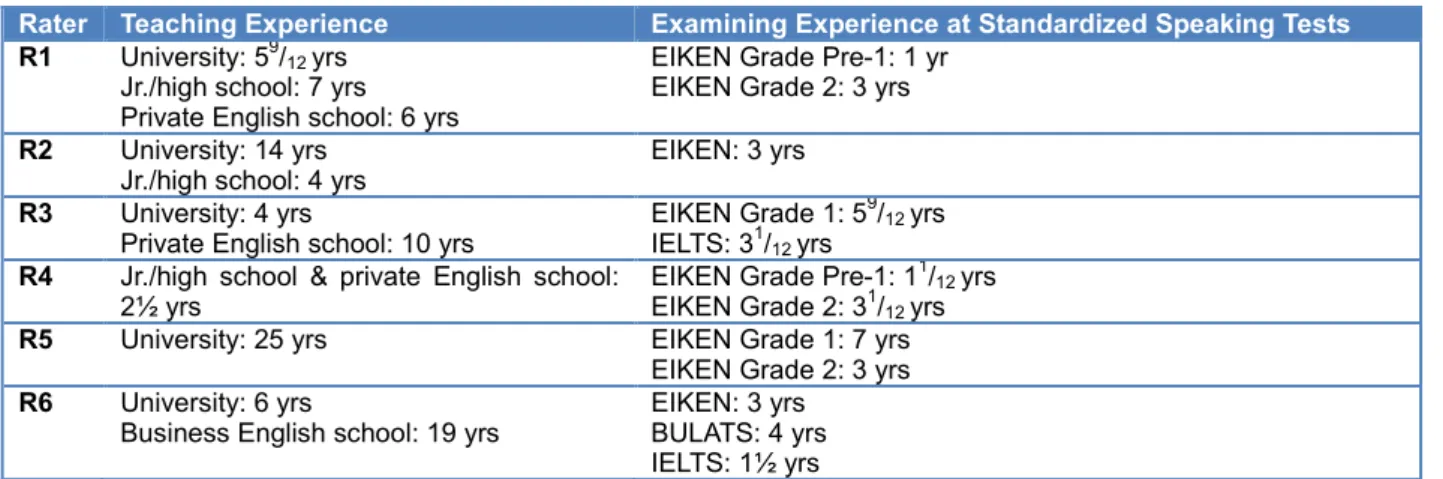
The three raters were selected by Eiken. All raters were experienced teachers at Japanese universities but with different levels of experience as professional raters in standardized speaking tests. One did not have any experience, another had two to three years’ experience rating the EIKEN speaking tests, and another had five years’ experience rating the International English Language Testing System (IELTS), Business Language Testing Service (BULATS), and EIKEN speaking tests. They all attended a rater training session prior to the test event. The varied level of experience was considered an advantage, as it would provide an opportunity to trial and review training procedures to see whether novice raters and raters trained for another test would rate speech samples in a consistent manner after the training session.
2.3.2 Data Collection
As mentioned in Section 1.2, all the test procedures were piloted with three students prior to Study 1. This mini-trial test was to confirm that the planned testing procedures would work smoothly, and also to help predict what problems, if any, should be anticipated in the Study 1 data collection.
Recordings of these students were also used in the interlocutor training session and the rater training session as sample performances. The samples had been assigned ratings by the Eiken project team using the draft scales prior to the training session.
Study 1 was carried out in July 2011. An overview of the test procedures and task instructions was
provided in Japanese to the 23 students for perusal while waiting to take the test. The students did
not have access to this sheet during the test. The information was provided in Japanese in advance,
as the TEAP is a new test and students did not have prior access to information about the test
structure. For operational versions of the test, it is envisaged that information on the test structure
will be readily available for potential test takers. The speaking test consisted of the four tasks as
described in Table 1. Immediately after their participation, they were asked to complete a feedback
questionnaire about their test-taking experience.
19 Prior to the test event, three interlocutors and three raters took part in the interlocutor and rater training sessions, respectively. After these training sessions, they were asked to fill out a feedback questionnaire on the effectiveness of the training sessions.
During the Study 1 data collection, the three trained interlocutors interviewed 7 or 8 students each, but they did not assign marks to students’ live performances. After completing their test sessions, they were asked to fill in a feedback questionnaire about different aspects of the interlocutor frame and interviewing procedures.
All performances were video-recorded, and all the 23 recorded performances were rated by the three trained raters using the draft rating scales described earlier.
2.3.3 Data Analysis
As noted earlier, this research drew on Weir’s (2005) socio-cognitive framework for validating speaking tests, which was further elaborated in Taylor (Ed., 2011). The socio-cognitive framework was useful for shaping the research design in this study, not only because the test specifications were developed based on the framework but also because the framework includes a list of contextual parameters that could influence task demands in relation to test takers’ outputs required to fulfill the task, such as lexical, structural, and functional features. The use of the framework also enabled us to pinpoint which validity aspect each analysis was targeting. Furthermore, since the TEAP Writing Test has also been developed and validated based on the comparable framework for writing (Weir, 2012), the outcome of this research will fit into a wider validity argument for the TEAP test.
The analysis of the data collected in Study 1 was carried out as follows.
Transcribing the Video-Recorded Performance
All video recordings were transcribed using a slightly simplified version of conversation analysis (CA) notation (Atkinson & Heritage, 1984; the transcription notation is provided in Appendix 2).
CA transcription is informative and enables us to examine micro-analytic features of interaction between the examiner and the candidate.
The recordings were transcribed by a research assistant who had previous experience in transcribing speaking-test data and who is a native speaker of English but is also familiar with Japanese speakers of English. The consultant carefully checked the first couple of transcripts, and some modifications were suggested before the research assistant commenced the rest of the transcriptions. An interactive, consensus approach was taken to ensuring consistency in transcriptions. Several transcriptions were checked throughout the process by the Eiken project team member overseeing the transcription, and one full transcript was reviewed by the whole project team at Eiken. Any differences in interpretation were resolved through discussion between the research assistant, the consultant, and the project member overseeing transcription. Prior to a second research assistant carrying out segmentation of the transcripts for the linguistic and discourse analysis described below, all transcripts were double-checked by the second research assistant while watching all recorded samples.
Language Function Analysis
The transcripts were first analyzed for the coverage of language functions elicited in each task.
O’Sullivan, Weir, and Saville’s (2002) observation checklist was slightly modified for use with the
20 given data. The observation checklist consists of an extensive table of informational (e.g., expressing opinion, justifying opinion), interactional (e.g., asking for information, negotiating meaning), and managing interaction functions (e.g., initiating, reciprocating). While the checklist was originally developed for analyzing language functions elicited from candidates in paired speaking tasks of the Cambridge Main Suite examinations, the potential to apply the list to other speaking tests such as the IELTS Speaking Test (Brooks, 2003) and the Graded Examinations in Spoken English (GESE) (Nakatsuhara & Field, 2012; O’Sullivan, Taylor, & Wall, 2011) has been explored. Since the list draws on Bygate’s (1987) speaking model, the applicability of the checklist is not limited to any particular types of L2 candidates’ speech, and the list was also useful for examining a range of language functions elicited in the TEAP Speaking Test.
This was the same list used for the language function surveys with educators at Japanese high schools and Sophia University which informed our selection of the task formats in the test (described in Section 1.2). Therefore, by using the same checklist in this validation study, we were able to directly compare language functions specified in the test specifications with functions that were actually elicited from target test takers.
Linguistic and Discourse Analysis of Students’ Speech Samples
This analysis was aimed at examining whether test takers’ output language validates the descriptors used to define the levels on each rating scale. Previous studies have employed this approach to rating scale validation, including Brown (2006a) and Brown, Iwashita, & McNamara (2005). A variety of linguistic measures were selected to reflect the features of performance relevant to the test construct defined within the draft analytical rating scales, so as to investigate whether these measures differ in relation to the proficiency levels of the candidates assessed using the rating scales. The transcripts were coded for these features by a research assistant. As with transcription, an interactive consensus approach to coding was taken. The project member who oversaw the data preparation reviewed several complete transcripts after they had been coded, and any differences in interpretation were resolved through discussion between the research assistant, the consultant, and the project member overseeing the data preparation.
Three trained raters rated the 23 students’ video-recorded test sessions, using the draft TEAP Speaking Test rating scales, which consist of the following five categories:
a. Grammatical range and accuracy b. Lexical range and accuracy c. Fluency
d. Pronunciation
e. Interactional effectiveness
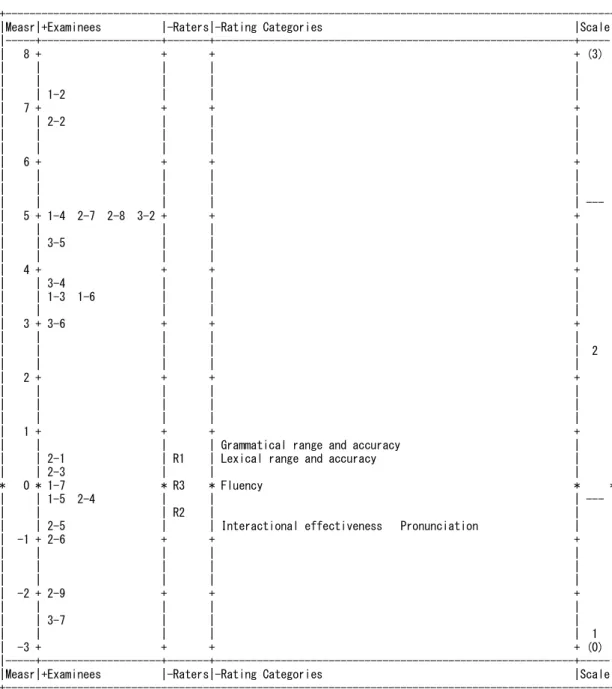
Since it is crucial that speech samples selected for the analysis are reliable representatives of a particular level for each analytical category, the test scores were first of all analyzed using multifaceted Rasch analysis.
Once the score analysis had confirmed that the rating scores were assigned by the three raters in a satisfactory and consistent way, as judged by Rasch fit indices and other statistical measures (see Section 3.2.1 for details), the video-recorded speech samples and their transcripts were analyzed for the linguistic characteristics illustrated in Table 2. These linguistic features were selected to reflect elements of performance covered in the draft rating scale descriptors, with the exception of the last three measures listed under “Other—The amount of talk.”
The linguistic features were analyzed to investigate the extent to which each of these features
differs between the adjacent levels of the rating scales. Since not all measures were relevant for all
21 parts of the test, appropriate parts were selected for different analyses. Section 3.2.2 describes how each of the characteristics was selected and measured.
However, it is important to note that there is no assumption that the measurement criteria listed in Table 2 fully cover the five analytical categories of the rating scale. They relate to some representative aspects of the five categories and thus can only be broadly indicative in quantifying each one.
Table 2: Linguistic Measures
Corresponding Rating
Category Focus Measure Parts of the Test
Applied a. Grammatical range and
accuracy
Complexity Ratio of subordinate clauses to AS-units** 1, 2, 3, 4
Number of words per AS-unit 1, 2, 3, 4
Accuracy Percentage of error-free AS-units 1, 2, 3, 4 b. Lexical range and
accuracy
Range Lexical frequency coverage (K1+ K2 words) 1, 2, 3, 4
Academic Word List coverage 1, 2, 3, 4
Accuracy* - -
c. Fluency
Hesitation
Number of unfilled pauses (utterance initial)
per 50 words 1, 2, 3, 4
Total pause time as a percentage of
speaking time 3
Disfluency Ratio of repair, false starts, and repetition to
AS-units 1, 2, 3, 4
Temporal Speech rate in Part 3 3
Articulation rate in Part 3 3
d. Pronunciation L1 influence
Number of words pronounced with noticeable L1 influence (katakana-like) as
percentage of total words produced 1, 2, 3, 4
e. Interactional effectiveness
Length of
response Average words per response 1, 4
Number of extra
questions Number of separate questions asked that
were not on required list in Part 2 2 Back-channeling
and comments
Number of instances of back-channeling and
comments in Part 2 2
f. Other—The amount of talk
Length of long
turn Total number of words produced in Part 3 3
Total production
Total amount of production across all parts
of the test, measured in words 1, 2, 3, 4 Total number of AS-units produced across
all parts of the test 1, 2, 3, 4
* Lexical accuracy was not measured in this analysis for reasons described in Section 3.2.2b.
** AS-unit = analysis-of-speech unit.