第56巻 第1号101–116 2008c 統計数理研究所
[研究詳解]
霊長類のミトコンドリア DNA における進化速度
松井 淳
1 *・Felix Rakotondraparany
2・宝来 聰
**・長谷川 政美
1,3(受付 2008年1月8日;改訂 2008年2月8日)
要 旨
我々は,ヴェローシファカ(Propithecus verreauxii)の糞サンプルから,そのミトコンドリア
DNA
全塩基配列を決定し,14種の霊長目のデータと共に解析を試みた.アミノ酸配列から得 られた系統樹で,明らかに真猿類の枝の長さが原猿類の枝に比べて長くなっていた.最尤法で 分子時計が成り立つか検定すると,真猿類の進化速度は原猿類のものと有意に異なり,増大し ていた.これには(i)真猿類で非同義置換・同義置換サイトの両方の変異率が増大している,(ii)変異 率は変わらないが,真猿類でアミノ酸置換(非同義置換)に進化速度の増大がおこっている,の
2
通りの可能性が考えられる.これらを区別するために,系統樹のそれぞれの枝で,非同義置換率dN と同義置換率dSの 比ω(=dN/dS)を推定した.ωが
1
をこえる(dN/dS >1)場合,自然選択の重要な目安となる
が,ωが1
をこえるような枝はみつからなかった.しかしながら,真猿類のωは原猿類のそれ よりも2
倍以上大きいことが見出された.こうして真猿類のアミノ酸置換速度が増大したこと が示唆された.ここから,真猿類のミトコンドリアタンパク質の機能的制約が緩んだ,あるい はさらに適応的な進化がおこっている可能性が考えられる.キーワード: 霊長目,ミトコンドリア
DNA,進化速度,同義置換,非同義置換,適
応進化.1. はじめに
DNA
の塩基配列に突然変異が起こり,塩基がランダムに置き換わっていくことを塩基置換 という.塩基置換が,ある個体というレベルではなく,ある種の配列に固定され蓄積されると,その変異は種の違い(進化)をもたらす要因となる.また,塩基配列における単位時間あたりの 塩基置換の回数を塩基置換速度(進化速度)というが,一般に,異なった性質を持つ遺伝領域ご とに,あるいは種間の相同な遺伝子を比較しても,この速度にはばらつきがある.
相同な遺伝子の塩基・アミノ酸配列を種間で比較解析し,生物進化の道筋を推測する分子系 統学の分野においては,この「進化速度」がきわめて重要な議論になる場合がある.進化速度
1統計数理研究所:〒106–8569 東京都港区南麻布4–6–7
2Department of Animal Zoology, University of Antananarivo, BP 906,Antananarivo 101, Madagascar;
3復旦大学 生命科学学院:220 Handan Road, Shanghai 200433, China; [email protected]
∗現 京都大学 霊長類研究所:〒484–8506 愛知県犬山市官林41–2
∗∗2004年8月10日逝去
が極端に異なる生物群を含む系統解析においては,誤った系統樹推定をすることがあり,見 かけ上の枝の長さ(進化速度)が長い(速い)系統が引き合うように見えることから
Long-branch attraction
と呼ばれる現象が知られている(Felsenstein, 1978).また,生物種が分岐した年代を 推定する場合,系統ごとの進化速度が一定である「分子時計」が成り立てば,どこか1
つの分 岐に絶対年代を与え,その他の分岐は比例計算で年代推定できるが,全ての系統で進化速度の 有意差が検出されない(分子時計が成り立つ)遺伝子は少なく,できるだけ多くの遺伝情報を 用いて信頼性の高い解析を試みる手法をとることが難しい.こうして系統ごとの進化速度のば らつきを考慮に入れた年代推定の方法がいくつか開発されるようになり,なかでもThorne
とKishino
の方法(Thorne et al., 1998; Thorne and Kishino, 2002)やSanderson
の方法(Sanderson,2003)は複数の絶対年代を与えることができる方法としてよく用いられる.
このように,系統解析,分岐年代を推定する上で,系統間での進化速度が一定といえるかど うかは,考えるべき重要な点である.また,仮に進化速度が系統間で一定でないことがはっき りと検出されれば,そこから,適応的な分子進化を予測・発見していくきっかけになる.
分子レベルの進化で蓄積された塩基,あるいはアミノ酸の変化の多くは,種の生存や種の存 続に有利にも不利にもならないような中立的な変化であることを
Kimura
は提唱した(Kimura,1968; Kimura, 1983).この,いわゆる分子進化の中立説によれば,突然変異のうち,有害な変
異はただちに負の自然選択として集団から取り除かれ,結果的に観測することもできない.一 方,正の自然選択によって選ばれる分子レベルの変化は,中立的な変化に比べて圧倒的に少な いというものである.この説は,アミノ酸の変化を伴う塩基置換(Kimura, 1977; Miyata and Yasunaga, 1980),偽 遺伝子の塩基置換(Miyata and Yasunaga, 1981)の解析によって確かめられ,広く支持されて いる.
この考えに基づくならば,通常,多くの遺伝子においてアミノ酸の変化をおこす塩基置換(非 同義置換)に比べてアミノ酸の変化をおこさない塩基置換(同義置換)が多数を占めることが予 想される.こうしてある遺伝子における同義置換の進化速度を,その遺伝子の中立的な進化速 度とし,これと非同義置換の進化速度を比べて適応進化を検出しようとする解析が行われる.
比較する配列間で非同義置換率dN(非同義座位(非同義置換サイト)あたりの非同義置換数)と 同義置換率dS(同義座位(同義置換サイト)あたりの同義置換数)を推定し,dN/dSの値によっ てdN/dS <
1
ならば負の自然淘汰(機能的制約),dN/dS= 1
ならば中立的な進化状態(機能的 制約のゆるみ),dN/dS >1
ならば正の自然淘汰(適応的な進化)がおこっているのではないか と推測するのである.このdN とdSは推定値であり,いくつかの計算方法がこれまでに考えられている.Miyata と
Yasunaga
の方法(Miyata and Yasunaga, 1980),Li
らの方法(Li et al., 1985),Nei
とGojobori
の方法(Nei and Gojobori, 1986),PamiloとBianchi
の方法(Pamilo and Bianchi, 1993),近年 では最尤法によるYang
とNielsen
の方法(Yang and Nielsen, 2000),Seoらの方法(Seo et al.,2004)などがあり,トランジション/トランスヴァージョン比や塩基組成のバイアスへの考慮な
ど,いくつかの違いがある.dN/dSの値は推定値であるので,dN/dS >1
の値がある遺伝子に おいて見出されたとしても,有意なものであるかを統計的に検定しなければ,適応進化である とはいえない.霊長類の進化において,見出された適応進化の例を示す.
オナガザル科コロブス亜科のリゾチーム(Lysozyme)はウシなど反芻動物のリゾチームと共通 の進化をしていることが見出された(Messier and Stewart, 1997)(鳥類ではツメバケイの同様な 進化が知られている(Kornegay et al., 1994)).リゾチームは涙や唾液に含まれ,細菌類から身 を守るための酵素である.先に述べた動物たちは植物の葉を食べ,セルロースをエネルギー源
とするが,これらの動物はセルロースを分解する酵素を持っていない.そこで特殊な胃にセル ロースを分解できる細菌類を飼い,次の段階で細菌類の細胞壁をリゾチームで溶かすことで,
醗酵させた葉を消化するのに利用しているのである.反芻動物にはリゾチームの遺伝子が複数 あり,そのうちひとつをこの消化の機能に利用しているが,霊長類のリゾチームの遺伝子はひ とつしかなく,コロブスは細菌類に対抗するリゾチームをこの「消化のための」リゾチームに転 用する方向に進化した(Swanson et al., 1991).これら胃で働くリゾチームは,胃という酸性下 で,しかもタンパク質分解酵素であるペプシンに分解されないように特殊化している(Dobson
et al., 1984).また,アミノ酸配列の比較から,いくつかのアミノ酸座位で共通の一致がコロブ
ス類と反芻動物でみられ(Stewart et al., 1987),それぞれ独立に機能を獲得した収斂進化を強 く示唆している.また別の例では,ヒヒのαグロビンには正の自然淘汰があることが示されている(Shaw et
al., 1989).α
グロビンはβグロビンとともにヘモグロビンを構成する.ヒヒの高地適応に関連がありそうであるが,その生物学的意味はよくわかっていない.
上記の例はいずれも有意なdN/dS >
1
が検出されているが,検定の結果,棄却されてしまう ことも多い.仮にある生物の進化のうえで非常に重要なアミノ酸置換が1
つあったとしても,物理的近傍の配列に中立的な置換が多い場合や,その置換を獲得してからかなりの時間が経過 してしまった場合などは,埋もれてしまって検出できないこともありうるだろう.また機能タ ンパク全体でみるよりも,あるタンパク活性部位に限ってみることでしか検出できないことも あるかもしれない.また,仮に有意なdN/dS >
1
が検出されたとしても,そのアミノ酸置換に 生物学的な説明がつけられないことも多く,推測された適応進化の意味を明らかにしていくこ とが非常に重要な課題となる.実際,先に示した例であれば,ヒトからテナガザルを含むヒト 上科のリゾチームでもコロブス類と同じように有意なdN/dS >1
が現れているが(Yang, 1998), その生物学的な意味は不明である.また,適応進化と機能進化は言葉のうえで必ずしも一致する概念ではない.適応進化とは環 境に応答するように獲得された様々な有利な機能の進化であり,機能進化の一部の現象である といえる.機能進化はもう少し広く,機能の上で支障にならない変異をも含めた,いわゆる機 能の中立進化とも言うべきものも含むと考えられる.新たに穏やかな環境がひらけた場合など が考えられるが,必ずしも適応的に有利な進化だけではなく,機能的に制約の緩んだ状況下で 獲得した機能が後に,適応的に働く場合もあるだろう.
2. 細胞小器官ミトコンドリア
ミトコンドリアは生体内でその複雑な電子伝達経路による酸化的リン酸化反応で
ATP
を産 生する.平均的なミトコンドリアのサイズはおよそバクテリアと同程度のマイクロメーターの 単位であり,外膜,内膜の2
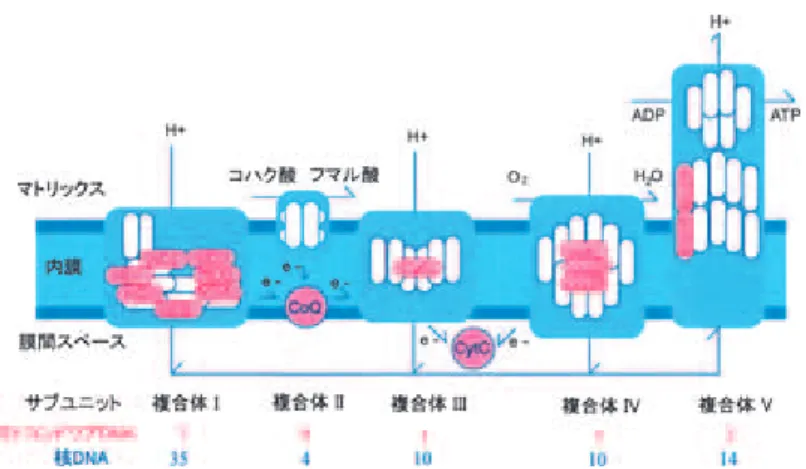
層の膜構造を持ち,外膜・内膜の膜間スペースと内膜の内側のマ トリックスと呼ばれる区画を持つ.ミトコンドリアの電子伝達系では,複合体I,III,IV
がマ トリックスから膜間スペースにプロトンを輸送し,内膜にプロトン勾配をつくりだし,この電 気化学的ポテンシャルによってF
0F
1-ATPase
(複合体V)が ATP
を合成する(Scheffler, 2007)(図
1).
複合体
I
は,TCA
回路の脱水素酵素などで生じたNDHA
を酸化し,ユビキノン(ubiquinone:UQ)を還元する(Brandt, 1997).この反応でマトリックスから膜間スペースにプロトンを輸送
する.ウシの心筋由来のX
線結晶構造解析がなされていて,少なくとも42
のサブユニットか ら構成され,そのうち7
つの膜内在性サブユニットがミトコンドリアDNA
にコードされてい る,L字型のタンパク質複合体である(Sazanov et al., 2000).図1. ミトコンドリアの電子伝達系の模式図.
複合体
II
は,コハク酸の酸化によって電子をユビキノンに伝えるTCA
回路と電子伝達系を 直接連絡する複合体である.動物では4
つのサブユニット全て核遺伝子にコードする(Scheffler,1998).
複合体
III
(別名bc
1複合体)は,複合体I
とII
で還元されたユビキノン(つまりユビキノー ル)から電子を受けとり,チトクロームc
(cytochrome c)に伝達し,この反応でマトリックスか ら膜間スペースにプロトンを輸送する(Brandt, 1998).ミトコンドリアの複合体の中では最も 多くX
線結晶構造解析がなされていて,ウシの心筋由来のデータから,哺乳類では11
のサブ ユニットから構成され,そのうち1
つのサブユニットであるチトクロームb
がミトコンドリアDNA
にコードされていることがわかった(Xia et al., 1997; Iwata et al., 1998).複合体
IV
は,酸素分子を還元する電子伝達系の最後の複合体であり,この反応過程でプロ トンをマトリックス側から内膜スペースへと輸送している(Varotsis, 1993).ウシ心筋からのX
線結晶構造解析によって哺乳類では13
個のサブユニットからなり,そのうち大きくて主要な3
つのサブユニットがミトコンドリアDNA
にコードされていて,その他の核遺伝子由来のサブ ユニットは複合体構造の調節や集合に関与していると考えられている(Tsukihara et al., 1996).複合体
V
(ATP合成酵素)は,複合体I,III,IV
が作り出した内膜の内と外のプロトン濃度 勾配によって流入してくるプロトンを利用しATP
を合成する(Walker et al., 1991).哺乳類で は大きく二つの,内膜中でプロトンの受け渡しをするF
0と,ATPの活性部位があるF
1 のサ ブユニットから構成される.F0のサブユニットはさらに11
のサブユニットから構成され,そ のうち2
つのサブユニットがミトコンドリアDNA
にコードされている(Abrahams et al., 1994;Bianchet et al., 1998).F
1 のサブユニットは回転しながらATP
を合成することが知られてい る(Boyer, 1993; Boyer, 1997; Noji et al., 1997; Kinosita et al., 1998).このようにエネルギー産生に関わる重要な細胞小器官であるミトコンドリアには複雑なサブ ユニットが多数存在し制御されている.ミトコンドリア
DNA
にもそのうち重要なサブユニッ トとなるタンパク質,あるいはrRNA, tRNA
などがコードされていて,この変異が原因となっ て十分な好気的エネルギー産生が行えなくなることによって起るミトコンドリア病が,1980年 代から脚光を浴びるようになった(Holt et al., 1988).その原因として,ミトコンドリアDNA
由来のタンパク質の点変異(Wallace et al., 1988),ミトコンドリアDNA
の多重欠失(Zeviani etal., 1989),部分重複(Poulton et al., 1989),tRNA
領域の点変異(Shoffner et al., 1990; Goto etal., 1990),またミトコンドリア DNA
の欠乏(Moraes et al., 1991)などがつきとめられた.多く の場合,エネルギー需要の多い,脳,骨格筋,心筋が異常を起こすことが多い(DiMauro et al.,1985).未だにその構造・機構の理解は十分とは言えず,アルツハイマー病やパーキンソン病
にもミトコンドリアの機能低下・異常が推測されることもあるが,不明な点が多い.3. 霊長目のミトコンドリアDNA
1981
年にヒトのミトコンドリアDNA
の全塩基配列が決定され,これによって電子伝達系の サブユニットの一部となる13
のタンパク質,2つのrRNA, 22
個のtRNA
をコードしているこ とが明らかになった(Anderson et al., 1981).この遺伝子配置が多くの動物で一致しているこ とから,様々な生物の系統解析で重要な働きをしてきた.霊長目においては,ヒトの起源につ いての研究に用いられ,大きな成果をもたらしてきた(Brown et al., 1982; Horai et al., 1995).図
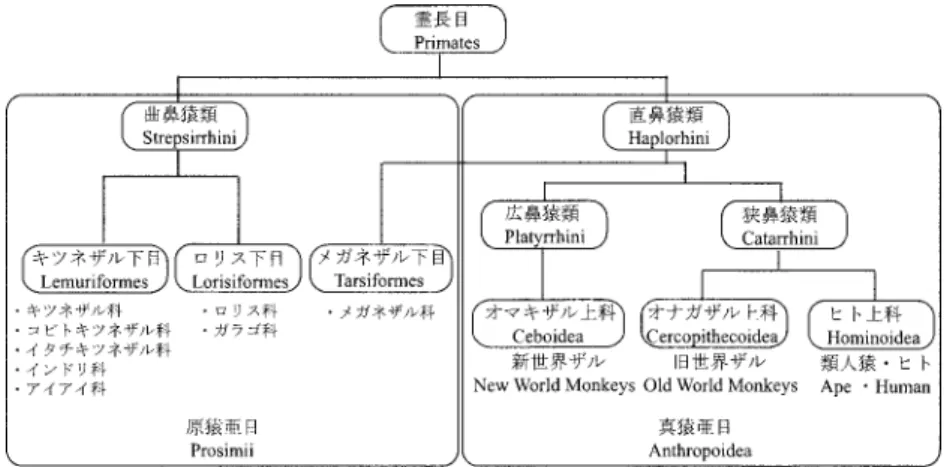
2
に,模式的な霊長目の分類を示す.また,部分配列の報告例があった当時から,霊長目のミトコンドリア
DNA
のアミノ酸レベル の進化速度は,他の哺乳類よりもかなり速いことが示唆されていた(Brown and Simpson, 1982;Ramharack and Deeley, 1987).これらは複合体 IV
のサブユニットであるチトクロームc
オキ シダーゼII
(cytochrome c oxidase subunit II:COX2などと以降は示す)についての報文である が,これに伴い霊長類では,核DNA
にコードされた複合体IV
に働きかけるタンパク質である チトクロームc
(cytochrome c)のアミノ酸レベルでの進化速度も速くなっていることがわかり,ミトコンドリア
DNA
と核DNA
の協調的な進化が推測された(Cann et al., 1984; Ramharackand Deeley, 1987).また,霊長目のミトコンドリア DNA
の中では,チトクロームc
に関わる複合体
III,IV
タンパク質サブユニットに,進化速度の増加がみられることが,他の哺乳類のデータと比較してわかってきた(Adachi et al., 1993).
複合体
IV
では,霊長類の中でも真猿類,とりわけ旧世界ザルのCOX2
の進化速度が増加し ていること,それから,いくつかのチトクロームc
と相互作用があるアミノ酸サイトに,高 等な霊長目で共通した変異があることが示された(Adkins and Honeycutt, 1994; Adkins et al.,1996).また COX1
でも,類人猿で,COX2と同様のことがあることが示されることとなった(Andrews and Easteal, 2000).
図2. 鼻の形態をもとにした霊長類の分類.
一方,13ある複合体
IV
のサブユニットのうち,核DNA
にコードされた10
のサブユニッ トについては,COX4で霊長目内の比較にて類人猿にアミノ酸レベルの進化速度の増大がある ことがわかった(Wu et al., 1997; Wildman et al., 2002).また,COX8にはチトクロームc
と 相互作用があり,真猿類でCOX4
と同様のことがみられた(Wu et al., 2000).COX8には,発 現する箇所により異なるアイソフォームが知られているが,収縮筋でのアイソフォームである
COX8H
は,真猿類で偽遺伝子化しているのに対し,それ以外の霊長類では機能している(Grossman et al., 2001; Goldberg et al., 2003).先にあげた
COX8
とは遍在性のアイソフォームである
COX8L
のことである.COX8Hを失ったことでCOX8L
の進化速度が高まったという考えや,ミトコンドリア
DNA
由来のCOX1
の進化速度増大に伴い,サブユニット同士の相 互作用がCOX8L
に及んでいるという考えが示唆されている(Goldberg et al., 2003).COX6A(Schmidt et al., 1997),COX7A(Schmidt et al., 1999)など,心臓等,発現が局所的なアイソ フォームタンパクの解析や,COX5A,COX6B,COX6C,COX7C,そして
COX8L
に関する 解析(T. R. Schmidt et al., 2002)が進められている.複合体
III
のサブユニットであるチトクロームb
(cytochrome b)にも,類人猿での進化速度 の増大があることが示された(Andrews et al., 1998).核DNA
にコードされているサブユニッ トでは,複合体III
の主要部品である鉄-硫黄タンパク(ISP)で真猿類のアミノ酸置換速度に増 大傾向がみられた(Doan et al., 2005).ISPと複合体III
サブユニット9
はひとつの遺伝子から 作られ,お互い電子のやりとりはおこらない位置にある.電子伝達系で重要な働きをするISP
にだけ進化速度の増大がみられたことは,機能になんらかの進化がおこっていることが推測さ れる.さらに複合体
III,IV
については,核DNA
とミトコンドリアDNA
にコードされたサブユ ニット間の関係,それに伴う共進化の研究がなされるようになってきた(Schmidt et al., 2001;Grossman et al., 2001; Doan et al., 2004).実際,異種のミトコンドリア DNA
を注入した細胞 では,核DNA
のタンパク質とうまく機能しないのである.ここで浮かび上がってくるのが,電子伝達系の機能はいかに進化したのかということと,電子伝達系の機能進化と生物学的な現 象(脳の新皮質の増大など)に関連があるのか,ということである(Grossman et al., 2004).
後者について確かめることは重要であるが,非常に難しいであろう.前者の機能の進化に ついてはひとつの提案がなされている.それは,チトクローム
c
とCOX
の結合サイトの静電 相互作用に関わる箇所に集中して機能進化がおこっているのではないか,というものである(Schmidt et al., 2005).1500以上ある
COX
のアミノ酸サイトのうちチトクロームc
との結合 に関与するサイトは57
程度であることが結晶構造解析から見積もられ,そこでの進化速度が それ以外のサイトに比べて,真猿類で増大しているようである.さらに旧世界ザル・類人猿へ の進化過程で,核DNA
にコードされているチトクロームc
のアミノ酸では,結合サイトで,電荷の性質が異なるアミノ酸置換はたった
2
つであるのに対し,57
あるCOX
のチトクロームc
結合サイトのうち,少なくとも27
サイトで,アミノ酸の置換がみられ,多くの場合電荷を持 つアミノ酸から電荷を持たないアミノ酸へ置換していることが推測された.このように複合体
III,IV
についてはかなり研究が進んでいる.複合体I,II, V
の機能につ いての進化的な研究は,霊長類の複合体III,IV
のように進化速度の違いが見出されるなど,分子進化的な予測が難しかったこともあり,あまり進んでいない状況にある.
複合体
I
については,そのサブユニットの変異が様々な病気に結びついている報告が多くあ る.レーバー氏(Lerber)病では,ND1(全長配列にして3460
塩基目)(Huoponen et al., 1991),ND4
(全長配列にして11778
塩基目)(Hofhaus et al., 1996),そしてND6
(全長配列にして14459
塩基目(Jun et al., 1996),14484塩基目(Wissinger et al., 1997),14498塩基目(Leo-Kottler etal., 1996))等で遺伝性の視神経障害との関連が示唆されている.パーキンソン病と複合体 I
での変異との関わりも示唆されている(Blandini et al., 1998; Smigrodzki et al., 2004).また,そ の他にも,サブユニット
ND1
(全長配列にして3316
塩基目)では,インスリン非依存性糖尿病(NIDDM)との関連が(Odawara et al., 1996),ND1,ND5,ND6ではミトコンドリア脳症との 関連が示唆されている(Malfatti et al., 2007).ミトコンドリア
DNA
にコードされたサブユニッ トは疎水性のサブユニットであるが,そのうちND4
とND5
が,ヒトの複合体I
の構造組織化 にはたす役割が調べられている(Bourges et al., 2004).ヒトのミトコンドリアにコードされた
13
のタンパク質のなかで,複合体V
のサブユニットATP6
のバリエーションが高いことが示唆されている(Mishmar et al., 2003).これは,ヒトの ように寒冷な地から温暖な地まで幅広い気候帯で生活している動物のエネルギー代謝に差があ るためであろうという,もっともらしい解釈もあるが,よくわからない.ミトコンドリアDNA
の複製の開始点から近いために現れた差であろうという説もある(Fuku et al., 2002).実際,ヒ ト以外の42
種の霊長類と比較したところ,ATP6のおよそ230
アミノ酸サイトのうち,ヒト 内部において,その他の霊長類では保存されていた25
のアミノ酸サイトを含む80
サイトでア ミノ酸変異がみられたとの報告がある(Mau et al., 2005).一方で,ATP6(全長配列にて9185
と9191
塩基目(Moslemi et al., 2005),8993塩基目の点変異:TからG/C
(Cortes-Hernandezet al., 2007; Baracca et al., 2007))が,リー氏症候群(Leigh syndrome)と関連するとの報告もあ
り,かなり保存された領域も存在する.4. 霊長目ミトコンドリアDNA全長配列を用いた解析
我々は,キツネザル下目インドリ科のヴェローシファカ(Propithecus verreauxii)の糞サンプ ルから,そのミトコンドリア
DNA
全長配列を決定することに成功した(Matsui et al., 2007).このデータとデータベース上に報告されている
14
種の霊長目のミトコンドリア全長配列(2005 年段階)と共に解析を試みた.ミトコンドリアDNA
にコードされた13
のタンパク質データの うちND6
(他のタンパク質とは相補鎖にコードされていて,塩基組成・アミノ酸組成が異なる)を除く
12
のタンパク質についてClustalX
(Thompson et al., 1997)でアラインメントし,コド ン・アミノ酸配列から補正した.こうして得たアラインメントデータをつなぎ合わせ,3,585残基のアミノ酸データで,14種 の霊長目の系統解析を行った.系統解析は最尤法(Felsenstein, 1981)の簡便法である
Quartet- puzzling
法(QP法)(Strimmer and von Haeseler, 1996)で行った.実際に用いたプログラムはTREE-PUZZLE
(H. A. Schmidt et al., 2002)である.QP法は比較的大きなデータセットにつ いても解析が速やかであり,TREE-PUZZLEはサイト間の進化速度の不均一性をガンマ分布 に近似し,考慮することが出来る.モデルにはミトコンドリアDNA
にコードされたアミノ酸 置換のモデルであるmtREV
モデル(Adachi and Hasegawa, 1996)を用いた.QP
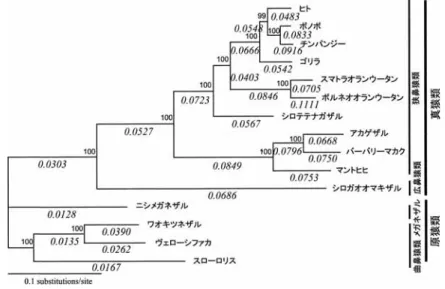
法による解析結果を図3
に示す.図
2
にも示した従来の分類からすると,主たる4
つのグループ狭鼻猿類(ヒト,チンパンジー,ゴリラ,オランウータン,テナガザル,ヒヒ,マカク),広鼻猿類(オマキザル),メガネザル,曲 鼻猿類(ワオキツネザル,シファカ,ロリス)が今回の解析では扱われているが,シファカのデー タを加えてみると,曲鼻猿類の内部でワオキツネザルとシファカがマダガスカルのキツネザル 下目として単系統であることが
QP
値からも強く支持され,従来の解析とも一致した(Yoder etal., 1996; Pastorini et al., 2001).
図
3
をみると,系統樹中で,明らかに真猿類の枝の長さ(アミノ酸の置換数に比例して見積 もられる)が原猿類(メガネザルと曲鼻猿類)に比べて長くなっていることがみてとれる.最尤法で,この進化速度の違いが有意なものか,「分子時計が成り立つかどうか」でもって検
図3. ミトコンドリアタンパク質のアミノ酸配列(3,585残基)をもとに解析したQP系統樹.QP サポートバリュー(各ノードの信頼値:%)を各ノードに示す.各枝の下には,dN/dS=ω の推定値を斜字体で示す.ガンマ分布の形状母数は0.45と推定された.
定することができる(Hasegawa et al., 1993).進化速度がすべての系統で均一であるモデル:A
(分子時計が成り立つモデル)は,系統ごとに進化速度が違うモデル:Bの特殊な状況であり,
A
はB
に包含されると考えるのである.分子時計を仮定しない解析では,扱う種の数(OUT:operationally taxonomic unit)が
nであるとき,パラメーターの数は,枝長をそれぞれ見積もる ことから2
n−3
である.それに対し,分子時計を仮定する解析では,枝長の解析に要するパラ メーターがn−1
となる.この解析に要するパラメーター数の差,すなわちn= 15
のとき自由 度(2n−3)
−(n−1) = 13
のカイ二乗分布に,この2
つのモデルの対数尤度差の2
倍が従いう るか行う検定が,尤度比検定である.プログラム
PAML
(phylogenetic analysis by maximum likelihood)(Yang, 1997)による計算 で,これら2
つのモデルの対数尤度の差は194.52
であり,2倍した389.04
は,自由度13
のカ イ二乗分布の有意水準1
パーセント27.69
よりもはるかに大きく,これらの尤度に差がないと した仮説は棄却できることとなった.つまり分子時計一定はなりたたず,一見して枝の長さに 違いがある真猿類の進化速度は,それ以外のものと有意に異なる.こうしてメガネザルが分岐した以降の真猿類で,進化速度の増大がおこっていることが示さ れたのだが,こうしたことは真猿類の分岐年代推定を行う場合には重大な問題となる.実際,
過去の研究ではこのことを考慮していないこともある(Arnason et al., 1998).たしかに彼らは,
真猿類のミトコンドリアデータに進化速度の増大があることに気がついていたが,原猿類の データが不足していたこともあり真獣類から霊長目が分岐してから霊長目全体の進化速度が速 くなったと考えていた.このために,真猿類内部の分岐年代が,より古い年代として推定され ることとなったと考えられる.真獣類のミトコンドリア
DNA
では,さまざまな系統で進化速 度の違いが大きいことが報告されている(Cao et al., 2000; Hasegawa et al., 2003).真猿類のミトコンドリア
DNA
にコードされたタンパク質で,アミノ酸レベルの進化速度が 原猿類よりも速くなっている現象には2
通りの可能性が考えられる.(i)真猿類で非同義置換・同義置換サイトの両方の変異率が増大している,(ii)変異率はかわらないが,真猿類でアミノ
酸置換(非同義置換)に進化速度の増大がおこっている,の二通りである.
これらを区別するために,系統樹のそれぞれの枝で非同義置換率dN と同義置換率dS の
比ω(=dN/dS)を推定した.具体的にはコドン単位でデータを扱い,PAMLの
CodeML
プログラムを
F61
モデルで,それぞれの枝について(Yang and Bielawski, 2000)計算したωの値を 図3
の系統樹で枝の下に斜字で示した.ωが
1
をこえる(dN/dS >1)場合,自然選択の重要な目安となるが,図 3
に示したように,ω が1
をこえるような枝はみつからなかった.しかしながら,興味深いことに,真猿類のωは原猿類のそれよりも
2
倍以上大きいことが見 出された.しかもこのωの差は,尤度比検定の結果,有意な違いであることがわかった.1
を超えたωが検出できなかったからといって,必ずしも霊長目のミトコンドリアタンパク 質の進化で,適応進化がおこっていないことを示してはいない.つまり,タンパク質の限られ た領域で,機能において重要な変異が起こっていた場合,今回のように12
のタンパク質を連 結したデータセットでは検出できないことも多いからだ.また,上で示した枝ごとにそれぞれωを推定する方法と同様に,それぞれサイトごとにωを 推定する方法がある(Yang and Bielawski, 2000).今回用いた
15
種の霊長目のデータセットで は,原猿類,新世界ザルなどまだまだ種数が不足している.しかしながら,このデータセット を用いた解析で,いくつかのタンパク質のアミノ酸サイトに,ある霊長類に特異な置換がある ことが示唆されている(データ不掲載).こうして,真猿類のミトコンドリア
DNA
の変異率が原猿類よりも増大したというよりも,アミノ酸置換速度が増大したことが示唆された.ここから,真猿類のミトコンドリアタンパク 質の機能的制約が緩んだ,あるいはさらに適応的な進化が真猿類でおこっている可能性が考え られる.しかし,まだ比較解析には霊長類の種数が不足している.また,タンパク質を領域ご と,さらには機能上の領域ごとに限り比較解析することで,霊長類のミトコンドリアの進化が より明らかにできるのではないかと考えている.
5. おわりに
進化学的な手法で,霊長目のミトコンドリアタンパク質の機能・進化上重要なアミノ酸サイ トを予測することは,ミトコンドリアの機能を解析する実験の方向性を与える重要な研究と なる.
これまでミトコンドリアの電子伝達系では,複合体
III,IV
がよく研究され,成果をおさめ てきた.しかし,電子伝達系は一連の「電子(プロトン:H+)の流れ」が重要で,一部の律速段 階が全体の機能を制限してしまうため,その他の複合体にも検出されない機能進化がかくれて いる可能性は高い.また,ミトコンドリアのタンパク質の変異は病気と密接に関係している.ヒト以外の霊長目 のミトコンドリアと比較解析し,ヒトのミトコンドリア進化を考えてみることで,機能上重要 な部位が発見できるかもしれない.
謝 辞
本稿は,情報システム研究機構・新領域融合研究センター・機能と帰納プロジェクトの研究 成果の一部をまとめたものである.
参 考 文 献
Abrahams, J. P., Leslie, A. G., Lutter, R. and Walker, J. E.(1994). Structure at 2.8 A resolution of F1-ATPase from bovine heart mitochondria,Nature,370, 621–628.
Adachi, J. and Hasegawa, M.(1996). Model of amino acid substitution in proteins encoded by mito- chondrial DNA,Journal of Molecular Evolution,42, 459–468.
Adachi, J., Cao, Y. and Hasegawa, M.(1993). Tempo and mode of mitochondrial DNA evolution in vertebrates at the amino acid sequence level: Rapid evolution in warm-blooded vertebrates, Journal of Molecular Evolution,36, 270–281.
Adkins, R. M. and Honeycutt, R. L.(1994). Evolution of the primate cytochrome c oxidase subunit II gene,Journal of Molecular Evolution,38, 215–231.
Adkins, R. M., Honeycutt, R. L. and Disotell, T. R.(1996). Evolution of eutherian cytochrome c oxidase subunit II: Heterogeneous rates of protein evolution and altered interaction with cytochrome c,Molecular Biology and Evolution,13, 1393–1404.
Anderson, S., Bankier, A. T., Barrell, B. G., de Bruijn, M. H., Coulson, A. R., Drouin, J., Eperon, I. C., Nierlich, D. P., Roe, B. A., Sanger, F., Schreier, P. H., Smith, A. J., Staden, R. and Young, I. G.(1981). Sequence and organization of the human mitochondrial genome,Nature,290, 457–465.
Andrews, T. D. and Easteal, S.(2000). Evolutionary rate acceleration of cytochrome c oxidase subunit I in simian primates,Journal of Molecular Evolution,50, 562–568.
Andrews, T. D., Jermiin, L. S. and Easteal, S.(1998). Accelerated evolution of cytochrome b in simian primates: Adaptive evolution in concert with other mitochondrial proteins?,Journal of Molecular Evolution,47, 249–257.
Arnason, U., Gullberg, A. and Janke, A.(1998). Molecular timing of primate divergences as estimated by two nonprimate calibration points,Journal of Molecular Evolution,47, 718–727.
Baracca, A., Sgarbi, G., Mattiazzi, M., Casalena, G., Pagnotta, E., Valentino, M. L., Moggio, M., Lenaz, G., Carelli, V. and Solaini, G.(2007). Biochemical phenotypes associated with the mitochondrial ATP6 gene mutations at nt8993,Biochimica et Biophysica Acta,1767, 913–919.
Bianchet, M. A., Hullihen, J., Pedersen, P. L. and Amzel, L. M.(1998). The 2.8-A structure of rat liver F1-ATPase: configuration of a critical intermediate in ATP synthesis/hydrolysis,Proceedings of the National Academy of Sciences of the United States of America,95, 11065–11070.
Blandini, F., Nappi, G. and Greenamyre, J. T.(1998). Quantitative study of mitochondrial complex I in platelets of parkinsonian patients,Movement Disorders,13, 11–15.
Bourges, I., Ramus, C., Mousson de Camaret, B., Beugnot, R., Remacle, C., Cardol, P., Hofhaus, G.
and Issartel, J. P.(2004). Structural organization of mitochondrial human complex I: Role of the ND4 and ND5 mitochondria-encoded subunits and interaction with prohibitin, The Biochemical Journal,383, 491–499.
Boyer, P. D.(1993). The binding change mechanism for ATP synthase Some probabilities and possibilities,Biochimica et Biophysica Acta,1140, 215–250.
Boyer, P. D.(1997). The ATP synthase A splendid molecular machine, Annual Review of Bio- chemistry,66, 717–749.
Brandt, U.(1997). Proton-translocation by membrane-bound NADH: Ubiquinone-oxidoreductase (complex I) through redox-gated ligand conduction, Biochimica et Biophysica Acta,1318, 79–91.
Brandt, U.(1998). The chemistry and mechanics of ubihydroquinone oxidation at center P (Qo) of the cytochrome bc1 complex,Biochimica et Biophysica Acta,1365, 261–268.
Brown, G. G. and Simpson, M. V.(1982). Novel features of animal mtDNA evolution as shown by
sequences of two rat cytochrome oxidase subunit II genes,Proceedings of National Academy of Sciences of the United States of America,79, 3246–3250.
Brown, W. M., Prager, E. M., Wang, A. and Wilson, A. C.(1982). Mitochondrial DNA sequences of primates: Tempo and mode of evolution,Journal of Molecular Evolution,18, 225–239.
Cann, R. L., Brown, W. M. and Wilson, A. C.(1984). Polymorphic sites and the mechanism of evolution in human mitochondrial DNA,Genetics,106, 479–499.
Cao, Y., Fujiwara, M., Nikaido, M., Okada, N. and Hasegawa, M.(2000). Interordinal relationships and time-scale of eutherian evolution as inferred from mitochondrial genome data,Gene,259, 149–158.
Cortes-Hernandez, P., Vazquez-Memije, M. E. and Garcia, J. J.(2007). ATP6 homoplasmic mu- tations inhibit and destabilize the human F1F0-ATP synthase without preventing enzyme assembly and oligomerization,The Journal of Biological Chemistry,282, 1051–1058.
DiMauro, S., Bonilla, E., Zeviani, M., Nakagawa, M. and DeVivo, D. C.(1985). Mitochondrial my- opathies,Annals of Neurology,17, 521–538.
Doan, J. W., Schmidt, T. R., Wildman, D. E., Uddin, M., Goldberg, A., Huttemann, M., Goodman, M., Weiss, M. L. and Grossman, L. I.(2004). Coadaptive evolution in cytochrome c oxidase:
9 of 13 subunits show accelerated rates of nonsynonymous substitution in anthropoid primates, Molecular Phylogenetics and Evolution,33, 944–950.
Doan, J. W., Schmidt, T. R., Wildman, D. E., Goodman, M., Weiss, M. L. and Grossman, L. I.
(2005). Rapid nonsynonymous evolution of the iron-sulfur protein in anthropoid primates, Journal of Bioenergetics and Biomembranes,37, 35–41.
Dobson, D. E., Prager, E. M. and Wilson, A. C.(1984). Stomach lysozymes of ruminants. I. Distri- bution and catalytic properties,The Journal of Biological Chemistry,259, 11607–11616.
Felsenstein, J.(1978). Cases in which parsimony and compatibility methods will be positively mis- leading,Systematic Zoology,27, 401–410.
Felsenstein, J.(1981). Evolutionary trees from DNA-sequences ? A maximum-likelihood approach, Journal of Molecular Evolution,17, 368–376.
Fuku, N., Oshida, Y., Takeyasu, T., Guo, L. J., Kurata, M., Yamada, Y., Sato, Y. and Tanaka, M.
(2002). Mitochondrial ATPase subunit 6 and cytochrome B gene polymorphisms in young obese adults,Biochemical and Biophysical Research Communications,290, 1199–1205.
Goldberg, A., Wildman, D. E., Schmidt, T. R., Huttemann, M., Goodman, M., Weiss, M. L. and Grossman, L. I.(2003). Adaptive evolution of cytochrome c oxidase subunit VIII in anthro- poid primates,Proceedings of National Academy of Sciences of the United States of America, 100, 5873–5878.
Goto, Y., Nonaka, I. and Horai, S.(1990). A mutation in the tRNA(Leu)(UUR) gene associated with the MELAS subgroup of mitochondrial encephalomyopathies,Nature,348, 651–653.
Grossman, L. I., Schmidt, T. R., Wildman, D. E. and Goodman, M.(2001). Molecular evolution of aerobic energy metabolism in primates,Molecular Phylogenetics and Evolution,18, 26–36.
Grossman, L. I., Wildman, D. E., Schmidt, T. R. and Goodman, M.(2004). Accelerated evolution of the electron transport chain in anthropoid primates,Trends in Genetics,20, 578–585.
Hasegawa, M., Di Rienzo, A., Kocher, T. D. and Wilson, A. C.(1993). Toward a more accurate time scale for the human mitochondrial DNA tree,Journal of Molecular Evolution,37, 347–354.
Hasegawa, M., Thorne, J. L. and Kishino, H.(2003). Time scale of eutherian evolution estimated without assuming a constant rate of molecular evolution,Genes and Genetic Systems,78, 267–283.
Hofhaus, G., Johns, D. R., Hurko, O., Attardi, G. and Chomyn, A.(1996). Respiration and growth defects in transmitochondrial cell lines carrying the 11778 mutation associated with Leber’s
hereditary optic neuropathy,The Journal of Biological Chemistry,271, 13155–13161.
Holt, I. J., Harding, A. E. and Morgan-Hughes, J. A.(1988). Deletions of muscle mitochondrial DNA in patients with mitochondrial myopathies,Nature,331, 717–719.
Horai, S., Hayasaka, K., Kondo, R., Tsugane, K. and Takahata, N.(1995). The recent African origin of modern humans revealed by complete sequences of hominoid mitochondrial DNAs,Proceedings of National Academy of Sciences of the United States of America,92, 532–536.
Huoponen, K., Vilkki, J., Aula, P., Nikoskelainen, E. K. and Savontaus, M. L.(1991). A new mtDNA mutation associated with Leber hereditary optic neuroretinopathy,American Journal of Hu- man Genetics,48, 1147–1153.
Iwata, S., Lee, J. W., Okada, K., Lee, J. K., Iwata, M., Rasmussen, B., Link, T. A., Ramaswamy, S. and Jap, B. K.(1998). Complete structure of the 11-subunit bovine mitochondrial cytochrome bc1 complex,Science,281, 64–71.
Jun, A. S., Trounce, I. A., Brown, M. D., Shoffner, J. M. and Wallace, D. C.(1996). Use of trans- mitochondrial cybrids to assign a complex I defect to the mitochondrial DNA-encoded NADH dehydrogenase subunit 6 gene mutation at nucleotide pair 14459 that causes Leber hereditary optic neuropathy and dystonia,Molecular and Cellular Biology,16, 771–777.
Kimura, M.(1968). Evolutionary rate at the molecular level,Nature,217, 624–626.
Kimura, M.(1977). Preponderance of synonymous changes as evidence for the neutral theory of molecular evolution,Nature,267, 275–276.
Kimura, M.(1983). The Neutral Theory of Molecular Evolution, Cambridge University Press, Cam- bridge.
Kinosita, K., Jr., Yasuda, R., Noji, H., Ishiwata, S. and Yoshida, M.(1998). F1-ATPase: A rotary motor made of a single molecule,Cell,93, 21–24.
Kornegay, J. R., Schilling, J. W. and Wilson, A. C.(1994). Molecular adaptation of a leaf-eating bird: Stomach lysozyme of the hoatzin,Molecular Biology and Evolution,11, 921–928.
Leo-Kottler, B., Christ-Adler, M., Baumann, B., Zrenner, E. and Wissinger, B.(1996). Leber’s hered- itary optic neuropathy: Clinical and molecular genetic results obtained in a family with a new point mutation at nucleotide position 14498 in the ND 6 gene,German Journal of Ophthal- mology,5, 233–240.
Li, W., Wu, C. and Luo, C.(1985). A new method for estimating synonymous and nonsynonymous rates of nucleotide substitution considering the relative likelihood of nucleotide and codon changes,Molecular Biology and Evolution,2, 150–174.
Malfatti, E., Bugiani, M., Invernizzi, F., de Souza, C. F., Farina, L., Carrara, F., Lamantea, E., Antozzi, C., Confalonieri, P., Sanseverino, M. T., Giugliani, R., Uziel, G. and Zeviani, M.
(2007). Novel mutations of ND genes in complex I deficiency associated with mitochondrial encephalopathy,Brain,130, 1894–1904.
Matsui, A., Rakotondraparany, F., Hasegawa, M. and Horai, S.(2007). Determination of a complete lemur mitochondrial genome from feces,Mammal Study,32, 7–16.
Mau, B. L., Lee, H. M. and Tzen, C. Y.(2005). Identification of human-specific adaptation sites of ATP6,Annals of the New York Academy of Sciences,1042, 142–147.
Messier, W. and Stewart, C. B.(1997). Episodic adaptive evolution of primate lysozymes,Nature, 385, 151–154.
Mishmar, D., Ruiz-Pesini, E., Golik, P., Macaulay, V., Clark, A. G., Hosseini, S., Brandon, M., Easley, K., Chen, E., Brown, M. D., Sukernik, R. I., Olckers, A. and Wallace, D. C.(2003). Natural selection shaped regional mtDNA variation in humans,Proceedings of National Academy of Sciences of the United States of America,100, 171–176.
Miyata, T. and Yasunaga, T.(1980). Molecular evolution of mRNA: A method for estimating evo-
lutionary rates of synonymous and amino acid substitutions from homologous nucleotide se- quences and its applications,Journal of Molecular Evolution,16, 23–36.
Miyata, T. and Yasunaga, T.(1981). Rapidly evolving mouse alpha-globin-related pseudo gene and its evolutionary history,Proceedings of the National Academy of Sciences of the United States of America,78, 450–453.
Moraes, C. T., Shanske, S., Tritschler, H. J., Aprille, J. R., Andreetta, F., Bonilla, E., Schon, E. A.
and DiMauro, S.(1991). mtDNA depletion with variable tissue expression: A novel genetic abnormality in mitochondrial diseases,American Journal of Human Genetics,48, 492–501.
Moslemi, A. R., Darin, N., Tulinius, M., Oldfors, A. and Holme, E.(2005). Two new mutations in the MTATP6 gene associated with Leigh syndrome,Neuropediatrics,36, 314–318.
Nei, M. and Gojobori, T.(1986). Simple methods for estimating the numbers of synonymous and nonsynonymous nucleotide substitutions,Molecular Biology and Evolution,3, 418–426.
Noji, H., Yasuda, R., Yoshida, M. and Kinosita, K., Jr.(1997). Direct observation of the rotation of F1-ATPase,Nature,386, 299–302.
Odawara, M., Sasaki, K. and Yamashita, K.(1996). A G-to-A substitution at nucleotide position 3316 in mitochondrial DNA is associated with Japanese non-insulin-dependent diabetes mellitus, Biochemical and Biophysical Research Communications,227, 147–151.
Pamilo, P. and Bianchi, N.(1993). Evolution of the Zfx And Zfy genes: Rates and interdependence between the genes,Molecular Biology and Evolution,10, 271–281.
Pastorini, J., Forstner, M. R. and Martin, R. D.(2001). Phylogenetic history of sifakas (Propithecus:
lemuriformes) derived from mtDNA sequences,American Journal of Primatology,53, 1–17.
Poulton, J., Deadman, M. E. and Gardiner, R. M.(1989). Duplications of mitochondrial DNA in mitochondrial myopathy,Lancet,1, 236–240.
Ramharack, R. and Deeley, R. G.(1987). Structure and evolution of primate cytochrome c oxidase subunit II gene,The Journal of Biological Chemistry,262, 14014–14021.
Sanderson, M. J.(2003). r8s: Inferring absolute rates of molecular evolution and divergence times in the absence of a molecular clock,Bioinformatics,19, 301–302.
Sazanov, L. A., Peak-Chew, S. Y., Fearnley, I. M. and Walker, J. E.(2000). Resolution of the mem- brane domain of bovine complex I into subcomplexes: Implications for the structural organi- zation of the enzyme,Biochemistry ,39, 7229–7235.
Scheffler, I. E.(1998). Molecular genetics of succinate: Quinone oxidoreductase in eukaryotes, Progress in Nucleic Acid Research and Molecular Biology,60, 267–315.
Scheffler, I. E.(2007). Mitochondria, 2nd ed., J. Wiley and Sons, New York.
Schmidt, H. A., Strimmer, K., Vingron, M. and von Haeseler, A.(2002). TREE-PUZZLE: Maximum likelihood phylogenetic analysis using quartets and parallel computing, Bioinformatics,18, 502–504.
Schmidt, T. R., Jaradat, S. A., Goodman, M., Lomax, M. I. and Grossman, L. I.(1997). Molecular evolution of cytochrome c oxidase: Rate variation among subunit VIa isoforms,Moleculer Biology and Evolution,14, 595–601.
Schmidt, T. R., Goodman, M. and Grossman, L. I.(1999). Molecular evolution of the COX7A gene family in primates,Molecular Biology and Evolution,16, 619–626.
Schmidt, T. R., Wu, W., Goodman, M. and Grossman, L. I.(2001). Evolution of nuclear- and mitochondrial-encoded subunit interaction in cytochrome c oxidase, Molecular Biology and Evolution,18, 563–569.
Schmidt, T. R., Goodman, M. and Grossman, L. I.(2002). Amino acid replacement is rapid in pri- mates for the mature polypeptides of COX subunits, but not for their targeting presequences, Gene,286, 13–19.
Schmidt, T. R., Wildman, D. E., Uddin, M., Opazo, J. C., Goodman, M. and Grossman, L. I.
(2005). Rapid electrostatic evolution at the binding site for cytochrome c on cytochrome c oxidase in anthropoid primates,Proceedings of National Academy of Sciences of the United States of America,102, 6379–6384.
Seo, T. K., Kishino, H. and Thorne, J. L.(2004). Estimating absolute rates of synonymous and nonsynonymous nucleotide substitution in order to characterize natural selection and date species divergences,Molecular Biology and Evolution,21, 1201–1213.
Shaw, J. P., Marks, J., Shen, C. C. and Shen, C. K.(1989). Anomalous and selective DNA mutations of the Old World monkey alpha-globin genes,Proceedings of the National Academy of Sciences of the United States of America,86, 1312–1316.
Shoffner, J. M., Lott, M. T., Lezza, A. M., Seibel, P., Ballinger, S. W. and Wallace, D. C.(1990). Myoclonic epilepsy and ragged-red fiber disease (MERRF) is associated with a mitochondrial DNA tRNA(Lys) mutation,Cell,61, 931–937.
Smigrodzki, R., Parks, J. and Parker, W. D.(2004). High frequency of mitochondrial complex I mutations in Parkinson’s disease and aging,Neurobiology of Aging,25, 1273–1281.
Stewart, C. B., Schilling, J. W. and Wilson, A. C.(1987). Adaptive evolution in the stomach lysozymes of foregut fermenters,Nature,330, 401–404.
Strimmer, K. and von Haeseler, A.(1996). Quartet puzzling: A quartet maximum likelihood method for reconstructing tree topologies,Molecular Biology and Evolution,13, 964–969.
Swanson, K. W., Irwin, D. M. and Wilson, A. C.(1991). Stomach lysozyme gene of the langur monkey: Tests for convergence and positive selection, Journal of Molecular Evolution, 33, 418–425.
Thompson, J. D., Gibson, T. J., Plewniak, F., Jeanmougin, F. and Higgins, D. G.(1997). The ClustalX windows interface: Flexible strategies for multiple sequence alignment aided by qual- ity analysis tools,Nucleic Acids Research,25, 4876–4882.
Thorne, J. L. and Kishino, H.(2002). Divergence time and evolutionary rate estimation with multi- locus data,Systematic Biology,51, 689–702.
Thorne, J. L., Kishino, H. and Painter, I. S.(1998). Estimating the rate of evolution of the rate of molecular evolution,Molecular Biology and Evolution,15, 1647–1657.
Tsukihara, T., Aoyama, H., Yamashita, E., Tomizaki, T., Yamaguchi, H., Shinzawa-Itoh, K., Naka- shima, R., Yaono, R. and Yoshikawa, S.(1996). The whole structure of the 13-subunit oxi- dized cytochrome c oxidase at 2.8 ˚A,Science,272, 1136–1144.
Varotsis, C., Zhang, Y., Appelman, E. H. and Babcock, G. T.(1993). Resolution of the reaction sequence during the reduction of O2 by cytochrome oxidase, Proceedings of the National Academy of Sciences of the United States of America,90, 237–241.
Walker, J. E., Lutter, R., Dupuis, A. and Runswick, M. J.(1991). Identification of the subunits of F1F0-ATPase from bovine heart mitochondria,Biochemistry,30, 5369–5378.
Wallace, D. C., Singh, G., Lott, M. T., Hodge, J. A., Schurr, T. G., Lezza, A. M., Elsas, L. J. 2nd and Nikoskelainen, E. K.(1988). Mitochondrial DNA mutation associated with Leber’s hereditary optic neuropathy,Science,242, 1427–1430.
Wildman, D. E., Wu, W., Goodman, M. and Grossman, L. I.(2002). Episodic positive selection in ape cytochrome c oxidase subunit IV,Molecular Biology and Evolution,19, 1812–1815.
Wissinger, B., Besch, D., Baumann, B., Fauser, S., Christ-Adler, M., Jurklies, B., Zrenner, E. and Leo- Kottler, B.(1997). Mutation analysis of the ND6 gene in patients with Lebers hereditary optic neuropathy,Biochemical and Biophysical Research Communications,234, 511–515.
Wu, W., Goodman, M., Lomax, M. I. and Grossman, L. I.(1997). Molecular evolution of cytochrome c oxidase subunit IV: Evidence for positive selection in simian primates,Journal of Molecular
Evolution,44, 477–491.
Wu, W., Schmidt, T. R., Goodman, M. and Grossman, L. I.(2000). Molecular evolution of cy- tochrome c oxidase subunit I in primates: Is there coevolution between mitochondrial and nuclear genomes?,Molecular Phylogenetics and Evolution,17, 294–304.
Xia, D., Yu, C. A., Kim, H., Xia, J. Z., Kachurin, A. M., Zhang, L., Yu, L. and Deisenhofer, J.
(1997). Crystal structure of the cytochrome bc1 complex from bovine heart mitochondria, Science,277, 60–66.
Yang, Z.(1997). PAML: A program package for phylogenetic analysis by maximum likelihood,Com- puter Applications in the Biosciences,13, 555–556.
Yang, Z.(1998). Likelihood ratio tests for detecting positive selection and application to primate lysozyme evolution,Molecular Biology and Evolution,15, 568–573.
Yang, Z. and Bielawski, J. P.(2000). Statistical methods for detecting molecular adaptation,Trends in Ecology and Evolution,15, 496–503.
Yang, Z. and Nielsen, R.(2000). Estimating synonymous and nonsynonymous substitution rates under realistic evolutionary models,Molecular Biology and Evolution,17, 32–43.
Yoder, A. D., Cartmill, M., Ruvolo, M., Smith, K. and Vilgalys, R.(1996). Ancient single origin for Malagasy primates,Proceedings of National Academy of Sciences of the United States of America,93, 5122–5126.
Zeviani, M., Servidei, S., Gellera, C., Bertini, E., DiMauro, S. and DiDonato, S.(1989). An autosomal dominant disorder with multiple deletions of mitochondrial DNA starting at the D-loop region, Nature,339, 309–311.
Substitution Rate of Mitochondrial DNA of Primates
Atsushi Matsui
1, Felix Rakotondraparany
2, Satoshi Horai
∗and Masami Hasegawa
31The Institute of Statistical Mathematics
2Faculty of Science, University of Antananarivo
3School of Life Sciences, Fudan University
∗Deceased August 10, 2004
We determined a new complete mitochondrial DNA (mtDNA) sequence of sifaka ( Propithecus verreauxii ) from a feces sample and aligned it with the sequences of 14 primate mtDNAs. By using protein-encoding gene sequences, we conducted phylogenetic analyses at the amino acid level. Then, it was clearly observed that the branch lengths of Anthropoidea were much longer than those of prosimians (Strepsirrhini and Tarsier).
The molecular clock hypothesis can be tested by the likelihood ratio test with the non-clock hypothesis. As a result, the clock model was rejected and we detected that significant evolutionary rate acceleration at amino acid level of mt proteins occurred in the Anthropoids lineage after they diverged from tarsier.
There are two possible explanations for this observation; (i) the mutation rate is higher in Anthropoidea than in prosimians and accordingly both nonsynonymous and synonymous rate accerelations occurred in Anthropoidea, or (ii) the mutation rate remains unchanged and the acceleration of amino acid substitution rate (nonsynonymous rate) occurred in Anthropoidea.
In order to distinguish between the two possibilities, we estimated the nonsynony- mous/synonymous rate ratio ω = dN/dS for each branch, where dN and dS are the number of nonsynonymous and synonymous substitutions per site. An ω ratio in exess of 1 has been regarded as an important indicator of positive selection. By using the CodeML program in PAML program package with F61 model of codon frequencies, we applied the codon-based likelihood method that allows for variable ω ratios among lineages to the 15 primate data with the evolutionary relationship. We could not find branches having ω ratios > 1 but found that the ω ratios of Anthropoidea estimated by the free ratio model are more than twice those of prosimians.
We showed that the amino acid substitution rate of mt-proteins accelerated in An- thropoidea relative to prosimians, and that this is largely due to the increase in the nonsynonymous/synonymous rate ratio in Anthropoidea, although the increase of muta- tion rate of mtDNA in Anthropoidea could not be ruled out. This can be explained either by relaxation of selective constraints operating on the mt-proteins in Anthropoidea, or by adaptive evolution in Anthropoidea.
Key words: Primate, mitochondrial DNA, substitution rate, nonsynonymous substitution, synony- mous substitution, adaptive evolution.