Dental Medicine Research 33(2):205 208, 2013 205
クリニカル・テクノロジー
A New Technique for Removing a Cement-retained Superstructure from the Implant Abutment
Yuji S
ATOand Keiichiro U
CHIDADepartment of Geriatric Dentistry, Showa University School of Dentistry
(Received February 18, 2013)
Abstract
Purpose: The aim of this report was to introduce a technique for removing a cement-retained superstructure from the implant abutment easily without any special instrumentation.
Procedures: A cement-retained superstructure was fabricated using conventional methods. A hole (diameter:
≤1 mm) was prepared from the outer to inner surface of the superstructure before casting, with a horizontal opening for removal. A machined carbide bur was inserted into the horizontal hole for removal of the superstructure. The bur was pressed downward to check whether the superstructure could be removed properly. When removing the superstructure, the bur was inserted into the opening of the superstructure and pressed downward.
Conclusion: A machined carbide bur applied in a horizontal opening fabricated in the cement-retained superstructure was effective for easy removal. Furthermore, this technique reduces the pain due to impact force when using a conventional removing device.
Y. Sato and others
206 Dental Med Res. 33
Fig. 1 Photographs of: a: Superstructure with a hole and machined bur. b:
Superstructure on the working cast.
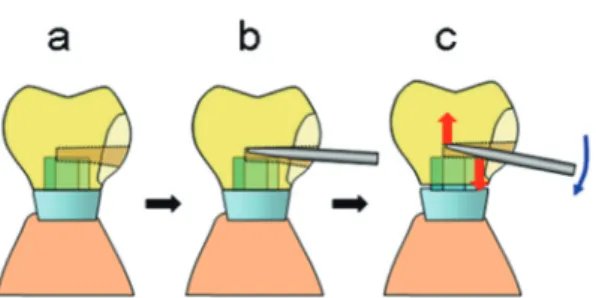
Fig. 2 Schematic illustration of: a: Cross section of superstructure and working cast. b: Inserted bur. c: Lifted superstructure with the bur pressed downward.
Fig. 3 Photographs of: a: Bur inserted from the buccal side. It is confi rmed that the bur inserts smoothly. b: Checking whether the superstructure can be removed smoothly.
207 A Technique for Removing a Cement-retained Implant
Dental Med Res. 33
Introduction
Cement-retained superstructures can be removed using
a removable knob attached to the superstructure and provisional luting agents; however, removing the cement- retained superstructure from the abutment is often difficult. In addition, there is a possibility of damaging the superstructure. Moreover, some conventional removal techniques require a special driver, and preparation of a cylindrical guide hole in the superstructure as well as the abutment must be precise.
1, 2)Furthermore, the small size of the removing device means that it is easily lost and should be stored safely as it is diffi cult to refabricate.
Therefore, a technique using a special instrument has been reported previously.
1〜5)This report introduces a new technique to facilitate easy removal of a cement- retained superstructure without special instrumentation.
Procedures
1.
A cement-retained superstructure is manufactured using conventional methods.
2.
A hole (diameter: ≤1 mm) is prepared from the outer to the inner surface of the superstructure before or after casting to serve as a horizontal opening for removal (Figs. 1a, b, and 2a).
3.
A machined carbide bur is inserted into the horizontal hole for removal of the superstructure (Jet carbide bur, Shofu, Kyoto, Japan).
4.
The head of the bur is cut off using an air turbine and polished with a silicone point (Fig. 1a). The bur is then inserted in the opening of the superstructure on the working cast (Figs. 2b and 3a).
5.
The bur is pressed downward to check whether the superstructure can be removed smoothly (Figs. 2c and 3B).
6.
The superstructure is cemented to the abutment with a provisional luting agent (Hy-bond temporary
cement soft
®, Shofu, Japan).
7.
The opening, which acts as a cement access vent hole, is fi lled with resin composite (Clearfi l
®AP-X, Kuraray Medical, Japan). The resin composite is retained by mechanical interlocking.
8.
When removing the superstructure, remove the resin composite with a carbide bar and insert the bur in the opening of the superstructure, then press the bur downward.
Discussion
The new technique does not require special instru-
men tation, and the abutment does not have to be custom modified and this new instrument can usually be reused. This technique will decrease discomfort when the cement-retained superstructure is removed, and thus reduce the force of impact to the patient from the removing device. Consequently, maintenance will become easy and recall may be facilitated. However, if the height of abutment is insufficient for mechanical retention of the superstructure, this technique should be used carefully because it may cause loosening of the superstructure. Moreover, the opening is placed on the buccal side for ease of operation. It would be considerably more aesthetically pleasing than placing the opening on the occlusal surface, as with the screw- retained superstructure; therefore, this new method may be selected in lower molars. It can be applied in any case;
however, if the opening is placed on the lingual or palatal side, it would be difficult to insert the bur. Pulling the bur upward might be considered as opposed to pressing the bur downward; however, pulling might generate an upward force on the superstructure far from the center, which may result in rotation of the superstructure.
Moreover, pulling might increase the risk of chipping of
the veneering material.
Y. Sato and others
208 Dental Med Res. 33
Conclusion
We have introduced a new technique that enables the
easy removal of a cement-retained superstructure without the need for special instrumentation.
References
1) Okamoto M, Minagi S: Technique for removing a cemented superstructure from an implant abutment. J Prosthet Dent, 87:
241 242, 2002
2) Doerr J: Simplified technique for retrieving cemented implant restorations. J Prosthet Dent, 88: 352 353, 2002
3) Watanabe K, Watanabe F, Ichikawa T: Basic Technology
& Technique. J Dent Tech, extra issue: 92 95, 2004 (in Japanese)
4) Ichikawa T, Ishida O, Watanabe M, Tomotake Y, Wei H, Jianrong C: A new retrieval system for cemented-retained im- plant superstructure. J Prosthet Dent, 17: 487 489, 2008 5) Chen JR, Nagano K, Tomotake Y, Oka K, Hada M, Ichikawa
T: Influence of a vent hole on the retentive force of a ce- mented-retained superstructure before/after thermo-cycling.
Prosthodont Res Pract, 5: 157 160, 2006