A Guide for Silage Making and Utilization in the Tropical Regions
March 2005
Japan Livestock Technology Association
日 本 中 央 競 馬 会 特 別 振 興 資 金 助 成 事 業
FOREWORD
Japan Livestock Technology Association (JLTA) has, under super vision of Ministr y of Agriculture, Forestr y and Fisheries, been implementing a wide range of works to support Japanese livestock-related Official Development Assistance (ODA). Technical manual making is one of these supporting activities.
In the dr y tropics having longer dr y season, feed shortage in dr y season is quite serious, and becomes a common and big constraint in cattle production.
To solve feed shor tage, hay making is not always good solution due to the necessity of securing machines and difficulty of dr ying grasses in wet season.
On the other hand, silage making will be more feasible and effective because of its cheapness and easiness in preparation. In Thailand, silage making has become popular year after year and proved to be an easy solution to feed shor tage in dr y season in dair y cattle farming.
The aim of making this pamphlet is to provide Japanese overseas livestock technical exper ts working in developing countries or to be assigned in the future with technologies and knowledge of making good silage in terms of cost and quality.
In this pamphlet, the principle of making silage is included, which is based on Japanese technologies, and also overseas good examples obser ved and collected in developing countries through Japanese technical cooperation implementation activities.
I would be much happier, if this pamphlet is useful in your works.
Tokyo, March 2005
Yoshihiro Yamashita President
Japan Livestock Technology Association
List of the Authors
Name Managerial Position
Mr. Seiichi Chiba Director of Feed Division, Iwate Station, National Livestock Breeding Center, Incorporated Administrative Agency
Mr. Hisao Chiba Technical adviser, Livestock Production Department,
ZEN-NOH ( National Federation of Agricultural Co-operative Associations)
Dr. Masuo Yagi Technical adviser, Japan Livestock Technology Association
A Guide for Silage Making and Utilization in the Tropical Regions
Contents
1. Shortage of livestock feed and importance of its storage in dr y season in
the tropical regions ……… 1
2. Principles of silage making ……… 3
3. Major raw forage materials for silage making ……… 5
4. Kinds of silos (for small-scale operation having about 10 animals) ……… 5
5. The size of a silo ……… 8
6. The place and method for building a silo ……… 10
7. Silage making technology ……… 11
8. Method of feeding silage and a point to note ……… 16
9. Judging the quality of silage ……… 16
10. Prevention of the aerobic deterioration……… 17
11. Prevention of accidents in silo works……… 18
12. Actual examples of silage making and utilization in the tropical regions……… 19
13. Examples of advanced silage making and utilization technologies ……… 25
Addendum Urea treatment of rice straws, etc. ……… 27
1 . Shortage of livestock feed and importance of its storage in d r y season in the tropical regions
(1) Feed resources in tropical regions
The feed resources for animals (cattle and other ruminants) in the tropical regions include mainly native plants, fodder trees, farm by-products (leaves and stems except for food use, straws, grains, brans, etc.), food processing by-products (cassava meal, soybean curd residue, brewery spent grains, molasses, etc.). On the contrar y, the use of forage crops like pasture plants are limited to the advanced regions where mainly dair y farming is practiced.
It is important to make good use of the feed resources which are produced in these regions and are inexpensively and easily available.
It is necessar y to solve the production and utilization problems of forage crops, like pasture plants, by considering the land use, cost of production and feed needs in the dair y farming, etc. As to the use of farm and food processing by-products, the condition of the production (time, form, moisture content, amount, etc.), availability, prices, and methods for procurement like transportation should be examined. It is necessar y to adjust the moisture content of the silage (TMR: total mixed ration) materials, accelerate fermentation and improve the nutritional value of the feed by adding these by-products to the materials of feed crops or native grasses at the time of silage making.
(2) Seasonal productivity of the feed resources and shortage of feed during the dr y season In many tropical regions, such as South East Asia, the climate conditions are characterized by the rainy season and the dr y season (in continental regions, Thailand, Vietnam, etc., from October to April; in the coastal island regions like Indonesia, etc., from June to September).
In the rainy season, as the growth of herbage including native grasses and pasture plants is vigorous, sufficient feed becomes available and in most cases animals can be fed enough by cut-and-carry or grazing.
However, in the dr y season, not enough feed tends to be secured and fed to animals, because herbage plants stops growing or dying due to the continued dr y condition during the dry season. Thus animals suffer malnutrition, reduction of milk production, loss of body weight (see Figure 1 and Table 1), outbreak of diseases and reproduction disorders. These marked reduction in animal productivity causes mainly the stagnation of income growth in animal farming and becomes a limitation factor for increasing the animal keeping number.
In the advanced regions where dair y farming are practiced, pasture plants, etc. suitable for the tropical regions are introduced and selected and are widely spreading. Therefore it is vital to produce good quality roughage year-round by increasing the cropping area on the basis of those information and proven data.
Figure 1. Seasonal change of liveweight of grazing cattle in Northern Australia (Norman, 1966)
Table 1. Effect of introducing pasture legumes and applying fertilizers on beef productivity in native pastures
(3) Preparation and storage of silage for the dr y season
As a measure against feed shortage of during the dr y season, it is general that vigorously grown herbages in the rainy season (high temperature and heavy rain) are prepared, and stored as hay and silage and used in the dr y season. However, it is difficult to make hay due to the climatic condition and cost, etc.
350
300
250
200
150 kg Liveweight
+150
−54
+106
−62
−33
+72
Rainy season Dry season Rainy season Dry season Rainy season Dry season 1 year of age 2 years of age 3 years of age 4 years of age
Native pastures
29 30 63
pasture legumes
93 56 73 279
Superphosphate
148 76 120 474
Reference
Shawand't Mannetje(1970)
Graham and Mayer(1972)
Winks(1973)
Stobbs(1969)
(Note) Liveweight gain (kg/ha/year)
As a method for preparing and storing herbages under the climate condition of the rainy season, the silage making technology is the most reliable and low cost.
In the advanced regions in Thailand and Indonesia, silage making is spreading, and it is apparent that the technologies in the two countries can be used.
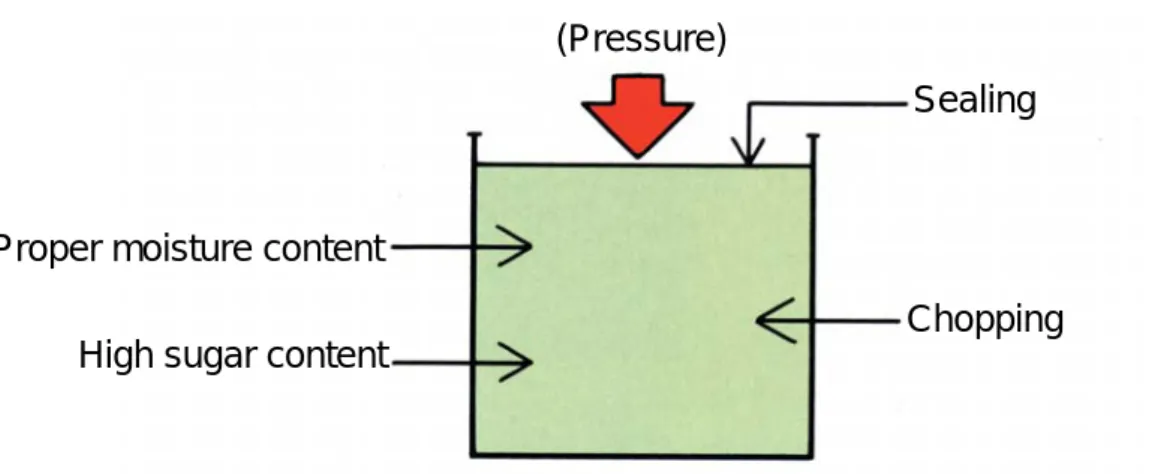
In silage making, the basic principles of silage making (manual) must be practiced as follows; ①harvesting and chopping the material herbages at the proper time, ②adjusting the moisture content, ③giving sufficient treading, early complete sealing and application of heavy weights, ④ addition of molasses, or sugars and by-products (in case of delayed harvesting and poor condition for silage condition), ⑤practicing complete silo management (measures against damages by birds, field mice, etc.), ⑥short working time for adjustment at each silo. It is also important to introduce and use simple and inexpensive silos which can be easily procured or made in the region.
It is also vital to understand the nutritional characteristics that the most of the tropical herbages have a low content of sugars which are essential for silage making (lactic acid fermentation), and to utilize the local feed resources to the maximum, for example by mixing as TMR with other silage materials (farm by-products, food wastes, etc.).
(4) Measures for securing various feed resources and their spread
Rice straws are produced in large quantities in paddy field areas, but in reality most straws are not utilized as a feed resource due to the climatic conditions (because of the high air temperature and heavy rain, it is difficult to dr y rice straws), the timing of the double and triple cropping, har vesting labor under the extreme heat condition, shortage of labor and storage facilities, etc.
There is a simple and low cost "urea treatment technology" as a method for collecting and storing these rice straws, and the straws can be stored in raw condition (with the moisture content at the cutting time) with improved digestibility, palatability and nutritional value.
Therefore it can be expected that the use of rice straws for feed will increase.
The transitional time between the rainy season and the dr y season often overlaps with the harvest time of agricultural products. By-products of the har vest are also produced in large quantities and can be used as stored feed after dr ying naturally. Furthermore herbage can be used (by grazing or cutting) as it is as standing hay or as storage feed after cutting and drying.
For extension of making and utilizing silage of herbages, it is necessar y to demonstrate various disadvantages occurring with feed shortage during the dr y season and advantages of feeding animals by securing the stored feed, and to make and distribute manuals (guides) for silage making technology, as well as to demonstrate the actual proof.
2. Principles of silage making
Silage, which is a succulent roughage, is made by keeping chopped silage materials air-tight in
a suitable container (silo) to undergo mainly lactic acid fermentation with the aim of storing feed. The principle of silage is the same as that in making pickles.
The fermentation process of silage is as follows:
(1) The first stage
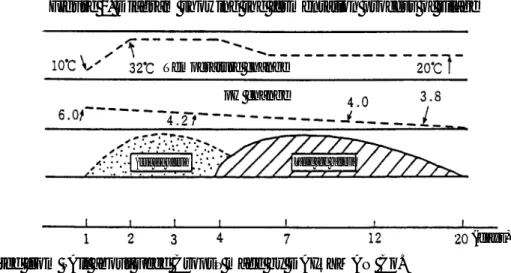
①The packed raw materials are still respiring immediately after chopped and consumes oxygen.
②The temperature will rise to about 32ºC around 4 days after packing.
(2) The second stage
①Acetic acid production begins by fermentation with acetic acid bacteria during the respiration in the first stage.
②The silage pH slowly changes from about 6.0 to about 4.0.
(3) The third stage
①Lactic acid fermentation begins by lactic acid bacteria about 3 days after packing chopped materials.
②Acetic acid fermentation by acetic acid bacteria decreases, and then acetic acid production declines.
(4) The fourth stage
①Lactic acid production continues for about 2 weeks.
②The temperature goes down slowly to about the normal atmospheric temperature.
③The pH decreases to about 4.0, and the activity of the various bacteria ceases.
(5) The fifth stage
①If the reaction proceeds smoothly up to the fourth stage, it enters a stable phase with a low pH condition, and high quality silage is made.
②The lactic acid fermentation completes in about 20 days, and the silage product is finished.
③If the lactic acid production is insufficient, butyric acid fermentation begins and quality deterioration occurs.
The fermentation process of silage is shown in Figure 2.
Figure 2. Diagram showing the fermentation process of silage
Temperature change
Acetic acid bacteria Lactic acid bacteria
pH change
(days) (Note) cited from “All about Feed Crops” made by DAIRYMAN Co.
3. Major raw forage materials for silage making
(1) Pasture grasses: Elephantgrass (Napiergrass), Guineagrass, Rhodesgrass, Sudangrass, Setaria, Ruzigrass, Atratum, Kinggrass, etc.
(2) Pasture legumes: Desmentus, Stylo, etc.
(3) Corn: Corn for feed
(4) Sorghum: Sorghum for feed (5) Fodder tree: Leucaena, etc.
(6) Straws: rice straw, wheat straw, soybean chaff, peanut hulls, etc.
(7) Farm by-products: stover of sweet corn, stover of sweet sorghum, pineapple stover, sugar cane top, rice bran, wheat bran, etc.
Cassava meal, soybean curd residue, brewer y spent grain, juice pomace, molasses, etc.
4 . Kinds of silos (for small-scale operation having about 10 animals)
(1) Stack silo
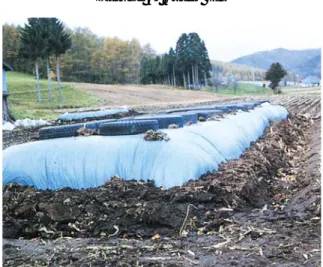
①Silage can be made easily with a simplest silo.
②A plastic sheet (about 0.1 mm thick) is spread over the ground, and similarly chopped silage materials on the sheet are entirely covered with a plastic sheet. Proper tread pressure has to be applied, and complete sealing is required.
③The size can be determined according to the number of raising animals.
④It is necessar y to make steps to prevent damages on the plastic sheet by field mice or birds.
Figure 3. Stack silo
(2) Bunker silo
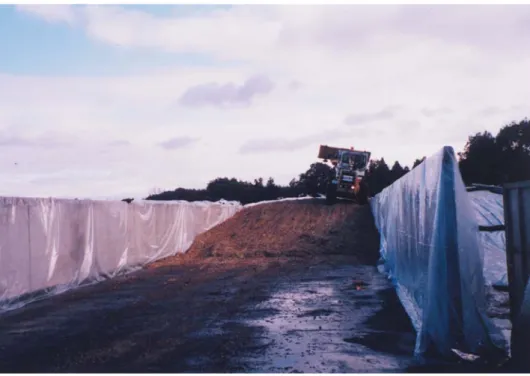
Figure 4 shows a bunker silo, half of which is below the ground level.
①A bunker silo is generally built on the ground (Figure 4), but there are other building (Note) cited from “Zen-Noh Grass”
methods to build a silo using the configuration of the ground (slope) or a semi underground type, which is half below from the ground level.
②Side walls made of wood and concrete are needed, and the interior is preferably sealed by plastic sheets. Proper tread pressure has to be applied, and complete sealing is required.
③Supports are needed so that the side walls do not fall toward the outside.
④The width of the front should be such that the total amount of silage per day can be taken out with a thickness of 20-30 cm to prevent aerobic deterioration.
Figure 4. Bunker silo
(3) Trench silo
①A trench silo can be built by simply digging the ground, but it is better to place plastic sheets inside to prevent loss.
Proper tread pressure also has to be applied, and complete sealing is required.
②A trench silo whose interior is coated with concrete can be used for a long time (Figure 5).
③The width of the front should be such that the total amount of silage per day can be taken out with a thickness of 20-30 cm to prevent aerobic deterioration.
Figure 5. Trench silo
(4) Plastic bag silo
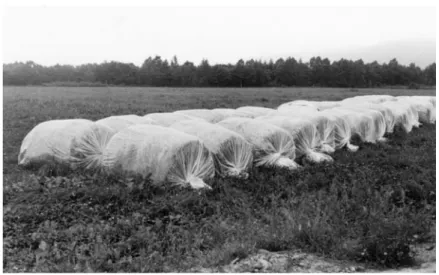
Figure 6 shows plastic bag silos.
①This is a plastic bag with the thickness of about 0.1 mm and silage materials are packed inside.
②Commercial plastic bags are used if available.
③Plastic bags for fertilizer and feed may be reused for cost-cutting. Bags must be packed with chopped raw materials, compressed as much as possible to remove the internal air and then sealed completely.
④The number of bags is determined freely in accordance with the operation size.
⑤It is necessar y to watch out for damage on the plastic bag by field mice, birds and dogs.
Figure 6. Plastic bag silos
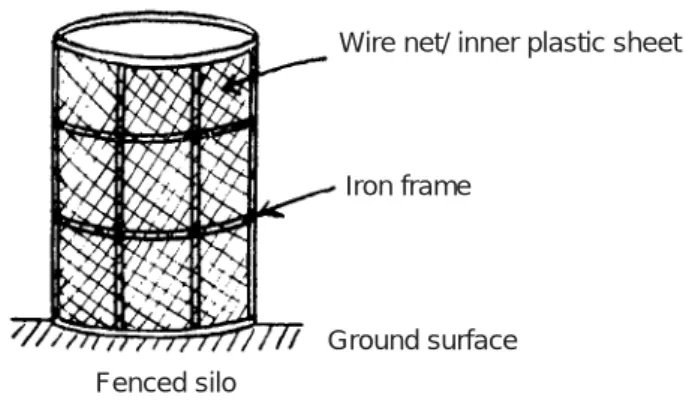
(5) Fenced silo (framed silo)
①The frame is made of bamboo, wooden, iron materials, etc., which are easily available locally.
②The shape of cross section may be circular or rectangular.
③The inside is sealed with plastic sheets. The silos are packed with compact and chopped raw materials and must be compressed as much as possible to remove the internal air and sealed completely.
④As the silo cannot be made in a large size, the number of silos is determined by the size of operation.
⑤This is a convenient silo because it can be easily made.
Figure 7. Fenced silo (framed silo)
(Source) “Kinds and Characteristics of Silos (by Nobuo Takano)”
5. The size of a silo
The silo size is determined by a herd size, the amount of daily feed, the number of feeding days and packed density of the raw materials. An example of calculation in case of 10 dair y cows is as follows:
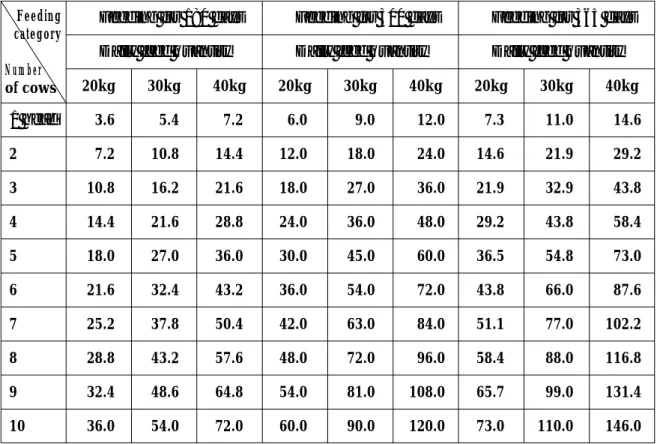
①Ten dair y cows (a herd size) ×20 kg (daily ration) ×180 days (number of feeding days)
= 36 tons (see Table 2)
②The capacity of the silo is: 36,000 kg ÷700 kg/m3(see table 5) = 51.4 m3
③10% is added to account for packing loss in the silo: 51.4 m3÷(1 – 0.1) = 57.1 m3
④20% is added to account for loss during storage. The resulting calculated silo capacity is:
57.1 m3÷(1 – 0.2) = 71.4 m3
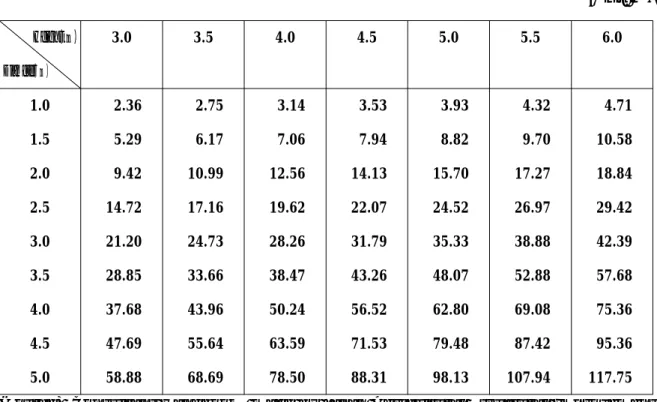
⑤See Table 3 and 4 for the type of a silo.
Wire net/ inner plastic sheet
Iron frame
Ground surface Fenced silo
Table 2. The needed amount of silage corresponding to a herd size
(Unit: ton)
Table 3. Volume calculation chart for rectangular silos (stack, trench and bunker types) (Unit: m3) Feeding for 180 days Feeding for 300 days Feeding for 365 days Daily feed quantity Daily feed quantity Daily feed quantity 20kg 30kg 40kg 20kg 30kg 40kg 20kg 30kg 40kg
1 head 3.6 5.4 7.2 6.0 9.0 12.0 7.3 11.0 14.6
2 7.2 10.8 14.4 12.0 18.0 24.0 14.6 21.9 29.2
3 10.8 16.2 21.6 18.0 27.0 36.0 21.9 32.9 43.8
4 14.4 21.6 28.8 24.0 36.0 48.0 29.2 43.8 58.4
5 18.0 27.0 36.0 30.0 45.0 60.0 36.5 54.8 73.0
6 21.6 32.4 43.2 36.0 54.0 72.0 43.8 66.0 87.6
7 25.2 37.8 50.4 42.0 63.0 84.0 51.1 77.0 102.2
8 28.8 43.2 57.6 48.0 72.0 96.0 58.4 88.0 116.8
9 32.4 48.6 64.8 54.0 81.0 108.0 65.7 99.0 131.4
10 36.0 54.0 72.0 60.0 90.0 120.0 73.0 110.0 146.0
Feeding category Number of cows
Length m
4 5 6 7 8 9 10 11 12
2×1 8 10 12 14 16
3×1 12 15 18 21 24 27
4×1 16 20 24 28 32 36 40
5×1 20 25 30 35 40 45 50 55
2×2 16 20 24 28 32 36 40 44 48
3×2 24 30 36 42 48 54 60 66 72
4×2 32 40 48 56 64 72 80 88 96
5×2 40 50 60 70 80 90 100 110 120
3×3 36 45 54 63 72 81 90 99 108
4×3 48 60 72 84 96 108 120 132 144
5×3 60 75 90 105 120 135 150 165 180
6×2 72 90 108 126 144 162 180 198 216
Width × height (m)
Table 4. Volume calculation chart for cylindrical silos
(Unit: m3)
6. The place and method for building a silo
(1) Place to build a silo
①A place with good drainage and no staying of rain water (especially close attention is required when building a semi-underground silo or a trench silo).
②A place which is not exposed under direct sunlight, as far as possible, because quality deterioration of silage often results from the direct sunlight in tropical regions.
③When building a stack silo, the preparation should be done by raising the ground level in advance, if there is no place with good drainage to be found.
④A place near the place (feed trough) for feeding animal where the carrying work is easy at feeding.
⑤If the distance for transportation between the production field and the silo is shorter, the work efficiency is better.
(2) Method for building a silo
①There are actual examples in the tropical regions which simple roofs made of leaves of palm or banana trees are built to avoid direct sunlight or torrential rains. It is also effective to lower the rise of the inside temperature of a silo that if covering the entire top surface of the sealed plastic sheets is done with soil to avoid the direct sunlight
②An ideal trench silo has concrete side walls, but in case the silo does not have walls, it is necessar y to seal the silo by covering the side par ts with plastic sheets instead.
③The floor of a stack silo, bunker silo, trench silo, etc. should have a slope of 3-5% toward
Height(m) 3.0 3.5 4.0 4.5 5.0 5.5 6.0
Diameter(m)
1.0 2.36 2.75 3.14 3.53 3.93 4.32 4.71
1.5 5.29 6.17 7.06 7.94 8.82 9.70 10.58
2.0 9.42 10.99 12.56 14.13 15.70 17.27 18.84
2.5 14.72 17.16 19.62 22.07 24.52 26.97 29.42
3.0 21.20 24.73 28.26 31.79 35.33 38.88 42.39
3.5 28.85 33.66 38.47 43.26 48.07 52.88 57.68
4.0 37.68 43.96 50.24 56.52 62.80 69.08 75.36
4.5 47.69 55.64 63.59 71.53 79.48 87.42 95.36
5.0 58.88 68.69 78.50 88.31 98.13 107.94 117.75
(Source) “Consultant Handbook” made by Japan Agricultural Structural Improvement Association
the entrance to make the flow of liquid discharge easy.
④Rat poison should be scattered around the places where many field mouse inhabit.
7. Silage making technology
(1) The procedures for silage making
The procedures for silage making are as follows.
①Because it is preferable to be able to finish the work of packing materials into one silo (stack, bunker, trench, etc.) within a short time (1 or 2 days), the silo size, working machineries and working system (labor) should be examined.
③Cutting and transportation of raw forage materials
a. Cutting work for raw forage materials is carried out by hand cutting using sickles, bush cutter etc., or by machiner y like hand mowers etc. which are locally popular and available.
b. For cutting work in a large area, the introduction and use of mowers, har vesters etc. are efficient. However, their cost and after-service etc. should be considered.
c. For the transpor tation work, the means such as man-power (carr ying poles with baskets), carts, wagons, which are locally popular and available, should be utilized.
④The following points should be closely watched in silage making:
a. Harvesting of the raw forage materials at proper time
b. Chopping, treading, early sealing and pressurizing with heavy weights c. Control of the moisture content of raw forage materials
d. Additives (used when the raw forage materials are not of good quality and the conditions for making silage are poor).
Cutting of the raw forage materials
Hand cutting/machine cutting
Wilting Transportation Chopping
In case of high moisture content Cart/trailer etc.
Filling/treading/
Packing and treading are parallel works
Immediately after filling Sealing/pressur ing with heavy weights
Countermeasures against bird and rat damage
Straw cutter/chopper
Anti-bird net/rat poison
The start of feeding
About 20 days after sealing in case of the tropical regions additives
Figure 8. Important points for silage making
The Forage Q&A (made by All Japan Agricultural Cooperative Federation)
(2) Har vesting of raw forage materials, etc. at proper time and mixing of them
①Pasture grasses (including native grasses)
From early heading to heading stage: this period can acquire the highest nutritional yield per unit area and high quality silage. Delayed cutting tends to cause the decline in the silage quality (palatability) and regrowth vigor of grasses.
②Pasture legumes (including native legumes)
From budding to early flowering stage: this period can acquire the highest nutritional yield per unit area and high quality silage. Mixing with pasture grasses makes fermentation better and silage making easier.
③Corn
Yellow ripening stage:
・When the grain moisture content becomes 40-45%.
・When the grain milk line of the grain passes the central par t.
・When the moisture content of the whole plant, including stems, leaves and grains is about 65-73%.
[Judgment of the yellow ripening stage]
The milk line is utilized for judging the yellow ripening stage.
The milk line is a line between the yellow par t and the white par t of kernels that can be seen clearly when one breaks an ear of corn by hand and obser ves the outer part. The proper har vesting time is when this milk line passes the center point of the grain.
cited from “Zen-Noh Tane 1995 Spring seeding”
(Pressure)
Proper moisture content
Sealing
Chopping
High sugar content
(4) Sorghum
Dough stage: ・When the hardness of the grain becomes like that of dough.
・The time when the dr y matter yield is maximum and the moisture content, including stems and leaves, is 65-70%.
⑤Agricultural and food processing by-products such as stovers and by-products
a. Since stovers (fresh forage), raw by-products are easy to decompose if left without any treatment, they are mixed with other materials (forage) and made into silage.
b. If they are dr y and preser vable, they are stored and utilized as moisture content regulators for raw materials with high moisture content.
c. The forage plants in the tropical regions are quite often low in the sugar content that is essential for lactic acid fermentation.
For this reason, it is important to improve the quality of silage by adding locally available and cheap by-products (especially high-sugar-content by-products).
(3) Moisture content in raw materials
①In case of the tropical regions, the moisture content of raw materials should be adjusted at 65-75% in silage making, which is a little higher than in the temperate regions, because the chance of failure becomes much less from the viewpoint of preventing aerobic deterioration(60-70% is the optimum moisture content for butyric acid fermentation.).
If the moisture content of the raw materials is too high (80% or more), it may cause poor fermentation and the loss of liquid discharge and they need to be adjusted by mixing by- products and straws with low moisture content.
②The sign of the optimum moisture content is that water seeps out of chopped raw materials by hand squeezing.
(4) Chopping of raw materials
①The raw materials are chopped to about 1-3 cm long so that the packing density is kept higher, lactic acid fermentation takes place in good condition and the work of packing and taking out are carried out easily.
②The raw materials har vested by directly cutting with a chopper (frail mower type) contains stems and leaves that are 20-30 cm long, but the silage quality is not af fected.
(5) Packing and treading
①The chopped raw materials are packed with occasional flattening so that they will pile up evenly.
②The treading is applied by human feet or tractors in parallel with the packing, and especially the peripheral area should be given priority for treading.
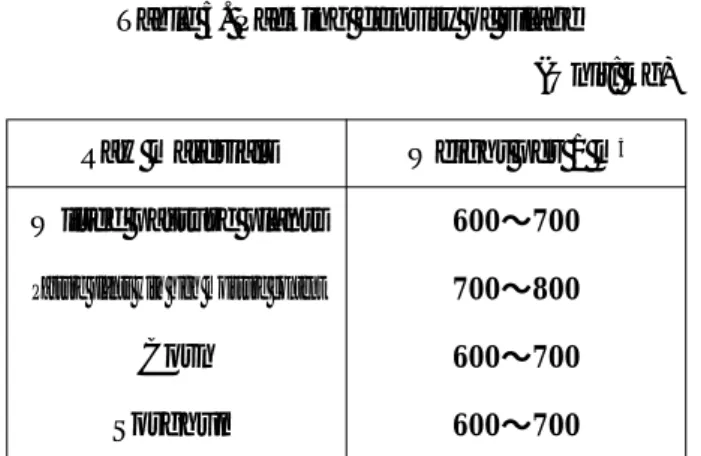
③The signs of the finishing of treading are that there is almost no sinking of the shoes when human labor is used, and that the sinking of the tractor tires is less when a tractor is used. The density at that finishing time is shown on Table 5.
Table 5. Packing density of silage (Unit: kg)
④Ideally the packing should be finished in a shor t time within the day. If the packing work has to be continued to the next day, the packed raw materials should be covered with plastic sheets at the end of the work in the first day so that the packed raw materials are not exposed directly to the air.
(6) Additives
When the raw materials are fresh and of high quality (high sugar content), there is especially no need for additives to be used (this leads to low cost). If the quality of the raw materials is deteriorated, due to delayed cutting and rainfall so on, additives should be used
Raw materials Weight per 1 m3 Wilted pasture plants 600〜700 Pasture plants with high moisture content 700〜800
Corn 600〜700
Sorghum 600〜700
(Source) “Consultant Handbook” (Japan Agricultural Structural Improvement Association)
to improve the quality.
Usually molasses and brans are easy to obtain in the tropical regions, so these are utilized.
The method for adding is as follows:
①Addition of molasses
a. Molasses solution is diluted by 2 times with hot water and is sprayed on the raw materials with a watering pot or the like at the level of about 2-3% of the material weight.
b. If the moisture content of the raw material is high, molasses addition may have no effect. In that case, the raw materials are dried up to about 65-75% of moisture content.
②Addition of bran
a. When the moisture content of the raw materials is 80% or higher, brans are evenly sprayed at about 10% of the silage materials with manual. When the moisture content is 70-80%, 5% is sprayed.
b. Addition of brans also leads to the moisture adjustment of raw materials having higher water content.
c. Bran additives are expensive just for only improving the fermentation, but they bring about the effect of nutritional improvement.
(7) Early complete sealing
①The sealing by plastic sheets and so on should be done to put the silage into air tight condition immediately after the packing and treading works are completed.
②Especially the peripheral area should be given a priority for sealing to prevent deterioration.
③In case of transparent plastic sheets, inside raw materials are visible from outside and have a tendency to receive damage from birds. Therefore it is better to use colored sheets.
(8) Pressurizing with weight after sealing
①In stack silo, bunker silo, trench silo etc., the sealed plastic sheets is covered completely by soil with about 20 cm thickness.
This covering is also effective to suppress the temperature rise in the silo caused by direct sunlight.
②The used tires or fertilizer bags filled with earth and sand etc. can be used as weights.
The heavier the weight is the better.
(9) Countermeasures against damages by rats, birds and dogs
①To prevent damages by birds, anti-bird nets can be put up, fish lines or plastic tapes, etc.
may be put up criss-cross.
②If there is a possibility of damages by rats, rat poison should be scattered around.
If weeds grow around the silo, they should be cut whenever necessar y.
③After the silage sealing, the plastic sheets should be inspected for breakage from time to time, and if breakage is found, it should be repaired to maintain the airtight condition.
(10) Termination of silage fermentation
Since lactic acid fermentation ends about 20 days after sealing, with the pH dropped around 4 and the quality of the silage stabilized. From this time, the silage can be fed.
8. Method of feeding silage and a point to note
(1) Since the nutritional ingredients of silage varies greatly with the kind, mixing ratio, and moisture content of the raw materials, it is important to analyze feed, and carr y out appropriate feeding to cattle.
(2) Pasture plant silage should be fed together with other roughage such as hay, although it can be fed alone.
(3) In general, whole crop silage is not fed by itself. It is because this silage contains high nutrients (TDN), if it is fed too much females will become fat and tend to be infer tile.
(4) If the number of animals suffering from diarrhea increases, as it might be possible that the silage has deteriorated in quality, and feeding should be stopped. After discarding the deteriorated parts, feeding may be restarted.
(5) When keeping on feeding a large quantity of silage having a high concentration of nitrate nitrogen (2,000 ppm or higher in DM), it is needed to pay close attention because females might develop infertility, abortion, sudden death, etc.
Silage with a high concentration of nitrate nitrogen is sometimes found when pasture plants, corns, etc., to which too much manure was applied, is har vested (especially early cutting) and processed.
If there is a possibility that the silage might contain high concentration of nitrate nitrogen, it is preferable to check the concentration beforehand (it can be simple to do with an indicator drug). Depending on the result of the check, the silage may be discarded, or given with a reduced ration by combining it with other roughage (straws, etc. having low nitrate nitrogen concentration).
9. Judging the quality of silage
The quality of silage can be judged by its color, smell, taste and touch.
(1) Color: In general, pale yellow indicates good quality. If the color is from dark brown to dark green, the silage under went bad fermentation and is of bad quality.
(2) Smell: Acidic or a sweet-sour pleasant smell indicates good quality. On the other hand, if there is a manure smell or putrid smell and it is so repugnant that one cannot put the silage near one's nose, the quality is poor.
(3) Taste: If the silage tastes sour and there is no problem in putting it in one's mouth, the quality is good. On the other hand, if the silage tastes bitter and one cannot put it in one's mouth, the quality is poor.
(4) Touch: When squeezing the silage tightly in a hand and then opening the hand, if the silage breaks slowly into two, that silage is of good quality. If the silage breaks into
small pieces separately, the silage is deficient in moisture content. If water is dripping, the moisture content of the silage is too high.
Table 6. Judgment of the quality of silage in the field
(Source) “Silage Bible” (Rakuno Gakuen Shuppan)
1 0 . P revention of the aerobic deterioration
Secondar y fermentation occurs easily in such conditions that the air temperature is high, the packing density is low, the moisture content of raw materials is low or the take-out amount per day is small.
Especially in tropical regions, it is assumed that often the air temperature is high, the packing density is low and the amount taken out per day is small. Therefore it is important to pay attention to the type and size of the silo as well as to follow the basics of silage making.
(1) The packing density of silage should be increased to about 700 kg per 1 m3.
(2) The moisture content of raw materials should be adjusted to about 65-75%.
(3) The size (width) of a silo should be adjusted so that the thickness of silage taken out per day is 20 cm or thicker.
Category Grade Color Smell
Observation when touching silage
with hands
Flieg
score pH Feeding
Safety
A Pale yellow, olive color
Pleasant light sweet-sour
Silage is judged so clean that it is considered not necessary to wash hands
80 points
or higher 3.6〜3.8 Can be fed in large quantities
B B r o w n i s h yellow
Sweet-sour smell with slightly stimulative smell
Smell on hands is gone after washing with water
60 points
or higher 3.9〜4.2 Be careful in feeding cows in milking
Danger Attentionneeded C Dark brown Strong pungent
smell
It needs wash hands with hot water
40 points
or higher 4.2〜4.5 For feeding to growing feifers
Unsuitable
D
Dark brown and dark green
Ammonia smell, putrid smell
The smell on hands is gone only after washing with hot water and soap
39 points or lower
4.6 or higher
Stop feeding to cows in milking
Also be careful in feeding growing heifers
Figure 9. A concrete method for preventing secondar y fermentation
(Source) “The Forage Q&A” (Zen-Noh information)
1 1 . P revention of accidents in silo works
(1) It may happen occasionally that poison gas is produced in underground silos, causing oxygen deficiency.
When a worker enters into a silo to restart packing more silage materials after silage making works were temporarily discontinued and it passed more than half a day, and when the work for silage take-out is carried out in the lower part of a silo, a burning candle (fixed on a stick) should be brought near the lower part of a silo to check whether fire is extinguished. If fire is extinguished immediately, there is a possibility that oxygen may be deficient. Since this is a ver y dangerous situation, air in the lower part of the silo should be ventilated before starting work by exhausting with a vacuum cleaner or sending air with a blower, etc.
(2) A ladder should be used to go up and down to prevent people from falling. When an underground silo becomes empty, a fence should be built around the silo.
a Used plastic sheet a Used plastic sheet
① A plastic sheet-made internal bag is put into a summer silo, and if secondary fermentation occurs, the silo is immediately sealed.
② A bag silo is used during summer and resealed at every take-out
③ If secondary fermentation occurs, the lid for prevention of secondary fermentation needs to be utilized, and the secondary fermentation is prevented while silage is taken out.
④ The silo in which secondary fermentation occurred should be sealed with a water lid by pouring water.
Meanwhile, another silo is utilized.
Plastic sheet/
internal bag Bag silo Lid for prevention of
secondary fermentation
Silo water lid Poured water
Secondary fermentation silage
Secondary fermentation silage Silage
Secondary fermentation silage
1 2 . Actual examples of silage making and utilization in the tropical regions
(1) Indonesia
①Examples in the JICA’s “The Strengthening Project of Artificial Insemination Center in Indonesia” (Singosari)
Hand cutting of raw materials (Elephant grass).
Grass height is 2-3m.
Hand cutting of raw materials (Guinea grass).
Heading stage
Cultivation of indigenous corn in Indonesia
Chopping of raw materials (Elephant grass) by a small-sized cutter with an engine
Treading work in a plastic bag silo
Cultivation without application of cattle manure Increased production by cultivation using cattle manure
②Actual examples of JICA’s Dairy Technology Improvement Project in the Republic of Indonesia” (Bandung) Completion of sealing work
Packing a trench silo dug into the ground with chopped materials (Plastic sheets are laid inside the silo.)
Concrete-made trench silo (packing, leveling and treading)
Covering work of plastic sheets (A roof is put up using coconut leaves to shut off the direct sunlight.)
A concrete-made bunker silo (The frontage is made narrow to prevent secondary fermentation.)
Quick sealing is needed after packing work. The container is reusable.
(2) Thailand
Actual examples in Thailand
After sealing, the plastic sheets covering the silo are further covered with colored sheets to prevent pin- hole formation on the plastic sheets, damages by birds, etc.
A drum can silo (Drum cans can be obtained easily and placed in a convenient place.)
Feeding cows with a simple wooden feed trough
A chopper shredding corn stover left after harvesting ears
Silage making by packing chopped pasture plants into small plastic bags (for garbage disposal) (nationwide use)
Silage making in a small plastic bag which is the re- use of a fertilizer bag (Central region)
Silage making by re-using a discarded plastic container (Central region)
A carton container utilized for silage making, which is a discarded container for tomato paste and a thin plastic bag is placed inside.
Silage making by packing chopped pasture plants in a larger plastic bag (in the center and right side) (Central region)
Silage making using concrete cylinders on a farm (Central region)
Silage making by packing chopped pasture plants in a concrete-made bunker silo (also note two large plastic bag silos next to the bunker silo, which have preventive measures against dogs) (Central region)
Silage making by packing chopped pasture plants in a bunker silo built with concrete blocks (Central region)
A plastic stack silo placed on a concrete floor (The top is covered by rice straws to protect the silage from direct sunlight.)
Silage making in a bunker silo dug in the ground with utilizing a depression
A silo on a concrete floor with a raised ground as side walls
An ammonia treatment trough for rice straws
(3) Chile
Examples of JICA’s “ Improvement of Productivity for the Small Scale Farmers Project in the Republic of Chile” (Valdivia)
A stack silo (Pasture grasses are perennial ryegrass. No plastic sheet is laid down, and the moisture content is controlled by the liquid discharge seeping into the ground. From the floor about 10-20 cm thick of silage may be damaged, but the overall quality is good.)
Take-out of silage (Cut off by a tool with an ax-like edge. The cutting edge is kept hard, preventing secondary fermentation.)
Feeding silage with wooden feed troughs (The area around feed troughs becomes muddy condition due to rainfall. Some countermeasures are needed.)
Feeding silage in the pastures (With some loss caused)
A large bunker silo in the Agricultural Experiment Station (If air tightness is maintained, storage for more than 1 year is possible.)
A large stack silo in a dairy farm (Since moisture content is high, at about 80%, secondary fermentation does not occur.)
1 3 . E x a m p l e s o f a d v a n c e d s i l a g e m a k i n g a n d u t i l i z a t i o n technologies
(1) Silage making technologies generally widely used
In countries with advanced livestock industries, such as Europe, America and Japan, widely used silage making is carried out in vertical silos which are cylinder- or square- shaped concrete tower silos (built underground or semi underground type) or in horizontal silos like bunker silos, trench silos or stack silos.
The technologies for silage making consists of the work of har vesting raw materials for silage, like pasture plants, corn plants, etc., by tractor-pulled or self-propelled har vesters, the work of transporting the har vested raw materials by vehicles (forage wagons, trucks, etc.) to the silos, the work of packing the transpor ted raw materials into the silos and treading, and finally the work of sealing the silos.
As an example of generally practiced silage making by a bunker silo
An example of silage making by bunker silos
(2) Roll bale silage making technology
The roll bale silage making technology has been spread rapidly in farms in Japan since late Harvesting corn plants and loading chopped plants to
a transporting car
Harvesting pasture plants by a self-propelled harvester and loading chopped plants to a transporting car
Treading by a wheel loader in a bunker silo Sealing and storing in the bunker silo with a roof (the weights are old tires)
1975. After har vesting pasture plants, etc. and reducing the moisture content of these materials to about 60%, the materials are packed into cylinder-shaped bales (called roll bales) and wrapped around rapidly with a film to seal it air tight.
This film wrapping forms about 4-6 layers, and the machine used for wrapping is called a bale wrapper. The size of the bales is about 1 m in diameter, and the weight is about 350 kg, although it varies depending on the moisture content of the raw materials. Silage is made in about 2 months, and if the degree of sealing is good, it may be preserved in good quality condition for more than 6 months.
Originally, the roll bale silage is a technology for making pasture plants silage. But recently the machiner y for chopping, making roll bales and wrapping, and technology have been developed to utilize large-sized crops like corn plants as raw materials, and they are attracting attention as an energy-saving technology for making and utilizing corn silage.
Also relatively small machiner y has been developed for utilizing pasture plants, rice for feed, rice straw, etc. cultivated in relatively small fields to make roll bale silage.
Examples of roll bale silage making with pasture plants are shown as follows.
An example of making roll bale silage with pasture plants
Pasture plants gathered in a windrow before being rolled into bales by a roll baler
A pasture plant roll bale made by a roll baler
Wrapping work of a roll bale Wrapped roll bales (completed)
Addendum Urea treatment of rice straws, etc.
In the tropical regions there is a shortage of roughage, but rice straws and wheat straws are often seen discarded without being utilized. Therefore, as it is expected that the shortage of roughage may be improved by utilizing these unused resources as feed, and the preparation method is explained below.
Because rice straws and wheat straws are high in fiber content and hard, their digestibility and palatability are low. They have the feed characteristic that they are low in protein and fat content in nutritional value. By treating these straws with urea (ammonia treatment), they can be stored for a long period of time as raw straws, their digestibility and palatability are increased, and the nutritional value is also improved (increase in nitrogen content).
Fur thermore, it is said that urea treatment is ef fective against fungal growth, has an insecticidal effect and may is a preventive measure against hepatic facioliasis.
The quality improvement of rice straws through urea treatment
Unit: % of materials
(1) Basic principles of the treatment
①Raw materials to be treated: fresh rice straws or wheat straws produced in the year are used.
②Moisture content after the treatment: the moisture content is adjusted to 40-60% after the addition of urea solution.
③Amount of urea added: 2-3% of the weight of the silage materials.
④Method for storage: a plastic bag or a stack silo, etc.
⑤Sealing duration for treatment: about 20 days.
⑥Confirmation of urea degradation: with ammonia smell and the material changed to yellow color.
Ingredients
Organic matter Crude protein Total fiber Highly-digestible
pH Lactic acid
Tested feed fiber component
Untreated straws 82.4 3.1 57.6 5.2
Treated with 2.3% urea 80.3 10.8 60.0 13.6 7.87 0.49
Pasture plants silage 78.1 3.9 63.6 6.5 4.38 1.04
(Source) Mr. Tsuneo Kondo at National Agricultural Research Center for Tohoku Region
(2) Treatment procedures
(3) Treatment technology
①The fresh materials produced in the current year are used.
②The materials are cut into appropriate size for easy handling when feeding.
③Adjustment of urea solution
a. In the case that one ton of rice straws with moisture content of 30% is used.
b. About 20 kg of urea is needed (2-3% of materials).
c. Adjusting water is needed (for making the moisture content of materials to 50 %)
- 1,000kg (rice straws) ×70/100 (moisture content of rice straws)=700kg (DM content of rice straws)
- 700kg of water is needed to change 700kg dr y matter materials into air dr y matter materials having 50% moisture content.
- As 1,000 kg of rice straws contains 300 kg of water, insufficient 400 kg (700 kg – 300 kg) of water is required.
d. Take a proper quantity of water from the prepared 400 kg of water for dissolving 20 kg of urea is heated to 20-30ºC (due to insolubility of urea in cold water).
e. 20 kg of urea is dissolved in the above-mentioned hot water.
f. Then, this urea water is returned to the original water to complete the urea-added solution of about 400 kg.
④The raw materials are packed into a silo while being sprayed the urea solution evenly over with a water pot or the like.
In case that the moisture content of raw materials such as rice straws is high (40-50%), the concentration of the urea-added solution should be increased, and the adding volume be reduced and sprayed evenly by using a sprayer, etc.
⑤There is no need for a heavy weight, different from silage making, but it is recommended Preparation of raw materials Chopping
Packing work Addition of urea solution
Fresh straws produced in the current year into the lengths to be easily handled
In bags, stack silo, etc. Spraying evenly with a watering pot while packing
Treading Sealing work
No need to pack as hard as for silage making In the similar way to silage making Weight
No need to place weights as heavily as for silage making
Making of urea solution Preparation of urea
for the tropical regions to cover the top surface with soil to shut off direct sunlight.
⑥Concerning the rest of the technology, that of the silage making is applied..
(4) Feeding
①In the tropical regions, silo can be opened in about 20 days after sealing and then urea- treated rice straws can be used.
②Since urea-treated rice straws have an ammonia smell immediately after being taken out of the silo, the needed amount should be taken out and left outside for 1-2 days to reduce the smell, and then be fed to cattle.
③It is preferable to feed urea-treated rice straws together with hay or silage rather than feeding itself alone.
Storage situation of "ammonia-treated rice straws"
with a plastic bag