1. Introduction
Gifted education in the Philippines has not made great advancements during the last three decades, due to the unfortunate political situation and economic development. The challenges for Philippine schools in providing for the gifted and talented have been: (1) the resistance to various forms of ability grouping in gifted education and (2) calls for improved instruction. This paper presents how an academic program for high ability students has been continuously developed and implemented in Miriam College High School, a private all girls high school in the Philippines. It is a narrative of two programs that discusses how the school has addressed these various challenges.
History of Gifted Education in the Philippines Recognition of gifted individuals in the Philippines started in 1963 when President Diosdado Macapagal signed into law Republic Act 3661 which establishes the Philippine Science High School System (PSHS).
In 1964, the main campus of PSHS was built, by the late 80ʼs the first regional campus was built. To date, there is one main campus and 9 regional campuses of the PSHS System. Every year, 17,000 prospective elementary students take the entrance tests to enter the PSHS system wherein 240 students are accepted
in the main campus and 90 freshmen students in each regional campus.
Much of gifted education systems in the Philippines have focused on the Sciences and Mathematics as evidenced by establishments of Science high schools. In the 70ʼs, recognizing the need for science talent development established the Manila Science High School, other science high schools were also established. In 1994, regional public science high schools (RSHS) were again established by order of the government, by virtue of the Department of Education, Culture and Sports (DECS) Order No. 69, series.1993. There were 11 RSHSs instituted that year. This however was a reconstruction of the schools involved to turn into science high schools rather that creation of new schools.
In 1977, the Philippine High School for the Arts was established and accepted students who are gifted in various art forms. The school was built in a scenic mountain environment. Their alumnus boasts of famous artists who have succeeded in the arts.
In the decades to come, private schools have also established their own gifted education programs in addressing science and math talent development.
Formal education in the Philippines
Formal schooling in the Philippines involves three
理数に才能のある生徒を対象とした教育プログラムの開発:
フィリピンを事例とした社会的・情緒的ニーズと知的ニーズの考量
(Instructor, Programs of Excellence in Mathematics, Miriam College)
フロランテ・ C ・ベラルド
(Faculty of Education, Ehime University)
隅 田 学
Developing a Program for Students with High Ability in Mathematics and Science:
Balancing the Socio-Emotional and Intellectual Needs in a Philippine Setting Florante C. Belardo & Manabu Sumida
(平成22年6月5日受理)
levels: Elementary Education-schools accept students ranging from 6-7 years old. The first level involves six or seven grade levels. It is categorized into 2 levels, the primary level which involves the first to fourth grade and the intermediate level which includes the fourth to six or seventh grade. Secondary Education (high school) -in the Philippines is four years of formal schooling which follows the basic elementary school.
Tertiary education-are the courses of studies leading to academic degrees.
Basic education in the Philippines has a total of 10 years compared to most countries where basic education is 12 years. Advanced science and mathematics courses are usually not offered by public schools. The Philippines has the shortest basic education in the Association of Southeast Asian Nations (ASEAN).
Gifted Programs of MCHS (Miriam College High School)
Miriam College High School is where the researcher has performed the focused group discussions. Miriam College High School is an all girls private high school located in Quezon City, Philippines. It is a part of Miriam College. Miriam College only accepts female students though some of its centers accept male students. Established in 1926 by the Sisters of Maryknoll congregation, it is a large school with a Child Study Center-for nursery and kindergarten, a grade school, high school, college, graduate school, and even an Adult Education Center-for adults who have not finished grade school and high school.
The graduate school, child study center and adult education center accept male students. It was then known as Maryknoll College; in 1977 it was renamed to Miriam College.
MCHS has a student population of about 1,600 students and the population is growing every year. In each year level there are 9 up to 11 classes of about 42 students per section. In 1989, they started their own gifted program, in the third and fourth year
levels; they designated a special class and placed the gifted students to join that class. Identification of the gifted students was largely based on academic achievements, assessed through their grades and teacherʼs recommendations.
The class was known as the Math-Science (MS) class. They have a different curriculum structure for Math and Science, apparently non-Math and science teachers noticed that a lot of opportunities can be presented to the Math-Science section, thus they also changed some content when teaching students in the Math-Science section. The primary reason for establishing this was that those who excelled in these two key subjects were most likely to excel in the other subjects as well. Research has also shown that talented youngsters can master topics approximately 2 years ahead before being offered in school (Lynch, 1992). They had a different curriculum for math and science as they were given added advanced topics and a deeper analysis of existing topics in Math and Science. In their third year, the Math-Science (MS) students have a Science Investigatory Project exclusive to them. In 2004, the Math-Science class was abolished.
There was also a Mathematics tracking program that was established in 1991, a few years after the Math-Science section was established. This was instituted to provide the mathematics preparation for the Math-Science students when they get to their 3rd year and 4th year. Second year students admitted to this program were almost sure to be members of the Math-Science section when they get to their 3rd year. The Math tracking program involved a pull- out of high ability students in mathematics in their respective math classes and was made to attend the advanced math class. This was called Math A;
the regular math class was called Math B. In 2005, the Math tracking program of the second year was abolished.
The abolishment of the Mathematics tracking
program was also a consequence of the abolishment of the Math-Science Section. The Math-Science section was the Math tracking component in 3rd and 4th year. Since there were neither classes nor sections for the second year Math-A students, the Math tracking program was also dissolved. While the order to abolish the programs was being implemented, the researcher with other school officials went on to form focused group discussions with the students.
2. Research (1)
Participants for Focused Group Discussion 2003 Participants in the focused group discussions held in September, 2003 were of two sets, 52 from the regular sections and 42 students from the Math- Science section. Alumnae (7 total) of both Math- Science class and regular class also participated in the focused group discussion.
Focused Group Discussion Guidelines
The questioning methods used in the focused group discussion were both structured and unstructured.
Both groups of students were asked questions on the following themes:
A. Free association on terms Honours and Non- honors
B. Experience of pressure from expectations of others C. Endorsement of the continuation of the Math-
Science class
D. Alternative pull-out classes as compared to Math- Science class group
Results of the first focused group discussions Free Association: A free-association response and impressions on the words honors (referring to the Math-Science students) and non-honors referring to the regular students were firstly analyzed. The table below (table 1.0) summarizes the responses from the regular students and table 1.1 summarizes the responses from students in the Math-Science section.
Table 1.0. Free Association Response from Students in the Regular Class
Honors students Non-honors students
Smart The nons
Leaders The regulars
Elitist Fun-loving, carefree, and relaxed
Always gets recognition
Stressed Knows how to laugh at own inadequacies
May strike others as
boastful Ta k e s e v e r y t h i n g i n moderation
Feel pressured to pass entrance exams of top universities
We know how to enjoy ourselves in class
Their boyfriends are members of the honors section of other all boysʼ schools
Always being sent to school competitions
Table 1.1. Free Association Response from Students in the Math-Science Section
Honors students Non-honors students We a l w a y s h a v e f u n
together Always competes with us
We are the same with the other sections when it comes to having our fun
They try to do their best to beat us, it' s their only motivation
We have more ideas to
bounce around They criticize us when we do something wrong We enjoy the interaction
with each other
We help each other grow We stand in awe of each other
Experience of pressure from expectations of others
A leadership issue: A recurring issue that is prevalent in both groups is on the subject of leadership roles. There seems to be a notion that leadership capabilities are associated with high achievement. It implies that someone who excels in the academics is also a leader. The regular students
voiced out their concerns that the leaders of the student community always come from the Math- Science section, the Math-Science section on the other hand pointed out that the existence of the Math-Science section gives opportunities to the other classes to step up and become leaders, since they are not grouped with them.
Unequal Opportunities: Other concerns were of their teachers, both groups say that their teachers treat them differently. For example, in a class debate, they wondered why the teacher gave different topics to the Math-Science section students when they felt they could also handle the topics given ample time to prepare. The regular section students however donʼt have much to say on why the teachers give longer tests for students in the Math-Science section.
Experience of difficulty in adjustments to academics
Getting support from each other: Another prevalent issue presented in the discussion with the Math-Science students was that they enjoy being in the Math-Science section because they feel to be with their peers, they enjoy exchanging their ideas and believe that they have found there are true friends in the class. This has been helpful because they support each other to ease the academic pressures they feel.
These bonds of friendships have not escaped the eyes of the regular sections and have branded the group as elitist.
On the other hand, when asked to describe their classes in the regular sections, the majority responded that their class is normal. It is interesting to note that the regular students believe that given the same opportunities as to students in the Math-Science section, through hard work and ample time, they can achieve the high academic standard as expected to students in the Math-Science section.
Endorsement of the continuation of the Math- Science section
Regular students do not want it to continue:
The claim of the regular students for existence of the Math-Science section is about its discrimination.
They say that teachers always compare them to the Math-Science section, teacherʼ s comment like the Math-Science section is more behaved is perceived as the discrimination. Teachers do not give equal opportunities to all students. Yet, most of the regular students recognize that there are students that learn faster and can understand lessons faster than them.
In this regard, they recommend that a pull-out system can be done for mathematics and science classes. They view this as so because they would see the Math-Science students interacting with them during other regular classes. They also view the program as faulty when it comes to identifying the gifted because it does not give opportunities to students who bloom during their third year or fourth year. This again means that they believe that high achievement is something that can be achieved through hard work and motivation.
Another interesting note is that they say that having a Math-Science section/Honors class in MCHS will not be accepted as a practice, even if it works in other schools. This may be a unique phenomena in an all girlsʼ school.
Math-Science students recommend and endorse its continuation: Math-Science students are challenged to do their best; they cite experiences during their first and second year that they would cram for exams. But the Math-Science section enhances them to prepare ahead. They also view the Math-Science section as a challenge to prove themselves. They continue to cite that being in the Math-Science group motivates them to perform well.
The issue of leadership roles are cited again. They say that the existence of the class gives more chances to students in the regular section to become leaders of their own groups. They say that they are always tapped to become leaders when they were not in the Math-Science section during their second year.
They also say that it should be advantageous for the regular sections because the teacher can teach the regular sections at their own pace. They believe that if they were grouped in the regular sections, they might be more relaxed in their studies and that they might not be inspired by their classmates. According to Olszewski-Kubilius (2003), special programs for gifted individuals may be necessary to save them from underachieving and poor study habits resulting from perceived easy and boring classes. Programs that give time for gifted individuals to stay together are vital to their education.
They further went on to say that while they feel pressure, they view the pressure as something that motivates them. Further comments state that they should start grouping at the first year level in order for them to get to know each other more.
3. Development of the Program of Excellence in Mathematics and Science The program to help the high ability students that was next instituted in the school, was named LEAP- Learning Enhancement and Advancement Program (2005 -2006). Students with perceived high ability in Mathematics, Science and English, based on grades were invited to join the program after school. This was also instituted as a remediation program for students at risk. They have to pay a fee to join the program.
However, students had a hard time accepting the program because they feel that the school should provide advanced lessons for free. Having such a program being held after school hours was another factor why it has not received much interest. The high ability classes for mathematics and the sciences after school were dissolved.
The next program that was soon to be developed was the Program of Excellence in Mathematics (POEM). This has then changed to Program of Excellence in Mathematics and Science (POEMS).
This new program that was instituted in 2007-2008 followed a pull-out system for mathematics and has been implemented only for first and second year students. In the succeeding years, the POEM will also be implemented for third and fourth year. For school year 2008 -2009, a pull-out system for science was also started.
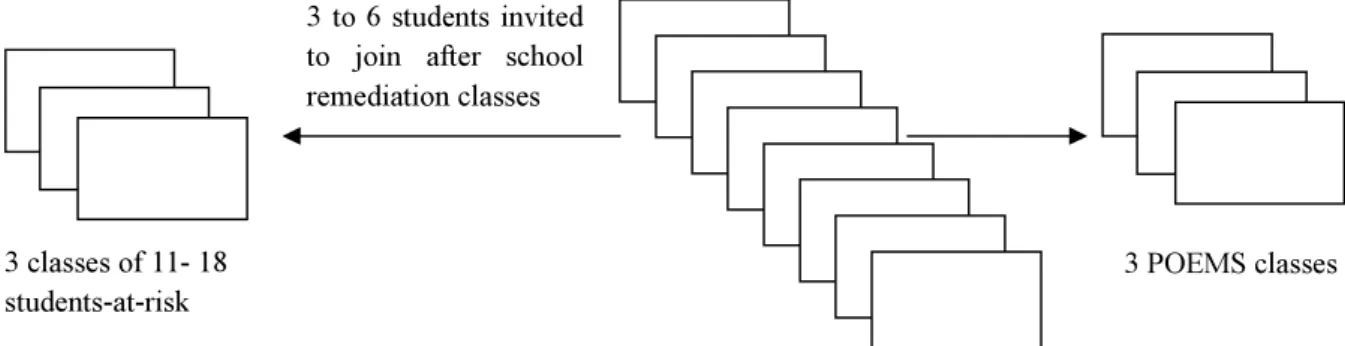
The new program followed a different framework from the old sectioning practice as recommended by the regular students. There are many gifted-education models in which a gifted class can be modelled upon (Friedman & Lee, 1996). The program that was developed next was based solely on student and teacher consultation. And a pull-out system was also developed. Figure 1 describes how 3 to 6 students are pulled out from each class (there are 8 or 9 regular classes) to form 3 special classes of 11- 18 students.
Figure 1. Pull-out Diagram of the POEMS
However, in order for the program to be justified as being showing equal concerns, a high ability program should also be accompanied by remediation classes for students who are at risk (see Figure 2). A new curriculum was also drafted for the POEM class.
Letters to parents were needed to be drafted to be sent to both groups. An orientation for the parents of the POEM class was scheduled to articulate the various components of the program. In March 2008, the second focused group discussion was made.
4. Research (2)
Participants for Focused Group Discussion 2008 Participants in the second focused group discussions held in March, 2008 were of two sets, 20 members of the First year POEM class and 22 members from the Second year class were invited to join the focused group discussion.
Focused Group Discussion Guidelines 2
The questions used in the focused group discussion are listed in Table 2. Follow-up questions were then used to clarify students answers. Both groups of students were asked questions on the following themes:
A. Creation of a single high ability class rather than a pull-out system.
B. Experiences in the POEM class with POEM
classmates, POEM teacher, and classmates in the regular class.
C. Recommendations on the POEM program.
Results of focused group discussions with POEM Students
The table below summarizes the responses of the students. The Results column is derived from the majority of the responses from the students. Key Responses show sample responses from the students to the questions asked.
The data above can only verify one what has been said through many years of gifted education research -that high ability and gifted students will always need time to spend with each other even just part of a school day (Gentry, 1998; Kulik, 1992; VanTassel- Baska, 1992). The POEM students have expressed that they have positive gains in their achievement by being in the program. It seems that meeting the cognitive needs of the gifted also means meeting the socio-emotional needs of the gifted as evidenced by the above focused group discussions where the POEM or Math-Science students usually focus on being together rather than their academic gains.
Furthermore, the researcher believes that the global self-esteem of these separated students are greater than most of the regular students based only on the results of the focused group discussions.
Figure 2. Pull-out diagram of LEAP and POEM
Table 2. Results of Focused Group Discussion
5. Concluding Remarks
According to Buchanan and Woerner (2002), the students of schools who have experienced successful gifted programs have been part of choices in their school. They had a voice in the curriculum and the students view themselves as empowered. They further report that the successful schools have mechanisms that enchance studentsʼ voice in the campus. By voice it becomes possible to consider studentsʼ concerns.
They have had choices in which programs to pursue.
Such is the importance of listening to the studentsʼ voice in the development of the program.
Students who have been part of gifted programs have reported that the programs have had an overwhelmingly positive impact on their lives (Hertzog, 2003). They feel having a better education . Moreover, a gifted program involves a lot of non-negotiables (VanTassel-Baska, 1998), such as the identification processes, a differentiated curriculum, and fast-paced or accelerated learning.
All of these should be considered in preparing a gifted program.
Finally, Miriam College High School, being an all- girls school, there is a big challenge in encouraging girls in Math and Science. Encouraging them, however, is an attainable goal if paired with the right strategies (Reis & Carol, 2005). While much is still to be desired in making gifted programs in the Philippines, much more is needed to be done.
References
Buchanan, N., & Woerner, B. (2002). Meeting the Needs of Gifted Learners Thorough Innovative High School Programs. Roeper Review, 24 (4), 213- 219.
Friedman, R. C., & Lee, S. W. (1996). Differentiating Instruction for High-Achieving/Gifted Children in Regular Classrooms: A Field Test of Three Gifted- Education Models. Journal for the Education of the Gifted, 19 (4), 405-436.
Gentry, M. a. (1998). Distinguishing Myths from Realities: a NRC/GT Research. National Research Center on the Gifted and Talented Newsletter, 9-12. Hertzog, N. B. (2003). Impact of Gifted Programs
From the Studentsʼ Perspectives. Gifted Child Quarterly, 47 (2), 131-142.
Kulik, J. (1992). An Analysis of the Research on Ability Grouping: Historical and Perspectives. CT: NRC/GT.
Lynch, S. J. (1992). Fast-paced High School Science for the Academically Talented: A Six-Year Perspective.
Gifted Child Quarterly , 36 (3), 147-154.
Olszewski-Kubilius, P. (2003). Special Summer and Saturday Programs for Gifted Students. In N.
Colangelo, & G. A. Davis (Eds.), Handbook of Gifted Education (3rd Edition) (pp. 219-226). Boston: Allyn and Bacon.
Reis, S. M., & Carol, G. (2005). Needed: Teachers to Encourage Girls in Math, Science and Technology.
Gifted Child Today , 28 (3), 14-21.
Rogers, K. (2001). Reforming Gifted Education:
Matching the Program to the Child. Quest, 12 (2), 5-8.
VanTassel-Baska, J. (1992). Educational Decision making on Acceleration and Grouping. Gifted Child Quarterly, 36 (2), 68-74.
Van Tassel-Baska (1998) . Curriculum for the gifted:
Theory research and practice. In J. Van Tassel- Baska, J. Feldhusen, K.Seeley, G. Wheatley, L.
Silverman and W. Foster (Eds.), Comprehensive curriculum for gifted learners, Boston, MA: Allyn and Bacon.