日本包装学会誌 V ol.8 No. 1 (1999)
アアL 1 =
1
S a f e t y o f C h i l d - r e s i s t a n t P a c k a g e ( 2 ) Masato HIDAKA*1) ,Hideo MIURA*2) and Masayasu SUGIHARA*3)
The CRPs (child-resistant packages) can ensure the safety for children since it is difficult for them to open the packages and gain access to the contents. Concerning the function of CRPs, the test for adults and senior citizens is also required by ISO 8317. It is the necessary condition for the packages to maintain accessibility to their contents by adults while providing a degree of resistance to opening and reclosing by children. But it is easily anticipated that adults keep the cap in opening condition due to the troublesomeness of opening and reclosing CRPs. Such situation is not desirable when the contents are hazardous substances, especially in the case of drugs. Leaving hazardous substances in an open condition might bring danger to children.
Under these conditions, adults should recognize the significance of CRPs. After investigating one CRP using the method regulated by ISO 8317, we confirmed that adults were able to open the package easily and the package had the function protecting children from unintentional ingestion.
Keywords : Child-resistant packaging, Press-and-turn type, ISO, Child test for CRP
1 . I n t r o d u c t i o n
In the previous report1)
,we investigated the safety of one CRP for children and infants.
The CRPs generally can ensure the safety for children since it is difficult for them to open the packages and gain access to the contents. Concerning the function of CRPs, the test for the adults and senior citizens is also required by ISO 8317. It is the necessary condition for the packages to maintain accessibility to their contents by adults while providing a degree of resistance to opening and reclosing by children. But it is easily anticipated that adults keep the cap in opening condition due to the troublesomeness of opening and closing CRPs.
Such situation is not desirable when the contents are hazardous substances, especially in the case of drugs. Leaving hazardous substances in an open condition might bring danger to children. Under these conditions, adults should recognize the significance of CRPs. We investigated the effectiveness of one CRP in adults using the method regulated by ISO 8317.
* 1 Japan Society of Pharmaceutical Packaging for Technical Consulting, Higashi 2-17-1, Kunitachi-shi , Tokyo 186-0002
*2 Production Department, Sankyo Co. , Ltd. 5-1, Nihonbashi-honcho 3-chome, Chuo-ku, Tokyo 103-8426
*3 Science University of Tokyo, Hunakawa-cho 12, Ichigaya, Shinjuku-ku, Tokyo 162-0826
Safety of Child-resistant Package (2)
2 . M a t e r i a l s a n d M e t h o d s
2 . 1 S t r u c t u r e a n d f u n c t i o n o f C R P
The structure of the CRP used in the present study was the same one reported in our p r e v i o u s s t u d y1 ).
2 . 2 A d u l t t e s t
Based on the ISO 83172), healthy male and female adults between 18 and 65 years of age were selected for the test. And it was investigated whether they were able to open and reclose the package3). One hundred and one adults between 18 and 60 years of age and 13 adults between 61 and 65 years of age were selected from 5 institutions (Table 1) and 3 institutions (Table 2), respectively. The test was carried out on the total of 114 adults.
Table. 1 The institution for adult test and number of subjects (age of 18 to 60 years old)
Name of Institution and Organization Number of Subjects
Higashi-nakano Tennis Club 63
Library in Tokyo Women's Medical College 14
Photo Studio in Tokyo Women's Medical College 4
Administration Room in Tokyo Women's Medical College 16
DI Room in Tokyo Women's Medical College 4
Total 101
(Female 71, Male 30)
Table. 2 The institution for adult test and number of subjects (age of61 to 65 years old)
Name of Institution and Organization Number of Subjects
Higashi- nakano Tennis Club 4
Yakuoii Civil Welfare Hall in Shiniuku-ward 4
Tomihisa-cho Civil Welfare Hall in Shiniuku-ward 5
Total 13
(Female 10, Male 3)
The distribution of age and sex for the 114 adults regulated by ISO 8317, is given in Fig. 1.
The detail of testing procedure in adults is shown as follows.
日本包装学会誌 Vol.8 No.1 (1999)
3
is H
i o H
s-{
m
^
1
1 J - 1 9 2 0 - 2 9 3 0 - 3 9 4 0 - 4 9 5 0 - 5 9 6 0 - 6 5
Age (years)
F ' B - 1 D i s t r i b u t i o n o f s e x a n d a g e i n a d u l t t e s t b y I S O 8 3 1 7
2.2.1 Age and number of adults required for the test
Not less than 90 between 18 and 60 years of age, and not less than 10 between 61 and 65 years of age were selected. (In total, not less than 100 healthy adults between 18 and 65 years of age.) Seventy % of the two groups were female.
2 . 2 . 2 T e s t i n g p r o c e d u r e
Not less than 90% of the participants were able to open and reclose the package properly when a period of 5 min for the test gave them with the written instructions.
But the demonstration how to open and reclose the package was not presented.
2 . 2 . 3 A s s e s s m e n t o f r e s u l t s
The full test was carried out to determine if the CRP fulfilled the required standards in ISO 8317. Sequential test was performed using the appropriate chart. When the trail of the filled squares passed below the limit line I, the package was estimated to have passed the test.
And when the trail of the filled squares passed above the limit line II, the package was estimated to have failed the test. If neither occurred, the result was assessed in accordance
Safety of Child-resistant Package (2)
with the criteria.
O t h e r n e c e s s a r y c o n d i t i o n s f o r a d u l t s w e r e a s f o l l o w s .
i) Were able to read and understand the instructions for opening and reclosing the CRP.
ii ) N o t en g ag ed in t h e d es ig n an d man u fa ctu re o f th e C R P i i i ) N o n u s e r o f t h e C R P
3 . R e s u l t s a n d D i s c u s s i o n
3 . 1 R e s u l t o f t h e f u l l t e s t
The result of the full test in 114 adults is shown in Fig. 2
%
io(H
J 8 a . 8 0 H 6 0 H
2 0 H
The adult-use effectiveness for the CRP greatly exceeded 90%, the values regulated by ISO 8317. Namely, all of 114 adults of age between 18 and 65 succeeded in opening and reclosing the package. This means that the CRP passed the adult test. When the test was carried out, the instructions which were also printed on the overcap were given to the participants.
While there was a description "under pressing down the tab,……" in the instructions, some participants were not able to understand the meaning of the tab and about 20% of them a s k e d i t .
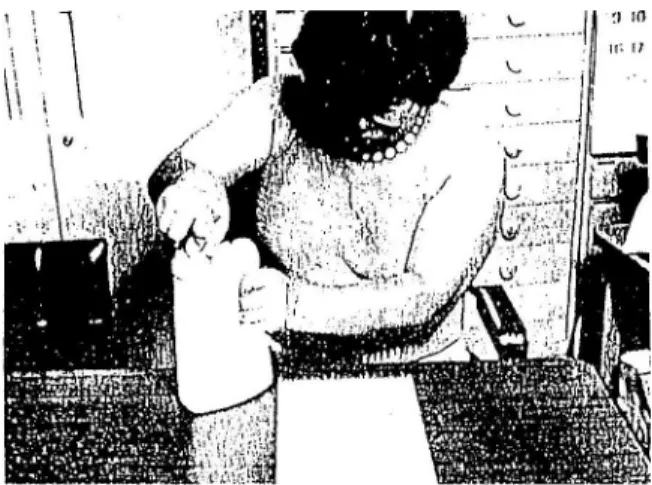
As shown in Fig. 3 some adults tried to open the package one-handed and spent some time for finding a solution. In this case, they opened it with both hands within 5 min. after reconsidering or rereading the instructions. In participants higher than 61 years old, some
日 本 包 装 学 会 誌
V o l . 8 N o . 1 ( 1 9 9 9 )misread the part "under pressing down the tab,……" in the instructions as "under pressing up the tab,……". In the attempt at finding a solution with rereading the instructions, they had a hard time to succeed in opening the package.
Fig. 3 Actual exampl e o f one-handed openin g oper at ion
In participants higher than 65 years old, some complained that they lacked in the power to press down the tab. This was supposedly caused by their lowered physical strength. In all participants of ages between 18 and 65, it took shorter time for those who understood how to use the tab quickly, to open and reclose the package. It suggested that there was little effect of age on the test. The result of the sequential test is shown in Fig. 4
1 0
0 1 1
0
Safety of Child-resistant Package (2)
Since the 32nd adult in the aggregate failed to open and reclose the package, the plot went up to the second step. But the trail of the plot finally remained in the area under limit line I because the subsequent adults succeeded in opening and reclosing the CRP.
Therefore the CRP for use in adults complied with the criteria of the adult test.
Based on the results assessed in accordance with the International Standards, the CRP met the requirements of ISO 8317. There was every reason to expect that the package had child- resistant function.
This study was a part of the investigation entrusted by the Ministry of International Trade and In d u s t r y .
R e f e r e n c e s
1) M. Hidaka, H. miura, M, Sugihara : Journal of Packaging Science and Technology, Japan, 8 (1), 23 (1999)
2) International Organization for Standardization (ISO) 8317 (1989)
3) Report on Basic Investigation of the Safety for Child-resistant Package in 1988 (Investigation Entrusted by the Ministry of International Trade and Industry)
(原稿受付1998年 8月26日) (審査受付1998年11月24日)
小児安全包装の安全性
(2)日高正人*・三浦秀雄**・杉原正泰***
幼児においてCRSは開封困難で、内容物が取り出しにくいことから安全性の確保が可能となる。
PRPの機能に関しては、ISO規格によって成人・老人についても試験が義務づけられている。幼
児の開・閉封とは逆に成人に対しては開封可能であることが必要条件となる。しかし成人 がCRPを使用する際の開・閉封の煩わしさから蓋を開封状態にすることが考えられる。このよ うな事態は内容物が安全性に欠く物資である場合特に医薬品においては好ましくない。また、開 封状態で放置されることによって、幼児に対する危険性が生じる。以上のことからCRPについ て成人をも認識する必要がある。今回はCRPの成人についてISO 規定に準じた検討を行い、そ れが幼児の誤飲防止機能があり、成人では開封可能であることを確認した。
キーワード キーワード キーワード
キーワード:小児安全包装、プレスアンドターン型、ISO、CRPの小児テスト
*医 薬 品 包 装 技 術 研 究 会
(〒
1 8 6 - 0 0 0 2国 立 市
2 - 1 7 - 1 )**
三共
(株
)生産部
(〒
103-8426東京都中央区日本橋本町
3-5-1)* * *
東 京 理 科 大 学( 〒
1 6 2 - 0 8 2 6東 京 都 新 宿 区 市 谷 船 河 町1 2 )
日本包装学会誌 Vol.8 No. 1 (1999)
>
P a c k a g i n g E n g i n e e r i n g E d u c a t i o n a t T h e U n iv e rs it y of M i s so u r i- R o ll a
Stephen A. RAPER
This paper discusses a university level, engineering based, packaging education program located in the United States. The program described is located in the Department of Engineering Management at The University of Missouri-Rolla. It is one of only two engineering based packaging programs in the United States. The packaging engineering program is described in terms of its academics and the philosophical approach followed in development of the curriculum. In addition challenges and future directions that the program faces are also discussed.
Key Words : engineering, packaging, higher education, engineering management, systems
1 . 0 I n t r o d u c t i o n
Packaging education in the United States is a relatively small discipline in higher education with only a small number of universities offering either full-scale degree programs, or packaging specialties that are part of more traditional academic departments. These packaging degrees, or programs, are typically offered as science based, technology based, or engineering based. Major and successful packaging science degree programs are offered at Michigan State University, Rochester Institute of Technology, and Clemson
University. Technology based degree programs include Indiana State University, The University of Wisconsin Stout , and San Jose State University. Rutgers University and The University of Missouri-Rolla offer more limited engineering based programs. Several other universities also offer one or two packaging courses in all three major categories. The "School of Packaging" at Michigan State University, established in the early 1950's, was the first packaging program in the United States, and has provided industry with the largest n u mb e r o f g r a d u a t e s t o d a t e .
Since the early 1950's, the need for trained packaging professionals has increased markedly. There are many reasons for this increase including but not limited to the proliferation of advanced materials, machinery and processes related to packaging; the establishment of packaging as a functional unit within organizations; the ever increasing concern for packagings' impact on the environment; and the proven ability of the package to market and protect products through the large and complex mass distribution system of the United States.
日 本 包 装 学 会 誌
V o l . 8 N o . l ( 1 9 9 9 )Packaging engineering education at The University of Missouri-Rolla (UMR) began in the late 1970's under the direction of Dr. Henry Sineath. Dr. Sineath came to the Department of Engineering Management at UMR after a distinguished career in the supply side of the packaging industry. His first teaching assignment was a course entitled " Production management." This course covered a multitude of topics and methods related to production and operations management. However, the particular textbook used in the course did not provide any coverage on the topic of packaging. Having just left a successful career in the supply side of the packaging industry, and knowing how important packaging was to a wide range of industries and end-use companies, Dr. Sineath set about introducing a course in packaging to students in the Engineering
Management Department. The purpose of this paper therefore is to describe the packaging engineering program at UMR from its inception to its current state today. The remaining sections discuss both the philosophies of the UMR approach to packaging education, and the curricular model it is based on. Future challenges will also be discussed.
2.0 The University of Missouri-Rolla
The University of Missouri-Rolla (UMR) was established in 1871 and was initially known as the School of Mines and Metallurgy. UMR is one of the four campuses in the University of Missouri system and is known as the states primary technological campus. The university offers degrees programs through the College of Arts and Sciences, The School of Engineering, and The School of Mines and Metallurgy. Degree programs are offered at the Bachelors, Masters, and Doctor of Philosophy levels. Approximately 5000 full-time students attend UMR. The breakdown of students is approximately 3800 undergraduate and 1200 graduate students. UMR has a longstanding reputation for providing high quality undergraduate engineering education, and became the first university to be awarded the prestigious Missouri Quality Award, based on the national Malcolm Baldridge Quality Award Criteria. Many other objective measures attest to the quality of education provided by UMR, and many objective metrics also provide a measure of the in-coming quality level of students who choose to attend UMR1 ).
3.0 Engineering Management at UMR
As mentioned in the Introduction section, the packaging engineering program at UMR is one of only two universities in the United States that offer either a degree or a program that is based on the engineering model of higher education rather than the science or technology model. The other engineering based program, Rutgers University, offers a Bachelors of Science in Engineering with a heavy packaging emphasis.
The University of Missouri-Rolla program is more accurately described as an "Option" area within the Department of Engineering Management. The Department of Engineering Management is one of five degree granting departments within the School of Engineering. Other departments include Mechanical & Aerospace Engineering, and Engineering Mechanics; Electrical and Computer Engineering; Civil Engineering; Chemica
日本包装学会誌 Vol.8 No.1 (1999)
E n g i n e e r i n g ; a n d B a s i c E n g i n e e r i n g .
The Engineering Management Department, founded in 1965, is charged with the preparation of men and women for " effective performance as leaders in today's complex business environment as engineers, managers and educators that are capable of designing, implementing, operating and optimizing sophisticated high technology enterprises in manufacturing, government or industrial service sectors of the global economy. "
The discipline of engineering management is defined as designing, operating and continuously improving purposeful systems of people, machines, money, time, information and energy by integrating engineering and management knowledge, techniques and skills, to educate leaders who can achieve desired goals in a technological enterprise through concern for the environment, quality and ethics. Degrees in the Department are offered at the Bachelors, Masters, and Doctor of Philosophy levels. The bachelors degree program was one of the first established in the nation, and is fully accredited by the Accreditation Board for Engineering and Education (ABET). This accreditation allows students to pursue professional engineering registration.
The packaging engineering program is one of five undergraduate ABET accredited internal option areas offered by the Department. The other option programs are Manufacturing Engineering, Industrial Engineering, Quality Engineering, and Management of Technology. Students may also seek a general external option among a wide range of engineering disciplines offered on the campus. Examples include but are not limited to Mechanical Engineering, Chemical Engineering, Environmental Engineering, and Civil Engineering.
The basic model of Engineering Management is shown in Figure 1. As seen in the figure, students receive
日 本 包 装 学 会 誌
V o l . 8 N o . l ( 1 9 9 9 )basically the same first two years of engineering, mathematics, and science coursework that all engineering students are required to take. In the third and fourth years, students pursue either an internal Option area, or a general option area. The choice of internal department options allows the student to take more upper level engineering management courses. Whereas the choice of the general option means a student will have one additional year in a typical engineering discipline. In either case, students will take a common core of engineering management courses, which includes organizational and general management, accounting and finance, marketing, engineering economy, and operations management. Students who choose an internal option take required courses specific to that option and a small number of elective courses General option students choose a minimum of four in-department courses to complete their program of study. Elective courses are structured as senior/graduate level, thus enabling masters and doctoral students to also pursue emphasis areas in their studies. In general, graduates of the Department are well prepared for positions in any of the internal option areas, as well as production planning and scheduling, plant or production engineering, operations management, sales engineering and technical marketing to name just a few.
4.0 Packaging Engineering at UMR
In introducing packaging engineering to UMR, Dr. Sineath initially sought to develop only one course that provided an overview of packaging production management. However, due to the generous financial support of the Packaging Education Foundation (now known as the Packaging Education Forum) , four courses where initially developed. In general the courses included an introductory course, two materials courses, and an integrated case studies course. These courses were developed in close cooperation with a very active
packaging industry advisory board. The advisory board members came from both the supply and demand side of the packaging industry. Many of their companies also provided financial and scholarship support in addition to overall guidance of the program. The board continues to provide advice and guidance to the packaging engineering program, meeting once each semester. During the latter portion of the 1980's, and early 1990's, two additional courses, packaging machinery, and environmental packaging were added. The packaging machinery course was added after receiving financial support from the Packaging Machinery Manufacturers Institute. The environmental course was added based on the current state of affairs with regard to packaging and the environment in the United States, and with significant input from the packaging i n d u s t r y a d v i s o r y b o a r d .
Prior to 1988, no internal options existed in the Department of Engineering Management. If students wished to study packaging, they could take packaging courses as part of their required four course (12 semester hours) electives needed for a general preference area such as Mechanical Engineering. After 1988, an internal preference area called Manufacturing/Packaging engineering enabled students to take more courses in either packaging or manufacturing. Packaging Engineering is currently an independent, ABET accredited option,
日 本 包 装 学 会 誌
V o l . 8 N o . l ( 1 9 9 9 )within the Department of Engineering Management. Students of the program graduate with a Bachelors of Science in Engineering Management, however their transcript reflects the Option of Packaging Engineering.
The current packaging curriculum is shown in Table 1. As can be seen in the table, the packaging engineering program is heavily grounded in engineering, mathematics, and science. Nearly 43% of the entire 134 credit-
日 本 包 装 学 会 誌
V o l . 8 N o . l ( 1 9 9 9 )hour curriculum is devoted to those subjects. Approximately 19% of the curriculum are in the humanities and social sciences. The remaining 38% are taken within the Engineering Management Department with 22%
specific to packaging engineering and 16% allotted to required Engineering Management courses. The total curriculum provides a student with a very strong dose of engineering, science and mathematics, provides a strong foundation related to the business enterprise or system, and presents packaging and related topics in a systems oriented manner. As compared to other universities who offer packaging curriculum, the packaging engineering program has less packaging specific courses. This is due partly by design, and partly due to the requirements of ABET. ABET requires specific allotments of credit which address engineering science and engineering design content within the total curriculum. Any courses taken within the entire curriculum are categorized on the basis of science, design, or "other" content.
The approach (by design) to packaging engineering at UMR is based on two key issues. First, packaging is viewed as a total packaging sub-system where the sub-system includes the package itself, packaging converting machinery, end-use packaging machinery, packaging distribution systems, packaging marketing systems, packaging environmental systems, and packaging organizational systems. In other words, the UMR approach to packaging considers more than just the container itself. The second issue is how the packaging sub-systems approach fits into the broader and more complex " productive systems view ". This system depicts how a high quality product is ultimately delivered into the ultimate end-use consumer beginning with the development of the product and processes, and ending with the final disposition of the product and package.
The total productive system approach also provides a lifecycle view for not only the product that is manufactured, but also the package that is manufactured. The systems view shows the relationship between various sub-systems and the ordered linkages that exist in the total system. This approach helps to allow for the manufacture and delivery of high quality, low cost products to a wide variety of cost-conscious,
environmentally aware consumers2). Table 2 lists various sub-systems that are usually studied and addressed in the total productive systems approach.
T a b l e 2 F u n c t i o n a l S u b - S y s t e m s o f T h e T o t a l P r o d u c t i v e S y s t e m Process Research and Development
Manufacturing Packaging
Transportation/Logistics Warehousing and Distribution
Wholesale and Retail Customer/Consumer
Marketing Environmental/Solid Waste
Legal and Regulatory Enterprise/Organization
日 本 包 装 学 会 誌
V o l . 8 N o . 1 ( 1 9 9 9 )The curricular approach towards packaging engineering at UMR addresses each subsystem with specific packaging courses, or other courses in the department. For instance, it is widely known that packaging plays a strong role in the marketing of a product. However, a specific packaging-marketing course is not required because marketing is already a required element of the Engineering Management degree. The same can be said for materials handling, logistics, and other courses. The heavy emphasis on engineering, science, and mathematics courses provide students with a strong set of problem solving, analysis, and synthesis tools that can subsequently be applied in the packaging design and development process. The Engineering Management core courses provide the student with a broad knowledge of the total business enterprise. Focussed packaging courses provide an overview of all elements of the packaging system, and other courses in the option address many issues relevant to manufacturing, operations, and logistics.
As stated previously, there are 6 packaging specific courses in the program. The introductory course, Packaging Management, provides an "A - Z" perspective based on the packaging subsystems view.
Packaging Materials I and II provide coverage of all major packaging materials, and their converting processes. Laboratory activities and experiments are also a part of these two courses. Packaging Machinery provides coverage of package converting, and package end-use machinery. In addition, other topics such as specifying packaging machinery and systems, and economic justification of packaging machinery systems are also a part of the course. This course also has a laboratory component. The Environmental and Solid Waste Management course provides in-depth coverage of how packaging relates to the environment specifically and solid waste in general. The capstone course for the program is the Packaging Systems Design course. This course makes use of packaging case studies to integrate material learned in previous classes. Guest speakers and field trips are also an integral part of the program. Students may pick up additional packaging knowledge and experience through employment as interns or "coops " at various companies associated with packaging.
These work experiences are not counted as program credit due to ABET requirements, but they are strongly encouraged.
Graduate students at the Master's and Doctoral level may also specialize in packaging. This is possible because all packaging and related courses are structured as senior/graduate level courses. Graduate students may also acquire more depth specific to packaging by conducting thesis or dissertation research
This unique program prepares graduates to be immediately productive employees in the supply side of the packaging industry, or in companies who use packaging materials and machinery in the own total productive systems. The students strong engineering backgrounds also enable graduates to work in construction and consulting engineering firms who specialize in total packaging systems. Past students who have taken one or more packaging courses are employed in a wide range of companies and industries associated with the
日 本 包 装 学 会 誌
V o l . 8 N o . 1 ( 1 9 9 9 )demand side of packaging, or organizations that use packaging materials and machinery.
5.0 Challenges and Future Direction
The purpose of this paper was to present one approach toward higher packaging education. As stated earlier, this type of education can be delivered in a science base, a technology base, or an engineering base. Among the three types, engineering based is the least prevalent with only two schools following this approach. It is to be stated clearly that all approaches are equally valid in providing qualified graduates to industry. While science and technology based packaging programs may provide more packaging specific courses the engineering based approach with its heavy emphasis on problem solving skills provides an equally sound approach. While the UMR program has been moderately successful thus far in its history, several challenges remain to ensure the program continues to meet the ever-increasing demands of industry.
The first issue regards the total curriculum to be offered in the program. Given the unique degree that packaging engineering is situated in, and wide range of courses available both in and outside of the
department, it is imperative to continually review the total curriculum to ensure the most appropriate courses are a part of the program. In addition, given the small number of packaging specific courses available, it is also necessary to revise the courses so that they represent "state-of-the-art" as compared to the industry so that students will be adequately prepared to made immediate and positive impacts.
In the past, the packaging industry advisory board has sought to develop the packaging program into an independent packaging degree. However, due to campus and state political issues, financial concerns, and other reasons, this option is not likely in the near future. However, a more reasonable option may be to combine the manufacturing and packaging options and seek to develop a degree in Manufacturing and Packaging systems Engineering. This has appeal due to the strong synergies that exist between manufacturing and packaging in many industry categories3'. Campus and state political hurdles that impede this vision are not trivial.
Closely related to curriculum is the need to develop a more comprehensive packaging laboratory that can serve the needs of the students, the department, and industry. The need to upgrade and enlarge the
packaging laboratories has long been a pressing issue for the program. Financial considerations have been the biggest impediment to laboratory development. The packaging industry advisory board and those associated with the program on campus are seeking to address this issue through fund raising efforts. The current laboratory focus is heavily manufacturing oriented focussing on computer integration, robotics, and automation, which is also a unique attribute of this program.
日 本 包 装 学 会 誌
V o l . 8 N o . l ( 1 9 9 9 )The final and most important issue for the future of the packaging engineering program is to attract students into the program, and maintain a critical mass to supply to industry. This is a complex problem with no easy answers. First, the student base to draw from on the campus of UMR is small, and this is further amplified because the total number of Engineering Management students is not large. Second, because of the unique and general nature of the degree, even students who specialize in packaging may choose to work in other fields. As stated before, graduates with one or more packaging courses have been successful in industry, and there is no reason to believe this will change. The challenge will be to achieve and maintain sufficient critical mass to meet industry needs. In order to do this, our program would like to graduate from 15 - 25
undergraduate students per year who specialize in packaging engineering. The target for graduate programs is 5 - 1 0 .
6 . 0 C o n c l u s i o n s
In this paper, the packaging engineering program at the University of Missouri-Rolla is broadly described.
The evolution of the program is presented, the curricular structure is shown, and the philosophical approach is described. The future direction of the program and the challenges faced are also discussed. In addition, general information on the University, School, and Department the program is located in is given.
This packaging program, along with the packaging program at Rutgers University, is unique in that it is engineering based both curricularly and administratively. This uniqueness allows for novel approaches to packaging education. This novel approach is based on a total productive systems view that also follows a life- cycle model for both products and packages. It is believed this approach will be successful in the future provided the challenges presented in this paper are addressed adequately.
R e f e r e n c e s
1. The University of Missouri-Rolla Web Page, http://www.umr.edu.
2. Raper, S.A., Fukuda, S. , "Understanding The Packaging System, and The Potential Opportunities For The Application of Collaborative Product Development Methods," CE 98 - Advances In Concurrent Engineering, Annual Conference Proceedings, Edited by Fukuda and Chawdhry, pgs. 471 - 476.
3. Raper, S.A., Sun, M.R., "Understanding the Role of Packaging in Manufacturing and Manufacturing Systems," Handbook of Design, Manufacturing and Automation, Edited by Richard C. Dorf, and Andrew Kusiak, John Wiley & Sons, Inc., pgs. 331 - 342.
(「Received 7 August. 1998」)