Particle Swarm Optimization Containing Cooperative Particles
Masaki SUGIMOTO Haruna MATSUSHITA Yoshifumi NISHIO (Tokushima University) (Hosei University) (Tokushima University)
1. Introduction
Particle Swarm Optimization (PSO) [1] is a popular optimization technique for the solution of object func- tion and is an algorithm to simulate the movement of flock of birds and the movement of a school of fish toward foods.
In this study, we propose PSO containing coopera- tive particles (PSOC). The important feature of PSOC is that each particle of PSOC shares the same veloc- ity information. We investigate the behavior of PSOC and confirm its efficiency.
2. PSOC
[PSOC1] (Initialization) Let a generation step t = 0. Randomly initialize the particle i = (1,2, ..., M) position Xi= (xi1, xi2, ..., xiD) and its velocityVi = (vi1, vi2, ..., viD) for all particles i and initialize Pi = (pi1, pi2, ..., piD) with a copy ofXi.
[PSOC2] Evaluate the current cost f(Xi). Update the personal best positionpbestPi= (pi1, pi2, ..., piD) for each particle i and the global best position gbest Pg= (pg1, pg2, ..., pgD) among the all particles.
[PSOC3]Update Vi of each particleidepending on itspbestand its swarm bestgbest;
vid(t+ 1) =wvid +c1r1{pid−xid(t)}
+c2r2{pgd−xid(t)}, (1) where r1 andr2 are two random variables distributed uniformly on [0,1], w is an inertia weight of all par- ticles, and c1 and c2 are positive acceleration coeffi- cients.
[PSOC4] All the particles shared Vc = (vc1, vc2, ..., vcD). LetVc represent the average veloc- ity of all the particles;
vcd = 1 M
∑M
i=1
vid (2)
[PSOC5]UpdateXi depending on itsVc andVi; xid(t+ 1) =xid(t) +cvcd(t+ 1) +vid(t+ 1), (3) wherec is an cooperation coefficients. In other words, the particles combine the action of individual and co- operation.
[PSOC6] Let t = t+ 1. Go back to [PSOC2], and repeat until t=T.
3. Numerical Experiments
In order to evaluate the efficiency of PSOC and in- vestigate the behavior of PSOC, we compare the two
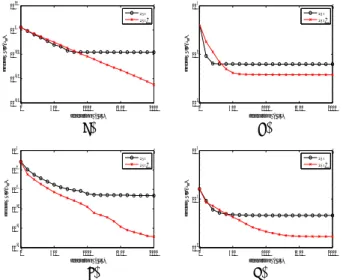
algorithms that PSO and PSOC. PSO is the standard PSO and PSOC is the proposed algorithm. The iner- tia weight w is 0.5. We carry out the simulation 30 times for two optimization functions with 2000 gener- ations. Figures 1(a), (b), (c) and (d) show the mean gbestvalues of every generation over 30 runs for Sphere function and Rastrigin function with 30-dimension and 100-dimension. The optimum function valuesf(x∗) of the two functions are 0. From these results, we can confirm that the mean values of PSOC are the best among four problems. Therefore, we can confirm that PSOC algorithm is the most effective.
0 500 1000 1500 2000
10-60 10-40 10-20 100 1020
Generation ( t ) Gbest f (Pg)
PSO PSOC
0 500 1000 1500 2000
101 102 103
Generation ( t ) Gbest f (Pg)
PSO PSOC
(a) (b)
0 500 1000 1500 2000
10-6 10-4 10-2 100 102 104
Generation ( t ) Gbest f (Pg)
PSO PSOC
0 500 1000 1500 2000
102 103 104
Generation ( t ) Gbest f (Pg)
PSO PSOC
(c) (d)
Figure 1: Mean gbest value of every generation for four problems. (a) Sphere function (30-dimension,).
(b) Rastrigin function (30-dimension). (c) Sphere function (100-dimension). (d) Rastrigin function (100- dimension).
4. Conclusions
In this study, we have proposed PSOC. We have investigated its behavior with the simulation and have confirmed the efficiency.
References
[1] J. Kennedy and R. Eberhart, “Particle swarm opti- mization”,Proc. IEEE Int. Conf. Neural Netw., vol. 4, pp. 1942–1948, 1995.
[2] M. Sugimoto, T. Haraguchi, H. Matsushita and Y. Nishio, “Particle swarm optimization containing plural swarms”, Proc. RISP Int. Workshop on Nonlin- ear Circuits and Signal Processing, pp. 419–422, 2009.
平成22年度電気関係学会四国支部連合大会