
• 検索結果がありません。

110 Misconceptions about the ocean b y R o b E R t J . F E l l E R

N/A
N/A
Protected

Academic year: 2021

シェア "110 Misconceptions about the ocean b y R o b E R t J . F E l l E R"

Copied!
4
0
0

読み込み中.... (全文を見る)

全文

(1)

Oceanography Vol. 20, No. 4 170

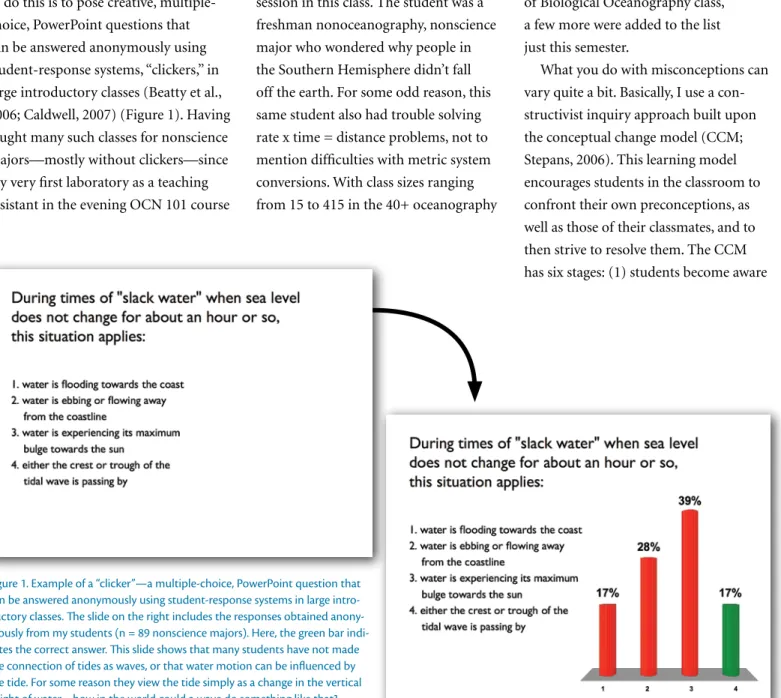
Misconceptions impede student learn- ing, especially in science. As teachers of earth science, we would be wise to identify misconceptions whenever pos- sible before launching new topics in our oceanography courses. A good way to do this is to pose creative, multiple- choice, PowerPoint questions that can be answered anonymously using student-response systems, “clickers,” in large introductory classes (Beatty et al., 2006; Caldwell, 2007) (Figure 1). Having taught many such classes for nonscience majors—mostly without clickers—since my very first laboratory as a teaching assistant in the evening OCN 101 course

E d u c at i o N

110 Misconceptions about the ocean

b y R o b E R t J . F E l l E R

at the University of Washington in sum- mer 1970 (taught by Eddy Carmack, by the way), I have come across stu- dent misconceptions too numerous to count. The very first one came during a one-on-one laboratory write-up help session in this class. The student was a freshman nonoceanography, nonscience major who wondered why people in the Southern Hemisphere didn’t fall off the earth. For some odd reason, this same student also had trouble solving rate x time = distance problems, not to mention difficulties with metric system conversions. With class sizes ranging from 15 to 415 in the 40+ oceanography

classes I’ve taught since 1970, one would think that few misconceptions would go unheard or unread on tests, but this is simply not the case. I still confront new ones all the time. Thanks to the current crop of students in my Fundamentals of Biological Oceanography class, a few more were added to the list just this semester.

What you do with misconceptions can vary quite a bit. Basically, I use a con- structivist inquiry approach built upon the conceptual change model (CCM;

Stepans, 2006). This learning model encourages students in the classroom to confront their own preconceptions, as well as those of their classmates, and to then strive to resolve them. The CCM has six stages: (1) students become aware

Figure 1. Example of a “clicker”—a multiple-choice, PowerPoint question that can be answered anonymously using student-response systems in large intro- ductory classes. The slide on the right includes the responses obtained anony- mously from my students (n = 89 nonscience majors). Here, the green bar indi- cates the correct answer. This slide shows that many students have not made the connection of tides as waves, or that water motion can be influenced by the tide. For some reason they view the tide simply as a change in the vertical height of water—how in the world could a wave do something like that?

This article has been published in Oceanography, Volume 20, Number 4, a quarterly journal of The oceanography Society. copyright 2007 by The oceanography Society. all rights reserved. Permission is granted to copy this article for use in teaching and research. Republication, systemmatic reproduction, or collective redistirbution of any portion of this article by photocopy machine, reposting, or other means is permitted only with the approval of The oceanography Society. Send all correspondence to: [email protected] or Th e oceanography Society, Po box 1931, Rockville, Md 20849-1931, uSa.
(2)

Oceanography december 2007 171

of their preconceptions about a concept by thinking about it and making predic- tions (commit to an outcome); (2) they expose their beliefs by sharing them, ini- tially in small groups and then with the entire class; (3) they confront their beliefs in small group discussions; (4) students then resolve conflicts between their ideas (based on classroom discussions) and their observations (based on new or additional information provided), thereby accommodating the new con- cept; (5) students extend the concept by trying to make connections between what they just learned in the classroom and their daily lives; lastly, (6) students are encouraged to go beyond their level of understanding and pursue additional questions related to the concept. In brief, you lead students to a quandry that con- flicts with their current level of under- standing (the misconception or incorrect perception), so they must now confront their level of understanding with evi- dence or data to the contrary that should, hopefully, lead them to a new under- standing of whatever is the “truth.”

I also sometimes simply discuss a PowerPoint slide directly with the class after seeing how many have selected an answer that would indicate a misconcep- tion exists. I try to figure out why some- one would think that way, and I do this out loud, sort of reasoning to myself.

Surprisingly, having heard my line of rea- soning to justify reaching the incorrect answer, students will frequently blurt out

“That’s what I was thinking” or “Yeah, my science teacher told us that” or “Isn’t that what the book says?” or “That’s the way my friend explained it to me” or some such remark. They love confirmation of their way of thinking, right or wrong—

that’s just human nature. It is never a good idea for the teacher to simply state that they are wrong and tell them here’s the way it is—this doesn’t get to the root of their misconception. They have to reach a state of confusion before they can rectify their thinking based on the new evidence or information. Once you have sort of gotten them hooked into your line of reasoning, then you can back up and explain where the flaws exist by showing the new (to them, anyway) information again and explaining why you reject that particular line of reasoning.

I provide some common misconcep- tions on the next two pages (with apolo- gies for an obvious southeastern seafood bias engendered by wonderful field trips with students to barrier islands off the South Carolina coast). They are catego- rized rather loosely, and the number assigned to each has no significance as to how frequently I’ve heard it or how deeply embedded it is. Many of these you will have encountered before, some may be new, but none had as great an impact on me as #40, dutifully pro- nounced about 20 years ago by one of my children’s elementary-level science teachers. Because of its obvious potential for causing harm, this single uninformed misstatement of fact about seawater and electricity was the initial impetus for my more recent formal forays into the complex, challenging world of science education—I simply had to get more deeply involved.

As for the origins of these misconcep-

tions, most have been uttered in some way by undergraduates but, unfortu- nately, many come from an alarmist media or science teachers (and par- ents!) whose only, if any, undergraduate courses in science were of the “rocks for jocks” and self-paced astronomy ilk. If you want to learn more about science misconceptions in general, a great place to start is Driver et al. (1994). You will be amazed by their findings. The recent article by Bloom and Weisberg (2007) on resistance to understanding science is also quite instructive to anyone who teaches science in any field. It is now time to HEM and HAW—Help Eradicate Misconceptions and join the Hunt for Additional Wisdom. I must now turn my attention to misconceptions in biol- ogy and ecology. Did you know that the nonliquid biomass a tree accumu- lates as it grows from a seed comes from the soil? Those who teach carbon cycles and global warming better attack this one right away. I guess CO

2

is just blowing in the wind…

REFERENcES

Beatty, I.D., W.J. Gerace, W.J. Leonard, and R.J.

Dufresne. 2006. Designing effective questions for classroom response system teaching. American Journal of Physics 74(1):31–39.

Bloom, P., and D.S. Weisberg. 2007. Childhood origins of adult resistance to science. Science 316:996–997.

Caldwell, J.E. 2007. Clickers in the large classroom:

Current research and best-practice tips. CBE Life Science Education 6(1):9–20.

Driver, R., A. Squires, P. Rushworth, and V. Wood- Robinson. 1994. Making Sense of Secondary Science:

Research into Children’s Ideas. Routledge, KY, 210 pp.

Stepans, J. 2006. Targeting Students’ Science

Misconceptions. Physical Science Concepts Using the Conceptual Change Model, 3

rd

ed. Showboard, Inc., Clearwater, FL, 286 pp.

This is Contribution No. 1464 from the Belle W. Baruch Institute for Marine &

Coastal Sciences.

RobERt J. FEllER ([email protected])

is Professor, Marine Science Program

and Department of Biological Sciences,

and Director, Center for Science

Education, University of South Carolina,

Columbia, SC, USA.

(3)

Oceanography Vol. 20, No. 4 172

WaVES/tidES/cuRRENtS

1. Waves are highest near shore, don’t break much in the open ocean.

2. The open ocean is static, still, and quiet compared to the coast’s big waves.

3. Tsunamis occur after every underwater earthquake.

4. Tides are caused by Earth’s rotation.

5. Tidal currents are fast and therefore deadly.

6. Ignoring tides, sea level is the same everywhere.

7. Spring tides are a seasonal phenomenon.

8. Ocean currents are caused by the tides.

9. The deep sea is stagnant, never changes.

10. Coriolis is an actual force (as in F = m a).

11. The Gulf Stream is a river in the sea.

12. Currents in the Northern and Southern hemispheres run in the same direction.

13. A north current flows from the north, just like a north wind.

14. You can swim against a rip current or rip tide and make it back to shore.

GEoGR aPHic/batHyMEtRic/Global 15. The ocean is basically a bowl, deepest in the middle.

16. The ocean is blue from sky reflection.

17. UV light does not penetrate water.

18. Syzygy is why some people think the world is coming to an end.

19. Global warming means the ocean is getting hotter and hotter.

20. Global warming makes more, and more intense, hurricanes.

21. Sea level is rising rapidly due to melting glaciers—

big floods are coming!

22. Melting sea ice causes sea level to rise.

23. The three big oceans are not connected; each acts alone.

24. Seasons are caused by changes in Earth’s distance from the sun.

25. There are no real seasons in the ocean.

26. We have the technology to dive to any desired depth in the ocean.

27. Nuclear submarines routinely dive to the bottom of the ocean.

28. The clearest ocean water is in the Caribbean.

29. The Bermuda Triangle is a really unsafe, dangerous place.

30. There are no more pirates on the high seas—that’s just in the movies.

31. Undertow = “under-toe,” the swash/backwash erosion underfoot on the beach.

32. Where does seawater go when sea level drops? It changes phase from liquid to gas.

33. The edge of the continental shelf is a steep cliff.

34. The Panama Canal runs east-west.

WEatHER/cliMatE

35. It doesn’t rain as much over the ocean as it does on land.

36. All Atlantic hurricanes come off the African coast.

37. Winds and sunlight control the climate much more than do ocean currents or sea-surface temperature.

38. Coastal areas are safe places to live except in Florida and the Gulf of Mexico (thank you, Andrew and Katrina, respectively).

39. A water spout is not the same thing as a tornado.

cHEMical

40. Salt water does not conduct electricity.

41. Oceans have the same salinity everywhere.

42. They’re salty because of deep-sea vents.

43. They’re salty because of river runoff for eons.

44. All icebergs are made of salt water.

45. When sea creatures make calcium carbonate shells, this sequesters C in the ocean.

46. You can drink seawater, just not too much, especially if you’re dehydrated.

47. Table salt + water = seawater.

48. Salty oceans are not linked to land’s freshwater cycle.

bioloGical/oRGaNiSMal 49. Algae (phytoplankton) are plants.

50. Zooplankton are like insects of the sea.

51. Food chains are the linear portions of food webs.

52. The photic zone is the same depth everywhere.

110 Misconceptions about the ocean

Oceanography Vol. 20, No. 4

172

(4)

Oceanography december 2007 173

53. High latitudes, being cold, must be unproductive.

54. Deep-sea creatures are large, fearsome, bizarre.

55. Zooplankton are “bugs” (way too many geologists say this!).

56. All fishes have swim bladders.

57. Coral reefs occur everywhere.

58. The largest animals live deepest or near the bottom.

59. Soft sediments (e.g., mud flats) are dead zones.

60. Ctenophores are jellyfish.

61. Echinoderms are shellfish.

62. Phytoplankton die only from grazing.

63. As in my garden fertilizer, more nutrients = more phytoplankton.

64. Nothing much lives in the middle depths of the ocean.

65. There are no reptiles (snakes) on beaches, just flies and mosquitoes.

66. Sea birds probably taste funny, hence are inedible.

67. “Sea monkeys” are really some sort of marine monkeys.

68. A sponge is a sponge is a sponge; same for nematodes.

69. Salt marshes are just smelly swamps.

70. Detritus is just waste, not useful for anything.

71. Nothing lives in anoxic mud.

72. Marsh grass is pretty to look at but otherwise useless.

73. The fastest swimming fish is a barracuda.

74. Jacques Cousteau saved the ocean from certain death.

75. Sharks never sleep, have to swim all the time to stay alive.

76. Phytoplankton are too small to be important—trees win.

77. Sharks are out to eat humans, thus shark attacks are premeditated.

78. Sharks are the most dangerous animals in the ocean.

MaRiNE MaMMalS

79. Whales spout water through their blow holes.

80. Killer whales are not whales.

81. Seals are the same as sea lions.

82. All whales are endangered species.

83. Only indigenous people harvest whales now.

84. Flipper is a porpoise.

85. Dolphins exist to help people.

86. A whale shark is a whale, not a fish.

87. Marine mammals are intelligent, like humans.

SEaFood

88. Bottom feeders are not good to eat, will taste bad.

89. All king crabs come from Alaska, all lobsters come from Maine.

90. Fishermen don’t catch enough bycatch to have to change their fishing methods.

91. Saltwater fish taste better than freshwater fish.

92. The “vein” in a shrimp is for blood circulation, must be removed.

93. All cans of tuna fish are “dolphin-safe” now.

94. A scallop has no shell—at least I’ve never seen one on my plate.

95. Big clams are better to eat than little clams.

96. Blue crabs can’t hurt you if you pick them up.

97. Fish are abundant; it’s impossible to overfish any species.

PollutioN

98. All areas of the ocean are monitored regularly—we’re on top of it.

99. Humans have no permanent effect on the ocean—it will recover.

100. The ocean is like a sponge, so just dump stuff in and it will absorb it.

101. Newer ocean-going oil tankers can’t sink.

102. Most oil in the ocean comes from tanker spills.

103. Fish kills only happen in the Gulf of Mexico around Florida.

104. Sailors can outdrink and outcurse anyone.

105. The ocean is huge, vast, endless in its dilution capacity for pollution.

106. Turbid coastal waters are polluted because you can’t see through them.

107. Water will be clean if you just remove particulates like my water filter does.

108. Human activities inland can’t possibly harm or impact the oceans.

109. If tourists just look, they can’t harm coral reefs very much.

110. Bacteria die as soon as they reach salt water.

Oceanography december 2007 173

Figure 1. Example of a “clicker”—a multiple-choice, PowerPoint question that  can be answered anonymously using student-response systems in large  intro-ductory classes

参照

関連したドキュメント

[r]

のようにすべきだと考えていますか。 やっと開通します。長野、太田地区方面  

[r]

It is not a bad idea but it means that since a differential field automorphism of L|[x 0 ] is given by a birational transformation c 7→ ϕ(c) of the space of initial conditions, we

The limiting phase trajectory LPT has been introduced 3 as a trajectory corresponding to oscillations with the most intensive energy exchange between weakly coupled oscillators or

OFFI CI AL SCORE CERTI FI CATE GTEC (4技能) (CBT可). Test Repor t For m I ELTS™(Academi c

Hugh Woodin pointed out to us that the Embedding Theorem can be derived from Theorem 3.4 of [FM], which in turn follows from the Embedding Theorem for higher models of determinacy

※ MSCI/S&P GICSとは、スタン ダード&プアーズとMSCI Inc.が共 同で作成した世界産業分類基準 (Global Industry Classification