Ryoji Baba
On the annotations in ARTE GRANDE
Francis Xavier came to Japan in 1549, and the Catholic mis-sion began at that time. The Jesuits came to Japan and studied the Japanese language. João Rodriguez came to Japan in 1577 and published ARTE GRANDE in1608. ARTE GRANDE is a Japanese grammar book written in Portuguese and we have two copies of it: one in the Bodleian Library and the other in a per-sonal collection. While their contents are the same, the copy in the Bodleian has no annotations written by hand but the copy in the private collection does have them.
I analyzed the annotations making full use of the knowledge of Japanese, Portuguese, and Latin and of the experience of Jap-anese language education, and classified them into eight groups: kanzi, striking out, additions, indication of reference, pronuncia-tion, numbering words, writing on words and illegible words.
Key words: Arte Grande, Arte da Lingoa de Iapam, João Rodriguez, anno-tations
1. Introduction
Francis Xavier came to Japan in 1549, and the Catholic mission began at that time. The Jesuits came to Japan and studied the Japanese language. João Rodriguez came to Japan in 1577 and published ARTE
GRANDE in1608. ARTE GRANDE is a Japanese grammar book written in
Portuguese and we have two copies of it: one in the Bodleian Library and the other in a personal collection. While their contents are the same, the copy in the Bodleian has no annotations written by hand but the copy of the private collection does have them.
Doi (1982, pp. 87-89) and Ogahara (2015, pp. 174-178) re-searched the annotations on the copy. Doi listed 30 annotations and classified them into five groups and mentioned two illegible annotations. Ogahara found nine more annotations and classified them into nine groups with some explanations. I found five more annotations and ten “+” in the annotations. I listed them and classified them into eight groups and ana-lyzed why they wrote the notes.
The people who annotated the copy were learners or teachers. I call them “the users”.
Language teachers analogize the system and the structure of the language that the learners have acquired. João Rodriguez wrote the system and the structure of Japanese in the book. To research his book is like see-ing inside his brain. That is interestsee-ing for Japanese language teachers like me.
The language that they learned in the 15th century was Latin, and they did not learn their mother tongue. Rodriguez described Japanese, applying it to Latin grammar and contrasting it with Portuguese. The users complemented and corrected his descriptions.
I analyzed the users’ annotations making full use of the knowl-edge of Japanese, Portuguese, and Latin and of the experience of Japanese language education, and classified them into eight groups: 1. kanzi, 2. striking out, 3. additions, 4. indication of reference, 5. pronunciation, 6. numbering words, 7. writing on words and 8. illegible words.
The scanned images of Arte Grande are from the copy of the private collection. The white scanned images of “7. Writing on words” are from the copy in the Bodleian Library.
1. Kanzi
Rodriguez wrote about kanzi, but the book was printed only with alphabet and there is no kanzi in it. A user or users complemented some
annotations with kanzi in leaves1 55, 130v2, 151, 159 and 180v. 1-1 In leaf 55
Rodriguez introduces kanzi in the chapter “On orthography” and says that kanzi has three writing styles: xin, gui , s . Xin is regular script, gui is semi-cursive script and s is cursive script. Rodriguez places these three names in order as xin, s , gui in his book and explains the first style is fundamental and called xin, the second is semi-cursive called gui and the third is cursive called s . He should have placed the names as xin, gui and s .
There are no samples of kanzi in the book. So a user ano-tated “caelú ( 天 ) xin. caelú s . caelú ghi ”. “Caelú” means “sky” in Latin. is of regular script, is of semi-cur-sive script and is of cursive script. So the user should have an-notated “caelú xin. caelú ghi . caelú s ”. The user was confused, because Rodriguez’s description was confused. Rodriguez spelt ghi but the user spelt ghi , perhaps because the user wanted to clarify that the pronunciation of the name is [ɡjɔ] and not [ɡujɔ] nor [ɡwjɔ]3.
1 Each leaf has its number on the upper right corner in Arte Grande. 2 “ V ” means the reverse side of a leaf.
3 See from 5-1 to 5-5.
Fig. 1 Scanned image of leaf 55.
1-2 In leaf 130v
Rodriguez gives a list of copulative conjunctions in the chapter “On conjunctions, the seventh part of speech”. There are mata and mo mata in the list. Both of them mean “also”. Rodriguez says that the kan-zi of first mata is different from the second. And a user annotated the two kanzi, 又 for mata and 亦 for mo mata in the margin.
1-3 In leaf 151
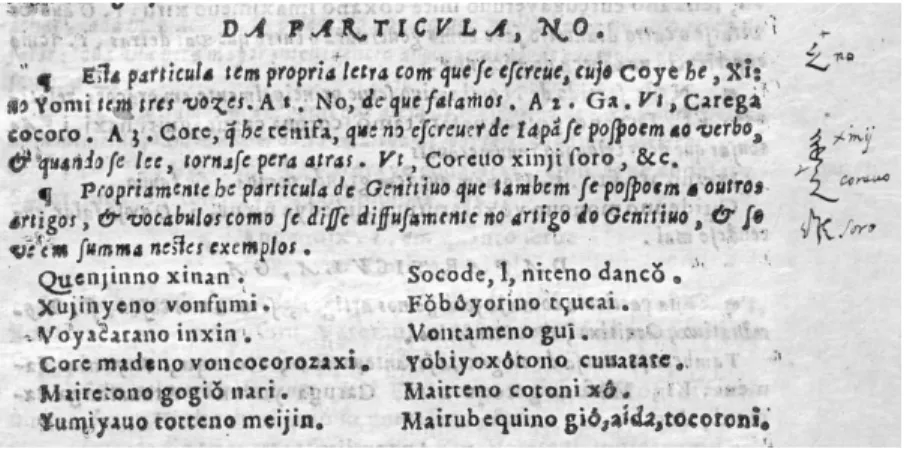
The particle no is used very frequently and is important in the Japanese language and Rodriguez says that the particle has its proper kan-zi in the section “On the particle, no”. A user put “+” upon “propria letra (proper letter)” and wrote the kanzi ( 之 ) in the righthand margin. The kanzi has three sounds: no, ga and core. Rodriguez says,
Fig. 2 Scanned image of leaf 130v.
“Core, that is placed after a verb in writing Japanese, but the order is reversed when reading aloud”, and gives a sentence Coreuo xinji soro. And a user annotated the sentence ( 進 , xinij) ( 之 , coreuo) ( 候 , soro) in cursive script kanzi with the reading sounds of each letter. The sign レ between the letter 進 and 之 means that you have to read the letters in reverse order. The user mistakenly wrote the sound of the letter 進 as xinij instead of xinji.
1-4 In leaf 159
Rodriguez says that Japanese is an elegant language and has a highly sophisticated system of honorific expressions. He gives three honor-ific particles, on, o and mi in the chapter “On the particles of honour that are attached to nouns”, saying that they are written with the same kanzi. A user annotated the kanzi ( 御 ) with its reading sounds, guio. go. von. vo. mi. in the margin.
1-5 In leaf 180v
Rodriguez introduces a Chinese poem composed of four lines, in the chapter “On Chinese verse”. He gives their Japanese reading sounds in alphabet. A user annotated the kanzi of the first two lines of the poem with their reading sounds: 行 (yuq) 尽 (tzucusu) 江 (c ) 南 (nanno) 数 (su) 十 (git) 程 (tei) 暁 (ki ) 風 (f ) 残 (zan) 月 (ghet) 入 (iru) 華 (qua) 晴 (xeini). The kanzi 二 between 入 and 華 means “two” and 一 under 晴 means “one”. These two kanzi indicate the order to read the last three kanzi and the figures from 1 to 3 designate the order to read them.
Kanzi is very important for Japanese writing system. Rodriguez explains the system of its reading sound and refers to some kanzi in the
book. But there are no kanzi prints.
Rodriguez did not use kanzi types with many reasons. But the learners and the teachers needed kanzi. And a user or users added some kanzi in the margins.
• The Jesuits published RACVYOXU, a kind of kanzi dictionary, in 1598, and they could study kanzi with it.
• It is not easy to compose the alphabet types and the kanzi types mixed. They must have not had many printers capable to do it. • The Japanese government began to persecute the Christianity in 1587, but they published VOCABVLARIO DA LINGOA DE IAPAM in 1603-1604, ARTE DA LINGOA DE IAPAM in 1604-1608, Manuale
ad Sacramenta in 1605 and Spiritual Xugiǒ in 1608. They did not
have time, paper, types or printers4.
The inclination of “g” in the annotations of leaves 55 and 159 is almost the same. And the shape of “∫” in the annotations of leaves 55 and 151 is almost the same. A user might write these three annotations.
2. Striking out
A user or users struck out words and parts of words and annotated in leaves 21v, 55, 67v, 109v and 151.
2-1 In leaf 21v
4 See Baba (2015), pp.319-335.
Rodriguez quotes a sentence with the particle coto from the
Tale of the Heike in the section “Particles with which the infinitive mood
is made”: Fitono xitgaini tçuqucoto fuqu cajeno cusa, quiuo nabicasuga gotoxi. A user struck out ni in xitagaini and annotated xitagai in the margin because xitagai does not have ni in the Tale of the
Heike.
2-2 In leaves 55 and 109v
A user struck out of X ocu and annotated xôsocu in the mar-gin, perhaps because xôsocu was more popular than x socu.
Rodriguez says that you use the accusative particle uo, when you say that you pass through some place, and shows a sample Cugauo ay de maitta, which means “I came here walking through land”. A user struck out its and annotated ay de in the margin, perhaps because ay de was more popular than ay de at the time.
2-3 In leaves 67v and 151
Fig. 7 Scanned image of leaf 55.
Fig. 8 Scanned image of leaf 109v.
Rodriguez lists first person pronouns in the section “Various grades of primitive pronouns. I etc. for first persons”. Ga of Chinga, and Vareraga between “Vare. Varera” and “Vatacuxi” are struck out. Chinga and vareraga are pronouns with subjective particle ga and other pronouns in the list are without ga. The user thought that it is better to have pronouns without subjective particle.
A user struck out tta in catanadeua quitta and annotated ranu upon tta. Quiranu is the present negative form of the verb quiru (to cut). This sentence is one of the examples of the dual particle deua (de + ua). The examples are s deua nai (not so), soredeua aru (that’s it), catanadeua quitta (I cut it with a sword) and michideua aua-nu (I do not meet him on the street). The first, the second and the fourth sentences are in the present and quitta is in the past. The first and the fourth sentences are negative. The user may have thought that the present negative form quiranu is better to understand the usage of deua than the past affirmative quitta.
A teacher or teachers might have struck out ga, Vareraga and tta, and a teacher might have noted ranu. He, she or they considered the students educationally and formatted the example sentences.
3. Additions
A user or users complemented words and parts of words in Jap-anese, Latin and Portuguese in leaves 3, 9, 28v, 76v, 103, 154, 155, 159v, 169, 170, 173, 173v, 220 and 235, and leaf numbers in leaf 83.
3-1 In Japanese 3-1-1 In leaf 9
A user added aru between cocoro and uo of the quoted sen-tence cotoni furete auaremu cocorouo jinto y in ninth leaf. The sentence was quoted from Rongo. And it is cocoroaruuo in Rongo.
Rongo was a philosophical book to read in Japan. The user also
read it.
3-1- 2 In leaf 28v
Rodriguez gives examples of some verbs in the section “General rules to know the preterit forms of the verbs of this second conjugation”. Two of them are xunda (penetrated, soaked) and musunda (formed a connection with, tied). The user annotated the other forms: x da and mus da, perhaps because these two forms were also popular at the time.
The system of Japanese verb conjugation changed significantly from the 14th century to the 16th century. Rodriguez was in its transition era. The verb conjugation was confusing for him, for the learners and for the teachers.
3-1-3 In leaf 76v
Fig. 11 Scanned image of leaf 9.
Fig. 12 Scanned image of leaf 28v.
Rodriguez gives examples of some copulative conjunctions in the section “Copulatives”. One of them is vonaju (together, in the same way). A user annotated “Vonajicu. It.”. Vonajicu is a synonym of vonaju and “It.” is an abbreviation of the Latin “item (likewise)”. The user wanted to increase the vocabulary.
The user annotated an adverb synonym here, a noun allomorph in leaf 55 (2-2) and allomorphs of verb conjugation in leaves 109v (2-2) and 28v (3-1-2).
3-1-4 In leaf 103
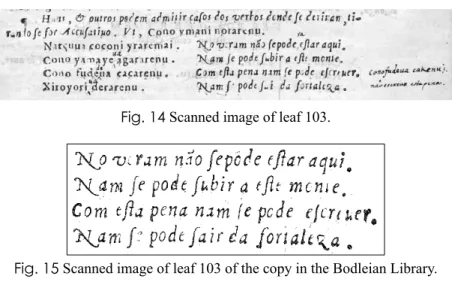
A user put the particle ua after yamaye and xiroyori. He saw the other two sentences with ua and wanted to make them even. All of them are correct either with or without ua. He perhaps thought that it is confusing to have two types of sentences mixed up and that the sentences with ua are used more than the sentences without ua.
And Rodriguez gives Japanese sentences and their Portu-guese translations in the section “On the impersonal verb”, leaf 103. A user put “ra” after “pode”. “Pode” is the present indicative singu-lar third person form of the verb “poder (to be able to)” and “podera”
Fig. 14 Scanned image of leaf 103.
is its future singular third person form. The Japanese sentence can be understood as either present or future. So he did not need to change “pode” to “podera”. But he did it. He wanted to make the sentence reflect the actual situations of the Jesuits. They were proscribed by the Japanese government at the beginning of the seventeenth centu-ry. And he chose a Japanese sentence suitable for teaching and learn-ing, that means “We will not be able to stay here next summer”. The last sentence of the four Portuguese ones is “Nam se pode sair da fortaleza”. But the “e” in the “se” and the “r” in the “sair” in the private collection copy are illegible. A user did not annotate these “e” or “r” but added “ra” to “pode”. Its tense must have been future for him.
The user searched for better Japanese sentences and tried to make the translation better. He studied hard.
3-1-5 In leaves 154 and 170
Rodriguez introduces a proverb Qui ye, Tçucuxi, Ni, Bandô. Sa. in the section “On the particle, ye”, leaf 154 and in the chapter “On some abuses in the speech and pronunciation peculiar to some kingdoms”, leaf 170. The particle ye indicates direction and the proverb means that they use ye in Kyôto, ni in Kyûsyû and sa in Kantô to indicate direc-tion. A user put “+” upon Bandô and annotated Quantô sa. with “+” above it. Quantô is a synonym of Bandô in leaf 154.
They use ye in Kyôto to express a direction to move but ni in Kyûsyû. Therefore it is not good to use ni formally to express a direction.
Fig. 16 Scanned image of leaf 154.
But the verb iru (to enter) requires the particle ni. And a user annotated “Excipe verbú iru. i. intrare.” in Latin in the margin of leaf 170. That means that the verb iru which means “enter” is exceptional. Iru is a verb to express a movement but requires ni in Kyôto.
The user has the linguistic knowledge of the relations between verbs and particles and knows that particles have their own meanings and usages.
3-2 In Latin 3-2-1 In leaf 155
Rodriguez gives a list of negative particles and some example words with them. We have fi in the list and fid (injustice), figui (against rules), fifô (illegal), jefi (right or wrong) as its example words. And Ro-driguez says that jefi means nefas5 (injustice). This is wrong. And a user wrote “fas (justice)” upon “Nefas” and annotated “je, fas. Fi, fas, nefas.” in the margin.
3-2-2 In leaf159v
Rodriguez treats the honorific particle on in the section “On the particles of honour that are attached to nouns”. He says that you cannot use this on to sacanas for example tai (porgy), tara (cod), funa (crucian), saque (salmon), facuchô (swan), tçuru (crane) and gan (wild goose).
5 “Fas” and “nefas” are Portuguese and Latin.
Fig. 18 Scanned image of leaf 155.
Sacana has two meanings in Japanese: “fish” and “food for alcoholic drink”. Rodriguez mentions sacana with the second meaning, but a user put “+” upon sacanas and annotated “piscis (‘fish’ in Latin)”.
The user did not know that sacana has two meanings and that it means “food” in this case.
3-2-3 In leaf 169
Rodriguez gives the word Cuni qui dan in the chapter “On some abuses in the speech and pronunciation peculiar to some kingdoms”. The word means “dialect” and a user put “+” upon the “q” of qui dan and annotated a Latin word “dialectus (dialect)” in the margin.
3-2-4 In leaf 173 and 173v
Rodriguez treats provincial pronunciation in the chapter “On the mode to pronounce the Japanese language”. He quotes a Japanese phrase Sumìto y cotouo sumíto y : mata, Faxíuo, faxito y (they pro-nounce ‘carbon’ as ‘corner’ and ‘chopsticks’ as ‘stairs’). And a user an-notated “sumì. i. carbo (carbon), sumí. i. angulus (corner)”6 and “faxí. i.
6 Each word has its accent and each mora of a word has its tone in Japanese. Akinaga (1977) says that sumi (carbon) had a low-low accent and sumi (corner) had a low-high accent according to the dictionaries edited in the eleventh and the twelfth centuries.
Fig. 20 Scanned image of leaf 169.
paxilli qb edútŕ cibi. faxì scala (faxí that is sticks with which we eat and faxì that is stairs)”7.
The user knows that the Japanese word accents distinguish their meanings and he knows the accents of sumi (carbon), sumi (corner), faxi (sticks) and faxi (stairs).
3-2-5 In leaf 220
Rodriguez treats measures of length and one of them is quen. Icquen means 1 quen and he explains 1 quen is Rocuxacu gosun (6 syaku 5 sun), when you measure the size of Tas (rice fields). And a user put “+” upon Tas and annotated “Varias (various)8” in the margin.
3-2-6 In leaf 235
Rodriguez introduces Nenrai in leaf 235. Nenrai is a kind of chronological table, in which all the kings of China and Japan are regis-tered in historical order. And a user put “+” upon the word, annotating “an-nales (‘chronological table’ in Latin)”.
7 Akinaga (1977) says that hasi (chopsticks) had a low-high accent and hasi (stairs) had a high-low accent.
8 The reason why rice fields are various is obvious. “Variās” is Latin and the female plural accusative form of the adjective “varius”.
Fig. 22 Scanned image of leaf 220.
3-3 In Portuguese in leaf 3
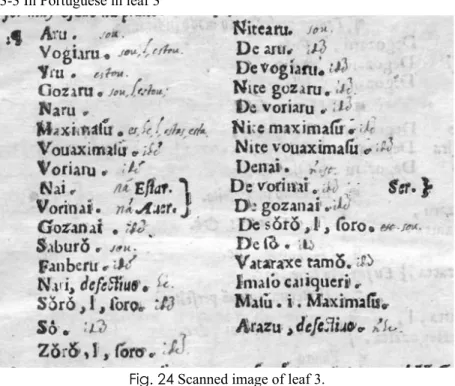
Rodriguez says in the section “Conjugation of the substantive verbs for the common practice” that this language has many substantive verbs. He gives a list of the verbs divided into two groups and explains that the verbs in the left column have the meaning of the verbs “estar, auer” and the ones in the right column are with the particles de, nite and have the meaning of the verb “ser”. “Estar, auer and ser” mean to exist and “estar” and “ser” are copulas, too. “Estar” expresses a temporal state and “ser” a nature.
The annotated words are “sou”, “es”, “he”, “hé”, “estou”, “estas”, “esta”, “nã”, “n’he”, “n’est”, “idß” and “l”. “Idß” means “the same as the upper one” and “l” means “or” in English. “He”, “hé”, “estas”, “esta”, “nã” and “n’he” are “é”, “é”, “estás”, “está”, “não” and “não é” in contemporary orthography. “Est” of “n’est” must be an abbreviation of some conjugated form of “estar”. “Sou”, “es” and “é” are the first, second and third person
singular present forms of “ser”, and, “estás” and “está” are the second and third person singular present forms of “estar”.
A user added nine annotations: “sou.”, “sou, l, estou”, “estou”, “es, he, l, estas, esta”, “nã”, “hé”, “n’est”, “est. sou” and “n’he”. “Est. sou” should be the same as “sou”. And he did not add any annotations to naru, imaso cariqueri and masu, maximasu. That means that he devided the verbs into nine groups: groups of “sou”, “sou, l, estou”, “estou”, “es, he, l, estas, esta”, “nã”, “hé”, “n’est”, “est. sou” and “n’he”, and a group with no annotation.
3-4 Leaf numbers in leaf 83
The book has leaf numbers in the upper right corners. But the first leaf of the second part does not have a number. The last leaf of the first part is numbered 80 and the second leaf of the second part is numbered 84. A user annotated “81. 82. 83” on the upper right corner of the first leaf of the second part.
・ The user formatted the sentences, adding ua and adjusted the translation to the actual situations. These are educational consider-ations.
・ The user(s) complemented the quotations and the leaf numbers. He, she or they added the synonyms and the explanation to Rodri-guez’s description, translated the Japanese words into Latin and ex-plained the usage of the particle and the accents of the words.
・ They read ARTE GRANDE well and made efforts.
4. Indication of reference
A user annotated the numbers of the reference leaves in leaves 78, 135 and 137v.
4-1 In leaf 78
A user annotated “Vide9 137. b et 149.” in the righthand margin of the title of the section “DO ARTIGO. (on the article)”. “Vide 137. b et 149.” means “See the reverse side of 137 and 149” in Latin. There is a chapter “On the articles that serve to the nominative” on the reverse side of 137 and a chapter “On the particle, last and tenth part of speech” on leaf 149.
4-2 In leaf 135
A user put “+” upon “capitulo (chapter)” in the sentence “Ca, se vejam no capitulo de interrogaçam (Ca that appears in the chapter of in-terrogative)” and annotated “pag. 89” in the margin. We find an item about the interrogative ca on the page.
9 “Vidē” is Latin and the present singular second person imperative form of the verb “vidēre (to see)”.
Fig. 26 Scanned image of leaf 78.
4-3 In leaf 137v
A user put “+” upon “tratado” in the sentence “como se dira no tratado das particulas (as we will say in treatise of particles)” written in the chapter “DA CONSTRVIÇAM DO ARTIGO oitaua parte da oraçam. (On the construction of the article, eighth part of speech)” and annotated “Vide 149”. We find a chapter “DA PARTICVLA VLTIMA E decima parte da ora-çam. (on the particle, last and tenth part of speech)” in leaf 149.
・The user or the users annotated the reference leaves as learners and teachers do nowadays.
5. Pronunciation
There are some annotations to clarify the pronunciations of Japa-nese words in leaves 95, 156v, 158v, 174 and 218.
5-1 In leaf 95
On the first line of the section “Various vocabularies that serve for the superlative” we find: “I , Supremo. Ch , Meão, l. mediocre, Gue,
Infimo.” A user annotated Ghe and “+” upon its “h”. He wanted to clarify
the pronunciation of Gue. It is [ɡe] and not [ɡue] nor [ɡwe].
Fig. 28 Scanned image of leaf 137v.
5-2 In leaf 156v
A user wrote Ghi on the lefthand margin of Gui (thing) on the reverse side of leaf 156. He wanted to clarify the pronunciation of Gui. It is [ɡi] and not [ɡui] nor [ɡwi].
5-3 In leaf 158v
A user wrote “+” upon “V” of the section’s title GVIO, GO. and annotated “Lege Ghio” in the margin. “Lege” is the second person sin-gular present imperative form of the verb “legere (to read)”. He wanted to clarify the pronunciation of guio. It is [ɡjo] and not [ɡuio] nor [ɡwio]. 5-4 In leaf 174
A user wrote Ki on the righthand margin of Qui (book). He wanted to clarify the pronunciation of Qui . It is [kjɔ] and not [kuiɔ] nor [kwiɔ].
5-5 In leaf 218
Fig. 30 Scanned image of leaf 156v.
Fig. 31 Scanned image of leaf 158v.
Fig. 32 Scanned image of leaf 174.
A user wrote Geni under Ieni on the last line of leaf 218. He wanted to clarify the pronunciation of ieni. Its pronunciation is [ʒeɲi] and not [ieɲi] nor [jeɲi].
5-1, 5-2 and 5-3 concern hard “g”. Gue, gui and guio have “u” but you do not pronounce it. You do not pronounce “u” in qui , either.
5-5 concerns the pronunciation of “i”, which has two sounds: [i] and [j].
The user(s) knew the ambiguity of the sounds of “g” and “i”. 6. Numbering words
Rodriguez presents Japanese honorific auxiliary verbs in the sec-tion “On some particles that together with the roots of verbs supply all the moods and tenses very elegantly”: re, rare, xerare, saxerare, tamai. And a user put numbers 1 to 5 on each.
Numbering words is also useful for learners and teachers to study them at the time.
7. Writing on words
A user or users wrote letters and something on the printed letters in leaves 69v, 73, 79v.
7-1 In leaf 69v
A user wrote a small “n” on the capital “N” of “Negativo”, per-haps because “affirmatiuo”, “actiuo” and “passiuo” in the sentence are with small letters.
A user wrote something on the second “actiuo” in the sentence “Impessoal actiuo he todo verbo actiuo, & commum, & neutro corrente”. 7-2. In leaf 73
Fig. 36 Scanned image of leaf 69v of the copy in the Bodleian Library. Fig. 35 Scanned image of leaf 69v.
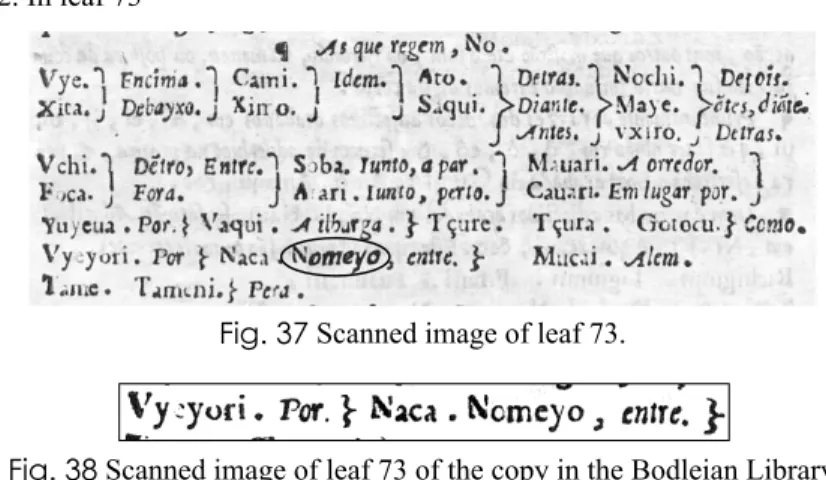
Fig. 38 Scanned image of leaf 73 of the copy in the Bodleian Library. Fig. 37 Scanned image of leaf 73.
Rodriguez lists some nouns which make phrases with no in the section “On the postposition”. Naca no in the list means “in the middle” which is “no meio” in Portuguese. A user traced the word “nomeyo (no meio)” in italics. He did it because upright type means Japanese, and Por-tuguese have to be in italic type. But “Nomeyo” is in upright type.
7-3 In leaf 79v
A user wrote a “∫” over the “s” of s mocuno.
A user or users corrected misprints in leaves 69v and 73. What he wrote on “active” in leaf 69v and why he wrote a “∫” over the “s” of s mocuno in leaf 79v are unknown.
8. Illegible words
There are two illegible words in leaves 206v and 212v. 8-1 In leaf 206v
A user annotated a word that looks like “Coniminoia’ “ in the lefthand margin of the title of the sector “On the heretical names that the
Fig. 39 Scanned image of leaf 79v.
Fig. 40 Scanned image of leaf 79v of the copy in the Bodleian Library.
Japanese use in their mode”. 8-2 In leaf 212v
There is an incomprehensible annotation in the lefthand margin of the title “Treatise on various modes of counting, which is a major part of this language”.
9. “+”
A user or users wrote “+” to indicate annotations and words that were annotated.
There are thirteen “+” in ARTE GRANDE: three on the annota-tions and ten on the words that were annotated. The three are in leaves 95 (5-1, Fig. 29), 151 (1-3, Fig. 3) and 154 (3-1-5, Fig. 16). The ten are in leaves 95 (5-1), 135 (4-2), 137v (4-3), 151, 154, 158v (5-3), 159v (3-2-2), 169 (3-2-3), 220 (3-2-5) and 235 (3-2-6). “+” was placed on both of anno-tations and annotated words in three cases above and was placed only on annotated words in other seven cases.
10. Who annotated?
The annotations were usually written with pen, and only two of them were with pencil in leaves 206v and 212v. The pens are almost al-ways fine, but they are broad in the case of kanzi and in leaves 55, 69v, 73, 79v and 160v.
The annotations usually were written with cursive writing, but Ghe in leaf 95, Ghi in leaf 156v and Ki in leaf 174 were with typeface.
The copy has been from a person to another, and not a user but some users perhaps annotated in the copy.
They may have been Jesuits or not. I do not know who. But I know that they worked hard, studying Japanese.
11. Teaching Japanese
The foreign students who learned the Japanese language in Japan in the 1980s wanted to know Japanese business style and to go back to their countries with the knowledge. Many people were interested in the Japanese pop cultures from the 2000s. And now, many young people study it in Vietnam, Nepal and other Asian countries to achieve higher status and to make their dreams come true.
People study foreign languages anytime and anywhere with many reasons. And they work hard sometimes. The notes written in the copy prove their hard work. You always write down notes in the margin. And we, language teachers, learn again from them to work hard.
References
1. João Rodriguez (1608) ARTE DA LINGOA DE IAPAM, Society of Jesus.
2. Ryoji Baba (2015) João Rodriguez ‘ARTE GRANDE’ no Sêritu to Bunseki, Kazama Syobô. 3. João Rodriguez, translated by Doi Tadao (1955) Nihon Daibunten, Sansêdô.
4. Tadao Doi (1982) Kirisitan Ronkô, Sansêdô.
5. Tosio Ogahara (2015) Rodorigesu Nihondaibunten no Kenkyû, Izumisyoin. 6. Akinaga (1977) Nihongo Akusento-shi Sôgô Shiryô, Sakuin-hen, Tôkyôdô Syuppan.