Title
Parameter and Reliability Estimation for a Bivariate
Exponential Distribution
Author(s)
Nakao, Zensho; Liu, Zeng-Zhong; Kinjo, Masaya
Citation
琉球大学工学部紀要(46): 253-257
Issue Date
1993-09
URL
http://hdl.handle.net/20.500.12000/1978
Parameter and Reliability Estimation
for a Bivariate Exponential Distribution1
Zensho NAKAO* Zeng-Zhong Liu** and Masaya KiNJO*
Abstract
Parameter and reliability estimators for a bivariate exponential
distribution are derived by the moment and the maximum likelihood
methods.
Key Words: Bivariate exponential distribution, Maximum likelihood
estimation, Moment estimation, Parameters, Reliability
function
1 . Introduction
System elements are connected in series and/or in
parallel. For example, in electric circuits, two resis
tors may be connected in series or in parallel; in elec tric power distribution, two generators may be used in parallel to supply energy; in multi-computer sys
tems (space shuttles, for example) , three or more
computers may be connected (redundantly) in parallel
for reliability.
Suppose that such a system consists of two com ponents in series or in pa railed, and is shocked by three Poisson random interferences from outside: one shocking the first element, the second striking the second, and the third hitting the two components simultaneously. Then the survival probability function
for the system can be shown to be given by a bivariate exponential distribution (BVE) with parameters X0J, X./0,and Xtl : F{xfy)~ P(X>x,Y> y) = exp[-X0,x-XI0
y-Xnmax{x,y)], where X, Y denote the lifelength
of the two components, X0}>0,Xw>0tXn>0,x,y>
We will present a set of estimators for the para meters and the reliability function of such systems by the method of moments and the maximum
likelihood method. Bayesian and empirical Bayesian
methods for estimating the parameters and the relia bility function of a parallel BVE system where past data are available are given in [4,5].
2. Derivation of a BVE
Let two independent Poisson processes Zt{t;X0J), ^itt'Xio) shock the components, numbered 1,2,
respectively, and let a third Poisson process Zn(t;
Xn) shock the components 1,2 simultaneously. Let
X,Y denote the lifelength of the 1,2 com ponets, and define the survival probability function by F[x, y) = P (X>x,Y>y). Then F{x.y) = P[Z,{x;Xol) = O, ^(y;Xi0) = 0,
Zn (max(x> y); Xn) = 0] =exp(-XOix)* exp
wp[n[y)]
p[OiiOy
[x,y]\, where X01>0t Xl0>0,Xn>0pxtytZ0[3\.
Recall that a Poisson random process Z(t;X) is
given by
Received on : May 10,1993.
Education of Common Course, Fac. of Eng.,
** Software Technology, Inc.
t A preliminary version of this paper was presented at the Spring Kyushu Regional Meeting of the Mathematical
254
Nakao, Liu, Kinjo :
Parameter and Reliability Estimation for a Bivariate Exponential Distribution
ity can be obtained by replacing X,'s with their estima tors X's:
3 . Parameter and reliability estimation for a BVE a. Moment estimation for a- BVE
It is known [3] that
(where X, = X0/ +X,/o + X,//, and E[] denotes
the expected value).Using the method of moments, we obtain a system of
equations:
x_ &__,
£.(**») 111
, \
L=J-fi
= y • ,—■*-*— + r—■*-»— ; (n:sample size).
A. \A.0[ + A.n kio+kii)Solving this system for the parameters, we get the
estimators: 5" -' = ' "•/i/ — —: i=i _ f=~l
w
tx,'
Our method is slightly different from the moment
method in [2] in that their third equation differs from
ours given above, and that if |{«-*J^ = 3i)| = 0 (| | denotes the cardinality of a set) , then XN=0 in[2], which is a difficulty in that method. For a para
llel system, the system is in an unfailed state at timet, if at least one components survive at the time t. Hence the reliability of the system is given by R{t) = P{X > t or Y> l) = P{X > t) + P{Y> t) - P{X > t,
Y>t)=F(t,0) + F{0,t)-F(t.t)
exP[ - fiio + ^u) t]-exp[-X t).
b. Maximum likelihood estimation for a BVE For parallel systems, the maximum likelihood
estimation for a BVE was made by F. Prochan and P. Sullo [6] ; here we will derive maximum likelihood estimators for a BVE in series, which turns out to be much simpler than for parallel systems. Let [X,Y)~ BVE{\OI, \10, X,,), and S = {(/. 0), (ft 1), {1,1) ). For se S , define a characteristic function Vs as fol lows [1] :
tfX<Y
ifX>Y; _\lifX>Y,
-[ ifX<Y;
X = Y,XtY.
Thus, for every sample (Xj , "JJ.) , i = 1 •, n, we have l{ ,- defined, i = l n. Let Ns= Z, Vsi,
i = l " and let Ui = min{Xi,Y^,i,e., the life time of the series
system i = /,...,«. Now, for a series system,
the entire system fails when one unit fails. So the only information available is on the life time of the system, Uj, i = ],...,n , and on which unit has the longer life time, Vsi,i = l n. It is obvious that Vsi,/ = /, ...,«, are independent of Uj,j = 1 ,...,n [1] ,
and moreover, ( N(o,/). N(i.o)> #(/,/) ) has a trinomial
distribution with probabilities -&■, -^, -^-, respectA, A, A
ively. So the joint probability is given (where n =
N[o,i) + %0) + %/) ) by P[W,ft/) = n(ft t> NUf0) = n{liOy
tyi. /) = «(U> ui > '• ' = A.... n ] = P[N{0 t) = «(ft Iy N[i0)
= n(i.oy%/, = «{/./)]• P[Uj>t, i=l,..,n]
Thus the corresponding estimator R(t) for the
reliabil-To derive maximum likelihood estimators, we take the logarithm of the likelihood function above, and set its
Solving the resulting system of equations, we get the following estimators: _ "(0./) _ W(AQ) ";— _ "(/■/)-— -jj . j/
For a series system, the system is in a failed state at time t if at least one components fail at the time t. Hence the reliability of the system is given by
R{t) = P{X>t. Y>t) = exp{-Xt).
Thus the corresponding estimator k(t) for the reliabil ity becomes
tu
n = l4. Simulation on parameter and reliability estima
tion
a. Methods
We give some detail for computer simulation:
First, RND{p)[pe{0, /)] is used to produce random
values in the unit interval (0,1) • Secondly, we let
U~E[XOI), V-E{Xi0), W~E{\n), (E{X):k): an exponential distrbution with parameter A) , and due to the fact that /- exp{ -XQl U)-R{0, 1), 1-exp(-*■//V)~*(0. 1), l-exp{-XnW)~R{0, 1) (where R
(0, /) is a uniform distribution in the interval (0, 7))
we get samples (of size n) Ult... , t/n; vt,•'•,]/„; Wi, ••\WV Thirdly, we obtain independent random variables U, V, W,X = min (U,W) , and Y = min(V,W), and get sample values of (X,Y)
which is
b. Results and analysis
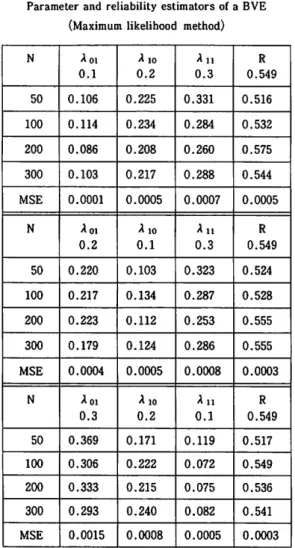
Results of simulation are shown for moment estimation of parallel systems and for maximum likeli hood estimation of series systems in Tables 1 and 2, respectively. We used the mean squared errors
(MSE) for evaluation of the estimators, where
£ (estimator-true value)2
MSE=Table 1
Parameter and reliability estimators of a BVE
(Method of moments)
N 50 100 200 300 MSE N 50 100 200 300 MSE N 50 100 200 300 MSE A 01 0.1 0.129 0.159 0.097 0.133 0.0011 A 01 0.2 0.288 0.243 0.238 0.201 0.0028 A 01 0.3 0.361 0.195 0.390 0.292 0.0057 A 10 0.2 0.204 0.305 0.171 0.247 0.0035 A 10 0.1 0.087 0.174 0.099 0.123 0.0015 A 10 0.2 0.242 0.118 0.239 0.239 0.0029 An 0.3 0.308 0.242 0.285 0.281 0.0010 A,, 0.3 0.281 0.267 0.266 0.288 0.0007 An 0.1 0.104 0.210 0.050 0.089 0.0037 R 0.728 0.718 0.755 0.741 0.738 0.0003 R 0.728 0.739 0.739 0.751 0.733 0.0002 R 0.682 0.842 0.794 0.886 0.865 0.0014256
Nakao, Liu, Kinjo :
Parameter and Reliability Estimation for a Bivariate Exponential Distribution
Table 2
Parameter and reliability estimators of a BVE (Maximum likelihood method)
Table 3 Comparison of MSE's N 50 100 200 300 MSE N 50 100 200 300 MSE N 50 100 200 300 MSE A oi 0.1 0.106 0.114 0.086 0.103 0.0001 A oi 0.2 0.220 0.217 0.223 0.179 0.0004 A oi 0.3 0.369 0.306 0.333 0.293 0.0015 A io 0.2 0.225 0.234 0.208 0.217 0.0005 A io 0.1 0.103 0.134 0.112 0.124 0.0005 A io 0.2 0.171 0.222 0.215 0.240 0.0008 An 0.3 0.331 0.284 0.260 0.288 0.0007 An 0.3 0.323 0.287 0.253 0.286 0.0008 An 0.1 0.119 0.072 0.075 0.082 0.0005 R 0.549 0.516 0.532 0.575 0.544 0.0005 R 0.549 0.524 0.528 0.555 0.555 0.0003 R 0.549 0.517 0.549 0.536 0.541 0.0003
(N: Sample sizes, MSE: Mean Squared errors, t = 1)
In Table 1, 0.0002 < MSE (reliability) £ 0.0014; 0.0011 £ MSE[XOI) <, 0.057; 0.0015 <, MSE{X,0) < 0.0035; 0.0007 <5 MSE{\,,) £ 0.037;
while in Table 2,
0.003 £ MSE (reliability) <
0.0005; 0.0001 Z MSE(\OI) <. 0.0015; 0.0005 £ MSE{X,0)< 0.008; 0.0005 £ MSE{Xn) <, 0.0008We see that, from Tables 1 and 2, the MSE's for
both the moment and the maximum likelihood estima
tion are small enough as expected of the methods, and that, from Table 3, the MSE's for the maximum likelihood estimators are consistently smaller than those for the moment estimators.
MSE MSE MSE Moment estimators A oi 0.1 0.0011 A oi 0.2 0.0028 A oi 0.3 0.0057 A io 0.2 0.0035 A io 0.1 0.0015 A io 0.2 0.0029 A,, 0.3 0.0010 An 0.3 0.0007 A,, 0.1 0.0037 Maximum likelihood estimatorss A oi 0.1 0.0001 A oi 0.2 0.0004 A oi 0.3 0.0015 A io 0.2 0.0005 A io 0.1 0.0005 A io 0.2 0.0008 An 0.3 0.0007 An 0.3 0.0008 An 0.1 0.0005 5. Conclusions
We obtained parameters and reliability estimators for a BVE where the system components are connected in series or in parallel; used the MSE's for evaluating
the goodness of estimation and found that the MSE's
are small enough as expected of the methods; in general, the maximum likelihood estimation suits bet
ter than the moment estimation for the parameters and the reliability function of a BVE; thus, for parallel systems, the estimators obtained in [6 ] and, for series systems, our estimators can be adopted.
There remain problems of hypothesis testing on
the parameters of a BVE, which will be the subjects
for our next investigation.
References
[1] Arnold, Barry C. : Parameter Estimaton for a Multivariate Exponential Distribution, JA.SA., 63, pp.848-852, 1968.
[2] Bemis, Bruce M., Bain, Lee J. and Higgins,
James J. : Estimation and Hypothesis Testing for the Parameters of a Bivariate Exponential Distribution, J.A.SA ., 67, pp.927-929, 1972.
[3] Marshall, A.W. and Olkin, I. : A Multivariate
Exponential Distribution, JA.SA., 62, pp.30-44, 1967.
[4] Nakao, Z. and Liu, Z.Z. : Empirical Bayesian In
ca 35, No.5, pp.949-957, 1990.
[5] Nakao, Z. and Liu, Z.Z. : On Bayesian Para
meter and Reliability Estimation in a Bivariate Exponential Model, Mathematica Japonica 36, No.6, pp.1085-1091, 1991.
[6] Proschan, Frank and Sullo, Pasquale: Estimating
the Parameters of a Multivariate Exponetial Distribution, JA.SA., 71, pp.465-472, 1976.