INVITED PAPER
Special Section on Multiple-Valued Logic and VLSI ComputingBiomimetics Image Retrieval Platform
Miki HASEYAMA†a), Takahiro OGAWA†, Sho TAKAHASHI†,Members, Shuhei NOMURA††, andMasatsugu SHIMOMURA†††,Nonmembers
SUMMARY Biomimetics is a new research field that creates innovation through the collaboration of different existing research fields. However, the collaboration, i.e., the exchange of deep knowledge between different research fields, is difficult for several reasons such as differences in tech- nical terms used in different fields. In order to overcome this problem, we have developed a new retrieval platform, “Biomimetics image retrieval plat- form,” using a visualization-based image retrieval technique. A biological database contains a large volume of image data, and by taking advantage of these image data, we are able to overcome limitations of text-only informa- tion retrieval. By realizing such a retrieval platform that does not depend on technical terms, individual biological databases of various species can be integrated. This will allow not only the use of data for the study of var- ious species by researchers in different biological fields but also access for a wide range of researchers in fields ranging from materials science, me- chanical engineering and manufacturing. Therefore, our platform provides a new path bridging different fields and will contribute to the development of biomimetics since it can overcome the limitation of the traditional re- trieval platform.
key words: biomimetics, inter-field collaboration, visualization-based im- age retrieval, scanning electron microphotograph
1. Introduction
Biomimetics is a new research field that yields new manu- facturing concepts based on the structures, functionality and reproduction processes of natural organisms. For example, it is known that by mimicking physical architectures of bi- ological neuronal systems, various kinds of neuromorphic very large-scale integration (VLSI) sensors can be devel- oped[1]. In addition, by artificially reproducing surfaces of biological organisms including unique functions, a wide va- riety of nanomaterials can be also developed[2],[3]. Based on collaboration between different research fields such as biology and engineering, biomimetics has attracted much attention due to its potential to realize a sustainable soci- ety[4],[5].
Manuscript received October 13, 2016.
Manuscript revised January 9, 2017.
Manuscript publicized May 19, 2017.
†The authors are with Graduate School of Information Sci- ence and Technology, Hokkaido University, Sapporo-shi, 060–
0814 Japan.
††The author is with Department of Zoology, National Museum of Nature and Science, Tsukuba-shi, 305–0005 Japan.
†††The author is with Department of Applied Chemistry and Bio- science, Chitose Institute of Science and Technology, Chitose-shi, 066–8655 Japan.
a) E-mail: [email protected] (Corresponding author) DOI: 10.1587/transinf.2016LOI0001
1.1 Background
In the field of biomimetics, mutual exchange of knowledge between different research fields is necessary. More specif- ically, biomimetics requires biological knowledge, but ob- taining that knowledge is difficult due to the biodiversity.
Biomimetics has contributed to the development of excel- lent products and technology, but in order to continuously provide new manufacturing concepts and create the next- generation sustainable manufacturing foundation, we need a platform that allows us to obtain information related to the manufacturing from biological aspects.
Recently, due to the widespread use of the scanning electron microscope (SEM), observations of subcellular structures on the surfaces of various biological organisms have been intensively carried out. Researchers of nano- materials and nanofabrication have become able to repro- duce nanostructures that are similar to the unique nanos- tructures of biological organisms for realizing their specific functions in materials. Therefore, it is necessary to not only enable access to researchers of different kinds of biological organisms by integrating the separately accumulated SEM images of various organisms including insects, birds and fish but also enable access to a wide range of researchers in ma- terial science, engineering and manufacturing fields[2],[3].
However, due to the biodiversity, collecting effective data from bio-organisms requires much knowledge and effort.
For collecting data useful for biomimetics, the coopera- tion of museums that accumulated samples and information pertaining to this vast diversity would be necessary. In re- cent years, knowledge of bio-organisms as well as surface structures of bio-organisms revealed by microscopic images has provided useful insights for manufacturing. Thus, there is a need for a retrieval system that supports the extraction of data that are useful for manufacturing from the large volume of bio-organism data.
1.2 Related Works and Remaining Problems
Many services for image and video retrieval are currently being used. Existing retrieval systems are based on metadata attached to each content. There has recently been an acceler- ation in research of image/video analysis, more specifically, image/video semantic understanding, which can automati- cally attach metadata to multimedia contents[6]. This tech- Copyright c2017 The Institute of Electronics, Information and Communication Engineers
nology is currently being used in existing services[7]. Fur- thermore, with the rapid growth of deep learning technolo- gies[8], there has been a great improvement in image/video understanding performance in the field of generic object recognition[9]. Although existing research fields such as machine learning have contributed greatly to the improve- ment in performance, overcoming the “Semantic Gap” re- mains an important problem[10]. The “Semantic Gap” is the gap between the numeric features extracted from image data and their meanings. In order to achieve accurate im- age/video understanding, methods based on machine learn- ing still need a large volume of diverse training data that cor- respond to the meaning of each keyword. However, when dealing with image data for biomimetics, it is impossible to prepare a large volume of training data for each category, e.g., each kind of bio-organism. Generally, due to the bio- diversity, there are many images of various bio-organisms.
However, for each kind of bio-organism, small number of images are only taken. Furthermore, when dealing with SEM images, this problem becomes more significant since only one image is generally taken for each part of each kind of bio-organism at each magnification. Therefore, the above condition causes the problem of decreased retrieval accu- racy.
In addition to the above problems, a new problem has become significant in recent years. Sometimes, we can- not clearly provide a query keyword that expresses the de- sired contents, making it difficult to obtain the desired con- tents using conventional retrieval methods[11]. This prob- lem is mentioned in the investigation reports of the Inter- national Data Corporation (IDC)[12]–[14], and they con- clude that we will need new search and discovery tools. The above problem has become more significant in the field of biomimetics. More specifically, when researchers search for images from a research field other than their own, it is dif- ficult for them to express their desired content using appro- priate technical terms. This is because technical terms often differ significantly between different research fields.
1.3 Our Contribution
In order to provide a solution to the aforementioned prob- lems, we have studied a new retrieval technique that in- cludes visualization methods for obtaining desired infor- mation from a large volume of data[15]–[18]. This im- age retrieval technique enables users to obtain desired im- ages from a large volume of accumulated images by visu- alizing the images even if they cannot provide appropriate keywords, i.e., technical terms. Through the visualization results provided by this image retrieval technique, users can find an overview of the entire database and reach their de- sired images more effectively.
A novel biomimetics image retrieval platform based on the visualization-based image retrieval technique is pre- sented in this paper. From SEM images acquired by re- searchers in different research fields, we focus on the char- acteristic that although the terminology used to describe
certain properties is completely different between different fields, the visual features of corresponding SEM images are similar to each other if their nanostructures are similar.
Thus, we utilize the similarity in visual features between images to visualize the entire database in a low-dimensional space that is viewable by users. Therefore, even if two SEM images come from different fields, as long as their nanos- tructures are similar, they will be placed close together in the low-dimensional visualization space, enabling researchers from various fields to understand the potential properties of these SEM images. In other words, this retrieval platform can play an important role as a trigger for creating inter-field collaboration.
The biomimetics image retrieval platform explained in this paper accumulates SEM images in a database and is intended to (1) allow biology researchers from differ- ent fields to make new discoveries and (2) allow engineer- ing researchers to obtain new knowledge from existing bio- organisms. Furthermore, by rearranging the images in the database, the platform enables the generation of new ideas through several different patterns of cooperation between different research fields. Thus, we can find a new path ex- isting between different fields by using the proposed plat- form, and the development of biomimetics is realized since our platform can drastically break the limitation of the tra- ditional retrieval platform.
1.4 Organization
This paper is organized as follows. First, in Sect. 2, the ne- cessity of biomimetics image retrieval is described and a so- lution using visualization-based image retrieval is provided.
A detailed explanation of the biomimetics image retrieval platform is given in Sect. 3. In Sect. 4, the effectiveness of the biomimetics image retrieval platform is discussed on the basis of results obtained by applying it to a real biological image database. Finally, concluding remarks are given in Sect. 5.
2. Necessity of Biomimetics Image Retrieval and New Visualization-Based Image Retrieval Technique In this section, we first explain the motivation of our study, i.e., necessity of biomimetics image retrieval, in 2.1. The idea of the new visualization-based image retrieval tech- nique, which is a fundamental element of the biomimetics image retrieval platform, is introduced in 2.2.
2.1 Necessity of Biomimetics Image Retrieval
As described above, biomimetics is a research field that cre- ates innovation through the collaboration of various research fields. In order for researchers with deep knowledge of their own research fields to cooperate with each other, exchang- ing and sharing their knowledge is necessary. However, it is difficult to understand different research fields due to the
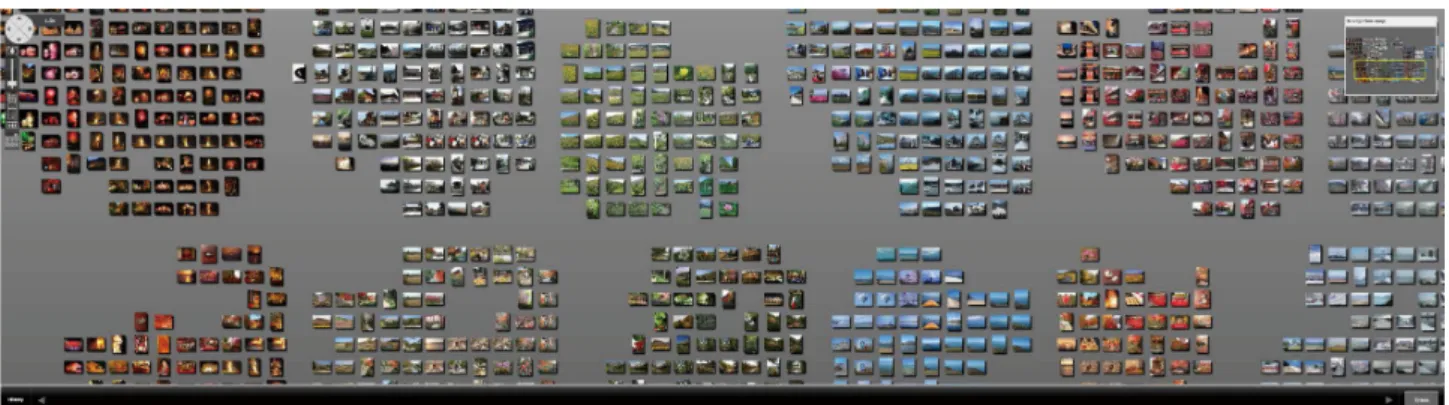
Fig. 1 Image Vortex, an image retrieval system based on visualization-based image retrieval. In this system, we can find relationships among images in a database according to their visual features in three- dimensional space.
Fig. 2 Image Cruiser, a large-scale database retrieval engine that was developed as a practical imple- mentation of Image Vortex.
difference in terminology. Below, we show an example of the word “adhesion” being used in different fields.
Biology[19]: “After applying the adhesive to the substrate, the samples were allowed to dry for 24 hours under a bio-safety cabinet.”
Medicine [20]: “Adhesion formation is the most com- mon complication following peritoneal surgery and the leading cause of small bowel obstruction, acquired in- fertility and inadvertent organ injury at reoperation.”
Robotics[21]: “The result is Stickybot, a robot that climbs glass and other smooth surfaces using directional adhe- sive pads on its toes.”
The use of the word “adhesion” in the three examples above demonstrates that, while the high-level concept remains constant, there are subtle differences in meaning. Such dif- ferences become an obstacle to mutual understanding be- tween different fields and hinder the consolidation of knowl- edge. In order to minimize this obstacle, construction of dic- tionaries and ontologies over different fields is effective, and several trials for biomimetics have been carried out[22].
On the other hand, establishing relationships between different technical terms has its limitations, and we pro- pose another novel approach, which tries to provide break- throughs by utilizing unstructured data such as image and
video data obtained from different fields. More specifically, this is the “Biomimetics Image Retrieval Platform”, which integrates different types of data from different fields and is based on the theory of visualization-based image retrieval.
By using this retrieval platform, it becomes feasible to find images that share a common visual structure and to find their relationship without using technical terms of each research field. Then, by using visual features that can be directly compared between different fields, images that were accu- mulated separately can be consolidated, realizing coopera- tion between researchers from different research fields.
2.2 New Visualization-Based Image Retrieval
Visualization-based image retrieval analyzes features of un- structured data such as image and video data and enables users to find new data of different fields. Figure 1 shows the interface of the system “Image Vortex,” which was devel- oped on the basis of the idea of visualization-based image retrieval. Image Vortex enables image information retrieval in conditions under which conventional retrieval methods struggle – more specifically, where the user is unable to provide a specific query keyword[16]. This system enables users to effectively obtain their desired content from a large volume of accumulated image data. The system calculates
a visual feature vector for each image in the database and utilizes these vectors to define the difference between pairs of images as the distance between them[23],[24]. Finally, based on the defined distance, the system visualizes the im- ages in a three-dimensional space as shown in Fig. 1. By utilizing this interface, users can view the entire database as an overview and reach their desired image effectively.
Figure 2 shows “Image Cruiser”, a large-scale database retrieval engine that was developed as a practical implemen- tation of Image Vortex. Image Cruiser realizes high-speed image rearrangement by utilizing the image distance mea- sure defined by Image Vortex. By realizing an easy-to-user interface, the system enables users to see an overview of a large volume of image data and reach their desired images quickly and effectively. Furthermore, this interface does not require users to express their desired content as a query, us- ing keywords or otherwise.
3. Biomimetics Image Retrieval Platform
The biomimetics image retrieval platform is described in this section. An overview of the system is given in Sect. 3.1, and the main functions of the platform are explained in de- tail in Sect. 3.2.
3.1 System Overview
A system overview of the biomimetics image retrieval plat- form based on the idea of the visualization-based image re- trieval introduced in the previous section is given in this sub- section. The biomimetics image retrieval platform shows an overview of the entire database consisting of a large vol- ume of SEM image data. More specifically, the platform enables visualization of the images in the database by per- forming dimensionality reduction – rearranging the images in a 2D space based on the distance between the visual fea- tures extracted from images in the database. The algorithm performing the rearrangement is based on our previously re- ported algorithm[16]. Through the cruising model based on the 2D-interface, users can make a survey of the whole data (all of the images in the database) and easily find their desired images. Our system consists of the following three basic algorithms.
(i) Extraction of visual features from images
Several visual features, such as color histograms, color correlograms and those focusing on target objects, are extracted from images[23]. For these feature vectors calculated from all of the images in the database, prin- cipal component analysis is applied to reduce their di- mensions to lower dimensions.
(ii) Definition of the distance between two images The distance between a pair of visual feature vectors is defined by the simplestl2-norm[24].
(iii) Dimensionality reduction for visualization
Two-dimensional positions are determined for all of the images in the target database based on the dimension-
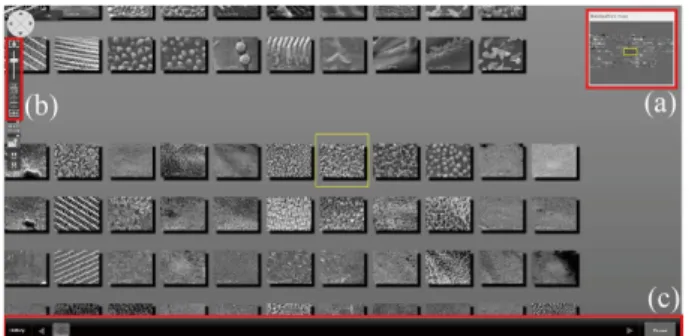
Fig. 3 The interface of the biomimetics image retrieval platform: (a) dis- played parts of the entire image database, (b) function that changes the number and size of displayed images, and (c) history of previously viewed images.
ality reduction algorithm[16]using the distances cal- culated in (ii).
In our system, it is possible to select different visual features, distance measures and dimensionality reduction algorithms that are more effective for the target database, enabling bet- ter visualization results to be obtained. For example, some results presented in the next section were obtained by using speeded up robust features (SURF)[25]for the feature ex- traction. In that case, we confirmed that the results strongly reflect the properties of visual patterns.
3.2 Main Functions Implemented in Our Platform The main functions implemented in the biomimetics im- age retrieval platform are explained in this subsection. The biomimetics image retrieval platform is implemented as an interface that enables users to effectively find the infor- mation they need to achieve their goals by accessing an overview of the database that contains SEM images useful for manufacturing, e.g., materials science. In the rest of this subsection, we explain the main functions of the proposed retrieval platform.
(A) Overview of the Image Database
Figure 3 shows the appearance of the image database overview. Each item in the interface of the biomimet- ics image retrieval platform is explained within this fig- ure. The parts of Fig. 3 (a) contained within the yel- low border show the displayed parts of the entire image database. The displayed parts can be moved by drag- ging. Furthermore, by using Fig. 3 (b), we can change the number and size of the displayed images. As shown in Fig. 3 (c), the bottom part of the interface shows a history of previously viewed images.
(B) Confirmation of Bio-organism Information
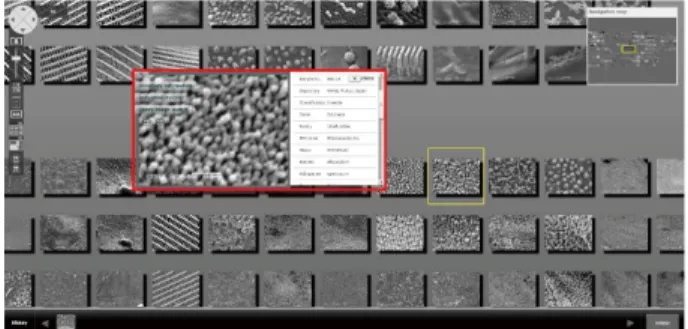
By selecting each image, we can confirm the details of the bio-organism as shown in Fig. 4. Specifically, the entire inventory information for the target bio- organism is shown, with each SEM image containing attached inventory information. Table 1 shows repre- sentative inventory information attached to each SEM image as metadata. Furthermore, if users select their
desired inventory information, it is possible to narrow down the displayed images using that information. Fig- ure 5 illustrates the use of this function in practice. The displayed SEM images are narrowed down to only im- ages that show a specific magnification. The inventory information allows biologists to enter important infor- mation about the functions of the bio-organism shown
Fig. 4 Selection of an image and confirmation of its bio-organism infor- mation.
Table 1 Representative inventory information attached to SEM images in the biomimetics image retrieval platform.
Order Magnification Position Genus Depository Classification
Sex Family JPN name
Collector Species Subspecies
Eco. keywords Locality Method
Coating Habitat Camera
Photographer Size (mm) –
Fig. 7 Appearance of query image-based retrieval. By selecting the function of “query image-based retrieval” shown in (a), the uploader appears as shown in (b). The uploaded query image is shown in the right side of the interface as can be seen in (c). Furthermore, eight similar images surrounding the query image can be seen as shown in (d).
in each image, particularly ecosystem keywords (“Eco.
keywords”) that represent unique characteristics and functions of target bio-organisms. Therefore, when de-
Fig. 5 Appearance of images narrowed down to only images that show a specific magnification. In this figure, the results are limited to images of magnification×10000.
Fig. 6 Function of the keyword-based retrieval. By inputting keywords, images including keywords in the inventory information can be found.
veloping particular materials, engineering researchers are able to discover a new functionality by searching for SEM images of bio-organisms that have structures similar to those of the developed materials and by ex- amining the ecosystem keywords for those images. For example, Eco. keywords in the current database are moth-eye, anti-reflectivity, hydrophobic, structural ad- hesion, structural color, photonic crystal, etc.
(C) Query Keyword-based Retrieval
As mentioned earlier, each image in the biomimetics image retrieval platform contains inventory informa- tion. Based on this information, it is possible to en- ter keywords and search for bio-organism images that match the keywords, as shown in Fig. 6. Since, in prac- tice, biologists and engineers often know “what bio- logical properties” or “what kind of material function- ality” they are searching for, it is possible to effectively reach the desired data by performing keyword-based retrieval. However, as mentioned previously, keyword- based retrieval is difficult since the terminology differs between different research fields. In order to overcome this problem, construction of dictionaries and ontolo- gies that connect technical terms across different fields is effective, and such dictionaries are being created for the different fields encompassing biomimetics[22].
Then, by registering keywords that can be used across different fields as Eco. keywords, the platform provides a new path to the user for reaching their desired con- tents.
(D) Query Image-based Retrieval
Figure 7 (a) illustrates image-based retrieval: the but- ton shows the “query image retrieval” panel, allowing the user to upload a new image (see Fig. 7 (b)). Once the retrieval is completed, the uploaded image is shown in the blue frame (see Fig. 7 (c)), and the “query im- age” window appears. Upon clicking on the “Similar images” button, eight similar images are shown (see Fig. 7 (d)). The displayed eight images are selected on the basis of the distance of the visual features explained in the previous subsection. This function enables biol- ogists and engineers to find SEM images with simi- lar visual structures without relying on the differences in terminology across different fields. Furthermore, as mentioned previously, the inventory information con- tained in each SEM image in the retrieved results, in particular, the ecosystem keywords, enable a common functionality to be discovered without having special biological knowledge.
4. Discussions of the Effectiveness by Application to an Actual Image Database
In this section, the effectiveness of the biomimetics image retrieval platform is discussed on the basis of results ob- tained by applying the platform to a real-world biology im- age database. The platform enables retrieval in a networked
environment, where an example site of the platform can be accessed from the following URL:
http://bmireng.ist.hokudai.ac.jp/
Through a Web browser, users can access our retrieval plat- form.
As mentioned above, the biomimetics image retrieval platform supports retrieval of SEM images of biological or- ganisms. Specifically, it includes SEM images of several species such as insects, fish and birds†, with over 50000 SEM images having been registered in the platform. The ef- fectiveness of its core algorithm, i.e., the visualization algo- rithm based on dimensionality reduction, has already been verified from the perspective of information science[26].
Furthermore, in order to show the effectiveness of the plat- form from a biomimetics perspective, it is necessary to demonstrate that it supports real researchers in the discovery of new ideas. Therefore, the effectiveness of the platform is verified in this section by presenting examples of new dis- coveries obtained through actual use of the proposed plat- form by real biologists and engineers. We show examples of discoveries of bio-organisms that share common structures and discoveries of similar characteristics in bio-organisms and materials in the following subsection.
(I) Discovered Similarities Between Different Biological Organisms
Figure 8 shows the application of the biomimetics im- age retrieval platform to examine the database. Fig- ure 8 (b) shows retrieval results of the lower-right clus- ter of Fig. 8 (a), limited to Dytiscidae. As shown in Fig. 8 (c), among the results limited to Dytiscidae, there are some results related toCybister japonicus, but, as shown in Figs. 8 (d)–(f), there are many images belong- ing to different families in the neighborhood of that par- ticular image, e.g.,Haliplus ovalis(Haliplidae),Orec- tochilus villosus (Gyrinidae) andHydrophilus acumi- natus Motschulsky (Hydrophilidae). Although these images belong to insects from different families, they are placed close together since they possess similar vi- sual structures.
Figures 9 and 10 show other retrieval results of the biomimetics image retrieval platform. These figures show visualization results of insect images and fish im- ages. Figure 9 (b) shows a fish image and Fig. 9 (c) shows an insect image. However, these images are shown at close positions as can be seen in Fig. 9 (a) since their visual characteristics are similar. Similarly, the images in Figs. 10 (b) and (c) are shown at close po- sitions as can be seen in Fig. 10 (a). These images are a fish image and an insect image, respectively.
†The SEM images of insects, fish and birds included in the biomimetics image retrieval platform were provided by Dr. Shuhei Nomura, Dr. Gento Shinohara, Dr. Keiichi Matsuura in National Museum of Nature and Science and Dr. Takeshi Yamasaki in Ya- mashina Institute for Ornithology.
Fig. 8 Examples of retrieved images of biological organisms using the biomimetics image retrieval platform: (a) images shown in our retrieval platform and results limited to (b) Dytiscidae, (c)Cybister japonicus(Dytiscidae), (d)Haliplus ovalis(Haliplidae), (e)Orectochilus villosus(Gyrinidae), and (f) Hydrophilus acuminatusMotschulsky (Hydrophilidae).
Fig. 9 Examples of retrieved images of biological organisms using the biomimetics image retrieval platform: (a) images shown in our retrieval platform and images for (b)Mustelus manazo(Triakidae) and (c)Copelatus tenebrosus(Dytiscidae).
(II) Discovered Similarities Between Biological Organ- isms and Materials: Example 1
Figure 11 shows the results of retrieval from insect im- ages using the biomimetics image retrieval platform.
Figure 11 assumes a scenario where a material scientist registers his/her own four material images and searches for images of biological organisms. Figure 11 (a) shows that images of the micro lens array generated
Fig. 10 Examples of retrieved images of biological organisms using the biomimetics image retrieval platform: (a) images shown in our re- trieval platform and images for (b)Sufflamen fraenatum(Balistidae) and (c)Copelatus tenebrosus(Dytiscidae).
on the basis of [27] are placed closely to images of the moth-eye structure of Helicoverpa armigera, the wings of the cicadaTerpnosia nigricosta†, and the sur- face of the front wings ofGraptopsaltria bimaculata.
†The SEM images ofHelicoverpa armigeraandTerpnosia ni- gricostawere provided by Dr. Takahiko Hariyama in Hamamatsu University School of Medicine.
Fig. 11 Retrieval results including similar structures of insects and materials (Example 1): (a) visu- alization results of SEM images including similar structures, (b)Helicoverpa armigera(Noctuidae), (c) Terpnosia nigricosta(Cicadidae), (d)Graptopsaltria bimaculata(Cicadidae), and (e) and (f) micro lens array (material images).
Fig. 12 Retrieval results including similar structures of insects and materials (Example 1): (a) visu- alization results of SEM images including similar structures, (b)Terpnosia nigricosta(Cicadidae), and (c) and (d) silicon nanospike array.
Furthermore, Fig. 12 shows that images of the silicon nanospike array generated on the basis of[27]in the material field are placed closely to images of the wing cross-section ofTerpnosia nigricosta. These retrieval results show that focusing on similar surface structures enables retrieval of different kinds of information (e.g., biological organisms and materials).
(III) Discovered Similarities Between Biological Organ- isms and Materials: Example 2
Figure 13 shows an example of retrieval results after uploading an SEM image of artificial photonic crys- tals†as a query. In this case, the image retrieval system
†The SEM image of the artificial photonic crystals was pro- vided by Dr. Hiroshi Fudouzi in National Institute for Materials Science.
Fig. 13 Results of query image-based retrieval after uploading an SEM image of artificial photonic crystals to the biomimetics image retrieval platform (Example 2): (a) results obtained by uploading the SEM image of artificial photonic crystals, (b) artificial photonic crystals (query image), (c)Platypleura miyakona(Cicadidae), (d)Meimuna opalifera(Cicadidae), (e)Parantica sita(Nymphalidae), and (f) Eupholus schoenherri(Curculionidae).
Fig. 14 Results of performing a search of images of fish, insects and materials using the biomimetics image retrieval platform: (a) visualization results of SEM images including similar structures, (b) sur- face treatment metal, (c)Sufflamen fraenatum(Balistidae), (d)Hippichthys spicifer(Syngnathidae), (e) Oplegnathus fasciatus(Oplegnathidae), and (f)Cosmiomorpha similis(Scarabaeidae).
used SURF features[25]as visual features. Figure 13 shows the actual retrieval result focusing on artificial photonic crystals. Photonic crystals are nanostructures with a periodically changing refractive index that can control the way in which light (electromagnetic waves with wavelengths from several hundred to several thou-
sand nm) is transmitted through them. SEM images of Eupholus schoenherriare shown as the result of a similar image retrieval. The potion developing color of Curculionoidae are quite similar. It is known that Curculionoidae produces photonic crystals. Further- more, from the point of view of biologists and mate-
rial scientists, the similarity between photonic crystals of Curculionoidae and nanopiles of “Cicad body sur- face” suggests that a functionality is created by subcel- lular structures. Interestingly, the retrieval results also contain a recurring structure of a completely different scale, as demonstrated by the example forParantica sita.
(IV) Discovered Similarities Between Biological Organ- isms and Materials: Example 3
Figure 14 (a) shows the visual result of insect im- ages and fish images using the biomimetics image re- trieval platform. Figure 14 (b) shows an SEM image of a metallic surface. Images similar to that shown in Fig. 14 (b) are shown in its neighborhood. Fig- ures 14 (c), (d) and (e) show SEM images of fishes in- cluding the rear side ofSufflamen fraenatum, the right center side ofHippichthys spicifer, and the surfaces of the center side ofOplegnathus fasciatus. Furthermore, Fig. 14 (f) shows an SEM image of an insect, the left rear wing surface ofCosmiomorpha similis. Images in Figs. 14 (c)–(f) are in the neighborhood of the im- age in Fig. 14 (b) since they are visually similar; more specifically, they possess smooth surfaces and protrud- ing patterns. These results show that even across differ- ent biological organisms and materials, it is possible to search for SEM images with similar surface structures and that the similarity enables new discoveries about their relationships.
5. Conclusions
A novel biomimetics image retrieval platform based on visualization-based image retrieval is presented in this pa- per. Large volumes of image data separately accumulate in different research fields, with each field containing invalu- able knowledge. This invaluable knowledge is often difficult to express in words, hindering its ability to be shared with experts outside that particular field. In this situation, the problems in each research field become more complex, and it is often difficult to determine where the problem actually is. Limiting experts’ knowledge to a particular field limits our ability to solve such problems. Biomimetics attempts allow us to tackle such problems. The biomimetics image retrieval platform presented in this paper is an implemen- tation of an industrial collaboration platform that supports manufacturing through integrating accumulated knowledge in a cross-field database.
Acknowledgements
This work was supported by JSPS KAKENHI Grant Num- ber JP24120002 in Scientific Research on Innovative Areas
“Innovative Materials Engineering Based on Biological Di- versity”.
References
[1] C.M. Higgins and V. Pant, “A biomimetic VLSI sensor for visual tracking of small moving targets,” IEEE Transactions on Circuits and Systems I: Regular Papers, vol.51, no.12, pp.2384–2394, 2004.
[2] M. Shimomura, “The new trends in next generation biomimetics ma- terial technology: Learning from biodiversity,” Science & Technol- ogy Trends Quarterly Review, no.37, pp.53–75, 2010.
[3] M. Shimomura, “Engineering biomimetics: Integration of biology and nanotechnology,” Design for Innovative Value Towards a Sus- tainable Society: Proceedings of EcoDesign 2011: 7th Interna- tional Symposium on Environmentally Conscious Design and In- verse Manufacturing, pp.905–907, 2012.
[4] J.F.V. Vincent, O.A. Bogatyreva, N.R. Bogatyrev, A. Bowyer, and A.K. Pahl, “Biomimetics: Its practice and theory,” Journal of The Royal Society Interface, vol.3, no.9, pp.471–482, 2006.
[5] B. Bhushan, “Biomimetics: Lessons from nature-an overview,” The Royal Society, vol.367, no.1893, pp.1445–1486, 2009
[6] A.W.M. Smeulders, M. Worring, S. Santini, A. Gupta, and R. Jain,
“Content-based image retrieval at the end of the early years,” IEEE Transactions on Pattern Analysis and Machine Intelligence, vol.22, no.12, pp.1349–1380, 2000.
[7] M. Flickner, H. Sawhney, W. Niblack, J. Ashley, Q. Huang, B. Dom, M. Gorkani, J. Hafner, D. Lee, D. Petkovic, D. Steele, and P. Yanker,
“Query by image and video content: The QBIC system,” Computer, vol.28, no.9, pp.23–32, 1995.
[8] J. Schmidhuber, “Deep learning in neural networks: An overview,”
Neural Networks, vol.61, pp.85–117, 2015.
[9] O. Russakovsky, J. Deng, H. Su, J. Krause, S. Satheesh, S. Ma, Z. Huang, A. Karpathy, A. Khosla, M. Bernstein, A.C. Berg, and L. Fei-Fei, “Imagenet large scale visual recognition challenge,” In- ternational Journal of Computer Vision, vol.115, no.3, pp.211–252, 2015.
[10] R.W. Picard, “Applications of affective computing in human- computer interaction,” International Journal of Human-Computer Studies, vol.59, no.1-2, pp.55–64, 2003.
[11] I. Campbell, “Applying ostensive functionalism in the place of de- scriptive proceduralism: The query is dead,” British Computer So- ciety Workshop on Information Retrieval and Human Computer In- teraction, University of Glasgow, September, 1996.
[12] J.F. Gantz, C. Chute, A. Manfrediz, S. Minton, D. Reinsel, W.
Schlichting, et al: “The diverse and exploding digital universe,” IDC White Paper, IDC, 2008.
[13] J. Gantz and D. Reinsel, “The digital universe decade, Are you ready?,” IDC iView, 2010.
[14] IDC Digital Universe Study, sponsored by EMC, Dec. 2012, http://www.emc.com/about/news/press/2012/20121211-01.htm [15] M. Haseyama, T. Ogawa, and N. Yagi, “A review of video retrieval
based on image and video semantic understanding,” ITE Transac- tions on Media Technology and Applications, vol.1, no.1, pp.2–9, 2013.
[16] M. Haseyama, T. Murata, and H. Ukawa, “A new image re- trieval interface and its practical use in “View Search Hokkaido”,”
The 13th IEEE International Symposium on Consumer Electronics, pp.851–852, 2009.
[17] M. Haseyama and T. Ogawa, “Trial realization of human-centered multimedia navigation for video retrieval,” International Journal of Human-Computer Interaction, vol.29, no.2, pp.96–109, 2013.
[18] M. Haseyama, “Realization of associative image search: Devel- opment of image retrieval platform for enhancing serendipity,”
2016 IEEE 46th International Symposium on Multiple-Valued Logic (ISMVL), pp.56–59, 2016.
[19] M. Zhang, S.C. Lenaghan, L. Xia, L. Dong, W. He, W.R. Henson, and X. Fan, “Nanofibers and nanoparticles from the insect-capturing adhesive of the Sundew (Drosera) for cell attachment,” Journal of nanobiotechnology, vol.8, no.20, pp.1–10 2010.
[20] R.P.G. ten Broek, N. Kok-Krant, E.A. Bakkum, R.P. Bleichrodt, and H. van Goor, “Different surgical techniques to reduce post-operative adhesion formation: A systematic review and meta-analysis,” Hu- man Reproduction Update, vol.19, no.1, pp.12–25, 2013.
[21] S. Kim, M. Spenko, S. Trujillo, B. Heyneman, D. Santos, and M.R.
Cutkosky, “Smooth vertical surface climbing with directional adhe- sion,” IEEE Transactions on Robotics, vol.24, no.1, pp.65–74, 2008.
[22] K. Kozaki and R. Mizoguchi, “A keyword exploration for retrieval from biomimetics databases,” Joint International Semantic Technol- ogy Conference, vol.8943, pp.361–377, 2014.
[23] T. Watanabe and M. Haseyama, “A study on accurate image clus- tering using color edges,” IEICE Technical Report, vol.106, no.534, pp.7–10, 2007. (in Japanese)
[24] R. Tokumoto and M. Haseyama, “Color distribution-based simi- lar image clustering and its performance evaluation,” International Conference on Kansei Engineering and Emotion Research 2007 (KEER2007), vol.C-25, 2007.
[25] H. Bay, A. Ess, T. Tuytelaars, and L. Van Gool, “Speeded-Up Ro- bust Features (SURF),” Computer Vision and Image Understanding, vol.110, no.3, pp.346–359, 2008
[26] K. Kobayashi, T. Ogawa, and M. Haseyama, “Novel evaluation cri- terion for visualization of image search results based on feature in- tegration theory,” ITE Transactions on Media Technology and Ap- plications, vol.1, no.4, pp.333–342, 2013.
[27] Y. Hirai, H. Yabu, Y. Matsuo, K. Ijiro, and M. Shimomura,
“Biomimetic bi-functional silicon nanospike-array structures pre- pared by using self-organized honeycomb templates and reac- tive ion etching,” Journal of Materials Chemistry, vol.20, no.48, pp.10804–10808, 2010.
Miki Haseyama received her B.S., M.S.
and Ph.D. degrees in Electronics from Hokkaido University, Japan in 1986, 1988 and 1993, re- spectively. She joined the Graduate School of Information Science and Technology, Hokkaido University as an associate professor in 1994.
She was a visiting associate professor of Wash- ington University, USA from 1995 to 1996. She is currently a professor in the Graduate School of Information Science and Technology, Hok- kaido University. Her research interests include image and video processing and its development into semantic analysis.
She has been a Vice-President of the Institute of Image Information and Television Engineers, Japan (ITE), an Editor-in-Chief of ITE Transactions on Media Technology and Applications, a Director, International Coordi- nation and Publicity of The Institute of Electronics, Information and Com- munication Engineers (IEICE). She is a member of the IEEE, IEICE, Insti- tute of Image Information and Television Engineers (ITE) and Acoustical Society of Japan (ASJ).
Takahiro Ogawa received his B.S., M.S.
and Ph.D. degrees in Electronics and Infor- mation Engineering from Hokkaido University, Japan in 2003, 2005 and 2007, respectively. He joined Graduate School of Information Science and Technology, Hokkaido University as an as- sistant professor in 2008. He is currently an as- sociate professor in the Graduate School of In- formation Science and Technology, Hokkaido University. His research interests are multime- dia signal processing and its applications. He has been an Associate Editor of ITE Transactions on Media Technology and Applications. He is a member of the Association for Computing Ma- chinery (ACM), IEEE, EURASIP, IEICE and ITE.
Sho Takahashi received his B.S., M.S. and Ph.D. degrees in Electronics and Information Engineering from Hokkaido University, Sap- poro, Japan in 2008, 2010 and 2013, respec- tively. He is currently an assistant professor in the Graduate School of Information Science and Technology, Hokkaido University. His research interests include semantic analysis in videos. He is a member of the IEEE, IEICE and ITE.
Shuhei Nomura received his B.S., M.S.
and Ph.D. degrees in Agriculture from Kyushu University, Fukuoka, Japan in 1985, 1987 and 1990, respectively. He was an assistant profes- sor of the faculty of agriculture, Kyushu Univer- sity from 1990 to 1995. He is currently a Se- nior Curator of the Department of Zoology, Na- tional Museum of Nature and Science, Tsukuba, Japan. He is also a visiting associate professor of Kyusyu University from 2014. His specialty of research is the taxonomy, morphology and biodiversity of staphylinid beetles (Insecta, Coleoptera, Staphylinidae). He is the president of the Coleopterological Society of Japan.
Masatsugu Shimomura received his B.S., M.S. and Ph.D. degrees in Engineering from Kyushu University, Japan in 1978, 1980 and 1985, respectively. He joined the Department of Organic Synthesis of Kyushu University as an assistant professor in 1980, and moved to Tokyo University of Agriculture and Technology as an associate professor in 1985, then held a full pro- fessor position of Research Institute for Elec- tronic Science, Hokkaido University in 1993.
He was a director of Nanotechnology Research Center, Hokkaido University from 2003 to 2006, and concurrently held a team leader position in RIKEN Institute from 1999 to 2007. He moved to Tohoku University in 2007 as a professor of Institute of Multidisciplinary Research for Advanced Materials and shifted to a principal investigator po- sition of WPI-AIMR. He is currently a professor of Chitose Institute of Science and Technology from 2014. He is a chairperson of the Research Group on Biomimetics of the Society of Polymer Science, Japan. He is a professor emeritus of Hokkaido University and Tohoku University, respec- tively.