Topics Surrounding the Combinatorial Anabelian Geometry of Hyperbolic Curves II:
Tripods and Combinatorial Cuspidalization
By
Yuichiro HOSHI and Shinichi MOCHIZUKI
November 2012
R ESEARCH I NSTITUTE FOR M ATHEMATICAL S CIENCES
KYOTO UNIVERSITY, Kyoto, Japan
ANABELIAN GEOMETRY OF HYPERBOLIC CURVES II:
TRIPODS AND COMBINATORIAL CUSPIDALIZATION
YUICHIRO HOSHI AND SHINICHI MOCHIZUKI NOVEMBER 2012
Abstract. Let Σ be a subset of the set of prime numbers which is either equal to the entire set of prime numbers or of cardinal- ity one. In the present paper, we continue our study of the pro-Σ fundamental groups of hyperbolic curves and their associated con- figuration spaces over algebraically closed fields in which the primes of Σ are invertible. The starting point of the theory of the present paper is a combinatorial anabelian result which, unlike results ob- tained in previous papers, allows one to eliminate the hypothesis that cuspidal inertia subgroupsarepreserved by the isomorphism in question. This result allows us to [partially] generalize combina- torial cuspidalization results obtained in previous papers to the case of outer automorphisms of pro-Σ fundamental groups of config- uration spaces that do not necessarily preserve the cuspidal inertia subgroups of the various one-dimensional subquotients of such a fun- damental group. Such partial combinatorial cuspidalization results allow one in effect to reduce issues concerning theanabelian geom- etry of configuration spaces to issues concerning the anabelian geometry ofhyperbolic curves. These results also allow us, in the case of configuration spaces of sufficiently large dimension, to give purely group-theoretic characterizations of the cuspidal iner- tia subgroups of the various one-dimensional subquotients of the pro-Σ fundamental group of a configuration space. We then turn to the study of tripod synchronization, i.e., roughly speaking, the phenomenon that an outer automorphism of the pro-Σ fundamental group of a log configuration space associated to a log stable curve typically induces thesameouter automorphism on the various sub- quotients of such a fundamental group determined bytripods[i.e., copies of the projective line minus three points]. Our study of tripod synchronization allows us to show that outer automorphisms ofpro-Σ fundamental groups of configuration spaces exhibit somewhatdiffer- ent behaviorfrom the behavior that may be observed in the case of discretefundamental groups, as a consequence of the classicalDehn- Nielsen-Baer theorem. Other applications of the theory of tripod synchronization include a result concerning commuting profinite Dehn multi-twiststhat, a priori, arise from distinctsemi-graph of
2010 Mathematics Subject Classification. Primary 14H30; Secondary 14H10.
Key words and phrases. anabelian geometry, combinatorial anabelian geometry, combinatorial cuspidalization, profinite Dehn twist, tripod, tripod synchronization, Grothendieck-Teichm¨uller group, semi-graph of anabelioids, hyperbolic curve, con- figuration space.
The first author was supported by Grant-in-Aid for Scientific Research (C), No.
24540016, Japan Society for the Promotion of Science.
1
anabelioids of pro-ΣPSC-typestructures [i.e., the profinite analogue of the notion of adecomposition of a hyperbolic topological surface into hyperbolic subsurfaces, such as “pants”], as well as the computation, in terms of a certainscheme-theoretic fundamental group, of the purely combinatorial/group-theoretic commensurator of the group of profinite Dehn multi-twists. Finally, we show that the condition that an outer automorphism of the pro-Σ fundamental group of a log stable curveliftto an outer automorphism of the pro-Σ fundamental group of the correspondingn-th log configuration space, wheren≥2 is an integer, is compatible, in a suitable sense, with localization on the dual graph of the log stable curve. This localizability prop- erty, together with the theory of tripod synchronization, is applied to construct a purely combinatorial analogueof the natural outer surjectionfrom the ´etale fundamental group of the moduli stack of hyperbolic curves overQto theabsolute Galois groupofQ.
Contents
Introduction 2
0. Notations and Conventions 12
1. Combinatorial anabelian geometry in the absence of
group-theoretic cuspidality 14
2. Partial combinatorial cuspidalization for F-admissible
outomorphisms 28
3. Synchronization of tripods 47
4. Glueability of combinatorial cuspidalizations 92
References 136
Introduction
Let Σ ⊆ Primes be a subset of the set of prime numbers Primes which is either equal to Primes or of cardinality one. In the present paper, we continue our study of thepro-Σfundamental groupsof hyper- bolic curves and their associated configuration spaces over algebraically closed fields in which the primes of Σ are invertible [cf. [MzTa], [CmbCsp], [NodNon], [CbTpI]]. One central theme of this study is the issue of n- cuspidalizability [cf. Definition 3.20], i.e., the issue of the extent to which a given isomorphism between the pro-Σ fundamental groups of a pair of hyperbolic curveslifts [necessarilyuniquely, up to a permuta- tion of factors — cf. [NodNon], Theorem B] to an isomorphism between the pro-Σ fundamental groups of the corresponding n-th configuration spaces, forn≥1 a positive integer. In this context, we recall that both the algebraic and the anabeliangeometry of such configuration spaces revolves around the behavior of the variousdiagonalsthat are removed from direct products of copies of the given curve in order to construct these configuration spaces. From this point of view, it is perhaps nat- ural to think of the issue of n-cuspidalizability as a sort of abstract
profinite analogue of the notion of n-differentiability in the theory of differential manifolds. In particular, it is perhaps natural to think of the theory of the present paper [as well as of [MzTa], [CmbCsp], [NodNon], [CbTpI]] as a sort of abstract profinite analogue of the classical theory constituted by thedifferential topology of surfaces.
Next, we recall that, to a substantial extent, the theory of combi- natorial cuspidalization developed in [CmbCsp] may be thought of as an essentially formal consequenceof thecombinatorial anabelian result obtained in [CmbGC], Corollary 2.7, (iii). In a similar vein, the generalization of this theory of [CmbCsp] that is summarized in [NodNon], Theorem B, may be regarded as an essentially formal con- sequence of the combinatorial anabelian result given in [NodNon], The- orem A. The development of the theory of the present paper follows this pattern to a substantial extent. That is to say, in §1, we begin the development of the theory of the present paper by proving afundamen- tal combinatorial anabelian result [cf. Theorem 1.9], which generalizes the combinatorial anabelian results given in [CmbGC], Corollary 2.7, (iii); [NodNon], Theorem A. A substantial portion of the main results obtained in the remainder of the present paper may be understood as consisting of various applications of Theorem 1.9.
By comparison to the combinatorial anabelian results of [CmbGC], Corollary 2.7, (iii); [NodNon], Theorem A, themain technical featureof the combinatorial anabelian result given in Theorem 1.9 of the present paper is that it allows one, to a substantial extent, to
eliminate the group-theoretic cuspidality hypothesis
— i.e., the assumption to the effect that the isomorphism between pro- Σ fundamental groups of log stable curves under consideration neces- sarily preserves cuspidal inertia subgroups — that plays a central role in the proofs of earlier combinatorial anabelian results. In§2, we apply Theorem 1.9 to obtain the following [partial] combinatorial cusp- idalization result [cf. Theorem 2.3, (i), (ii); Corollary 3.22], which [partially] generalizes [NodNon], Theorem B.
Theorem A (Partial combinatorial cuspidalization for F-ad- missible outomorphisms). Let (g, r) be a pair of nonnegative inte- gers such that 2g−2 +r > 0; n a positive integer; Σ a set of prime numbers which is either equal to the set of all prime numbers or of car- dinality one;X ahyperbolic curveof type(g, r)over an algebraically closed field of characteristic 6∈ Σ; Xn the n-th configuration space of X; Πn the maximal pro-Σ quotient of the fundamental group of Xn;
OutF(Πn)⊆Out(Πn)
the subgroup of F-admissible outomorphisms [i.e., roughly speaking, outomorphisms that preserve the fiber subgroups — cf. [CmbCsp], Def- inition 1.1, (ii)] of Πn;
OutFC(Πn)⊆OutF(Πn)
the subgroup of FC-admissible outomorphisms [i.e., roughly speaking, outomorphisms that preserve the fiber subgroups and the cuspidal iner- tia subgroups — cf. [CmbCsp], Definition 1.1, (ii)] of Πn. Then the following hold:
(i) Write ninj
def=
½ 1 if r 6= 0,
2 if r = 0, nbij def=
½ 3 if r6= 0, 4 if r= 0. If n≥ninj (respectively, n ≥nbij), then the natural homomor- phism
OutF(Πn+1)−→OutF(Πn)
induced by the projections Xn+1 → Xn obtained by forgetting any one of the n+ 1 factors ofXn+1 [cf. [CbTpI], Theorem A, (i)] is injective (respectively, bijective).
(ii) Write
nFCdef=
2 if (g, r) = (0,3),
3 if (g, r)6= (0,3) and r6= 0, 4 if r= 0.
If n ≥nFC, then it holds that
OutFC(Πn) = OutF(Πn).
(iii) Suppose that (g, r) 6∈ {(0,3); (1,1)}. Then the natural injec- tion [cf. [NodNon], Theorem B]
OutFC(Π2),→OutFC(Π1)
induced by the projections X2 →X1 obtained by forgetting ei- ther of the two factors of X2 is not surjective.
Here, we remark that thenon-surjectivitydiscussed in Theorem A, (iii), is, in fact, obtained as a consequence of the theory of tripod syn- chronization developed in §3 [cf. the discussion preceding Theorem C below]. This non-surjectivity isremarkable in that it yields an impor- tant example of substantially different behavior in the theory of profi- nite fundamental groups of hyperbolic curves from the corresponding theory in the discrete case. That is to say, in the case of the classi- cal discrete fundamental group of a hyperbolic topological surface, the surjectivity of the corresponding homomorphism may be derived as
an essentially formal consequence of the well-known Dehn-Nielsen- Baer theorem in the theory of topological surfaces [cf. the discussion of Remark 3.22.1, (i)]. In particular, it constitutes an important“coun- terexample” to the“principle”[which appears to play a central role in the discussion of [Lch]] that one should expect essentially analogous behavior in the theory of profinite fundamental groups of hyperbolic curves to the relatively well understood behavior observed classically in the theory of discrete fundamental groups of topological surfaces [cf.
the discussion of Remark 3.22.1, (iii)].
Theorem A leads naturally to the following strengthening of the result obtained in [CbTpI], Theorem A, (ii), concerning the group- theoreticity of the cuspidal inertia subgroups of the various one- dimensional subquotients of a configuration space group [cf. Corol- lary 2.4].
Theorem B (PFC-admissibility of outomorphisms). In the no- tation of Theorem A, write
OutPF(Πn)⊆Out(Πn)
for the subgroup ofPF-admissibleoutomorphisms [i.e., roughly speak- ing, outomorphisms that preserve the fiber subgroups up to a possible permutation of the factors — cf. [CbTpI], Definition 1.4, (i)] and
OutPFC(Πn)⊆OutPF(Πn)
for the subgroup ofPFC-admissibleoutomorphisms [i.e., roughly speak- ing, outomorphisms that preserve the fiber subgroups and the cuspi- dal inertia subgroups up to a possible permutation of the factors — cf. [CbTpI], Definition 1.4, (iii)]. Let us regard the symmetric group on n letters Sn as a subgroup of Out(Πn) via the natural inclusion Sn ,→ Out(Πn) obtained by permuting the various factors of Xn. Fi- nally, suppose that (g, r)6∈ {(0,3); (1,1)}. Then the following hold:
(i) We have an equality
Out(Πn) = OutPF(Πn).
If, moreover, (r, n)6= (0,2), then we have equalities Out(Πn) = OutPF(Πn) = OutF(Πn)×Sn. (ii) If either
r >0 , n≥3 or
n ≥4, then we have equalities
Out(Πn) = OutPFC(Πn) = OutFC(Πn)×Sn.
The partial combinatorial cuspidalization of Theorem A has natural applications to the relativeand [semi-]absolute anabelian geom- etry of configuration spaces [cf. Corollaries 2.5, 2.6], which gen- eralize the theory of [AbsTpI], §1. Roughly speaking, these results allow one, in a wide variety of cases, to reduce issues concerning the relative and [semi-]absolute anabelian geometry ofconfiguration spaces to the corresponding issues concerning the relative and [semi-]absolute anabelian geometry of hyperbolic curves. Also, we remark that in this context, we obtain a purelyscheme-theoreticresult [cf. Lemma 2.7] that states, roughly speaking, that the theory of isomorphisms [of schemes!]
between configuration spaces associated to hyperbolic curves may be reduced to the theory of isomorphisms [of schemes!] between hyper- bolic curves.
In §3, we take up the study of [the group-theoretic versions of] the various tripods [i.e., copies of the projective line minus three points]
that occur in the various one-dimensional fibers of the log configuration spaces associated to a log stable curve. Roughly speaking, these tripods either occur in the original log stable curve or arise as the result of blowing up various cusps or nodes that occur in the one-dimensional fibers of log configuration spaces oflower dimension[cf. Figure 1 at the end of the present Introduction]. In fact, a substantial portion of §3 is devoted precisely to the theory of classification of the various tripods that occur in the one-dimensional fibers of the log configuration spaces associated to a log stable curve [cf. Lemmas 3.6, 3.8]. This leads natu- rally to the study of the phenomenon oftripod synchronization, i.e., roughly speaking, the phenomenon that an outomorphism [that is to say, an outer automorphism] of the pro-Σ fundamental group of a log configuration space associated to a log stable curve typically induces the sameouter automorphism on the various [group-theoretic] tripods that occur in subquotients of such a fundamental group [cf. Theorems 3.16, 3.17, 3.18]. The phenomenon of tripod synchronization, in turn, leads naturally to the definition of the tripod homomorphism [cf.
Definition 3.19], which may be thought of as the homomorphism ob- tained by associating to an [FC-admissible] outer automorphism of the pro-Σ fundamental group of the n-th log configuration space associ- ated to a log stable curve, where n≥ 3 is a positive integer, the outer automorphism induced on the [group-theoretic] central tripod, i.e., roughly speaking, the tripod that arises, in the case where n = 3 and the given log stable curve has no nodes, by blowing up the intersection of the three diagonal divisors of the direct product of three copies of the curve.
Theorem C (Synchronization of tripods in three or more di- mensions). Let (g, r) be a pair of nonnegative integers such that2g− 2 +r > 0; n a positive integer; Σ a set of prime numbers which is
either equal to the set of all prime numbers or of cardinality one; k an algebraically closed field of characteristic 6∈ Σ; (Speck)log the log scheme obtained by equipping Speck with the log structure determined by the fs chart N → k that maps 1 7→ 0; Xlog = X1log a stable log curve of type (g, r) over (Speck)log. Write G for the semi-graph of anabelioids of pro-ΣPSC-type determined by the stable log curve Xlog. For each positive integer i, write Xilog for the i-th log configuration space of the stable log curve Xlog [cf. the discussion entitled “Curves”
in [CbTpI], §0]; Πi for the maximal pro-Σ quotient of the kernel of the natural surjection π1(Xilog) ³ π1((Speck)log). Let T ⊆ Πm be a {1,· · · , m}-tripod of Πn [cf. Definition 3.3, (i)] for m a positive integer ≤n. Suppose that n≥3. Write
Πtpd ⊆Π3
for the central {1,2,3}-tripod of Πn [cf. Definitions 3.3, (i); 3.7, (ii)]. Then the following hold:
(i) Thecommensuratorandcentralizer of T inΠm satisfy the equality
CΠm(T) = T ×ZΠm(T).
Thus, if an outomorphismα ofΠm preserves theΠm-conjugacy class of T ⊆ Πm, then one obtains a “restriction” α|T ∈ Out(T).
(ii) Let α∈OutFC(Πn) be an FC-admissible outomorphism of Πn. Then the outomorphism ofΠ3 induced byα preserves theΠ3- conjugacy class of Πtpd ⊆Π3. In particular, by (i), we obtain a natural homomorphism
TΠtpd: OutFC(Πn)−→Out(Πtpd).
We shall refer to this homomorphism as the tripod homo- morphism associated to Πn.
(iii) Let α ∈ OutFC(Πn) be an FC-admissible outomorphism of Πn
such that the outomorphism αm ofΠm induced byαpreserves the Πm-conjugacy class of T ⊆ Πm and induces [cf. (i)] the identity automorphism of the set ofT-conjugacy classes of cuspidal inertia subgroups ofT. Then there exists ageometric [cf. Definition 3.4, (ii)] outer isomorphism Πtpd →∼ T with respect to which the outomorphism TΠtpd(α) ∈ Out(Πtpd) [cf.
(ii)] is compatible with the outomorphism αm|T ∈ Out(T) [cf. (i)].
(iv) Suppose, moreover, that either n ≥ 4 or r 6= 0. Then the homomorphism TΠtpd of (ii) factors through OutC(Πtpd)∆+ ⊆ Out(Πtpd)[cf. Definition 3.4, (i)], and, moreover, the resulting
homomorphism
TΠtpd: OutF(Πn) = OutFC(Πn)−→OutC(Πtpd)∆+
[cf. Theorem A, (ii)] is surjective.
Here, we remark that the surjectivityof the tripod homomorphism [cf. Theorem C, (iv)] is obtained [cf. Corollary 4.15] as a consequence of the theory of glueability of combinatorial cuspidalizations developed in §4 [cf. the discussion preceding Theorem F below]. Also, we recall that the codomainof this surjective tripod homomorphism
OutC(Πtpd)∆+
may be identified with the [pro-Σ]Grothendieck-Teichm¨uller group GTΣ [cf. the discussion of [CmbCsp], Remark 1.11.1]. Since GTΣ may be thought of as a sort of abstract combinatorial approximation of the absolute Galois group GQ of the rational number field Q, it is thus natural to think of the surjective tripod homomorphism
OutF(Πn)³OutC(Πtpd)∆+
of Theorem C as a sort of abstract combinatorial version of the natural surjective outer homomorphism
π1((Mg,[r])Q)³GQ
induced on ´etale fundamental groups by the structure morphism (Mg,[r])Q
→Spec (Q) of the moduli stack (Mg,[r])Q of hyperbolic curves of type (g, r) [cf. the discussion of Remark 3.19.1]. In particular, thekernel of the tripod homomorphism — which we denote by
OutF(Πn)geo
— may be thought of as a sort of abstract combinatorial analogue of the geometric´etale fundamental group of (Mg,[r])Q [i.e., the kernel of the natural outer homomorphism π1((Mg,[r])Q)³GQ].
One interesting application of the theory of tripod synchronization is the following. Fix a pro-Σ fundamental group of a hyperbolic curve.
Recall the notion of a nondegenerate profinite Dehn multi-twist [cf. [CbTpI], Definition 5.8, (ii)] associated to a structure ofsemi-graph of anabelioids of pro-Σ PSC-type on such a fundamental group. Here, we recall that such a structure may be thought of as a sort of profinite analogue of the notion of a decomposition of a hyperbolic topological surface into hyperbolic subsurfaces [i.e., such as “pants”]. Then the following result asserts that, under certain technical conditions, any such nondegenerate profinite Dehn multi-twist that commutes with another nondegenerate profinite Dehn multi-twist associated to some given totally degenerate semi-graph of anabelioids of pro-Σ PSC- type [cf. [CbTpI], Definition 2.3, (iv)] necessarily arises from a struc- ture of semi-graph of anabelioids of pro-Σ PSC-type that is“co-Dehn”
to, i.e., arises by applying a deformation to, the given totally degener- ate semi-graph of anabelioids of pro-Σ PSC-type [cf. Corollary 3.25].
This sort of result is reminiscent of topological results concerning sub- groups of the mapping class group generated by pairs of positive Dehn multi-twists [cf. [Ishi], [HT]].
Theorem D (Co-Dehn-ness of degeneration structures in the totally degenerate case). In the notation of Theorem C, for i = 1, 2, let Yilog be a stable log curve over (Speck)log; Hi the “G” that occurs in the case where we take “Xlog” to be Yilog; (Hi, Si, φi) a 3- cuspidalizable degeneration structure on G [cf. Definition 3.23, (i), (v)]; αi ∈Out(ΠG)anondegenerate(Hi, Si, φi)-Dehn multi-twist of G [cf. Definition 3.23, (iv)]. Suppose that α1 commutes with α2, and that H2 istotally degenerate[cf. [CbTpI], Definition 2.3, (iv)].
Suppose, moreover, that one of the following conditions is satisfied:
(i) r6= 0.
(ii) α1 and α2 are positive definite [cf. Definition 3.23, (iv)].
Then (H1, S1, φ1) is co-Dehn to (H2, S2, φ2) [cf. Definition 3.23, (iii)], or, equivalently [sinceH2 istotally degenerate],(H2, S2, φ2)¹ (H1, S1, φ1) [cf. Definition 3.23, (ii)].
Another interesting application of the theory of tripod synchroniza- tion is to the computation, in terms of a certain scheme-theoretic fundamental group, of the purely combinatorial commensurator of the subgroup of profinite Dehn multi-twists in the group of 3-cuspidali- zable, FC-admissible, “geometric” outer automorphisms of the pro- Σ fundamental group of a totally degenerate log stable curve [cf.
Corollary 3.27]. Here, we remark that the scheme-theoretic [or, per- haps more precisely, “log algebraic stack-theoretic”] fundamental group that appears is, roughly speaking, the pro-Σ geometric fundamental group of a formal neighborhood, in the corresponding logarithmic mod- uli stack, of the point determined by the given totally degenerate log stable curve. In particular, this computation may also be regarded as a sort of purely combinatorial algorithm for constructing this scheme-theoretic fundamental group [cf. Remark 3.27.1].
Theorem E (Commensurator of profinite Dehn multi-twists in the totally degenerate case). In the notation of Theorem C [so n ≥ 3], suppose further that if r = 0, then n ≥ 4. Also, we as- sume thatG istotally degenerate [cf. [CbTpI], Definition 2.3, (iv)].
Writes: Speck →(Mg,[r])k def= (Mg,[r])Speck [cf. the discussion entitled
“Curves” in§0] for the underlying (1-)morphism of algebraic stacks of the classifying (1-)morphism (Speck)log → (Mlogg,[r])k def= (Mlogg,[r])Speck
[cf. the discussion entitled “Curves” in §0] of the stable log curve Xlog over (Speck)log; Neslog for the log scheme obtained by equipping Nes
def= Speckwith the log structure induced, vias, by the log structure of (Mlogg,[r])k; Nslog for the log stack obtained by forming the [stack-theoretic]
quotient of the log scheme Neslog by the natural action of the finite [k- ]group “s×(Mg,[r])ks”, i.e., the fiber product over(Mg,[r])k of two copies of s; Ns for the underlying stack of the log stack Nslog; INs ⊆π1(Nslog) for the closed subgroup of the log fundamental group π1(Nslog) of Nslog given by the kernel of the natural surjection π1(Nslog) ³ π1(Ns) [in- duced by the (1-)morphism Nslog → Ns obtained by forgetting the log structure]; π1(Σ)(Nslog) for the quotient of π1(Nslog) by the kernel of the natural surjection from INs to its maximal pro-Σ quotient INΣs. Then we have an equality
NOutF(Πn)geo(Dehn(G)) =COutF(Πn)geo(Dehn(G)) and a natural commutative diagram of profinite groups
1 −−−→ INΣs −−−→ π1(Σ)(Nslog) −−−→ π1(Ns) −−−→ 1
y y y
1 −−−→ Dehn(G) −−−→ COutF(Πn)geo(Dehn(G)) −−−→ Aut(G) −−−→ 1 [cf. Definition 3.1, (ii), concerning the notation “G”] — where the horizontal sequences are exact, and the vertical arrows are isomor- phisms. Moreover, Dehn(G) is open in COutF(Πn)geo(Dehn(G)).
In §4, we show, under suitable technical conditions, that an auto- morphism of the pro-Σ fundamental group of the log configuration space associated to a log stable curve necessarilypreserves the graph- theoretic structure of the various one-dimensional fibers of such a log configuration space [cf. Theorem 4.7]. This allows us to verify the glueability of combinatorial cuspidalizations, i.e., roughly speak- ing, that, forn≥2 a positive integer, the datum of ann-cuspidalizable outer automorphism of the pro-Σ fundamental group of a log stable curve is equivalent, up to possible composition with a profinite Dehn multi-twist, to the datum of a collection of n-cuspidalizable automor- phisms of the pro-Σ fundamental groups of the variousirreducible com- ponentsof the given log stable curve that satisfy a certaingluing condi- tioninvolving the induced outer actions on tripods [cf. Theorem 4.14].
Theorem F (Glueability of combinatorial cuspidalizations). In the notation of Theorem C, write
OutFC(Πn)brch ⊆OutFC(Πn)
for the closed subgroup of OutFC(Πn) consisting of FC-admissible out- omorphisms α of Πn such that the outomorphism of Π1 determined by
α induces the identity automorphism of Vert(G), Node(G), and, more- over, fixes each of the branches of every node of G [cf. Definition 4.6, (i)];
Glu(Πn)⊆ Y
v∈Vert(G)
OutFC((Πv)n) for the closed subgroup of Q
v∈Vert(G)OutFC((Πv)n)consisting of “glue- able” collections of outomorphisms of the groups “(Πv)n” [cf. Defini- tion 4.9, (iii)]. Then we have a natural exact sequence of profinite groups
1−→Dehn(G)−→OutFC(Πn)brch −→Glu(Πn)−→1.
This glueability result may, alternatively, be thought of as a re- sult that asserts the localizability [i.e., relative to localization on the dual graph of the given log stable curve] of the notion of n- cuspidalizability. In this context, it is of interest to observe that this glueability result may be regarded as a natural generalization, to the case of n-cuspidalizability for n ≥ 2, of the glueability result obtained in [CbTpI], Theorem B, (iii), in the “1-cuspidalizable” case, which is derived as a consequence of the theory of localizability [i.e., relative to localization on the dual graph of the given log stable curve] and synchronization of cyclotomes developed in [CbTpI], §3, §4. From this point of view, it is also of interest to observe that the sufficiency portion of [the equivalence that constitutes] this glueability result [i.e., Theorem F] may be thought of as a sort of “converse” to the theory of tripod synchronizations developed in §3 [i.e., of which the necessity portion of this glueability result is, in essence, a formal consequence].
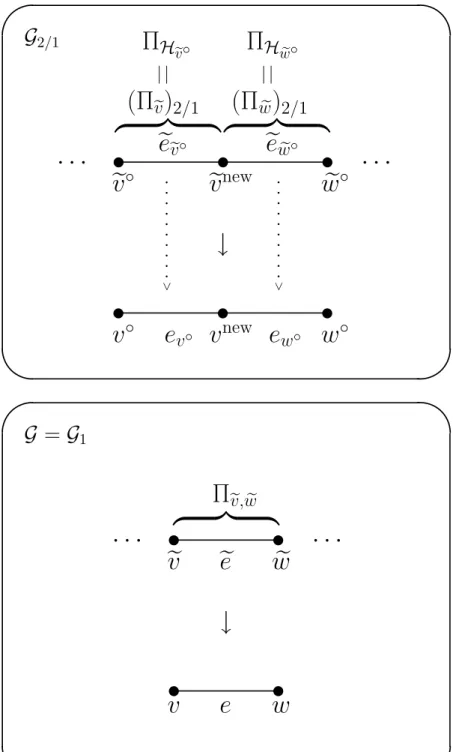
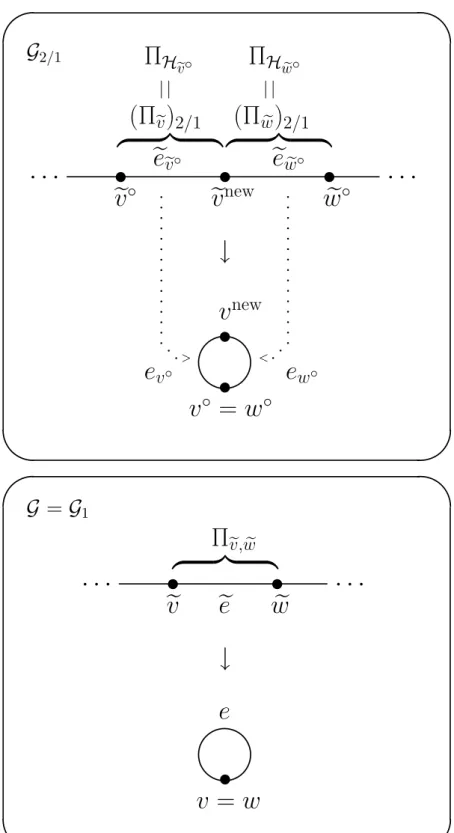
Indeed, the bulk of the proof given in §4 of Theorem 4.14 is devoted to the sufficiencyportion of this result, which is verified by means of a detailed combinatorial analysis [cf. the proof of [CbTpI], Proposition 4.10, (ii)] of the noncyclically primitiveand cyclically primitive cases [cf. Lemmas 4.12, 4.13; Figures 2, 3, 4].
Finally, we apply this glueability result to derive acuspidalization theorem — i.e., in the spirit of and generalizing the corresponding results of [AbsCsp], Theorem 3.1; [Hsh], Theorem 0.1; [Wkb], Theorem C [cf. Remark 4.16.1] — for geometrically pro-l fundamental groups of log stable curves over finite fields [cf. Corollary 4.16]. That is to say, in the case of log stable curves over finite fields,
the condition of compatibility with the Galois action is sufficient to imply the n-cuspidalizabilityof arbi- trary isomorphisms between the geometric pro-l fun- damental groups, for n≥1.
In this context, it is of interest to recall thatstrong anabelian results [i.e., in the style of the “Grothendieck Conjecture”] for such geomet- rically pro-l fundamental groups of log stable curves over finite fields
are not known in general, at the time of writing. On the other hand, we observe that in the case of totally degenerate log stable curves over finite fields, such “strong anabelian results” may be obtained un- der certain technical conditions [cf. Corollary 4.17; Remarks 4.17.1, 4.17.2].
0. Notations and Conventions
Groups: We shall refer to an element of a group astrivial(respectively, nontrivial) if it is (respectively, is not) equal to the identity element of the group. We shall refer to a nonempty subset of a group as trivial (respectively, nontrivial) if it is (respectively, is not) equal to the set whose unique element is the identity element of the group.
Topological groups: Let G be a topological group and J, H ⊆ G closed subgroups. Then we shall write
ZJ(H)def= ZG(H)∩J ={j ∈J|jh=hj for any h∈H} for the centralizer of H inJ and
ZJloc(H)def= lim−→ZJ(U)⊆J
— where the inductive limit is over all open subgroupsU ⊆H ofH — for the“local centralizer”ofH inJ. We shall writeZloc(G)def= ZGloc(G) for the “local center” of G. Thus, a profinite group G is slim [cf. the discussion entitled “Topological groups” in [CbTpI], §0] if and only if Zloc(G) ={1}.
Curves: Let (g, r) be a pair of nonnegative integers such that 2g − 2 +r > 0. Then we shall write Mg,[r] for the moduli stack of pointed stable curves of type (g, r), where the marked points are regarded as unordered, over Z;Mg,[r] ⊆ Mg,[r] for the open substack ofMg,[r] that parametrizes smooth curves, i.e., hyperbolic curves; Mlogg,[r] for the log stack obtained by equipping Mg,[r] with the log structure associated to the divisor with normal crossings Mg,[r]\ Mg,[r] ⊆ Mg,[r]; Cg,[r] → Mg,[r] for the tautological stable curve over Mg,[r]; Dg,[r] ⊆ Cg,[r] for the corresponding tautological divisor of cuspsof Cg,[r] → Mg,[r]. Then the divisor given by the union of Dg,[r] with the inverse image in Cg,[r]
of the divisor Mg,[r] \ Mg,[r] ⊆ Mg,[r] determines a log structure on Cg,[r]; write Clogg,[r] for the resulting log stack. In particular, we obtain a (1-)morphism of log stacks Clogg,[r]→ Mlogg,[r]. We shall write Cg,[r]⊆ Cg,[r]
for the interior of Clogg,[r] [cf. the discussion entitled “Log schemes” in [CbTpI], §0]. Thus, we obtain a (1-)morphism of stacks Cg,[r]→ Mg,[r]. If S is a scheme, then we shall denote by means of a subscript S the result of base-changing via the structure morphism S → SpecZ the various log stacks of the above discussion.
Figure 1 : tripods in the various fibers of a configuration space
tripod
tripod tripod
. . . . . . . .
tripod
tripod tripod
. . . . . . . .
. . . .
. . . .
. . . .
. . . .
. . . . . . . .
1. Combinatorial anabelian geometry in the absence of group-theoretic cuspidality
In the present §1, we discuss various combinatorial versions of the Grothendieck Conjecture for outer representations of NN- and IPSC- type [cf. Theorem 1.9 below]. These Grothendieck Conjecture-type results may be regarded as generalizations of [NodNon], Corollary 4.2;
[NodNon], Remark 4.2.1, that may be applied to isomorphisms that are not necessarily group-theoretically cuspidal. For instance, we prove [cf. Theorem 1.9, (ii), below] that any isomorphism between outer representations of IPSC-type [cf. [NodNon], Definition 2.4, (i)] is nec- essarily group-theoretically verticial, i.e., roughly speaking, preserves the verticial subgroups.
A basic reference for the theory ofsemi-graphs of anabelioids of PSC- typeis [CmbGC]. We shall use the terms “semi-graph of anabelioids of PSC-type”, “PSC-fundamental group of a semi-graph of anabelioids of PSC-type”, “finite ´etale covering of semi-graphs of anabelioids of PSC- type”, “vertex”, “edge”, “node”, “cusp”, “verticial subgroup”, “edge-like subgroup”, “nodal subgroup”, “cuspidal subgroup”, and “sturdy” as they are defined in [CmbGC], Definition 1.1 [cf. also Remark 1.1.2 below].
Also, we shall apply the various notational conventions established in [NodNon], Definition 1.1, and refer to the “PSC-fundamental group of a semi-graph of anabelioids of PSC-type” simply as the “fundamental group” [of the semi-graph of anabelioids of PSC-type]. That is to say, we shall refer to the maximal pro-Σ quotient of the fundamental group of a semi-graph of anabelioids of pro-Σ PSC-type [as a semi- graph of anabelioids!] as the “fundamental group of the semi-graph of anabelioids of PSC-type”.
In the present§1, let Σ be a nonempty set of prime numbers andGa semi-graph of anabelioids of pro-Σ PSC-type. Write G for the under- lying semi-graph ofG, ΠG for the [pro-Σ] fundamental group of G, and G → Ge for the universal covering ofG corresponding to ΠG. Then since the fundamental group ΠG of G is topologically finitely generated, the profinite topology of ΠG induces [profinite] topologies on Aut(ΠG) and Out(ΠG) [cf. the discussion entitled “Topological groups” in [CbTpI],
§0]. If, moreover, we write Aut(G) for the automorphism group of G, then, by the discussion preceding [CmbGC], Lemma 2.1, the natural homomorphism
Aut(G)−→Out(ΠG)
is an injection with closed image. [Here, we recall that an automor- phism of a semi-graph of anabelioids consists of an automorphism of the underlying semi-graph, together with a compatible system of iso- morphisms between the various anabelioids at each of the vertices and
edges of the underlying semi-graph which are compatible with the var- ious morphisms of anabelioids associated to the branches of the under- lying semi-graph — cf. [SemiAn], Definition 2.1; [SemiAn], Remark 2.4.2.] Thus, by equipping Aut(G) with the topology induced via this homomorphism by the topology of Out(ΠG), we may regard Aut(G) as being equipped with the structure of a profinite group.
Definition 1.1. We shall say that an elementγ ∈ΠG of ΠG isverticial (respectively, edge-like; nodal; cuspidal) if γ is contained in a verticial (respectively, an edge-like; a nodal; a cuspidal) subgroup of ΠG.
Remark 1.1.1. Letγ ∈ΠG be a nontrivial[cf. the discussion entitled
“Groups” in§0] element of ΠG. Ifγ ∈ΠGisedge-like[cf. Definition 1.1], then it follows from [NodNon], Lemma 1.5, that there exists a unique edge ee ∈ Edge(Ge) such that γ ∈ Πee. If γ ∈ ΠG is verticial, but not nodal [cf. Definition 1.1], then it follows from [NodNon], Lemma 1.9, (i), that there exists a unique vertexev ∈Vert(Ge) such that γ ∈Πev.
Remark 1.1.2. Here, we take the opportunity to correct an unfortu- nate misprintin [CmbGC]. In the final sentence of [CmbGC], Definition 1.1, (ii), the phrase “rank ≥2” should read “rank>2”.
Lemma 1.2 (Existence of a certain connected finite ´etale cov- ering). Let n be a positive integer which is a product [possibly with multiplicities!] of primes ∈ Σ; ee1, ee2 ∈ Edge(Ge); ev ∈ Vert(Ge). Write e1 def= ee1(G), e2 def= ee2(G), and v def= ve(G). Suppose that the following conditions are satisfied:
(i) G is untangled [cf. [NodNon], Definition 1.2].
(ii) If e1 is a node, then the following condition holds: Let w, w0 ∈ V(e1) be the two distinct elements of V(e1) [cf. (i)].
Then (N(w)∩ N(w0))] ≥3.
(iii) If e1 is a cusp, then the following condition holds: Let w ∈ V(e1) be the unique element of V(e1). Then C(w)]≥3.
(iv) e1 6=e2. (v) v 6∈ V(e1).
Then there exists a Galois subcovering G0 → G of G → Ge such that n divides [Πee1 : Πee1 ∩ΠG0], and, moreover, Πee2, Πev ⊆ΠG0.
Proof. Suppose that e1 is a node (respectively, cusp). Write H for the [uniquely determined] sub-semi-graph of PSC-type [cf. [CbTpI], Definition 2.2, (i)] of G whose set of vertices is = V(e1) = {w, w0} [cf. condition (ii)] (respectively, = {w} [cf. condition (iii)]). Now it follows from condition (ii) (respectively, (iii)) that there exists an e3 ∈ Node(G|H) = N(w)∩ N(w0) (respectively, ∈ Cusp(G|H)∩Cusp(G) = C(w)) [cf. [CbTpI], Definition 2.2, (ii)] such that e3 6= e2. Moreover, again by applying condition (ii) (respectively, (iii)), together with the well-known structure of the abelianization of the fundamental group of a smooth curve over an algebraically closed field of characteristic 6∈ Σ, we conclude that there exists a Galois covering GH0 → G|H that arises from a normal open subgroup of ΠG|H and which isunramifiedat every element of Edge(G|H)\ {e1, e3}andtotally ramifiedate1,e3 with ramification indices divisible by n. Now since GH0 → G|H is unramified at every element of Cusp(G|H)∩Node(G), one may extend this covering to a Galois subcoveringG0 → G of G → Ge which restricts to the trivial covering over every vertex u of G such that u 6= w, w0 (respectively, u 6= w). Moreover, it follows immediately from the construction of G0 → G that n divides [Πee1 : Πee1 ∩ΠG0], and Πee2, Πev ⊆ ΠG0. This
completes the proof of Lemma 1.2. ¤
Lemma 1.3 (Product of edge-like elements). Let γ1, γ2 ∈ ΠG be two nontrivial edge-like elements of ΠG [cf. Definition 1.1]. Write e
e1, ee2 ∈ Edge(Ge) for the unique elements of Edge(Ge) such that γ1 ∈ Πee1,γ2 ∈Πee2 [cf. Remark 1.1.1]. Suppose that the following conditions are satisfied:
(i) For every positive integer n, it holds that γ1nγ2n is verticial.
(ii) ee1 6=ee2.
Then there exists a [necessarily unique — cf. [NodNon], Remark 1.8.1, (iii)] ve∈Vert(Ge) such that {ee1,ee2} ⊆ E(ev); in particular, it holds that γ1γ2 ∈Πev.
Proof. Since ee1 6= ee2 [cf. condition (ii)], one verifies easily that there exists a Galois subcoveringH → G ofG → Ge that satisfies the following conditions:
(1) ee1(H)6=ee2(H).
(2) H is untangled [cf. [NodNon], Definition 1.2; [NodNon], Re- mark 1.2.1, (i)].
(3) For i ∈ {1,2}, if eei ∈ Node(Ge), then the following holds: Let w, w0 ∈ V(eei(H)) be the twodistinct elements of V(eei(H)) [cf.
(ii)]. Then (N(w)∩ N(w0))]≥3.
(4) For i ∈ {1,2}, if eei ∈ Cusp(Ge), then the following holds:
Let w ∈ V(eei(H)) be the unique element of V(eei(H)). Then C(w)] ≥3.
Now it is immediate that there exists a positive integer m such that γ1m ∈Πee1 ∩ΠH,γ2m ∈Πee2 ∩ΠH. Letev ∈Vert(Ge) be such that γ1mγ2m ∈ Πve [cf. condition (i)].
Suppose that ve(H) 6∈ V(ee1(H)). Then it follows from Lemma 1.2 that there exists a Galois subcovering H0 → H of G → He such that γ1m 6∈ΠH0, and, moreover, Πee2 ∩ΠH, Πev∩ΠH ⊆ΠH0. But this implies that γ2m, γ1mγ2m ∈ ΠH0, hence that γ1m ∈ ΠH0, a contradiction. In particular, it holds that ev(H) ∈ V(ee1(H)); a similar argument implies that ev(H)∈ V(ee2(H)), hence that V(ee1(H))∩ V(ee2(H))6=∅. Thus, by applying this argument to a suitable system of connected finite ´etale coverings ofH, we conclude thatV(ee1)∩V(ee2)6=∅, i.e., that there exists a ev ∈ Vert(Ge) such that {ee1,ee2} ⊆ E(ev). Then since Πee1, Πee2 ⊆ Πev, it follows immediately that γ1γ2 ∈ Πve. This completes the proof of
Lemma 1.3. ¤
Proposition 1.4 (Group-theoretic characterization of closed subgroups of edge-like subgroups). Let H ⊆ ΠG be a closed sub- group of ΠG. Then the following conditions are equivalent:
(i) H is contained in anedge-like subgroup.
(ii) An open subgroup of H is contained in an edge-like sub- group.
(iii) Every element of H is edge-like [cf. Definition 1.1].
(iv) There exists a connected finite ´etale subcovering G† → G of G → Ge such that for any connected finite ´etale subcovering G0 → G of G → Ge that factors through G† → G, the image of the composite
H∩ΠG0 ,→ΠG0 ³Πab/edgeG0
— where we writeΠab/edgeG0 for thetorsion-free[cf. [CmbGC], Remark 1.1.4] quotient of the abelianization ΠabG0 by the closed subgroup topologically generated by the images in ΠabG0 of the edge-like subgroups of ΠG0 — is trivial.
Proof. The implications (i) ⇒ (ii) ⇒ (iv) are immediate. The equiv- alence (iii) ⇔ (iv) follows immediately from [NodNon], Lemma 1.6.
Thus, to complete the verification of Proposition 1.4, it suffices to ver- ify the implication (iii)⇒(i). To this end, suppose that condition (iii) holds. First, we observe that, to verify the implication (iii) ⇒ (i), it suffices to verify the following assertion:
Claim 1.4.A: Let γ1, γ2 ∈ H be nontrivial elements.
Write ee1, ee2 ∈ Edge(Ge) for the unique elements of Edge(Ge) such thatγ1 ∈Πee1,γ2 ∈Πee2 [cf. Remark 1.1.1].
Then ee1 =ee2.
To verify Claim 1.4.A, let us observe that it follows from condition (iii) that, for every positive integer n, it holds thatγ1nγ2n isedge-like, hence verticial. Thus, it follows immediately from Lemma 1.3 that there exists a element ev ∈ Vert(Ge) such that {ee1,ee2} ⊆ E(ev); in particular, it holds that γ1, γ2 ∈ Πev. Thus, to complete the verification of Claim 1.4.A, we may assume without loss of generality — by replacing ΠG,H by Πev, Πev∩H, respectively — that Node(G) = ∅[soee1,ee2 ∈Cusp(Ge)].
Moreover, we may assume without loss of generality — by replacing ΠG (respectively, γ1, γ2) by a suitable open subgroup of ΠG (respectively, suitable powers of γ1, γ2) — that Cusp(G)] ≥ 4. Thus, it follows immediately from the well-known structure of the abelianization of the fundamental group of a smooth curve over an algebraically closed field of characteristic 6∈Σ that the direct product of any 3 cuspidal inertia subgroupsof ΠGassociated todistinctcusps ofG mapsinjectivelyto the abelianization ΠabG of ΠG. In particular, since γ1γ2 is edge-like, hence cuspidal, it follows, by considering the cuspidal inertia subgroups that contain γ1, γ2, and γ1γ2, that ee1 = ee2. This completes the proof of Claim 1.4.A, hence also of the implication (iii) ⇒ (i). This completes
the proof of Lemma 1.4. ¤
Proposition 1.5 (Group-theoretic characterization of closed subgroups of verticial subgroups). Let H ⊆ ΠG be a closed sub- group of ΠG. Then the following conditions are equivalent:
(i) H is contained in a verticial subgroup.
(ii) An open subgroup ofH is contained in a verticial subgroup.
(iii) Every element of H is verticial [cf. Definition 1.1].
(iv) There exists a connected finite ´etale subcovering G† → G of G → Ge such that for any connected finite ´etale subcovering G0 → G of G → Ge that factors through G† → G, the image of the composite
H∩ΠG0 ,→ΠG0 ³Πab-combG0
— where we writeΠab-combG0 for thetorsion-free[cf. [CmbGC], Remark 1.1.4] quotient of the abelianization ΠabG0 by the closed subgroup topologically generated by the images in ΠabG0 of the verticial subgroups of ΠG0 — is trivial.