Abstract
The main purpose of this paper is to introduce several graphical meth- ods of describing deductive hyperdigraphs and explains its significance for description of complex systems.
Deductive hyperdigraphs
A method of describing diversity of coherences
Ver0.98 99.1.30
Akira Higuchi
Department of Mathematics, Hokkaido University
Kazumasa Matsuo
Technology Development Department, NTT Communicationware Corporation
Toru Tsujishita
Department of Mathematics, Hokkaido University
January 30, 1999
Contents
1 Deductive hyperdigraphs 5
1.1 Definition . . . 5
1.2 Examples . . . 5
1.2.1 Simple logic, empirical logic . . . 5
1.2.2 Mutual dependency of random variables . . . 6
1.2.3 Functional relations . . . 6
1.2.4 Algebraic structures . . . 6
1.2.5 Metabolic systems . . . 6
1.2.6 Events . . . 6
2 Equivalent concepts 7 2.1 Closure operators . . . 7
2.2 Moore family . . . 7
2.3 Lattice labeling . . . 7
2.4 Bijective correspondences . . . 9
2.4.1 Bijection between deductive hyperdigraphs and clo- sure operators . . . 9
2.4.2 Bijection between closure operators and Moore fam- ilies . . . 9
2.4.3 Bijection between Moore families and lattice labelings 10 2.4.4 Bijection between lattice labeled sets to deductive hyperdigraphs . . . 10
2.4.5 Summary . . . 11
2.5 Examples . . . 11
2.5.1 Example 1 . . . 11
2.5.2 Example 2 . . . 12
2.5.3 Example 3 . . . 12
3 The lattice of deductive hyperdigraphs 14 3.1 Poset of deductive hyperdigraphs . . . 14
3.1.1 Closure operator . . . 14
3.1.2 Moore families . . . 14
3.1.3 Lattice labelings . . . 14
3.1.4 Equivalence . . . 15
3.2 Existence of graded poset structure . . . 15
3.3 Deformation of deductive hyperdigraphs . . . 15
4 Description of deductive hyperdigraphs of degree up to 4 15 4.1 Deductive hyperdigraphs of degree three . . . 15
4.1.1 Representation by generating arcs . . . 16
4.1.2 Representation by closed sets . . . 17
4.1.3 Representation by labeled lattice . . . 18
4.2 deductive hyperdigraphs of degree four . . . 19
4.2.1 graded lattice structure . . . 19
4.2.2 An example of generation of coherence . . . 20
5 Application to description of complex systems 20 5.1 Aspects of interrelationship among components . . . 20
5.2 Change of coherence caused by freezing components . . . . 24
5.3 Relation with the environment . . . 25
5.3.1 Example 1 . . . 25
5.3.2 Example 2 . . . 26
6 Concluding remarks 26
A Closure operator of lattices 29
B Proof of Proposition 3.1.4 30
Introduction
Although research of complex systems require description of various in- tricate interrelationship between their components, there seems to be few concepts which can handle the relationship among more than two compo- nents, such as
• the componentadoes not determine the behavior of the component cbutaandbdo determinec. On the other handbis determined by the componentsa, c,
or
• the componentadetermines both of the componentbandc.
We say that there is a functional dependency of a componentaon the components b1,· · ·, bn, if the status of the latter determines that of the former. Note that the causality is a special functional dependency when temporal factor is taken into consideration. The functional dependencies in a system have rather complex relationship with each others and it is hopeless to try to express their totality without mathematical language.
In this paper, we show that the concept of deductive hyperdigraph is precisely the mathematical concept which can depict such totality. More- over, this concept is helpful also for such diverse topics as metabolic sys- tems, deduction systems, and concurrent systems.
Ahyperdigraphconsists of a set of nodes and a relation`which relates finite subsets of nodes to nodes. We express the statement that the nodes a1,· · ·, anare related tobby
a1,· · ·, an→b.
By this relation we intend to mean that the components a1,· · ·, an col- lectively determine the behavior ofb, or, we can infer the behavior of the componentbonce we know the behavior of the componentsa1,· · ·, an.
A hyperdigraph is calleddeductiveif
• it istransitivein the following sense: From a0, a1,· · ·, an→b, and
c1,· · ·, cm→a0, it follows
c1,· · ·, cm, a1,· · ·, an→b,
• it isreflexive, i.e.,a1,· · ·, an→aifor alli,
• it ismonotone, i.e.,a1,· · ·, an→bimpliesa, a1,· · ·, an→b.
In contrast to the digraphs which have the natural planar graph rep- resentation, there seems to be no such canonical representation for hy- perdigraphs, although there are many representations of them, which are claimed to be minimal[AAS].
In this paper we also give various method of describing deductive hy- perdigraphs. We illustrate these methods by describing 14 different co- herence structures on systems composed of 3 elements.
One of the most concise method of description seems to be given by a set with lattice labeling. A lattice labeling ona setV is simply a map λfromV to a latticeL. This induces a deductive hyperdigraph structure onV by
a1,· · ·, an→b ⇐⇒def λa1
_· · ·λan≥λb.
When we impose the condition that the image ofλgenerates Lwith respect to the join operation, then this description is essentially unique.
Thus this allows us to enumerate all deductive hyperdigraph structures on a given set easily when the number of components is small. We can use it also to analyze interrelations between various deductive hyperdigraphs structures on a fixed set, which can be interpreted as the relation between coherences of complex systems.
Notations PV will denote the powerset of a setV, which is regarded as a lattice by the usual inclusion orders. We usually write a singleton set {v}simply byv for brevity. We use the notationA ⊆B when A is a subset ofB andA⊂BwhenA⊆B butA6=B.
Through this paper,all sets are assumed to be finite.
1 Deductive hyperdigraphs
1.1 Definition
A hyperdigraph is a pair Γ = (V, E), with E ⊆ PV ×V. We write W→Γv when (W, v) ∈ E. If {a1,· · ·, an} = W, we use the notation a1,· · ·, an→v. We often refer to a hyperdigraph simply by a pair (V,→).
Two hyperdigraphs (Vi,→i) (i= 1, 2) are calledisomorphic if there is a bijectionf:V1→V2 satisfying
W→1v⇐⇒f W→2f v for allW ⊆V1 andv∈V1.
A hyperdigraph Γ is calledtransitiveif it satisfies the following condi- tion:
(T R) W∪v→v0 W0→v
W∪W0→v0 , i.e., ifW→vandW0∪v→v0holds, thenW∪W0→v0.
It is easily shown that the transitivity is equivalent to the following apparently stronger condition:
(T R0) W→v ∀w∈W[U→w]
U→v .
A hyperdigraph is calledreflexive ifW→wfor allv∈W, andmono- toneif
W→v W∪W0→v for allW0⊆V.
A hyperdigraph is called deductive if it is reflexive, monotone and transitive. The set of all the deductive hyperdigraphs with the vertex set V is denoted by DHGraph(V).
1.2 Examples
It is easily shown that the following (V,→)’s are deductive hyperdigraphs.
1.2.1 Simple logic, empirical logic
Let V be a finite set of propositions. Define W→v if the proposition v holds whenever every proposition inW is valid [Cl]. The transitivity is nothing but the cut rule of deduction.
Such logic appears commonly in daily life as the empirical deduction based on memories of concrete events. In fact, when certain propositions
p1,· · ·, pnturn out to be true, we sometimes conclude thatpis true when the proposition p was true under all the situations we can recall where p1,· · ·, pnhold. Such empirical judgments are continuously changing ac- cording to the increase or decrease of the memory of empirical situations.
1.2.2 Mutual dependency of random variables
Let (X,B, µ) be a probability space. Let (xv : X→Xv)v∈V be a finite family of random variables. This defines the following deductive hyper- digraph with base setV:a1,· · ·, an→bwhen the support of the induced probability measure onXa1× · · · ×Xan×Xbis included in the graph of a function fromXa1× · · · ×Xan toXb. This example can be considered as a special case of the next example.
1.2.3 Functional relations
Let {Xv|v∈V } be a family of nonempty sets and R ⊆ Q
v∈VXv. DefineW→Rvwhen
∀w∈W [w(x) =w(y) ] v(x) =v(y)
for allx, y∈R. Herev(x) denotes thev-th component ofx∈R.
Remark. It is known that every deductive hyperdigraph of finite degree can be realized in this way[A].
1.2.4 Algebraic structures
When a setV is given a family of operations, then every subsetA⊆V defines a closed subset A ⊆V called its closure, which is the collection of the elements generated byA with the given operations. For example, if G is a group, thenA ⊆ Ggenerates a subgroup A ⊆ G. We define a1,· · ·, an→bifbis generated bya1,· · ·, an.
1.2.5 Metabolic systems
LetV be a finite sorts of chemical molecules. DefineW→vwhen molecules of sortvcan be produced from the molecules of sorts inW. Under some situations, the monotonicity might be questionable, since some molecule can inhibit certain chemical reactions. However, if there are no such inhibiting molecules, it is obvious thatW→vdefines a deductive hyper- digraph.
1.2.6 Events
Let V be a finite set of events of a system P of concurrent processes.
DefineW→Pv if in every possible behavior ofP, the eventvmust have occurred whenever every event inW has occurred. In other words, the totality of events inW cannot occur without accompanying the eventv.
The monotonicity is again questionable when certain set of events might conflict and cannot occur.
Consider the hyperdigraphW→v defined by the condition that the events in W must have occurred whenever v is occurred. Then this is transitive and reflexive. However, this obviously not generally monotone, since otherwise V→v for any v ∈ V and hence every event must have occurred when some event has occurred, which is a very degenerate situ- ation.
2 Equivalent concepts
The notion of deductive hyperdigraphs have three equivalent concepts, closure operator, Moore family and lattice labeled set.
2.1 Closure operators
A mapC:PV→PV is calleda closure operator onV if it satisfies, for A, B∈ PV,
(C1) A⊆CA,
(C2) A⊆B =⇒ CA⊆CB, (C3) CCA=CA.
We denote by Con(V) the set of all the closure operators onV. Note that we do not impose the condition
C∅=∅
which is sometimes included in the definition of closure operators.
2.2 Moore family
A family A of subsets of V is called an intersection structure on V if A∩B ∈ Awhenever A, B ∈ A. An intersection structure A is called a Moore family if containsV. We denote by Moore(V) the set of all the Moore family onV. We call a Moore familyA totally alivewhen it contains the empty set. When A is not totally alive, then there are elements in the intersection of A which may be regarded as constant components able to be ignored in many aspects.
2.3 Lattice labeling
A mapλfromV to a latticeLis calleda lattice labeling ofV. It is called reduced whenλgeneratesLwith respect to the join operation, i.e., each
`∈Lis the join of the image of a subset ofV.
Two lattice labelings λi : V→Li(i= 1, 2) are called isomorphic if there is a lattice isomorphismg:L1→L2 satisfyingλ2=g◦λ1.
A lattice labeled set is a pair (V, λ) of a set and a lattice labelingλ.
Ifλis reduced, we call (V, λ) a reduced lattice labeled set.
A lattice labelingλ:V→Linduces a mapλ∗:L→P V defined by λ∗`:={v∈V |λv≤`}.
Proposition 2.1 (i)The mapλ∗is a meet semilattice map, i.e., λ∗(`1∧`2) =λ∗`1∩λ∗`2.
In particular, the image ofλ∗is a Moore family. Furthermore
λ∗(`1∨`2) =λ∗`1
[ λ∗`2,
where the closure is taken with respect to the image of λ∗ which is meet closed family of subsets (cf. A.1).
(ii)The following conditions are equivalent to each others:
(a) The lattice labelingλis reduced.
(b) For every`∈L,
`= _
v∈λ∗`
λv.
(c) λ∗is injective.
Proof. Let`i∈L(i= 1, 2). Then
λ∗(`1∧`2) = {v|λv≤`1 ∧ λv≤`2}
= {v|λv≤`1} ∩ {v|λv≤`2}
= λ∗`1∩λ∗`2. Hence the assertion (i).
Supposeλis reduced. Then, for`∈L,`=W
v∈Iλvfor someI ⊆V. SinceI⊆λ∗`, we have
`=_
v∈I
λv≤ _
v∈λ∗`
λv≤`.
It is obvious that (b) implies (c).
Suppose now (c) holds. For`∈L, put
`0:= _
λv≤`
λv≤`.
Thenλ∗`≤λ∗`0 since
v∈λ∗`⇒λv≤` ⇐⇒ λv≤`0 ⇐⇒ v∈λ∗`0. On the other hand, λ∗`0 ≤λ∗` since `0 ≤ `. Hence λ∗` = λ∗`0, which
implies`=`0by (c). q.e.d.
Remarks (i) Note that the Moore families coincide when they are induced by isomorphic lattice labelings. (ii)Note that there are researches with results representing a lattice concretely as a sublattice of the powerset lattice of a set [BF]. For example, given a latticeL, we defineV to be the set of join-irreducible elements ofLand consider the inclusionι:V→L.
Then this defines a reduced lattice labeling ofV [Co]. However, for our purpose, the role of lattices are secondary compared to the base setV to
be labeled. For example, when an element v ∈ V is labeled by a join- reducible element, this means that it isredundant since it is produced by {w|λw < λv}because
λv= _
λw<λv
λw.
2.4 Bijective correspondences
We show that the structures introduced above correspond bijectively to each others naturally.
2.4.1 Bijection between deductive hyperdigraphs and clo- sure operators
Let Γ = (V,→) be a deductive hyperdigraph. Define, forA∈ PV, CΓ(A) :={v∈V |A→v}.
Proposition 2.2 CΓis a closure operator.
Proof. The conditions (C1) and (C2) obviously hold. We have only to show thatCCA ⊆CA. Supposev ∈ CCA, i.e. W→v withW ⊆CA.
Then, for eachw ∈ W, there is aUw ⊆A with Uw→w. By (TR’), we haveU :=∪w∈WUw→v. SinceU ⊆A, we obtainv∈CA. q.e.d.
On the other hand, for a closure operatorConV, define W→Cv ⇐⇒def v∈CW.
Proposition 2.3 The pair(V,→C)is a deductive hyperdigraphs.
Proof. Obviously→C is reflexive and monotone. SupposeW→v and W0∪ v→v0 hold. FromW0 ⊆CW0 and v ∈ CW, we haveW0∪ v ⊆ CW∪CW0⊆C(W∪W0). Hence
v0∈C(W0∪ v)⊆CC(W∪W0) =C(W∪W0),
which meansW∪W0→v0. q.e.d.
It is obvious that the above correspondences are inverse to each other.
Proposition 2.4 The correspondence which associates Γ with CΓ is a bijection.
2.4.2 Bijection between closure operators and Moore fam- ilies
LetC be a closure operator onV. A subsetAofV is calledclosed with respect to C if it is a fixed point ofC, i.e., CA=A. The set of all the closed sets will be denoted byAC, which is a Moore family by Proposition A.1 since it obviously containsV.
Conversely, supposeAis a Moore family onV. Define CAX := \
X⊆A∈A
X.
Then this is a closure operator again by A.1.
By A.1 we have
Proposition 2.5 The correspondence which associates a closure operator C to the Moore familyAC is bijective.
2.4.3 Bijection between Moore families and lattice label- ings
LetAbe a Moore family onV. DefineλAv:=CA{v}.
Proposition 2.6 The lattice labelingλA:V→Ais reduced.
Proof. SupposeA∈ A. SinceλAa=CAa⊆Afor alla∈A, we have A⊆ [
a∈A
λAa⊆A,
whenceA=W
a∈AλAa. q.e.d.
Suppose now λ : V→L is a lattice labeling on V. Define Aλ :=
{λ∗`|`∈L}. By Proposition2.1, we have obviously the following.
Proposition 2.7 Ifλis a lattice labeling, then the familyAλis a Moore family.
We have the following proposition.
Proposition 2.8 The correspondence is bijective which associates a Moore familyAto the isomorphic class, represented byλA, of reduced lattice la- belings.
Proof. Since the lattice for the labeling λA isAitself, the correspon- dence is injective. It is surjective, since for a reduced lattice labeled set (V, λ :V→L), the Moore family Aλis isomorphic as a lattice to L and induces a lattice labeling obviously isomorphic toλ. q.e.d.
2.4.4 Bijection between lattice labeled sets to deductive hyperdigraphs
The composition of the above bijections gives one between isomorphic classes of reduced lattice labelings to deductive hyperdigraphs. Its direct description is as follows. A lattice labelingλ:V→Linduces a deductive hyperdigraph→defined by
W→v ⇐⇒def λW≥λv, whereλW :=W
w∈Wλw.
Proposition 2.9 The pair(V,→)is a deductive hyperdigraph.
Although it is easy to trace the correspondences constructed above to show this, we prove this directly because of the importance of the representation of deductive hyperdigraphs by lattice labelings.
Proof. Obviously→C is reflexive and monotone. SupposeW→v and W0∪v→v0hold.
λ(W∪W0) = λW∨λW0
≥ λv∨λW0
= λ(v∪W0)
≥ λv0.
HenceW∪W0→v0. q.e.d.
2.4.5 Summary
We have proved the following.
Theorem 2.10 The correspondences
Γ↔C↔ A ↔(V, λ) give bijections between the following sets
• deductive hyperdigraphs onV,
• closure operators onV,
• Moore families onV,
• lattice labelings onV.
2.5 Examples
2.5.1 Example 1
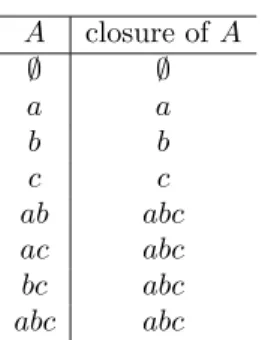
In this example, besides the emptyset and the total set abc there are only three nontrivial closed sets a,b and c. Hence the closure of any subset with two elements is the total space, which means that any two components dominates the other one. Since singleton sets are closed, no single component determine the others.
A closure ofA
∅ ∅
a a
b b
c c
ab abc
ac abc
bc abc
abc abc
Table 1: Closure operator
2.5.2 Example 2
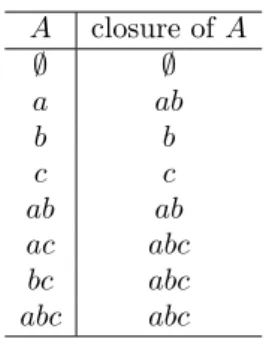
In this case the nontrivial closed sets areb, candab. Hence the closure of a isab, which means a→b. In other words, the componentadominates b. Furthermore the closure of bc is abc, which means b, c→a, i.e., the components b, c together dominate a although neitherbnor ccan do it sinceb,care closed sets. We may say that once the componentcis frozen the componentsaandbdominates each other.
2.5.3 Example 3
There are only five nontrivial closed setsb, c, d, ab, bcd. Hence as in Ex- ample 1, any two ofbcddetermines the other. The closure ofabis abcd, whenceabdominatescandd:
a, b→c a, b→d.
Note that either of these hyperarcs induce the other. For example,a, b→c andb, c→dimpliesa, b, b→dby the transitivity.
A closure ofA
∅ ∅
a ab
b b
c c
ab ab
ac abc
bc abc
abc abc
Table 2: Closure operator
A closure ofA
∅ ∅
b b
c c
d d
a, ac ac
bc, bd, cd, bcd bcd ab, ad, abc, abd, acd, abcd abcd
Table 3: Closure operator
3 The lattice of deductive hyperdigraphs
3.1 Poset of deductive hyperdigraphs
The set of deductive hyperdigraph structures on a setV is a Moore family onPV ×V, where→:=→1∩ →2 is defined by
W→v ⇐⇒def W→1v∧W→2v.
We call the closure of a subsetU ofPV ×V with respect to the closure operator corresponding to this Moore family, asthe deductive hyper- digraph generated byU.
The natural partial order ofP(PV×V) induces one on DHGraph(V), which can be described as
→1≤ →2
⇐⇒def W→1v W→2v.
This partial order has the following description in each cryptomorphic expression.
3.1.1 Closure operator
LetCi(i= 1, 2) be closure operators onV . Define C1≤C2
⇐⇒def C1W⊆C2W for allW ⊆V.
3.1.2 Moore families
For Moore familiesAi(i= 1, 2), define A1≤ A2
⇐⇒ Adef 1⊇ A2.
A stronger intersection structure as fewer closed sets.
3.1.3 Lattice labelings
Letλi:V→Li(i= 1, 2) be lattice labelings. Define λ1≤λ2
when there is an injective meet lattice map i : L2→L1 such that the closure operator C :L1→L1, corresponding to the Moore family Im(i), satisfies
C(λ2(v)) =i(λ2(v))
for allv∈V. Recall here that the meet semilattice map preserves the top element which is the meet of the empty set.
3.1.4 Equivalence
Proposition 3.1 Let →i, Ci,Ai, λi(i= 1, 2) correspond to each other under the cryptomorphisms, then
→1≤ →2 ⇐⇒ C1≤C2
⇐⇒ A1≤ A2
⇐⇒ λ1≤λ2
We prove this in the Appendix.
3.2 Existence of graded poset structure
The poset of Moore families onV has a graded poset structure [H, BDK].
The following is the key lemma behind this fact.
Lemma 3.2 ([H] Lemma3, Lemma 6) Let A be a Moore family on V. Then
A \ {X } ↔X∈ A
is a one-to-one correspondence between the Moore families which coverA with respect to the order “≤” and those elementsX of Asatisfying
X 6=\
{A∈ A |A⊃X }.
LetAbe a Moore family. We call an elementx∈ Aremovableif x6= \
y∈A,y6=x
y,
i.e. it is meet irreducible. The above lemma says that ifxis removable, thenA \ {x}is a Moore family again.
An elementy /∈ Ais calledaddable to Aif x∩y∈ Afor allx∈ A.
It is obvious that ifyis addable thenA ∪ {y}is a Moore family.
3.3 Deformation of deductive hyperdigraphs
When a multicomponent system varies, the mutual dependencies of com- ponents change. The above lemma 3.2 describes how the change takes place successively. Changes can be described as the succession of atomic changes, which either remove removable closed sets or add addable sets.
4 Description of deductive hyperdigraphs of degree up to 4
4.1 Deductive hyperdigraphs of degree three
There are 14 isomorphic types of deductive hyperdigraphs on a set of three elements, which will be graphically described in the following tree ways:
• representation by generating arcs,
• representation by closed sets,
• representation by labeled lattice.
4.1.1 Representation by generating arcs
We say thatW→ais minimal, if there is noW0⊂W withW0→a. When ab→cis minimal, we write an arc from middle of the edgeabto the vertex c.
4.1.2 Representation by closed sets
4.1.3 Representation by labeled lattice
We note that when the emptyset is join irreducible, then we can remove it. Hence we have in fact five more diagrams.
4.2 deductive hyperdigraphs of degree four
4.2.1 graded lattice structure
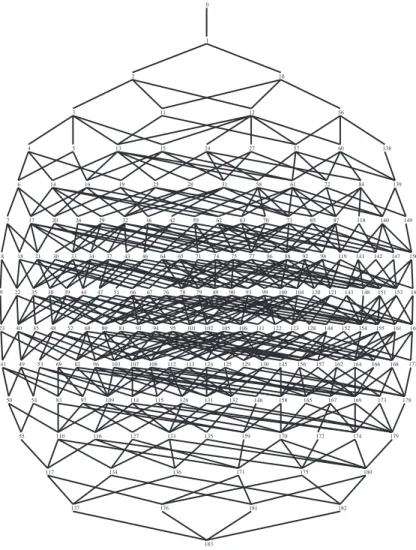
There are 184 deductive hyperdigraphs of degree four. They form a graded lattice whose shape is as follows:
0
1
2
3
4 5
6
7
8
9
10
11 12
13
14
15
16
17
18
19
20
21
22
23
24
25
26
27
28
29
30
31
32
33 34
35
36
37
38 39
40
41
42
43
44
45
46
47
48
49
50
51
52
53
54
55
56
57
58
59
60
61
62 63
64 65
66 67
68
69
70
71
72
73
74 75
76
77
78 79
80 81
82
83
84
85
86
87
88
89 90
91
92
93
94 95
96
97
98
99 100
101 102
103
104
105 106
107 108
109
110
111
112 113
114 115
116
117
118
119
120 121
122 123
124 125
126
127
128
129 130
131 132
133
134
135
136
137
138
139
140
141 142
143
144
145
146
147
148 149
150
151
152
153
154 155
156 157
158
159
160
161
162
163
164
165
166
167
168
169
170
171
172
173
174
175
176
177
178
179
180
181 182
183
Figure 1: Hasse diagram of the lattice of closure operators of degree 4
4.2.2 An example of generation of coherence
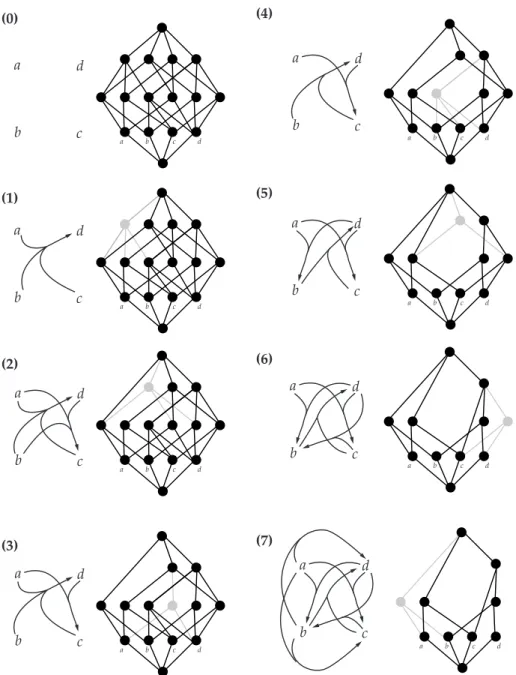
Every path in Figure 1 from the bottom to the top describes a shortest path of change coherence, from the weakest to the strongest. We pick up arbitrary such path and draw the coherence of each step by hyperdigraph and by lattice labeled set in Figures 2,3.
5 Application to description of complex systems
5.1 Aspects of interrelationship among compo- nents
We can read various aspects of interrelationship among components from labeled lattices.
1. When a node is labeled by a single labelx, then thex-component by itself dominates no other ones.
2. When a node is labeled by several labels x1,· · ·, xm, then any of these dominates the others. Namely these components are com- pletely coherent and any of them dominates all the others. When this node is the bottom, then these components are frozen, whereas the empty set is closed, these components combined together have onlyone degree of freedom.
3. For the deductive hypergraph given by the following graph, the com- ponentsaandbeven combined together dominate no other ones.
4. The following graph means c→a, c→b and a, b→c. Namely, the componentcdominates bothaandb, but is dominated byaandb combined together. However neitheranorbdominatescin isolation.
5. The following graph meansc→aandc→bbuta, b→cdoes not hold.
Namely, the componentcdominatesaandbbutaandbeven com- bined together cannot dominatec.
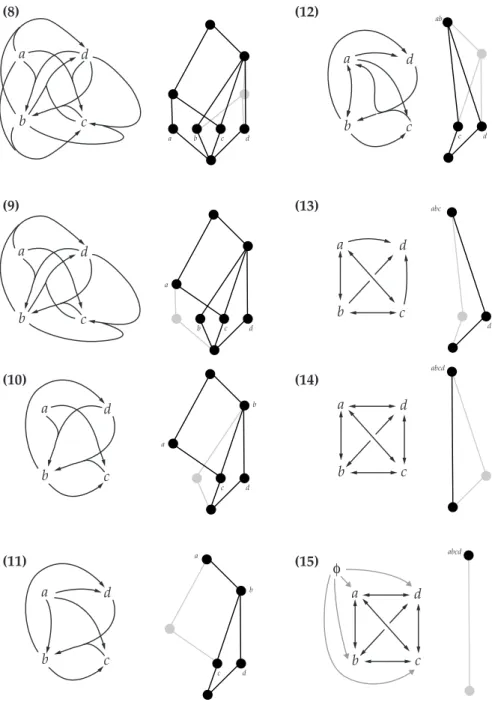
Figure 2: Change of coherence (i). (0) draws the weakest coherence where every component is independent of other ones. At the stage (3) the componentsa, d suffice to dominatec. At the stage (5) the components exceptaare dependent on some of the other components. any of the pairsha, di,ha, di,ha, di,ha, di, two components dominate the other ones.
φ
Figure 3: Change of coherence (ii). At the stage (9), the componenta alone begins to dominate c and at the stage (11) it begins to dominate the whole system. At the stage (14) every component is interlocked to each others and at final stage (15) every component gets frozen.
6. The following graph describes the deductive hyperdigraph of Exam- ple 1. The componentadominatesbandbwith the help ofcin turn dominatesa. Recall that this is the lattice called pentagon which prevents the whole lattice being modular.
7. The following graph meansa, b→c,b, c→a,c, a→b, namely, any two of the three dominate the other one. Recall that this is the lattice called diamond which prevents a modular lattice being distributive.
8. For the deductive hyperdigraph given by the following graph, each ofaandbdominatesc. But this might give rise to conflicts between aandbwhen they want to controlcindependently. In other words, this coherence implies that there is certain relationship between a and b, which might be very strong. In the context of functional dependencies, this case is described by the equations
xc=f(xa) =g(xb),
which obviously induces implicit functional relationship f(xa) = g(xb). Although generally this induces almost functional relation- shipa↔bwhen the relation is differentiable, it is not necessary the case with general case.
5.2 Change of coherence caused by freezing com- ponents
When some of the components of a system is frozen being clamped from outside, the mode of mutual coherence changes in various ways. The lattice labelings gives us concise description of such changes.
Letλ:V→Lbe the current mode of coherence, whereV is the set of components of the system. Suppose the components inW ⊂V is frozen.
Then the set of possibly active components of the system turns toV \W and the resulting coherence is stronger or equal to the one given by the lattice labeling
λW :V \W→LW, where
LW :={`∈L|`≥`W := _
w∈W
λw}, and
λWv:=λv∨`W.
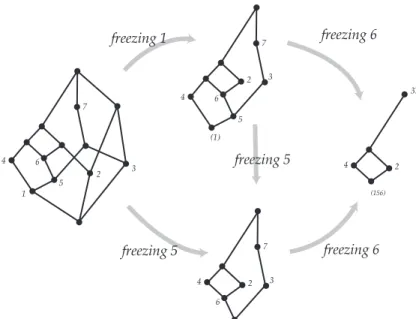
The justification that why this construction describes the lower bound of the effect of freezing components can be seen by first analyzing the deductive hyperdigraph →0 of the resulting coherence. Since the com- ponents inW are fixed, every component actually dominates W and its closure. HenceU→0vifUS
W→v. So, if we define U→Wv ⇐⇒def U[
W→v, then→0≥ →W.
The lattice labeling of→W is given by extracting those closed sets of
→which includesW, whence the image of the labelingλW of→W isLW. Moreover,
λW(v) = \
v∈U,W⊆U
U =v[
W ={v}_
W =λv∨`W.
We illustrate this operation by the following example. When the com- ponent 1 is frozen, then the component 3 begins to dominate 5 since 1∨3≥5. Similarly 2 begins to dominate 6 since 2∨1≤6. When 6 is frozen, then 3 and 7 begin to dominate the entire system.
Figure 6: Change of coherence by freezing components
5.3 Relation with the environment
The deductive hyperdigraphs offers a rich language to talk about inter- relationship between a system and its environment. Especially, it can express the subtleties of the influence of the environment on the systems, which seems not possible for the natural language.
We illustrate only a few of such examples.
5.3.1 Example 1
Supposea, bbelongs to the system andcis outside of the system. Then this coherence means that with the factorcone can control the mode of mutual determination of the componentsa, bof the system. Ifcis frozen, then the componenta, bacts in a fixed interlocked mode.
Suppose b, c belongs to the system and a is outside of the system.
Then the system dominates the partaof the environment. However bya one can effect the mutual relationship betweenbandc. In fact, by getting hold ofa, one can control the behavior of the system in the componentb by closely observing the behavior ofc. However, in this case, there might occur inconsistency or conflict in the control since the controller citself can be controlled by the system.
By this example it should be realized that a, c→b
under a coherence does not imply thata, ccontrolsb. For example, ifbis rigid, then presence of this coherence implies certain constraint between a, c.
5.3.2 Example 2
Supposea, bbelongs to the system andcis outside of the system. Then the component bis determined by the component a internally, whereas a is determined bybwhen cis controlled from outside. In this case the control can effect only the inverse determination frombtoa.
Suppose nowb, cbelongs to the system andais outside of the system.
Then one can controlbof the system directly byabut, the system can get hold ofawhencis used jointly withb. So here again there is conflict when this coherence is utilized both by the environment and by the system.
6 Concluding remarks
Deductive hyperdigraphs are closely related to various topics.
Multicategory If we give names to hyperarrows as ϕ:a1,· · ·, an→b,
then we come roughly to the notion of symmetric multicategory of Lambek[L].
Infinite base set When the base set V is infinite, we must use the concept of compactness. The closure operators should be restricted to satisfy the compactness condition
CY = [
A⊂Y,Ais finite CA.
We must also impose a Moore familyAthe compactness condition
Y = [
A⊂Y,A∈A
A.
The lattice used in labeling should be algebraic lattice in the sense that every elements can be expressed as the join of compact elements.
Domain When the monotonicity condition is dropped to a certain de- gree, we obtain a structure studied in the domain theory. We will discuss such structure in future [HMT].
Matroid If a deductive hyperdigraph satisfies the following condition, then it is a structure usually calledmatroid. IfW→bbutW06 →bfor all proper subsetW0⊂W, thenW∪b\w→wfor allw∈W. The family of closed sets forms a semi-modular lattice. Only a few of deductive hyperdi- graphs are matroids. For example, among the 14 deductive hyperdigraph of degree 3, there only three such ones. The matroid has yet another defi- nition bysubmodular functionρ:P(V)→N, where submodularity means that
(R1) ρ∅= 0,
(R2) ρXis less that the number of elements ofX, (R3) ρis submodular, namely,
ρ(A∪B)≤ρ(A) +ρ(B)−ρ(A∩B).
When the conditionR2 is dropped, we obtainpolymatroid. Whenρ is a polymatroid, we can define a deductive hyperdigraph (V,→) by
W→v ⇐⇒def ρW =ρ(W[ v).
We can show conversely that every deductive hyperdigraph can be ob- tained in this way using the Dilworth embedding of lattices in to matroids [DW, Theorem 14.1], although non isomorphic polymatroids can give a same deductive hyperdigraph.
Chu spaces A relationR ⊆X×Y is sometimes calleda Chu space [P] orcontexts in the formal concept analysis [DP, Ch 11], plays various roles in many branch of mathematics. It is well-known that this defines a pair of closure operators which have anti-isomorphic lattice of closed sets [B], calledGalois connection since it is a general mechanism behind the formal aspects of the Galois theory. In this case, two sets are labeled by one lattice, although it is used with the opposite order for one set.
References
[AAS] G. Ausiello and A. D’Atri and D. Sacc`a. Minimal representation of directed hypergraphs. SIAM J. Comput. Vol 15, 418–431, 1986.
[A] W.W. Amstrong, Dependency structures of database relationships, Proc. IFIP 74, North Holland, 1974, 580-583.
[B] G. Birkoff. Lattice theory, 3rd edition, Coll. Publ. XXV, AMS, Prov- idence, 1967.
[BF] Garrett Birkoff and Orrin Frink, JR. Representations of lattices by sets. Trans. Amer. Math. Soc.64, 299-316, 1948.
[BDK] G.Burosch, H, Demetrovics and G.O.H.Katona, The Poset of Clo- sures as a Model of Changing Databases. Order4, 127-142,1987 [Cl] John P. Cleave. A study of logics. Oxford University 1991.
[Co] A.D. Campbell. Set-coordinates for lattices. Bull. Amer. Math. Soc.
49, 395–398, 1943.
[DP] B. A. Davey and H. A. Priestley. Introduction to Lattices and Order.
Cambridge University Press 1990.
[DW] P. Crawley and R.P. Dilworth. Algebraic theory of lattices.
Prentice-Hall, 1972.
[GLP] Giorgio Gallo, Guistino Longo and Stefano Pallottino. Directed hy- pergraphs and applications. Discrete Applied Mathematics 42, 177–
201, 1993.
[H] Akira Higuchi. Lattices of closure operators. Discrete Mathematics 179, 267-272, 1998.
[HMT] Akira Higuchi, M.Matsuo and T. Tsujishita. Deductive hyperdi- graphs II, A method of describing diversity of coherences with con- flicts, in preparation.
[L] J.Lambek. Deductive systems and categories II. In Lecture Notes in Mathematics, no. 86, Springer-Verlag, pp76-122, 1969.
[P] V. Pratt. Chu spaces: Complementarity and Uncertainty in Rational Mechanics. Course notes, EMPUS summer school, 35pp, Budapest, 1994. Reprint available from the URL
‘‘http://boole.stanford.edu/chuguide.html’’.
Proofs of propositions
A Closure operator of lattices
LetLbe a lattice. A mapC:L→L is called a closure operator if for all
`, `i∈L(i= 1, 2), C1’ C`≥`,
C2’ `1≥`2 ⇒C`1≥`2, C3’ CC=C.
Proposition A.1 There is a bijective correspondence between
• a closure operatorC:L→L,
• a meet sublatticeM ofLcontaining the top of L, given by
CM(`) := \
m≥`,m∈M
m,
and
MC:={`|C`=`}.
Proof. First we show thatMC is meet closed. Suppose`i(i= 1, 2)∈ MC. ThenC(`1∧`2)≤C`i(i= 1, 2) implyC(`1∧`2) ≤C`1∧C`2 =
`1∧`2. SinceC is monotone, it follows`1∧`2 is closed.
Next we show that CM is a closure operator. Obviously C := CM
satisfies (C1’) and (C2’). SinceC`∈M for all`∈M andC`0=`0for all
`0∈M, we haveCC`=C`, whence (C3’).
Now we show that the above correspondences are inverses to each other.
LetM =MC. Since C`∈M, we have CM`≤CMC`=C`.
On the other hand, sinceCM`is closed with respectC, C is monotone andCM`≥`, we have
CM`=CCM`≥C`.
HenceCM`=C`.
Put nowC =CM. Letm ∈M. Then Cm=C, whence m ∈MC. Suppose conversely`∈MC. Then
`=C`= \
m≥`,m∈M
m∈M,
sinceM is meet closed. HenceMC=M.
q.e.d.
B Proof of Proposition 3.1.4
Proof. Suppose→1 ≤ →2. For A∈ PV, letv∈C1A. ThenA→1v, whenceA→2. Thus we havev∈C2A. This impliesC1A⊆C2A.
Suppose nowC1≤C2 andA∈ A2.
A⊆C1A⊆C2A=A, whenceA∈ A1 and we haveA2⊆ A1.
SupposeA1 ≤ A2. Letι:A2→A1 be the inclusion map. Then the closure operator corresponding toι(cf. the appendix) isC2and we have obviously
C2λ1v=C2C1v=∗C2v=λ2v, where∗holds becauseC2v⊆C2C1v⊆C2C2v=C2v.
Suppose now that (V, λ1)≤(V, λ2). There is by definition an injective meet semilattice mapι:L2→L1 with
Cλ2v=ιλ2v,
whereC:L1→L1 is the closure operator corresponding to the meet sub- lattice Im(ι)⊆L1. LetW→1v, i.e.,
λ1≤ _
w∈W
λ1w.
Putm=ιW
w∈Wλ2w. Then
m≥ιλ2w=Cλ1w≥λ1w for allw∈W, whence
m≥ _
w∈W
λ1w≥λ1v
. SincemisC-closed, we obtain
m≥Cλ1v=ιλ2v.
Sinceιis injective, we obtain _
w∈W
λ2w≥λ2v,
i.e. W→2v. q.e.d.