Doctoral Dissertation
IMPLEMENTATION OF BASEL STANDARD: IMPACT ON
MACROECONOMIC AND BANKING INSTITUTION
March 2017
Siti Norbaya Binti Yahaya
Graduate School of Business Administration and Computer Science Aichi Institute of Technology
TABLE OF CONTENTS
CHAPTER 1: INTRODUCTION………1
1.1 History of Basel……..………....…1
1.2 Basel I…….………3
1.3 Basel II……….………...4
1.4 Basel III…………....………...5
1.5 Problem Statement……..………..11
1.6 Research Questions………..……….12
1.7 Objectives of Study………..……….13
CHAPTER 2: Analyzing Trend of Capital Adequacy and Basel Standard Using Text Mining Technique…..……..………...17
2.1 Introduction……..……….……….…...17
2.2 Objectives of Study ……….……….……….…...18
2.3 Methodology ……….……….………..…19
2.3.1 Text Mining……….………..……..19
2.3.2 Research Flow………..……….……….23
2.4 Analysis and Discussion…………..……….………26
2.4.1 Correspondence Analysis………..……….……….27
2.5 Conclusion………..….……….………33
CHAPTER 3: Financial Performance and Economic Impact on Capital Adequacy
Ratio in Japan ………...………...……...34
3.1 Introduction……….………..……34
3.1.2 Overview of Japanese Financial System………..36
3. Literature Review……….………...37
3.3 Methodology…………..……….………..42
3.3.1 Econometric Model………...………...47
3.4 Results and Discussion………..………...47
3.5 Conclusion ………..……….52
CHAPTER 4: The Impact of Basel Standard on Macroeconomic :Case of Japan and Malaysia………...………...………54
4.1 Introduction………..…….………54
4.1.1 How Does Basel Standard Affect the Macroeconomic..……..………...56
4.2 Methodology…...………..……...57
4.3 Discussion…...………..………59
4.4 Conclusion ………..……….……....66
CHAPTER 5: Credit Risk and SME Financing……..………….………..……….67
5.1 Introduction……….………..…………67
5.1.1 SME Background in Malaysia………..…….……..………...69
5.2 Literature Review……….………..………...70
5.2.1. Importance of Credit Risk Assessment…………..…………..…………70
5.2.2 Financial Factor……….………..……… 73
5.2.3 Non Financial Factor………...………...74
5.3 Methodology…….………....78
5.3.1 Hypothesis………...…..79
5.3.2 Research Framework………..……...80
5.4 Conclusion………….………..…….81
CHAPTER 6: CONCLUSION ………..………...83
REFERENCES……….………..…………85
APPENDIXES………...……….93
ACKNOWLEDGMENT……….96
LIST OF PUBLICATIONS………97
1
Chapter 1:
Introduction
1.1 History of Basel
The Basel Committee on Banking Supervision (BCBS) is a committee among the G10 countries for special focused on banking supervisory. The main objective is to endorse and strengthen supervisory and risk-management practices. The committee reached an agreement on international meeting of capital measurement and capital standards in 1988. This agreement was named as Basel Capital Accord or also knows as Basel Standard. The first Basel Standard was introduced in 1988 with strictly precise on minimum capital adequacy or levels of capital for banks. From further discussion the committee announced that, bank needs to retain at least or more than 8 percent of capital against the amount of risk weighted assets (RWA) held by a bank.
The BCBS presented this accord not only to the G10 countries, but also to more than 100 non-member countries. Banking industry criticize the accord as too tight, besides that, there is inadequate purpose as a tool for evaluating the risks and security of banks. The BCBS welcome the critics; therefore they began full-fledged revision of the accord in 1998 to uphold confidence in international regulation. After six years of negotiation, in 2004, the committee announced a new framework known
2
as Basel II, included a wide variety of methods for risk assessment for banks and supervisors to accommodate diversified banking practices around the world. It also attempts to enlarge the scope of risk measured and redefine the practical context in a more inclusive method by including focuses on market discipline and supervisory review proses. More precise framework has now been executed. Some economist observed the Basel I process through two-level approaches, cooperation at the international level and domestic negotiations between financial institutions and regulators.
The agreements are agreed by international regulator to strengthen accuracy method and stabilize the international banking system, besides that it is also helps to weaken the current source of modest disparity.
Figure 1.1: Basel Standard and Year of Introduction Basel l
• 1988
Basel ll
• 2004
Basel lll
• 2010
3
1.2 Basel 1
i. Basel 1 focused on single risk (credit risk) related to capital adequacy
ii. The committee suggests minimum capital requirement need to be fixed at 8%
of risk-weighted assets (RWA). RWA is defined as asset with different risk profile
iii. Standard approach of measurement and capital culculation
4
1.3 Basel II
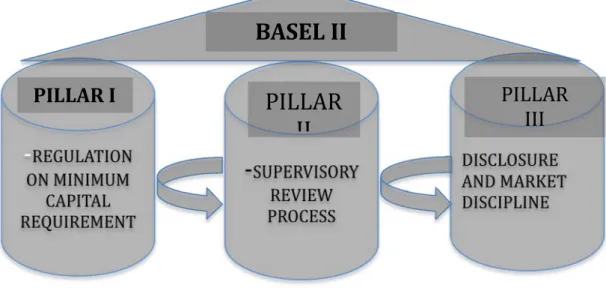
Figure 1.2: Objectives of Basel II
i. Focused on combination of few risks including credit risk, operational risk, and market risk
ii. Compliance with minimum standard requirement, assessment of risk profile, review of compliance with all regulation and prudent auditing report
iii. Disclosure policy
PILLAR I
PILLAR
II
PILLAR III
BASEL II
5
1.4 Basel III
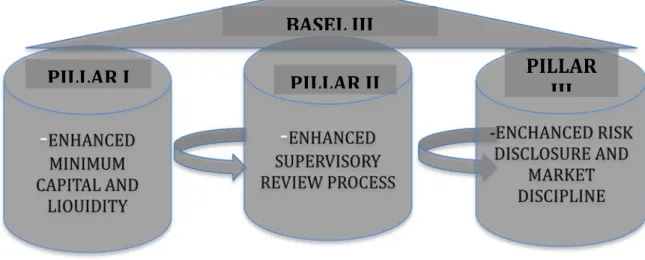
Figure 1.3: Objectives of Basel III
i. Providing incentive for bank for better risk and return management over the long term period
ii. To effectively triple the size of capital reserve
PILLAR I PILLAR II PILLAR
III BASEL III
6
Sources : Basel Committee on Banking Supervision, Bank of International Settlement.
7
The Basel Committee on Banking Supervision (“Basel Committee”) decided a guidelines to deal and inclusively supported capital and liquidity rules with the goal of strengthening the global banking system in December 2010. The guidelines are comprehensively written in Basel III. Basically, as mentioned in the above paragraph, there are three main pillars established to support strengthen the content of Basel III.
This standard is originally extended from the existing of Basel II Framework.
Furthermore, its presents broad definition of new capital and liquidity standards to toughen the existing regulation, supervision and risk management of the entire banking and financial institution.
Basel III was scheduled to be introduced in 2010 by the members of the Basel Committee on Banking Supervision, the completion is expected to be done in 2019.
The Basel III rules were in reaction to the shortages in financial regulation that is discovered by the 2000’s financial crisis. Basel III was proposed to strengthen bank capital requirements by accumulative bank liquidity and reducing bank leverage. Due to high capital buffer, the standard requires financial institution to hold more capital than the level of capital requires in previous standard. Therefore, the additional liquidity ratio are introduce to firm the holding capital in case of more severe financial crisis occur.
Basel III explain thoroughly on capital standards through more bright capital definitions and further capital buffers. The improvements will essentially control profitability and involve revolution of the bank business activities. Advanced capital
8
requirements will mainly influence big financial activities such as sales and trading of financial paper. These new standards will have an extensive influence to most banks, mostly in commercial banking activities.
The second pillar emphasize on supervisory review process. This pillar needs banks to define and control their risk management further from the minimum capital set in previous standard. Further risk such as interest rate risk should be combined to be more extensive. The bank management should possess good understanding in risk control and they should know to compare the definition and level of different risk involve in Basel II and Basel III. In Basel III supervisory review process is proposed not only to safeguard banks to have sufficient capital to fund all the risks in their business, but also to reassure banks to cultivate and to improved risk management methods in observing and dealing their risks.
The third pillar of Basel III explained about the risk disclosure and market discipline. Financial institution need to disclosure the risk level acceptance, this will let the investors identify and manage the risk wisely. Financial institution needs to follow the standard of reporting system that is familiar with all reader including the analyst, investor and the regulators. Because of the Basel III is established with response to financial crisis, therefore the lesson learned is to enhance risk disclosure.
Besides that, Basel III forms message and involves more disclosure of a firm’s capital position. The disclosure suggested under Basel III required financial institution to be clearer about their business activities and the way they report for capital to pay off the basic risks.
9
All staff involve in reporting system especially, senior top management need to answerable for risk management, the must possess good understanding in businesses and underlying risks nonetheless qualifying them to accomplish the business with better risk controlling. Transparency in reporting system will allow regulators to evaluate systemic risks more precisely. In addition all stakeholder including, analysts, and investors will have a better opinion of the risk and returns of banks’ business models.
In December 2010, the Basel Committee on Banking Supervision finalized a set of rules to support global capital and liquidity rules with the goal of strengthening the resilience of the global banking system.
The rules are meticulous in the documents Basel III with the main pillar emphasize on a global regulatory framework for more resistant banks and banking systems. Bank Negara Malaysia as a central bank of Malaysia supports the execution of these rules in order to strengthen the existing capital and liquidity standards for banking institutions in Malaysia.
The Bank goals is to execute the reform set in Malaysia in line to the globally-agreed levels and execution timeline which provides for a gradual phase-in of the standards beginning 2013 until 2019 as mention in chapter 1 related to Basel III.
10
Source : KPMG Analysis of Basel Committee of Banking Supervision
11
1.5 Problem of Statement
Problem statements of the study are:
i. The weaker banks may find a difficulty in increasing required capital when having unfavorable economic condition.
ii. This will lead to few revision in banking policy related to reduction in dividend paid to shareholder, increase retained earnings, more financial paper will be issued in order to raise more capital.
iii. Maintaining or increasing the percentage of capital adequacy may affect the bank lending capacity and limit banking activity.
iv. Significant pressure on profitability and return of equity (ROE) due to increase in capital requirement. Banks may increase the cost of funding, therefore need to reorganize and deal with regulatory reform that will put pressure on margin and operating capacity.
12
1.6 Research Questions
The study developed research questions as follow:
I. How far the discussion and awareness about Basel Standard among media in Japan?
II. How implementations of Basel Standard through capital adequacy impact the financial performance of banking institution?
III. Is macroeconomic of one country is affected with the implementation of Basel Standard through capital adequacy?
IV. What is the trend of macroeconomic indicator during the implementation of Basel Standard?
13
1.7 Objective of study
This study will be conducted base on these research objectives:
i. To analyze the trend and pattern of discussion about the introduction and execution of Basel Standard (BS) related to Capital Adequacy Ratio (CAR) ii. To investigate the financial performance and macroeconomic impact capital
adequacy to regional bank in Japan
iii. To study the trend of macroeconomic indicators during the implementation of Basel Standard
Objective 1 of this research is discussed in chapter 2. Capital adequacy ratio is widely discussed among the banking institution as they must secure certain amount as required by financial regulator. It represents the percentage of risk-weighted asset and act as the indication of no excess leverage should be hold by them. Therefore the Basel Committee has designed Basel l, Basel ll and Basel lll for banking institution as a reference to ensure the capital requirement is sufficient in minimizing the operational risk. Objective 1 aims to analyze the trend and pattern on capital adequacy and its execution in banking system in Japan after the introduction of Basel Standard. The study covered the 11 years articles published in Nikkei 21 from 2004 to 2014 by using text mining and correspondence analysis as a methodology.
RMeCab and MeCab in R statistical tools were used and it leads to present the importance of Basel Standard as guidance in determining the level of capital adequacy ratio. From the research, the result discussed conclude that the result has captured a tendency to anticipate the changes in global issue related to credit risk management raised in Basel Standard. An interesting trend and pattern of words
14
appears give a general view about how far the discussion and whether it gives enormous impact to Japanese people.
Chapter 3 in this research discussed further about objective 2 of this research.
Objective 2 touch on the impact of financial performance and economic impact of capital adequacy ratio to banking institution. Capital adequacy is a crucial factor in determining the level of risk absorption of a banking institution. This issue has been discussed widely as it is an important yardstick to gauge the complete picture of banking performance. Capital adequacy is closely related to the economic performance of related country, therefore, this study investigates the financial performance and economic impact of capital adequacy ratio in Japan. Five variables were employed that represent economic performance - unemployment rate, inflation rate, real exchange rate, money supply and gross domestic product, while financial performance of the regional banks consisted of six variables, namely the deposit-to- asset ratio, return on assets, return on equity, total assets, total deposits and total loans. 64 regional banks were evaluated over a period of 10 years from 2005 to 2014.
Secondary data were composed of World Bank data and the individual financial statements of Japanese regional banks. The results show a various signs of relationships between variables and it was slightly different from previous study.
This was supported by result tested by panel regression analysis and correlation analysis conducted in order to measure the relationship between capital adequacy and each variable. From deep analysis, we hope this discussion among other gives a vast reference to depositor, banking institution and policy maker in not only maintaining but also need to improve the level of capital adequacy for a stable security to all parties.
15
Objective 3 of this research is discussed in chapter 4. Bank of International Settlement (BIS) has introduced a new framework in order to strengthen the regulation in term of risk coverage and security of lending activity held by financial institution. However the framework is seen to give a massive impact to some macroeconomic indicators. Therefore this study aims to analyze the trend and impact of macroeconomic performance during the introduction of Basel Standard. Since the impact of macroeconomic performance of some countries reflects in different ways to the standard, hence this study focused on comparative study between developed and developing country represent by Japan and Malaysia. Study period covered from 2000 to 2015. Gross domestic product (GDP), inflation rate (IR) and annual exchange rate (AER) are among the macroeconomic indicators considered into this study, all data are gained from world bank’s website
Bank of International settlement established the Basel Standard based on main pillar which is maintaining capital adequacy in financial institution in order to control credit risk due to default by borrower. Hence, this study also investigated the caused that led to credit risk. Other than personal loan, business loan is among the major loan managed by financial institution. There is more financial institution established to focus on lending business loan to SME (small medium Enterprise).
However, Before loan can be granted to borrower, all FI must have their own model in analyzing the capacity of borrower to pay back the loan, therefore all factors included in the credit model need to be able to examine from overall view Forecasting of small and medium enterprise (SME) loan default is very crucial and widely studied as it gives a significant impact on SME ‘s finance in decision-making
16
process. This study analyzes the factors included in order to define and construct SME’s credit risk model in SME financing process by financial provider (FP).
17
Chapter 2 :
Analyzing Trend of Capital Adequacy and Basel Standard using Text Mining Technique
2.1 Introduction
Basel standard has been introduced since 1988 and time-to-time the standard was reviewed consequently based on feedback from financial institution. The standard was improved and more risk sensitive. Even though several parties have argued it but the standard is still defined as the secure reference correlated to security risk faced by most of the financial sector.
Basel Standard described capital requirement need to be secured by financial institution to shelter the unseen incoming risk that will interfere their operation. In Japan Basel rules are binding to 16 international active banks that encountered around 56% of the Japanese banking sector assets. Local bank is governed by Financial Services Agency of Japan (JFSA) enforce a marginally modified version of Basel lll.
The committee suggested minimum capital requirement need to be fixed at 8% of risk weighted assets (RWA), therefore the definition of capital risk
18
management must be defined specifically by taking into consideration the combination of different types of risk that may affect banking’s operation. Even though the Basel Standards is apply for international bank however capital adequacy is agreed to have a positive relationship with profitability for both to local and international bank (Abba,Peter &Inyang, 2013).
Level of risk exposed by the bank need to disclose to the central bank.
Financial crisis in 2008 had attracted full attention from financial market, Basel ll had been revised and new standard (Basel lll) was released in 2010. However Basel ll is not fully superseded by Basel lll. The main purpose of new guidelines is to promote a strong banking system by fully concentrating on liquidity, leverage and capital. In the Basel III Japan Assessment, the Basel Committee gave Japan rankings of “Grade 3”, and “Compliant” or “Largely Compliant” in each detailed finding (Toshikawa, Bingham & Mimura, 2014).
2.2 Objective of Study
Capital Adequacy always seen as a critical issue discussed by financial institution. It is defined as percentage ratio of a financial institution's primary capital to its assets used as a measure of its financial strength and stability (Asikhia &
Sokefun, 2013)). The study focused on the analysis of text as some indication of extensive discussion that have been done and captured by financial sector. Trend and pattern of discussion about the introduction and execution of Basel Standard to capital adequacy ratio will be studied. Therefore the overall view about the discussion can be concluded effectively.
19
This research emphasizes on combination of text mining and correspondence analysis. This method have a limited literature, other than that the existing reference related to analysis on trend of capital adequacy and Basel standard in Japan are mainly published in Japanese language, therefore this article is likely to globally give vast reference to researcher around the world especially to non-Japanese speaker.
2.3 Methodology
In order to close some discrepancy in Basel I, the committee decided to replace it with new accord called Basel II in 2004. Basel II superseded the old standard by introducing a better risk calculation technique by maintaining minimum 8% capital adequacy; it is very crucial to ensure the risk monitoring process is running effectively. To study the level of discussion and execution of Basel standard, text mining is employed in this study.
2.3.1 Text Mining
Text Mining is the process of extracting information from different printed resources. An important component is the connecting the extracted information to form new facts or new theories to be discovered more by means of experimentation.
Besides that, text mining involves the variation field named data mining. It used to produces remarkable patterns from huge databases
According to Witten (2004), text mining performs to hold the whole of automatic natural language processing and, arguably, far more besides, for example, analysis of linkage structures such as citations in the academic literature and
20
hyperlinks in the Web literature, both useful sources of information that lie outside the traditional domain of natural language processing.
Fan et al (2006) explained that text mining is related to data mining, but it is intended to handle structured data from databases and working with unstructured or semi structured data sets such as email, full-text documents, and HTML files. They agreed that text mining is a much better solution for companies with large volumes of information.
Text mining applies the same analytical functions of data mining to the domain of textual information. This is discussed in study done by Dorre et al (1999).They have tested the method in relying on sophisticated text analysis techniques that condense information from free-text documents. The study positively practical in studying patent portfolios, customer complaint letters, and competitors’ Web pages
Text mining is the study of data enclosed in expected text by transforming text into statistical data. This method is used to study the trend and pattern of discussion about the introduction and execution of Basel Standard (BS) related to Capital Adequacy Ratio (CAR). The study captured the nouns as an importance concept. The articles were analyzed using Text mining technique through R software using RMecab and MeCab. These methods managed to recognized Japanese character and google translator is used in translation process.
The data targeted the news published in Nikkei 21 for the period of eleven years since 2004 to 2014 published in Japanese language. The comprehensive search leads to total of 262 substantial articles. The process of searching the articles is shown in figure 2.
21
In Japan Nikkei is known as one of the biggest media corporation specialized in financial and business news. This research gained data from news published in Nikkei 21, besides Nikkei 21, Nikkei Veritas similarly published professional finance news unfortunately this publication is relatively new. Since this research covered eleven years time from 2004 to 2014, we cannot use for correspondence analysis because Nikkei Veritas is only started their publication in February 2008 as a weekly newspaper.
Besides newspaper, this research declines to consider publication through Web and Television program, this is due to low coverage in term of financial news compare to Nikkei 21, which is reliable and professionally focuses on financial news.
Figure 1 shown the comparison of publication of Nikkei 21 and ASAHI newspaper regarding BIS Rules. For the period of eleven years (2004 to 2014) total publication related to BIS Rules for Nikkei 21 is 208 compare to ASAHI newspaper, which only covered 45 publications for the period. Therefore this research concentrated only on Nikkei 21.
22
Figure 2.1 Total publication For Nikkei 21 and Asahi Newspaper in Year 2004 until 2014
According to Tan (1999) text mining is believed to have commercial potential higher than data mining because of more hidden indication normally enclose in written way. Limited study had been done using text mining analysis, however most of the researcher agreed that text mining in overview is an interdisciplinary field of activity amongst data mining, linguistics, computational statistics, and computer science (Xavier & Doris, 2012). It involve the processes such as text classification, text clustering, taxonomy creation, document summarization and language analysis.
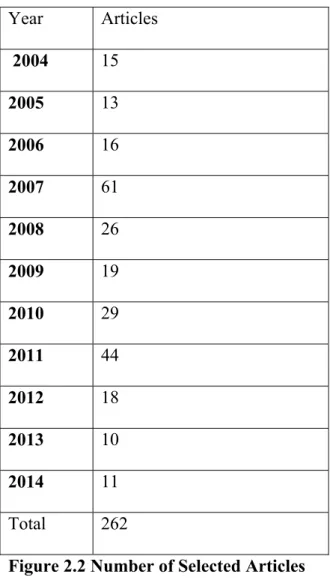
Furthermore text mining gives a picture in reading and analyzing information retrieve from comprehensive text and data. Table 1 shows the result of article searched for each year by using a few keywords related to the capital adequacy and Basel Standard.
21 20
11
19 22
43
24
14 18
7 9
6 3 3 6 5
15
3 2 1 1 0
0 5 10 15 20 25 30 35 40 45 50
2004 2005 2006 2007 2008 2009 2010 2011 2012 2013 2014 NIKKEI 21 ASAHI
23
Year Articles
2004 15
2005 13
2006 16
2007 61
2008 26
2009 19
2010 29
2011 44
2012 18
2013 10
2014 11
Total 262
Figure 2.2 Number of Selected Articles 2.3.2 Research Flow
The process of extracting articles from Nikkei 21 are began from selecting the related year and keyword such as capital adequacy, Basel I, Basel II and Basel III were key in into search bar. The same process was repeated until 11 year starts from 2004 until 2014. This period of study covered the introduction and execution of the three Basel Standard. The result of number of articles found can be seen in Table 1.
In data processing, RMeCab and MeCab are used in order to achieve the objective of the study by analyzing the articles.
24
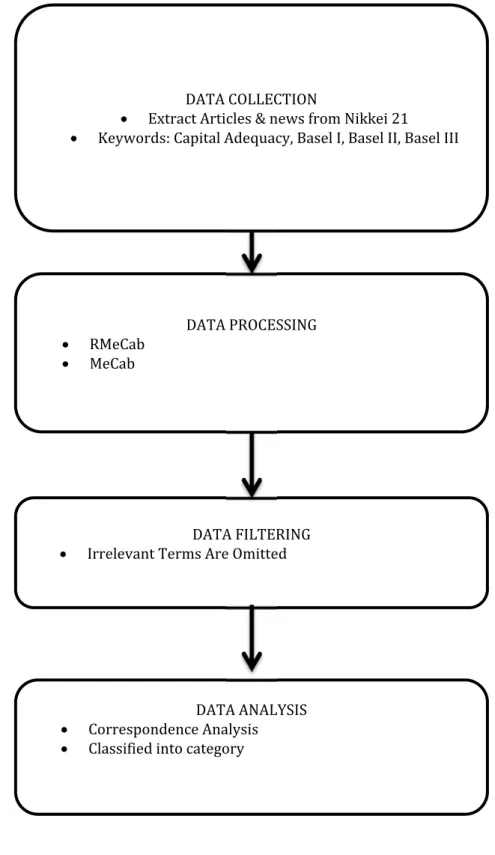
MeCab is capable in detecting and reading the Japanese character that is very helpful to non-native speaker. Once the articles are analyzed, two categorical data (year and word) are produced. Google translator from Japanese language to English is used in data filtering. Next step is by screening all the captured words, irrelevant words and character such as numbers, hyphen and others are omitted. Resulting from the filtering and screening process, the study able to capture 56 relevant words as shown in table 3. This is very crucial process as the captured relevant words will be analyzed and the accuracy of the overall result can be done precisely. 56 words captured are then analyzed using correspondence analysis. Summarize of research flow is displayed in figure 2.
25
Figure 2.3 Research Flow
DATA COLLECTION
Extract Articles & news from Nikkei 21
Keywords: Capital Adequacy, Basel I, Basel II, Basel III
DATA PROCESSING
RMeCab
MeCab
DATA FILTERING
Irrelevant Terms Are Omitted
DATA ANALYSIS
Correspondence Analysis
Classified into category
26
2.4. Analyses and Discussion
By using substantial keyword search, total of 262 articles have been extracted, while 56 relevant words have been recognize. Wide discussion had occurred in 2007 and 2011. The word crisis is specifically referring to the global issues for instance the collapse of Lehman Brothers and subprime issue makes financial and market player more concern on capital adequacy and risk management as appeared in Basel regulation. Basel committee seeks to improve capital adequacy and liquidity risk management by introducing more stringent risk assessment to strengthening their capital (Aleksandra, Dalia, & Julija, 2014) .
In addition the introduction and execution of Basel standard also attract financial institution to respond to the contents, therefore the word such as stability and recovery are frequently appeared. Furthermore Fukushima earthquake (2011) give massive impact to local banking institution as they started to deeply think on the present percentage of capital adequacy to secure their operational risk.
After Lehman Brothers crisis Europe and China became central issue, as represent in Table 3 and Figure 4, the words Europe and China are steadily appeared at year 2008 and above. The word crisis had appeared the most in 2008. From a substantial word search, exciting discussion about risk management occur in 2008 and 2007, furthermore the discussion about risk had been globally discussed even before the Lehman Brother’s problem.
27
Risk minimization by combining different type of risk such as operational risk and market risk are among the popular risk minimization debated in Basel lll.
Realistic words (recovery, stability and crisis) for common discussions related to Basel Standard, credit risk minimization and capital adequacy are strongly found in the result.
2. 4.1 Correspondence Analysis
Correspondence analysis (CA) is used as a tool for data analysis. Limited study is done in analyzing data by using this method. The advantage of using CA is due to precision in analyzing textual data converting into statistical data. Besides that CA is proven to read short texts of high content density [10]. The result from CA is plotted in two-dimensional scatterplot as shown in figure 3.
Correspondence analysis is a graphical technique to illustrate which rows or columns of a frequency table have similar patterns. In the correspondence analysis plot, there is a point for each row and for each column. Correspondence Analysis is use when there are many levels which making it tough to develop valuable data from the mosaic plot.
The row can be explained as the set of row rates, or the counts in a row divided by the total count for that row. Points in the correspondence analysis plot are close together. The distance between a row point and a column point has no meaning.
Nevertheless, the directions of columns and rows from the origin are meaningful, and the relationships help interpret the plot.
28
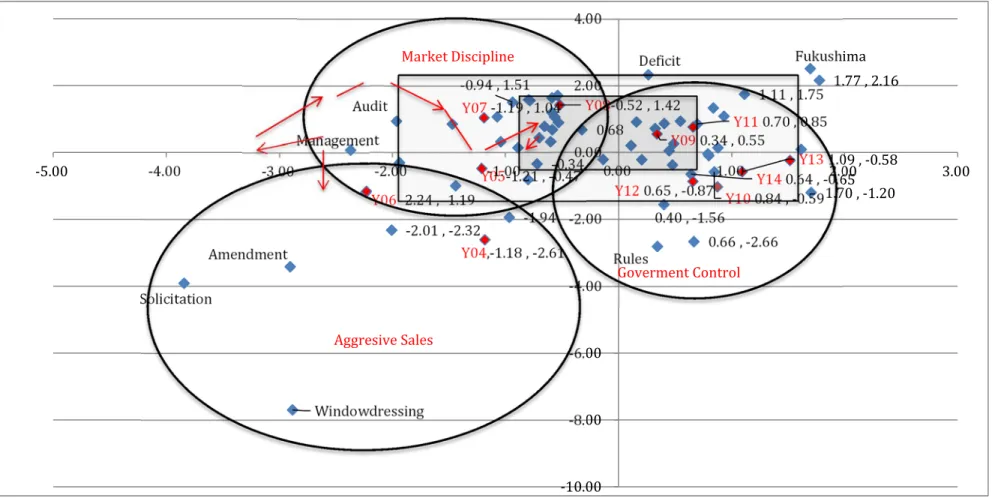
From figure 3, the trend and pattern of discussion about Basel Standard and capital adequacy are illustrated. Microsoft excel is used to plot each word in X and Y axis.
29
Figure 2.4 Two Dimensional Graph of Correspondence Analysis and Canonical Correlation Analysis
Windowdressing Amendment
Solicitation
‐1.94
‐2.01 , ‐2.32
Rules Management
Audit
‐0.34
0.40 , ‐1.56
‐0.94 , 1.51
0.68
Deficit
0.66 , ‐2.66
1.11 , 1.75 1.77 , 2.16 Fukushima
1.70 , ‐1.20
Y04,‐1.18 , ‐2.61 Y05‐1.21 , ‐0.47 Y06‐2.24 , ‐1.19
Y07‐1.19 , 1.04 Y08‐0.52 , 1.42
Y090.34 , 0.55
Y100.84 , ‐0.59 Y110.70 , 0.85
Y120.65 , ‐0.87
Y131.09 , ‐0.58 Y140.64 , ‐0.65
‐10.00
‐8.00
‐6.00
‐4.00
‐2.00 0.00 2.00 4.00
‐5.00 ‐4.00 ‐3.00 ‐2.00 ‐1.00 0.00 1.00 2.00 3.00
Goverment Control Market Discipline
Aggresive Sales
30
From correspondence analysis the study had proven that the data resulted to standard normal distribution where mean is zero and the total variance is equal to 1.
CA is analyzed using two-dimensional as it is more precise and accurate. In figure 3, data are reading in one sigma and two sigma. It can be seen that at least 50% level of satisfactory, where the words scattered in the shaded area.
To strengthen the analysis, canonical correlation analysis (CCA) is deployed.
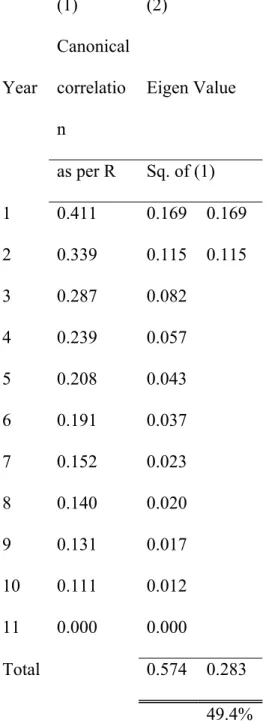
CCA is used to measure the linear relationship between two dimensional, furthermore it also connecting cross-covariance matrices. In this study CCA constructed 49.4% contribution rate referring to table 2, and it can be concluded that the plotted words are satisfactory.
Canonical correspondence analysis (CCA) is the canonical form of correspondence analysis (CA). As a form of direct gradient analysis, wherein a matrix of explanatory variables intervenes in the calculation of the CA solution, only correspondence that can be 'explained' by the matrix of explanatory variables is represented in the final results (Greenacre, 2007)
According to Ter (1986), CCA is an extension of correspondence analysis and a popular ordination technique that extracts continuous axes of variation from abundance data. Such ordination axes are naturally inferred with the assistance of outside information and data on environmental variables. In this technique, ordination axes are selected in the light of known environmental variables by impressive the extra limit that the axes be linear combinations of environmental variables.
31
(1) (2)
Year
Canonical correlatio n
Eigen Value
as per R Sq. of (1) 1 0.411 0.169 0.169 2 0.339 0.115 0.115
3 0.287 0.082
4 0.239 0.057
5 0.208 0.043
6 0.191 0.037
7 0.152 0.023
8 0.140 0.020
9 0.131 0.017
10 0.111 0.012 11 0.000 0.000
Total 0.574 0.283
49.4%
Figure 2.5 Canonical Correlation Analysis
32
From the result, the study can be analyzed in three categories included aggressive sales, government control and market discipline. Aggressive sales era apparently referred to collapse of Lehman Brother due to subprime issue. Lehman Brothers is among the biggest investment company in US and was filed their bankruptcy in 2008. Most of the financial reviewer concludes that the company is the largest victim of US subprime mortgage that boomed around year 2003 and 2004.
Housing sale and mortgage demand are growing steadily during the year (2003 and 2004) lead to more mortgage company aggressively lend at the competitive rate.
However due to some mistake made by Mortgage Company which easily give out mortgage without complete documentation or low creditworthiness lead to the subprime bubble. Lehman Brothers acquired five mortgage companies and it seems a big mistake resulted to the failure to the company. This problem also been blamed to Basel ll which is too tight to be implemented, because of that the Basel Committee introduce Basel lll which is more risk sensitive.
Market discipline by definition is price system where the prices are set by sellers and consumer according to law of supply and demand without any intervention by government. Adegbite [3] agreed that macroeconomic stability act as a major factor in financial steadiness, it is crucial in maintaining stable price and insuring that public sector deficits are marginal and external debt is sustainable. Bank with greater capital adequacy ratio will absorb higher level of unpredicted losses before becoming insolvent.
33
2.5. Conclusion
Information gathered from related articles make it possible to conclude that the result has captured a tendency to anticipate the changes in global issue related to credit risk management raised in Basel Standard. We could not across to clear conclusion although a thorough study has been conducted. However an interesting trend and pattern of words appears give a general view about how far the discussion and whether it gives enormous impact to Japanese people.
This study agreed that in determining the level of capital need to be secured by any deposit taking institution, macroeconomic indicators such as inflation, economic growth and employment rate need to be considered as the indicators will significantly affected on risk management process (Harley, 2011). Other than that, the analysis done through correspondence analysis and text mining are expected to give massive reference in future.
Chapter 3 :
Financial Performance and Economic Impact on Capital Adequacy Ratio in Japan
3.1. Introduction
Capital adequacy play a major role in banking security, and besides that, it also portrays a bank’s image as a whole, potentially attracting public confidence to invest in the bank. There is a solid public relations characteristic to capital adequacy.
It is commonly accepted that the readiness of capital is a perfect sign of health of a bank and a satisfactory situation to guarantee the safeguarding of certainty by investors, creditors and depositors.
Banking performance is significantly related to the macroeconomic performance, changes in level of gross domestic product (GDP) will affect level of capital adequacy ratio. Banks will conduct strict policies in lending activity since borrower’s ability to repay the loan may decrease. Fall in GDP result to increase in CAR as banking institution is now securing more percentage in CAR.
The collapse of Lehman Brothers in 2008 and the Great East Japan Earthquake 2011 massively impacted the Japanese financial system. For the most part, regional banks in Fukushima Prefecture were minimally affected. Regional banks are currently required to maintain a 4% capital adequacy ratio, with some
35
arguments put forth for whether areas tending to be affected by natural disasters need to maintain the same figure as an area with less of a probability of being hit by such a catastrophe. Affected areas probably need additional financial aid to recover from their operational risk.
Japan’s economic growth is anticipated to drop slightly in 2011. Japan’s gross domestic product (GDP) increased in the third quarter of 2011 since 2010, other than that progressive growth is projected in 2012. Most sectors trade statistics also indicate positive signs. In addition, the recovery of Japan’s export sector was influencing by weak economic conditions in Europe and the US.
SMEs’ performances in particular area affected by Great East Earthquake in 2011 are slightly decreased due to migration and decreasing number of local population. Besides that due to the contamination and radiation problem from nuclear power plant leakage, consumer avoids production from Fukushima Prefecture. According to Junichi, Akira & Masashi, (2013), small and medium enterprises in affected area faced with difficulties in obtaining a new loan is most likely the result of the double loan problem. This may increase the risk associated with the non-performing of the affected bank. Other than that, Japan economic performance also contributes to the performance regional banks. Therefore, this study attempts to investigate the relationship between Japan’s economic performance and the financial position of regional bank with respect to capital adequacy ratios.
This ratio reflects the management of credit risk and it is critical for protecting the depositor and to avoid any possibilities of bankruptcy.
36
3.1.1 Overview of Japanese Financial System
Japanese regional banks have earned immense loyalty from customers because of their prudent management over their long history. The regional banks are devoted to protecting their stakeholders thorough practical management based on self-responsibility by working to stimulate further restructuring and proficiency in all aspects of management. They are efficient in responding to management issues and improving their operational risk by diversification of customers’ needs. The introduction of the Basel Accord requires bank to calculate CAR based on international standards. According to the Japanese Bankers Association (Zenginkyo), banks with international standards need to maintain a CAR of 8% while domestic standards simply requires CARs of 4%.
There are a total of 64 regional banks in Japan operating based in the principle city of a prefecture. As a consequence, they normally have resilient relationships with local enterprises and government organisations. As of 2014, regional banks in Japan hold ¥172 trillion in loans and discounted bills, possess ¥236 trillion in deposits, operate 7.5 thousand branches, employ 132 thousand employees, manage 35 thousand automated teller machines and are capitalized with ¥2,556 billion in stock.
37
3.2. Literature Review
Capital adequacy has always been seen as a vital issue for financial institutions. It is defined as the percentage ratio of a financial institution’s primary capital to its assets and used as a measure of its financial strength and stability (Asikhia & Sokefun, 2013).
Romdhane (2012) studied the determinants of banks' capital ratio in an emerging country. A model was developed to measure the relationships between a number of key variables of the banks and their profitability ratio. The study covered 18 banks with semi-annual data from 2002 to 2008. The findings seemed to agree that the interest margin and risk strongly influenced the capital ratio. Guarantees by the bank to provide returns to investors may raise banking pressure, but is contrasted to the fact that investors value higher returns, potentially attracting more deposit to the institution.
According to Victor and Juan (2000), optimal financial decisions must consist of setting a capital ratio that is the sum of the regulatory minimum plus a capital cushion. This ratio assists in reducing the probability of capital distress below the regulatory necessity.
The Basel Standard was introduced in 1988 and implemented subsequent feedback from financial institutions. The standard was upgraded to be more risk sensitive. Although various parties argued against it, the standard is still distinctive
38
as a safe reference associated with security risk encountered by most of the financial sector.
The Basel Standard made requirements for capital that needed to be locked by financial institutions to protect them from any hidden risk that might disrupt their operations. In Japan, Basel rules are binding to 16 internationally active banks that encompass approximately 56% of Japanese banking sector assets. Local banks are administrated by the Financial Services Agency of Japan (JFSA) that enforces a marginally modified version of Basel lll.
The Basel committee suggested a minimum capital requirement needs to be secured at 8% of risk weighted assets (RWA), so, therefore, the explanation of capital risk management must be clearly defined by reflecting the combination of different types of risk that may affect banking operations.
According to Basel standards, the level of risk visible to the bank needs to be revealed to the central bank. The financial crisis in 2008 had attracted full attention from the financial markets, and Basel ll was reviewed and a new standard (Basel lll) was released in 2010. Nevertheless, Basel ll is not fully superseded by Basel lll.
The main resolution of the new rules was to encourage a solid banking system by fully focused on liquidity, leverage and capital. In the Basel III Japan Assessment, the Basel committee gave Japan rankings of “Grade 3”, “Compliant” or “Largely Compliant” in each detailed evaluation (Toshikazu, Bingham, & Aizawa, 2014).
39
The Basel committee seeks to improve capital adequacy and liquidity risk management by introducing more stringent risk assessment to strengthen capital (Aleksandra, Dalia & Julija, 2014). Even though the Basel standards apply to international banks, capital adequacy is thought to have a positive relationship with profitability for both international and local bank (Abba, Zachariah, & Inyang, 2013).
Hanke (2013) found that in 2010, the Bank of International Settlements (BIS) introduced Basel III - a global regulatory framework - for the purpose of hiking capital requirements.
The primary function of bank capital is to provide resources to absorb possible future losses on assets (Ahmet & Hasan, 2011). In determining the level of capital needing to be secured by any deposit-taking institution, macroeconomic indicators, such as inflation, economic growth and the employment rate, need to be considered as the indicators will significantly influence risk management process (Harley, 2011).
Adegbite (2010) agreed that macroeconomic stability acts as a major factor in financial steadiness, it is key for maintaining stable prices and it insures public sector deficits are marginal and external debt is sustainable. Banks with greater CARs will absorb higher levels of unpredicted losses before becoming insolvent. This study considered economic indicators and the financial positions of each bank as variables to examine the impact of the capital adequacy ratio.
Asikhia and Sokefun, (2013) indicated that capitalisation and profitability are indicators of bank risk management efficiency and mitigate losses not covered by
40
current earnings. Profit or returns generated by the bank demonstrates the level of security, and besides-the investment from investor will be higher. Thus, profitability plays a major role in convincing depositors to supply funds in the form of bank deposits on beneficial terms.
Previous studies observed that bank profitability is normally measured by return on assets (ROA), return on equity (ROE) and net interest margins (NIM).
ROA is commonly affected by a bank's policy decisions and uncontrollable factors connected to the economy and government regulations. Many regulators believe ROA is the best measure of bank profitability (Hassan & Bashir, 2003). In addition, profitability is best represented by ROA, as it shows the ability of the firm to generate returns on its portfolio of assets.
Harley (2011) investigated the impact of banks’ characteristics, financial structure and macroeconomic indicators on banks’ capital bases in the Nigerian banking industry for 28 years. The study applied an error correction framework and revealed that economic indicators, like rate of inflation, real exchange rate, demand deposits, money supply, political instability and return on investment are the most robust predictors of the determinants of capital adequacy in Nigeria. Additionally, the study also determined that there is a negative relationship between inflation and banks’ capital base as inflation erodes bank capital in most developing economies.
Abba et al (2013) examined the relationship between capital adequacy and banking risk. Three independent variables were used - risk-weighted asset ratio,
41
deposit ratio and inflation rate. Twelve banks were sampled from a population of twenty-two banks in the Nigerian banking industry over a period of five years. The study adopted value at risk theory and found that changes in the capital adequacy ratio are explained by changes in the independent variables - there is a significant negative relationship between risk and the capital adequacy ratio of banks, meaning that when risk levels rise, the capital adequacy ratio falls in the Nigerian banking industry.
According to Adegbite (2010), there is a mutual connection between stability in macroeconomic, regulatory and supervisory policies. It helps maintain the strength of a financial institution. If, however, an institution becomes unstable, then the policies should be geared towards resolution policies.
Samson & Harley (2012) examined the impact of capital adequacy in the banking sub-sector and the growth of the Nigerian economy using macroeconomic variables over a period of 30 years. It employed the error correction framework and co-integration techniques to test the relationship between bank capital base and macroeconomic variables. The study suggested that political stability might reduce financial distress and bankruptcy. In addition, the study also established that there is a negative relationship between inflation and banks’ capital base as inflation erodes bank capital in most developing economies.
Ahmet and Hassan (2011) examined the determinants of Turkish banks' capital adequacy ratio and its effects on financial positions of banks for five years.
42
The study used nine variables from different viewpoints, including profitability, leverage, liquidity and the size of the bank. It was observed that leverage had negative a relationship with while profitability positively influenced the CAR.
3.3. Methodology
The purpose of this study was to examine the factors influencing Japan regional banks' capital adequacy ratios and its effect on financial position and economic level. Secondary data were gathered from World Bank data and the individual financial statements of 64 regional banks in Japan. This study covered a 10 years period, beginning in 2005 to 2014.
In order to analyse the relationship between a banks’ financial position, represented by total assets (TA), total loans (TLoan), total deposit (TDep), return on assets (ROA), return on equity (ROE) and the deposit-to-asset ratio (DAR) with the dependent variable, capital adequacy ratio (CAR), panel data regression methodology was used. Other than that, the same methodology was applied to investigate the relationship between economic level and CAR whereby the economic level will use the inflation rate (INF), real exchange rate (REx), unemployment rate (UNEM), money supply (MS) and gross domestic product (GDP) as economic indicators. CAR is calculated according to the formula and rules fixed by Japanese Bankers Association. A clear picture of variable can be seen in Figure 1.
Total assets (TA) represent the size of the bank. It is important to determine the extent of the ability of the firm to generate profits in future. It also helps firms operate in the long-term. Thus, total assets directly influence the calculation of CAR.
43
Total loans (TLoan) include short-term and long-term debt. It is also considered a company commitment and firms need to make sure they possess the ability to survive by being able to pay the debt in a fashion designated by the creditor. Risk in the form of interest rate risk and operational risk will be mitigated if the company is able to generate sufficient profits to service existing loans.
Total deposits (TDep) are known as the amount of the investor or depositor’s money that is placed with the institution. Companies with high profiles are likely to gain more profits compare to companies that are highly exposed to financial risk.
This indicator is really about the security of the investor associated with their deposit.
Return on assets (ROA) by definition is a ratio of net income and total assets.
It shows how profitable a firm is relative to its total assets. ROA convey the message of how efficient the firm is in generating earnings. The formula for ROA:
/ 2
Return on equity (ROE) indicates the ratio of net income and shareholder equity. The money invested by shareholders is projected to be used in wise investments that will generate high returns. Higher ROEs will affect the CAR of the company since the shareholders will contribute more capital to the company.
44
The deposit-to-asset ratio (DAR) is one that measures the ratio of deposits used to generate assets of the company. DAR seems to have a positive influence on the CAR of a company.
Inflation rate (INF) by definition recorded the changes of price level of goods and services that may affect the level of consumer purchasing power. Inflation rate is a vital indicator for evaluating a country’s economic level. In order to have an excellent economy, the government needs to control the prices of goods and services so as to positively regulate the cost of living for the consumer.
Real exchange rate (REx) is the purchasing power of one currency relative to another. The difference between currencies affects the stability of a particular currency. Besides that, it also affects economic level of a country. Currency levels significantly impact import and export businesses as consumer need to pay an import tariff from trading imported goods.
Unemployment rate (UNEM) is defined as the percentage of the total labour force that is unemployed but actively seeking employment and willing to work. It is
45
the most closely observed statistic because a growing rate is a sign of a diminishing economy that may call for cuts in interest rates. In addition, a falling rate indicates a rising economy that is commonly complemented by a higher inflation rate and may necessitate an increase in interest rates.
Money supply (MS) is total amount of money available in an economy at a specific time. Standard measures normally include currency in circulation and demand deposits. Records of money supplies can be found at a country’s central bank. Money supplies need to be closely monitored as it may influence the level of inflation and the exchange rate.
Gross domestic product (GDP) is the monetary value of finished goods and services produced within a country during a specific time period. GDP includes private and public consumption, investment and the difference between exports and imports. GDP is a vital statistic for measuring a country’s economic level.
Figure 3.1. Research framework
Financial Position - TA - TLoan
- TDep - ROA - ROE - DAR Economic Indicators
- INF - REx - UNEM
- MS - GDP
Effect on Capital Adequacy Ratio
(CAR) ‐Positive/ Negative Relationship
- Most Significant Variable Affecting CAR
3.3.1 Econometric Model
This study investigates the effects of banks’ financial position and economic indicators on the capital adequacy ratio by using the panel regression model. Based on a review of the theoretical literature, the following panel regression model is formed:
CARit = β0 + β1TAit + β2TLoanit + β3TDepit + β4ROAit + β5ROEit +β6DARit + β1INFit
+ β2RExit + β3UNEMit + β4MSit + β5GDPit +εit (1)
In the previous equation, β0 is a constant and β is a coefficient of the variables while εit is the residual error of the regression.
3.4. Results and Discussion
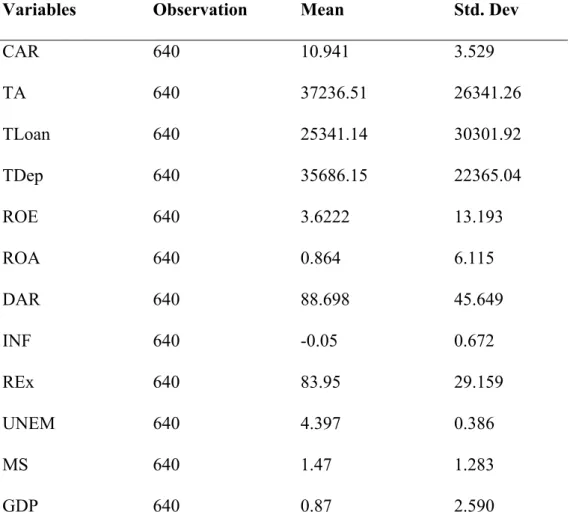
Table 1 shows the results of numerous descriptive analyses calculated based on selected variables, specifically the means and standard deviation. Dependent variable is represent by capital adequacy ratio (CAR) while others are independent variables. During the study period, CAR averages at 10.94%, this figure being rather high compared to the regulatory requirement of 4%. This indicates that regional banks remained strong and stable over the course of the study. Furthermore, the standard deviation of CAR is 3.52%, demonstrating the slight disparity between the CAR of various banks.
48
Variables Observation Mean Std. Dev
CAR 640 10.941 3.529
TA 640 37236.51 26341.26
TLoan 640 25341.14 30301.92
TDep 640 35686.15 22365.04
ROE 640 3.6222 13.193
ROA 640 0.864 6.115
DAR 640 88.698 45.649
INF 640 -0.05 0.672
REx 640 83.95 29.159
UNEM 640 4.397 0.386
MS 640 1.47 1.283
GDP 640 0.87 2.590
Figure 3.2. Descriptive analysis of study variables
Table 2 is the correlation matrix employed to determine the relationship between dependent and independent variables. This study used regression analysis in order to check the effect and relationship of each variable, the same model used in previous study done by Harley (2011). It can be observed that there are inverse relationships between INF, REx, GDP and CAR, while other variables show positive relationship. There are negative relationship between inflation and CAR, this is expected sign as shown by previous study, Japan government need to retain low level of inflation in order to be further globally competitive. .
Note. (***) and (**) significant at 1% and 5% respectively.
Figure 3.3 The pairwise correlation matrix for dependent (CAR) and explanatory variables
Furthermore, all variables were tested for multicollinearity through using variance inflation factors; the results elicited being fairly satisfactory.
Multicollinearity measure how much the variance of the coefficients (square of standard deviation) is increase because of collinearity (Romdhane, 2012). The regression results will be analysed using a fixed effect model as detailed in Table 3.
Adjusted R square values are 13.2%, suggesting that 13.2% variability of the CAR can be explained by TA, TDep, TLoan, ROA, ROE, DAR, INF, REx, UNEM, MS and GDP, while the other 86.8% would be explained with other variables.
Financial position represent by TLoan shows a negative relationship with CAR and is significant at 1%. This indicate the wrong sign as a positive sign is normally expected and in line with previous study, as the high risk of exposure by the bank through loan release requires bank to keep high reserves to mitigate default risk. TDep is significant at 1% with inverse relationship with CAR, the more deposit reserve will give more security to the bank, in this case bank have an option for other banking activity instead of locking more percentage of CAR. ROE indicates positive relationship and significant at 5%. Other than that, DAR indicate a positive relationship, this is in line with result produced by Al-Sabbagh (2004).
Economic performance represented by GDP and MS show a negative sign, implying worsening economic levels should encourage the banks to attract more reserve to avoid bankruptcy. Changes in 1% level of money supply leads to an increase in CAR. This result is in line with finding from previous study Harley (2011). Real exchange rate (REx) displays inverse relation with CAR, this sign
51
similar with the previous study Samson et al (2012), increase in REx will reduce the flow of trade activity and lowering the level of foreign direct investment (FDI).
TA, TDep, TLoan and DAR are significant at 1% while ROE, INF, and UNEM are significant at 5%.
Explanatory Variables Fixed Effect Regression Model
Constant 10.05865
TA 0.0001232
TDep -0.0000241
TLoan -2.91000
ROA -0.00593
ROE 0.03825
DAR 0.01432
INF -0.25281
REx -0.00899
UNEM -0.75243
MS -0.06837
GDP -0.11667
N x T = 64 x 10 640 (strongly balanced)
R2 0.1320
Figure 3.4. Panel regression results
52
3.5. Conclusion
This study sought to investigate the relationship between financial performance of Japanese regional banks and the economic performance of Japan with the capital adequacy ratio. Secondary data is used and gathered from annual report of regional bank in Japan and economic statistic is taken from World Bank report. This study covered 10 years period from 2005 to 2014 with a total number of 640 observations. Five variables were employed to represent the economic performance while 6 variables represent financial performance of the regional bank.
Regression analysis shows a various signs of relationships between variables were slightly different from previous study, like for instance the fact that inflation should be positively associated, through in this study; inflation and CAR are inverse to one another. It can be concluded that other factors will have more impact on regional banks when determining their CARs.
This study faced difficulties in searching for some literature about the Japanese banking performance due to most of the references are published in Japanese language, therefore this study is hope to furnish optional reference for non Japanese speaker.
In future research, additional variables should be tested in order to get more comprehensive results to explain the CAR. This research is expected to give more references to researcher especially in studying Japan banking performance and also in analysing Japan economic performance. Besides that it give compelling evidence
53
to investor and banking institution about the importance of securing enough capital in order to mitigate the banking risk.
54
Chapter 4 :
The Impact Of Basel Standard On Macroeconomic : Case Of Japan And Malaysia
4.1. Introduction
Basel Committee on Banking Supervision (BCBS) was found in 1974 and suggested best practice for banking standards. This practice essentially focuses on capital measurement system. It has been introduced to guide financial institution and improving required level of capital, hence firming the capacity to mitigate any uncalculated risk that may occur in future.
Basel committee until now succeeds in introducing three standards known as Basel I, Basel ll and Basel 111. It first was introduced in 1988. These three rules are initially focused on credit risk before extended to a combination of risk that is expected to define risk extensively. Basel ll was announced in 2004 with better upgrading to improve the regulatory system in monitoring capital requirement.
Basel Committee introduces third Basel in 2010; Basel lll is more strict and comprehensive in defining and covering the credit risk, liquidity and capital adequacy of financial institution. It aims to improve banking sector’s ability to absorb financial and economic shock, thus plummeting the risk of spillover from the