Title
Determination of Iodide in Seawater by Capillary Ion
Chromatography Using Hexadimethrine Bromide Modified C30
Stationary Phases( 本文(Fulltext) )
Author(s)
RONG, Li; LIM, Lee Wah; TAKEUCHI, Toyohide
Citation
[Analytical sciences : the international journal of the Japan
Society for Analytical Chemistry] vol.[29] no.[1] p.[31]-[34]
Issue Date
2013-01-10
Rights
The Japan Society for Analytical Chemistry (公益社団法人日本
分析化学会)
Version
出版社版 (publisher version) postprint
URL
http://hdl.handle.net/20.500.12099/53386
Introduction
Iodine is one of the most abundant and biologically essential minor elements in seawater, where it exists mainly as iodide and iodate, along with a small fraction of dissolved organic iodine.1–4 Iodide, a thermodynamically unstable species in the oceans, is usually a minor species in seawater compared with iodate. It is produced by a biologically mediated reduction of iodate, also favorable under reducing conditions.5,6 The distribution of iodide, being varied with depth and geographical location, provides the important clues about the marine environment. Therefore, various analytical methods have been developed for the determination of iodide.
Since it was initiated in 1975 by Small et al.,7 ion chromatography (IC) has become a routine analytical method for the determination of inorganic anions and cations, and small organic ions in aqueous samples. For the determination of trace iodide in seawater, sub-μg L–1 levels of iodide can be measured by the use of IC. However, the IC method for iodide analysis in seawater faces a difficulty of ion separation in high matrix concentrations of chloride and sulfate from the much smaller iodide peak.3,8 Thus, some IC methods add sodium chloride to the mobile phase to remove interferences by the variability in the composition of inorganic matrix ions.
Hexadimethrine bromide (polybrene, HDMB), a polymeric surfactant, has been employed to modify or reverse the electroosmotic flow in capillary zone electrophoresis (CZE) by dynamically coating the capillary wall,9–11 allowing the
separation and sensitive detection of inorganic anions and low-molecular-mass organic acids; these modified columns give excellent relative migration time repeatability. It was suggested that a good potential for long-term monitoring systems could be obtained with HDMB-modified columns.
It was found in our previous studies12–14 that triacontyl-functionalized silica (C30), a hydrophobic stationary phase, can be used as the stationary phase for the determination of iodide
via permanent coating or dynamic modification with substances. In the present study, we tried to develop a new stationary phase for a simple and direct determination of iodide in seawater using a laboratory-made C30 packed stationary phase modified with HDMB. The modification conditions, eluent conditions, and the effect of adding of organic substances to the eluent are examined in this paper. It should be noted that the determination of iodide in seawater samples will be successful even when the eluent containing low concentration of chloride is used as the eluent.
Experimental
Apparatus
The chromatographic measurements were carried out by using a capillary LC system that comprised an L.TEX-8301 Micro Feeder (L.TEX Corp., Tokyo, Japan) equipped with an MS-GAN 050 gas-tight syringe (0.5 mL; Ito, Fuji, Japan) as a pump, a Model 7520 injector with an injection volume of 0.2 μL (Rheodyne, Cotati, CA) as an injector, a 100 nm × 0.32 mm i.d. microcolumn, and a UV-2075 plus UV-Vis detector (Jasco, Tokyo, Japan). The flow-rate of the pump was kept at 2.5 μL min–1, since the highest theoretical plate number (642/colum) could be obtained. Also, the UV detector was
2013 © The Japan Society for Analytical Chemistry
† To whom correspondence should be addressed. E-mail: [email protected]
Determination of Iodide in Seawater by Capillary Ion
Chromatography Using Hexadimethrine Bromide Modified C30
Stationary Phases
Li R
ONG,*
,**
†Lee Wah L
IM,** and Toyohide T
AKEUCHI**
* Department of Chemistry, School of Physics and Chemistry, Xihua University, 999 Jinzhou-Road,
Chengdu 610039, P. R. China
** Department of Chemistry, Faculty of Engineering, Gifu University, 1-1 Yanagido, Gifu 501–1193, Japan
A novel and simple capillary ion chromatographic method for the determination of iodide is reported. Separation was achieved on a laboratory-made packed capillary column (100 mm × 0.32 mm i.d.) packed with triacontyl-functionalized silica, followed by a modification with hexadimethrine bromide, where 1 mM sodium chloride–acetonitrile (95:5, v/v) was used as the eluent and UV-absorbing analyte anions were detected at 225 nm. The effects of the eluent composition on the retention behavior of inorganic anions were investigated. The addition of a small amount of an organic substance in an eluent such as acetonitrile increased the retention of iodide, while the addition of methanol decreased its retention. The present analytical method was successfully applied to the rapid and direct determination of iodide in seawater without any preconcentration. Also, this modified column could be used for about two months (6 h operation per day) without hexadimethrine bromide being contained in the eluent.
operated at 225 nm for the measurement of iodide. The data were acquired by a CDS data processor (LAsoft, Chiba, Japan).
Reagents
The reagents employed were of guaranteed reagent grade, and were obtained from Wako Pure Chemical Industries (Osaka, Japan) or Nacalai Tesuque (Kyoto, Japan), unless otherwise noted. HDMB was obtained from Nacalai Tesuque. Purified water was produced in the laboratory by using an RFU424CA ultrapure water system (Advantec, Tokyo, Japan). All solutions used in this study were prepared using the purified water and filtered through a 0.45-μm membrane filter and stored at 4°C in a refrigerator.
Column preparation
Develosil C30-UG-5 (C30; 5 μm particle diameter; Nomura Chemical, Seto, Japan) packing materials were taken from conventional-size packed columns commercially available, and were packed into a fused-silica capillary with 0.32 mm i.d. by using a slurry packing method, previously reported,15 and then conditioned with purified water. An aqueous solution containing HDMB was then passed into the fused-silica capillary at a flow-rate of 2.5 μL min–1 for ca. 2 h, followed by washing with purified water for ca. 30 min until the baseline was stabilized. The concentration of HDMB dissolved in water as the modification solution was examined. The column was operated at room temperature (ca. 25°C).
Results and Discussion
Effect of the modification conditions
The effect of the concentration of HDMB on the retention of analyte anions was examined. Considering the stability of the base material (C30), HDMB was dissolved in water without adjusting the pH. An aqueous solution of HDMB with a different concentration (1, 3 or 5%, w/v) was passed into each capillary column at a flow-rate of 2.5 μL min–1 for ca. 2 h before the measurements. A concentration of 1 mM sodium chloride containing no HDMB was used as an eluent, and supplied at a flow-rate of 2.5 μL min–1. It was observed that the retention times of iodate, nitrate, iodide and thiocyanate were nearly the same, independent of the modification concentration. Since the difference in the retention factor was not very different for the modification with 1, 3 and 5% HDMB solutions, a 1% HDMB solution was employed for the modification in following experiments.
Optimization of the eluent for anion separation
In IC, the eluent concentration is one of the most important parameters affecting the retention. The separation of iodate, nitrate, iodide and thiocyanate was therefore carried out on the C30/HDMB modified stationary phase by using different concentrations of the eluents, such as sodium chloride, sodium sulfate, sodium perchlorate, sodium carbonate, sodium dihydrogenphosphate, sodium acetate, ammonium acetate, ammonium chloride, sodium bicarbonate, potassium chloride, lithium chloride, calcium chloride, and magnesium chloride. It was found that the retention factor (k) of the analyte anions decreased with increasing eluent concentration in the region between 1 and 10 mM. However, linear relationships between log k and the eluent concentration were not observed. In other words, it is presumed that in addition to an electrostatic interaction, another interaction mechanism was involved in the retention of the analyte anions on the present stationary phase.
The plots of the retention time as a function of the eluent concentration were not very different for the eluents examined. When NaCl was used as the eluent, better resolution, i.e., a better peak shape was achieved. Considering the resolution and the retention time, 1 mM NaCl was used as the eluent in this work. In addition, the elution order of anions, IO3– < NO3– < I– < SCN–, as shown in Fig. 1A , was the same as that observed in common IC.
Separation mode
The breakthrough curve of the C30/HDMB modified stationary phase was determined. Briefly, the column was flushed with 1 mM NaCl, and then flushed with purified water until the baseline was stabilized: It was finally flushed with 1 mM NaIO3, NaNO3, NaI and/or NaSCN eluent at 2.5 μL min–1 until the breakthrough was achieved, and at the same time the effluent was monitored by UV detector operated at 210 nm. The adsorption capacity of the C30/HDMB modified stationary phase was obtained as 1.1 × 10⁻⁷, 1.2 × 10⁻⁷, 1.8 × 10⁻⁷, and 2.0 × 10⁻⁷ mol column–1 for 1 mM NaIO3, NaNO3, NaI and NaSCN, respectively. It is obvious that the adsorption capacity was different when a different eluent was used. Therefore, it is presumed that the retention of analytes may not be caused by Fig. 1 Separation of an authentic mixture of four anions on the modified Develosil C30-UG-5 column (A) and unmodified Develosil C30-UG-5 column (B). Column, Develosil C30-UG-5 packed column modified with 1% HDMB (A) and unmodified Develosil C30-UG-5; 100 × 0.32 mm i.d.; eluent, 1 mM sodium chloride; flow-rate, 2.5 μL min–1; analyte, 0.1 mM each of iodate, nitrate, iodide, and
thiocyanate; injection volume, 0.2 μL; wavelength of UV detection, 225 nm.
the electrostatic interaction, but by a hydrophobic interaction, and ions or ion pairs distribute between the aqueous solution and the stationary phase. The retention of an analyte anion on the stationary phase increases with increasing its hydrophobic property. In addition, the elution order of the analyte anions follows their hydrophobicity. When the typical hydrophobic stationary phase, unmodified C30 stationary phase, was used as the stationary phase, the selectivity of the four test analytes was poor when 1 mM sodium chloride was used as the eluent, as shown in Fig. 1B. This means that the C30 modified with HDMB provide different selectivity compared to C30. The breakthrough curve of the unmodified C30 stationary phase was also determined with 1 mM NaI. Also, the adsorption capacity was obtained as 0.3 × 10⁻⁷ mol column–1 for NaI. Since the adsorption capacity on unmodified C30 was smaller than it on the C30/HDMB modified stationary phase, it was presumed that the positive charge of HDMB could catch the analyte anions and allow them to access to C30 easier. The reasons for retention behaviors of anions on this C30/HDMB modified stationary phase have be elucidated, and more work should be required for an elucidation of the retention mechanism involved in the present separation system in the future.
Effect of organic substances
Some organic solvents, such as acetonitrile and methanol, can effectively enhance the resolution, and the peak shape.16,17 Thus, the influence of acetonitrile and methanol on the retention of anions was investigated in the present work. Since C30 modified with HDMB is hydrophobic, when an organic substance is added in the eluent, the C30/HDMB modified stationary phase can be solvated or modified with the organic substance added, which could affect the retention of the analyte anions.
The concentration of acetonitrile as well as methanol was varied between 1 and 5% (v/v). It was found that the addition of acetonitrile increased the retention of anions, while the addition of methanol decreased the retention of anions. Moreover, the addition of acetonitrile could effectively enhance the resolutions and peak shapes, and on the contrary, methanol could not. It is reported that acetonitrile molecules have additional interactions with water clusters, while methanol molecules have substitutional interactions with water clusters.18 It is presumed that acetonitrile works as a chaotrope to break the network due to water-water hydrogen bonds of the bulk water. The polarity of the bulk water thus increases, leading to an increase in the hydrophobic interaction between hydrophobic anions and the C30/HDMB modified stationary phase. On the other hand, methanol does not break water-water hydrogen bonds of the bulk water at such concentrations, and they work as kosmotropes.
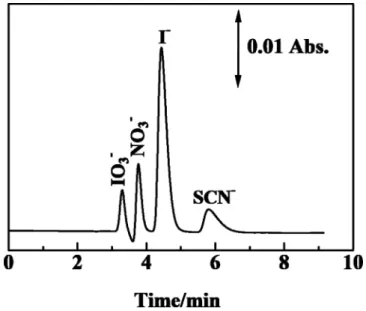
When 1 mM sodium chloride–acetonitrile (95:5, v/v) was used as the eluent, the highest theoretical plate number (642/column) was obtained. Thus, 1 mM sodium chloride containing 5% acetonitrile was selected as the eluent for the separation of analytes anions in the following experiments. Figure 2 demonstrates the separation of four UV-absorbing anions. It can be seen that all of the analyte anions were eluted within
ca. 7 min, and well separated from each other. In addition, the stability of the column was not affected by the addition of 5% acetonitrile in the eluent.
Validation
The repeatability of the retention time, peak area and peak height was examined for six successive chromatographic runs under the conditions in Fig. 2. The results are given in Table 1. It can be seen that the relative standard deviations (RSDs; n = 6)
of the retention time, peak area and peak height were smaller than 3.34% for all of the analyte anions. These values show comparatively satisfactory repeatability of the present method.
Under the optimized operating conditions in Fig. 2, the limit of detection of iodide was 6.4 μg L–1 (S/N = 3), and the limit of quantification was 21 μg L–1 (S/N = 10). These results indicate that this system is more sensitive than in our previous study12–14 for the iodide. In addition, the linear range of quantification of iodide was 21 μg L–1 – 63 mg L–1 with a regression coefficient (r2) of 0.999.
It should be noted that this modified column could be used for about two months (6 h operation per day), even when 1 mM sodium chloride–acetonitrile (95:5, v/v) without HDMB was used as the eluent. The stability of the retention time might be better if the eluent contains HDMB, but the iodide could not be completely separated from nitrate. Spent columns can easily be regenerated by passing a 50% aqueous acetonitrile solution, followed by passing a HDMB solution.
Application to seawaters
To illustrate an application of the developed method, seawater samples collected from Tokoname (Aichi, Japan) and Numazu Fig. 2 Separation of UV-absorbing anions on the modified Develosil C30-UG-5 column using 1 mM sodium chloride–acetonitrile (95:5, v/v) as the eluent. Column, Develosil C30-UG-5 packed column modified with 1% HDMB; 100 × 0.32 mm i.d.; eluent, 1 mM sodium chloride–acetonitrile (95:5, v/v); other operating conditions as in Fig. 1.
Table 1 Repeatability for test analyte anions
RSD (%, n = 6, within-day) RSD (%, n = 6, day-to-day) Retention time Peak area Peak height Retention time Peak area Peak height IO3– NO3– I– SCN– 0.78 0.93 1.05 0.80 2.98 2.47 2.96 2.34 1.45 1.28 1.52 1.13 1.35 1.46 1.22 1.31 3.11 3.27 3.08 3.34 2.87 2.75 2.44 2.63 Column: Develosil C30-UG-5 packed column modified with 1% HDMB, 100 × 0.32 mm i.d.. Analyte: 0.1 mM each of iodate; nitrate; iodide; thiocyanate. Other operating conditions as in Fig. 2.
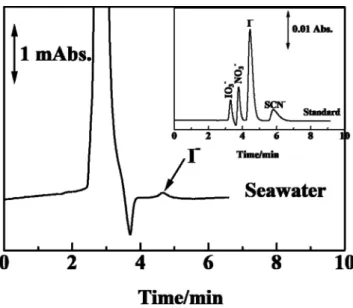
port (Shizuoka, Japan) were used for the determination of iodide. These seawater samples were applied to the determination within a few days after the sampling. After filtration through a 0.45-μm membrane filter, the samples were stored at 4°C in a refrigerator and directly subjected to ion chromatographic analysis. Under the conditions in Fig. 2, a peak due to iodide was actually observed for the seawater sample, as demonstrated in Fig. 3. Since it is presumed that the anions are adsorbed on the C30/HDMB modified stationary phase by a hydrophobic interaction, ions or ion pairs were partitioned into eluent and stationary phases. Therefore, despite the fact that the seawater samples contained a molar concentration of chloride and sulfate, they were not strongly retained on the C30/HDMB modified stationary phase because of their lower hydrophobicity, which had no interference on the determination of iodide ion. Also, a large peak preceding the iodide peak is thought to be due to the matrix ion. Since this peak overlaps with the iodate peak, the present system could not determine iodate ion.
Iodide contained in the seawater samples was determined to be 37.8 and 49.6 μg L–1, by using a standard addition method. The recoveries of added iodide were 98.7 and 105.5% for these spiked seawater samples, as shown in Table 2. In addition, nitrate in seawater could not be determined because bromide and nitrate eluted close, and could not be separated.
Conclusion
It was proven that a laboratory-made C30 packed column (100 mm × 0.32 mm i.d.) modified with HDMB retained anions and allowed the determination of iodide in seawater within 7 min, when 1 mM sodium chloride–acetonitrile (95:5, v/v) was used as the eluent. The relative standard deviations of the retention time, peak area and peak height were all smaller than 2.4% for all of the analyte anions. Also, the limit of detection of iodide was 6.4 μg L–1 (S/N = 3). This method is applicable for the direct determination of iodide in seawater, and avoids adding matrix ions at very high concentrations to the eluent. More work will be required for elucidating the retention mechanism involved in the present separation system.
Acknowledgements
This work was a project sponsored by the Scientific Research Foundation for the Returned Overseas Chinese Scholars, State Education Ministry, China (No. 11233229) and the Key Research Fund Program of Xihua University (No. 81023313).
References
1. V. W. Truesdale, Mar. Chem., 1975, 3, 111. 2. G. T. F. Wong, Rev. Aquat. Sci., 1991, 4, 45. 3. K. Ito, Anal. Chem., 1997, 69, 3628.
4. J. Zheng, H. Takata, K. Tagami, T. Aono, K. Fujita, and S. Uchida, Microchem. J., 2012, 100, 42.
5. M. L. A. M. Campos, Mar. Chem., 1997, 57, 107.
6. A. M. Farrenkopf, M. E. Dollhopy, S. NiChadhain, G. W. Luther, and K. H. Nealson, Mar. Chem., 1997, 57, 347. 7. H. Small, T. S. Stevens, and W. C. Bauman, Anal. Chem.,
1975, 47, 1801.
8. K. Ito, J. Chromatogr., A, 1999, 830, 211. 9. J. Hagberg, J. Chromatogr., A, 2003, 988, 127.
10. A. G. Jensen and S. H. Hansen, J. Pharm. Biomed. Anal., 2002, 27, 167.
11. N. Bord, G. Crétier, J. L. Rocca, C. Bailly, and J. P. Souchez, J. Chromatogr., A, 2005, 1100, 223.
12. L. Rong and T. Takeuchi, J. Chromatogr., A, 2004, 1042, 131.
13. L. Rong, L. W. Lim, and T. Takeuchi, Chromatographia, 2005, 61, 371.
14. L. Rong, L. W. Lim, and T. Takeuchi, Talanta, 2007, 72, 1625.
15. T. Takeuchi and D. Ishii, J. Chromatogr., 1981, 213, 25. 16. C. A. Pohl, J. R. Stillian, and P. E. Jackson, J. Chromatogr.,
A, 1997, 789, 29.
17. S. Nussbaumer, S. Fleury-Souverain, L. Bouchoud, S. Rudazb, P. Bonnabry, and J. Veuthey, J. Pharm. Biomed.
Anal., 2010, 53, 130.
18. A. Wakisaka, H. Abdoul-Carime, Y. Yamamoto, and Y. Kiyozumic, J. Chem. Soc. Faraday Trans., 1998, 94, 369. Fig. 3 Typical chromatograms of seawater and an authentic mixture
of inorganic anions on modified Develosil C30-UG-5 column. Column, Develosil C30-UG-5 packed column modified with 1% HDMB, 100 × 0.32 mm i.d.; other operating conditions as in Fig. 2.
Table 2 Iodide concentration and recovery in seawater samples (n = 6)
Seawater sample Found/μg L–1 Spiked/μg L–1 Recovery, %
Tokoname Numazu port 37.8 49.6 50 50 98.7 105.5