Title Pathogenesis of Hemolytic Serum in Babesia rodhaini-InfectedMice( 本文(Fulltext) ) Author(s) 邱, 詩蘋 Report No.(Doctoral Degree) 博士(獣医学) 甲第419号 Issue Date 2014-03-13 Type 博士論文 Version ETD URL http://hdl.handle.net/20.500.12099/49042 ※この資料の著作権は、各資料の著者・学協会・出版社等に帰属します。
Pathogenesis of Hemolytic Serum in Babesia
rodhaini-Infected Mice
(Babesia rodhaini ឤᰁ࣐࢘ࢫ࠾ࡅࡿ⁐⾑ᛶ⾑Ύࡢཎᛶ㛵ࡍࡿ◊✲)
2013
The United Graduate School of Veterinary Science, Gifu University
(Gifu University)
Contents
General Introduction- 3
Chapter 1 5
Mechanism of serum in vitro hemolytic activity
Introduction 5
Materials and methods 7
Results 11 Discussion 14
Chapter 2 23
In vivo pathogenesis of anti-erythrocyte autoantibody in hemolytic serum
Introduction 23
Materials and methods 25
Results 28 Discussion 29
Chapter 3 34
Generation of monoclonal anti-erythrocyte autoantibody in B. rodhaini infection Introduction 34
Materials and methods 36
Results 38 Discussion 39
General Discussion 43
Acknowledgements 46
General Introduction
Babesia is a tick-borne hemoprotozoan parasite belongs to the Apicomplexa
phylum infects a wide range of mammalian host species. Babesia spp. infect and proliferate in erythrocyte [55]. Babesia gibsoni naturally infects dogs and B. bigemina naturally infects cattle, which can cause mild to fatal disease and lead to economic loss. After entering the host animal via tick bite, Babesia firstly enters the blood flow and penetrates erythrocyte membrane. Babesia protozoa differentiate into merozoites in erythrocyte and undergo asexual reproduction to produce more merozoites. Infective merozoites then are released into blood flow again and infect more erythrocytes. During tick feeding, infected-erythrocytes are ingested into tick gut and transform to macro- and micro-gamonts to undergo sexual reproduction. Macro- and micro-gamonts therefore fuse into zygote and penetrate tick intestinal epithelium. Zygotes finally enter the tick salivary gland to form sporozoites for next transmission. Zygotes can also migrate into tick ovary via transovarial transmission and transform to merozoites in the infected-tick egg [55].
Egression of intraerythrocytic replicated Babesia results in the destruction of erythrocyte. Indeed, the main clinical symptom of babesiosis is hemolytic anemia [19, 55]. In acute clinical cases, anorexia, lethargy and fever are also common consequence of anemia. Although most clinical signs can be improved after parasiticidal treatment, some infected animals suffer from acute hemolysis and develop severe anemia despite having a relatively low parasitemia [19, 49]. This phenomenon was reported in canine Babesia gibsoni infection and bovine Babesia
bigemina infection [19, 49]. Onishi et al. first reported that in dog naturally infected
with B. gibsoni, serum from infected individuals shows an ability to cause the destruction of intact erythrocytes from non-infected healthy individuals [42]. The presence of hemolytic factor(s) may imply another hemolytic mechanism also
activated in babesiosis beside physically destruction of parasitized erythrocyte. However, the relationship between serum hemolytic activity and clinical hemolytic anemia still remains unclear, as the identification of serum hemolytic factor(s).
On the other hand, modulation of host immunity was also reported in babesiosis. In 1990s, anti-erythrocyte autoantibodies generated in dog naturally and experimentally infected with B. gibsoni were reported [1, 2, 3, 4, 5]. In cattle infected with B. bigemina and mice infected with B. rodhaini, the synthesis of autoantibody was also reported [18, 30]. Typical laboratory findings of immune mediated hemolytic anemia (IMHA) such as autoagglutination and a positive result of direct Coomb’s test are occasionally seen in these cases [41]. In these infected animals, secondary IMHA is diagnosed. In such cases, parasiticidal treatment alone is not effective to improve clinical signs. Although immune suppressive treatment with corticosteroids is reported to improve the outcome of acute IMHA cases in dog infected with B. gibsoni, they may also take the risk of acute raise of parasitemia [55]. Moreover, the exact mechanism which anti-erythrocyte autoantibody involved in has not been identified yet, arguing the administration of immunosuppression treatment in critical cases.
Although mice infected with B. rodhaini develop extremely high level of parasitemia, which is different from low parasitemia in dog and cattle babesiosis, the infected mice also developed anti-erythrocyte antoantibody and serum hemolytic ability as reported in dog and cattle babesiosis [2, 3, 18, 41, 42]. In mouse study, serum transferation and monoclonal antibody studies are also applicable. Therefore, the aim of present study is to elucidate the mechanism which mediates to hemolysis and the in vivo pathogenesis of hemolytic serum by mouse model. Also, the property of anti-erythrocyte autoantibody in babesiosis was evaluated.
Chapter 1
Mechanism of serum in vitro hemolytic activity
Introduction
Animals infected with Babesia spp. sometimes develop severe anemia despite having a relatively low parasitemia. This phenomenon was reported in canine Babesia
gibsoni infection and bovine Babesia bigemina infection [18, 49], leading to the
possibility that non-parasitized erythrocytes are also destroyed by hemolytic mechanisms. In babesiosis, erythrocytes were physically destructed during parasite egression. Infected erythrocytes also express parasite antigen on their surface and induce antibody production. Antibody-opsonized erythrocytes were then removed from the host’s circulation by up-regulated erythrophagocytosis and antibody-mediated aggregation in the spleen and liver [34, 35]. Moreover, it was reported that sera from B. gibsoni-infected dogs induced hemolysis of erythrocytes from uninfected individuals [41, 42]. Erythrocytes from healthy individuals were destructed after co-incubated with serum from infected individuals in vitro. Although serum hemolytic activity may also be responsible for the aggravation of anemia in babesiosis, the mechanism that mediates serum hemolytic activity remains unknown to date.
On the other hand, it is also well known that erythrocytes of animals infected with piroplasms such as Babesia and Theileria suffer from oxidative stress. This includes increased lipid peroxidation of erythrocyte membranes, which has previously been reported in canine B. gibsoni infections [33, 44], equine Theileria equi and
Babesia caballi infections [14], and bovine B. bigemina infections [49]. Increased
superoxide was also observed to be generated in erythrocytes in dogs experimentally infected with B. gibsoni [44]. Furthermore, oxidative stress can also result in
increased osmotic fragility of erythrocyte membranes in B. gibsoni- and B.
bigemina-infected hosts [33 49]. Another consequence of erythrocyte oxidative
damage is increased susceptibility to erythrophagocytosis [34, 35]. However, it still remains unclear whether oxidative injury of erythrocytes in babesiosis directly results in hemolysis. The effect of infected serum on the induction of erythrocyte oxidation and erythrocyte anti-oxidant capability is also poorly understood.
In this chapter, it is demonstrated that mice infected with B. rodhaini also developed anti-erythrocyte antibodies and hemolytic activities, as reported in dog babesiosis. The aim of this chapter is to elucidate the mechanism that leads to serum hemolytic activity in Babesia-infected animals and postulated that serum of B.
rodhaini-infected individuals can induce the breakdown of redox balance in
Materials and methods
Experimental animals and parasites
Eight-week-old female C57BL/6 and Cr1j:CD1 mice were purchased from CLEA Japan Inc, (Tokyo, Japan). The Australian strain of B. rodhaini was kindly provided by the Kyushu Branch of the National Institute of Animal Health and injected into Cr1j:CD1 mice intraperitoneally. Seven days after injection, heparinized whole blood was collected and the parasitemia was determined by examining
Giemsa-stained thin blood-smears. The infected blood was diluted (2x) with storage
buffer (Vega y Martinez Buffer containing 20% (w/v) polyvinylpyrrolidone (PVP)) and stored at -80°C until used as a parasite stock. The experiments were performed in accordance with the Gifu University Animal Care and Use Committee guidelines.
Experimental infection and infected serum
C57BL/6 mice were intravenously infected with 106 parasitized erythrocytes within a total of 1.856 × 10⁶ cells. Mice within the mock-infected group were intravenously infected with 1.856 × 10⁶ non-parasitized erythrocytes from a non-infected Cr1j:CD1 mouse. Eleven days post-infection, all mice were sacrificed and whole blood was obtained. Whole blood was clotted at room temperature for 2 h to collect serum. Sera for hemolytic assays were then processed immediately, while those for other experiments, sera were stored at -20°C before use.
Hemolytic assay
Sera collected on the 11th day after infection was used for all hemolytic assay experiments. Whole blood from healthy C57BL/6 mice was collected and washed 3 times with phosphate buffered saline (PBS) and centrifuged at 1,200 rpm for 10 min. Plasma and buffy coat were removed by manual aspiration during each wash. Erythrocytes were finally re-suspended in Tyrode’s buffer (pH=7.4) and adjusted to 107 cells/ml. Mock and B. rodhaini-infected serum were heated at 56°C for 30 min to
inactivate complement. Ten μl of heated serum were incubated with 10 μl of 107/ml of target erythrocytes at 37°C for 2 h. Remaining target erythrocytes were counted with a standard hemocytometer. Hemolytic activity was calculated by the following formula: Hemolysis (%) = [(total RBC number – remaining RBC number) / total RBC number] × 100%. For the antioxidant enzyme experiment, 10 μl of 107/ml target erythrocytes were initially incubated with 10 μl of Tyorde’s buffer containing either 250, 1000, or 2000 ȝg/ml of catalase for 15 min., then 10 μl of serum was added directly into the mixture. The final mixture was incubated at 37°C for 2 h.
Enzyme-linked immunosorbent assay (ELISA) for anti-erythrocyte autoantibody detection
A 96-well ELISA plate was coated with 100 μl of 107/ml erythrocyte membrane antigen in 50 nM carbonate buffer (pH 9.6) per well and incubated at 4°C overnight. After washing three times with 0.05% Tween 20-PBS, the reaction was blocked with 300 μl of PBS containing 3% skim milk at 37°C for 1 h. After washing three times with Tween 20-PBS, serum collected on the 11th day post-infection was diluted 1:40 in 3% skim milk and added to each well before being incubated at 37°C for 3 h. After washing five times with Tween 20-PBS, 100 μl of horse-radish peroxidase (HRP)-conjugated rabbit-anti-mouse immunoglobulin G, diluted 1:3000 with PBS containing 3% skim milk was added as the second antibody, then incubated at 37°C for 1 h. After washing five times with Tween 20-PBS, 50 μl of substrate solution (SAT-blue) was added to each well, the reaction was stopped by adding 50 μl of 1N H2SO4 solution. Absorbance at 450 nm was determined using an ELISA microplate reader.
Superoxide concentration
Serum superoxide was measured using a chemiluminescence probe (2-methyl-6-p-methoxyphenylethynyl-imidazopyrazinone, MPEC) according to the
manufacturer’s instructions. Mock and B. rodhaini-infected sera from C57BL/6 mice were collected on the 2nd, 5th, 8th, and 11th day post-infection. In each well of a 96-well plate, 10 μl of 5× diluted serum and 180 μl PBS were added. 10 μl of 300 μM MPEC were added directly before analysis using a Wallac 1420 ARVOsx multi-label reader (Perkin Elmer Life Sciences, Tokyo, Japan).
Leukocyte remove and reconstruction
Leukocytes were removed by passing whole blood from healthy C57BL/6 mice through CF11 cellulose filters twice as described previously [53]. Filtrated erythrocytes were then washed three times with PBS before being diluted in Tyrode’s buffer to 107/ml. For leukocyte reconstruction, erythrocytes were removed from whole blood samples after 10 times the cell volume of Tris-NH4Cl solution was added. Leukocyte and reconstructed erythrocyte suspension concentrations were adjusted to 104 leukocytes and 107 erythrocytes per ml. Thin blood smears were made and leukocyte number per 105 erythrocytes was calculated under a light microscope (magnification 1000x) using a standard hemocytometer. Hemolytic activity was assayed using erythrocyte suspensions containing different ratios of leukocytes.
Catalase activity
Catalase activity of non-infected target erythrocytes was measured according to previous study [6]. First, serum hemolytic activity on the 11th day post-infection was assayed as described above and infected sera from 2 to 3 mice were pooled according to hemolytic activity. Sixty μl of serum were incubated with 60 μl of 107/ml target erythrocytes diluted in PBS at 37°C for 2 h. The mixture was then diluted to 3 ml in double distilled water. Catalase activity was assayed by measuring the rate of decrease in H2O2 absorbance at 240 nm.
Statistical analysis
Mann-Whitney test and the distribution of serum hemolytic activities was analyzed by Chi-squared test. Catalase activities were analyzed with Dunnett’s multiple comparison tests. Anti-erythrocyte autoantibody titers and serum superoxide concentrations were analyzed by Student’s t test. Relationships between hemolytic activity, autoantibody titer, and serum ROS concentration were assessed by linear regression analysis.
Results
Hemolytic activity of B. rodhaini-infected serum
Target erythrocytes from non-infected healthy mice were incubated with sera of
B. rodhaini-infected individuals and hemolytic activity was examined by calculating
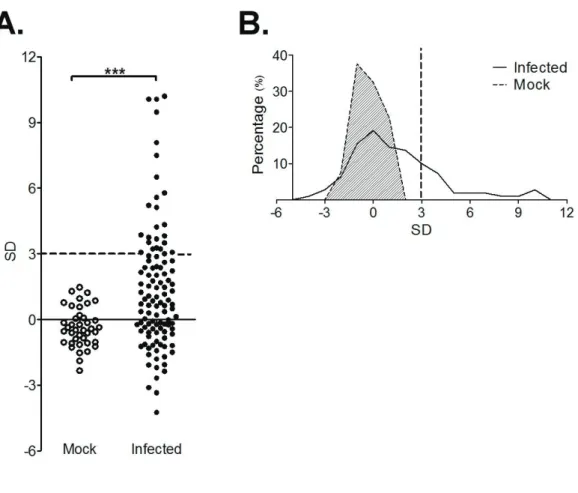
the remained erythrocyte (totally 5 independent experiments, totally n=110 in infected group and n=40 in mock group, respectively). Results were standardized using the mean and standard deviation (SD) hemolytic activities of mock infected mice in each experiment. Mean hemolytic activity was higher in the B. rodhaini-infected group than in the mock-infected group (Fig. 1-1A, p<0.0001, Mann-Whitney test). Significant difference in the distribution of hemolytic activity was observed between the B. rodhaini-infected group and the mock-infected group (Fig. 1-1B, p<0.0001, Chi-squared test). Twenty-seven percent (30/110) of the B. rodhaini-infected mice showed hemolytic activities higher than three SD of the mock-infected mice.
Anti-erythrocyte autoantibody and hemolytic activity of B. rodhaini-infected serum
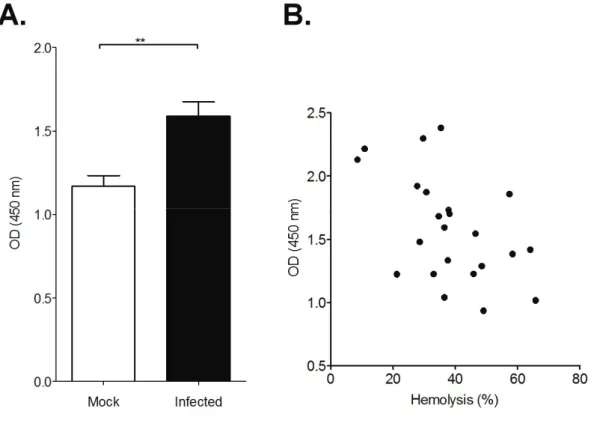
Anti-erythrocyte autoantibody titers in B. rodhaini-infected serum were significantly higher than those in mock-infected serum (Fig. 1-2A, p<0.001, Student’s t test). Serum hemolytic activities of the B. rodhaini-infected mice were measured and the correlation between anti-erythrocyte autoantibody titer and hemolytic activity was examined. As shown in Fig 1-2B, a positive relationship was not observed (R2=0.0197, regression test, p=0.25).
Changes in serum superoxide concentration after B. rodhaini infection
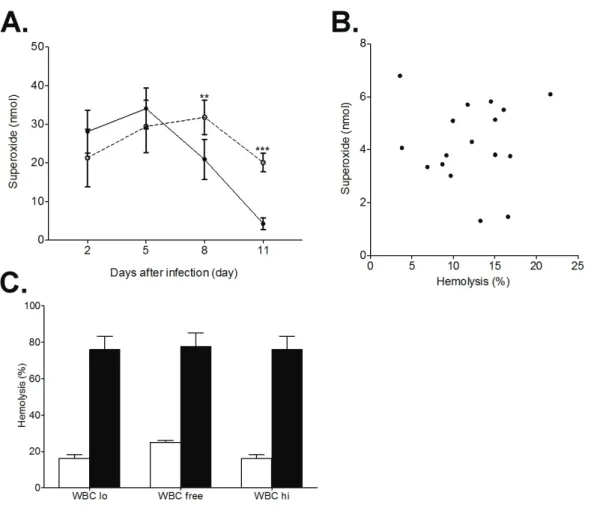
Serum superoxide concentrations for B. rodhaini-infected mice were significantly lower on 8 and 11 days after infection (dai) (Fig. 1-3A, p<0.001 on 8 dai,
p<0.0001 on 11 dai, Student’s t test). Positive correlations between hemolytic activity
and superoxide concentration of the sera from each B. rodhaini-infected mice were not observed (Fig. 1-3B, R2=9E-05, regression test, p=0.97).
Effect of leukocyte-derived reactive oxygen species (ROS) on in vitro hemolysis
We assessed the possibility that leukocytes remaining within the target erythrocyte suspension produced ROS and erythrocytes were lysed by the leukocyte-derived ROS in the hemolytic assay. Although in the hemolytic assay, leukocytes were partially removed from the target erythrocyte suspension, some leukocytes still remained (59 cells/100,000 erythrocytes, “WBC lo” in Fig. 1-3C). Therefore, a highly purified target erythrocyte suspension (0 cell/100,000 erythrocytes, “WBC free” in Fig. 1-3C) was prepared by removing leukocytes as described in the materials and methods section. As a control, purified leukocytes were added back to the “WBC free” target erythrocyte suspension to reconstruct a leukocyte-erythrocyte ratio similar to that in whole blood (196 cells/100,000 erythrocytes, “WBC hi” in Fig. 3c). Hemolytic activities of sera from B. rodhaini-infected mice were similar when measured using WBC lo, WBC free, and WBC hi (Fig. 1-3C). Elimination of total leukocytes from the target erythrocyte suspension did not reduce the serum hemolytic activity of B. rodhaini-infected individuals.
Effect of B. rodhaini-infected serum on Catalase activity of healthy erythrocytes
Sera from 2 to 3 B. rodhaini-infected mice were clustered into high hemolytic, (B1 and B2), medium hemolytic (B3 and B4), and a no hemolytic (B5) groups (Fig. 1-4A). After co-incubation with high hemolytic infected serum, the catalase activity of the non-infected target erythrocyte significantly decreased (Fig. 1-4B). The medium hemolytic serum also induced such decreasing of catalase activity. However, the low hemolytic serum did not have an inhibit effect on catalase activity of target erythrocyte (Fig. 1-4C).
When target erythrocytes were incubated with infected serum in the presence of exogenous catalase, hemolytic activity was inhibited in a dose dependent matter (Fig. 1-4D, p<0.05). Neither serum from the B. rodhaini-infected mice, nor the
Discussion
Hemolytic activity of B. gibsoni-infected canine serum was first reported in the early 1900s [41, 42]. These studies suggested that the presence of serum hemolytic factor(s) was one of the major causes of severe anemia in babesiosis besides physically destruction and anti-erythrocyte autoantibody-mediated hemolysis [41, 42]. The aim of present study was to elucidate the mechanism which leads to serum hemolytic activity of Babesia-infected animal. The results showed that serum from B.
rodhaini-infected individuals also exhibited an ability to destroy non-infected
erythrocytes and support the previous findings reported for canine babesiosis [42]. Onishi et al. assessed clinical cases of B. gibsoni-infected dogs, which all showed higher hemolytic activity than uninfected ones [42]. The development of serum hemolytic activity in B. rodhaini-infected mice was observed (Fig. 1-1). However, not all but only 27% of infected individuals showed such hemolytic activity (Fig. 1-1B). This different presence of hemolytic activity between B. gibsoni-infected dogs and B. rodhaini-infected mice may be because of the biased sampling used in selecting clinical cases. In the case of natural infection, some infected dogs may not develop severe clinical signs and recover asymptomatically. Such individuals may not be admitted to a veterinary hospital and consequently, not selected for clinical studies. However, another study that assessed dogs experimentally infected with B. gibsoni also reported that all individuals exhibited higher serum hemolytic activity [41]. Thus, the difference in hemolytic activities between B. gibsoni-infected canine and B.
rodhaini-infected mice may be also due to differences between the two Babesia spp.
Previous reports have revealed that anti-erythrocyte autoantibodies are synthesized in dogs, cattle and mice infected with B. gibsoni, B. bigemina and B.
rodhaini, respectively [1, 5, 18, 30]. These autoantibodies potentially mediate
anti-erythrocyte autoantibody titers in B. rodhaini-infected serum was detected (Fig. 1-2A, p<0.05), supporting the previous study [30]. However, no significant correlation was observed between antibody titer and serum hemolytic activity (Fig. 1-2B). Although the in vivo pathogenicity of autoantibodies is still not yet known, the result of this study suggested that they do not directly induce in vitro serum hemolytic activity. Complement was suggested to be the main factor that induce anemia in equine infectious anemia virus infection [51]. However, in the present study, sera were heated at 56°C for 30 min to inactivate complement before process to the study of hemolytic activity. Thus the role of complement to induce serum hemolytic activity was ruled out.
Previous studies have also shown that piroplasmosis patients suffer from oxidative stress. This includes increased lipid peroxidation on the erythrocyte membrane and down-regulation of antioxidant enzyme activity, which were reported in dogs infected with B. gibsoni, cattle infected with B. bigemina, and horses infected with T. equi and B. caballi [14, 44, 49]. Such oxidative injury of erythrocytes can result in increased membrane fragility in bovine B. bigemina infections [49]. Furthermore, membrane oxidative injury facilitates the binding of anti-erythrocyte antibodies to erythrocytes, up-regulates erythrocyte phagocytosis, and promotes erythrocyte-antibody complex aggregate formation in the spleen and liver [2, 3, 43].
In this study, an absence of superoxide up-regulation and no positive correlation between serum superoxide concentrations and hemolytic activities during B. rodhaini infection was observed (Fig. 1-3B), suggested that superoxide in infected serum was not responsible for serum hemolytic activity. Furthermore, leukocytes are considered to be a main source of ROS in diseases such as Staphylococcus spp., Listeria spp., and
Toxoplasma gondii infections [47]. To eliminate the contaminated leukocytes in target
further purified by totally removing all leukocytes. However, the removal of leukocytes did not reduce serum hemolytic activity in my hemolytic system (Fig 1-3C), and thus, disagreed with the postulated role of leukocyte derived ROS on serum hemolytic activity.
In erythrocytes, superoxide anions generated by Hemoglobin (Hb) autoxidation are converted to hydrogen peroxide (H2O2) by superoxide dismutase (SOD). H2O2 is then transformed to H2O by reacting with GSSH in the presence of glutathione peroxidase (GSH-Px) or transformed to H2O and O2 by catalase (CAT). Down-regulation of antioxidant enzyme activity also leads to the accumulation of ROS in erythrocytes and induces oxidative injury [57]. Such breakdown of the erythrocyte redox balance has also been previously reported in a variety of blood parasite infections. In bovine and ovine Theileria annulata infections, erythrocyte CAT, SOD, and GSH-Px activities were decreased [39, 48]. Lower CAT, SOD, and GSH-Px erythrocyte activities were also reported in humans infected with
Plasmodium vivas, and mice experimentally infected with P. vinckei [15, 54]. Nazifi
et al. also claimed that SOD activity declined in cattle infected with Anaplasma
marginale with a parasitemia of more than 10% [40]. Nonetheless, the source of
factors induces the down-regulation of antioxidant still remains unclear.
The effect of hemolytic serum on the erythrocyte antioxidant cascade was also examined. Pre-incubation of target erythrocytes with exogenous SOD did not reduce serum hemolytic activity (data not shown), suggesting that the conversion of superoxide anion to H2O2 by SOD was not affected by the hemolytic serum of B.
rodhaini-infected mice. In human and mouse erythrocytes, H2O2 is mainly removed by GSH-Px under normal metabolic conditions. CAT subsequently plays an important role when erythrocytes are exposed to increase H2O2 influx [23]. Thus, the assay used in this study for measuring the disruption of additional H2O2 by erythrocytes, is also
widely used to measure CAT activity of erythrocytes. When the presence of exogenous CAT with target erythrocytes, serum hemolytic activity was reduced (Fig. 1-4D). Although CAT is membrane impermeable [12], ROS generated inside erythrocyte is able to pass through erythrocyte membrane [24]. Exogenous CAT supplement in this system may work extracellularly to remove ROS. Down-regulation of antioxidant capacity of non-infected erythrocytes in this study was therefore likely due to decreased CAT activity of the erythrocytes. These results indicated that B.
rodhaini-infected serum has the potential to suppress catalase activity in non-infected
erythrocytes and cause hemolysis. Although gathering of ROS in the erythrocytes from B. rodhaini-infected mouse was not detected (data not shown), the effect of infected serum on erythrocyte anti-oxidant enzyme was apparent (Fig 1-4B, 1-4C), It was probably because that, erythrocytes in the circulation were extremely fragile and destructed immediately after accumulation of excessive ROS. Although the in vitro experiment showed significant effect of hemolytic serum on the suppression of CAT activity, the level of CAT suppression did not completely relate to the degree of hemolytic activity (Fig 1-4A, 1-4C). It may be because other pathways also contribute to the hemolysis. It was reported that cyanide and azide a herbicide, 3-amino-1,2,4 triazole (3-AT) are potential CAT inhibitors [28]. The infected serum might contain similar molecules.
Hemolytic activities, blood cell counts, and parasitemia were measured on 7 days after infection, when the parasitemia just started to developed. Whereas the parasitemia was 1.77%-10.87% (3.373±2.2 %), no infected mouse showed either anemia or hemolytic activity then (data not shown). In contrast, on 10 days after infection, with rapid rise of parasitemia, increased anti-erythrocyte autoantibody titer and up-regulated hemolytic activity were detected (data not shown, Fig. 1-1A, 1-2B). However, significant relationship between anti-erythrocyte antibody titer and anemia
and relationship between hemolytic activity and anemia were not observed (R2=0.1802 and R2=0.0077, respectively). Thus, in the case of B. rodhaini infection, serum hemolytic activity and autoantibody may not be important in the development of anemia in B. rodhaini infections, whereas hemolytic activity appeared to closely correlate with the onset of anemia in B. gibsoni-infected individuals [41, 42]. This difference might be due to the extremely high parasitemia (>50%) that developed in B.
rodhaini infections. The results of this study showed that, infected mouse developed
higher parasitemia showed more severe anemia (R2=0.84). The acutely rising of parasitemia in B. rodhaini infection may mask the potential pathogenicity of hemolytic serum.
In canine B. gibsoni infections, erythrocytes from babesiosis animals are relatively more resisted to serum hemolytic activity than healthy erythrocytes [41]. Thus, erythrocytes may survive when initially exposed to hemolytic serum. However, because erythrocytes comprise about 40% of the whole blood volume and act as a main scavenger of circulating ROS, oxidative stressed erythrocytes may not only lose their scavenging function, but also are able to spread oxidative stress throughout the circulatory system.
To my knowledge, this is the first report to suggest that Babesia-infected hemolytic serum can suppress CAT activity of non-infected healthy erythrocytes and induce hemolysis. Further study on the pathogenesis of hemolytic serum needs to be conducted to further elucidate the in vivo effect of hemolytic serum on redox balance.
Fig. 1-1 Hemolytic activities of B. rodhaini-infected serum
A. Serum hemolytic activities of mock (˕, n=40) and B. rodhaini-infected (˗, n=110) mice 11 days after infection. Results from five independent experiments were standardized using the mean and SD of mock data in each experiment (*** p<0.0001 by Mann-Whitney test). Dashed line indicates three SDs.
B. Distribution of serum hemolytic activities of mock (shadowed, broken line) and B. rodhaini (continuous line) infected mice. Hemolytic activity was standardized using the mean and SD hemolytic activities of mock infected mice as shown in (a) (p<0.0001 by Chi-squared test). Dashed line indicates three SDs.
Fig. 1-2 Relation between anti-erythrocyte antibody and hemolytic activity
A. Anti-erythrocyte antibody titer of mock (open column, n=10) and B.
rodhaini-infected (closed column, n=23) mice 11 days after infection (** p<0.001 by Student’s t test).
B. Relationship between hemolytic activities and anti-erythrocyte antibody titer for B. rodhaini-infected mice (R2=0.0197, by regression test, p=0.25).
Fig. 1-3 Effect of serum and leukocyte derived ROS on hemolytic activity
A. Change in serum superoxide concentration for mock ( ˕ , n=5) and B.
rodhaini-infected (˗, n=20 on day 2, 5, 8, n=17 on day 11) mice (** p<0.001,
*** p<0.0001 by Student’s t test).
B. Relationship between hemolytic activities and serum superoxide concentrations of B. rodhaini-infected mice 11 days after infection (R2=9E-05 by regression test, p=0.97).
C. Serum hemolytic activities of mock (open column, n=5) and B.
rodhaini-infected (closed column, n=4) mice incubated with target erythrocyte
suspensions containing low, free, and high leukocytes (lo: 59, free: 0, high: 196 WBC/105 RBCs).
Fig. 1-4 Effect of infected serum on catalase activity of healthy target erythrocyte A. Hemolytic activities of mock (open symbols, n=5) and B. rodhaini-infected (closed symbols, n=17) mice 11 days after infection. Infected sera were pooled according to high (B1 ˍ, B2 ˏ), medium (B3 ˑ, B4 ˓ ), and no (B5˜) hemolytic activities for further experiments in Fig. 4b, 4c (** p<0.001 by Mann-Whitney test).
B. Catalase activities of healthy target erythrocytes treated with mock (open column) and high hemolytic infected B1 sera (closed column) (* p<0.05 by Student’s t test).
C. Catalase activities of healthy target erythrocytes treated with B. rodhaini-infected sera. Average catalase activity of mock treated target erythrocytes was set as one (*** p<0.0001, ** p<0.001 by Dunnett’s multiple comparison test).
D. Hemolytic activities of infected serum in the presence of antioxidant enzyme. Target erythrocyte suspension was pre-incubated with the indicated catalase concentration for 15 min before adding infected serum (*** p<0.0001, **
Chapter 2
In vivo pathogenesis of anti-erythrocyte autoantibody in hemolytic
serum
Introduction
In canine babesiosis, anti-RBC autoantibody generated during the infection was reported for decades. Erythrocyte binding IgG in canine naturally infected with B.
gibsoni, B. canis canis, and B. canis vogeli, and erythrocyte binding IgM in canine
naturally infected with B. canis canis, and B. canis vogeli was reported [55]. Secondary IMHA in canine babesiosis is occasionally diagnosed in accordance to a positive result of direct Coomb’s test [41, 55]. In cattle babesiosis, anti-erythrocyte IgG was also reported in B. bigemina and B. bovis infection [18]. Furthermore, a major pathogenic autoantibody reported in canine primary IMHA, against erythrocyte membrane band3 molecule, was also reported in canine B. gibsoni infection [4]. Up-regulated erythrocyte phagocytosis and increased erythrocyte aggregation in liver and spleen is also reported in canine infected with B. gibsoni [34]. However, there is no direct evidence reveal that autoantibody result in in vivo pathogenicity.
In mouse babesiosis infected with B. rodhaini, higher serum concentration of anti-erythrocyte autoantibody was also reported [30]. However, due to the high degree of parasitemia in B. rodhaini infection, autoantibody may not be the major factor which induce anemia, and its pathogenesis may be overlooked [10]. Anti-erythrocyte autoantibody is also reported in the strain of New Zealand Black (NZB) mice. NZB, a well-known mouse strain develop autoantibody against erythrocyte band3 molecule spontaneously and induce hemolytic anemia via two distinct pathways [53]. The finding of autoantibody in NZB mice suggested that, although in B. rodhaini infection anemia was mainly induced by physically destruction of erythrocyte,
autoantibody-mediated hemolysis may also be a potential factor to cause the exacerbation of anemia.
The aim of chapter 2 is to elucidate the in vivo pathogenesis of autoantibody in babesiosis by directly transfer the serum containing high concentration of anti-erythrocyte autoantibody from B. rodhaini-infected mice into healthy uninfected mice.
Materials and methods
Experimental animals and parasites
Eight-week-old female C57BL/6 and Cr1j:CD1 mice were purchased from CLEA Japan Inc, (Tokyo, Japan). Retired New Zealand black (NZB) mice were purchased from Japan SLC Inc, (Shizuoka, Japan). The Australian strain of B.
rodhaini was kindly provided by the Kyushu Branch of the National Institute of
Animal Health and injected into Cr1j:CD1 mice intraperitoneally. Seven days after injection, heparinized whole blood was collected and the parasitemia was determined by examining Giemsa-stained thin blood-smears. The infected blood was diluted (2x) with storage buffer (Vega y Martinez Buffer containing 20% (w/v) polyvinylpyrrolidone (PVP)) and stored at -80°C until used as a parasite stock. The experiments were performed in accordance with the Gifu University Animal Care and Use Committee guidelines.
Experimental infection and infected serum
C57BL/6 mice were intravenously infected with 106 parasitized erythrocytes within a total of 1.856 × 10⁶ cells. Mice within the mock-infected group were intravenously infected with 1.856 × 10⁶ non-parasitized erythrocytes from a non-infected Cr1j:CD1 mouse. For the serum used in study of the change of antibody titer during infection, whole blood from each individual was collect every other day. For the other studies, all mice were sacrificed eleven days post-infection and whole blood was obtained. Whole blood was clotted at room temperature for 2 h to collect serum. All sera for were stored at -20°C until use.
Enzyme-linked immunosorbent assay (ELISA) for anti-erythrocyte autoantibody detection
A 96-well ELISA plate was coated with 100 μl of 107/ml erythrocyte membrane antigen in 50 nM carbonate buffer (pH 9.6) per well and incubated at 4°C overnight.
After washing three times with 0.05% Tween 20-PBS, the reaction was blocked with 300 μl of PBS containing 3% skim milk at 37°C for 1 h. After washing three times with Tween 20-PBS, serum samples were diluted 1:40 in 3% skim milk, and 50 μl diluted serum was then added to each well before being incubated at 37°C for 3 h. After washing five times with Tween 20-PBS, 100 μl of horse-radish peroxidase (HRP)-conjugated rabbit-anti-mouse immunoglobulin G, diluted 1:3000 with PBS containing 3% skim milk, or 100 μl of horse-radish peroxidase (HRP)-conjugated rabbit-anti-mouse immunoglobulin M, diluted 1:5000 with PBS containing 3% skim milk, was added as the second antibody, then incubated at 37°C for 1 h. After washing five times with Tween 20-PBS, 50 μl of substrate solution (SAT-blue) was added to each well, the reaction was stopped by adding 50 μl of 1N H2SO4 solution. Absorbance at 450 nm was determined using an ELISA microplate reader.
Western Blotting
Heparinized whole blood from healthy mice was centrifuged at 8,000 rpm for 1 min, the plasma and buffy coat then removed. Erythrocyte was washed for 5 times with 10 times volume of 0.09% NaCl. Packed erythrocyte was hypotonic lysed with 10 mM Tris-HCl (pH=7.5) and incubated at 4°C for 15 min. After centrifuged at 8,000 rpm for 2 min and removal of the supernatant, erythrocyte lysate was re-suspensed in 10 ml 10mM Tris-HCl (pH=7.5). Same volume of 0.25 M glucose was added into the lysate and incubated at at 4°C for 5 min. After centrifuge at 10,000 g for 2 min, the supernatant and reddish erythrocyte hemolysate was discarded, and pale RBC ghost was collected from the bottom of tube. 50 μl of erythrocyte ghost was incubated with 50 μl of SDS sample buffer at 98°C for 10 min and electrophoresed in a 10% SDS-PAGE (Atto co.). Protein separated by SDS-PAGE then electrophoretically transferred to nitrocellulose membrane. The nitrocellulose membrane was washed 3 times in 0.1% Tween 20-PBS for 5 min and incubated at 4°C overnight immersed in
blocking buffer (PVDF blocking reagent, Toyobo).
After discard the blocking buffer, nitrocellulose membrane was rinsed with 0.1% Tween 20-PBS once and than washed 3 times with 0.1% Tween 20-PBS for 5 min each wash. Serum collected on the 11th day after B. rodhaini infection or from NZB mice was diluted 1:200 in immunoreaction enhance solution (Toyobo-NKB-101) and incubated with the membrane for 1 hr at 37°C. The membrane was then washed 3 times with 0.1% Tween 20-PBS for 5 min each time and incubated with HRP labeled rabbit-anti-mouse-IgG diluted 1:10000 in immunoreaction enhance solution for 1 hr at 37°C. Finally, the membrane was washed 3 times with 0.1% Tween 20-PBS for 5 min each time. ECL Prime western blotting detection reagent (GE Healthcare co.) diluted 1:1 in PBS was added onto the membrane and the development of fluorescent band was recorded with film at an exposure time of 5 s, 10 s, 1 min, and 3 min.
Serum Transferration
Anti-erythrocyte autoantibody in B. rodhaini and mock infected serum was assayed on the 11th day post-infection. Sera from 3 NZB mice, 4 mock infected mice, 5 B. rodhaini-infected mice with high concentration of anti-erythrocyte autoantibody, and 6 B. rodhaini-infected mice with low concentration of anti-erythrocyte autoantibody were clustered and pooled to a total number of 900μl in each group respectively. Three hundred μl of pooled serum was injected intravenously into an eight-week-old female C57BL/6 mouse. Whole blood of each recipient was collected before and on 2, 4, 6, 8, 10, 12 days after serum transferration and erythrocyte counts were calculated using a standard hemocytometer.
Statistical analysis
The relation between anti-erythrocyte IgG and IgM was analyzed with linear regression test. Anti-erythrocyte IgG and IgM titer and change of erythrocyte count after serum transferration was analyzed with Student’s t test.
Results
Anti-erythrocyte IgG and IgM in B. rodhaini-inected serum
A positive relationship was observed between the titer of anti-erythrocyte IgG and IgM in B. rodaini-infected serum (Fig 2-1A, R2=0.8441, regression test, p<0.01).
After B. rodhaini infection, serum anti-erythrocyte IgM was elevated since 6 days after infection and maintained at a significantly high concentration throughout the study, anti-erythrocyte IgG was elevated since 8 days after infection and maintained at a significantly high concentration throughout the study (Fig 2-1B,
p<0.0001, Student’s t test).
Multiple clones of antibody react to different erythrocyte antigens, respectively, were observed in B. rodhaini-infected serum. Antibody reacted with 90-100kDa erythrocyte protein was presented in 2 infected mice. Antibody reacted with 78 kDa and 72kDa erythrocyte protein was observed in 4 and 2 infected mice, respectively (Fig 2-1C).
In vivo Effect of infected serum on uninfected mice
Sera from 5 and 6 B. rodhaini-infected mice were clustered and pooled into high antibody and low antibody groups, respectively (Fig. 2-2A). After transferred into uninfected mice, clinically recognized anemia (RBC < 6 x 10⁹/ml) was not observed. However, erythrocyte count of mice transferred with high antibody serum was decreased significantly on 6, 8, 10, and 12 days after transferration (p<0.05, Fig 2-2B, Student’s t tests).
Discussion
Anti-erythrocyte autoantibody generated in Babesia gibsoni-infected dog and B.
bigemina-infected cattle has been reported for decades and was suggested to be one of
the hemolytic factors in Babesia-infected serum [1, 2, 3, 4, 5, 18, 43]. Along with these findings, evidence of antibody-mediated intravascular and extravascular hemolysis, including up-regulation of erythrophagcytosis and increased of erythrocyte aggregation in the spleen and liver, were also observed in dog babesiosis [34, 35]. On the other hand, oxidative injury of parasitized and non-parasitized erythrocyte was also a common finding in dogs infected with B. gibsoni, cattle infected with B.
bigemina, and horses infected with T. equi and B. caballi [14, 44, 49]. Oxidative
injury fastened the removal of erythrocyte from the circulation. Indeed, previous report also demonstrated that anti-erythrocyte autoantibody in babesiosis reacts with aged and oxidative stressed erythrocytes [32]. Although remove of oxidative stressed erythrocyte by autoantibody result in the increase of severity of anemia, the effect of autoantibody on healthy erythrocyte remains unclear. Thus, whether the generation of anti-erythrocyte autoantibody is a consequence of clearance of oxidative stressed and aged erythrocyte, or an independent pathogenic cascade activated in babesiosis is still unknown.
In Fig. 2-1A and 2-1B, the dynamic of anti-erythrocyte IgM and IgG after B.
rodhaini infection was observed. The production of IgM and IgG were gradually
elevated parallelly in each individual within 2 weeks after infection (Fig 2-1B). Previous studies showed that after inoculation, the rise of antigen-specific IgM generated by primary immune response can be observed as soon as within 2 weeks. In contrast, the generation of IgG reacts to the same antigen usually took much longer. For instance, in children immunized with measles vaccine, seroconversion of measles-specific IgM occurred in 61% patient within 2 weeks after vaccination, while
seroconversion of measles-specific IgG occurred in only 14% patient with 2 weeks and in 81% patient within 3 weeks after vaccination [21]. In another study of dog experimentally infected with Borrelia burgdorferi, seroconversion of IgG was observed within 3-5 weeks depending on the antigen used for ELISA assay [58]. Taking these together, these results indicated that primary immune response to erythrocyte was activated during B. rodhaini infection, since anti-erythrocyte IgM in infected mice was elevated on 6 days after infection. The early incidence of anti-erythrocyte IgG may be a result of activated secondary immune response, or may simply because the isotype switching of anti-erythrocyte antibody in B.
rodhaini-infected mice occurred earlier than in other infections. Because whole lysate
of erythrocyte was used as antigen in this study, it is impossible to make an interpretation whether the two different isotypes of anti-erythrocyte autoantibody react with the same antigen on erythrocyte.
In dog IMHA, band3 was reported to be the main target antigen of anti-erythrocyte autoantibody. Previous studies have showed that anti-band3 autoantibody was generated after dog experimentally infected with B. gibsoni [4]. In NZB mice, anti-band3 autoantibody was also the one of the main pathogenic clone of autoantibody [7, 20]. In Fig 2-1C, it was showed that, in 2 B. rodhaini-infected mice, a clone of autoantibody reacted with erythrocyte antigen (90~100kDa) was developed. Besides, four infected mice also developed antibody against erythrocyte antigen 78kDa and three infected developed antibody against erythrocyte antigen 72kDa. In previous studies applied by whole erythrocyte lysate as antigen, erythrocyte antigen 90~100kDa, 78 kDa, and 72 kDa were recognized as Band3, Band4.1 and Band4.2 antigen, respectively [7]. Thus, these results strongly suggested that anti-Band3, anti-Band4.1, and anti-Band4.2 autoantibody was generated in B. rodhaini-infected serum. Band3 is a glycoprotein with transmembrane structure and appears as a wide
band in western blot. Band4.1 is a cytoskeletal protein. Both Band3 and Band4.1 proteins are considered as oxidized-erythrocyte membrane proteins and can act as target during the clearance of aged erythrocyte [4, 7]. Therefore, generation of anti-Band3 and anti-Band4.1 autoantibody in B. rodhaini-infected mice may be a result of increased oxidative injury on erythrocyte membrane.
Although autoantibody generated during B. rodhaini infection may also react with oxidative damaged erythrocyte [32], Autoantibody itself has a potential ability to mediate the degradation of healthy erythrocyte was further demonstrated. As shown in Fig 2-2B, erythrocyte count decreased significantly only in the recipient injected with infected serum containing high concentration of anti-erythrocyte autoantibody. It strongly suggested that, even without the increase of aged erythrocyte in the circulation, anti-erythrocyte autoantibody alone is pathogenic. The absence of clinically recognized anemia induced by the infected serum may be because that, in the study of serum in vivo pathogenesis, only one dose of infected serum were administrated on day 0 through the whole study. Allogeneic antibody may be eliminated from the circulation by immune system of recipient or simply degraded due to their half-life.
To study the pathogenesis of anti-erythrocyte autoantibody, purification of autoantibody with protein A or protein G column is a wide applied method. However, due to the low concentration and low affinity of autoantibody in infected serum, purification of autoantibody from infected serum was failed (data not shown).
My finding in chapter 2 revealed that multiple clones of anti-erythrocyte autoantibody, including anti-Band3-like and anti-Band4.1-like autoantibody were generated during B. rodhaini infection. Serum containing these clones of autoantibody is potent to induce the decreasing number of erythrocyte even in healthy mice.
Fig. 2-1 Anti-erythrocyte autoantibody generated in B. rodhaini infection
A. Relationship between anti-erythrocyte IgG and anti-erythrocyte IgM titer for mock (open circle, n=6) and B. rodhaini-infected (closed circle, n=6) mice 11 days after infection (R2=0.8441 for B. rohaini-infected and R2=0.1037 for mock mice, by regression test).
B. Development of anti-erythrocyte IgG (˗) and IgM (ˍ) after B. rodhaini infection (n=15 on 2, 4, 6, 8, 10 days and n=14 on 11 days after infection, ***
p<0.0001 by Student’s t test).
C. Multiple clones of anti-erythrocyte autoantibody developed after B. rodhaini infection on 11 days after infection (1-5 represent serum from five B.
rodhaini-infected mice, respectively, Red arrowhead: 90-100 kDa, exposure time:
Fig. 2-2 Effect of infected serum on the erythrocyte count of healthy individual A. Anti-erythrocyte autoantibody of mock (open symbols, n=4) and B.
rodhaini-infected (closed symbols, n=17) mice 11 days after infection. Infected
sera were pooled according to high (ˏ), and low (ˑ) concentration of autoantibody for further experiments in Fig. 2-2B (*** p<0.0001 by Student’s t test).
B. Erythrocyte count of healthy C57/BL6 mice after injection of serum from NZB mice ( ˗ ), serum containing high ( ˏ ), and low ( ˑ ) concentration of autoantibody from B. rodhaini-infected mice, and serum from mock infected mice (˕) on day 0. (n=3 in each group, * p<0.05 by Student’s t test).
Chapter 3
Generation of monoclonal anti-erythrocyte autoantibody in B.
rodhaini infection
Introduction
Anti-erythrocyte autoantibody in babesiosis has been reported for decades and considered to induce secondary hemolytic anemia during infection. However, the pathogenesis of autoantibody alone has not been clarified yet. The results in chapter 2 suggested that after in B. rodhaini infection, autoantibody suspected to react with erythrocyte membrane Band3 antigen, a well-know target antigen in canine IMHA was generated in infected serum. It was also showed that, after a single injection of infected serum containing high concentration of autoantibody, red blood cell count of recipient decreased significantly. Although several developed protocol are applied for the purification of antibody in mice serum for further study, due to the limited amount of serum that can be collected from one single mouse, it is not applicable in the study of autoantibody in babesiosis.
Development of monoclonal antibody (mAb) against self erythrocyte antigen has been performed previously for the studying of pathogenic mechanism in NZB mice [16, 53]. Anemia in healthy recipient can be induced by a single of IP injection of purified mAb [52]. Furthermore, pathogenic mechanism study was also performed and revealed that mAb in NZB induces the destruction of erythrocyte via two distinct pathways [52]. As showed in chapter 2, multiples clone of anti-erythrocyte autoantibody generated in mice infected with B. rodhaini, suggested that high pathogenic, as well as low pathogenic clones of autoantibody may be developed in infected serum. Thus, the generation of mAb enables the study of pathogenic property of each clone of autoantibody in babesiosis.
In chapter 3, mAb react with mouse erythrocyte antigen from B.
rodhaini-infected mice was generated. It was also showed that mAb secreting
Materials and methods
Experimental animals and parasites
Eight-week-old female C57BL/6 and Cr1j:CD1 mice were purchased from CLEA Japan Inc, (Tokyo, Japan). The Australian strain of B. rodhaini was kindly provided by the Kyushu Branch of the National Institute of Animal Health and injected into Cr1j:CD1 mice intraperitoneally. Seven days after injection, heparinized whole blood was collected and the parasitemia was determined by examining
Giemsa-stained thin blood-smears. The infected blood was diluted (2x) with storage
buffer (Vega y Martinez Buffer containing 20% (w/v) polyvinylpyrrolidone (PVP)) and stored at -80°C until used as a parasite stock. The experiments were performed in accordance with the Gifu University Animal Care and Use Committee guidelines.
Experimental infection and splenocyte collection
C57BL/6 mice were intravenously infected with 106 parasitized erythrocytes within a total of 1.856 × 10⁶ cells. Eleven days post-infection, all mice were sacrificed and spleen was obtained and splenocyte was collected immediately. For the control, splenocyte from un-infected C57BL/6 mice were collected.
In vitro stimulation and hybridoma production
One billion per ml splenocyte was cultured with 107/ml erythrocyte in RPMI-1640 (supplied with 15% FCS) at 37°C with 5% CO2 for 3 days and proceed to the fusion of hybridoma.
After in vitro culture, 15 x 107 splenocyte was fused with 3 x 10⁷ myeloma cell by polyethylenglycol (PEG) 4000 (Merck). Hybridoma then cultured in hypoxanthine-aminopterin-thymidine (HAT) culture medium (Sigma-H0262) at a concentration of 5 x 10⁶/ml in 96 well culture plates at 37°C with 5% CO2. 14 days after hybridoma fusion, cell colony was recorded under UV light box. Supernatant from each well showed colony growth was collected for ELISA. Hybridoma showed
an anti-erythrocyte concentration was moved to 24 well plates and culture in HT medium (Sigma-H0137).
Enzyme-linked immunosorbent assay (ELISA) for anti-erythrocyte autoantibody detection
A 96-well ELISA plate was coated with 100 μl of 107/ml erythrocyte membrane antigen in 50 nM carbonate buffer (pH 9.6) per well and incubated at 4°C overnight. After washing three times with 0.05% Tween 20-PBS, the reaction was blocked with 300 μl of PBS containing 3% skim milk at 37°C for 1 h. After washing three times with Tween 20-PBS, hybridoma culture supernatant was added to each well before being incubated at 37°C for 3 h. Supernatant from un-fused myeloma culture cell was used as negative control. After washing five times with Tween 20-PBS, 100 μl of horse-radish peroxidase (HRP)-conjugated rabbit-anti-mouse immunoglobulin G, diluted 1:3000 with PBS containing 3% skim milk was added as the second antibody, then incubated at 37°C for 1 h. After washing five times with Tween 20-PBS, 100 μl of substrate solution (ABTS) was added to each well, the plate was incubated in the dark at room temperature for 1h. Absorbance at 415 nm was determined using an ELISA microplate reader.
Statistical analysis
Mean results of antibody production of hybridoma were statistically analyzed using the Mann-Whitney test. The distribution of serum antibody concentration in the culture supernatant was analyzed by Chi-squared test.
Results
Anti-erythrocyte autoantibody secreting hybridoma generated from B. rodhaini-infected mice
Fourteen days after hybridoma fusion, a total number of 22 and 7 hybridoma clones from three B. rodhaini-infected and mock mice secreted anti-erythrocyte antibody, respectively (Tab 3-1). The antibody secreting hybridoma clones were collected and further extended.
Anti-erythrocyte autoantibody secreting hybridoma from B. rodhaini-infected mice after clone extension
Seven days after extension, anti-erythrocyte antibody of each clone was accessed. Results were standardized using the mean and standard deviation (SD) antibody concentration of control myeloma cell in each experiment. Mean anti-erythrocyte antibody concentration was higher in the B. rodhaini-infected group than in the mock group (Fig. 3-1A, p<0.05, Mann-Whitney test). Significant difference in the distribution of anti-erythrocyte antibody secreting clones was observed between the B. rodhaini-infected and the mock group (Fig. 3-1B, p<0.05, Chi-squared test). Fifty-nine percent (13/22) of hybridoma clones from the B.
rodhaini-infected mice produced anti-erythrocyte antibody higher than three SD of
Discussion
In NZB mice, it was reported that natural autoantibody can bind to healthy erythrocyte and mediate intravascular and extravascular hemolysis, results in anemia [17, 52]. To verify the production of anti-erythrocyte autoantibody is an activated circumstance after the infection of B. rodhaini, fusion of hybridoma using splenocyte from un-infected mice was performed. Ex vivo stimulation of splenocyte from un-infected mice did not bring a successful production of erythrocyte-reacting antibody (Tab 3-1). It suggested that natural antibody in healthy C57/BL6 mouse does not react with erythrocyte antigen. On the other hand, significantly high frequency of anti-erythrocyte antibody production clone was generated by splenocyte from B.
rodhaini-infected mice (Fig 3-1). The ability of antibody production is stable in these
clones and still observed on 21 days after fusion (Tab 3-1).
In chapter 2, it was showed that autoantibody react with erythrocyte Band3 and Band4.1 are the two candidate clones that showed the potential ability to induce hemolysis in B. rodhaini-infected serum. Although a low concentration of naturally occurring anti-Band3 autoantibody presents in circulation is responsible for the clearance of aged and oxidatively stressed erythrocyte [1, 2, 16, 26, 32], the activation level of antibody producing cell in un-infected mice is not sufficient to fulfill the generation of hybridoma. On the contrary, anti-erythrocyte antibody secreting hybridoma was successfully generated from B. rodhaini-infected mice. The result suggested that, the activation of anti-erythrocyte antibody producing cell is a specific event in B. rodhaini-infected mice.
In the preliminary experiment, hybridoma generated from B. rodhaini-infected mice displayed an unstable ability to produce anti-erythrocyte antibody (data not shown). One reason of the loss of antibody production ability is the low affinity of anti-erythrocyte autoantibody. Even though the affinity of antibody is not directly
related to its pathogenicity, indeed, low-affinity anti-erythrocyte autoantibody can induce severe anemia in mouse experimental autoimmune hemolytic anemia model [22]. However, production of low-affinity antibody may also be a factor to accelerate the loss of antibody secreting ability.
Another possibility related to the loss of antibody secreting is the unstable nature of hybridoma [59]. Hybridoma is produced by fusion of splenoctye and mylemoa cell. The co-existence of two cell nuclei in hybridoma resulted in the loss of antibody secreting ability after passage. To solve this problem, early analysis after the establishment of monoclonal hybridoma is necessary.
My result in chapter 3 clearly showed that, multiple anti-erythrocyte antibody is generated in B. rodhaini infection. The generation of monoclonal antibody provides a powerful tool for the study on the pathogenesis of self-reacting antibody.
Tab. 3-1 Number of anti-erythrocyte autoantibody secreting hybridoma clones generated from B. rodhaini-infected mice
Individual No. of Clone (day 14) >means of supernatant (day 14) >means of supernatant+3SD (day 21) B. rodhaini A 25 7 4 B 21 6 5 C 15 9 4 Mock A 11 3 0 B 5 2 0 C 4 2 0
On 14 day after fusion, numbers of hybridoma clones generated from B. rodhaini and mock infected mice were recorded. Hybridoma clones secreting higher titer of anti-erythrocyte antibody more than means of myeloma cell before fusion were kept. One week later (21 day after fusion), the number of hybridoma secreting higher titer of anti-erythrocyte antibody more than means + 3SD of myeloma cell before fusion were kept.
Fig. 3-1 Frequency of anti-erythrocyte autoantibody secreting hybridoma generated from B. rodhaini-infected mice
A. Anti-erythrocyte antibody titer in the supernatant of cultured hybridoma generated from mock infected mice (˕, n=7) and B. rodhaini-infected (˗, n=22) mice 21 days after hybridoma fusion. Results were standardized using the mean and SD of the absorbance of supernatant from cultured myeloma cell before hybridoma fusion in each experiment (* p<0.05 by Mann-Whitney test). Dashed line indicates three SDs.
B. Distribution of anti-erythrocyte antibody titer in the supernatant of hybridoma generated from mock infected mice (open column) and B. rodhaini- infected (closed column) mice. Results were standardized using the mean and SD of the absorbance of supernatant from cultured myeloma cell before hybridoma fusion as shown in (a) (p<0.05 by Chi-squared test).
General Discussion
Auto-immune diseases sometimes occur following infectious diseases. For example, patients infected with Staphylococcus spp. or herpes simplex virus seldom produce self-reactive antibody and are suffered by catastrophic antiphospholipid syndrome [13, 29, 50]. However, in the previous studies, almost all experiments were carried out in vitro using serum samples collected from infected individuals. The relationship between biological properties of the auto-reactive antibodies and clinical symptom can only be estimated by the in vitro results. In this study, in vivo pathogenesis of infected serum containing self-reacting antibody in mouse infected with B. rodhaini was firstly investigated. In chapter 2, it was showed that infected serum containing high concentration of anti-erythrocyte antibody has a potential ability to induce the decrease of erythrocyte count in vivo. This provided the evidence for the first time that, infected serum in babesiosis has a potential ability to induce the decrease number of erythrocyte in vivo.
Hemolytic anemia in is a severe clinical symptom in babesiosis. In dog and cattle infected with B. gibsoni and B. bigemina, respectively, severe anemia was reported despite of relatively low parasitemia [19, 49]. Beside physical destruction of erythrocyte by the parasite protozoa, serum hemolytic factors have been reported for decades [41, 42]. Although the presence of hemolytic factors are suggested to induce severe anemia in babesisos, there is still no direct evidence showed that hemolytic factors are able to induce in vivo hemolysis. Thus, the pathogenesis of hemolytic factor still remains unclear. To finally achieve the in vivo pathogenic study by transfer the infected serum into healthy individuals, a mouse model, in which C57/BL6 mouse was infected with B. rodhaini was set up (chapter 1). It was showed that serum from mouse infected with B. rodhaini display in vitro hemolytic activity and also contain anti-erythrocyte autoantibody, as reported in B. gibsoni-infected dog. This brought the
application of mouse model in the study.
In chapter 1, the in vitro mechanism of hemolytic serum was studied. Anti-erythrocyte autoantibody and ROS are two main hemolytic factors reported previously [2, 5, 32, 33, 44]. As showed in chapter 1, hemolytic serum can induce the down-regulation of catalase activity of healthy erythrocyte and result in hemolysis. However, the relation between the breakdown of anti-oxidative activity in erythrocyte and in vivo hemolytic activity was unclear. It may be because that, in mouse babesiosis, extremely high parasitemia was developed during infection. A majority number of erythrocyte was destructed by the egression of parasite. Thus, the effect of hemolytic factor in B. rodhaini-infected mouse is not significant.
Due to the limit amount of serum a mouse contains, it is impossible to study the effect of infected serum showed strong ability to inhibit catalase activity on healthy erythrocyte in vivo. In chapter 2, I showed that serum in vivo effect on erythrocyte is related to anti-erythrocyte autoantibody. Also, the results of chapter 3 suggested that the production of anti-erythrocyte antibody is specifically activated in B.
rodhaini-infected mouse. Beside the modulation of membrane antigen by the parasite
antigen on erythrocyte, oxidative stressed erythrocyte was also reported to induce the production of anti-erythrocyte antibody [9].
On the other hand, previous studies showed that anti-erythrocyte autoantibody in
B. gibsoni-infected dog react with aged and oxidative stressed erythrocyte in vitro
[32], suggested that oxidative injury on erythrocyte accelerate their removal from circulation by anti-erythrocyte antibody.
Take these together, this study suggested that, after infected with B. rodhaini, the catalase activity of healthy erythrocyte was down-regulated in the presence of infected serum, and in consequence, oxidative change on the membrane of healthy erythrocyte was observed (chapter 1). Oxidative damage of erythrocyte membrane
changes the exposure of target antigen expression and is able to induce the production of anti-erythrocyte autoantibody (chapter 2). Anti-erythrocyte autoantibody not only reacted with oxidative stress erythrocyte, but also has a potential effect on the removal of healthy erythrocyte from the circulation. Finally, a useful tool for the study on the pathogenesis of self-reacting antibodies was further generated (chapter 3).
Acknowledgements
This study has been accomplished by the tremendous efforts, involvement and participation of people. The achievement established in this study is based on their generous and kind assistance. I would like to express my appreciation from the deepest part of my heart.
First of all, I would like to express my sincere gratitude to Associate Professor Dr. Yasuhiro Takashima, for his grateful support of knowledge and patience throughout my study. I would also like to show my sincerest appreciation to Professor Dr. Katsuya Kitoh, for his benevolent guidance and continuous support in my study.
I would like to express my gratitude to Professor Dr. Ikuo Igarashi, Professor Dr. Naoaki Yokoyama, and Professor Dr. Hisashi Inokuma (Obihiro University of Agriculture and Veterinary Medicine), for their helpful and invaluable comments.
I would like to show my appreciation to Interchange Association, Japan, for their kindly financial support throughout my study.
In my daily work, I have been blessed with a friendly and cheerful group of laboratory members. Thank you to all of those who helped me in Laboratory of Veterinary Parasitology for the warm and kindly support in many ways.
I also want to express my grateful thanks to my favorite bands, especially “kyte” and “Belle and Sebastian”. Without the gorgeous music you brought to the world, my thesis will never be completed.
Thank you to all my dearest friends in every corner of the world. Your love across the oceans is always by my side.
Finally, I would like to express my appreciation to my family. Thanks so much for your love and support to make my effort to be real.
Reference
1. Adachi, K. and S. Makimura (1992). Changes in anti-erythrocyte membrane antibody level of dogs experimentally infected with Babesia gibsoni. J Vet Med
Sci 54(6): 1221-1223.
2. Adachi, K., M. Tateishi, Y. Horii, H. Nagatomo, T. Shimizu and S. Makimura (1994). Elevated erythrocyte-bound IgG value in dogs with clinical Babesia
gibsoni infection. J Vet Med Sci 56(4): 757-759.
3. Adachi, K., M. Tateishi, Y. Horii, H. Nagatomo, T. Shimizu and S. Makimura (1994). Reactivity of serum anti-erythrocyte membrane antibody in Babesia
gibsoni-infected dogs. J Vet Med Sci 56(5): 997-999.
4. Adachi, K., M. Tateishi, Y. Horii, H. Nagatomo, T. Shimizu and S. Makimura (1995). Immunologic characteristics of anti-erythrocyte membrane antibody produced in dogs during Babesia gibsoni infection. J Vet Med Sci 57(1): 121-123.
5. Adachi, K., A. Yoshimoto, T. Hasegawa, T. Shimizu, Y. Goto and S. Makimura (1992). Anti-erythrocyte membrane antibodies detected in sera of dogs naturally infected with Babesia gibsoni. J Vet Med Sci 54(6): 1081-1084.
6. Aebi, H. (1984). Catalase in vitro. Methods Enzymol 105: 121-126.
7. Barker, R. N., C. R. Shen and C. J. Elson (2002). T-cell specificity in murine autoimmune haemolytic anaemia induced by rat red blood cells. Clin Exp
Immunol 129(2): 208-213.
8. Baudino, L., L. Fossati-Jimack, C. Chevalley, E. Martinez-Soria, M. J. Shulman and S. Izui (2007). IgM and IgA anti-erythrocyte autoantibodies induce anemia in a mouse model through multivalency-dependent hemagglutination but not through complement activation. Blood 109(12): 5355-5362.
9. Beppu, M., A. Mizukami, M. Nagoya and K. Kikugawa (1990). Binding of anti-band 3 autoantibody to oxidatively damaged erythrocytes. Formation of senescent antigen on erythrocyte surface by an oxidative mechanism. J Biol
Chem 265(6): 3226-3233.
10. Chiou, S. P., N. Yokoyama, I. Igarashi, K. Kitoh and Y. Takashima (2012). Serum of Babesia rodhaini infected mice down regulates catalase activity of healthy erythrocytes. Exp Parasitol 132(3): 327-333.
11. Clarebout, G., B. Gamain, E. Precigout, A. Gorenflot, C. Slomianny, D. Camus and D. Dive (1998). Babesia hylomysci and B. divergens: presence of antioxidant enzymes destroying hydrogen peroxide. Parasitol Res 84(1): 75-77.
12. Dahlgren, C. and A. Karlsson (1999). Respiratory burst in human neutrophils. J
Immunol Methods 232(1-2): 3-14.
13. Dalekos, G. N., K. Zachou and C. Liaskos (2001). The antiphospholipid syndrome and infection. Curr Rheumatol Rep 3(4): 277-285.
14. Deger, S., Y. Deger, K. Bicek, N. Ozdal and A. Gul (2009). Status of lipid peroxidation, antioxidants, and oxidation products of nitric oxide in equine babesiosis: status of antioxidant and oxidant in equine babeiosis. J Equine Vet
Sci 29(10): 743-747.
15. Erel, O., A. Kocyigit, S. Avci, N. Aktepe and V. Bulut (1997). Oxidative stress and antioxidative status of plasma and erythrocytes in patients with vivax malaria. Clin Biochem 30(8): 631-639.
16. Fossati-Jimack, L., S. Azeredo da Silveira, T. Moll, T. Kina, F. A. Kuypers, P. A. Oldenborg, L. Reininger and S. Izui (2002). Selective increase of autoimmune epitope expression on aged erythrocytes in mice: implications in anti-erythrocyte autoimmune responses. J Autoimmun 18(1): 17-25.