C210
Impact of Sedimentation on Reservoir Hydraulic Performance: From Perspective of
Changing Soil Hydrogeological Characteristics
〇Dina ELLEITHY, Sameh KANTOUSH, Tetsuya SUMI
INTRODUCTION
Context
Reservoirs are the core of many associated hydrological applications, such as flood control, power supply, storing of water, recharging groundwater aquifers, etc. Reservoirs sustainable management and constant monitoring are essential. Such management depends principally on hydraulic performance of the reservoir (groundwater recharge volumes, water storage, etc.) which highly affected by the reservoir sedimentation (Error! Reference source not found.)
Fig. 1 Typical longitudinal cross-section of catchment stream, showing example reservoir area and expected sedimentation. It also highlights the hydraulic zones which this research focuses on.
Problem statement
As it is commonly addressed, Reservoir sedimentation is recognized as a major factor determining the loss in the reservoirs’ storage volumes
and its impacts on the hydrological processes and the adequate and safe operation of water intakes and bottom outlets.
However, the accompanied alteration in the Soil Hydrogeological Characteristics (SHC) associated with the reservoir sedimentation have been insufficiently studied due to the phenomena’s complexity, especially at reservoir basin scale.
Aim
The main aim of this research is to overview the impact of sedimentation on reservoir hydraulic performance from a new point of view that considers the accompanied alteration in SHC.
METHODOLOGY
The understanding of the alteration in SHC associated with sedimentation and its mechanisms were tested by three different approaches, as follows:
Field application was done through a series of pedon investigation/s, soil sampling, laboratory analysis, and
Fig. 2 Reservoir sedimentation and altered SHC.
(SEDHYD,2021)
(a) (b)
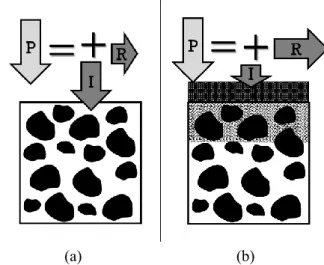
Fig. 3 Conceptual diagram showing the SHP and the whole water balance before and after reservoir sedimentation occurrence, a and b, respectively.
numerical simulations. In addition to, a case study application was chosen at the reservoir basin of a groundwater recharge dam located in Oman.
Numerical sensitivity analysis were done through a synthetic quantitative assessment for the sensitivity of SHP to altered SHC by simulating sets of soil compositions and soil profiles using common pedo-transfer functions and 1D surface-subsurface numerical simulation model (Hydrus-1D©).
Physical modelling was performed by simulating 12 different scenarios using customized soil column experiment for 6 different compositions of bed and suspended particles sizes under various hydraulic conditions (constant and variable).
RESULTS AND DISCUSSION
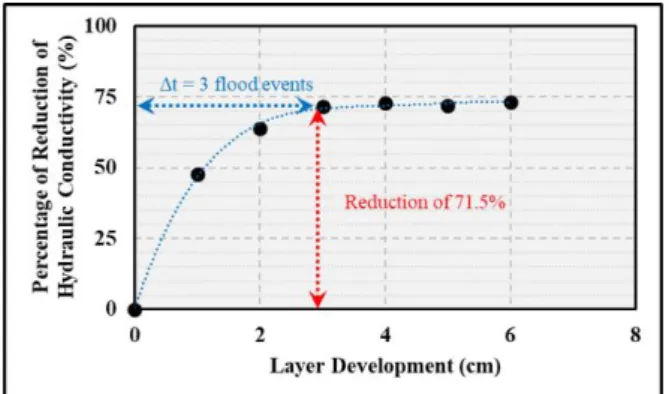
The results showed, that alteration in SHC can cause reduction in SHP ranges between 50% up to 95% depending on ratio of fine particles size and bed material, altered soil compositions, and formation of newly deposited layers.
Fig. 4 The as built setup of the soil column experiment apparatus at the laboratory room
Fig. 5 The as built setup of the soil column experiment apparatus at the laboratory room
CONCLUSION
To date, studies on sedimentation were conducted almost considering no change in the SHC. However, research on the alteration of SHC and its impacts on SHP should not be neglected, especially its influence on reservoir hydraulic performance, it is not well known.
Conclusions drawn from the research have shown that changing the SHC seriously impacts the reservoir hydraulic performance. Additionally, It is possible to connect different research areas together to conduct sustainable management. A relation between studies on physical clogging and alteration in SHC could be testified.
REFERENCES
(1) Fetzer, Jasmin, Markus Holzner, Michael Plötze, and Gerhard Furrer. 2017. "Clogging of an Alpine
streambed by silt-sized particles–Insights from laboratory and field experiments." Water research
126: 60-69.
(2) Schälchli, Ueli. 192. "The clogging of coarse
gravel river beds by fine sediment."
Hydrobiologia 1: 189-197.
(3) Schuh, W. M. 1990. "Seasonal variation of
clogging of an artificial recharge basin in a northern climate." Journal of Hydrology 121
(1-4): 193-215.
(4) Segismundo, Ezequiel Q., Lee-Hyung Kim, Sang-Man Jeong, and Byung-Sik Lee. 2017. "A
laboratory study on the filtration and clogging of the sand-bottom ash mixture for stormwater infiltration filter media." Water 9 (1): 32.
(5) Wang, Zijia, Xinqiang Du, Yuesuo Yang, and Xueyan Ye. 2012. "Surface clogging process
modeling of suspended solids during urban stormwater aquifer recharge." Journal of
Environmental Sciences 1418-1424.
(6) Xinqiang, Du, Yunqing Fang, Zijia Wang, Jiawei Hou, and Xueyan Ye. 2014. "The Prediction
Methods for Potential Suspended Solids Clogging Types during Managed Aquifer Recharge." Water
6 (4): 961-975.
The work carried out through this paper is part of the PhD thesis research which aims: 1) to minimize the impacts of the physical clogging occurrence; due to the existence of suspended sediments in the harvested floodwater and 2) to hinder the change of the characteristics of the recharge basin.
R ed uct io n in h yd ra ul ic co nducti vi ty S2 S3 S4 S5 S S 0 10 20 30 40 50 0 0 0 0 100 0 0.1 0.2 0.3 0.4 0.5