博士論文(要約)
論文題目
Synthesis of Copolymers Based on
π-Conjugated Planar Molecules as a Step
toward Semiconducting Foldamers
(半導体フォルダマーに向けたπ共役平面分
子共重合体の合成)
氏名
MingXiu Zhao
論文の内容の要旨
論文題目
Synthesis of Copolymers Based on
π-Conjugated Planar Molecules as a Step
toward Semiconducting Foldamers
(半導体フォルダマーに向けたπ共役平面分子共重合体の合成) 趙 明修
1. Introduction
Organic electronics such as organic field effect transistors (OFETs), light-emitting diode (OLED) and photovoltaics (OPVs) offer attractive alternatives to conventional inorganic electronics because of their potential of low-cost, large-area fabrication and mechanical flexibility. The semiconductors based on π-conjugated small molecules have achieved high charge motilities due to their high crystallinity in films or single crystals, but they often rely on energy-demanding vacuum deposition technologies.Semiconducting polymers have an advantage of solution processability that has higher compatibility with the low-cost roll-to-roll fabrication on flexible substrates. The charge motilities of the polymer films, however, are still lower than those of the small molecules. Charge transport processes in the polymer films are generally more complicated due to the large structural disorder: in the semicrystalline polymers, it is proposed that the charge delocalized states in the crystalline regions have efficient interchain charge transfer due to the better overlap of π-orbitals between the ordered chains. In addition, structural defects, grain boundaries, and disordered regions contribute to localized states that could lower the charge transfer. Therefore, not only the chemical structures of the polymer materials, but also the construction of the ordered structures in the conjugated units is highly important to achieve a good charge transport in the films.
To improve the crystallinity and the mobility of the polymer films, preorganization of the polymer chains with defined secondary structures, such as intramolecularly stacked conjugated segments, could be useful for both short and long range orders. This could be also advantageous in mixture bulk heterojunction (BHJ) type photovoltaics, where the polymers could
form ordered pure domain through the intramolecular interactions even in the mixture films. This could be beneficial to the control of the charge transport in the blended film. However, there have been few reports on the semiconducting polymers with the controlled secondary structures in solid state.
In this research, we propose a new design concept of the semiconducting copolymers, in which π-conjugated planar segments are connected by short flexible linkers that allow neighboring segments to interact closely with each other through face-to-face π-π interactions. Perylene diimide (PDI) and naphthalene diimide (NDI) derivatives are widely used in OFETs and photovoltaics as n-type materials for their high electron affinity and high electron mobility due to their large π-orbital overlap in the solid state. If we could control the polymer conformations in the films, the largely interacted PDI or NDI groups could lead to efficient intramolecular charge transport.
2. Synthesis and characterization of copolymers
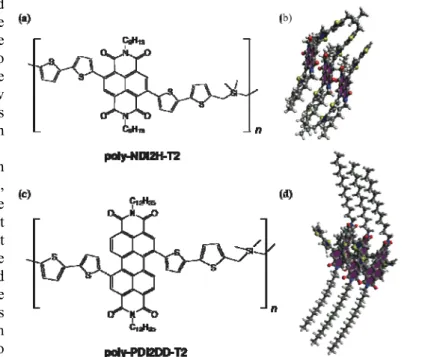
Fig. 1 shows the polymer designs in this study. Dimethyl-bis(thiophen-2-ylmethyl)silane as a flexible linker could facilitate the folding of the polymer chains and the intramolecular stacking of PDI or NDI groups. At the same time, the short turning length of the linker (-C-Si-C-) could maintain a constant stacking distance to maximize the intramolecular interactions between PDIs or NDIs and simultaneously minimize the entropic loss caused by folding. To demonstrate this, structural optimization of the trimer as a model compound was performed by MM2 calculation starting from open structures (Fig. 1b and d).
Fig. 1. Structural formula of the designed polymers based on (a) NDI and (c) PDI. Molecular model of trimer optimized by MM2 calculation starting from an open structure for (b) poly-NDI2H-T and (d) poly-PDI2DD-poly-NDI2H-T2.
Dimethyl-bis(thiophen-2-ylmethyl)silane linker was synthesized using Grignard reaction of 2-bromothiophene and bis(chloromethyl)dimethylsilane, with CuCl2 and prop-1-ynylbenzene as catalysts, and trimethylstannyl
group was added with BuLi treatment. The target polymers poly-PDI2DD-T2 and poly-NDI2H-T2 were synthesized by Stille coupling, showing good solubility in CHCl3 and number-average molecular weight (Mn) of
10 kDa and 7.9 KDa, respectively, measured by GPC. The monomeric model compound PDI2DD-T2 and NDI2H-T2 was also synthesized by Stille coupling reaction.
The UV-vis absorption spectra of the monomeric model compounds and the polymers in CHCl3 solution are
shown in Fig. 2. NDI based compounds show two absorbance peaks in the UV and visible regions, which is a pattern similar to those of the reported materials based on NDI-bisthiophene. This similarity in spectra is reasonable since the linker breaks the conjugation in poly-NDI2H-T2, and both the highest occupied molecular orbital (HOMO) and the lowest unoccupied molecular orbital (LUMO) are confined to the NDI-bisthiophene unit. However, the wavelengths at the peak maxima for poly-NDI2H-T2 are longer than those for NDI2H-T2. Note that the concentration of the solutions is too low to induce intermolecular interactions (1 mg L-1). Therefore, this difference suggests the
intramolecular interactions between NDI units in poly-NDI2H-T2. The change in the conformation of the polymer that contains the short and flexible linker as shown in Fig. 1b could allow an overlap of the frontier orbitals of NDI units, leading to a reduced optical band gap. Poly-PDI2DD-T2 showed similar red shift of their three absorbance peaks comparing with that of PDI2DD-T2, indicating similar interaction between PDI derivative segments when being connected by C-Si-C linkers (Fig. 2b).
To observe the reversible conformation change in the polymers, the respective temperature dependences of the absorption spectra of both the polymers and monomers were measured in the chlorobenzene solution with a
Fig. 3 Variable-temperature UV-vis spectra of (a) NDI2H-T2, (b) poly-NDI2H-T2, (c) PDI2DD-T2, and (d) poly-PDI-2DD-T2 in chlorobenzene at temperatures between 0 and 100 °C. Plots of the absorption maxima of (c) NDI and (f) PDI based materials as functions of the temperatures.
Fig. 2. Normalized UV-vis absorption of (a) NDI and (b) PDI based materials in CHCl3.
concentration of 1 mg L-1. As shown in Fig. 3, as the temperature was varied from 0 to 100 °C, the absorption peak of poly-NDI2H-T2 in the visible region showed a hypsochromic shift from 587 to 570 nm, while the position of the other peak remained constant at 360 nm. The peak intensity did not change significantly upon the temperature change. Peak maxima are plotted as functions of temperature in Fig. 3c for clarity. This shift in peak maxima was found to be fully reversible when the temperature was changed back to 0 °C. In contrast, the absorption peak maxima of NDI2H-T2 in both the visible and UV regions were almost independent of the temperature, as shown in Fig. 3a and c. These results indicate the decreased intramolecular interaction between NDI segments at high temperature, which could be attributed to the conformation change of poly-NDI2H-T2 to more “open” structure caused by an increase in the entropic term. Although the change was smaller, similar blue shift of longest absorbance peaks at high temperature was also detected in the case of poly-PDI2DD-T2, indicating a conformation change of PDI based polymer in solution.
3. Solid state properties and devices of polymers
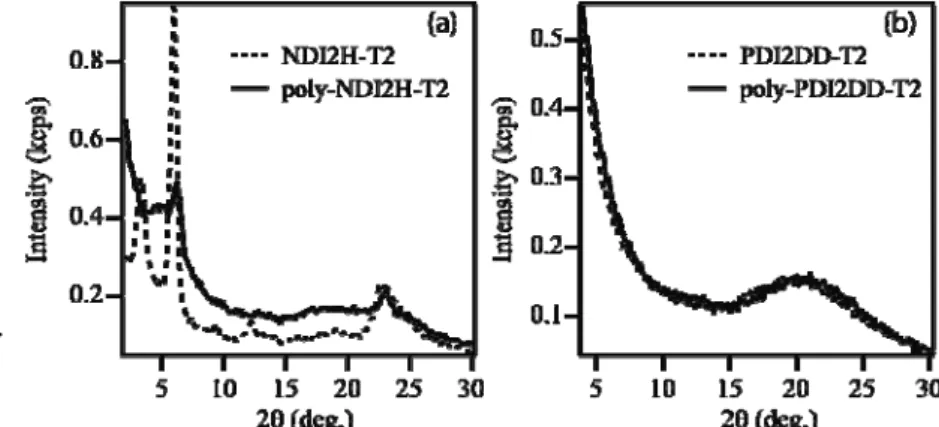
In-plane XRD patterns from the drop casted films of the polymers and the monomeric models are shown in Fig. 4. Poly-NDI2H-T2 film shows diffraction peaks at 6.18° and 23.19° corresponding to the d-spacings of 14.3 Å and 3.8 Å, respectively. NDI2H-T2 film shows diffraction peaks at 3.32°, 5.95° and 22.7° corresponding to the
d-spacings of 22.6 Å, 14.8 Å and 3.8 Å, respectively. The peaks at lower angles could be attributed to the
repeating structure along the long axis of NDI2H-T2, therefore, the corresponding peak in poly-NDI2H-T2 could be attributed to the intermolecular packing. The peaks at the larger angle could be assigned to the π-π stacking in films. The peak position in the polymer film (3.8 Å) agrees well with the value calculated by MM2 (3.8 Å) and it is similar to those for NDI2H-T2 film (3.9 Å) and the previous reports on the NDI based materials (3.4-3.9 Å). The full-width at half-maximum (FWHM) of peaks in both samples are comparable but the intensity from the polymer film is lower,
suggesting the lower crystallinity of the polymer films. However, the clear π-π stacking peak might suggest an intramolecular folded structure of the polymer in films. There is no peak in PDI based material films, indicating that the crystallinity is low in both the monomeric and polymeric materials. This may due to a bay–site substituent inducing twist of PDI planes, which could reduce the π−π interaction of PDI segments and induce large steric hindrance.
Bottom-gate top-contact OFETs were fabricated on n+-Si/SiO2/OTS substrates by spin-coating the
semiconducting polymers solutions (10 g L−1 in CHCl3). The film thickness was 50 nm measured by XRR. The
films were annealed at 160 °C for 2 h before the OFET structure was completed by vapor deposition of Au source/drain electrodes. Electrical measurements were performed both under high vacuum. The transfer and output curves of the OFETs are shown in Fig. 5 and 6. The positive gate voltage shows that both polymers are n-channel semiconductors. The mobility μ was calculated in the saturated region from the equation μ =
(2ISDL)/[WCi(VSG−Vth)2] and the electron mobility of poly-NDI2H-T2 was 0.002 cm2 V−1 s−1. This mobility is
comparable to those of PCBM that is commonly used for OPVs. However, output curve of poly-PDI2DD-T2 show no saturated range, indicating large number of traps in the fabricated FET devices, which could due to low crystallinity of films.
The polymers were used as the electron acceptor in the combination with P3HT in mixture BHJ OPV with mixture BHJ. The optimized OPV performance is summarized in Table 1. Fig. 6a
Fig. 4. In-plane XRD patterns for the drop cast films of (a) NDI and (b) PDI based materials.
Fig. 5. Output curves of FETs fabricated with (a) NDI and (b) PDI based copolymers.
shows the J–V curves of the best devices under the illumination of AM 1.5 (100 mW cm-2). The highest power conversion efficiency (PCE) of the photovoltaics reached 0.22% and 0.08% respectively, which was obtained by using a polymer ratio of 1:2 in DCB solution. The low FF of OPV indicates an inefficient charge separation in the blended film, which could be attributed to an unfavorable phase separation due to the large crystallinity difference between P3HT and the synthesized polymers. Poly-NDI2H-T2 cells showed larger JSC, which could
be attributed to the better mixing morphology of the films. The external quantum efficiency (EQE) curves of P3HT:polymer devices under the
illumination of monochromatic light are shown in Fig. 6b. The poly-NDI2H-T2 solar cells showed photocurrent response around 400 nm, and the poly-PDI2DD-T2 cells showed extended light response up to over 700 nm, suggesting that the hole-transfer from the photoexcited acceptor to the donor also occurs. The EQE value was relatively low in the whole range, limiting the overall photovoltaic performance. Further device optimization and the use of other donor materials are
expected to increase the EQE value and thus improve the photovoltaic performance.
Although the polymers are expected to have a folded structure as suggested by UV-vis in the solution and by XRD measurements in the film, the OFET and OPV performance were not improved. This could be due to the low crystallinity of the polymer films. UV-vis measurements suggested that the electronic interaction of PDI and NDI units in polymers could be weaker than those in the J-aggregates in the solutions. Therefore, competition between the intra- and intermolecular stacking during the coating process could induce an amorphous structure in polymer film. This could decrease the film crystallinity, thus the charge mobility and device performance. The planarity of NDI units could be lowered due to the twisting of naphthalene-thiophene rings. The bay-substituent could also induce twist of PDI rings, cause even worse planarity, which could be the reason of the bad crystallinity of PDI based polymer despite of the larger conjugated PDI rings that could give larger π−π interaction. Thus, more planer structure or the introduction of additional interactions such as hydrogen bonding could help to achieve the folded structure in the film. Also, bulky substituents at the linker part could make the folded conformation more favorable and lower the entropy difference between the folded and unfolded conformation which must be compensated by the interaction energy.
Table 1. Performances of BHJ polymer photovoltaics.
VOC (V) JSC (mA cm−2) FF PCE
P3HT:poly-NDI2H-T2 0.5 1.66 0.24 0.22% P3HT:poly-PDI2DD-T2 0.44 0.73 0.23 0.07%
4. Summary
In this research, it was demonstrated that the novel design enables the conjugated planer segments in copolymers to interact with each other through π−π interaction. The copolymers showed conformation change in solution with variation of temperature, and intramolecular interaction of the conjugated segments in the polymers may increase the short range order of polymer film. It is shown that the planarity of conjugated units significantly influence the crystallinity of the copolymer films, which further effect the electronic properties of the devices. More planer structure or the introduction of additional interactions could help to achieve the desired folded structure in the film.
5. Publications
1. “Synthesis of Copolymers Based on Naphthalene Diimide Connected with Non-conjugated Flexible Linker”, M. Zhao, K. Tajima, K. Hashimoto, Synth. Met., submitted.
2. “Organic Electronic Devices with Copolymers Based on Naphthalene Diimide Connected with Non-conjugated Flexible Linker”, M. Zhao, K. Tajima, K. Hashimoto, Jpn. J. Appl. Phys., submitted.
3. “Linker Effect on Folding of Naphthalene Diimide based Copolymers”, in preparation.