ROW AND COLUMN GENERATION ALGORITHM FOR MINIMUM MARGIN MAXIMIZATION
OF RANKING PROBLEMS
YOICHIIZUNAGA, KEISUKESATO, KEIJI TATSUMI,AND YOSHITSUGU YAMAMOTO
ABsTliAcT. We consider the ranking problem of learning a ranking function from the data setof objects each of which is endowed withanattribute vector andarankinglabel chosen from the ordered set oflabels. We proposeaprimalformulation with dual representation of normalvector, andthen propose to apply the kerneltechniquetothe formulation. We also propose algorithmsbased ontherowand column generation in order to mitigate the
computational burden duetothelargenumber of objects.
1. INTRODUCTION
This paper is concerned with a multi-class classification problem of $n$ objects, each of
which is endowed with an $m$-dimensional attribute vector $x^{i}=(xi, x_{2}^{i}, \ldots, x_{m}^{i})^{T}\in \mathbb{R}^{m}$ and a label $\ell_{i}$. The underlying statistical model
assumes
that object $i$ receives label $k$, i.e.,$\ell_{i}=k$, when the latent variable $y_{i}$ determined by
$y_{i}=w^{T}x^{i}+ \epsilon^{i}=\sum_{j=1}^{m}w_{j}x_{j}^{i}+\epsilon^{i}$
falls between two thresholds$p_{k}$ and $p_{k+1}$, where
$\epsilon^{i}$
represents arandom noise whose proba-bilistic property is not known. Namely, attributevectors of objectsare loosely separated by hyperplanes $H(w,p_{k})=\{x\in \mathbb{R}^{m}|w^{T}x=p_{k}\}$ for $k=1$,2,. . .,$l$ which share a common
normal vector $w$, then each object is given
a
label according to the layer it is located in. Note that neither$y_{i}’ s,$$w_{j}$’s
nor
$p_{k}$’sare
observable. Our problemisto find thenormalvector$w\in \mathbb{R}^{m}$
as
wellas
thethresholds$p_{1},p_{2}$, . . .,$p_{l}$ that best fitthe inputdata$\{(x^{i}, \ell_{i})|i\in N\}.$This problem is knownasthe rankingproblem andfrequently arises insocial sciencesand operations research. See, for instance Crammer and Singer[2], Herbrich et al. [3], Liu [4], Shashuaand Levin [6] and Chapter8 ofShawe-Taylor and Cristianini[8]. It is a variation of the multi-class classification problem, for which several learning algorithms of the support vectormachine ($SVM$ forshort) have beenproposed. Werefer the reader to Chapters4.1.2
and 7.1.3 of Bishop [1], Chapter10.10 of Vapnik [10] and Tatsumiet al. [9] and references
therein. What distinguishes the problem from other multi-class classification problems is that the identical normalvector should be shared byallthe separating hyperplanes. In this paper basedon the formulation
fixed
margin strategy by Shashua and Levin[6],we
proposea row and column generation algorithm to maximize the minimum margin for the ranking
problems.
Key words and phrases. ranking problem, Support vector machine, Multi class classification, Kernel
technique, Dualrepresentation.
This paper is organized as follows. We give some definitions and notations in Section 2. In Section3, we formulate the maximization of minimum margin with the hard margin constraints and apply the dual representation of the normal vector to the formulation. In Section4, we propose a
row
and column generation algorithm and prove the validity of the algorithm. In Section5, after reviewing the kernel technique, we apply the kernel technique to the hard margin problem with the dual representation. In Section6, 7 and 8,weexpand the discussionsso far into the softmargin problem. In Section9, wedemonstrate
an illustrative example for a small instance, then report computational experiments of
our
algorithm in Section 10. In Sectionll, we discuss a desirable property of the separating
curves.
2. DEFINITIONS AND NOTATION
Throughout the paper $N=\{1, 2, . . . , i, . . . , n\}$ denotes the set of $n$ objects and $x^{i}=$
$(Xi, x_{2}^{i}, \ldots, x_{7}^{i_{n}})^{T}\in \mathbb{R}^{m}$ denotes the attribute vector ofobject $i$. The predetermined
set of labels is $L=\{0, 1, . . . , k, . . . , l\}$ and the label assigned to object $i$ is denoted by $\ell_{i}$
.
Let$N(k)=\{i\in N|\ell_{i}=k\}$ be the set of objects with label $k\in L$, and for notational
conveniencewe write$n(k)=|N(k)|$ for $k\in L$, and $N(k..k’)=N(k)\cup N(k+1)\cup\cdots\cup N(k’)$
for $k,$$k’\in L$ such that $k<k’$. For asuccinct notation we define $X=[$ . . . $x^{i}$ .
. .
$]_{i\in N}\in \mathbb{R}^{m\cross n}$
$X_{W}=[\cdots x^{i}\cdots]_{i\in W}\in \mathbb{R}^{7n\cross|W|}$ (2.1) for $W\subseteq N$, and the corresponding Gram matrices
$K=X^{T}X\in \mathbb{R}^{n\cross n},$
$K_{W}=X_{W}^{T}X_{W}\in \mathbb{R}^{|W|\cross|W|}.$
We denote the $k$-dimensional zero vector andvector of$1$’sby
$0_{k}$ and $1_{k}$, respectively. Given
a subset $W\subseteq N$ and a vector $\alpha=(\alpha_{i})_{i\in W}$ we use the notation $(\alpha_{W}, 0_{N\backslash W})$ to denote the
$n$-dimensional vector $\overline{\alpha}$ such that
$\overline{\alpha}_{i}=\{\begin{array}{ll}\alpha_{i} when i\in W0 otherwise.\end{array}$
3. HARD MARGIN PROBLEMS $F$ SEPARABLE CASE
3.1. Primal Hard Margin Problem. Henceforthwe
assume
that $N(k)\neq\emptyset$ for all $k\in L$for the sake of simplicity, and adopt the notational convention that $p_{0}=-\infty$ and$p_{l+1}=$
$+\infty$. We say that an instance $\{(x^{i}, l_{i})|i\in N\}$ is separable if there exist $w\in \mathbb{R}^{m}$ and
$p=(p_{1},p_{2}, \ldots,p_{l})^{T}\in \mathbb{R}^{l}$ such that
$p\ell_{i}<w^{T}x^{i}<p_{l_{i}+1}$ for $i\in N.$
Clearly an instance is separable ifand only ifthere are $w$ and$p$ such that
For each $k\in L\backslash \{O\}$
we see
that$\max w^{T}x^{i}\leq p_{k}-1<p_{k}<p_{k}+1\leq\min w^{T}x^{j},$
$i\in N(k-1) j\in N(k)$
implying
$\min\underline{w^{T_{x^{j}}}}- \max \underline{w^{T}}_{X^{i}}\geq\frac{2}{\Vert w\Vert}.$
$j\in N(k)\Vert w\Vert i\in N(k-1)\Vert w\Vert$
Then the marginbetween$\{x^{i}|i\in N(k-1)\}$ and $\{x^{j}|j\in N(k)\}$is at least $2/\Vert w\Vert$
.
Hencethe maximization of the minimum margin is formulated
as
the quadratic programming(H) minimize
$\Vert w\Vert^{2}$
subject to $p\ell_{i}+1\leq(x^{i})^{T}w\leq p\ell_{i+1}-1$ for $i\in N,$
or
more
explicitly with the notation introduced in Section 2(H)
minimize $\Vert w\Vert^{2}$
subject to $1-(x^{i})^{T}w+p_{\ell_{i}}\leq 0$ for $i\in N(1..l)$ $1+(x^{i})^{T}w-p_{\ell_{t}+1}\leq 0$ for $i\in N(O..l-1)$
.
Theconstraints therein arecalled hard margin constraints, andwe namethis problem (H)
.
3.2. Dual Representation. A close look at theprimal problem (H) shows that the follow-ing property holds for theoptimum solution $w^{*}$
.
See, for example Chapter 6 of Bishop [1],Shashua and Levin[6] and Theorem 1 in Sch\"olkopfet al.[7].
Lemma 3.1. Let $(w^{*},p^{*})\in \mathbb{R}^{m+l}$ be an optimum solution
of
(H).
Then $w^{*}\in \mathbb{R}^{m}$ lies inthe range space
of
$X$, i. e., $w^{*}=X\lambda$for
some $\lambda\in \mathbb{R}^{n}.$Proof.
Let $w_{1}$ be the orthogonal projection of$w^{*}$ onto the range space of$X$ andlet $w_{2}=$$w^{*}-w_{1}$. Then
we
obtain$(x^{i})^{T}w^{*}=(x^{i})^{T}(w_{1}+w_{2})=(x^{i})^{T}w_{1}$ for $i\in N,$
meaning $(w_{1},p^{*})$ is feasible to (H), and
$\Vert w^{*}\Vert^{2}=\Vert w_{1}\Vert^{2}+\Vert w_{2}\Vert^{2}\geq\Vert w_{1}\Vert^{2}.$
Hence by the optimality of$w^{*}$ we conclude that $w_{2}=0.$ $\square$
The representation$w=X\lambda$ is called the dual representation.
Substituting$X\lambda$ for $w$ yields another primal hard margin problem $(\overline{H})$:
(H) minimize
$\lambda^{T}K\lambda$
subject to $p\ell_{i}+1\leq(k^{i})^{T}\lambda\leq p_{\ell_{i}+1}-1$ for $i\in N,$
where $(k^{i})^{T}=((x^{i})^{T}x^{1}, (x^{i})^{T}x^{2}, \ldots, (x^{i})^{T}x^{n})$ is the ith row of the matrix $K$. Since $n$ is
typically by far larger than $m$, problem (H) might be less interesting than problem (H)
.
Howeverthefact that this formulationonly requiresthe matrix$K$will enablethe application ofkernel technique to the problem.4. ALGORITHM FOR HARD MARGIN PROBLEMS
In this section, we consider the problem (H) with dual representationof normal vector. The dimension $m$ of the attribute vectors is usually much smaller than the number $n$ of
objects, hence we need a small number of attribute vectors for the dual representation. Furthermore it is likely that most of the constraints areredundant at the optimal solution. We introduce asubset $W$, called working set, of$N$ and consider the following sub-problem.
$(\overline{H}(W))$
minimize $\lambda_{W}^{T}K_{W}\lambda_{W}$
subject to $p\ell_{i}+1\leq(k_{W}^{i})^{T}\lambda_{W}\leq p_{\ell_{i}+1}-1$ for $i\in W,$
where $(k_{W}^{i})^{T}$ is the row vector consisting $(x^{i})^{T}x^{j}$ for $j\in W$
.
We propose to start thealgorithm withasub-problemwhich is much smaller than the problem (H) in both variables and constraints, and increment $W$ as the computation goes on. Notethat the dimension of
$\lambda_{W}$ varies when the size of $W$ changes as the computation goes on.
Algorithm $RC\overline{H}$ (Row and
Column Generation Algorithm for $(\overline{H})$)
Step 1 : Let $W^{0}$ be an
initial working set, and let $\nu=0.$
Step 2: Solve $(\overline{H}(W^{\nu}))$ to obtain $\lambda_{W^{\nu}}$ and $p^{\nu}.$
Step 3: Let $\Delta=\{i\in N\backslash W^{\nu}|(\lambda_{W^{\nu}},p^{v})$ violates$p_{\ell_{i}}+1\leq(k_{W^{\nu}}^{i})^{T}\lambda_{W}\leq p_{\ell_{i}+1}-1\}.$ Step 4: If$\Delta=\emptyset$, terminate.
Step 5: Otherwise choose $\Delta^{\nu}\subseteq\Delta$, let $W^{\nu+1}=W^{\nu}\cup\triangle^{\nu}$, increment $v$ by 1 and go to Step 2.
The following lemma shows that Algorithm RCH solves problem (H) upon termination. Lemma 4.1. Let $(\hat{\lambda}_{W},\hat{p})\in \mathbb{R}^{|W|+l}$ be an
optimum solution
of
$(\overline{H}(W))$.If
$\hat{p}\ell_{i}+1\leq(k_{W}^{i})^{T}\hat{\lambda}_{W}\leq\hat{p}_{\ell_{i}+1}-1foralli\in N\backslash W$, (4.1)
then $(\hat{\lambda}_{W}, 0_{N\backslash W})\in \mathbb{R}^{n}$ together with$\hat{p}$
forms
an optimum solutionof
$(\overline{H})$.Proof.
Note that $((\hat{\lambda}_{W}, 0_{N\backslash W}),\hat{p})$ is a feasible solution of (H) since $(k^{i})^{T}(\begin{array}{l}\hat{\lambda}_{W}0_{N\backslash W}\end{array})=$$(k_{W}^{i})^{T}\hat{\lambda}_{W},$ $(\hat{\lambda}_{W},\hat{p})$
is feasible to $(\overline{H}(W))$ and satisfies (4.1).
For an optimum solution $(\lambda^{*},p^{*})$ of$(\overline{H})$, let $w^{*}=X\lambda^{*},$
$w_{1}$ be its orthogonal projection
onto the range space of$X_{W}$ and $w_{2}=w^{*}-w_{1}$. Then $w_{1}=X_{W}\mu_{W}^{*}$ for some $\mu_{W}^{*}\in \mathbb{R}^{|W|}$
and
$(\lambda^{*})^{T}K\lambda^{*}=\Vert w^{*}\Vert^{2}\geq\Vert w_{1}\Vert^{2}=(\mu_{W}^{*})^{T}K_{W}\mu_{W}^{*}$ (4.2)
by the orthogonality between$w_{1}$ and $w_{2}$
.
For $i\in N\cap W$ it holds that$(k_{W}^{i})^{T}\mu_{W}^{*}=(x^{i})^{T}X_{W}\mu_{W}^{*}=(x^{i})^{T}w_{1}=(x^{i})^{T}(w_{1}+w_{2})$ $=(x^{i})^{T}w^{*}=(x^{i})^{T}X\lambda^{*}=(k^{i})^{T}\lambda^{*},$
which is between $p_{\ell_{i}}^{*}+1$ and $p_{l_{i}+1}^{*}-1$ since $(\lambda^{*},p^{*})$ is feasible to $(\overline{H})$. Then $(\mu_{W}^{*},p^{*})$ is
feasible to $(\overline{H}(W))$. This and the optimality of$\hat{\lambda}_{W}$ yield the
inequality
$(\mu_{W}^{*})^{T}K_{W}\mu_{W}^{*}\geq\hat{\lambda}_{W}^{T}K_{W}\hat{\lambda}_{W}=(\begin{array}{l}\hat{\lambda}_{W}0_{N\backslash W}\end{array})K(\begin{array}{l}\hat{\lambda}_{W}0_{N\backslash W}\end{array})$
.
The two inequalities (4.2) and (4.3) prove the optimality of $((\hat{\lambda}_{W}, 0_{N\backslash W}),\hat{p})$. $\square$
Theorem 4.2. The Algorithm $RCH$ solves problem $(\overline{H})$
.
5. KERNEL TECHNIQUE FOR HARD MARGIN PROBLEMS
The matrix$K$ inthe primal hard margin problem (H) withdual representation of normal vector is composed of the inner products $(x^{i})^{T}x^{j}$ for $i,j\in N$. This enables
us
to apply thekernel technique simply byreplacing them by$\kappa(x^{i}, x^{j})$ for
some
appropriatekernel function$\kappa.$
Let $\phi:\mathbb{R}^{m}arrow \mathbb{F}$ be a function, possibly unknown, from $\mathbb{R}^{m}$
to some higher dimensional inner product space $\mathbb{F}$
, so-called the
feature
space such that $\kappa(x, y)=\langle\phi(x) , \phi(y)\rangle$holds for $x,$$y\in \mathbb{R}^{m}$, where $\rangle$ is the inner product defined on $\mathbb{F}$
. In the sequel we denote $\tilde{x}=\phi(x)$. The kernel technique considers the vectors $\tilde{x}^{i}\in \mathbb{F}$
instead of$x^{i}\in \mathbb{R}^{m}$, and finds
the normal vector $\tilde{w}\in \mathbb{F}$ and thresholds
$p_{1}$,. . .,$p_{l}$. Therefore the matrices$X$ and$K$ should
be replaced by $\tilde{X}$
composed ofvectors $\tilde{x}^{i}$
and $\tilde{K}=[\langle\tilde{x}^{i}, \tilde{x}^{j}\rangle]_{i,j\in N}$, respectively. Note that
the latter matrix is given
as
$\tilde{K}=[\kappa(x^{i}, x^{j})]_{i,j\in N}$ (5.1)
by the kernel function $\kappa$. The problem to solve is
(H)
minimize $\lambda^{T}\tilde{K}\lambda$
subject to $p\ell_{i}+1\leq(\tilde{k}^{i})^{T}\lambda\leq p_{\ell_{i}+1}-1$ for $i\in N.$ Solving $(\tilde{H})$ to find $\lambda^{*}$,
theoptimal normal vector $\tilde{w}^{*}\in \mathbb{F}$wouldbe given
as
$\tilde{w}^{*}=\sum_{i\in N}\lambda_{i}^{*}\tilde{x}^{i},$which is not available in general due to the absence of an explicit representation of $\tilde{x}^{i\prime}s.$
However, the value of $\langle\tilde{w}^{*},$$\tilde{x}\rangle$ can be computed for a given attribute vector $x\in \mathbb{R}^{n}$ in the
following way:
$\langle\tilde{w}^{*}, \tilde{x}\rangle=\langle\sum_{i\in N}\lambda_{i}^{*}\tilde{x}^{i}, \tilde{x}\rangle=\sum_{i\in N}\lambda_{i}^{*}\langle\tilde{x}^{i}, \tilde{x}\rangle=\sum_{i\in N}\lambda_{i}^{*}\langle\phi(x^{i}) , \phi(x)\rangle=\sum_{i\in N}\lambda_{i}^{*}\kappa(x^{i}, x)$.
Then by locating thethreshold interval determined by$p^{*}$ into which thisvalue falls, we can
assign a label to the new object with $x.$
In the same way as forthe hard margin problem $(\overline{H})$,
we
consider the sub-problem$(\tilde{H}(W))$
minimize $\lambda_{W}^{T}\tilde{K}_{W}\lambda_{W}$
subject to $p\ell_{i}+1\leq(\tilde{k}_{W}^{i})^{T}\lambda_{W}\leq p_{l_{i}+1}-1$ for $i\in W,$ where $\tilde{K}_{W}$ is the sub-matrix consisting of rows and columns of$\tilde{K}$
with indices in $W$, and
$(\tilde{k}_{W}^{i})^{T}$
Algorithm $RC\tilde{H}$ (Row and
Column Generation Algorithm for $(\tilde{H})$)
Step 1 : Let $W^{0}$ be an initialworking set, and let $v=0.$
Step 2: Solve $(\tilde{H}(W^{v}))$ to obtain $\lambda_{W^{\nu}}$ and $p^{v}.$
Step 3: Let $\Delta=\{i\in N\backslash W^{\nu}|(\lambda_{W^{\nu}},p^{\nu})$ violates $p\ell_{i}+1\leq(\tilde{k}_{W^{\nu}}^{i})^{T}\lambda w\leq p\ell_{i}+1-1\}.$ Step 4: If$\triangle=\emptyset$, terminate.
Step 5: Otherwise choose $\triangle^{\nu}\subseteq\triangle$, let $W^{\nu+1}=W^{\nu}\cup\triangle^{\nu}$, increment $\nu$ by 1 and go to
Step 2.
The validityof thealgorithm is straightforwardfromthe following lemma, whichis proved in exactly the same way as Lemma 4.1
Lemma 5.1. Let $(\hat{\lambda}_{W},\hat{p})\in \mathbb{R}^{|W|+l}$ be an optimum solution
of
$(\tilde{H}(W))$.
If
$\hat{p}_{\ell_{i}}+1\leq(\tilde{k}_{W}^{i})^{T}\hat{\lambda}_{W}\leq\hat{p}_{l_{i}+1}-1$
for
all$i\in N\backslash W,$then $(\hat{\lambda}_{W}, 0_{N\backslash W})\in \mathbb{R}^{n}$ together with$\hat{p}$
forms
an optimum solutionof
$(\tilde{H})$.Theorem 5.2. The Algorithm $RCH$ solves problem $(\tilde{H})$
.
6. SOFT MARGIN PROBLEMS FOR $NoN$-SEPARABLE CASE
6.1. Primal Soft Margin Problems. Similarly to thebinary SVM, introducing
nonnega-tiveslack variables $\xi_{-i}$ and $\xi+i$ for $i\in N$relaxes the hard margin constraints to
soft
marginconstraints:
$p\ell_{i}+1-\xi_{-i}\leq w^{T}x^{i}\leq p\ell_{i+1}-1+\xi+i$ for $i\in N.$
Positive valuesof variables$\xi_{-i}$ and$\xi+i$ meanmisclassification, hencetheyshould beas small as possible. Ifwe penalizepositive $\xi_{-i}$ and $\xi+i$ by adding $\sum_{i\in N}(\xi_{-i}+\xi_{+i})$ to the objective function, we have the following primal
soft
margin problem with 1-normpenalty.$(S_{1})$
minimize $\Vert w\Vert^{2}+c1_{n}^{T}(\xi_{-}+\xi_{+})$
subject to $p_{l_{i}}+1-\xi_{-i}\leq(x^{i})^{T}w\leq p_{\ell_{i}+1}-1+\xi+i$ for $i\in N$
$\xi_{-}, \xi_{+}\geq 0_{n},$
where $\xi_{-}=(\xi_{-1}, \ldots, \xi_{-n})$,$\xi_{+}=(\xi_{+1}, \ldots, \xi_{+n})$ and$c$ is apenalty parameter. When 2-norm
penalty is employed, we have
$(S_{2})$
minimize $\Vert w\Vert^{2}+c(\Vert\xi_{-}\Vert^{2}+\Vert\xi_{+}\Vert^{2})$
subject to $p_{\ell_{i}}+1-\xi_{-i}\leq(x^{i})^{T}w\leq p_{\ell_{i}+1}-1+\xi+i$ for $i\in N$
$\xi_{-}, \xi_{+}\geq 0_{n}.$
Lemma 6.1. The nonnegativity constraints on variables $\xi_{-i}$ and $\xi+i$
of
problem $(S_{2})$ areredundant.
Proof.
Let $(w, \xi_{-}, \xi_{+})$ be a feasible solution of $(S_{2})$ with the nonnegativity constraintsremoved. If$\xi_{-i}<0$forsome$i\in N$, replacing it with zerowill reducetheobjectivefunction
value. Therefore $\xi_{-}$ and $\xi_{+}$ are nonnegativeat any optimumsolution of$(S_{2})$.
Thus our problem with 2-normpenalty reduces to
$(S_{2})$
minimize $\Vert w\Vert^{2}+c(\Vert\xi_{-}\Vert^{2}+\Vert\xi_{+}\Vert^{2})$
subject to $p\ell_{i}+1-\xi_{-i}\leq(x^{i})^{T}w\leq p_{\ell_{i}+1}-1+\xi+i$ for $i\in N.$
AsproposedinMangasarian and Musicant [5], theadditionof
a
term $\Vert p\Vert^{2}$tothe objectivefunction yields the following two formulations $(S_{12})$ and $(S_{22})$
.
$(S_{12})$
minimize $\Vert w\Vert^{2}+c1_{n}^{T}(\xi_{-}+\xi_{+})+d\Vert p\Vert^{2}$
subject to $p\ell_{i}+1-\xi_{-i}\leq(x^{i})^{T}w\leq p_{\ell_{i}+1}-1+\xi+i$ for $i\in N$
$\xi_{-}, \xi_{+}\geq 0_{n},$
and $(S_{22})$
minimize $\Vert w\Vert^{2}+c(\Vert\xi_{-}\Vert^{2}+\Vert\xi_{+}\Vert^{2})+d\Vert p\Vert^{2}$
subject to $p\ell_{i}+1-\xi_{-i}\leq(x^{i})^{T}w\leq p\ell_{i}+1-1+\xi+i$ for $i\in N,$
where $d$ is apenalty parameter.
Naturally,
we
could add to eachofthe above formulations the constraints$p_{k’}+1-\xi_{-i}\leq(x^{i})^{T}w\leq Pk"-1+\xi+i$ for $k’,$$k”\in L$ such that $k’\leq\ell_{i}<k$
It would, however, inflate the problem size and most of those constraints would be likely redundant. Therefore we willnot discuss this formulation.
6.2. Dual Representation. Obviously we can replace $\Vert w\Vert^{2}$ and $(x^{i})^{T}w$ in each of the primal problems given in the preceding subsection by $\lambda^{T}K\lambda$
and $(k^{i})^{T}\lambda$, respectively, to
obtain theprimal problemwithdualrepresentationof normalvector. Take $(S_{1})$forinstance,
and we have
$(\overline{S}_{1})$
minimize $\lambda^{T}K\lambda+c1_{n}^{T}(\xi_{-}+\xi_{+})$
subject to $p\ell_{i}+1-\xi_{-i}\leq(k^{i})^{T}\lambda\leq p\ell_{i}+1-1+\xi+i$ for$i\in N$
$\xi_{-}, \xi_{+}\geq 0_{n}.$
7. ALGORITHM FOR SOFT MARGIN PROBLEMS
The algorithmforthe softmargin problems may not differsubstantiallyfrom that for the hard margin problems. Take the primal soft margin problem $(\overline{S}_{1})$ with dual representation
of normal vector. The sub-problem to solve is
$(\overline{S}_{1}(W))$
minimize $\lambda_{W}^{T}K_{W}\lambda_{W}+c1_{|W|}^{T}(\xi_{-W}+\xi_{+W})$
subject to $p\ell_{i}+1-\xi_{-i}\leq(k_{W}^{i})^{T}\lambda_{W}\leq p_{\ell_{i}+1}-1+\xi+i$ for $i\in W$
$\xi_{-W}, \xi_{+W}\geq 0_{|W|}.$
We propose the following algorithm for $(\overline{S}_{1})$ in whichwe solve $(\overline{S}_{1}(W))$ repeatedly.
Algorithm $RC\overline{S}_{1}$ (Row and Column Generation Algorithm for $(\overline{S}_{1})$)
Step 2 : Solve $(\overline{S}_{1}(W^{v}))$ to obtain $(\lambda_{W^{\nu}},p^{\nu}, \xi_{-W^{\nu}}, \xi_{+W^{\nu}})$.
Step 3 : Let $\triangle=\{i\in N\backslash W^{\nu}|(\lambda_{W^{\nu}},p^{\nu})$ violates$p\ell_{i}+1\leq(k_{W^{v}}^{i})^{T}\lambda_{W}\leq p_{\ell_{i}+1}-1\}.$ Step 4: If$\triangle=\emptyset$, terminate.
Step 5: Otherwise choose $\Delta^{v}\subseteq\triangle$, let $W^{\nu+1}=W^{\nu}\cup\triangle^{\nu}$, increment $\nu$ by 1 and go to
Step 2.
Lemma 7.1. Let $(\hat{\lambda}_{W},\hat{p},\hat{\xi}_{-W},\hat{\xi}_{+W})$ be an optimum solution
of
$(\overline{S}_{1}(W))$.If
$\hat{p}\ell_{i}+1\leq(k_{W}^{i})^{T}\hat{\lambda}_{W}\leq\hat{p}\ell_{i}+1-1 foralli\in N\backslash W,$
then $((\hat{\lambda}_{W}, 0_{N\backslash W}),\hat{p}, (\xi_{-W}^{\nu}, 0_{N\backslash W}), (\xi_{+W}^{\nu}, 0_{N\backslash W}))$ is an optimum solution
of
$(\overline{S}_{1})$.
$f^{)}roof$. First note that $((\hat{\lambda}_{W}, 0_{N\backslash W}),\hat{p}, (\hat{\xi}_{-W}, 0_{N\backslash W}), (\hat{\xi}_{+W}, 0_{N\backslash W}))$ is feasible to $(\overline{S}_{1})$
.
Let$(\lambda^{*},p^{*}, \xi_{-W}^{*}, \xi_{+W}^{*})$be anoptimumsolution of$(\overline{S}_{1})$, let $w^{*}=X\lambda^{*}$ and
$w_{1}$ be its orthogonal
projection onto the range space of $X_{W}$. Then we
see
that the coefficient vector $\mu_{W}^{*}$ suchthat $w_{1}=X_{W}\mu_{W}^{*}$ together with $(p^{*}, \xi_{-W}^{*}, \xi_{+W}^{*})$ forms a feasible solution of $(\overline{S}_{1}(W))$, and
$\Vert w^{*}\Vert\geq\Vert w_{1}\Vert$. Therefore in the same manner as Lemma 4.1, we obtain the desired result.
$\square$
The validity of the algorithm directly follows the above lemma. Theorem 7.2. The Algorithm $RC\overline{S}_{1}$ solves problem $(\overline{S}_{1})$.
8. KERNEL TECHNIQUE FOR SOFT MARGIN PROBLEMS
The kernel technique can apply to the soft margin problem in thesame way as discussed in Section5.
Forthekernel version of soft margin problems with dual representationofnormal vector, we have onlytoreplace $K$by $\tilde{K}$
givenby somekernel function $\kappa$. The kernelversion of$(\overline{S}_{1})$
for instance, is given as
$(\tilde{S}_{1})$
minimize $\lambda^{T}\tilde{K}\lambda+c1_{n}^{T}(\xi_{-}+\xi_{+})$
subject to $p\ell_{i}+1-\xi_{-i}\leq(\tilde{k}^{i})^{T}\lambda\leq p_{\ell_{i}+1}-1+\xi+i$ for $i\in N$
$\xi_{-}, \xi_{+}\geq 0_{n}.$
In the same way as in the previous sectionwe consider the sub-problem of$(\tilde{S}_{1})$, which is
given as
$(\tilde{S}_{1}(W))$
minimize $\lambda_{W}^{T}\tilde{K}_{W}\lambda_{W}+c1_{|W|}^{T}(\xi_{-W}+\xi_{+W})$
subject to $p_{\ell_{i}}+1-\xi_{-i}\leq(\tilde{k}_{W}^{i})^{T}\lambda_{W}\leq p_{\ell_{i}+1}-1+\xi+i$ for $i\in W$
$\xi_{-W}, \xi_{+W}\geq 0_{|W|}.$
Algorithm $RC\tilde{S}_{1}$ (Row and Column Generation Algorithm for $(\tilde{S}_{1})$)
Step 1 : Let $W^{0}$ be an initial working set, and let $v=0.$
Step 2 : Solve $(\tilde{S}_{1}(W^{\nu}))$ to obtain $(\lambda_{W^{v}},p^{\nu}, \xi_{-W^{\nu}}, \xi_{+W^{\nu}})$.
Step 3: Let $\triangle=\{i\in N\backslash W^{\nu}|(\lambda_{W^{v}}, p^{\nu})$ violates $p\ell_{i}+1\leq(\tilde{k}_{W^{\nu}}^{i})^{T}\lambda_{W}\leq p\ell_{i}+1-1\}.$ Step 4: If$\triangle=\emptyset$, terminate.
Step 5: Otherwise choose $\Delta^{\nu}\subseteq\Delta$, let $W^{\nu+1}=W^{\nu}\cup\triangle^{\nu}$, increment $\nu$ by 1 and go to
Step 2.
We then obtain the following theorem.
Theorem 8.1. The Algorithm $RC\tilde{S}_{1}$ solves problem $(\tilde{S}_{1})$
.
9. ILLUSTRATIVE EXAMPLE
We show withasmall instance howdifferent models result in different classifications. The instance is the grades in calculus of44undergraduates. Each student is given
one
of thefour possible grades $A,$$B,$$C,$ $D$ according to his/her total score of mid-term exam, end-of-termexam
anda
number of in-class quizzes. We take the scores of mid-term and end-of-termexams
to form an attributevector, and the gradeas a
label.Since the score ofquizzes is not considered
as
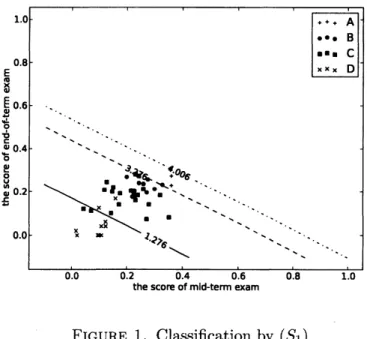
an attribute, the instance is not separable.Hence the hard margin problem (H) is infeasible. The solution of the soft margin problem
$(S_{1})$ with $c=15$ is given in Fig. 1, where students ofdifferent grades are loosely separated
by three straight lines.
FIGURE 1. Classification by $(S_{1})$
Using the following two kernel functions defined as
$\kappa(x, y)=\exp(-\frac{1}{2\sigma^{2}}\Vert x-y\Vert^{2})$ (Gaussian kernel),
$\kappa(x, y)=(1+x^{T}y)^{d}$ (Polynomial kernel)
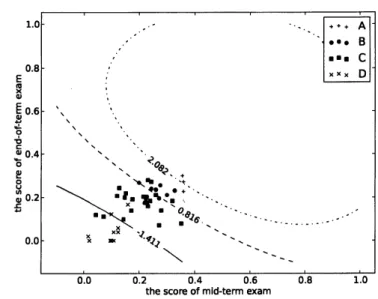
with several different values of $\sigma$ and $d$, we solved $(\tilde{S}_{1})$. The result of the Gaussian kernel
with $c=10$ and $\sigma=0.5$ is given in Fig. 2, where one
can
observe that the problem $(\tilde{S}_{1})$with the Gaussiankernel is exposed to the risk of over-fitting. The result of the polynomial kernel with $c=15$ and $d=4$ is given in Fig.3. From Fig.3, we observe that students of different grades are separatedby three gentle curves.
$FI(_{\grave{J}}URE2$. Classification by $(\tilde{S}_{1})$ with the $Gaussi_{J1}$ kernel
FIGURE 3. Classification by $(\tilde{S}_{1})$ with the polynomial kernel
10. COMPUTATIONAL EXPERIMENTS
We report the computational experimentswith
our
proposedalgorithms. The experimentwas performedon a PC with IntelCore i7, 3.07 GHz processor and 12.0GB of memory. We implemented the algorithms in Python, and used Gurobi5.6.3 as the QPsolver.
We used several randomly generated instances, which are divided into two types. The first type consists of separable instances and the second type consists of non-separable instances. First we generated $n$ attribute vectors $x^{i}=(Xi, x_{2}^{i})$ at random from the unit
square $[0$, 1$]$ $\cross[0$,1$]$
.
Each object $i$was
assigned alabel$\ell_{i}\in L=\{0$, 1,.
. .
,3$\}$ according tothe following rule:
$p_{i_{\ell_{\in}}}= \max_{L}\{\ell\in L|_{X}i+x_{2}^{i}>p\ell\}$
where $(p_{0},p_{1},p_{2},p_{3})=(-\infty, 0.5,1.0,1.5)$
.
Then this instance isseparable. Perturbing eachelement of the attribute vector, we have
a
perturbed attribute vector $(x_{1}^{i}+\epsilon_{1}^{i}, x_{2}^{i}+\epsilon_{2}^{i})$,where $\epsilon i$ as well as $\epsilon_{2}^{i}$ is a
random noise following anormal distribution with a zero mean
and
a
standard deviation of 0.03. Thenwe
givea
label $\ell_{i}$ toan
object $i$ according to thesumof elements of the perturbed vector instead of the value $xi+x_{2}^{i}$. Due to the presence ofthe randomnoise, the instance is not necessarily separable. We generatefive datasets for each instance with $n$ objects since the results may change owing to the random variables
used in the above instance generation method. We
name
the separable type datasets (the non-separable datasets) “S.n.$q$” (NS.n.q), where $q$ is a dataset ID.We solved the separable instances by the algorithm$RCH$and thenon-separableinstances
by the algorithm$RC\tilde{S}_{1}$ with $c=10$
.
In all experiments weusedthe polynomial kernel with
a parameter $d=4$. To make the initial working set $W^{0}$, we first calculate the value of
$x_{1}^{i}+x_{2}^{i}$ for each object $i$, and choose three objects whose values
are
the highest, the lowest and the median among objects assigned the
same
label. At Step5 in the algorithms,we
add at most twoobjects correspondingto the most violated constraints at $(\lambda_{W^{\nu}},p^{\nu})$ to the
current working set $W^{\nu}$ at a time, more precisely, we add the objects $i$ and $j\in N\backslash W^{\nu}$
such that
$i=[argmax]\{1-(\tilde{k}_{W^{\nu}}^{i})^{T}\lambda_{W^{\nu}}+p_{\ell_{i}}^{\nu}>0|i\in N\backslash W^{\nu}\},$
$j=. [argmax]\{1+(\tilde{k}_{W^{\nu}}^{i})^{T}\lambda_{W^{\nu}}-p_{\ell_{i}+1}^{\nu}>0|i\in N\backslash W^{\nu}\}.$
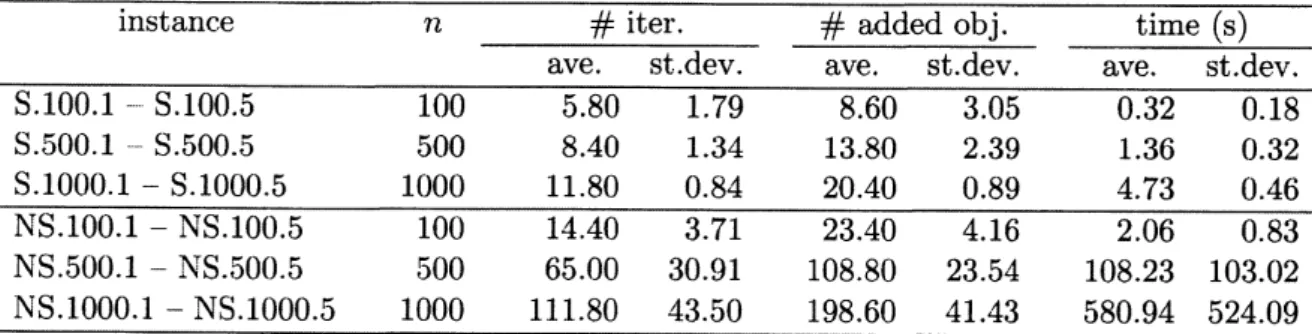
Table 1 shows the results of $RCH$ and $RC\tilde{S}_{1}$ for each instance,
where the columns $\#$
iter , $\#$ added obj.” and
$\langle$
time” represent thenumber ofsub-problems solved,the number of added objects and the computation time in seconds, respectively. The entries “ave.” and “st.dev.” show the average and the standard deviation
across
the five results ofa
corresponding column.
TABLE 1. Results of$RCH$ and $RC\tilde{S}_{1}$
$\overline{\frac{instance.n\frac{\#er}{ave.st.dev}\frac{\#addedobj}{ave.st.dev}\frac{time(s.)}{ave.stdev0.320.18}}{S.100.1-S.l0051005.81.798.603.05}}$
S.500.1 –S.500.5 500 8.40 1.34 13.80 2.39 1.36 0.32
$\frac{S.1000.1-S.1000.5100011.800.8420.400.894.730.46}{NS.100.1-NS.100.510014.403.7123.404.162.060.83}$
$NS.500.1-NS.500.5$ 500 65.00 30.91 108.80 23.54 108.23 103.02
NS.1000.1 –NS.1000.5 1000 111.80 43.50 198.60 41.43 580.94 524.09
From Table 1, weobserve that the number of added objects is much smaller than that of the original problem in the separable case. In the non-separable case, we observe that the number of iterations
as
well as the number of added objects is larger than the separable11. MONOTONICITY ISSUE
Insomesituations it would be desirable that theseparating
curves
havesome monotonic-ity property, namely an object with attribute vector $x$ be ranked higher than an object with $y$ such that $y\leq x$. Thenwe discuss the monotonicity of the separating curvesin thissection.
Let $P$ be a hyperplane in$\mathbb{F}$
defined by
$P=\{\tilde{x}\in \mathbb{F}|\langle\tilde{w}^{*}, \tilde{x}\rangle=b\}$
for some constant $b\in \mathbb{R}$ and let $C$ denote its inverse image under the unknown function $\phi,$
i. e.,
$C=\{x\in \mathbb{R}^{m}|\phi(x)\in P\}.$
Then $x\in C$ if and only if $\langle\tilde{w}^{*},$$\phi(x)\rangle=b$
.
Since $\tilde{w}^{*}=\sum_{i\in N}\lambda_{i}^{*}\tilde{x}^{i}=\sum_{i\in N}\lambda_{i}^{*}\phi(x^{i})$, weobtain
$\langle\sum_{i\in N}\lambda_{i}^{*}\phi(x^{i}) , \phi(x)\rangle=b.$
Due to the bi-linearlity of the inner product
we
have$\langle\sum_{i\in N}\lambda_{i}^{*}\phi(x^{i}) , \phi(x)\rangle=\sum_{i\in N}\lambda_{i}^{*}\langle\phi(x^{i}) , \phi(x)\rangle=\sum_{i\in N}\lambda_{i}^{*}\kappa(x^{i}, x)$,
and then an expression of the inverse image
$C= \{x\in \mathbb{R}^{m}|\sum_{i\in N}\lambda_{i}^{*}\kappa(x^{i}, x)=b\}$
by the kernel function $\kappa.$
Suppose that the kernel function $\kappa(x^{i}, \cdot)$ is nondecreasing for $i\in N$, in the sensethat
$x\leq x’\Rightarrow\kappa(x^{i}, x)\leq\kappa(x^{i}, x$
and $\lambda_{i}^{*}\geq 0$ for $i\in N$
.
Then $\sum_{i\in N}\lambda_{i}^{*}\kappa(x^{i}, x)$ is nondecreasing as awhole.Lemma 11.1. The kernel
function
$\kappa(x^{i}, \cdot)$ is nondecreasing and $\lambda_{i}^{*}\geq 0$for
$i\in N.$ Thenthe contours are nondecreasing. The polynomialkernel
$\kappa(x^{i}, x)=(1+(x^{i})^{T}x)^{d}$
is nondecreasing with respect to $x$ if $x^{i}\geq 0$ for $i\in N$. Therefore it would be appropriate to use the polynomial kernel when all the attribute vectors
are
nonnegative including those ofpotential objects, and the monotonicity is desirable. In this case the kernel hard margin problem $(\tilde{H})$ should be added non-negativity constraints of variables $\lambda_{i}’ s$:(H)
minimize $\lambda^{T}\tilde{K}\lambda$
subject to $p\ell_{i}+1\leq(\tilde{k}^{i})^{T}\lambda\leq p_{\ell_{i}+1}-1$ for $i\in N$
$\lambda\geq 0.$
The problemremains anordinaryconvexquadraticoptimization, and the additional
12. CONCLUSIONS
In this paper, we proposed to apply the dual representation of the normal vector to the formulation based on the fixed margin strategy by Shashua and Levin [6] for the ranking problem. The obtained problemhas the drawback that it has $n$ ofvariables as well as $n$ of
constraints. However the fact that it enables the application of kernel technique outweighs
thedrawback. Then
we
proposeda row
andcolumn generationalgorithm. Namely,we
startthe algorithm with
a
sub-problem which is much smaller than the master problem in both variables andconstraints, andincrement both of themas
the computationgoes on.Further-more we proved the validity of the algorithm. Through
some
preliminary experiments, ouralgorithm performed fairly well. However it should need further research such as a setting of the initial working set $W^{0}$ and achoice of $\triangle^{\nu}$ since aclever choice of these may enhance
the efficiency of the algorithm.
REFERENCES
[1] C.M. Bishop, Pattern Recognition and Machine Learning, Springer, New York, 2006.
[2] K. Crammer andY.Singer, “Prankingwith ranking,” in: T.G.Dietterich,S.Beckerand Z. Ghahramani
eds.,Advances inNeuralinformationProcessingSystems 14, MITPress, Cambridge, 2002, pp.641-647.
[3] R. Herbrich, T. Graepeland K. Obermayer, “Large margin rankboundaries for ordinal regression,” in:
A.J. Smola, P. Bartlette, B. Scholkoptand D. Schuurmanseds., Advances in Large Margin Classifiers,
MITPress, Cambridge, 2000, pp.115-132.
[4] T.-Y. Liu, Learning to Rankfor informationRetrieval,Springer-Verlag, Heidelberg,2011.
[5] O.L. Mangasarian and D.R. Musicant, “Successive overrelaxation for support vector machines,” IEEE Tmnsactions onNeural Networks 10 (1999) 5, 1032-1037.
[6] A. Shashua and A. Levin, “Ranking with large margin principles: two approaches,” in: Advances in
NeuralInformationProcessing Systems 15 (NIPS$2002),2003$,pp.937-944.
[7] B. Sch\"olkopf,R. Herbrich andA.J. Smola, “A generalized representer theorem in: D.Helmbold and B. Williamson eds., Computational Learning Theory, Lecture Notes in ComputerScienceVol. 2111 (2001)
pp. 416-426.
[8] J. Shawe-Taylorand N. Cristianini, Ke veel MethodsforPattern Analysis, CambridgeUniversity Press,
Cambridge, 2004.
[9] K. Tatsumi, K. Hayashida, R. Kawachi and T. Tanino, “Multiobjectivemulticlasssupport vector
ma-chines maximizing geometric margins,” PacificJournal ofoptimization 6 (2010) 115-140.
[10] V.N. Vapnik, StatisticalLearning Theory, John-Wiley &Sons, NewYork, 1998.
(Y. Izunaga)GRADUATE SCHOOLOFSYSTEMSANDINFORMATIONENGINEERING, UNIVERSITYOFTSUKUBA,
TSUKUBA, IBARAKI 305-8573, JAPAN
$E$-mail address: [email protected]
(K. Sato) SIGNALLING AND TRANSPORT INFORMATION TECHNOLOGY DIVISION, RAILWAY TECHNICAL
RESEARCH INSTITUTE, 2-8-38HIKAR1-CHO, KOKUBUNJI, TOKYO 185-8540, JAPAN
$E$-mailaddress: sato. keisuke.49Qrtri.or.jp
(K. Tatsumi) ELECTRICAL, ELECTRONIC AND INFORMATION ENGINEERING, GRADUATE SCHOOLOF
EN-G1NEER1NG, OSAKA UNIVERSITY, SUITA, OSAKA 565-0871, JAPAN
$E$-mailaddress: tatsumiQeei.eng.osaka-u.ac.jp
(Y. Yamamoto) FACULTY OF ENGINEERING, INFORMATION AND SYSTEMS, UNIVERSITY OF TSUKUBA,
TSUKUBA, IBARAKI 305-8573, JAPAN